Showing posts with label Quantative Easing (QE). Show all posts

Thursday, October 12, 2023

Too Low Inflation a Danger

 Popular Economics Weekly

Rather than worry about too much inflation still in the pipeline, we should worry about too little inflation going forward. The Producer Price Index of wholesale goods and services in September was 2.2 percent. It hit the Fed’s 2 percent target rate sometime between April-May this year. It then plunged to a zero inflation rate in June 2023 before rising to the current 2.2 percent inflation rate.

FREDppi

Too low inflation was the worry in 2009 after the Great Recession and the reason former Fed Chair Ben Bernanke instituted the Quantitative Easing (QE) policies that injected enough money into the system to bring the inflation rate back to its 2 percent target.

Today’s 2.2 percent PPI tells us the cost of wholesale goods and services has reached the Fed’s target rate and is a reason the Fed may have gone too far in suppressing wholesale prices. It means the supply chains have recovered and could even be over producing, which would continue to depress prices.

Why be worried when prices have risen so much in just two years? Final Demand Producer prices peaked in March 2022 at 12 percent. Consumers want prices to come down, after all.

But it’s a very dangerous monetary policy to suppress demand with such high interest rates for a prolonged period as Fed officials are saying they want to do.

Companies and consumers can quickly change course should there be more unforeseen consequences, such as a wider Middle East war creating scarcities that push prices up again. The 3.3 percent rise in final demand energy prices was the major culprit of the September PPI report.

The retail Consumer Price Index for September was a bit higher because of rising shelter costs and gas prices. But the headline all items annual inflation rate remained at 3.7 percent as in August.

“The index for shelter was the largest contributor to the monthly all items increase, accounting for over half of the increase. An increase in the gasoline index was also a major contributor to the all items monthly rise,” said the BLS.

So which index is more accurate?

The other Personal Consumption Expenditure Index (PCE) is rising at 3.5 percent over 12 months, right in the middle, and is probably the best picture of overall inflation. It shows the same bell curve and has also flattened of late.

“It’s the latest encouraging sign for Fed policymakers, who have been raising interest rates since March 2022 in a campaign to slow the economy and cool price increases,’ said NYTimes Jeanna Smialek. “While economic momentum has held up better than expected, a less ebullient housing market and a grinding return to normalcy in the car market have helped key prices — like automobile and rents — to fade.”

Unfortunately, the release of the Fed’s September FOMC minutes showed Fed officials aren’t yet getting the message that their credit policy may be too restrictive.

MarketWatch reporter Greg Robb summed it up: “The 12 voting Fed officials were unanimous in their decision to keep interest rates at a 22-year high, between 5.25% and 5.5 while penciling an additional rate hike before the end of the year to bring down inflation. “Almost all” of the 19 Fed officials supported holding rates steady, the minutes said.”

I am hoping circumstances will convince the Fed too low inflation can be a danger..

Harlan Green © 2023

Follow Harlan Green on Twitter: https://twitter.com/HarlanGreen

Thursday, September 29, 2022

Is It Time to Worry About Deflation, and a Recession?

 Financial FAQs


CNBC

The Fed is beginning to ease its purchases of Treasury and Mortgage-backed securities in its push to raise interest rates and lower inflation, a policy called Quantitative Tightening (QT) as opposed to the various Quantitative Easing efforts (QE) when it wanted to boost inflation by increasing the money supply in 2009 at the end of the Great Recession.

But what if QT, accompanied by the Fed’s short term interest rate hikes—3 percent to date with its federal funds rate up to a range of 3%-3.25%, which is the highest it has been since early 2008—results in shrinking the money supply so much that it causes a recession, or worse?

It’s possible if the Fed continues to boost interest rates while the worldwide energy and food crunch, which is the real reason wholesale and retail prices have risen so fast, ends almost as quickly as it began.

The Fed would then have to reverse course for fear we might fall into a disinflationary spiral, or worse; deflation as Japan experienced in a decade of lost growth. QE enabled our recovery from the Great Recession, a recession almost as bad in terms of lost assets as the Great Depression.

I reported recently that economists such as Nobel Prize-Winner Joe Stiglitz are beginning to signal that possibility.

“Monetary policy typically affects economic performance with long and variable lags, especially in times of upheaval,” said Professor Stiglitz in a recent Project Syndicate article. “Given the depth of geopolitical, financial, and economic uncertainty – not least about the future course of inflation – the Fed would be wise to pause its rate hikes and wait until a more reliable assessment of the situation is possible.”

Some Wall Streeters are joining the chorus to slow down the rate increases. Cathie Wood, CEO of hedge fund Ark Invest, and a vocal proponent of deflation, is getting a few high-profile supporters even as price pressures continued to surprise to the upside, as reported by CNBC.

Jeffrey Gundlach and Elon Musk recently joined Wood’s camp in calling for a decline for prices, expressing worries that the Federal Reserve might go too far. Bond King Gundlach warned of the deflation risk on Tuesday, urging investors to buy long-term Treasurys. Meanwhile, the Tesla CEO called falling commodity prices “neither subtle nor secret” and tweeted to his 100 million followers that “a major Fed rate hike risks deflation.”

Wood has been warning about deflation since last year and is now doubling down on her call as several leading indicators she watches are pointing to deflationary forces instead of inflation, says CNBC.

““Leading inflation indicators like gold and copper are flagging the risk of deflation,” Wood said. “Even the oil price has dropped more than 35% from its peak, erasing most of the gain this year.” Gold prices have slid 6% so far this year. “Inflation is turning into deflation,” she said.

There was a real deflation danger in 2009 and a reason for QE. More precisely, the retail Consumer Price Index used to measure retail inflation had sunk to a minus -1.96 percent with little sign of rising after the shock of the Lehman Brothers collapse and possibility that many other firms on Wall Street were also in danger of collapse.

Congress and the GW Bush administration raised more than $700 billion to save the banks and Wall Street at the time, but it took years to raise the inflation rate back to 2 percent.

That’s our past history, which seems to put the Fed between a rock and a hard place, as the saying goes. Should it allow the inflation rate to continue to decline on its own, as it is doing, or speed up the process of decline, thus threatening a more severe downturn?

Yikes, what a situation to be in!

Harlan Green © 2022

Follow Harlan Green on Twitter: https://twitter.com/HarlanGreen

Thursday, July 15, 2021

Why Keep Interest Rates This Low?

 Financial FAQs

FREDPersavings

Inflation isn’t yet a problem, but are very low interest rates becoming a problem? Interest rates have been at record lows for years, thanks to the Federal Reserve that has been buying up enough bonds and mortgage securities to hold down longer-term rates as well. Is that good for most of US, or just the wealthy?

Fed chair Jerome Powell has stated it is to encourage a return to full employment by keeping the cost of borrowed money as low as possible. But this policy has mostly boosted assets owned by higher-income earners rather than wage-earners.

A recent NYTimes Op-ed by banking analyst Karen Petrou says just 10 percent of Americans own most stock assets that have benefited from the cheap money and approximately 60 percent of households own homes with values rising in double digits over the past year from record low mortgage rates.

The rest of US with less cash to spare must rely on accumulating unspent income in less risky, federally insured savings accounts that do not ride the boom-and-bust cycles of American-style capitalism.

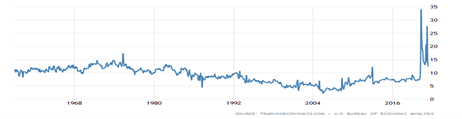
The personal saving rate has spiked of late (see FRED graph) because consumers had little to buy until now, but that is transitory with the sudden re-opening of businesses causing inflation indicators to rise sharply.

Such an inflation spike is also transitory, said Fed Chair Powell in his latest congressional testimony.

“Inflation has increased notably and will likely remain elevated in coming months before moderating,” Powell said, in testimony delivered to the House Financial Services panel.

Ms. Petrou wants the Fed to raise interest rates sooner to encourage savings that would benefit wage-earners, she says, and mitigate some of the inflation that dampens consumer demand. She uses the example of investing $10,000 in stocks vs. saving money conventionally since 2007. Savers would have lost money after inflation with just a savings account.

I must say this Fed is doing a welcome about face from the Paul Volcker led Fed of the 1980s and 90s that raised interest rates at the slightest hint of inflation, thus tamping down wage growth while benefiting Wall Street investors. It was trickle-down economics on a tear.

“These corporate and policy decisions had the most adverse consequences for low- and middle-wage workers,” said a recent EPI labor think-tank research paper on the roots of inequality, “who are disproportionately women and minorities, the groups whose legacy of being discriminated against in labor markets means that they especially need low unemployment, unions, strong labor standards, and policy supports for leverage when bargaining with employers.”

It is difficult to credit Ms. Petrou with much insight into what benefits ordinary wage-earners. Higher interest rates will certainly deflate stock and bond values that rely on cheap borrowed money to reach today’s highs (stocks) and lows (bond yields) and increase the propensity to save, but how much can wage-earners save without higher incomes?

She is a bank analyst, after all, who will want to buttress lenders’ bottom line that increases profits with rising interest rates. And American’s historical savings’ rates of 5-10 percent should continue that have been in line with that in other developed countries.

The best way to increase the wealth of wage-earners, vs. wealth-owners is to boost their incomes, which in turn would increase wage-earners' wealth. Use governmental policy to increase labor’s collective bargaining position that has been severely weakened and rescind much of the anti-labor legislation that has created some 26 right to work states that do not require workers to pay dues to the union shop that benefits them.

The same credit tightening debate happened in 1937 when there was as much unemployment, by the way. President Roosevelt caved to Republicans that wanted to re-balance the federal budget after so much New Deal spending. But in cutting back on government support and raising borrowing costs prematurely, the 1930’s economy went  into a second recession, and became the Great Depression.

Harlan Green © 2021

Follow Harlan Green on Twitter: https://twitter.com/HarlanGreen