Showing posts with label personal savings. Show all posts

Saturday, June 28, 2025

Anxious Consumers Shop Less

 Popular Economics Weekly

Disposable personal income (DPI)—personal income less personal current taxes—decreased $125.0 billion (0.6 percent) and personal consumption expenditures (PCE) decreased $29.3 billion (0.1 percent).”

We are seeing one of the classic signs of a looming recession—consumers are spending less and saving more, and they power 70 percent of economic activity.

The personal consumption expenditures (PCE) for May from the Bureau of Economic Activity (BEA) showed the personal savings rate has risen to 4.8 percent (black line in graph), while personal consumption expenditures decreased -0.1%, Personal savings had been increasing since early 2025. No surprise, since that is when Trump’s tariff plans were first announced.

Why are they spending less? One of the reasons cited by the consumer sentiment surveys is too much future uncertainty. Not so surprising with inflation worries still high, and the on again, off again tariff announcements that probably mean even higher prices.

The PEW Centers most recent survey said the public again sees inflation as one of the top problems facing the nation, with 62 percent saying inflation is a very big problem for the country – only slightly down from the 65 percent who said this last year (2024).

The Conference Board Consumer Confidence Index® deteriorated by 5.4 points in June, falling to 93.0 (1985=100) from 98.4 in May. “Consumer confidence weakened in June, erasing almost half of May’s sharp gains,” said Stephanie Guichard, Senior Economist, Global Indicators at The Conference Board. “The decline was broad-based across components, with consumers’ assessments of the present situation and their expectations for the future both contributing to the deterioration.”

The University of Michigan’s Consumer sentiment survey surged 16% from May in its first increase in six months but remains well below the post-election bounce seen in December 2024 when last year’s economic growth was 3 percent, the highest in the developed world, and jobs were still plentiful.

“Despite June’s gains, however, sentiment remains about 18% below December 2024, right after the election; consumer views are still broadly consistent with an economic slowdown and an increase in inflation to come,” said Survey Director Joanne Hsu.

From the same month one year ago, the PCE price index for May increased 2.3 percent. Excluding food and energy, the PCE price index increased 2.7 percent from one year ago. It’s at least a sign of stagflation if the spending slowdown continues, since the PCE report also shows signs of higher inflation that the Fed is worried about.

No wonder consumers are more worried. Bloomberg research reveals AI could replace 53 percent of the white-collar market research analyst tasks and 67 percent of sales representative tasks, while managerial roles face only 9 to 21% automation risk.

The World Economic Forum's 2025 Future of Jobs Report reveals that 41 percent of employers worldwide intend to reduce their workforce in the next five years due to AI automation. Industries like technology, finance, and consulting are highlighted as particularly vulnerable.

It really looks like Republicans are trying as hard as possible to start a recession. They are shrinking the workforce by deporting undocumented immigrants who work with their hands and thus would be needed to fill some of the 400,000 vacant manufacturing jobs.

And passing Trump’s Big Beautiful Bill will create an unsustainable debt load, keeping interest rates high.

So though Biden suffered through higher inflation, it was because of the $trillions in New Deal legislation that caused 3.2 percent GDP growth during his term. The Trump administration has managed just -0.5 GDP growth in Trump's first quarter as President.

This is what happens when Republican tax cuts transfer even more wealth to the Oligarchs from middle and working class Americans.

Harlan Green © 2025

Follow Harlan Green on Twitter: https://twitter.com/HarlanGreen

Thursday, October 3, 2024

NO MORE INFLATION

 Financial FAQs

The Fed is no longer worrying about inflation, since its preferred inflation gauge, the Personal Consumption Expenditure Index (PCE), recently dropped to a 2.2% inflation rate, close to the 2.0% target rate.

Fed Chairman Powell said recently the Fed is more worried that the job market is faltering, hence the -.50% Fed Funds rate cut last week with at least two more rate cuts in the offing this year. It would cut the Bank Loan Prime Rate to 7.50% that is the basis for most credit card and installment loan rates.

It is still too high for most borrowers, but auto sales have picked up, which is a sign consumers are still buying, that in means that Q3 GDP growth could also match second quarter’s GDP growth of 3.0 percent.

This is remarkable growth, even with the labor market slowdown, and the unemployment rate up to 4.3 percent in a year.

From the same month one year ago, the PCE price index for August increased 2.2 percent. Prices for goods decreased 0.9 percent and prices for services increased 3.7 percent. Food prices increased 1.1 percent and energy prices decreased 5.0 percent. Excluding food and energy, the PCE price index increased 2.7 percent from one year ago.

Job formation is slowing, as the BLS JOLTS report showed 8 million job vacancies, with 5.3 million Hires and 5.0 million Separations in the month. The 300,000 difference approximates the net number of new hires in August.

We are still fully employed, in other words, but the number of vacancies posted by employers looking for workers has come down considerably from the 12 million job opening high during the pandemic and lockdowns.

(That’s why it’s called the Job Openings and Labor Turnover Survey.)

Consumer spending is the biggest ‘tell’ on future employment and economic growth and it barely dropped to 2.7 percent annual growth from 2.8 percent in August. The savings rate is still a healthy 4.8 percent, close to historical norms, so the surge in vehicle sales is no fluke.

Business activity in the service sector is soaring (mainly dining out, travel, leisure activities), but the manufacturing sector is still contracting.

“In September, the Services PMI® registered 54.9 percent, 3.4 percentage points higher than August’s figure of 51.5 percent. The reading in September marked the seventh time the composite index has been in expansion territory this year,” said survey Director Sterve Miller.

Whereas, manufacturing “Demand remains subdued, as companies showed an unwillingness to invest in capital and inventory due to federal monetary policy — which the U.S. Federal Reserve addressed by the time of this report — and election uncertainty,” said survey director Timothy Fiore.

I see good growth this year. More reductions in interest rates will certainly boost manufacturing, and consumers are still saving, another sign they aren’t tapped out. 

But with one political party wanting to cut back on Bidenomics, the policies spurring much of the growth, economic and job growth next year could depend on which party wins the White House in November.

Harlan Green © 2024

Harlan Green on Twitter: https://twitter.com/HarlanGreen

Friday, August 30, 2024

Consumers Solvent Much Longer?

 Financial FAQs

I said last month we know why the US economy is still growing. Consumers have kept spending. The second revision of second quarter economic growth confirmed this when Gross Domestic Product growth jumped from 2.4 to 3.0 percent!

“Real gross domestic product (GDP) increased at an annual rate of 3.0 percent in the second quarter of 2024, according to the “second” estimate. In the first quarter, real GDP increased 1.4 percent.”

This is huge, but the question remains just how much longer consumers can ‘stay in the game’ before their chips run out, to parrot a well-known remark Roosevelt’s Fed Chairman Marriner Eccles made in testimony during the Great Depression.

Consumer spending was revised up to a 2.9% rate from the initial estimate of a 2.3% gain in the report. Whereas spending was up 1.5% in the first three months of the year, and such activity accounts for two-thirds of US economic activity these days. So, it’s extremely important to track how long they can continue to spend, as well as save.

Consumer confidence is rising again, which should help sustain the rally, as consumers seem to be worrying less about their job, per the Conference Board, even though personal savings have declined to dangerous lows.

“The Conference Board Consumer Confidence Index® rose in August to 103.3 (1985=100), from an upwardly revised 101.9 in July. The Present Situation Index—based on consumers’ assessment of current business and labor market conditions—improved to 134.4 from 133.1 in July.”

That’s a small improvement, but far below the 120 to 130 pt. index range prior to the pandemic. It says consumers are still shaking off the effects of the pandemic, for starters.

One reason for their uncertainty is household incomes have fluctuated wildly for decades due to the various recessions. Household income growth plunged to -0.1% at the beginning of the COVID-19 pandemic and was only back up to its +5% pre-pandemic highs in 2022, the last year it was calculated.

Household incomes have barely kept up with inflation, in other words, never able to get ahead of the longer term 2% average inflation rate that has prevailed since the Great Recession.

This in fact highlights the dangers consumers face going forward. They continue to borrow heavily, even with historic high interest rates, to ‘stay in the game’ to maintain their current lifestyles.

Their personal savings rate has just plunged from 3.4 percent to 2.9 percent, according to the BEA. It was lower only once since 1960—to 1.4 percent in July 2005 during the housing bubble and runup to the Great Recession.

Is there any reason to believe things will improve for the majority, when the Fed does cut interest rates? There have been recommendations, such as the child tax credit that both parties want to reinstitute; also lowering taxes on middle incomes and raising it for corporations and the wealthiest; as well as taxing the earnings of hedge fund managers managing $trillions in public monies.

Let us see if more of the economic pie will be distributed to those that have no savings left. Otherwise, we already know what happens when consumers can no longer stay in the game and their chips run out.

Harlan Green © 2024

Harlan Green on Twitter: https://twitter.com/HarlanGreen

Thursday, July 15, 2021

Why Keep Interest Rates This Low?

 Financial FAQs

FREDPersavings

Inflation isn’t yet a problem, but are very low interest rates becoming a problem? Interest rates have been at record lows for years, thanks to the Federal Reserve that has been buying up enough bonds and mortgage securities to hold down longer-term rates as well. Is that good for most of US, or just the wealthy?

Fed chair Jerome Powell has stated it is to encourage a return to full employment by keeping the cost of borrowed money as low as possible. But this policy has mostly boosted assets owned by higher-income earners rather than wage-earners.

A recent NYTimes Op-ed by banking analyst Karen Petrou says just 10 percent of Americans own most stock assets that have benefited from the cheap money and approximately 60 percent of households own homes with values rising in double digits over the past year from record low mortgage rates.

The rest of US with less cash to spare must rely on accumulating unspent income in less risky, federally insured savings accounts that do not ride the boom-and-bust cycles of American-style capitalism.

The personal saving rate has spiked of late (see FRED graph) because consumers had little to buy until now, but that is transitory with the sudden re-opening of businesses causing inflation indicators to rise sharply.

Such an inflation spike is also transitory, said Fed Chair Powell in his latest congressional testimony.

“Inflation has increased notably and will likely remain elevated in coming months before moderating,” Powell said, in testimony delivered to the House Financial Services panel.

Ms. Petrou wants the Fed to raise interest rates sooner to encourage savings that would benefit wage-earners, she says, and mitigate some of the inflation that dampens consumer demand. She uses the example of investing $10,000 in stocks vs. saving money conventionally since 2007. Savers would have lost money after inflation with just a savings account.

I must say this Fed is doing a welcome about face from the Paul Volcker led Fed of the 1980s and 90s that raised interest rates at the slightest hint of inflation, thus tamping down wage growth while benefiting Wall Street investors. It was trickle-down economics on a tear.

“These corporate and policy decisions had the most adverse consequences for low- and middle-wage workers,” said a recent EPI labor think-tank research paper on the roots of inequality, “who are disproportionately women and minorities, the groups whose legacy of being discriminated against in labor markets means that they especially need low unemployment, unions, strong labor standards, and policy supports for leverage when bargaining with employers.”

It is difficult to credit Ms. Petrou with much insight into what benefits ordinary wage-earners. Higher interest rates will certainly deflate stock and bond values that rely on cheap borrowed money to reach today’s highs (stocks) and lows (bond yields) and increase the propensity to save, but how much can wage-earners save without higher incomes?

She is a bank analyst, after all, who will want to buttress lenders’ bottom line that increases profits with rising interest rates. And American’s historical savings’ rates of 5-10 percent should continue that have been in line with that in other developed countries.

The best way to increase the wealth of wage-earners, vs. wealth-owners is to boost their incomes, which in turn would increase wage-earners' wealth. Use governmental policy to increase labor’s collective bargaining position that has been severely weakened and rescind much of the anti-labor legislation that has created some 26 right to work states that do not require workers to pay dues to the union shop that benefits them.

The same credit tightening debate happened in 1937 when there was as much unemployment, by the way. President Roosevelt caved to Republicans that wanted to re-balance the federal budget after so much New Deal spending. But in cutting back on government support and raising borrowing costs prematurely, the 1930’s economy went  into a second recession, and became the Great Depression.

Harlan Green © 2021

Follow Harlan Green on Twitter: https://twitter.com/HarlanGreen

Wednesday, November 4, 2020

How Will US Economy Survive COVID-19?

 Popular Economics Weekly

FREDpersonalconsumption

The US economy must first survive this pandemic before it will benefit most Americans. Some sectors are doing better but ignore the financial market swings, which benefit 401(k)s, but not most Americans.

Advance estimates of U.S. retail and food services sales for September 2020, adjusted for seasonal variation and holiday and trading-day differences, show an increase of 1.9 percent from the previous month, and 5.4 percent above September 2019 as an example.

This is a huge bump in spending as consumers left their confined spaces in July, which is mainly why GDP growth rose 33 percent in Q3 from its second quarter pandemic low, since consumers account for most GDP activity.

But it was mostly in so-called durable goods—autos, planes, appliances that last more than three years. The majority of services businesses, such as restaurants, lodgings and travel, will be suffering through much of next year until most Americans are vaccinated and feel it’s safe enough to re-engage with the larger world. Appliance sales are booming, for instance, because most of us remain at home during the pandemic out of caution.

The real question will be how much more will Americans suffer this winter due to the pandemic.

ADP

As a prelude to Friday’s official unemployment report, payroll data processor ADP reports a smaller increase of 365,000 new nonfarm payroll jobs in October, mostly in the service industries and down from 753,000 the prior month.

Last month’s US payrolls reported by the Labor Department increased by 661,000 nonfarm payroll jobs last month with an unemployment rate of 7.9 percent, so job creation may be declining in the government’s official report this Friday.

“The labor market continues to add jobs, yet at a slower pace,” said Ahu Yildirmaz, vice president and cohead of ADP Research Institute. “Although the pace is slower, we’ve seen employment gains across all industries and sizes.”

But that still begs the question of what will happen with coronavirus infections now reaching 100,000 per day and the infection rate rising to 9.3 percent, which means a faster community spread.

According to the Washington Post, Deborah Birx, one of the White House's most senior coronavirus advisers, issued her warning in an internal memo on November 2, saying that "We are entering the most concerning and most deadly phase of this pandemic ... leading to increasing mortality." And the White House, she wrote, is not doing enough: "This is not about lockdowns -- it hasn't been about lockdowns since March or April. It's about an aggressive balanced approach that is not being implemented."

The U.S. counted 92,660 new cases on Tuesday, according to a New York Times tracker, and at least 1,130 fatalities. In the past week, the U.S. has averaged 88,168 cases a day, up 46% from the average two weeks ago.

Does anyone believe things can get any better before this pandemic is controlled?

Harlan Green © 2020

Follow Harlan Green on Twitter: https://twitter.com/HarlanGreen

Saturday, October 17, 2020

Back to a 'V' Shaped Recovery?


Popular Economics Weekly

FREDcontinuedclaims

Richard Clarida, No.2 official at the Federal Reserve said on Wednesday that the U.S. recession begun in March with the coronavirus pandemic may already be over.

“This recession was by far the deepest one in postwar history but it also may go into the record books as the briefest recession in U.S. history,” Clarida said in prepared remarks to an Institute for International Finance conference. The flow of economic data since May has been “surprisingly strong,” he said.

Why? There is much pent up consumer demand with a record personal savings rate double (approximately 14 percent) what it was pre-pandemic because of the March to June business shutdown when they couldn’t spend on anything but essentials.

Meanwhile, initial jobless claims remained worryingly high in the week of October 10.  The seasonally adjusted level of state claims rebounded by 53K to 898K, which is the highest reading since the first half of August, said Reuters’ Wrightson/ICAP data service.  In not seasonally adjusted terms, claims were up 76K, with the increase spread across a range of states:  Indiana was up 19K, Illinois and Massachusetts were each up 10K, Georgia was up 8K, for instance. 

The pace of new layoffs continues to be a source of concern.  “We continue to think it is an open question whether there will be enough new hires and worker call-backs in October to offset the ongoing job losses,” said ICAP.  “The string of positive payroll gains could be interrupted this month.”

FREDunemployment

October’s unemployment report won’t be released until Friday after the November election. September’s unemployment rate fell to 7.9 percent from 8.4 percent in August.

In the continuing claims data, workers continued to fall off the state rolls in the week of October 3 as they exhausted their regular benefits.  The number of beneficiaries slid 1.2 million in seasonally adjusted terms to a level of 10.0 million still collecting some form of unemployment benefits. 

Economists’ consensus is that the economy should rebound at a 31.9 percent annualized rate in the July-September quarter. The economy sank at a record minus -31.4 percent rate in the second quarter.

The Fed vice chairman was not all upbeat though. He said the outlook for the economy was unusually uncertain and depends on the course of the virus. It will take time for the economy to recover all the lost ground in the recession and he said more help from Fed policy and Congressional spending “will be needed.”

I believe a full recovery in the consumer-dependent service sector probably won’t happen until next summer, at least, once a reliable vaccine is developed and widely distributed.

Harlan Green © 2020

Follow Harlan Green on Twitter: https://twitter.com/HarlanGreen
Saturday, May 30, 2020

A Fall Revival?

Financial FAQs


The second estimate of first quarter real GDP growth was revised to a negative -5.0 percent from its initial estimate of -4.8 percent, with the decline in consumer services the main culprit. It only hints at how much second quarter GDP may decline.

And today’s April personal income data from the Commerce Department confirms consumers that make up 67 percent of economic activity aren’t buying, so producers aren’t producing the services that consumers use (blue section of bar in graph). Information, retail and wholesale trade, scientific, technical and professional services are the major parts of this sector.

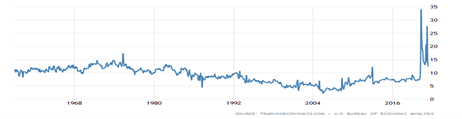
Americans personal income rose 10.5 percent but consumer spending fell 13.6 percent after falling 6.9 percent in March. Most of the income rise was from government support payments, as wages also fell. The rise in incomes and the drop in spending pushed the savings rate up to 33 percent in April from 12.7 in the prior month.

The high rate of savings is telling us consumers won’t begin to spend again until they feel safe.
Second quarter GDP growth will inevitably shrink much more due to 2.1 million more workers applying for unemployment benefits in the latest week, bringing the total to more than 46 million.

But combined with federal layoffs the total is closer to 3 million in the latest survey.  Initial claims have fallen steadily since hitting a record 6.9 million in the week ended March 28.


But Reuters reports the big surprise in the jobless claims data was a 3.7 million decline in the reported level of continuing claims in the regular state programs, which is a sign that more are returning to work.  In not seasonally adjusted terms, the number of state beneficiaries fell from 22.8 million to 19.1 million in the week of May 16.

The sharp rise in unemployment has made consumers more cautious, as I’ve been saying. Retail sales fell a record 16.4 percent in April. The government checks over the past two months helped consumers pay their bills but for the economy to recover, consumer spending has to rebound.

While it is possible that the decline in continuing claims reflects individuals who left the benefit program as the economy reopened,” said Reuters, “the erratic pattern in the data for some states makes us wary of reading too much into the week to week fluctuations.  (Florida’s jobless rolls fell 76% in the week of May 16, from 2.2 million to 0.5 million; California’s fell 40%, from 3.6 million to 2.1 million.)  We would not extrapolate from the May 16 level.”

One economist stated that though social distancing measures are gradually being relaxed across the country, the lingering virus fear and restrained incomes “will continue to constrain consumers’ willingness and ability to spend.”

This is while experts and Federal Reserve banks such as the Atlanta Fed are predicting GDP shrinkage of as much as 40 percent in the second quarter, while consumers continue to stay close to home.

The hope will be that activity picks up again in the fall, if the federal government will show some nationwide leadership in what is after all, a nationwide pandemic.

Harlan Green © 2020

Follow Harlan Green on Twitter: https://twitter.com/HarlanGreen