Showing posts with label universal health care. Show all posts

Thursday, November 7, 2024

What's Next, Republicans?

 Financial FAQs

What if conservatives succeeded in repealing Obamacare? “Republicans' Obamacare repeal bill would leave 17 million more people uninsured next year, and 32 million more in 2026, the Congressional Budget Office said in an estimate Wednesday. It also said premiums would double by 2026. …By 2026, three quarters of the population would live in areas with no insurers participating in the non-group market, due to upward pressure on premiums and downward pressure on enrollment, the report found.”

I wrote a Huffington Post piece in July 2017 during President Trump’s first term that could predict what we might look forward to with Republicans, and Donald Trump’s healthcare policy in his second go-around as president.

The result for working Americans of Republicans’ repeated attempts to repeal Obama that I wrote about then is shown in the above graph. It compares the soaring death rates of 45-54 white American males with other developed countries (red USW line). Obamacare is the only American universal healthcare plan that covers workers with pre-existing conditions if no employer healthcare, and yet Republicans can be expected to again attempt to replace it with a “concept” in Trump’s words.

Americans had just avoided another health care disaster in voting down the Senate’s ‘skinny’ Obamacare Repeal and Replace bill in 2017. Even though maintaining most of the taxes to pay for the Medicaid portion, it would have made insurance coverage prohibitively expensive for those older and sicker users with the removal of the private and employer mandate requirements that would cause younger and healthier people to leave the insurance markets.

This is just the latest precipice that’s been avoided. Americans already have the worst health outcomes in the developed world, precisely because America is the only developed country—in fact, even of undeveloped countries—that doesn’t have universal coverage.

The result is one of the highest birth death rates, as well as diabetes, heart and other infectious disease rates—which are diseases usually associated with poorer, undeveloped countries.

The last time Republicans swept the presidential election in 2017, it was the very white, male Tea Party reacting to our first Black President. But they didn’t replace it with something new. They went back to their base of wealthy Oligarchs formed during the Reagan era, still fighting labor unions and resisting more social programs to help the less fortunate, as Trump’s MAGA nation has promised to do.

Trump’s electorate has been good at wanting to tear down the old institutions, but not good at replacing them with a newer, better system. And if Elon Musk becomes the efficiency czar in Trump’s new administration, and he continues to brag he can cut $2 trillion in waste from the federal budget, we know social programs and maybe much more will suffer in the name of reducing the national debt.

There is another, better way to replace what hasn’t worked for working Americans; but that must be based on science and new technologies that can come from our educated elite (rather than our political and wealthy elite).

If Republicans want to be part of that future, they can’t follow a con artist who doesn’t believe in the future, only the past.

Harlan Green © 2024

Follow Harlan Green on Twitter: https://twitter.com/HarlanGreen

Tuesday, August 13, 2024

Make Healthcare More Equal!

 Answering Kennedy’s Call

Healthcare is back in the news, and Republicans still don’t get its importance as an election issue in its continuing efforts to repeal Obamacare, the 2010 Affordable Care Act (ACA), enacted that I wrote about in 2017 in the Huffington Post.

The Republican Party is now Trump’s party, and nothing has changed. Trump’s failed effort in 2017 to repeal the health-care law was blasted at the time over the prospect of millions of Americans losing their health insurance. Senator John McCain killed Republican’s last attempt in 2017 when I first wrote about it.

“Americans have just avoided another health care disaster in voting down the Senate’s ‘skinny’ Obamacare Repeal and Replace bill,” I said then. “Even though maintaining most of the taxes to pay for the Medicaid portion, it would have made insurance coverage prohibitively expensive for those older and sicker users with the removal of the private and employer mandate requirements that would cause younger and healthier people to leave the insurance markets.”

“Republicans' Obamacare repeal bill would leave 17 million more people uninsured next year, and 32 million more in 2026, the Congressional Budget Office said in a 2017 estimate. Premiums would double by 2026…By 2026, three quarters of the population would live in areas with no insurers participating in the non-group market, due to upward pressure on premiums and downward pressure on enrollment, the report found.”

This is even “Although overshadowed in the national political discourse by discussions about the importance of the economy, immigration, or abortion, voters have expressed that health care continues to be one of their highest priorities,” said a recent Brookings commentary.

“In fact, a May 2024 poll by Pew found that health care was the third-highest issue priority for voters, garnering a robust 57% from respondents”, continued Brookings.

Yet former President Donald Trump on the 2024 campaign trail said once again that he is “seriously looking at alternatives” to the Affordable Care Act if he returns to the White House, reports the NYTimes, “reigniting his longstanding crusade against former President Barack Obama’s signature health-care law.”

Then why do Republicans continue to attack Obamacare when it is so popular? It’s total self-interest, the hubris of the entitled, now in stark relief. Republicans have opposed almost any government-run social welfare legislation. Remember Bush II’s attempts to privatize social security, which would have raised its cost astronomically and given his Wall Street backers a multi-billion-dollar windfall?

This first became evident in Ronald Reagan’s 1980 original campaign slogan, “government is the problem”, which was a ploy to divert at least $1 trillion from wage earners to the holders of capital by busting the labor unions and cutting taxes for the wealthiest. It was the start of a new Gilded Age that created great wealth for the top 10 percent and the great inequality we have today.

America now has the worst income inequality in the developed world, according to the CIA World Factbook. And studies have shown that those countries with the most inequality also rank lowest in healthcare benefits.

The U.S. was in 106th place of the 149 countries in income inequality as ranked by the CIA’s World Factbook; with a Gini inequality index of developing countries like Peru and Cameroon in 2017. Whereas Finland and the Scandinavian countries are at the top of equality rankings, Germany and France are 12th and 20th, respectively, as I’ve highlighted in past columns. The higher the index, the greater the gap between wealthy and poorer citizens of a country’s population.

Another June 2024 Hart Research And Protect Our Care Poll cited by Protect Our Care, a social welfare nonprofit, found that over 60 percent of voters view Obamacare favorably.

Its many features include pre-existing condition coverage and no-cost preventive care, as well as allowing young adults on parents’ insurance. There is also broad support (82% favor, 47% strongly favor) for permanently lowering the cost of premiums for people who buy insurance through the ACA.

A recent NY Times article reported that more than 45 million people are enrolled in Affordable Care Act-related coverage, according to a recent report from the Department of Health and Human Services. A record number of people — more than 20 million — have signed up for plans on the act’s marketplaces this year, according to the Biden administration.”

What would happen if Republicans return Donald Trump to power? Americans already have the worst health outcomes in the developed world, precisely because America is the only developed country—in fact, even of undeveloped countries—that doesn’t have universal coverage.

The result is one of the highest birth death rates, as well as diabetes, heart and other infectious disease rates—which are diseases usually associated with poorer, undeveloped countries and regions.

On the other hand, a 2016 Commonwealth Club study lists Obamacare’s benefits:

“…evidence indicates that the ACA has likely acted as an economic stimulus, in part by freeing up private and public resources for investment in jobs and production capacity. Moreover, the law’s payment and other cost-related reforms appear to have contributed to the marked slowdown in health spending growth seen in recent years.”

The accrued savings in health care spending relative to their projected growth prior to the ACA are substantial: Medicare alone is now projected to spend $1 trillion less between 2010 and 2020.

The lobbies behind the Obamacare repeal effort have succeeded in making more Americans ill. I don’t even want to imagine what percentage of the 32 million would ultimately lose their coverage, if Trump keeps his promise to repeal Obamacare.

Senator McCain said back then that now is the time for Republicans and Democrats to work together in “regular order” to craft something better, maybe a universal healthcare bill that insures all Americans?

That would truly make Americans healthier.

Harlan Green © 2024

Follow Harlan Green on Twitter: https://twitter.com/HarlanGreen

Friday, April 24, 2020

How Do We Recover From This War—Part II?

Answering the Kennedys’ Call

“Every human society must justify its inequalities: unless reasons for them are found, the whole political and social edifice stands in danger of collapse, says economist Thomas Piketty in his latest book, “Capital and Ideology” (Harvard). “War, recession, religion—every facet of human existence has its roots in inequality.”
It is a sweeping charge but correcting the record income inequality where the top 10 percent income earners now garner 48 percent of national income will be the only way we achieve a sustainable recovery.

This really means do we want perpetual wars and/or recessions, whether it is due to recurring pandemics, or real wars between the Haves and Have nots?

It has been a long time coming, but the COVID-19 pandemic is the major reason we are witnessing the collapse of a united response and record suffering of Americans with infection and death rates far exceeding that of every other country.

The financial aid to date has focused not on the recovery but First Aid to businesses, with no longer term plan in place to restart the larger economy that has in effect come to a dead halt.

We are a society dependent on consumer spending by ordinary Americans that work in the service sector, which is why it’s bad news that another 4.4 million people filed new jobless claims last week to push the total above 26 million since much of the U.S. economy stopped working more than a month and a half ago.

The spike in unemployment has likely pushed the jobless rate to between 15 and 20 percent, economists estimate per MarketWatch’s Jeffry Bartash. “The only other time in American history when unemployment was that high was in the early stages of the Great Depression almost a century ago,” said Bartash.

The flash services PMI that measure service sector activity fell to 27 from 39.8 in March while the manufacturing PMI dropped to 36.9 from 48.5. Any reading below 50 indicates worsening conditions. It is a preliminary read, with a final read at the end of March but doers anyone doubt it will look better then?

The biggest help to ordinary American consumers that would lead to a sustainable recovery would be reformation of the U.S. health care system, since medical bills are the largest source of private bankruptcies. COVID-19 will probably make a universal health care plan inevitable as most Americans now support it; the question is what its final form will be. There are lots of models as all other developed countries have some private-public version of universal health care for all citizens.

Six-in-ten Americans say it is the federal government’s responsibility to make sure all Americans have health care coverage, including 31 percent who support a “single payer” approach to health insurance, according to a 2018 national survey by Pew Research Center.


Another recent PEW study showed how difficult an economic recovery from the COVID-19 pandemic will be. It has already exacerbated the lack of trust in our body politic between red and blue states, the Haves and Have-nots.

Although there are many reasons for the lack of trust, said the PEW study, a key element is ordinary citizens’ belief that elites are placing their own interests above broader shared values.
“The challenge for the existing political order in affluent countries is to show that it can effectively address problems like poverty and precarity (meaning insecure employment or income),” said a recent New Yorker review of Piketty’s new book. “In America, poverty is increasingly concentrated and thus more corrosive, while absolute economic mobility looks to be at a low point.”
COVID-19 is exposing and exploiting the weaknesses of every country that cannot unite behind a common foe. It will make a recovery even more difficult. Need we say more on the distrust engendered by an unlevel economic playing field?

Harlan Green © 2020

Follow Harlan Green on Twitter: https://twitter.com/HarlanGreen

Tuesday, June 4, 2019

Professor Stiglitz’s Plea to Save Capitalism

Popular Economics Weekly


Nobel laureate economist Joseph Stiglitz has been saying he wants to make capitalism work for everyone again in various writings, just as it did post-WWII, including this CNN commentary on the recent Earth Day. Is there even a viable alternative?
“America's economy has not been working for a large portion of the country. Workers at the bottom of the income scale earn wages, adjusted for inflation, that are not much higher than what they were 60 years ago, while the income of a typical full‐time male worker hasn't budged much from 40 years ago. In addition, life expectancy is in decline. But the economy is not only failing American citizens. It's failing the planet, and that means it's failing future generations.”
So how do we make it work for more Americans in the face of almost united opposition by the Republican Party? Firstly, we have to recognize the actual problem—Republican attempts to disempower large segments of Americans—women and blue-collar workers, for starters that have suffered the most from rollbacks in healthcare and workers’ collective bargaining rights.

We know the cost of the 2017 Republican tax cut bill; more than $1.5 trillion of spending cuts in Medicare and Medicaid coverage over 10 years in an attempt to lessen the projected $1 trillion annual budget deficit it is already costing; not to mention the endless attempts to cripple or outright abolish Obamacare without an alternative, and ban abortions, if not contraception outright.
And “In a new study for the Brookings Institution’s Hamilton Project, we report survey results in which we find that one in five workers with a high school education or less are subject to a noncompete. A quarter of all workers are covered by a noncompete agreement with their current employer or a past one,” reports the NYTimes.
This means they are banned from working for a competing company in a similar line of work for a certain period, limiting their mobility and hunt for a better job.

This is why Americans’ life expectancy is on the decline, while rising in all other developed countries; which have universal health care, pay for the costs of state-run, higher education institutions, and in general protect their citizens with an extensive social safety net.

Why does America have more than ten times the per capital prison population than other developed countries, and stratospheric gun violence—now 40,000 per year killed with white males the largest segment of gun suicides—whereas other developed countries annual gun deaths number in the 100s?

We don’t need to be diverted by the many “crimes and misdemeanors” of POTUS and the White House. Republicans have been rolling back social benefits and increasing inequality since at least 1980 by commandeering the levers of power—Wall Street with the repeal of Glass Stegall and deregulation of whole industries, corporate America with now unlimited fund-raising due to their Supreme Court win in citizens vs. united, and gutting of the Voters Rights Act that weakened federal enforcement of voter discrimination against minorities in states with a history of discrimination.

The list goes on and on. So what can be done about it? Make government(s) again the solution, rather than the problem that Reagan liked to intone to his supporters, and that ran up the first record public debt. It wasn’t until President Clinton’s successful attempt to actually create a budget surplus in his last four years (1996-2000) that America first began to pay down that debt.

But the Bush/Cheney government frittered it away with multiple budget cuts and foreign wars, increasing it again rather than diverting the savings to domestic programs that would strengthen America, and led to the Great Recession.

The lesson is obvious. Government wasn’t ever the problem, since Republicans have been willing to spend taxpayers’ money to support their own programs and run up record debt without any intention to pay it back to the American taxpayer.

Instead, government has worked very well when it funded their wars, higher corporate profits, or gone into the pockets of their high-net worth supporters. We should never buy Republicans’ attempt to brand-name government as the problem, particularly when it has benefited them far more than the average American.

Will it save capitalism, as we know it?  Only if we don’t buy the Republicans’ mischaracterizations.  Modern capitalism is really the creation of modern liberal democracies, with its ability to nurture growth and innovation that accompany the democratic checks and balances to prevent its excesses.

So  in saving democracy, we can save a modern capitalism that works for the many.

Harlan Green © 2019

Follow Harlan Green on Twitter: https://twitter.com/HarlanGreen

Monday, July 9, 2018

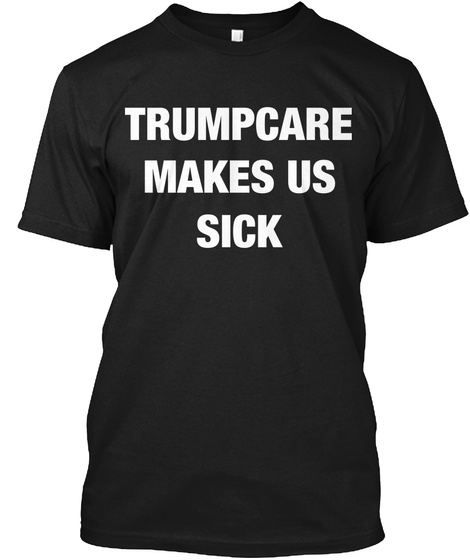
Trumpcare is Killing US!

Financial FAQs
Trumpcare
Makes Us
Sick Black T-Shirt Front

It took 4 hours to coax Patricia Okoumou, a Congolese immigrant, down from the Statue of Liberty while wearing a t-shirt that said, “Trumpcare Makes Us Sick.” It was serendipitous timing. She was part of a group wanting the abolition of ICE, but her t-shirt also brought attention to Republican and Trump administration’s efforts to abolish Obamacare, when a just released HHS report states that  Obamacare is doing better than ever for those in most need of health insurance.

President Trump has to be aware that most Americans want to keep Obamacare, even with the latest Republican tax cut bill that also abolishes the Obamacare mandate in 2019 requiring Americans not covered to pay a penalty if they have no health care coverage. The result has been higher premiums for those above the federal poverty level not subsidized by the federal government.

The reason Obamacare is popular with a majority of Americans is that the alternative Trumpcare bills attempted by Republicans last year wouldn’t just make Americans sicker, they will kill more people. Approximately 17,000 people could have died if a House Republican health proposal endorsed by the Trump administration had become law in 2018, who otherwise would have lived. By 2026, the number of people killed by Trumpcare could have grown to approximately 29,000 in that year alone, according to ThinkProgress, progressive think tank.  It is backed up by a CBO estimate that 24 million more Americans could lose health insurance by 2026 under Trumpcare.

Trump’s assertion that he has “gutted” Obamacare in his attempt to sicken and kill more Americans simply isn’t true. In fact, those in most need of health care coverage, those earning less than the federal poverty line, $48,500 for an individual, and $100,400 for a family of four, are doing quite well, according to the latest assessment from the Centers for Medicare and Medicare Services that administers Obamacare.
 
Overall, according to the figures released by the agency, 10.6 million Americans had signed up for ACA coverage by February and paid their first month’s premium, according to the Los Angeles Times. That was about 3 percent ahead of the 10.3-million enrollment at the same moment in 2017, the agency sai

Unsubsidized customers responded to the challenge of higher premiums by abandoning their health coverage in droves, HHS reported. The trend began in 2017, after Trump’s inauguration. That year, subsidized enrollments fell by about 223,000, or 3 percent. But unsubsidized enrollments fell by 1.3 million, or 20 percent.

This is while subsidized enrollment (those receiving Advanced Premium Tax Credits, or APTC) was 23 percent larger than unsubsidized (non-APTC) in 2014 and 32 percent larger in 2016 — and reached 61 percent in 2017.

Trump’s answer to the premium increases caused by his own policies has been to undercut the law even further by eliminating the consumer protections that make health insurance worth buying. These include requirements that all policies cover essential health benefits such as maternity care, hospitalization and prescription drugs, and opening the marketplace further to short-term junk insurance that carries lower premiums but offers substandard coverage.

We are not even mentioning Trump’s efforts to abolish the exemption for existing illnesses, and take away the federal payments meant to subsidize states’ Medicaid programs, which will result in even higher health insurance premiums for everyone.

Who are President Trump and his Republican synchophants really killing with their heartlessness?  Those now above the poverty line—the increasing number of unsubsidized in the middle class.  And they can and will vote, on what has become the number one issue for voters in November.


A new Pew Research Center survey reports 60 percent of Americans say the government should be responsible for ensuring health care coverage for all Americans, compared with 38 percent who say this should not be the government’s responsibility. The share saying it is the government’s responsibility has increased from 51 percent last year and now stands at its highest point in nearly a decade.

So, Trump and your Republican supporters of big business, please go right ahead and keep up your efforts to repeal and replace Obamacare if you want to become irrelevant.  Voters in November will know what this means.

Harlan Green © 2018

Follow Harlan Green on Twitter: https://twitter.com/HarlanGreen

Saturday, July 29, 2017

Why are Americans So Unhealthy?

Financial FAQs

Americans have just avoided a health care disaster in voting down the Senate’s ‘skinny’ Obamacare Repeal and Replace bill. Even though maintaining most of the taxes to pay for the Medicaid portion, it would have made insurance coverage prohibitively expensive for those older and sicker users with the removal of the private and employer mandate requirements that would cause younger and healthier people to leave the insurance markets.

This is really the latest precipice that’s been averted. Americans already have the worst health outcomes in the developed world, precisely because America is the only developed country—in fact, of most of the rest of the undeveloped world—that doesn’t have universal coverage.

The result is one of the highest birth death rates, as well as heart, diabetes, and infectious disease rates—which are diseases usually associated with poorer, undeveloped countries and regions.

Why has this happened in the America? Because Americans have the worst income inequality in the developed world, according to the CIA World Factbook. And studies have shown that those countries with the greatest inequality also rank lowest in healthcare benefits.


The U.S. ranks 106th of the 149 countries in income inequality as ranked by the CIA’s World Factbook; with a Gini inequality index of developing countries like Peru and Cameroon. Whereas Finland and the Scandinavian countries are at the top of equality rankings, as I’ve highlighted in past columns. The higher the index in the graph, the greater the gap between wealthy and poorer citizens of a country’s population.

This is while congress has even been attempting to take away Medicaid benefits for the poor, elderly and infirmed? It doesn’t compute. Just 3 Senators—Lisa Murkowski, Susan Collins and John McCain—were courageous enough to stand up to the conservative lobbies that would only worsen healthcare outcomes.

What if conservatives had succeeded in repealing Obamacare? “Republicans' Obamacare repeal bill would leave 17 million more people uninsured next year, and 32 million more in 2026, the Congressional Budget Office said in an estimate Wednesday. It also said premiums would double by 2026. …By 2026, three quarters of the population would live in areas with no insurers participating in the non-group market, due to upward pressure on premiums and downward pressure on enrollment, the report found.”
On the other hand, a 2016 Commonwealth Club study lists Obamacare’s many benefits. “…evidence indicates that the ACA has likely acted as an economic stimulus, in part by freeing up private and public resources for investment in jobs and production capacity. Moreover, the law’s payment and other cost-related reforms appear to have contributed to the marked slowdown in health spending growth seen in recent years.”
Some of those benefits are:

· Health care spending growth per person—both public and private—has slowed for five years.
 
· A number of ACA reforms, particularly related to Medicare, have likely contributed to the slowdown in health care spending growth by tightening provider payment rates and introducing incentives to reduce excess costs. 

· Faster-than-expected economic growth and slower-than-expected health care spending have led to multiple downward revisions of the federal deficit and projected deficits.

· These trends have also been a boon to state and local government budgets, as job growth has improved state tax revenues while cost growth in health care programs has slowed. At the same time, expanding insurance to millions of people who were previously uninsured has supported local health systems and enhanced families’ ability to pay for necessities, including health care.

· The accrued savings in health care spending relative to their projected growth prior to the ACA are substantial: Medicare alone is now projected to spend $1 trillion less between 2010 and 2020.

We can thank Senators Merkowski, Collins, and McCain that the so-called ‘freedom’ lobbies behind the Obamacare repeal efforts have not succeeded in making more Americans ill. I don’t even want to imagine the increased death totals due to lack of care of the 32 million aged and infirm that could ultimately lose their coverage.

So now is the time, in Senator McCain’s words, for Republicans and Democrats to work together in “regular order” to craft a truly bipartisan healthcare bill that could actually improve the health of Americans.

Harlan Green © 2017

Follow Harlan Green on Twitter: https://twitter.com/HarlanGreen

Monday, May 8, 2017

TrumpCare--The Un-American Health Care Act

Popular Economics Weekly

It’s incredible. Why have House Republicans just voted for a health care bill that only does one thing in the words of MIT Professor Jonathan Gruber, co-designer of the Massachusetts single-pay healthcare program and Obamacare?

On Lawrence O’Donnell’s Last Word he states that it gives the wealthiest what could be the single largest tax cut in history—almost $1 billion for those earning $200,000 plus per year—but cuts benefits to everyone else.

And this is when 23 percent of Americans have pre-existing medical conditions. The answer in the words of Paul Krugman has to be pure greed. Tax cuts are more important than protecting Americans from loss of coverage due to pre-existing conditions and soaring premium for everyone but the youngest and healthiest among US.

It was also an attempt to make the President look good, regardless of his broken promises that Obamacare benefits wouldn’t be reduced. Trump doesn’t care who loses, in other words, so long as he doesn’t look like a ‘loser’.

But what does it do for the white blue collar male Trump supporters who have suffered most from their loss of jobs, and whose mortality rate due to drugs and suicides is double that of other developed countries that lived through the same Great Recession?

Graph: CBO

The CBO graph pictures the suffering of 45-54 year-old white working class males in our post-industrial age. The rising red line is USA males, the falling lines are white males in other developed countries with Sweden having the lowest mortality rate “for all causes”. Even US Hispanics (blue line) had a falling mortality rate.

The House wouldn’t wait for the Congressional Budget Office latest ‘scoring’ of the costs of the bill, which confirms that House Republicans weren’t even concerned about its effects on federal and state budgets, much less on how many would lose their coverage, if taken off Obamacare.

The Congressional Budget Office projections on earlier House attempts to repeal projected that the revised GOP bill would realize $150 billion in reduced federal spending through 2026, which is less than half of the $337 billion in deficit reductions that the CBO had estimated for the bill's first version, said a CNBC summary of the report.
“But the newer version, like the first, is expected to lead to 14 million fewer people having health insurance in 2018, and 24 million fewer insured Americans by 2026 than would be covered if Obamacare remained as law in its current form. And an estimated total of 52 million people nationally would lack health coverage by 2026 if the revised bill becomes law, according to the CBO's projection. However, if Obamacare remained in effect, 28 million Americans would not have insurance by that year, according to the CBO.”

It cuts almost all Obamacare benefits, including to childcare, Medicare and Medicaid; even employers’ health care plans by turning over implementation to individual states. This is basically returning healthcare to the broken system it was before Obamacare that made US the unhealthiest developed country.

There were 20 mostly moderate Republicans that didn’t vote for the bill. The defectors were primarily centrists who had trepidations about voting for the bill after the addition of an amendment to let states apply for waivers from certain Obamacare provisions that prevent insurers from charging sick people higher premiums and mandate which services insurance plans must cover, said the Washington Post.

What are the effects of 24 million losing their health insurance? The New York Times Charles Blow cites a 2009 study conducted by the Harvard Medical School and Cambridge Health Alliance: “nearly 45,000 annual deaths are associated with lack of health insurance,” and “uninsured, working-age Americans have a 40 percent higher risk of death than their privately insured counterparts.”

Republican House members seem to have no idea that President Trump is leading their re-election chances over a cliff—just so he won’t look like the loser he really is.

Harlan Green © 2017

Follow Harlan Green on Twitter: https://twitter.com/HarlanGreen
Tuesday, July 3, 2012

Obamacare--What Loss of Freedom?

Popular Economics Weekly

Hallelujah. The Supreme Court of our land has given Obamacare a clean constitutional bill of health, thanks to its Chief Justice, who says government does have the power to tax those who can afford to buy health insurance, but won’t.

Republicans have framed Obamacare, or the Affordable Care Act, as a loss of individual freedom. But the only freedom lost is the freedom to be treated without having to pay for it, which is what the uninsured do when they have to go to emergency rooms. Most of us have health care, of course, if we have family and children to care for. Individual responsibility really means one should have to pay for their own health care, rather than taxpayers or the already insured.

So why are Republicans so adamantly against it, when they claim to believe in individual responsibility, and the constitution? It is because they might be taxed more, and of course all taxes are fundamentally evil. They say they abhor any kind of government aid or regulation as if they lived 100 years ago, when everyone had to take care of themselves—or suffer the consequences. But that was when birth and death rates were far worse than today, and we lived shorter lives. Are there any Republicans who would like to return to those days? Please stand up!

More Americans will be healthy, both physically and financially, since medical bankruptcies will become rarer and serious disease rates should drop, since preventative health care will be encouraged. And simple math tells us that with some 30 million more insured due to the mandate requirement, health care costs will be spread among more users of health care.

So know that health care premiums will drop, since as with Medicare, administrative costs will be severely restricted—85 percent of premiums have to be spent on health care—so that providers cannot as they currently use 25 percent of their premiums just for marketing, which means overselling all those medicines (like erectile dysfunction aids) that choke our daily television screens.

Actually, the real results of what is not yet a universal health care system with 20 million are not being openly discussed, at least yet. It should release a surge of consumer spending, for instance, according to economists such as Robert Shiller. Consumers will no longer have to put so much aside for those sick days because they no longer have to worry so much about budget busting medical bills. They might even enjoy more vacation days to spend with their families, if they take advantage of available preventative care measures for such things as obesity and bad diets.

Yale Economist Shiller has been advocating just such universal insurance for years in books such as The New Financial Order, Risk in the 21st Century, and Finance and the Good Society. It is part of his thesis that with the new information age ability to collate huge amounts of information we can level the playing field against risky outcomes, such as loss of income, or value in one’s home, or even serious illness, by insuring against such outcomes.

“If firms and individuals cannot insure themselves against bad outcomes, they will be necessarily cautious; the economy will grow more slowly than it should,” says a New York Times book review of Finance and The Good Society. “A company will not invest in a new factory if it cannot hedge against swings in exchange rates that might render its investment unprofitable. An individual will not consume to the full extent of his capacity if he cannot insure his house or health.”

So now we at least will have a better health care system. It’s a start.

Harlan Green © 2012