Showing posts with label win-win negotiation. Show all posts

Tuesday, September 17, 2019

Why Make America Small Again?

Popular Economics Weekly


Why make America small again is the question Americans should be asking President Donald Trump whose immigration policies are designed to do just that. He would reduce immigration flows by 50 percent, if he and his conservative supporters have their way.

The result would be stagnating economic growth because of the simple fact that immigrants are the main driver of population growth, due to the low birth rates of native-born Americans.

The U.S. birth rate is 1.8 births per woman, down from 3.65 in 1960, according to the World Bank. Demographers consider 2.1 births per woman as the rate needed to replace the existing population.


Economic 101 theory states that population growth is one-half of the equation for Gross Domestic Product growth (It’s population growth + productivity = GDP growth). Without adequate population growth, U.S. economic growth would stagnate, as it has in Europe and Japan.

In fact, the Japanese population has been shrinking for decades, which has resulted in a record government debt of some 200 percent of GDP. How else can the Japanese invest in their future but use their government to print money, when its own population contributes a shrinking amount to tax revenues?

And a 2017 report from the National Academies of Sciences, Engineering, and Medicine found immigration “has an overall positive impact on the long-run economic growth in the U.S.”

The best evidence of low native-born birth rates is that over the next five decades, the U.S. immigrant population of 45 million is projected to grow to a record 78 million. The growth rate of 74 percent will be more than double that for the U.S.-born population (30 percent), according to the PEW Study.

Then what does President Trump really believe would make “American Great Again,” if he restricts immigrant inflows, which would reduce U.S. population growth rates by more than half?

He and his supporters labor under a very ancient assumption (not based on fact) that resources are limited in a zero-sum game where one can only gain when others lose a share of income or wealth, or influence, or stature.

That was the mentality of the concentration camp that Nobel Prize-winner Eli Wiesal portrayed so graphically in Night, his description of conditions in Nazi death camps as a child.

It is unfortunately a picture that exists today, in which we are imprisoned in a world of declining resources. It also happens to be the mentality of fossil fuel interests that attempt to protect their limited and declining resources—and wealth that are the financial supporters of the Republican Party (such as the Koch Brothers).

They want to protect their very limited resources, whereas renewable energy offers the promise of unlimited energy resources, as does the Information Age and the Internet. This is a world that requires fewer restrictions of people and information across country borders.

American can only be small again in the Trump-Koch Brothers world of the last century, a world that seemed to have limited resources. There’s no part of America that would prosper with 14-foot-high border walls, or trade barriers, or immigration restrictions that are based on win-lose fallacies.

Such walls can only exist for those that still believe they are imprisoned in a past that no longer exists, or has any basis in fact.

Harlan Green © 2019


Follow Harlan Green on Twitter: https://twitter.com/HarlanGreen

Monday, July 15, 2019

Why Worry About Inflation?

Popular Economics Weekly


Almost everyone, including Fed Chair Powell, is worried about the low inflation rate.  It’s usually nearing 4 percent at this late stage of an economic recovery, not the current 2 percent if the US economy were running on all cylinders. Consumers should be spending more and businesses investing more to expand their markets—especially with the lowest unemployment rate in almost 50 years.

But the largest corporations don’t need to invest more. They have become fat and happy controlling their market share because they have been allowed to grow enough to buy up or stifle much of their competition. And with reduced competition they can spend most of their profits on stock buybacks and soaring CEO compensation packages.

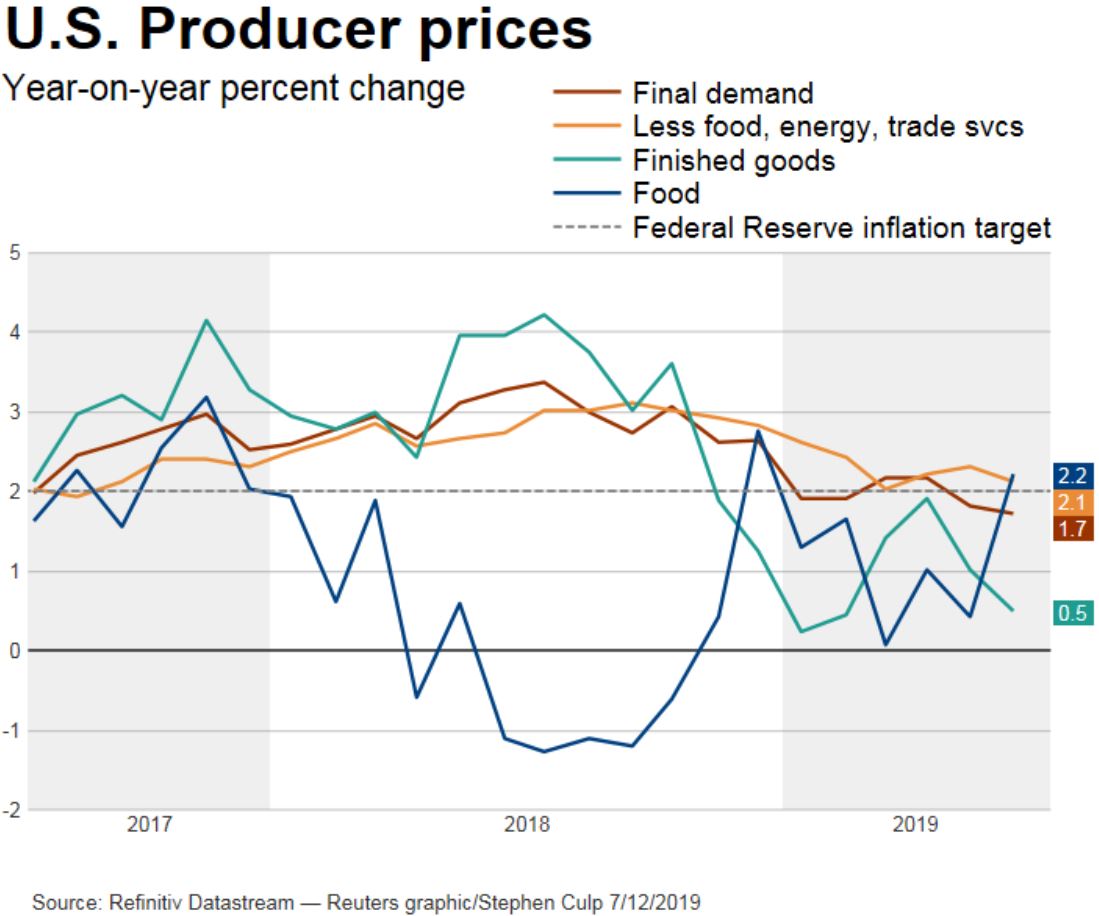
Last Friday’s wholesale Producer Price Index indicated as much, with raw materials for finished goods and services barely budging. There is very little wholesale inflation on raw materials, in spite of the increased tariffs being levied on Chinese goods and elsewhere. This is a very strange because fewer less foreign trade should mean imported goods are more expensive, not cheaper.

The Producer Price Index for final demand advanced 0.1 percent in June, seasonally adjusted, reported the U.S. Bureau of Labor Statistics. Final demand prices moved up 0.1 percent in May and 0.2 percent in April. On an unadjusted basis, the final demand index rose 1.7 percent for the 12 months ended in June, the lowest rate of increase since advancing 1.7 percent in January 2017.

The real problem that Alexandria Ocasio Ortiz for one, highlighted in her questioning of Fed Chair Jerome Powell lzt week is why there is almost no inflation, even with a full employment rate of 3.7 percent? She wanted interest rates lowered sooner to boost higher growth, with some 6-7 million workers either not looking for work, or working part time, but would prefer working fulltime and earn a living wage.

Powell said the U.S. is suffering from a bout of uncertainty caused by trade tensions and weak global growth, but he pledged to do whatever it takes to shore up the economy in what Wall Street took as a sign the central bank will cut interest rates soon.


The retail Consumer Price Index fared slightly better. Year-on-year the core is up 1 tenth to 2.1 percent. Housing and medical care which together make up about 1/2 the index -- are also on the high side, said Econoday.

But outside the core, energy prices fell a sharp 2.3 percent on the month with the gasoline subcomponent down 3.6 percent. Energy prices, which are down 3.4 percent on the year, are not helping the Fed achieve its 2 percent inflation goal.

Trade wars are not really winnable anymore, as I’ve been saying; because we no longer live in a win-lose world where the strong are able to prey or even conquer the weak and vulnerable so easily. Our world has become too populous, and thanks to modern technologies too interlinked for it not to affect world trade upon which economic growth depends.

World trade is now in decline, which means US manufacturing and exports are in decline. So we hope US consumers keep spending, since they make up two-thirds of economic activity, if we grow at all this year.

Harlan Green © 2019

Follow Harlan Green on Twitter: https://twitter.com/HarlanGreen