Showing posts with label energy prices. Show all posts

Thursday, July 30, 2026

Where's the Inflation?

Financial FAQs

“Economic activity is expanding at a solid pace despite elevated uncertainty that owes, in part, to the conflict in the Middle East…Inflation remains elevated relative to the Committee's 2 percent goal, in part reflecting supply shocks that have driven price increases in certain sectors, including energy.” FOMC

MarketWatch

New Fed Chair Kevin Warsh wouldn’t say when the Fed would join the chorus calling for a rate hike at his June press conference. He was waiting to hear from task forces studying problem! When have we heard this before?

The U.S. and Iran keep bombing each other, and Iran has just said they are in no hurry to negotiate another ceasefire, while Trump just found another way to keep tariffs high.

And the bond market and inflation indicators are showing higher inflation ahead. Is there any doubt that the Fed’s Fed Funds rate is going higher, as well, with the Fed’s FOMC statement mentioning “elevated uncertainty” re the Middle East conflict?

The financial markets didn’t like the Fed’s inaction, which is why the market indexes plunged after the FOMC statement—the DOW ended the day down by -1150 pts.

Yet economic disaster is staring Americans in the face, if Trump keeps raising tariffs and can’t stop his Gulf war. It cuts into consumer spending, raising the cost of everything when debt at all levels—national, corporate, and consumers are already at record levels.

Raising the Fed’s interest rate will slow rising inflation by slowing economic growth. The Fed FOMC conclusion that economic activity is “expanding at a solid case” was because of over investment in the AI build out of data centers, almost all of it borrowed money. And many of the AI investors are borrowing from and investing in each other, like Japan’s keiretsu system of interlocking ownerships that impeded them from writing off bad debts when their decades long economic stagnation occurred.

One ‘tell’ of the possibility of a US. recession is that huge new orders for computers and related products jumped 3.1% in June, the government said Monday in its monthly report on durable goods.

The last time there was such a surge in goods investment was during the dot-com era, according to MarketWatch’s Jeffry Bartash. “Over the past year, orders for the AI-related hardware have surged 17%, a level last sustained during the dot-com era more than a quarter of a century ago,” he said.

But the dot-com investments didn’t begin to show enough profit for decades to pay for the investments, hence the 2000 dot-com recession that Alan Greenspan and Nobel Laureate Robert Shiller predicted with their warning that irrational exuberance was blinding investors from reality.

Yet the Fed must act to raise rates sooner or later, since higher inflation is already embedded in consumer surveys, according to the University of Michigan’s sentiment survey:

“Year-ahead inflation expectations ticked down from 4.6% in June to a still-elevated 4.2% this month. The current reading substantially exceeds the 3.4% seen in February before the Iran conflict began, (my bold) along with all 2024 readings. Long-run inflation expectations held steady from last month at 3.3%, remaining a bit higher than the 2.8% to 3.2% range seen in 2024.”

The advance second quarter GDP growth estimate was just 1.5 percent, another casualty of the tariffs and Mideast wars despite the AI investment surge. It’s no wonder the Fed’s Governors are avoiding the obvious; when to begin to restrict credit before inflation becomes entrenched longer term, as it did in the 1970s.

What were the conditions then? Energy supplies were restricted, inflation soared, and economic growth stagnated. Hence the decade of stagflation. Is this a repeat?

Harlan Green © 2026

Follow Harlan Green on Twitter: https://twitter.com/HarlanGreen


Thursday, October 27, 2022

Third Quarter U.S. Growth Turns Positive

 Popular Economics Weekly

BEA.gov

The U.S. economy grew 2.6 percent in the third quarter due to exploding exports, declining imports after two quarters of negative growth from the aftereffects of the pandemic, and record GDP growth in 2021.

‘The increase in exports reflected increases in both goods and services,” said the Bureau of Economic Activity (BEA). “Within exports of goods, the leading contributors to the increase were industrial supplies and materials (notably petroleum and products as well as other nondurable goods), and nonautomotive capital goods. Within exports of services, the increase was led by travel and "other" business services (mainly financial services). Within consumer spending, an increase in services (led by health care and "other" services) was partly offset by a decrease in goods (led by motor vehicles and parts as well as food and beverages).”

Travel and leisure activities jumped because Americans fled their homes after two years of pandemic restrictions. Consumer spending held up and spending on capital goods, a good sign of future growth prospects, increased at a 10.8 percent pace, but investment in structures and new housing sank as soaring mortgage rates choked off home sales.

Housing remains the worm in the apple of future growth, and a reason there are predictions of some level of recession next year, because housing construction and sales feed so many other sectors, such as insurance, banking and other professional services, as well as causing homeowners to feel less wealthy, the so-called wealth effect that can imduce consumers to spend less.

For instance, sales of new single‐family houses in September 2022 were at a seasonally adjusted annual rate of 603,000. This is 10.9 percent below the revised August rate of 677,000 and is 17.6 percent below the September 2021 estimate of 732,000, said the Census Bureau.

More importantly, the inflation rate has already declined. The price index for gross domestic purchases increased 4.6 percent in the third quarter, compared with an increase of 8.5 percent in the second quarter. The decline mostly stemmed from a sharp drop in gasoline prices, said the BEA.

This is the disinflation we have been speaking of where the rate of inflation is declining, but it’s not outright deflation when overall prices are actually falling, a sign of recession. It is indicative of a soft landing, a desirable outcome the Fed and economists are looking for.

Inflation fell even more for consumers as the Personal Consumption Expenditure (PCE) Index that measures consumer spending increased 4.2 percent, compared with an increase of 7.3 percent in Q2. Excluding food and energy prices, the PCE price index increased 4.5 percent, compared with an increase of 4.7 percent.

Inflation would decline more quickly if not for the tight labor market. Weekly initial jobless claims rose slightly to 220,000 in the week ended October 22, with companies reluctant to lay off workers. The consensus among economists is that corporate record profits are enabling companies to retain workers, despite their higher costs.   

In fact, their record profits may be a sign of profit-taking, companies (like the oil giants) making excessive profits on the rising demand for their products.

It is not yet a given that growth will remain positive in the fourth quarter, or that inflation will continue to decline in the face of product shortages (like oil and food), but I am banking on the holidays to bring out shoppers and keep growth positive for the rest of this year.

Harlan Green © 2022

Follow Harlan Green on Twitter: https://twitter.com/HarlanGreen

Thursday, August 18, 2022

U.S. Industrial Production Surging

 Financial FAQs

FREDindustrialproduction

U.S. industrial production is the highest since 2018, continuing its climb from the two-month 2020 recession (gray bar in graph). Automobile production highlighted the surge.

This is huge, folks, and a sign that GDP growth in the third quarter may be positive after the first two quarters of negative growth in 2022. Capacity utilization rebounded to 80.3 percent in July from 79.9 percent in the prior month. Output of the U.S. industrial sector was at an all-time high, above the level hit in 2018.

Why the manufacturing surge now? President Biden’s $1.2 trillion infrastructure bill includes funding allocations of $89.9 billion to improve public transit, $65 billion toward better internet connectivity and access, and money for 500,000 electric vehicle charging stations, which could help address charging “deserts;” areas where it isn’t currently available.

“All of that’s good news for manufacturers who are already experiencing high demand, which could “continue on for months, if not years, going forward,” David Zrostlik, president of Stellar Industries, recently said in the Wall Street Journal.

The bill will also improve workers’ productivity by modernizing our transportation networks.

“The infrastructure bill widely focuses on improving passenger and freight transportation, for instance, so steel and material suppliers, including companies that produce materials for buses, trains, bridges, rail, or related equipment, could see heavy activity. Makers of products supporting things like 5G infrastructure and EV stations, too, will see improved demand,” said a Forbes Magazine article on its effects.

Retail sales also surged, which could even boost revisions to Q2 GDP from a negative to possibly breakeven says Reuters’ Wrightson/ICAP.

“Core sales in July (excluding autos and gas) were up 0.7% versus our forecast of a sluggish 0.1% increase, and the May and June levels were revised up markedly.  By themselves, this morning’s numbers should contribute to an upward revision to Q2 GDP on the order of half a percentage point.”

U.S. Manufacturing rose 0.7 percent in July after falling in the prior two months. Motor vehicles and parts output rose 6.6 percent after a 1.3 percent fall on the prior month. Excluding autos, total industrial output increased 0.3 percent. Auto assemblies were the highest since August 2020. Utilities output fell 0.8 percent in July. Mining output, which includes oil and natural gas, rose 0.7 percent, the third straight solid gain.

As important in bringing down oil prices was that oil and gas drilling is at a 7-year high. U.S. crude oil prices have dipped below $90 per barrel of late, and who knows how much lower they may decline?

Prices could ease further if Iran agrees to a new draft nuclear agreement after it backed off from its demand that the Islamic Revolutionary Guards be removed from the U.S. terrorism list, reports the NY Times, opening a potential of at least one million more barrels a day of Iranian petroleum exports (which would make up for the loss from the end of U.S. Petroleum Reserve contribution in November).

Harlan Green © 2022

Follow Harlan Green on Twitter: https://twitter.com/HarlanGreen

Friday, August 12, 2022

Is the Inflation Scare Over?

 Financial FAQs

BLS.gov

Both the retail Consumer Price Index (CPI) and wholesale inflation index for raw materials—the Producer Price Index (PPI)—fell in July. Since the PPI feeds into retail prices, it’s a sure sign that inflation is on the wane.

The more important U.S. CPI index was unchanged in July, the Labor Department said Wednesday, compared with the 1.3 percent gain in the prior month. The rate of inflation in the 12 months ended in July retreated to 8.5 percent from a 41-year high of 9.1 percent in June. Energy prices were the main culprit, up 33 percent YoY (black bar in BLS graph.).

But gas prices have been plummeting of late. The nationwide average price for a gallon of gas dropped to $3.99 on Thursday, according to AAA. That’s down 20 percent from the mid-June high, and it’s the first time the average has dipped below $4 since early March..

Both indexes brought the annual increase of core products without volatile food and energy fluctuations back into the 5 percent range, which is till high, but causing markets to breathe easier, because it substantiates that most of the price pressure was due to short term events, like a return to more normal activity from the COVID pandemic, which was a 100-year event, and the Ukraine war’s effect on energy and food shortages.

There are still supply-chain shortages as other countries begin to catch up to the surging demand by American consumers to buy anything and everything available in goods and services.

And there is some good news on that front as well. The Biden administration signed into law the Ocean Shipping Reform Act last June, which is engineered to bolster the maritime commission’s authority to regulate shipping that goes into American ports, which is dominated by foreign carriers.

“The law directs the agency to bulk up enforcement while creating systems that make it easier for aggrieved shippers to file complaints,” says Peter Goodman of the NY Times. “It increases the agency’s funding 50 percent by 2025.”

“The passage of the law has already had an impact, say exporters,” continues Goodman, “prompting ocean carriers to make more containers available at West Coast ports. It has also changed perceptions about the commission’s once-cozy dealings with the carriers.”

Nine container ship carriers dominate the Asia to North America imports, which the U.S. importers would have no control over without more government oversight and regulation. It’s one more example of the U.S. government’s role in keeping us growing during the trying times Americans are currently experiencing.

The closely watched “core” CPI measure of inflation that omits volatile food and energy rose 0.3 percent in July, down from a 0.7 percent gain in the prior month. The 12-month rate remained steady at 5.9 percent.

The U.S. producer price index fell 0.5 percent in July, the Labor Department said today. That’s down from a 1.0 percent jump in June and the first negative monthly print since April 2020.

Core PPI prices are up 5.8 percent from a year earlier, down from 6.4 percent in June. And the cost of goods fell 1.8 percent in July, the largest decline since the 2020 pandemic recession (my emphasis).

These results show that it will take a concerted private-public effort to further tame our inflationary impulses if we want to slow down the Fed’s rate increases and return economic growth to the plus column for the rest of this year.

In fact, governments working together to fix the energy and food shortages worldwide would have the greatest effect on inflation and return all of us to less trying times.

Harlan Green © 2022

Follow Harlan Green on Twitter: https://twitter.com/HarlanGreen

Monday, July 15, 2019

Why Worry About Inflation?

Popular Economics Weekly


Almost everyone, including Fed Chair Powell, is worried about the low inflation rate.  It’s usually nearing 4 percent at this late stage of an economic recovery, not the current 2 percent if the US economy were running on all cylinders. Consumers should be spending more and businesses investing more to expand their markets—especially with the lowest unemployment rate in almost 50 years.

But the largest corporations don’t need to invest more. They have become fat and happy controlling their market share because they have been allowed to grow enough to buy up or stifle much of their competition. And with reduced competition they can spend most of their profits on stock buybacks and soaring CEO compensation packages.

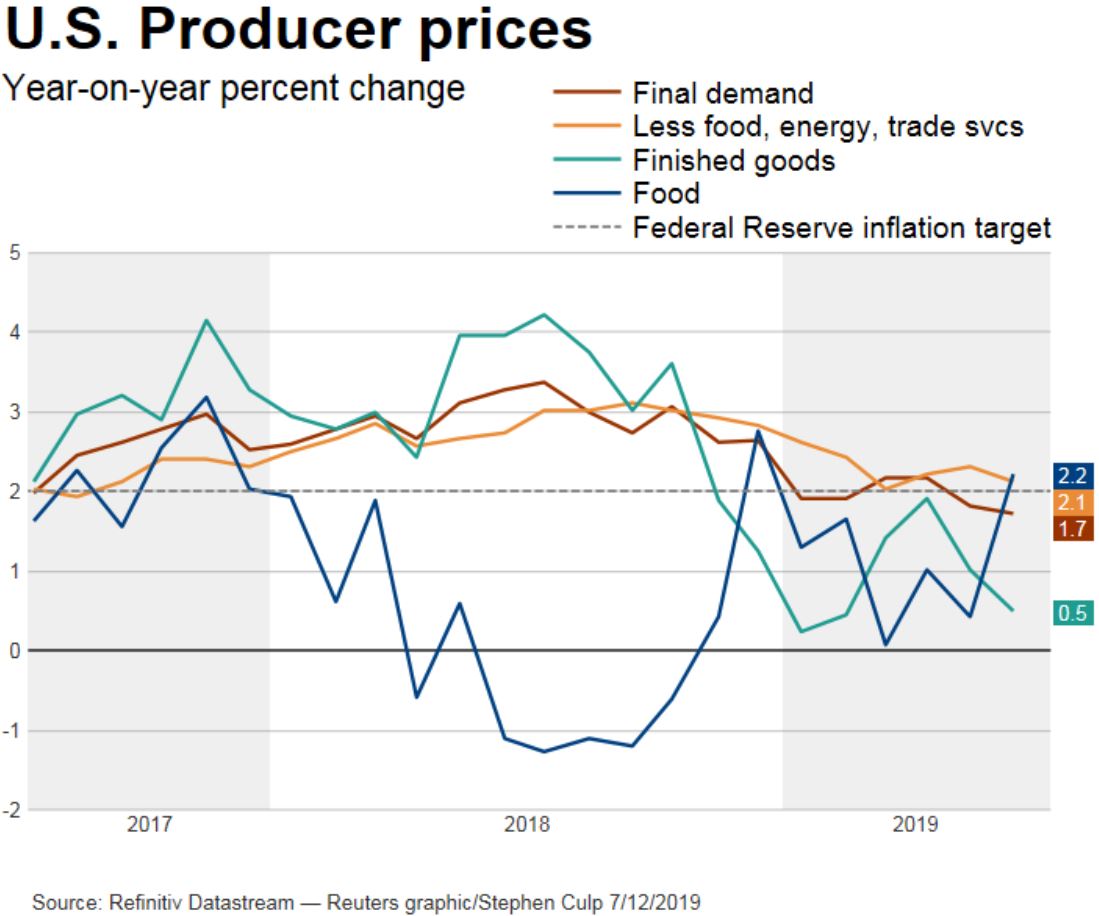
Last Friday’s wholesale Producer Price Index indicated as much, with raw materials for finished goods and services barely budging. There is very little wholesale inflation on raw materials, in spite of the increased tariffs being levied on Chinese goods and elsewhere. This is a very strange because fewer less foreign trade should mean imported goods are more expensive, not cheaper.

The Producer Price Index for final demand advanced 0.1 percent in June, seasonally adjusted, reported the U.S. Bureau of Labor Statistics. Final demand prices moved up 0.1 percent in May and 0.2 percent in April. On an unadjusted basis, the final demand index rose 1.7 percent for the 12 months ended in June, the lowest rate of increase since advancing 1.7 percent in January 2017.

The real problem that Alexandria Ocasio Ortiz for one, highlighted in her questioning of Fed Chair Jerome Powell lzt week is why there is almost no inflation, even with a full employment rate of 3.7 percent? She wanted interest rates lowered sooner to boost higher growth, with some 6-7 million workers either not looking for work, or working part time, but would prefer working fulltime and earn a living wage.

Powell said the U.S. is suffering from a bout of uncertainty caused by trade tensions and weak global growth, but he pledged to do whatever it takes to shore up the economy in what Wall Street took as a sign the central bank will cut interest rates soon.


The retail Consumer Price Index fared slightly better. Year-on-year the core is up 1 tenth to 2.1 percent. Housing and medical care which together make up about 1/2 the index -- are also on the high side, said Econoday.

But outside the core, energy prices fell a sharp 2.3 percent on the month with the gasoline subcomponent down 3.6 percent. Energy prices, which are down 3.4 percent on the year, are not helping the Fed achieve its 2 percent inflation goal.

Trade wars are not really winnable anymore, as I’ve been saying; because we no longer live in a win-lose world where the strong are able to prey or even conquer the weak and vulnerable so easily. Our world has become too populous, and thanks to modern technologies too interlinked for it not to affect world trade upon which economic growth depends.

World trade is now in decline, which means US manufacturing and exports are in decline. So we hope US consumers keep spending, since they make up two-thirds of economic activity, if we grow at all this year.

Harlan Green © 2019

Follow Harlan Green on Twitter: https://twitter.com/HarlanGreen