Showing posts with label Adam Smith Wealth of Nations. Show all posts

Monday, December 30, 2024

Who Wants to Know?

 Financial FAQs

“Fewer than a quarter of Americans (23%) currently rate the country’s economic conditions as excellent or good, while 36% say they are poor and about four-in-ten (41%) view conditions as “only fair,” PEW Research

Why do so many Americans doubt the strength of the American economy that is the fastest growing in the developed world since the COVID-19 pandemic? It depends on their politial leanings, according to the latest PEW Research poll.

PEW Research has been measuring political attitudess for decades. As many as 81 percent of Republicans had positive views of the nation’s economy during Trump’s first presidency, whereas a higher percentage of Democrats were positive during President Biden’s term, per the PEW graph.

It is a condemnation of the lack of economic literacy among American voters, and I maintain largely a reflection of its lack in our educational system.

This is also a reflection of the fact that economic science is still in its infancy. In fact, Adam Smith, who wrote the first treatise on economic theory, The Wealth of Nations, was a Scottish Professor of Moral Philosophy who was the first to show that a successful economy was based on its citizenry guided by an invisible hand to make the right moral choices (honesty, good character).

And economies went awry when those in charge didn’t follow the rules of good character, which have always been autocratic rulers out to serve themselves rather than their citizens, such as in China and Russia. And why is that possible?

A large fraction of voters do suffer from economic illiteracy. Indeed, it is fair to say that an ample majority do not understand the basics of how markets work. They are especially confused about labor and international markets. Voters also have severe misconceptions about how government spends their tax dollars, and are extraordinarily pessimistic about long-run economic conditions,” says Professor Bryan Caplan of George Mason University, citing a recent Washington Post/ Henry J. Kaiser Family Foundation/ Harvard University Survey Project.

Most voters lack even an elementary understanding of economics. When prices change, vague conspiracy theories - not supply-and-demand - are their default explanation, says Professor Caplan.

One survey item that captured the public's anti-market bias is the question asking why the price of gasoline rose back in 1996. Is the reason the "normal law of supply and demand," or is it instead "oil companies trying to increase profits"? An overwhelming majority of economists - 89% - point to supply and demand. An almost equally lopsided fraction of the public - 74% - say the opposite.

Why so much ignorance of financial markets and basic economic conditions that everyone should know to make accurate decisions about their financial future? An economic education was not a high priority for Americans during more prosperous times, a time of a growing middle class after the Great Depression and World War Two.

According to the Council for Economic Education’s latest biennial Survey of the States, a nonpartisan education organisation, just 28 states required K-12 students to take an economics course to graduate, until the COVID-19 pandemic and world-side economic shutdown.

But since the pandemic more than two-thirds of all states are now requiring personal finance classes for high school graduation.

The 2024 Survey found that 35 states now require students to take a course in personal finance to graduate. The new regulations in those dozen states will lead to over 10 million additional K–12 students – 21 percent of current students – gaining guaranteed access to this knowledge, the Survey notes.

The picture isn’t much better in higher education. Only 3.3 percent of colleges required students to take a basic economics course, according to a 2014 study by the American Council of Trustees and Alumni, titled "What Will They Learn?"

ACTA looked at 1,098 colleges and universities. The organization found 3.3 percent require an economics class, 18.3 percent require a U.S. government or history class, and 37 percent make students take a literature course.

There is one additional reason for Americans’ economic illiteracy. It is the well-studied phenomena of herd behavior that was called irrational exuberance by former Fed Chairman Alan Greenspan in an earlier decade.

Nobel Laureate Robert Shiller attributed it to a mental laziness that caused the housing bubble. People tend to listen to hearsay and word of mouth rather than rely on their own judgements to make financial decisions.

“It was, and is, about how errors of human judgment can infect even the smartest people, thanks to overconfidence, lack of attention to details, and excessive trust in the judgments of others, stemming from a failure to understand that others are not making independent judgments but are themselves following still others—the blind leading the blind,” said Dr. Shiller.

It is a sorry picture of our economic illiteracy, and the reason so many citizens are easily fooled by leaders without the requisite character traits, such as good morals and character, that Adam Smith said were required to run a successful economy and government that is for all the people.

Harlan Green © 2024

Follow Harlan Green on Twitter: https://twitter.com/HarlanGreen

Tuesday, October 15, 2019

Nobel Prize in Economics Breaks New Ground

Popular Economics Weekly

STOCKHOLM (AP) — The 2019 Nobel Prize in Economic Sciences has been awarded Monday to Abhijit Banerjee, Esther Duflo and Michael Kremer “for their experimental approach to alleviating global poverty.”

It was ground-breaking for several reasons. Firstly, the Nobel committee is recognizing that the field of economics is finally becoming more science than social science by championing empirical field research, rather than purely academic research that was conducted mostly in ivory towers with mathematical formulas.

For instance, Prof George Akerlof, one of three that won the 2001 Nobel Prize, was the first of several so-called behavioral economists to win for his research on how individuals actually make financial decisions. He proved that humans don’t always act rationally in their best interests without institutional safeguards, such as Lemon Laws that prevent faulty used car sellers from putting new car dealers out of business.

Though the proof was done with mathematical formulas, it began the ongoing divorce from what was originally called Political Economics. What else to call it when one major branch of microeconomics was under the assumption that investors and wage earners actually acted in their own best interests in a level playing field without government oversight, yet never was validated with actual results?

The lines had been drawn between conservatives that advocated Adam Smith’s pronouncement that free, mostly unregulated markets with low taxation would remain healthy of their own accord and were the best way to maximize prosperity for all; with the Keynesian, New Deal economics of progressives that wanted governments to discipline capital markets for their excesses.

These opposing viewpoints on how human beings made financial decisions were based more on political choices than actual scientific research on financial behavior until research in other fields, such as psychology were brought into economics.

Hence this new approach is called ‘experimental’, because it prioritized actual field work using scientific methods to improve the lives of the poorest in developing countries. What did they discover?

“The Laureates’ research findings,” said the Nobel Prize announcement, “– and those of the researchers following in their footsteps – have dramatically improved our ability to fight poverty in practice. As a direct result of one of their studies, more than five million Indian children have benefitted from effective programmes of remedial tutoring in schools. Another example is the heavy subsidies for preventive healthcare that have been introduced in many countries,” (that made preventative healthcare accessible to the poor).

It looks like this is becoming a worldwide movement to alleviate poverty and income inequality in developed countries as well, such as the U.S. of A. that has been lagging other developed (and underdeveloped) countries in improving the lives of our poorest citizens—thanks in large part to Big Business’s proclivity to maximize profits over every other corporate goal.

One example of this trend: JP Morgan Chase CEO Jamie Dimond announced in August a Statement on the Purpose of a Corporation by the Business Roundtable, a group of almost 200 large businesses, in which they “share a fundamental commitment to all of our Stakeholders”.
“While each of our individual companies serves its own corporate purpose,” said Dimond, “we share a fundamental commitment to all of our stakeholders. We commit to:
  • · Delivering value to our customers. We will further the tradition of American companies leading the way in meeting or exceeding customer expectations.
  • · Investing in our employees. This starts with compensating them fairly and providing important benefits. It also includes supporting them through training and education that help develop new skills for a rapidly changing world. We foster diversity and inclusion, dignity and respect.
  • · Dealing fairly and ethically with our suppliers. We are dedicated to serving as good partners to the other companies, large and small, that help us meet our missions.
  • · Supporting the communities in which we work. We respect the people in our communities and protect the environment by embracing sustainable practices across our businesses.
  • · Generating long-term value for shareholders, who provide the capital that allows companies to invest, grow and innovate. We are committed to transparency and effective engagement with shareholders.
It remains to be seen if corporate behavior--that is in large part responsible for the record income inequality we see with the globalization of market forces--actually changes. But this award shines a light on what can happen when the Economic Sciences begin to follow the rules of scientific discovery, rather than the Political Economic verities of old.

Harlan Green © 2019

Follow Harlan Green on Twitter: https://twitter.com/HarlanGreen

Monday, September 19, 2016

Popular Economics Weekly

Janet Yellen’s Fed meets again this midweek to decide whether to raise short term rates. It probably won’t happen, because they can’t decide if the US economy is ‘half-full’—i.e., still growing enough to boost inflation—or ‘half empty’, which means the economy is barely growing.

A terrific New York Times conversation between two extraordinary women, Senator Elizabeth Warren and Tracee Ellis Ross, actress and daughter of Diana Ross, brought out what is at stake in this election between the Haves and Have-nots, and best describes the current political debate.
“Go listen to those guys on the floor of the Senate talking about people who are losing their homes,” said Senator Warren, “describing them like you’d talk about furniture that should be tossed out. It’s a “they” that’s so far away.”
“But it’s not just in politics, it’s everywhere,” said Ms. Ross. “This “otherness” that’s all of a sudden part of our culture. People grabbing to what’s theirs out of fear it might be taken away.”
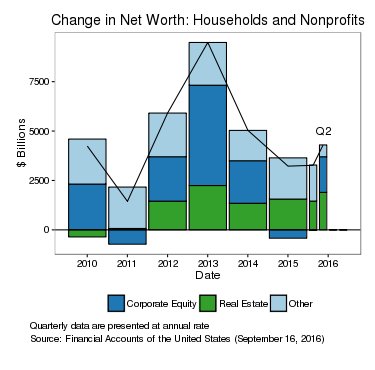
Yet The Federal Reserve has said most recently household net worth rose to $89.06 trillion in the second quarter, a rise of $1.07 trillion, or 1.2 percent to a record level as a percentage of Gross Domestic Product. The gains were almost equally split between the $452 billion rise in equities and the $474 billion advance in the value of real estate. So even middle-class homeowners are benefiting from the current recovery.


The fear mongers, such as Donald Trump, would have us believe the economic pie is fixed, a zero-sum game, in Senator Warren’s words, in which the wealthiest hoard their wealth in order to spend it on themselves, for themselves. (But) “That was not America. We were building an America that said, “If we educate all our kids, we”ll actually make more (of everything),” says Warren.

New data showing middle-class household incomes growing at the fastest rate since the recession seemed to confirm that a recovery that’s remained slow and uneven is finally touching the lives of ordinary, especially middle-class Americans. So there is more of the ‘pie’ being created, not the zero-sum that Trumpeteers would have us believe.


It is also why so many seem to believe Trump’s blame-game, which wants to “blame the immigrants, blame women, blame people who have different religious beliefs than you, blame people who aren’t the same color as you,” says Warren. “Because if everyone turns on each other—then the same old system that keeps billionaires on top stays right where it is.”

In fact, this explains the almost eternal struggle between the Haves and Have-nots, as well. Capitalism, the system that Adam Smith described best in his 1776 book, The Wealth of Nations, created today’s wealth by ‘paying it forward,’ by investing part of the profits in future growth.

And that is the real game of those Haves that support Trump and all his ugliness. They want to propagate the “same-old system”, the system that must build walls to make American great again.

Harlan Green © 2016

Follow Harlan Green on Twitter: https://twitter.com/HarlanGreen