Showing posts with label Janet Yellen. Show all posts

Wednesday, November 16, 2022

Inflation Won't Stop Holiday Shoppers

 Popular Economics Weekly

When will inflation subside enough to bring down interest rates again? There are estimates that it takes from one year to 10 years to cure large inflation spikes such as occurred this year, based on what pundits and economists see as past history.

But that hasn’t stopped shoppers. Retail sales that account for some half of consumer spending jumped a huge 1.3 percent in October, 7.6 percent YoY.
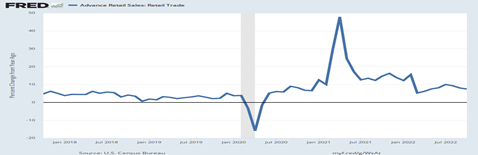
FREDretailsales

Consumers are keeping up with inflation, in other words, because it’s the holidays and they want to celebrate their world returning to normal. Dining out at restaurants increased 1.3 percent in October, twice the current inflation rate.

And inflation is already cooling. The Fed has pumped up short-term rates from essentially zero to 4 percent in 2022, which has pummeled stock and bond prices. But financial markets rallied on Tuesday because the Producer Price Index (PPI) for wholesale goods and services continued to decline. Wholesale prices in October rose just 0.2 percent month-month and core inflation without food, energy and trade services declined from 5.6 to 5.4 percent YoY.

Tradingeconomics.com

My bet is that inflation will drop quickly during the coming winter as supply chains continue to improve, which ground to a halt during the worldwide pandemic lockdowns.

For instance, the NY Federal Reserve’s Global Supply Chain Pressure Index (GSCPI) stated as much in its latest release. “The GSCPI’s year-to-date movements suggest that global supply chain pressures are falling back in line with historical levels,” it said.

It means that consumer prices will continue to decline as well, since the PPI measures the raw materials and data that go into retail products and services.

Alas, retail inflation is still too high, since the CPI declined to 7.7 percent in October compared to a year ago, down from 8.2 percent in September. Predictions are all over the map as to when the inflation rate will return to a more normal range. Treasury Secretary Janet Yellen has said in recent testimony it could take several years to return to the Federal Reserve’s two percent target.

Other pundits are predicting as much as 10 years, because they cite the 1970’s era of stagflation. Inflation soared to as high 14 percent in 1981 after 10 years of wage-price spirals. It was another 10 years before inflation returned to its more normal 2-3 percent range.

But this inflationary spiral has lasted just months, not years as in the 1970s, as Nobel Prize-winner and former Federal Reserve Chair Ben Bernanke has pointed out. So, there’s no reason for anyone to press the panic button, stock and bond traders included. Consumers are riding this inflation wave just fine to date.

Why shouldn’t they be upbeat, with Americans still fully employed?

The New York Fed also publishes a Survey of Consumer Expectations of inflation also shows inflation is a short-term problem. “Median one- and three-year-ahead inflation expectations increased to 5.9 percent and 3.1 percent from 5.4 percent and 2.9 percent, respectively. (But) The median five-year-ahead inflation expectations, meanwhile, rose by 0.2 percentage point to 2.4 percent.”

Wholesale prices are still high. The Producer Price Index for final demand in the U.S. rose 0.2 percent month-over-month in October of 2022, the same as a downwardly revised 0.2 percent increase in September. Goods cost went up 0.6 percent, the largest advance since a 2.2 percent rise in June, mainly pushed by a 5.7 percent jump in gasoline cost. Prices for diesel fuel, fresh and dry vegetables, residential electric power, chicken eggs, and oil field and gas field machinery also advanced. In contrast, the index for passenger cars declined 1.5 percent. Meanwhile, services cost fell 0.1 percent, the first decline since November of 2020.

So, the inflation outlook is muddled, but consumers’ inflation expectations give us a better picture of how consumers will behave in the future. It is another ingredient that helps to determine the Fed’s next move, and when shoppers buy or hold.

All this news backs my bet of inflation falling back to historical levels as soon as next summer.

Harlan Green © 2022

Follow Harlan Green on Twitter: https://twitter.com/HarlanGreen

Friday, April 15, 2022

What Recession?

 Financial FAQs

FREDretailsales 

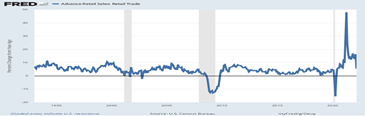
Retail sales are rising 5.5 percent YoY, which is a sign that the economy is still booming, and the possibility of a recession years away. That is, if inflation begins to taper of its own accord, which consumers think it will, despite the Ukraine war-induced sanctions.

Former Treasury Secretary Larry Summers doesn’t think it will, which is why he says a recession is “the most likely thing” partly because the Federal Reserve “is going to have to keep going [in its effort to subdue inflation] until we see disinflation.”

Summers has been the main inflation hawk, whereas Janet Yellen the current Treasury Secretary and past Chair of the Federal Reserve was more optimistic that the U.S. economy could escape a recession as it begins to raise interest rates.

Half of the inflation number is volatile gas prices. Gas sales rose 8.9 percent in the retail report, pushing up gas prices more than 8 percent, while auto sales fell -1.9 percent, signaling that car makers are catching up to demand and car prices moderating.

So even though the inflation rate has soared to 8.5 percent, consumers are increasingly optimistic about their future. The University of Michigan’s gauge of consumer sentiment rose in April to 65.7, a more than 10 percent increase from March’s reading of 59.4,

UofMichigan

Consumer Sentiment jumped by a surprising 10.6% in early April, although it remained below January's reading and lower than in any prior month in the past decade, said the University of Michigan’s press release. Nearly the entire gain was in the Expectations Index, which posted a monthly gain of 18.0%, including a leap of 29.4% in the year-ahead outlook for the economy and a 17.2% jump in personal financial expectations. 

The reason for their increasing optimism was plentiful jobs and rising wages. Consumers under the age of 45 expect a 5.3 percent increase in their wages this year, almost enough to keep up with inflation expectations.

“Consumers still anticipate that the national unemployment rate will inch downward, acting to improve consumers’ outlook for the national economy,” Richard Curtin, the survey’s chief economist wrote.

U.S. Treasury Secretary Janet Yellen is also more cautiously optimistic than Larry Summers re the inflation outlook. She said on Wednesday the Federal Reserve would need luck and skill to maintain a strong labor market while bringing inflation down, or in economists’ terms to engineer a “soft landing.”

“It has been done in the past. It’s not an impossible combination,” Yellen said, during a talk at the Atlantic Council. Yellen said she was more worried about the prospects of a recession in Europe given the impact of the war in Ukraine than one in the U.S..

Americans anticipated gasoline prices to remain steady over the next year, which is in line with their overall outlook that inflation will moderate, said the sentiment survey. Americans’ expectations for overall inflation over the next year held steady at a 5.4 percent inflation rate in March while expectations for inflation longer term over the next five years has remained at 3.0 percent for many months.

Another reason for optimism concerning a “soft landing” as the Fed begins to raise interest rates, is that industrial production is soaring, which also helps bring down inflation.

The Federal Reserve just reported that industrial production jumped 0.9 percent in March. and February’s gain was revised up to 0.9 percent from the initial estimate of a 0.5 percent increase. For the first quarter, output was up at an 8.1 percent annual pace, with the output of motor vehicles and parts up 7.8 percent in March.

So supply chains are beginning to catch up to demand, another reason that inflation may moderate, and consumers’ optimism is warranted. But it will require considerable  “luck and skill” to avoid a recession, as well as a favorable outcome to the war in Ukraine.

Harlan Green © 2022

Follow Harlan Green on Twitter: https://twitter.com/HarlanGreen

Wednesday, November 10, 2021

"It's the COVID Pandemic, Stupid!"

Financial FAQs

FREDcpi

Why the supply-chain bottlenecks and soaring inflation? “It’s the pandemic, stupid.” economists and industry leaders are saying.

President Biden’s $1.2 trillion Infrastructure Investment and Jobs Act (IIJA) was passed just in time to slow the inflation climb and make for a merrier Christmas.

Consumers and producers are worried because the consumer price index jumped 0.9% last month, the government said Wednesday. The pace of inflation over the past year marched to 6.2% in October from 5.4% in the prior month. That’s triple the Federal Reserve’s 2% target and is the highest rate since November 1990.

But even the latest price spike following last year’s pandemic-induced recession was barely higher than that following the 2007-9 recession (gray bar), per the above FRED graph of CPI inflation rates.

Economists such as Obama’s chief economic advisor, Austin Goolsby, are saying this is a one-of-a-kind slowdown caused by the pandemic. “The most important thing to watch if you want to understand the economy is, as has been the case for a year and a half now, the progress made against the virus,” said Goolsby in a recent NYTimes Op-ed.

Why will the new infrastructure bill create a merrier holiday season? Because it jump-starts a renewal of public investment in America’s future with the largest spending programs since Roosevelt’s New Deal.

The bill provides $110 billion to repair the nation's aging highways, bridges and roads. According to the White House, 173,000 total miles of America's highways and major roads and 45,000 bridges are in poor condition. And the almost $40 billion for bridges is the single largest dedicated bridge investment since the construction of the interstate highway system, according to the Biden administration.

“The bill is a significant down payment on the $2.5 trillion infrastructure investment gap that was identified in the 2021 Report Card and will benefit American businesses and families for years to come,” says the American Society of Civil Engineers (ASCE).

“The bill represents a historic, once-in-a-generation investment in our roads, bridges, water and wastewater networks, ports, electric grid, dams, and more. It increases funding, makes smart improvements to policy such as streamlining permitting, and it creates new programs targeted at almost all 17 categories in the 2021 Report Card for America’s Infrastructure, according to the ASCE.

Specifically, the IIJA includes a reauthorization of our surface transportation programs, the Drinking Water and Wastewater Infrastructure Act, as well as an additional $559 billion in new spending that is a combination of targeted funds for overdue state of good repair projects, but also forward-looking programs and policy to make our infrastructure more resilient, said ASCE.

These funds include:

  • $110 billion for roads, bridges, and major projects;
  • $66 billion for passenger and freight rail;
  • $65 billion for broadband internet;
  • $46 billion for resilience to help states and cities prepare for droughts, wildfires, climate change, and more;
  • $39 billion for public transit; and
  • $17 billion for ports and waterways.

This is just a down payment on what needs to be done to bring the American economy into the 21st century, according to the Federal Reserve Chair Janet Yellen: “We are now engaged in the most important economic project in recent history: Repairing the broken foundations of our economy, and on top of them, building something stronger and fairer than what came before.”

Consumers will continue to worry about inflation as much as the pandemic in the coming months. But the inflation rate is tied to the infection rate. How? Supply-chain shortages are causing the price hikes. And when millions more return to work (such as truck drivers) once the pandemic subsides sufficiently, this should in turn loosen the supply-chain constrictions, bringing down prices.

So, instead of saying, “It’s the economy, stupid.” we can say, “It’s the pandemic, stupid” that’s holding up the recovery.

Harlan Green © 2021

Follow Harlan Green on Twitter: https://twitter.com/HarlanGreen
 

Thursday, October 7, 2021

Why Have a Debt Ceiling Debate?

 Financial FAQs

FREDdebtgdp

We might have just been saved from an immediate default on the national debt with all of its consequences. Senate Minority Leader Mitch McConnell late on Wednesday made a new offer to the Democratic-run Senate as lawmakers struggled to end a standoff over the federal borrowing limit.

Republicans will “allow Democrats to use normal procedures to pass an emergency debt limit extension at a fixed dollar amount to cover current spending levels into December,” McConnell, a Kentucky Republican, said in a statement.

But that only kicks the debt ceiling can down the road. Why should there be a congressionally mandated debt ceiling? If the U.S. congress was serious about putting a cap on public spending, then it would require that any new spending be paid for, as has been done in the past.

It is beyond silly to have have a debt ceiling, otherwise. Because the debt incurred is from past spending. But, alas, congress has not been able to agree on an acceptable formula for reinstituting what has been called pay-to-play budget resolutions.

The above FRED graph shows the amount of public debt as a percentage of GDP owed by the federal government is today. The largest growth in U.S. public debt occurred because of the last two recessions (gray columns in graph)—the Great Recession caused by lax regulation of Wall Street lenders that led to the housing bubble, and the COVID-19 pandemic, respectively.

The pandemic recession lasted just two months, and public debt soared mainly because of the $trillions in emergency spending passed by congress during the Trump and Biden administrations that wasn’t paid for. In fact, the Trump administration pushed through massive tax cuts on corporations and lowered the maximum tax rate on personal income in 2017. Some $7.8 trillion was added to the public debt during his term.

Even the current level of public debt ($22.7 trillion) is less of a danger to growth than the debate over raising the debt ceiling.

This is because as Josh Bivens of the Economic Policy Institute points out, and I have discussed in past columns, over the past 25 years debt service payments (required interest payments on debt) shrank almost in half, from 3.0 percent of GDP to 1.8 percent, as the nominal federal debt rose from $5 trillion to $22.7 trillion. And it has averaged 3 percent of GDP, historically.

The main danger to economic growth is that a debt ceiling exists at all. Fed Chairwoman Janet Yellen just warned that the U.S.could fall into a recession if the debt ceiling isn’t raised in congress by October 18.

“It is utterly essential that this be done,” Yellen said, in recent congressional testimony. She called Oct. 18 “the deadline.”

In fact, we are at the beginning of a new growth cycle. Doubts about the direction of growth after the pandemic arise from outdated economic models—models that can be lumped under supply-side, or more derisively, trickle-down economic theories.

Conservative economists tend to be stuck in what has been called the golden years of Reaganomics—or supply-side economics--when stimulating the supply of ever more goods and services by lowering government oversight and reducing taxes was the ticket to prosperity.

But explained simply, having excess aggregate demand, or effective demand, which we have today, stimulates greater growth rather than an excess of supply. And businesses are following that formula with record amounts of private and public investments in capital goods. Total capital expenditures in the second quarter are up 25 percent from a year ago, per the Federal Reserve Bank of St. Louis (FRED).

Lord JM Keynes understood this in the 1930s, which is why he thought it more important to stimulate greater demand with public investments when private investment disappeared during recessions. That was the lesson we learned from the Great Depression.

And it is the lesson we need to carry forward with the current infrastructure legislation winding its tortured way through congress that will stimulate a longer lasting growth cycle.

Then our debt will pay for itself.

Harlan Green © 2021

Follow Harlan Green on Twitter: https://twitter.com/HarlanGreen

Wednesday, May 12, 2021

Job Openings Soar

 Financial FAQs

Calculatedriskblog

“The number of job openings reached a series high of 8.1 million (yellow line in graph) on the last business day of March, the U.S. Bureau of Labor Statistics reported today. Hires were little changed at 6.0 million (blue line). Total separations were little changed at 5.3 million (red bar). Within separations, the quits rate was unchanged at 2.4 percent while the layoffs and discharges rate decreased to a series low of 1.0 percent.”

In the arts, entertainment and recreation industry, vacancies increased by 81,000 jobs, said Reuters. Vacancies also increased in manufacturing, trade, transportation, and utilities industries as well as in finance. Job openings rose in the Northeast and Midwest regions. But vacancies dropped in the healthcare and social assistance industry.

There is a red-hot demand for workers after what I call the pandemic recession. So we are essentially at the starting gate of the next growth cycle with first quarter GDP already showing 6.4 percent growth.

So economic indicators will have crazy numbers until we reach herd immunity and everyone—including teachers, day-care workers and government workers—are able to return to work. There are still 2 million fewer women and 1.5 million fewer men in the labor force than pre-pandemic levels.

This Calculated Risk graph shows that companies are holding on to more of their employees with lower separations and quits, while last Friday’s unemployment report actually showed some 1 million new jobs were created, but just 266,000 above the normal seasonal rate of hiring.

The 2 million gap between Hires and Job Openings in the graph means companies are looking for workers. But it will take time for workers to find suitable jobs, and employers perhaps to begin to raise their minimum wages for essential workers in the service sector (that are the lowest paid).

A record number of small businesses said they could not fill open jobs in April, as well, adding to a growing national controversy over whether extra unemployment benefits are keeping scores of people from re-entering the labor force. The extra $300 in jobless benefits was extended to September in Biden’s $1.9 trillion American Recovery Act.

Some 44 percent of small businesses said job openings went unfilled in April, according to the National Federation of Independent Business. The NFIB is the nation’s largest small-business lobbying group.

And we have yet to see the enactment of an American Jobs Plan for massive infrastructure spending that will create even more jobs. Does that mean we have a labor shortage with more then 8 million still out of work who say they are looking for work?

There are supply bottlenecks while companies ramp up production again, and the inflation rate hitting new highs since the Great Recession. Will wages begin to rise as well from their lows of the last 40 years?

The consumer price index soared 0.8 percent to match the biggest monthly increase since 2009, the government said Wednesday. Economists had forecast a smaller rise. The rate of inflation over the past year jumped to 4.2 percent from 2.6 percent in the prior month — the highest level since 2008.

Wages have been held down for most workers by the rising power of corporations and weakening of labor unions since 1980. However, the trend is about to reverse as the demand for workers increases.

Will it cause the Fed to boost their short term interest rates? Fed Chair Powell doesn’t want to, but Treasury Secretary Yellen believes rates will have to rise if higher inflation continues.

Who is right? It is too early to tell. This also means the US economy is in for a wild ride this decade.

Harlan Green © 2021

Follow Harlan Green on Twitter: https://twitter.com/HarlanGreen

Thursday, March 25, 2021

We Need A Green Infrastructure Plan

 Popular Economics Weekly

Washington Post

The Biden administration’s $3 trillion infrastructure plan is next on their agenda to boost economic growth. And it will need a tax raise to pay for it.

“I think a package that consists of investments in people, investments in infrastructure, will help to create good jobs in the American economy,” testified Treasury Secretary Janet Yellen in congressional hearings this week, “and changes in the tax structure will help to pay for those programs.”

Yellen and Fed Chair Jerome Powell said there was no problem with any inflationary bulges that might occur with so much spending because it was spending that would boost productivity as well as employment, generating even more growth.

“Our best view is that the effect on inflations will be neither particularly large nor persistent,” said Powell during the same hearings.

The circa $3 trillion infrastructure bill President Biden is proposing should really be treated as if we are fighting another world war, as we treated spending during world War Two. This war to overcome the coronavirus pandemic has killed more people than all prior world wars.

So why even worry about inflation or budget deficits? In fact, rising inflation during WWII created negative real interest rates at the time because the Fed kept rates low to finance the war, just as it is doing now, which really means it is interest-free money (That is, real interest rates less than zero as it was during WWII).

And the infrastructure bill must be a green, environmentally friendly bill because much of it has to mitigate the damage to infrastructure from global warming. Need we be reminded of the recent breakdowns in power grids that can leave millions without water and electricity for days, as demonstrated by the Texas power crisis this year?

The National Resources Defense Council (NRDC) in a 2008 report said, “New research shows that if present trends continue, the total cost of global warming will be as high as 3.6 percent of gross domestic product (GDP). Four global warming impacts alone—hurricane damage, real estate losses, energy costs, and water costs—will come with a price tag of 1.8 percent of U.S. GDP, or almost $1.9 trillion annually (in today’s dollars) by 2100.”

This means an 80 percent reduction in U.S. greenhouse gases alone to meet Paris Accord goals, phasing out most uses of fossil fuels and replacing them with electric energy sources such as wind and solar power.

“Mr. Biden’s infrastructure plan will deal with the meat-and-potato issues that Republicans and Democrats agree are an urgent need,” say NYTimes reporters Jim Tankersley and Anni Karney. “It seeks to rebuild roads, bridges, transit, rail and ports, while also improving power grids and increasing the number of electric vehicle charging stations.”

The plan also requires the development of universal broadband, such as 5G networks that China is already building on a grand scale, a major issue in rural communities. Documents suggest it will include nearly $1 trillion in spending on the construction of roads, bridges, rail lines, ports, electric vehicle charging stations, and improvements to the electric grid and other parts of the power sector, according to Tankersley

There is much more to Biden’s infrastructure plan that will be detailed as we get more particulars. Any delays in passing it will only increase the costs from damage caused by the increasing frequency of hurricanes, tornadoes, wildfires, power failures; so much so that even the U.S. Pentagon says climate change has become a national security threat.

Over the past decade, the Pentagon has consistently, repeatedly cited climate change as a serious threat to America’s national security in official public documents.

“Climate change is a threat in their eyes because it’s going to degrade their ability to deal with conventional military problems, said Michael Klare in an Vox interview about his new book about the Pentagon’s role in combatting global warming, titled All Hell Breaking Loose: The Pentagon’s Perspective on Climate Change. “It’s going to create chaos, violence, mass migrations, pandemics, and state collapse around the world, particularly in vulnerable areas like Africa and the Middle East.”

“It is difficult to put a price tag on many of the costs of climate change: loss of human lives and health, species extinction, loss of unique ecosystems, increased social conflict, and other impacts extend far beyond any monetary measure, says the NRDC report. “But by measuring the economic damage of global warming in the United States, we can begin to understand the magnitude of the challenges we will face if we continue to do nothing to push back against climate change.”

If we can protect ourselves from COVID-19, then we surely can protect ourselves from a warming planet.

Harlan Green © 2021

Follow Harlan Green on Twitter: https://twitter.com/HarlanGreen

Tuesday, March 9, 2021

Why the American Rescue Plan Is So Important

 Financial FAQs

There are several good reasons for passing the American Rescue Plan (ARP). Firstly, it abolishes once-and-for-all the Reagan-era myth that ‘government is the problem’.

With the thinnest of Democratic majorities, the Biden administration is getting things done; from speeding up of vaccine deliveries, to expanding Obamacare coverage, to requiring masks on interstate and international travel and re-joining the Paris Accord on climate change—all this enabling a speedier economic recovery.

And it benefits so many Americans—more than 60 percent, according to economist Steven Ratner on Morning Joe, in comparing the American Rescue Plan to Trump’s Tax Cuts and Jobs Act that transferred $1.9 trillion in tax cuts to the wealthiest 10 percent of income earners with none of it supporting public spending, whereas the $1.75 trillion in spending from the ARP will benefit programs for more than 60 percent of Americans.

 MorningJoe

This will include the poorest among US, including minorities and immigrants, according to the PEW Research Center’s latest survey:

“About six-in-ten White (60%) and Asian adults (58%) currently say their personal financial situation is in excellent or good shape. In contrast, a majority of Black (66%) and Hispanic (59%) Americans say their finances are in only fair or poor shape.

The Congressional Budget Office has said that it could take five years for employment to reach levels prior to the pandemic without the American Rescue Plan.

The ARP’s main objective is to put people back to work as soon as possible, according to Fed Chairperson Janet Yellen.

““I think we should want a rapid recovery,” she said in a recent PBS Newshour interview. “We have a large number of workers who are long-term unemployed, and we have to make sure they’re not scarred to the point where this pandemic has a permanent impact on their lives.”

And speaking of the latest strong unemployment report that created 379,000 more payroll jobs, “at that pace it would take us more than two years to get to full employment,” Yellen said in the same interview. The “real” unemployment rate, after factoring in 4 million who dropped out of the labor force after losing their jobs, was more like 10 percent.

The PEW report said that income differences are particularly pronounced, with a gap of 60 percentage points between the shares of upper-income (86%) and lower-income (26%) adults who rate their financial situation as excellent or good. “About six-in-ten adults with middle incomes (58%) say their finances are in excellent or good shape.”

The ARP should also boost consumer sentiment now at a six-month low in the U. of Michigan February sentiment survey, with the entire loss concentrated in the Expectation Index and among households with incomes below $75,000 (the income brackets targeted by the government cash payouts), as I said last week.

“Households with incomes in the bottom third reported significant setbacks in their current finances, with fewer of these households mentioning recent income gains than anytime since 2014,” said the U. Michigan survey.

Need we say more? This is why the American Rescue Plan is so popular with a 76 percent approval rating per the latest Politico survey.

Harlan Green © 2021

Follow Harlan Green on Twitter: https://twitter.com/HarlanGreen

Thursday, February 11, 2021

The American Rescue Plan Must Pass

 Popular Economics Weekly


The number of job openings was little changed at 6.6 million on the last business day of December, the U.S. Bureau of Labor Statistics reported yesterday. Job growth slowed in January with just 49,000 net payroll jobs created, which is why even Fed Chair Janet Yellen maintains the American Rescue Plan currently in debate must pass.

Janet Yellen said on Sunday the country was still in a “deep hole” with millions of lost jobs, but that President Joe Biden’s $1.9 trillion relief plan could generate enough growth to restore full employment by next year.

“There’s absolutely no reason why we should suffer through a long, slow recovery,” she said.

Otherwise, the Congressional Budget Office projects the unemployment rate could remain elevated for years to come and take until 2025 to get unemployment back to 4 percent, in a recent CBO analysis done on the effects of raising the national minimum wage to $15 per hour by 2025. The jobless rate stood at a half-century low of 3.9 percent a year ago before the pandemic.

Barron’s reports retailers, warehousing, construction, durable-goods manufacturing, and healthcare lost a combined 110,000 jobs in January—all for the first time since last April.

The above graph shows job openings (yellow line), hires (dark blue), Layoff, Discharges and other (red column), and Quits (light blue column) from the JOLTS. The sharp spike in red columns showed how severe were last year’s job losses, with 20 million jobs lost last April and May 2020. Layoffs and Discharges were back down the 5.5 million in January.

In December, the number of hires decreased to 5.5 million (-396,000), per the BLS. Hires decreased in accommodation and food services (-221,000); transportation, warehousing, and utilities (-133,000); and arts, entertainment, and recreation (-82,000). Hires increased in retail trade (+94,000).


The NFIB Small Business Optimism Index also declined in January to 95.0, down 0.9 from December and three points below the 47-year average of 98. Owners expecting better business conditions over the next six months declined seven points to a net negative 23%, the lowest level since November 2013, said the report.

Small business owners are just as excited as consumers in seeing more economic aid from the congress, in part because a separate survey from the NFIB showed a third of small businesses reported in January that they had vacancies they could not fill, with 28% of those for skilled workers.

“As Congress debates another stimulus package, small employers welcome any additional relief that will provide a powerful fiscal boost as their expectations for the future are uncertain,” said NFIB Chief Economist Bill Dunkelberg. “The COVID-19 pandemic continues to dictate how small businesses operate and owners are worried about future business conditions and sales.”

There is some concern that it could be too much aid on top of the recently passed $900 trillion aid package. But how else do we get the 10 million that lost their jobs back to work that want to work? There is an additional 4 million that have stopped looking for work.

The task at hand must bring back a US and world economy under attack by an enemy that has inflicted far more casualties than any war.

Harlan Green © 2020

Follow Harlan Green on Twitter: https://twitter.com/HarlanGreen

Wednesday, December 2, 2020

Ending Our Economic Civil War—Part II

 Answering the Kennedys’ Call


MarketWatch

President-Elect Joe Biden can call a truce from the ongoing Red vs. Blue states economic civil war with just announced picks of his economics team, including Janet Yellen as Treasury Secretary and the economic advisors.

They are what have been called “progressive” economists because they advocate a national government that works for all the people in red and blue states, including stronger labor laws to protect wages and benefits of the salaried workforce that has been suppressed since the 1980s, causing most of the record income inequality we have today.

Janet Yellen is a UC Berkeley economist known for her labor expertise in advocating policies that combat income inequality. She worked to keep interest rates low when she was Fed Chair and advocated more public investments that the private sector avoided as Obama’s chief economic advisor.

Biden’s other progressive economists include Wally Adeyemo for deputy secretary of the Treasury; Cecilia Rouse as chair of the Council of Economic Advisers; and Jared Bernstein and Heather Boushey as members of the Council of Economic Advisers, all advocates of New Deal, Keynesian economics that cured the Great Depression.

Nobel Laureate Paul Krugman said on MSNBC that the advisors are incredibly qualified--even overqualified for the job—since anyone of them could be Biden’s CEA chair and chief economic advisor.

“It is no secret that the past few decades of widening inequality can be summed up as significant income and wealth gains for those at the very top and stagnant living standards for the majority,” Yellen said in a speech to a conference on inequality sponsored by the Boston Fed.

In her conference slide show, Professor Yellen showed that after adjusting for inflation, the average income of the top 5 percent of households grew by 38 percent from 1989 until 2013, Yellen said. By comparison, the average real income of the other 95 percent of households grew less than 10 percent.

Federal Reserve

Increasing the income of ordinary Americans will not only increase economic growth with their consumer spending (which even Henry Ford understood), but the concomitant rising tax collections will also help pay down the $1 trillion annual budget deficit engineered by the 2017 Republican tax cuts.

Higher taxes would also help to bring down the deficit. But Republicans that only love budget deficits when it means lower taxes for them, must be convinced that public service projects (e.g., infrastructure) or social programs (e.g, health care) are necessary for a strong economic recovery.

This economy cannot even begin to dig itself out of the COVID-19 pandemic damage to growth and jobs unless massive government aid is injected that includes social programs such as expanded health care that will aid the recovery.

In fact, due to the seriousness of this virus, economists are beginning to discuss the possibility of a ‘double-dip’ recession occurring due to the “dark winter” epidemiologist are predicting ahead for the pandemic.

“Our failure to protect ourselves has caught up to us” said New York Times’ infectious disease expert Donald J. McNeil, Jr. in a recent front-page article. “The nation must endure a critical period of transition, one that threatens to last for too long, as we set aside justifiable optimism about next spring and confront the dark winter ahead.”

He said there are epidemiologists predicting a doubling of the death toll by next March—to more than 500,000, which is approaching the 675,000 deaths estimated to have occurred during the 1918 Spanish flu pandemic.

McNeil also cites a recent U. of Washington study that estimates 130,000 lives could be saved by February if mask use became universal in the US immediately.

Unfortunately, this modern economic war had been caused by one political party’s nostalgia for an illusory past with their attempts to limit government’s role by repealing Obamacare and undermining support needed to conquer this virus, as well as a White House that won’t institute a national mandate to wear masks and socially distance in the name of personal responsibility.

And, “The regions of the country now among those hit hardest by the virus;” continued McNeil, “Midwestern and Mountain States, and rural counties, including in the Dakotas, Iowa, Nebraska and Wyoming; are the ones that voted heavily for Mr. Trump in the recent election.”

A majority of Americans in this election—six million and counting—have said that the income and wealth inequality resulting from owners garnering the lion’s share of income and wealth will no longer be tolerated with their choice of President-Elect Biden.

It has taken natural or human-made catastrophes--such as wars and disease-caused pandemics—to bring Americans together in past times. Let US not lose this opportunity the COVID-19 pandemic presents to end the economic civil war and begin a new economic peace.

President-Elect Biden looks to have picked his economic advisors that will do just that.

Harlan Green © 2020

Follow Harlan Green on Twitter: https://twitter.com/HarlanGreen

Tuesday, March 26, 2019

Near-Record Home Sales Combine with Record Low Interest Rates

The Mortgage Corner


Existing-home sales rebounded strongly in February, experiencing the largest month-over-month gain since December 2015, according to the National Association of Realtors. Three of the four major U.S. regions saw sales gains, while the Northeast remained unchanged from last month.

Total existing-home sales, https://www.nar.realtor/existing-home-sales, completed transactions that include single-family homes, townhomes, condominiums and co-ops, shot up 11.8 percent from January to a seasonally adjusted annual rate of 5.51 million in February. However, sales are still down 1.8 percent from a year ago (5.61 million in February 2018).

This tells us several things. Firstly, record-low interest rates are bringing more home buyers into the housing market. Many are first-time millennial generation buyers now in their 30’s, as I said last week. But it’s also a sign of optimism--that consumers see decent job and economic growth ahead.

Single-family resales, up 13.3 percent to a 4.940 million rate, were especially strong in the month which is good news for the housing sector in general. Condo sales were flat at a rate of 570,000.
“And supply is coming into the market which is more good news, up 2.5 percent in the month to 1.630 million. Yet given the surge in sales, supply relative to sales actually fell sharply to a very low 3.5 months from January's 3.9 months. Hopefully the pickup in sales will drive new resales into the market,” said the NAR.
But more importantly, it should drive more new-home construction, which surged 14 percent in January, reversing a 28 percent drop in December because of rising interest rates.
Lawrence Yun, NAR's chief economist, credited a number of aspects to the jump in February sales. "A powerful combination of lower mortgage rates, more inventory, rising income and higher consumer confidence is driving the sales rebound."
And interest rates in general are even lower at this writing. The 10-year Benchmark Treasury yield has dropped below 2.50 percent—its post-WWII low in the 1950s. The 30-year conforming fixed rate for loans guaranteed by the GSEs Fannie, Freddie, FHA and VA, are now back to 3.50-3.625 percent, last seen at the end of the Great Recession.

It will continue to boost home sales and refinances for the foreseeable future, as even former Fed Chair Janet Yellen sees no more Fed rates hikes this year, even the possibility of a rate cut, if economic growth doesn’t pick up this year, when speaking at the Credit Suisse Asian Investment conference in Hong Kong.

Present growth forecasts for Q1 are between 0.8 to 1.5 percent at the highest. Yellen was attempting to dispel the likelihood of a looming recession this year that some pundits are forecasting. But not responsible economists, as businesses are still looking for more the one million new workers, the highest total in decades, according to the Commerce Department’s latest JOLTS report. Job vacancies and quits (voluntary leaves because workers are finding better jobs) are already up 15 percent this year.

Bottom line is this does not translate to a looming recession, but the same steady growth that prevailed before the Republicans’ December 2017 tax cuts, and should now return to the post-recession, 2 percent average GDP growth.

Harlan Green © 2019

Follow Harlan Green on Twitter: https://twitter.com/HarlanGreen

Tuesday, January 15, 2019

Is There Too Little Inflation?

Financial FAQs 

 
The Consumer Price Index for All Urban Consumers (CPI-U) declined 0.1 percent in December on a seasonally adjusted basis after being unchanged in November, the U.S. Bureau of Labor Statistics reported Friday. Over the last 12 months, the all items index increased 1.9 percent before seasonal adjustment.

The major reason has been falling gas prices. Energy fell 3.5 percent in December as gasoline prices dropped for a second straight month, down 7.5 percent. Transportation costs in general slipped as airfares continued their decline, down 1.5 percent on the month following a 2.4 percent drop in November, according to Econoday.

It’s also why we have abnormally low interest rates at this late stage of the recovery, which actually mirror the amount of excess savings. No matter how much individuals and businesses have borrowed since the Great Recession, interest rates have stayed low. It’s as if there’s a bottomless supply of liquidity that holders of said currencies—including most of the world’s central banks—are eager to put to work in some way.

This could also be a worrisome indicator of what economists call slack demand. Consumers and businesses are spending less and saving more, in spite of the U.S. economy being fully employed with a 3.9 percent unemployment rate. The overall demand for goods and services has fallen from historical levels since the Great Recession as consumers and businesses have become more cautious than in other recoveries, when consumer economic activity now determines some 70 percent of economic growth.

This is while household incomes have barely kept up with inflation for decades from the progressive weakening of employee bargaining rights since the 1980s, and may only now be increasing with the fully-employment economy.


Former Fed Chair Janet Yellen has entered the discussion with her prediction that the U.S. is stuck in a low-inflationary environment. “All evidence suggests we’re going to be in an environment of low interest rates for a long time,” she said at a recent tech conference.

Such slack overall demand could also be a problem because the Trump trade wars are pushing up the cost of materials. This is hurting U.S. sales overseas, because U.S. export firms have had to raise their prices due to the rising costs of imported materials, such as aluminum and steel that have 10 and 25 percent tariffs, respectively.

Low inflation is therefore a two-edged sword in many ways. Lower inflation means products are more affordable to larger segments of the population, but it is also a sign that without rising prices producers cannot boost profits, hindering their growth prospects.

All-in-all, such stubbornly low inflation can also mean lower prospects for future job and income growth, hence lower overall economic growth, as well.

Harlan Green © 2019

 Follow Harlan Green on Twitter: https://twitter.com/HarlanGreen

Wednesday, November 1, 2017

Increased Growth Ahead, But Watch for Bubbles!

Financial FAQs

Maybe it’s the natural disasters plaguing U.S. Or the fact businesses haven’t been investing in future growth until now. But the times they are a’changing, as GDP grew 3 percent in Q3 for the second quarter in a row.

It’s mainly due to higher consumer spending and higher inventories as businesses see better times ahead. The higher capital investments have boosted manufacturing, and exports have also increased.

Graph: Econoday

What to make of all this in the eighth year of this recovery, and full employment? More automation, for one thing, as businesses have to depend more on robotics and other aids to productivity with the dearth of new workers entering the labor market. Jobs and income are the keys to October's report, says Econoday.
“ The assessment of October's jobs market is unusually favorable with only 17.5 percent of the sample saying jobs are hard to get, which is very low and down 1/2 percentage point from September.”
Graph: Econoday

Consumer confidence is also soaring, with the Conference Board’s index jumping 5.3 points in the headline index to 125.9 which is a 17-year high. Of course that was just before the dot-com bubble burst in 2000, so is it a sign of irrational exuberance?

Nobel economist Robert Shiller—first to coin the term “irrational exuberance”—has lately been warning of a stock bubble.
“…the US stock market today looks a lot like it did at the peaks before most of the country’s 13 previous bear markets,” said Shiller in a recent Project Syndicate column. “This is not to say that a bear market is guaranteed: such episodes are difficult to anticipate, and the next one may still be a long way off. And even if a bear market does arrive, for anyone who does not buy at the market’s peak and sell at the trough, losses tend to be less than 20 percent.“
The Fed is also expected to raise short term rates another one-quarter percent in their December FOMC meeting, and it looks like President Trump is about to appoint another Fed Governor, Jerome Powell, as the next Fed Chairman to take over February 1, when Janet Yellen’s term is over.

The ‘take’ on Powell is that he is well-qualified and likes fewer regulations, which Trump will like.
He also wants to reduce outstanding Federal Reserve holdings of securities more substantially, and according to former Fed Chair Ben Bernanke did not like so much Quantitative Easing that kept interest rates so low for so long. That puts him in the budget deficit hawk camp.

But what really can be done about reducing the budget deficit with the current one-party tax reform debate? Republicans are attempting once again to get around the Democrats and a bipartisan tax bill, as they did with the attempted repeal of Obamacare.

That didn’t work, so why do they believe it will work this time, especially when some cherished tax breaks would have to be eliminated to cover the approximately $1.5 trillion in tax breaks; that might include reducing 401(k) retirement savings’ accounts and eliminating $1.5 trillion in Medicaid and Medicare spending over the next decade?

Stay tuned, but the U.S. can’t function with a one-party system.

Harlan Green © 2017


Follow Harlan Green on Twitter: https://twitter.com/HarlanGreen

Friday, June 30, 2017

Interest Rates On the Rise!

Financial FAQs

Central Banks everywhere seem to be following our Federal Reserve in selling bonds they had accumulated to keep interest rates low for so long—in fact, since the end of the Great Recession. They also seem to be crossing fingers that it won't hurt growth.

The 10-year Treasury yield rose 1.8 basis point to 2.285 percent, contributing to a 14 basis point jump over the past week. The 30-year bond, or the long bond, gained 1.7 basis point to 2.831 percent, according to Marketwatch.

Our Fed Chair Janet Yellen took the lead in calling for more Fed rate hikes this year at the last FOMC meeting; as well as beginning to sell some of the $4.5 billion in Treasury bonds it had accumulated during the various Quantitative Easing programs first initiated by former Fed Chair Ben Bernanke.

The QE programs and extremely low inflation have kept long term rates below 3 percent for several years. The Fed’s actions in tightening credit mean they see higher inflation and growth ahead. But so far it’s just words. They are hoping that talking up interest rates will have the effect of boosting growth, for some reason.

I don’t see how, since consumer spending and business investment are still at post-recession lows. First quarter GDP’s final growth estimate rose from 1.2 to 1.4 percent and it’s averaged 2 percent annually since 2009, the end of the Great Recession. That’s the reason for the various QE bond buying programs that have taken so many bonds out of the market.


So the question is, as the Fed begins to sell them back into the bond market will interest rates rise? They are taking a gamble, since consumers aren’t spending as they should, and inflation is falling, rather than rising—another sign of weak demand.

Graph: Econoday

Real disposable personal income has fallen precipitously since 2014, and the Fed’s preferred PCE inflation index is down to 1.4 percent annually. That should be a danger sign, rather than a sign of higher growth.

Maybe the Fed is looking at consumer optimism, still holding at November post-election highs. Both the University of Michigan sentiment survey and Conference Board’s confidence survey show extreme optimism about future prospects.

Why such optimism? We are nearing full employment, or perhaps there is the hope that Republicans may be able to pass an infrastructure bill that would boost state and federal work projects.

But then Congress has to begin work on legislation that both Republicans and Democrats can agree on. They shouldn’t wait on much more partisan legislation that isn’t likely to pass—like reforming health care and cutting taxes, which no one seems to be able to agree on.

Harlan Green © 2017

Follow Harlan Green on Twitter: https://twitter.com/HarlanGreen

Thursday, June 15, 2017

Why Did Fed Raise Rates Again?

Popular Economics Weekly

U.S. growth cycles have averaged about 8 years since WWII, yet the Federal Reserve just announced they were raising their overnight rate for the third time—to 1.25 percent. It also forecast that the unemployment rate could fall further, and economic growth continue for another one to two years, before the inevitable downturn.

What is the basis for their very optimistic prognosis with this growth cycle already 8 years old, and as Goldman Sachs economist Jan Hatzius says 8 years has been the average length of recoveries since WWII? We have a 4.3 percent unemployment rate, and one million fewer workers were hired (5 million in May) than the number of job openings (6 million) in the Labor Department’s latest JOLTS report, so what comes next?

Graph: Hatzius-Goldman Sachs

Fed Chair Yellen said that because of the tight labor market, price pressures are more likely to intensify. The unemployment rate fell in May to a 16-year low of 4.3 percent amid widespread reports that businesses are running out of qualified workers to hire, as I said.

In some cases, firms have sharply boosted pay to attract or retain workers, and the Fed believes that is always a red flag for incipient inflation. “Conditions are in place for inflation to move up,” Yellen said in a press conference after the Fed action.

But inflation is nowhere in sight, nor are wages on average rising more than 2.5 percent, still to low to boost economic activity. The May Consumer Price Index was basically unchanged, which may be why retail sales fell in May, but are still rising some 5 percent. Retail sales aren’t corrected for inflation, so when prices fall, it can affect retail sales.

The annual CPI core rate without volatile food and energy prices is just 1.7 percent. The Fed just can’t seem to boost inflation, no matter how hard it tries to talk it up, so it has announced it will begin to sell its $4.5 billion cache of Treasury securities that were accumulated during the various Quantitative Easing programs that have driven interest rates to historic lows. The ten-year bond yield had sunk to an unheard of 2.11 percent, which is why mortgage rates are still at historic lows.

Republicans seem to want to improve the chances of another Great Recession with their passage of the Choice Act that rolls back all the Dodd-Frank regulations that are designed to prevent another Great Recession.

The New York Times just reported on its passage in the House last Thursday, “…a sweeping deregulation of the financial sector. It passed 233-186, with no Democratic support. One Republican, Walter Jones of North Carolina, voted no. This bill rolls back or weakens most of the protections put in place since the 2008 financial crisis through President Barack Obama’s Dodd-Frank Act.”

In their attempts to please Wall Street (how quickly they changed their tune once in power), they are doing everything in their power to remove any oversight, even putting the consumers main protection, the Consumer Financial Protection Bureau, back into the hands of those regulators that allowed the Bush era excesses to happen by looking the other way.

In their purview, the Lehman Brothers failure that started the panic and consequent Great Recession was “market cleansing”. Republicans are saying someone should be punished for the excesses, rather than those excesses be prevented with regulation, and it has to stockholders and homeowners (Lehman had funded all those liar loans without adequate collateral), rather than the banks which were bailed out by the Bush administration’s TARP program, and are now bigger than ever. So what happened to Too Big To Fail?

So the Federal Reserve seems to be operating in its own bubble of unreality. It is anticipating higher growth and inflation, whereas there are no signs of either. Or, it could be anticipating another downturn, and wants to be prepared for it by clearing out its portfolio of bonds. But in selling those bonds into the open market it will surely raise long term bond rates, and mortgages.

But in pushing up interest rates, it could in fact create the slowdown it seems to believe is about to happen.

Harlan Green © 2017

Follow Harlan Green on Twitter: https://twitter.com/HarlanGreen

Thursday, March 16, 2017

Single-Family Construction Exploding

Popular Economics Weekly

Starts on new houses climbed 3 percent in February to the second-highest level since 2007, reflecting pent-up demand in a steadily growing economy that builders are aiming to address. And builder optimism continues to rise to new levels.

In a sign that first-time homebuyers may finally find more affordable housing, the NAHB/Wells Fargo housing market index is up a very sharp 6 points in March to 71 for the best reading of the economic cycle, and a 12-year high. Home builders peg current sales at an index of 78, up 7 points from February, and see future sales also at 78, for a 5 point gain.

“While builders are clearly confident, we expect some moderation in the index moving forward,” said NAHB Chief Economist Robert Dietz. “Builders continue to face a number of challenges, including rising material prices, higher mortgage rates, and shortages of lots and labor.”
The pace of so-called housing starts rose to an annual rate of 1.29 million last month, with construction on single-family homes also hitting the highest level since before the Great Recession. And permits for single-family homes, where building costs and sale prices are the highest, rose 3.1 percent in February to an 832,000 rate that, in good news for a thinly supplied new home market, is up 13.5 percent year-on-year. This is offset, however, by a downturn in multi-family units where permits fell 22 percent in the month to a 381,000 rate that is down a yearly 11.2 percent.

And we will be seeing supply relief for single-family homes even though completions, in a detail that home builders will note, fell 6.5 percent to a 754,000 rate. Nevertheless, new supply is coming as homes under construction rose 1.3 percent to 1.091 million for the highest reading since the great bubble in October 2007, said the NAHB in it press release.

In a sign that job availability is still tight, initial jobless claims remain low. Initial jobless claims are holding at trend, down 2,000 in the March 11 week to 241,000, reports Econoday. The 4-week average, little changed at 237,250, is down nearly 10,000 from mid-February in what offers a favorable signal for the March employment report that comes at the end of the month.


So we have a surging housing market for single-family homes in particular, a sign that homebuyers—including first timers—are feeling more confident about their jobs.  In fact, job openings in the Labor Department’s Job Openings and Labor Turnover Survey (JOLTS) came in at 5.626 million in January and remain strong and right at their 2-year trend.

But there was an acceleration is hiring, which rose 2.6 percent in the month to 5.440 million for one of the best readings of the economic cycle. This is while the quits rate, up 1 tenth to 2.2 percent, hints at improved confidence among workers while the layoff rate remains low and unchanged at 1.1 percent.

No wonder the Federal Reserve has turned optimistic as well. Janet Yellen in her latest press release after the Fed raised its fed funds rate another one-quarter percent said we were entering a virtuous cycle of robust growth that was neither too hot (i.e., inflationary), nor too cold (more jobs were being created).

Harlan Green © 2017

Follow Harlan Green on Twitter: https://twitter.com/HarlanGreen

Wednesday, March 15, 2017

Retail Sales, Inflation, Interest Rates Rising

Financial FAQs

Gasoline prices pulled down February's retail sales, falling 0.6 percent after rising 2.1 percent in January. But when excluding volatile autos and gasoline prices, sales rose 0.2 percent vs January's very strong 1.1 percent. And control group sales, which are another core measure, inched only 0.1 percent in the month but follow an outstanding 0.8 percent gain in January, one that initially posted at 0.4 percent, says Econoday.


And strong retail sales are helping to push retail inflation higher, with the Consumer Price Index for retail goods and services now at 2.7 percent. This has to be why the Federal Reserve on Wednesday just increased its benchmark short-term interest rate for the second time in three months and signaled two more rate hikes this year. The Fed policy committee voted 9-to-1 to raise interest rates to a range of 0.75 to 1 percent.

Graph: Econoday

The overall year-on-year CPI rate continues to climb, at 2.7 percent that is well above the general 2 percent Federal Reserve target rate that was last matched nearly 5 years ago, in March 2012. But the core rate, which excludes energy, is steady at 2.2 percent.

So inflation is hardly a problem, and the Fed may be acting too quickly when economies will only grow more with higher prices, hence higher inflation. Because this means companies can raise their prices, hence profits. They can then expand their production of goods and services. This should be a no-brainer, so it is puzzling why the Fed is acting now, when it’s not even clear when and how the Trump administration will be able to enact their growth agenda.

In fact, it is mainly because gas and energy prices are stable that inflation hasn’t been rising faster. Energy prices fell a very sharp 1.0 percent in the month of February with gasoline down 3.0 percent.
Yet year-on-year rates are still very strong, at plus 15.2 percent for overall energy and plus 30.7 percent for gasoline. These are the gains that are pushing up the headline year-on-year inflation rate.

Harlan Green © 2017

Follow Harlan Green on Twitter: https://twitter.com/HarlanGreen

Friday, March 10, 2017

Strong February Jobs Report = Rising Interest Rates

Popular Economics Weekly

Economists are almost unanimous that the Fed will raise their short term rates at next week’s FOMC meeting. This is because total nonfarm payroll employment increased by 235,000 in February, and the unemployment rate dropped slightly to 4.7 percent, the U.S. Bureau of Labor Statistics reported today. Employment gains occurred in construction, private educational services, manufacturing, health care, and mining.


This is while Federal Reserve Chair Janet Yellen indicated last Friday that if the economy stays on track for the next few weeks, a rate hike would likely come when Fed leaders meet March 14-15.
"At our meeting later this month, the committee will evaluate whether employment and inflation are continuing to evolve in line with our expectations, in which case a further adjustment of the federal funds rate would likely be appropriate," Yellen said in the Chicago speech.
It’s now the 8th year of the post-Great Recession growth cycle, with a total of almost half a million jobs in the first two months of 2017, the best back-to-back performance since last summer. The unemployment rate dipped to 4.7 percent from 4.8 percent.

Yet Treasury yields retreated today, even after official data showed that U.S. employers created more jobs than expected in February, but wage growth remained unexpectedly weak. In February, average hourly earnings for all employees on private nonfarm payrolls increased by 6 cents to $26.09, following a 5-cent increase in January.

Over the year, average hourly earnings have risen by 71 cents, or 2.8 percent, which is still not enough to cause substantial inflation, and that is what worries bond traders that have an almost knee-jerk reaction to any sign of increased inflation. In February, average hourly earnings of private-sector production and nonsupervisory employees increased by 4 cents to $21.86 in February. The yield on the 10-year Treasury note was off nearly three basis points at 2.580 percent in recent trade, while the 30-year yield was down two points at 3.173 percent.

And lower inflation expectations will keep mortgage rates from rising as well, which means the construction industry—and housing—will continue to boom. Which is why sales of newly built, single-family homes rose 3.7 percent in January to a seasonally adjusted annual rate of 555,000 units, according to newly released data by the U.S. Department of Housing and Urban Development and the U.S. Census Bureau.

In February, construction employment increased by 58,000, with gains in specialty trade contractors (+36,000) and in heavy and civil engineering construction (+15,000). Construction has added 177,000 jobs over the past 6 months.

Employment in private educational services rose by 29,000 in February, following little change in the prior month (-5,000). Over the year, employment in the industry has grown by 105,000. Manufacturing added 28,000 jobs in February. Employment rose in food manufacturing (+9,000) and machinery (+7,000) but fell in transportation equipment (-6,000). Over the past 3 months, manufacturing has added 57,000 jobs.

Health care employment rose by 27,000 in February, with a job gain in ambulatory health care services (+18,000). Over the year, health care has added an average of 30,000 jobs per month.

Employment in mining increased by 8,000 in February, with most of the gain occurring in support activities for mining (+6,000). Mining employment has risen by 20,000 since reaching a recent low in October 2016. Employment in professional and business services continued to trend up in February (+37,000). The industry has added 597,000 jobs over the year.

Economists and bond traders don't seem to agree with Yellen's Fed and the inflation hawks, which is why longer term interest rates, and bond yields shouldn't rise substantially this year.  There just isn't enough inflation to justify more than one Fed rate hike in 2017.  Time will tell, of course, as will any substantial rise in the budget deficit due to increased federal spending.

Harlan Green © 2017

Follow Harlan Green on Twitter: https://twitter.com/HarlanGreen

Wednesday, February 22, 2017

Home Sales Reach 10-year High

Financial FAQs

Existing-home sales ran at a seasonally adjusted annual pace of 5.69 million, the National Association of Realtors said Wednesday. That was 3.3 percent above an upwardly-revised 5.51 million in December and 3.8 percent higher than a year ago.

Total existing-home sales , which are completed transactions that include single-family homes, townhomes, condominiums and co-ops, expanded 3.3 percent to a seasonally adjusted annual rate of 5.69 million in January from an upwardly revised 5.51 million in December 2016. January's sales pace is 3.8 percent higher than a year ago (5.48 million) and surpasses November 2016 (5.60 million) as the strongest since February 2007 (5.79 million), which marked the end of the housing bubble.


Lawrence Yun, NAR chief economist, says January's sales gain signals resilience among consumers even in a rising interest rate environment. "Much of the country saw robust sales activity last month as strong hiring and improved consumer confidence at the end of last year appear to have sparked considerable interest in buying a home," he said. "Market challenges remain, but the housing market is off to a prosperous start as homebuyers staved off inventory levels that are far from adequate and deteriorating affordability conditions."
But in fact interest rates have risen substantially only for the less than perfect credit holders, as my recent column has highlighted—those with credit scores below 700 with less than 20 percent down payment, and debt-to-income ratios below 30 percent.

The median existing-home price for all housing types in January was $228,900, up 7.1 percent from January 2016 ($213,700). This is yuge. January's price increase was the fastest since last January (8.1 percent) and marks the 59th consecutive month of year-over-year gains.

Total housing inventory at the end of January rose 2.4 percent to 1.69 million existing homes available for sale, but is still 7.1 percent lower than a year ago (1.82 million) and has fallen year-over-year for 20 straight months. Unsold inventory is at a 3.6-month supply at the current sales pace (unchanged from December 2016).

It is a record low housing inventory of homes for sale, and means that housing construction hasn’t been able to keep up with the demand for housing, another reason prices are rising so fast and first-time homebuyers are having such a hard time finding affordable housing.

Then we have overly restrictive mortgage qualification standards, mainly because Fannie Mae and Freddie Mac, the main guarantors of conforming mortgages are still ‘owned’ by the US Treasury, which has imposed draconian fees on prospective borrowers with less than perfect credit scores.

NAR President William E. Brown talks about this problem that could possibly drag down inventory for would-be buyers even further in coming months. "Supply and demand imbalances continue to be burdensome in many markets, and now Fannie Mae is supporting a Wall Street firm's investment in single-family rentals," he said. "This will only further hamper tight supply and put major investors in direct competition with traditional buyers. Instead, the GSEs should lower overly burdensome fees (link is external) and help qualified borrowers become homeowners."
"Competition is likely to heat up even more heading into the spring for house hunters looking for homes in the lower- and mid-market price range," added Yun. "NAR and realtor.com®'s new ongoing research — the Realtors® Affordability Distribution Curve and Score — revealed that the combination of higher rates and prices led to households in over half of all states last month being able to afford less of all active inventory on the market based on their income." 
First-time buyers were 33 percent of sales in January, which is up from 32 percent both in December and a year ago. NAR's 2016 Profile of Home Buyers and Sellersreleased in late 2016 — revealed that the annual share of first-time buyers was 35 percent.

Much will depend on whether Janet Yellen’s Fed can continue to keep interest rates at their historic lows. Conforming 30-year fixed rates are still obtainable at interest rates as low as 3.50 percent for those with credit scores above 740—those almost perfect credit score holders. It will be more difficult for the rest, unless the US Treasury eases its death grip on Fannie and Freddie, which would allow many more—as many as 1.1 million more to qualify for an affordable home, according to the Urban Institute.

Harlan Green © 2017

Follow Harlan Green on Twitter: https://twitter.com/HarlanGreen