Showing posts with label exports. Show all posts

Monday, May 26, 2025

Manufacturing Not the Problem

 Popular Economics Weekly

“In April, U.S. manufacturing activity slipped marginally further into contraction after expanding only marginally in February. Demand and output weakened while input strengthened further, conditions that are not considered positive for economic growth.” ISM Manufacturing
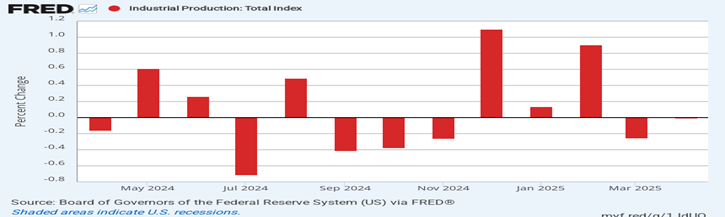
U.S. industrial production has stalled. Manufacturers are producing more than they can sell (higher input vs. output/demand). Unable to export the excess production, the Federal Reserve’s measure of industrial production showed seven months of zero or negative growth since last April.

What does that tell us? That manufacturing is no longer as important to our economy. We are now a mostly consumer-driven society that shops until we drop (and savings are exhausted), do lots of leisure things like travel and services that cater to us, such as healthcare, education, professional services (lawyers, doctors, engineers, etc.) construction, transportation and warehousing, and financial services.

But we also develop and export lots of software; information technologies, AI, ChatGPT and the like. This is all part of the service sector that really drives our economy. So, when President Trump says we need to bring back manufacturing, there’s not much manufacturing to bring back that would improve growth.

Also, we don’t have enough workers to fill the manufacturing jobs we have now. NyTimes’ David Brooks in an excellent Op-ed piece on our manufacturing history, said manufacturers can’t find enough workers today. There are almost 500,000 vacancies in manufacturing jobs. Trump is leading us down a blind path that only benefits him and Republicans, in other words.

This is while the service sector is still growing and will continue to grow even with more tariff threats if consumers will keep spending. The financial markets are more uncertain about future growth with higher tariffs because it means higher interest rates. We shouldn’t forget that former Fed Chair Alan Greenspan’s “irrational exuberance” speech warning that the financial markets were oversold, was four years before the Dot-com bubble burst and a recession ensued in 2000.

The Institute of Supply Management’s report on the service sector remains optimistic. “Economic activity in the services sector expanded for the 10th consecutive month in April, say the nation's purchasing and supply executives in the latest Services ISM® Report On Business®. The Services PMI® registered 51.6 percent, indicating expansion for the 56th time in 59 months since recovery from the coronavirus pandemic-induced recession began in June 2020.”

The take from this news is that Trump will make up any story to justify higher tariffs. He is thereby raising import taxes on the one hand for consumers and Main Street because we import so much, while cutting taxes for the wealthiest with the other hand via renewal of his tax cut bill that will cost more than $3trillion, according to government watchdog agencies.

Add the Medicaid and benefit cuts to the tariff costs, while firing those workers that run social security, Medicare; services that benefit all of us; and we can see the huge transfer of wealth to the oligarchs that Republicans’ budget deficits are engineering.

Harlan Green © 2025

Follow Harlan Green on Twitter: https://twitter.com/HarlanGreen

Tuesday, April 27, 2021

A Better Use of Economic Growth

 Popular Economics Weekly

AtlantaFed

The Atlanta Federal Reserve Bank puts out a GDP now forecast of upcoming monthly GDP growth, and its latest estimate puts growth at the highest level since the 1980s, as we recover from the COVID-19 pandemic.

“The GDPNow model estimate for real GDP growth (seasonally adjusted annual rate) in the first quarter of 2021 is 8.3 percent on April 16, unchanged from April 15 after rounding,” said the Atlanta Fed. “After this morning's housing starts report (last week) from the U.S. Census Bureau, the nowcast of first-quarter real residential investment growth decreased from 10.6 percent to 10.2 percent."

However, new-home sales’ figures Friday showed even faster residential investment growth ahead, reports the US Census Bureau

Sales of new single-family houses in March 2021 were at a seasonally adjusted annual rate of 1,021,000, according to estimates released jointly today by the U.S. Census Bureau and the Department of Housing and Urban Development. This is 20.7 percent (±23.7 percent) above the revised February rate of 846,000 and is 66.8 percent (±36.7 percent) above the March 2020 estimate of 612,000.

The problem is not finding more ways to boost GDP growth, per se, but how it will be utilized. Since the 1980s, a growing percentage of the Gross National Income derived from GDP growth has gone to ‘rentiers’, i.e., people that receive  income from their assets rather than wages.

That is in part due to the huge decline in personal and corporate taxation of said wealth that has allowed rentiers to accumulate more private wealth, rather than investing in productive enterprises.

What creates GDP? The aggregate, or effective demand of all goods and services produced domestically. Economists have broken it into four components, of which consumer spending is the largest portion. The rest is made up of net exports, government expenditures, and investments.

Consumers spend on private consumer goods, so it is up to investment and government spending to build for future growth. That has not happened because corporations haven’t been maintaining a decent level of capital expenditures and government investments in infrastructure, education, R&D, and our social safety net that would keep workers healthy enough to be more productive has been cut sharply since the 1970s.

GDP growth has been paying too little for future generations since then, in other words, so taxing some of the wealth accumulated since 1980 is needed to pay it forward.

President Biden’s $2.3 trillion American Jobs Plan is meant to correct the underinvestment in the public good. He is calling for more than $1 trillion to be invested just in the various components of infrastructure, including better roads, bridges, public transportation, expanding broadband and electric grids, as well as electric vehicle use.

He is also calling for more spending on health care and the national housing shortage—some $213 billion to “build, preserve and retrofit more than 2 million homes and commercial buildings to address the affordable housing crisis,” $100 billion to modernize public schools and early learning facilities, and $180 billion in research and development of future technologies, and more.

This supports much more than infrastructure, as it fulfills every person’s basic need of food, shelter, and security.

The initial first quarter GDP estimate comes out Thursday, and consensus predictions are for 7 percent growth. Whatever it will be, it is important that it be used in productive ways, and the just-passed American Recovery Act and upcoming American Jobs Plan begin that process of utilizing America’s economic growth to support a better future for all Americans.

Harlan Green © 2021

Follow Harlan Green on Twitter: https://twitter.com/HarlanGreen

Friday, August 30, 2019

Q2 GDP Growth Slowing—What Else?

Popular Economics Weekly


The 2nd estimate of second quarter Real Gross Domestic Growth slowed to 2 percent, from 3.1 percent in January. It looks like growth is slowing to the average rate that has prevailed since the end of the Great Recession.

Consumers are reacting to the slowdown in the U. of Michigan sentiment survey of 600 telephone respondents, which was well below expectations and the lowest reading since October 2016. The expectations component also fell more than 10 points in the month with the current conditions component down more than 5 points.
“The report cites consumer apprehension over rising tariffs which, for this phone sample, were spontaneously mentioned by 1/3 of the respondents” said Econoday.
There have been other signs of slower growth as well. The Economist reports US Steel announced earlier in August it would lay off 200 workers in Michigan. Sales of camper vans dropped by 23 percent in the 12 months ending in July, threatening the livelihoods of thousands of workers in Indiana, where many are made. Factory workers are not the only ones on edge. Lowes, a retailer, recently said it would slash thousands of jobs. Halliburton, an oil-services firm, is cutting too.

Why the slowdown now? Consumers are still spending (brown line), as the BEA’s Disposal Personal Income graph shows—but it’s a lot more than they are earning (blue line).


This means they could stop spending if any more shocks occur, such as the possibility that China might wait until after the 2020 election to make a deal.  Exports and residential investments also declined from Q1.


Manufacturing is the mainstay of exports. Employment in durable-goods manufacturing peaked in June 2006, about a year and a half before the onset of recession. This year has been another brutal one for industry. An index of purchasing managers’ activity registered a decline in August.

Since last December manufacturing output has fallen by 1.5 percent. Hours worked—considered to be a leading economic indicator—are declining. Some of this is also linked to President Donald Trump’s trade wars, which have hurt manufacturers worldwide.

Last Friday China said it would  increase existing tariffs from 5 percent to 10 percent on more than 5,000 U.S. products, including soybeans, oil and aircraft. A 25 percent duty on American-made cars would also be reinstituted. The value of these products is estimated by the Chinese Commerce Ministry to total around $75 billion.

Trump responded after financial markets closed by saying he would raise current U.S. tariffs. A 10 percent duty on $300 billion in Chinese goods will be raised to 15 percent in September while a 25 percent tariff on $250 billion in imports would be increased to 30 percent in October.

And on Wednesday, MarketWatch’s Robert Schroeder reported a coalition of 161 manufacturers, farmers, retailers, natural gas and oil companies as well as other business groups, as well as other business groups, sent a letter asking Trump to postpone tariff rate increases on Chinese goods slated to take effect this year.

Does that look like they are near to making a deal?

Harlan Green © 2019

Follow Harlan Green on Twitter: https://twitter.com/HarlanGreen

Saturday, June 2, 2018

Strong May Employment, But Uncertain Future

Popular Economics Weekly


The unemployment rate edged down to 3.8 percent in May, and the number of unemployed persons declined to 6.1 million, reported the Bureau of Labor Statistics this morning. Over the year, the unemployment rate was down by 0.5 percentage point, and the number of unemployed persons declined by 772,000.

This shows a strong economy, but not for long if the Trump administration’s trade war lasts. Because it means our trading partners will retaliate with their own tariffs, boosting costs and lowering the demand for US products.

The manufacturing and construction sectors added 18,000 and 25,000 jobs respectively in May yet have complained they can’t find enough skilled workers. Hourly pay rose by 8 cents, or 0.3 percent to $28.92 an hour in May. As a result, the 12-month increase in wages rose to 2.7 percent after holding at 2.6 percent for three months in a row.

Wages are barely rising, which makes the Fed happy, as wages make up two-thirds of products costs. It means there is very little inflation on the horizon, which should keep interest rates at the low end; another boost to continued growth. But this also means in fact there are still a lot of unemployed workers that are available for work, if wages continue to rise enough that would draw them back into the workforce.

For instance, the number of persons employed part time for economic reasons (sometimes referred to as involuntary part-time workers) was essentially unchanged at 4.9 million in May. And the number of persons marginally attached to the labor force, at 1.5 million in May, was little different from a year earlier. These individuals were not in the labor force, wanted and were available for work, and had looked for a job sometime in the prior 12 months. They were not counted as unemployed because they had not searched for work in the 4 weeks preceding the survey.

This jobs picture means we are near full employment, but it looks like the Trump administration’s new trade war with our allies could mean full employment may not last. Canada, Mexico and the European Union have already announced they will retaliate with tariffs of their own on US products.

It means a substantial rise in product costs, and reduction in the demand for American products, as I said. It could therefore cancel out all the benefits to businesses of the recent tax cuts, since Canadian Prime Minister Justin Trudeau said the fallout from US moves would be “more significant” than it realizes. Ottawa will impose billions of dollars of tariffs on steel, aluminum and a wide range of other U.S. goods, including some food and agricultural products.

The EU said it is also planning to hit back with billions of dollars of levies on U.S. exports which could go into effect staring June 20 and launch a case against American measures at the World Trade Organization on Friday. “This is protectionism, pure and simple,” the EU’s top executive, European Commission President Jean-Claude Juncker, said Thursday. “We will defend the Union’s interests, in full compliance with international trade law.”

If the US isn’t bluffing and carries out these tariff hikes on our closest allies—which would endanger rather than increase our national security—then look for a slowing economy and rising unemployment ahead.

Harlan Green © 2018

Follow Harlan Green on Twitter: https://twitter.com/HarlanGreen

Monday, April 2, 2018

Q4 GDP Growth Up 2.9% Q/Q

Financial FAQs


Fourth quarter Gross Domestic Product, the total value of the country's production of purchases of domestically-produced goods and services by individuals, businesses, foreigners and government entities, rose to 2.9 percent from 2.6 percent in its third and final revision by the Commerce Department, finishing off 2017 with a bang and raising total 2017 GDP growth to 2.6 percent.

It was mostly consumer spending, up 4 percent, but personal incomes are rising faster as well, which will boost spending and continued good growth in 2018. This is because Real Disposable Income (less inflation and taxes) rose 0.4 percent pushing the annual increase to more than 2 percent.


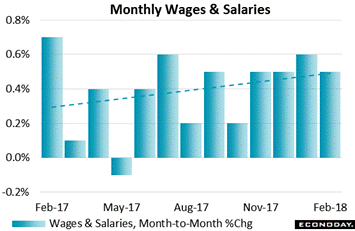
“The strongest news in the report comes from the wages & salaries component of personal income which posted a fourth straight sharp gain,” reports Econoday, “at 0.5 percent. This helped total income which rose 0.4 percent for a third straight month and also helped the savings rate which rose 2 tenths to a still modest 3.4 percent.”

This measure includes all forms of compensation including employer contributions to medical insurance and pensions and has been showing more life than average hourly earnings, which is part of the monthly employment report and is the most closely watched of all wage measures.

However, it did nothing to inflation, as the GDP’s price index rose 2.3 percent Q/Q, but is up just 1.8 percent annually, as is the Fed’s preferred Personal Consumption (PCE) index. So still no inflation, even though wage and salaries are beginning to surge, and labor costs account for 2/3rds of product costs.

The Fed has said it will probably raise their interest rate twice more this year, which will put the Prime Rate at 5.25 percent, raising credit card rates and crimping consumer borrowing.

But with wages soaring, that may not slow down consumer spending or the growing foreign trade deficit. The goods deficit from countries such as China is now $75B/per in February and growing. So why is this administration pushing for trade tariffs, which is already instigating a trade war, and making those same goods more expensive to Americans?

No one believes this will reduce the trade deficit, either, as the manufactured goods we export will become more expensive, as well, reducing the demand for exports.

Harlan Green © 2018

Follow Harlan Green on Twitter: https://twitter.com/HarlanGreen