Showing posts with label ISM manufacturing survey. Show all posts

Wednesday, June 4, 2025

More Signs of Slow Growth

 Financial FAQs

“The manufacturing economy continues to struggle,” Susan Spence of ISM said. “It will continue to struggle” due to all the trade uncertainty.

“The administration’s tariffs alone have created supply chain disruptions rivaling that of Covid-19,” an executive at an electronics company told ISM.

The only number in the Institute of Supply Management’s (ISM) manufacturing survey that rose were prices due to a shortage of commodities—i.e., supply. Every other component of the supply managers’ survey was contracting—such as new orders, production, and employment.

Manufacturing employment had been declining since 1980; from 19,000,000 jobs to 12,765,000 jobs in April per the FRED graph out of a total 159 million jobs.

It’s the first sector of the U.S. economy that is showing stagflation—prices are up while production is stagnating. Hence the above remarks from supply managers and Susan Spence, Chair of the ISM Survey.

The services index of the Institute for Supply Management also contracted for the first time in a year. It fell to 49.9% in May from 51.6% in April, the ISM said Wednesday. Any number below 50% signals contraction.

Economic activity in the services sector contracted in May, the first time since June 2024, say the nation's purchasing and supply executives in the latest Services ISM® Report On Business®. The Services PMI® indicated slight contraction at 49.9 percent, below the 50-percent breakeven point for only the fourth time in 60 months since recovery from the coronavirus pandemic-induced recession began in June 2020.

The Labor Department’s JOLTS report shows that the service sector is still adding jobs. Job openings rose in April for white-collar, retail, healthcare, and entertainment and recreation roles. But job listings fell at hotels and restaurants, whose business has been hurt by a decline in tourism. Some foreign visitors have put off trips to the U.S. because of the trade wars and other White House policies.

Another disheartening jobs report came out today. ADP, a private payroll processor, reported that privately run businesses created just 37,000 new jobs in May — the smallest increase in more than two years — as the most damaging global trade wars since the Great Depression spurred many firms to put a pause on hiring.

The real problem is that employers won’t begin to hire again until the trade wars are resolved, and President Trump says he isn’t letting up on the tariff wars because it will create more manufacturing jobs. But that will take years, and automation has replaced most of the manufacturing jobs (which no longer pay as well) before we see any signs of a manufacturing resurgence.

Economists such as Paul Krugman, who won a Nobel Prize for his pioneering research in foreign trade, remarking on the sudden 50 percent increase in steel tariffs, believes the damage  to the U.S. Economy from such draconian tariff rates (i.e., import taxes) is already done.

So steel tariffs don’t make any policy sense. But then neither does anything else in Trump’s trade war — and the nonsensical nature of the whole enterprise is why I don’t think he’ll find an off-ramp. After all, it’s obvious that the increased steel tariff wasn’t a considered policy, it was a temper tantrum after the Court of International Trade ruled against his other tariffs.

Is the contraction of both the service and manufacturing sectors the first sign that the U.S. economy is already in recession? This Friday’s ‘official’ U.S. Labor Department unemployment report will tell us more.

Harlan Green © 2025

Follow Harlan on Twitter: https://twitter.com/HarlanGreen

Monday, May 26, 2025

Manufacturing Not the Problem

 Popular Economics Weekly

“In April, U.S. manufacturing activity slipped marginally further into contraction after expanding only marginally in February. Demand and output weakened while input strengthened further, conditions that are not considered positive for economic growth.” ISM Manufacturing

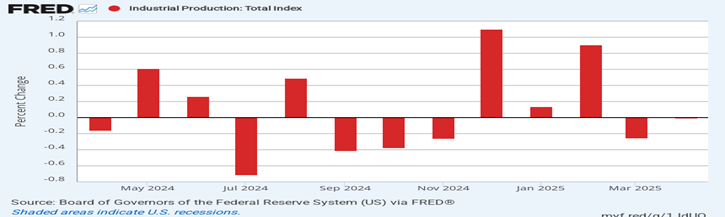
U.S. industrial production has stalled. Manufacturers are producing more than they can sell (higher input vs. output/demand). Unable to export the excess production, the Federal Reserve’s measure of industrial production showed seven months of zero or negative growth since last April.

What does that tell us? That manufacturing is no longer as important to our economy. We are now a mostly consumer-driven society that shops until we drop (and savings are exhausted), do lots of leisure things like travel and services that cater to us, such as healthcare, education, professional services (lawyers, doctors, engineers, etc.) construction, transportation and warehousing, and financial services.

But we also develop and export lots of software; information technologies, AI, ChatGPT and the like. This is all part of the service sector that really drives our economy. So, when President Trump says we need to bring back manufacturing, there’s not much manufacturing to bring back that would improve growth.

Also, we don’t have enough workers to fill the manufacturing jobs we have now. NyTimes’ David Brooks in an excellent Op-ed piece on our manufacturing history, said manufacturers can’t find enough workers today. There are almost 500,000 vacancies in manufacturing jobs. Trump is leading us down a blind path that only benefits him and Republicans, in other words.

This is while the service sector is still growing and will continue to grow even with more tariff threats if consumers will keep spending. The financial markets are more uncertain about future growth with higher tariffs because it means higher interest rates. We shouldn’t forget that former Fed Chair Alan Greenspan’s “irrational exuberance” speech warning that the financial markets were oversold, was four years before the Dot-com bubble burst and a recession ensued in 2000.

The Institute of Supply Management’s report on the service sector remains optimistic. “Economic activity in the services sector expanded for the 10th consecutive month in April, say the nation's purchasing and supply executives in the latest Services ISM® Report On Business®. The Services PMI® registered 51.6 percent, indicating expansion for the 56th time in 59 months since recovery from the coronavirus pandemic-induced recession began in June 2020.”

The take from this news is that Trump will make up any story to justify higher tariffs. He is thereby raising import taxes on the one hand for consumers and Main Street because we import so much, while cutting taxes for the wealthiest with the other hand via renewal of his tax cut bill that will cost more than $3trillion, according to government watchdog agencies.

Add the Medicaid and benefit cuts to the tariff costs, while firing those workers that run social security, Medicare; services that benefit all of us; and we can see the huge transfer of wealth to the oligarchs that Republicans’ budget deficits are engineering.

Harlan Green © 2025

Follow Harlan Green on Twitter: https://twitter.com/HarlanGreen

Friday, January 5, 2024

Still Fully Employed!

 Popular Economics Weekly

Ho hum, The U.S. economy was still fully employed in December. How boring! The St. Louis Fed (FRED) graph below shows the American economy has been at full employment since December 2021 when the unemployment rate first sank below 4 percent (to 3.9 percent).

And much of the hiring has been at state and local government levels because local governments are finally recovering from the COVID pandemic. That is the surest indicator of the beginning of a new uptick in the business cycle.

FREDunemployment

“Total nonfarm payroll employment increased by 216,000 in December, and the unemployment rate was unchanged at 3.7 percent, the U.S. Bureau of Labor Statistics reported today. Employment continued to trend up in government, health care, social assistance, and construction, while transportation and warehousing lost jobs.”

Average hourly wages of nonfarm private employees rose from 4.0 to 4.1 percent annually.

More good news is that factory orders have picked up, according to the Commerce Department, with new orders for U.S.-made goods increasing more than expected in November amid a surge in demand for civilian aircraft, government data showed on Friday.

Factory orders rose 2.6 percent after declining by 3.4 percent in October, the Commerce Department's Census Bureau said. Orders climbed 0.7 percent on a year-on-year basis in November. And manufacturing, which accounts for 10.3 percent of the economy, is still being constrained by high interest rates. It should therefore pick up even more this year as interest rates decline further.

This is what is called a ‘soft landing’, I said when the unemployment rate dropped back to 3.7 percent in November. Government agencies at all levels added 52,000 new jobs in December - the biggest of any industry - to cap off a record year of hiring (i.e., total of 2.7 million new jobs in 2023), says MarketWatch’s Jeffry Bartash. “Altogether, government employment rose by 672,000 in 2023 and accounted for one-quarter of all new U.S. jobs created.”

So, what’s not to like about this jobs report? Maybe the Fed may now change its mind and not bring down interest rates so quickly, which could happen beginning this March? The evidence is becoming overwhelming that inflation is continuing to rapidly fall. Maybe Powell, et. al., may begin to worry that prices could plunge even more, which isn’t a good sign, since profits then begin to decline, a precursor to a recession.

I believe all the government hiring shows something else—a full blown recovery leading to a new business cycle and maybe what I’ve been calling a ‘Roaring Twenty-Twenties’. Such a ‘roaring’ recovery happened once before, a century ago at the end of the last pandemic that was caused by the Spanish Flu.

Then again, maybe a more boring economic recovery is in the works, with steady employment, wages continuing to rise more than inflation, and a majority of consumers admitting they are happy. Maybe a boring economy is good!

Harlan Green © 2023

Follow Harlan Green on Twitter: https://twitter.com/HarlanGreen
Wednesday, July 26, 2023

What Is Bidenomics?

 The Mortgage Corner

The best way to describe ‘Bidenomics’ now being touted by a growing consensus of economists is best explained in the recent resurgence of construction spending, as portrayed in the FRED graph.

FREDconstructionspend

Nobel Laureate Paul Krugman, among others, has been touting the strength of the post-pandemic economic recovery, which is being called ‘Bidenomics’ in a play on words to compare it to Reaganomics, the 1980s recovery from the 1970’s era of stagflation and double-digit inflation.

“The economy’s resilience in the face of rate hikes suggests that overall demand has been stronger than anyone expected — possibly in part because Biden administration policies appear to have unleashed a huge wave of manufacturing investment,” said Krugman in a NYTimes Op-ed.

The big difference between the two eras is government’s role. President Reagan decreed that government was the problem, so it financed its recovery with tax cuts that inflated the first substantial federal debt since World War Two.

Bidenomics is being financed with tax receipts, private investment, and some increased taxes, but without tax cuts. So, it must pay for itself, and government-funded programs are providing the incentives.

President Joe Biden’s Infrastructure Investment and Jobs Act has become a part of the domestic economy, “driving a boom in large-scale infrastructure,” wrote Ellen Zentner, chief U.S. economist for Morgan Stanley, in a research note out last week cited by MarketWatch.

As a result, Morgan Stanley now projects 1.9 percent economic expansion in the first half of this year. That’s nearly four times the bank’s previous 0.5 percent forecast for growth in gross domestic product in the first half of 2023.

Some $1 trillion in infrastructure spending signed into law in 2021 marked an early legislative win for a president handed only a slim majority in Congress upon his election over then-incumbent Republican Donald Trump in November 2020.

It was followed up by another legislative banner for Biden: the Inflation Reduction Act, a climate-change- and healthcare-focused spending bill signed into law about a year ago. Many of the incentives in the laws are tied to domestic manufacturing and a reason manufacturing activity is beginning to expand again after a period of contraction, per the S&P U.S. manufacturing-sector index that rose to 49 from 46.3 in July, but has been negative for months.

Tomorrow the first estimate of second quarter GDP growth will be released by the US Bureau of Economic Research (BEA). The Atlanta Fed’s latest GDPNow estimate of second quarter GDP growth by Blue Chip economists is 2.4 percent.

Construction spending in manufacturing is soaring, up 76 percent YoY and helping to boost employment, traditionally with higher-paying jobs. So Bidenomics is a win-win solution for both continued economic growth and keeping workers fully employed.

Harlan Green © 2023

Follow Harlan Green on Twitter: https://twitter.com/HarlanGreen

Thursday, November 4, 2021

Manufacturing, Service Sector Growth Prolong Recovery

 Financial FAQs

 FREDmanufacturing

U.S. manufacturing and service sector activity continued to climb, despite the price hikes and supply bottlenecks. And we are just at the beginning of the holiday shopping season. Both economic sectors per the ISM supply managers’ indexes show a continuing red-hot demand for goods and services.

Inflation worriers can worry less, as production speeds up. Manufacturing output alone is up 14.8 percent in the second quarter YoY (see FRED graph), reducing price pressures. Eventually resolving supply-chain issues of clogged ports and container shipments will cause supplies to catch up to the demand for goods.

Timothy R. Fiore, ISM Manufacturing Chair, said “Business Survey Committee panelists reported that their companies and suppliers continue to deal with an unprecedented number of hurdles to meet increasing demand. All segments of the manufacturing economy are impacted by record-long raw materials lead times, continued shortages of critical materials, rising commodities prices and difficulties in transporting products. Global pandemic-related issues — worker absenteeism, short-term shutdowns due to parts shortages, difficulties in filling open positions and overseas supply chain problems — continue to limit manufacturing growth potential.”

The ISM services index measuring economic activity in industries such as Retail Trade; Transportation & Warehousing; Real Estate, Rental & Leasing; Arts, Entertainment & Recreation; jumped to an all-time high of nearly 67 in October, the Institute for Supply Management said Wednesday. The Business Activity and New Orders indexes reached 69.8 percent.

This tells us again that retail sales making up some 50 percent of consumer spending will continue strong in the holiday shopping season.

“In October, strong growth continued for the services sector, which has expanded for all but two of the last 141 months,” said ISM chair Anthony Nieves in a statement. “However, ongoing challenges — including supply chain disruptions and shortages of labor and materials — are constraining capacity and impacting overall business conditions.”

Though the huge obstacles to supply are causing some uncertainty, any figure above the 50 percent ISM survey breakeven point shows expansion. This is a sign that businesses are just beginning the replacement cycle of plants and equipment, rather than any imminent slowdown of activity caused by the bottlenecks and labor shortages.

As a side note, the number of Americans who applied for unemployment benefits in late October fell to yet another pandemic low in the latest week, reflecting an urgent need by companies to hold onto to current employees and find new ones. New jobless benefit claims dropped by 14,000 to 269,000 in the seven days ended Oct. 30, the government said Thursday.

Some five million have not returned to work that were employed before the pandemic and there are 10 million job openings, so it’s not yet possible to know when and if the current labor shortage will continue to put a drag on growth.

But, in a way, this might cool demand enough that economic growth doesn’t overheat and bring on another asset bubble, and maybe tame the inflation tiger as well.

Harlan Green © 2021

Follow Harlan Green on Twitter: https://twitter.com/HarlanGreen

Monday, October 4, 2021

U.S. Manufacturing Surging

 Financial FAQs


FREDmanuoutput

Growth in the U.S. manufacturing sector is exploding, according to the Institute for Supply Managers Report on Business. Output is up 17 percent in Q2 2021 YoY (per FRED graph). It is a  sign of good economic growth for the rest of this year, in spite of supply shortages and higher prices for raw materials.

Reporting growth in September were 16 of the 17 manufacturing industries. The top seven — in the following order — were: Furniture & Related Products; Petroleum & Coal Products; Machinery; Electrical Equipment, Appliances & Components; Computer & Electronic Products; and Chemical Products.

“The orders index was unchanged at the prior month’s very high level of 66.7 and the supplier delivery index rebounded by four points to 73.4.  The overall result was a 1.2-point increase to 61.1.  Any number over 50 percent indicates that a majority of those surveyed saw increases, and reaching 60 for any length of time is highly unusual,” according to the ISM survey announcement.

“There have been 15 ISM composite index readings of 60 or more in the past thirty years.  Seven of them have come in the past ten months,” said Reuters. This is in spite of the supply-chain delays and soaring product prices. The ISM Prices Index registered 81.2 percent. In September, 17 of 18 industries reported paying increased prices for raw materials.

Reuters

Even better news is that consumer spending is holding up, which powers some two-thirds of economic activity. This may be because consumers are paying less attention to the pandemic as the infection rate falls and the third Pfizer booster shot becomes available.

This is while Consumer spending grew at a robust 12.0 percent rate in the April-June quarter. The Commerce Department also said construction spending increased 8.9 percent on a year-on-year basis in August. Separately, the University of Michigan's Consumer Sentiment Index rose to a final reading of 72.8 in September from 70.3 in August.

Another sign of robust future growth (as shown in the Reuters graph) is that Disposable income was $2 trillion higher than Personal outlays--$18 billion vs. $16 billion, respectively—which is why the personal savings rate is holding at a high 9.4 percent.

And the NY Times just reported drug maker Merck announced Friday that its pill to treat Covid-19 was shown in a key clinical trial to halve the risk of hospitalization or death when given to high-risk people early in their infections. It probably won’t be available until late next year, however.

The supply-chain delays and healthy consumer pocketbooks show there is a very strong demand for goods and services that should last, even with the ongoing uncertainty over the coronavirus pandemic.

Now let us see what congress will do with the Biden administration proposals for infrastructure and social investments, no matter the final Dollar amount. If passed, I see a very prosperous decade for Americans.

Harlan Green © 2021

Follow Harlan Green on Twitter: https://twitter.com/HarlanGreen

Saturday, April 3, 2021

March Employment Augers Roaring 2020's

Popular Economics Weekly

MarketWatch.com

It may be difficult for the naysayers that believe too much aid is going into social programs to find fault with the March unemployment report that added 916,000 new nonfarm payroll jobs. It looks like March economic data augers a recovery that may lead to a decade of robust growth in the overall economy.

Companies are already hiring en masse, in spite of a winter that froze Texas and the record floods and tornadoes that have devastated much of the south.

Almost all business sectors are hiring, including a huge jump in the U.S. ISM’s Manufacturing Index to a 38-year high of 64.7, which means some 65 percent of manufacturing businesses surveyed were expanding.

Much of the hiring has come because happy consumers with an additional $1400 checks in their pockets are dining out and traveling more, but also because the housing market is booming—prompting 110,000 new construction hires in March.

The 916,000 new payroll jobs are just the beginning of this hiring boom that must bring back 10 million jobs to return to pre-pandemic levels. That is why Biden’s $3 trillion infrastructure spending will be needed as well.

So thank goodness for the $5 trillion in recovery aid already raised by congress that is encouraging even restaurants and other leisure servicers to hire 280,000 new workers, Education and Health 101,000, and Government 136,000 workers that is just the beginning of what is needed to make this decade this into a roaring 2020's decade.

The official unemployment rate, meanwhile, slipped to 6 percent from 6.2 percent, the Labor Department said Friday. Yet the official rate doesn’t capture nearly 4 million people who lost their jobs last year and weren’t counted in the numbers because they left the labor force.

It is also why Consumer confidence surged in March to a one-year high as more Americans were vaccinated and states began to open up for business. The index of consumer confidence shot up to 109.7 this month from a revised 90.4 in February, the Conference Board said Tuesday.

Confidence may be rising because some 3 million vaccines now administered per day may have 70 percent of American adults vaccinated by July, say the experts.

But new variants of COVID-19 are beginning to pop up, which has epidemiologists worried because it’s causing a plateauing of the infection rates at an unacceptably high level, according to the CDC.

According to the CDC, 153.6 million doses have been administered. 21.7 percent of the population over 18 is fully vaccinated, and 38.4 percent of the population over 18 has had at least one dose (99.6 million people have had at least one dose).

COVID.CDC.gov

Infection rates have plateaued because too many variants Of COVID-19 are popping up in some states. Winning the race between the spreading variants and administering enough vaccinations to stop their spread is the key to a robust recovery.

“I think a package that consists of investments in people, investments in infrastructure, will help to create good jobs in the American economy,” testified Treasury Secretary Janet Yellen in congressional hearings last week, “and changes in the tax structure will help to pay for those programs.”

Yellen and Fed Chair Jerome Powell said there was no problem with any inflationary bulges that might occur with so much spending because it was spending that would boost productivity as well as employment, generating even more growth.

Harlan Green © 2021

Follow Harlan Green on Twitter: https://twitter.com/HarlanGreen 

Wednesday, March 3, 2021

Manufacturing Boosts Economic Recovery

Financial FAQs


Manufacturing activity is roaring back. It joins construction and housing sales as the main drivers of economic growth at the moment. And we need all the drivers of economic growth to keep this economy in the black with what is coming--more climate unpredictability; the Texas deep-freeze being the latest example.

The ISM Manufacturing Index that measures purchasing managers’ sentiments is at 60.8 percent, a two-year high. This means almost 61 percent of manufacturing purchasing managers see increased activity ahead. Reuters lists its strengths:

  • The headline index hit a new post-pandemic high of 60.8, versus 58.7 last month and a forecast of 59.0.
  • The delivery lead-time index was the largest single contributor to the increase (up 3.8 points to 72.0), which is not entirely a positive development, but the orders and production indexes posted solid gains to 64.8 and 63.2 respectively.
  • The customers’ inventory slipped again to another new 11-year low of 32.5, which implies sustained demand in the months ahead.
  • Sentiment remained upbeat in the anecdotal portion of the survey. The survey managers reported that positive comments outnumbered cautious remarks by five to one this month, up from three to one in both December and January.

Fourth Quarter GDP growth was just revised upward to 4.1 percent from 4.0 percent in the second estimate, and economists are predicting even faster growth this year, but that is only if effects of the pandemic subside and there are no more major climate disasters like the Texas, Alabama, Arkansas, and Louisiana deep freeze in which millions lost power and clean drinking water.

The increase in fourth-quarter GDP reflected both the continued economic recovery from the sharp declines earlier in the year and the ongoing impact of the COVID-19 pandemic, including new restrictions and closures that took effect in some areas of the United States. The full economic effects of the COVID-19 pandemic cannot be quantified in the GDP estimate for the fourth quarter of 2020 because the impacts are generally embedded in source data and cannot be separately identified.

What is the main driver of all this activity? Higher Personal Income and Outlays, also per the U.S. Bureau of Economic Analysis (BEA).

Personal income increased 10.0 percent (monthly rate) while consumer spending increased 2.4 percent in January as pro,visions of the Coronavirus Response and Relief Supplemental Appropriations (CRRSA) Act enacted on December 27, 2020, began to take effect.

That is a huge jump in personal incomes, thanks to the $900 billion December pandemic aid package.  Much of it is being saved by consumers as they wait for the pandemic to subside before spending more on leisure services like entertainment and travel.

Consumer sentiment had edged downward in early February and is at a six-month low in the U. of Michigan sentiment survey, with the entire loss concentrated in the Expectation Index and among households with incomes below $75,000 (the income brackets targeted by the government cash payouts), as I said last weekHouseholds with incomes in the bottom third reported significant setbacks in their current finances, with fewer of these households mentioning recent income gains than anytime since 2014 (see the chart), said the U. Michigan survey.

That is the main reason the $1.9 trillion American Rescue Plan will soon pass with only minor changes, with or without Republican votes. It will go to those that need it the most to survive this once-in-a-century pandemic. It is extremely popular with a 76 percent approval rating per the latest Politico survey.

And why not with upcoming climate changes predicted to cause even more natural disasters?

Harlan Green © 2021

Follow Harlan Green on Twitter: https://twitter.com/HarlanGreen

Thursday, January 9, 2020

Why the Irrational Exuberance In Such A Dangerous Year?

Financial FAQs


We are now living in a much more dangerous world, because there is the possibility of war in the Middle East that is accompanying the various trade wars waged by the “Make America Great” White House.

In fact, it may have already begun with the “revenge” missile attacks by Iran against two Iraqi military bases housing U.S. personnel—though no casualties were reported. My wonder is that stocks are rallying on the news, with the DOW Jones up 200 points at this writing. Have stockholders forgotten the irrational exuberance reigning during Fed Chairman Greenspan’s tenure in the last decade?

It was such that Greenspan, et. al., raised the Fed’s interest rates 16 times (a total of 4 percent) over 2 years, which ultimately led to a busted housing bubble and the 2017-19 Great Recession that hasn’t been a full recovery for the majority of Americans.

In fact, median household incomes are still at 1970’s levels when inflation is subtracted, because most of the growth has been in stocks owned by just 50 percent of households, not with the wages and salaries of working folk. Hence the record income inequality that isn’t getting better, even at full employment.

And what if stocks plunge again as during the Great Recession that lost an estimated $9 trillion in value, with housing values also declining almost as much (the mainstay of middle class wealth)?
Greenspan had held rates too low for too long to finance the Bush/Cheney Iraq and Afghanistan occupations while cutting taxes at the same time, resulting in rising inflation and the largest federal budget deficit of the time.

In fact, we seem to be at the beginning of another period of irrational exuberance. The Fed dropped interest rates three times last year to boost slowing economic growth.

Manufacturing activity has been declining for the last five months, per Reuter’s Wrightson ISM Manufacturing Index graph above, mainly due to the various tariff hikes that bumped up prices on European and Chinese imports.

The service industries have been declining from a higher level of activity to the current 55 percent, reflected in the latest ISM non-manufacturing survey (also see graph, where a 50 percent result of those surveyed means breakeven growth).
“The upside surprise (of non-manufacturing survey) was almost entirely due to the subjective general business activity index, which rebounded by nearly six points to 57.2,” said Reuters.  “The employment and new orders indexes both fell.  The drop-off in employment was minimal (down 0.3 to 55.2), but the orders index fell off noticeably (down 2.2 points to 54.9, versus an annual average of 57.5). ”
Also important is the effect on world oil prices and economic growth in general, as I said in my last column, since the only reason the U.S. economy is continuing to grow is the very low inflation coupled with very low, recession-level interest rates. And that can’t be maintained if oil prices spike for some reason.


We are skating on thin ice, economically, as I said, even if oil prices and inflation don’t spike as they did during the early and mid-2000s. Oil may not be as important, but 39.7 million Americans still live at or below the U.S. poverty level, which is $21,300 for a family of three in 2017, per the U.S. Census Bureau, and median household incomes after inflation are not improving.

So the real question is why on earth did the U.S. kill Iran’s leading general and several Iraqi militia commanders at a time of recovery from the Great Recession, slowing worldwide growth, amid growing geopolitical uncertainty?

It has to be another form of irrational exuberance held by certain parties that believe this will make America Great Again, but without the friends and alliances that made America great until now.

Harlan Green © 2019

Follow Harlan Green on Twitter: https://twitter.com/HarlanGreen

Wednesday, December 4, 2019

Economic Growth...Watch Out--Part II

Popular Economics Weekly


It is obvious from the above graph that manufacturing activity is contracting, whereas the service industries continue to grow.  Exports that depend mostly on manufactured goods are therefore declining, while imports that depend on consumers are increasing. This also means slowing economic growth, since shrinking exports add less to GDP growth, while much larger import totals actually subtract from growth.
November was the fourth consecutive month of PMI® contraction, at a faster rate compared to the prior month, said Timothy R. Fiore, Chair of the Institute for Supply Management® (ISM®) Manufacturing Business Survey Committee. “Demand contracted, with the New Orders Index contracting faster, the Customers’ Inventories Index remaining at ‘too low’ levels and the Backlog of Orders Index contracting for the seventh straight month (and at a faster rate). The New Export Orders Index returned to contraction territory, likely contributing to the faster contraction of the New Orders Index.”
Manufacturing is in recession, in other words. The Philadelphia Inquirer reports that Kentucky’s steel industry has suffered because of steel and aluminum tariffs that have in fact slowed demand for its products. The result is steel prices have dropped by more than 40 percent since last summer.

“They have been hurt by tepid domestic demand for steel production amid a U.S. manufacturing recession and a global slowdown in economic growth, among other things,” reports the Inquirer.
Demand for steel in the U.S. grew 2.1 percent in 2018. But this year, a slowdown in American construction and automobile production helped diminish demand to just 1 percent, and it is projected to grow just 0.4 percent in 2020, the World Steel Association said this month, per the Inquirer.
And “Global trade remains the most significant cross-industry issue,” said ISM’s Fiore. “Among the six big industry sectors, Food, Beverage & Tobacco Products remains the strongest, while Fabricated Metal Products is the weakest. Overall, sentiment this month is neutral regarding near-term growth,” says Fiore.
Why the decline in manufacturing? It has to be the Trump administration’s trade policies, as manufacturing depends on foreign trade for many of its components, and foreign demand for many of its products.

This is while the Trump administration has just announced new tariffs on steel and aluminum products from Brazil and Argentina, further hurting global trade.

We also know overall Industrial Production is declining. Total industrial production was 1.1 percent lower in October than it was a year earlier. Capacity utilization for the industrial sector decreased 0.8 percentage point in October to 76.7 percent, a rate that is 3.1 percentage points below its long-run (1972–2018) average.

Last week’s revised Q3 GDP report was upped to 2.1 from 1.9 percent, with a slight increase in consumption and inventories. But it won’t help an even weaker Q4 GDP which is predicted to barely grow due to declining exports, as I said last week.


Manufacturing and consumer spending are really the two main components of economic growth. Stock prices of the largest steel companies have declined as much as 50 percent, also according to the Inquirer. And with steel prices down, their earnings have begun to decline.

So trade wars seem to be wreaking as much havoc to economic growth as other geopolitical concerns, such as growing civil unrest in the Middle East and Asia (Hong Kong). Continuing to wage trade wars in the name of national security is really becoming a danger to our national security, as well as economic growth.

Harlan Green © 2019

Follow Harlan Green on Twitter: https://twitter.com/HarlanGreen

Monday, October 7, 2019

How Much Has US Economy Slowed?

Financial FAQs


It’s a difficult question to answer. The ISM’s non-manufacturing Indexes still show growth, which is two-thirds of economic activity, but we are close to that edge of no growth at all.
The NMI® registered 52.6 percent, which is 3.8 percentage points below the August reading of 56.4 percent,” reports Anthony Nieves, Chair of the Institute for Supply Management. “This represents continued growth in the non-manufacturing sector, at a slower rate. The Non-Manufacturing Business Activity Index decreased to 55.2 percent, 6.3 percentage points lower than the August reading of 61.5 percent, reflecting growth for the 122nd consecutive month. The New Orders Index registered 53.7 percent; 6.6 percentage points lower than the reading of 60.3 percent in August. The Employment Index decreased 2.7 percentage points in September to 50.4 percent from the August reading of 53.1 percent. The respondents are mostly concerned about tariffs, labor resources and the direction of the economy,” said Nieves.
 We know the US economy is slowing, and the manufacturing activity is already contracting—the first of the four indicators that are used to call a recession—per the ISM’s Manufacturing Diffusion Index.


And last week’s Associated Data Processing survey came in at 135,000 jobs created, which is a slight downward trend. Just 8,000 jobs were added to the goods-producing sector, whereas 127,000 jobs were added to the service-providing sector, according to ADP.

ADP private payroll survey is usually within 50,000 of the US Bureau of Labor Statistics monthly survey coming out tomorrow, which isn’t much help in predicting the BLS unemployment report.
So there you have it. Employment growth has leveled off. i.e., is no longer increasing. Tomorrow’s report may also show more weakness in job creation.

The 10-year Treasury yield also slipped back into the 1.5 percent range, a sign that there is little demand for credit. Interest rates this low are also a sign of pessimism about future growth, which can be self-fulfilling.

I believe our economy will continue to barely grow, and so avoid an outright recession; at least until next year’s presidential election, when the trade wars might or might not be finally resolved. That seems to be the consensus.

Harlan Green © 2019

Follow Harlan Green on Twitter: https://twitter.com/HarlanGreen

Wednesday, May 8, 2019

Where Are the Workers?

Popular Economics Weekly

The number of job openings rose to 7.5 million on the last business day of March, the U.S. Bureau of Labor Statistics reported today. Over the month, hires and separations were little changed at 5.7 million and 5.4 million, respectively.

But the miniscule change in hires and separations doesn’t tell us the real employment story. This Calculated Risk graph shows the huge separation between the yellow line (Job openings) and blue line (Hires). It’s now almost 2 million.


The actual difference was because job openings surged 4.8 percent in the month to 7.488 million at the same time that hires fell 0.6 percent to 5.660 million, according to Econoday. “The gap between the two stands at a new record of 1.828 million, signifying a huge demand for workers that isn’t being met.”

Year-on-year, openings are up 8.6 percent vs. only a 0.6 percent rise for hires. The gap between total openings in March relative to the 6.211 million unemployed actively looking for a job in the month was 1.277 million.

This tells us how complex is the hiring process, since it’s becoming ever more difficult to match those looking for work with the advertised job openings. How can we fix the problem from the mismatch?

One hint is we know from last week’s unemployment report almost 500,000 fewer workers were available for work in the Household Survey, shrinking the labor pool, even though job hirings were up in the seasonally adjusted Establishment Survey that reports actual payroll numbers.

I believe those either leaving the workforce, or still looking for work, are waiting for better job prospects. Most do not want Amazon warehouse or Walmart jobs that pay barely above minimum wages.

The largest hires in the April unemployment report were all in the services sector. Professional services, education and health services led, with Leisure/Hospitality and construction hiring next—all in the lower-paying service sector.

Only 4,000 manufacturing jobs were created, according to the BLS, with the utilities and mining sector losing jobs.

Both the Institute of Supply Management’s (ISM) manufacturing and service sector activity surveys also declined in March, with manufacturing activity the weakest in 2 years. It was mainly due to the decline in new orders, possibly due to the trade uncertainty.

The 3.2 percent increase in the initial Q1 GDP growth estimate was a pleasant surprise, as I said last week, but it was largely because spending by local governments picked up due to the partial federal government shutdown and a “turnaround in investment, most notably in construction of highways and streets,” said the BEA. 

Local and state governments may have been waiting to see if the Trump administration would chip in to boost needed infrastructure upgrades, and since that didn’t happen states decided to implement the needed projects.

The buildup in unsold inventories, and fewer imports also increased GDP numbers. That’s because import prices are rising as the recent tariff increases are being passed on to the consumer, contrary to what administration officials are saying.

And rising prices will put a cap on growth, as well as future hiring. So we are waiting to see if more are willing to work, or are still waiting for the right job so they can afford to pay for those higher prices.

Harlan Green © 2019

Follow Harlan Green on Twitter: https://twitter.com/HarlanGreen

Wednesday, March 6, 2019

Will Service Sector Boom Reduce Deficits?

Popular Economics Weekly


All 18 non-manufacturing industries reported growth in February, according to the ISM’s non-manufacturing index, which gives a monthly overview of service sector activity. This is huge and says the service sector that makes up two-thirds of US business activity will continue to power growth this year.

In fact, a growing US service sector is keeping the trade and budget deficits from worsening at a time when fiscal policy (the tax cuts) and trade policy (the tariffs) are slowing economic growth in 2019.

What is the service sector economy? It’s the financial services, trade, transportation, construction, education and health industries, for starters. It has become the dominant sector because most US consumers and businesses consume manufactured goods now made overseas. Hence the trade imbalance between imports and exports that Trump wants to ‘rebalance’ with his trade wars on allies and adversaries alike.

The trade wars are a dumb way to attempt to correct the imbalance of manufactured products, needless to say, because said ‘imbalance’ is offset by foreign investors eager to buy safe and secure US stocks and bonds. If the Trump administration and Republicans were really serious about rebalancing the trade imbalances, it would seek more trade alliances (such as the Trans-Pacific Partnership) and work to reduce the looming $1 trillion annual deficit, instead of passing the 2017 corporate tax cut.

The non-manufacturing sector’s growth rate rebounded after cooling off in January. Respondents said they are concerned about the uncertainty of tariffs, capacity constraints and employment resources; however, they remain mostly optimistic about overall business conditions and the economy.
“The NMI® registered 59.7 percent, which is 3 percentage points higher than the January reading of 56.7 percent,” said Anthony Nieves, Chair of the Institute for Supply Management Non-Manufacturing Business Survey Committee. “This represents continued growth in the non-manufacturing sector, at a faster rate. The Non-Manufacturing Business Activity Index increased to 64.7 percent, 5 percentage points higher than the January reading of 59.7 percent, reflecting growth for the 115th consecutive month, at a faster rate in February.”
Particularly robust was the New Orders Index that registered 65.2 percent, 7.5 percentage points higher than the reading of 57.7 percent in January. The Employment Index decreased 2.6 percentage points in February to 55.2 percent from the January reading of 57.8 percent.

What about the manufacturing sector that is made up of durable goods like machinery, computers and transportation; and non-durable goods such as furniture, chemicals and petroleum products? The ISM’s February manufacturing survey reported a 2.4-point drop to 54.2 in February that was above low estimates. There was also a 2.7-point drop in new orders, a 3.2-point drop for employment, and a 5.7-point slide for production.


The trade wars have to be part of the problem, since Trump has focused on tariffs for manufactured products only, whereas China is also stealing information technology. Hence the Hauwei networking ban that the US fears might have implanted Chinese spyware.
“Demand remains healthy at the beginning of 2019,” said one respondent. “However, growing concerns for what could be another round of tariffs in March are further escalating price increases of already constrained electronic components.”
The total US trade imbalance was minus $550B last year, with service sector trade showing a net trade surplus of around $250B, since we export much of our information technologies, and approximately $800B net deficit in manufactured goods that are more cheaply made overseas.
“So we can’t “win” a trade war,’ says Nobel economist Paul Krugman. “What we can do is start a cycle of tit-for-tat, and when it comes to trade, America — which accounts for 9 percent of world exports and 14 percent of world imports — is by no means a dominant superpower. A cycle of retaliation would shrink overall world trade, making the world as a whole, America very much included, poorer.”
Therefore it’s not such a good idea to expend too much of our energy in attempting to correct the manufacturing imbalance, when there are better ways to cure deficits that are of our own making.

Harlan Green © 2019
 
Follow Harlan Green on Twitter: https://twitter.com/HarlanGreen

Wednesday, February 6, 2019

Can U.S. Economy Weather Trade Wars?

Financial FAQs

Econoday.com

Why is manufacturing doing so well in the face of rising tariffs—in January when mid-winter business activity tends to slow? Consumers flush with cash from rising wages and full employment are powering higher domestic demand. Exports, on the other hand, have declined because of the rising costs of materials and parts, causing buyers to switch to exports from other countries that aren’t affected by the trade wars. Manufacturing exports had the slowest growth in two years.
The Institute of Supply Management reported that its January manufacturing index registered 56.6 percent, an increase of 2.3 percentage points from the December reading of 54.3 percent. The New Orders Index registered 58.2 percent, an increase of 6.9 percentage points from the December reading of 51.3 percent. The Production Index registered 60.5 percent, 6.4-percentage point increase compared to the December reading of 54.1 percent. The Employment Index registered 55.5 percent, a decrease of 0.5 percentage point from the December reading of 56 percent.”
Any number over 50 indicates that a majority of managers are reporting expanding business in the various sectors that the ISM Indexes measure. The question then is how long can consumers keep this up, while foreign demand for U.S. goods continues to decline? There is very little optimism that the tariff wars will subside soon, given that the revamped NAFTA Treaty has yet to pass Congress, and Democrats in particular not happy with Trump’s cosmetic tweaks that do little to change it.
Brookings’ analysis was that “After a year and a half of negotiations, the three parties are going to end up with a new trade deal that looks remarkably similar to the old NAFTA.”

The ISM’s Non-manufacturing Index for the service sector is also growing robustly, which means that most of the U.S. economy will continue steady growth; at least for the first half of this year and maybe longer if interest rates remain at their current lows.

Econoday.com
“The NMI® registered 56.7 percent, which is 1.3 percentage points lower than the December reading of 58 percent. This represents continued growth in the non-manufacturing sector, at a slower rate. The Non-Manufacturing Business Activity Index decreased to 59.7 percent, 1.5 percentage points lower than the December reading of 61.2 percent, reflecting growth for the 114th consecutive month, at a slower rate in January. The New Orders Index registered 57.7 percent, 5 percentage points lower than the reading of 62.7 percent in December. The Employment Index increased 1.2 percentage points in January to 57.8 percent from the December reading of 56.6 percent.”
The problem with the Trump administration’s bargaining style in levying punitive tariffs on exports from friend and foe, on top of the fact that appearances seem to be more important than substance, is that such bully tactics turn off foreign countries who have lots of choices doing business elsewhere than with the U.S.

This is already showing signs of affecting U.S. growth, since consumers cannot maintain their higher consumption (largely fueled by borrowing) forever. The BEA’s Q3 2018 GDP final growth estimate was 3.4 percent, down from Q2’s 4.2 percent. Fourth quarter’s initial GDP estimate has been held up by the government shutdown.

Why the slowdown? “The deceleration in real GDP growth in the third quarter primarily reflected a downturn in exports and decelerations in nonresidential fixed investment and in Personal Consumption Expenditures (i.e., consumer spending),” said the BEA. “Imports increased in the third quarter after decreasing in the second.”

A continuation of this picture could be a sign of further growth problems, if the trade wars aren’t resolved soon.

Harlan Green © 2019


Follow Harlan Green on Twitter: https://twitter.com/HarlanGreen

Monday, January 7, 2019

A Gangbusters December Employment Report

Popular Economics Weekly


Total nonfarm payroll employment increased by 312,000 in December, and the unemployment rate rose to 3.9 percent, reported the U.S. Bureau of Labor Statistics last Friday. Job gains occurred in health care, food services and drinking places, construction, manufacturing, and retail trade.

It looks like the U.S. economy isn’t slowing as much as feared, contrary to the pessimists that have been driving down stock prices, while driving up bond prices, so that the 10-year Treasury bond yield is now 2.65 percent, and conforming 30-year fixed mortgage rates are at 3.875 percent with a 1 point origination fee for the best credit holders.

Health-care providers hired 50,000 people, professional firms filled 43,000 positions, manufacturers added 32,000 jobs, construction firms’ payrolls rose by 32,000 and restaurants hired 41,000 additional workers.

The unemployment rate, meanwhile, rose to 3.9 percent from a 49-year low of 3.7 percent. The percentage of working-age Americans in the labor force climbed to a one-and-a-half-year high as more people looked for jobs. That is a good sign since it means people think more jobs are available.

Strong hiring has also given workers more bargaining power. The amount of money the average worker earns climbed 11 cents or 0.4 percent to $27.48 an hour last month.

Who says the housing market is dead, as well? These low interest rates will stimulate more borrowing and home buying. And Fed Chairman Jerome Powell said the Fed would be flexible about raising interest rates this year at a recent conference. “We will be patient as we watch to see how the economy evolves,” given the low inflation outlook, he said.

The employment report contradicted yesterday’s December ISM Manufacturing Index that showed a slowdown in manufacturing hiring, falling more than 5 points to a 54.1 level. This is the lowest showing for this index since November 2016. Especially new orders slowed by 10 points to a 51.1 level that is suddenly very close to breakeven 50. It means approximately half of the supply managers surveyed saw an order slowdown.

This is the lowest showing for new orders since August 2016. Weakness is entirely on the domestic side, says Econoday, as one of the few positives in December's data is a 6 tenth rise in new export orders to 52.8 which is respectable for this particular reading.


The real question is what will economic growth look like in 2019. It will depend largely on a favorable outcome of the trade talks, which means a lowering of the Trump tariffs that do little for American interests, or American consumers.

That’s because higher tariff fees get passed on to consumers, ultimately, which pushes up inflation, then Federal Reserve interest rates; which cuts into consumer spending. And we have to worry about the soaring federal deficits, which means new taxes will be enacted sometime down the road.
However, this doesn’t worry Nobelist Paul Krugman at the moment in a recent NYTimes Op-ed: “…there are things government should be spending money on even when jobs are plentiful—things like fixing our deteriorating infrastructure and helping children get education, healthcare and adequate nutrition. Such spending has big long-run payoff, even in purely monetary terms.”
The bottom line is money is cheap at the moment with the very low interest rates, so this isn’t the time to worry about budget deficits. It’s much more important to be investing public monies into future growth and productivity that could even prolong this business cycle, now in its tenth year of continuous growth.

Harlan Green © 2019

Follow Harlan Green on Twitter: https://twitter.com/HarlanGreen

Tuesday, October 10, 2017

A Poor Employment Report?

Popular Economics Weekly

What does it mean when 33,000 nonfarm payroll jobs were lost in September? Not much, when many of the losses came from the hurricanes that threw 1.5 million out of work, according to Marketwatch’s Jeff Bartash, and the rest of our economy is doing very well.

Wages jumped, also good news, but it was mainly because many of those lost jobs were in retail and restaurants which tend to pay the lowest incomes, hence the upward trend may be temporary.


The number of employed jumped by a huge 906,000 in the smaller household survey that determines the unemployment rate—in spite of the storms—while the number of job losses was smaller; at 331,000, hence the lower unemployment rate. So the rest of the U.S. is doing well.

And we now have a fast growing manufacturing sector that will grow even faster with the cleanup and rebuild from those disasters. Its growth is also helped by the cheaper dollar, which is boosting exports.

Econoday reports ISM's manufacturing index, already running well beyond strength in factory data out of Washington, is accelerating even further, to an index of 60.8 in September which is a 13-year best. Part of the gain in the index is tied to hurricanes and specifically deliveries times where slowing is translated as strength, as we said.

But it's more than that—maybe those higher exports are boosting GDP growth as well? Factory new orders rose 4.3 points in the month to 64.6 which is a 4-year high. And the hurricanes didn't slow down production which is at a very strong 62.2. Employment is a big standout in today's report, posting the first 60 score at 60.3 in 6-1/2 years.


The ‘other’ non-manufacturing service sector part of the economy is also growing robustly. The headline ISM non-manufacturing survey index jumped to 59.8 for the highest score in more than 3 years. New orders, that include strength for exports, jumped nearly 5 points to a robust 61.3 level that was last exceeded in April this year. Backlog orders jumped 2.5 points to 56.0 which helped employment rise 6 tenths to 56.8 with both these readings the strongest since May this year.

So the U.S. economy is firing on all cylinders, which is why the Fed is making louder noises re a December rate hike, in spite of nonexistent inflation. Why do so? Because it wants to gradually sell off its $4.5 billion hoard of government securities, which reverses the various QE programs that injected that much cash to boost growth.

So with less cash in circulation, money is no longer so cheap and market interest rates tend to rise. The Fed wants to be able to anticipate this trend.

But shouldn’t we be seeing more indications of higher growth than just one quarter of 3.1 percent GDP growth? That may happen if more federal funding than a measly $14.6 billion is available for Hurricane Harvey alone, when cleanup may cost $200 billion

Government-is-the-problem Texas Gov. Greg Abbott has changed his tune now that Texas is in need of federal funding. He said he thinks the state will need "far in excess" of $125 billion in federal relief dollars. Houston Rep. Sheila Jackson Lee called for a record-breaking $150 billion aid package on CNN recently.

Really, and who knows what Florida and Puerto Rico’s cleanup will cost? In fact, it will take such large amounts of federal spending to even sustain last quarter’s 3.1 percent growth rate, in my opinion.

Harlan Green © 2017

Follow Harlan Green on Twitter: https://twitter.com/HarlanGreen

Wednesday, August 30, 2017

Cheaper Dollar Will Help GDP Growth

Popular Economics Weekly

The U.S. Dollar foreign exchange value is falling due to a number of factors. And it's already showing benefits, as Q2 GDP growth was just revised upward to 3 percent, and economists predict third quarter growth will also approach 3 percent.

That's because a cheaper dollar boosts  the export of manufactured goods, as our goods will now be less expensive overseas, which adds to GDP growth. It will hurt imports, which become more expensive (even imported oil), but that’s a good thing because domestically produced consumer goods become cheaper, boosting domestic jobs.

The euro now costs $1.20, when it was almost 1:1 to the Dollar last fall. Is the Dollar decline due to the latest North Korean missile launch, or Hurricane Harvey? Time will tell, but the U.S. factory sector is now doing very well because of the cheaper dollar.


Durable goods orders of goods that last more than 3 years, such as autos and appliances, are booming since the Dollar’s decline and this will help GDP growth. The boost to exports is a plus for our balance of payments problem and the budget deficit.

Graph: Econoday

Consumer confidence to date isn’t being hurt by either North Korean saber rattling or the Charlotte riots, according to the Conference Board. The Conference Board Consumer Confidence Index®, which had increased in July, improved further in August. The Index now stands at 122.9 (1985=100), up from 120.0 in July, said their press release. The Present Situation Index increased from 145.4 to 151.2, while the Expectations Index rose marginally from 103.0 last month to 104.0.
“Consumer confidence increased in August following a moderate improvement in July,” said Lynn Franco, Director of Economic Indicators at The Conference Board. “Consumers’ more buoyant assessment of present-day conditions was the primary driver of the boost in confidence, with the Present Situation Index continuing to hover at a 16-year high (July 2001, 151.3). Consumers’ short-term expectations were relatively flat, though still optimistic, suggesting that they do not anticipate acceleration in the pace of economic activity in the months ahead.”
All in all, a continuation in the dollar’s decline will also be beneficial to manufacturing jobs, which tend to pay higher wages. And higher wages are needed to boost worker productivity and get us out of the slow growth syndrome the U.S. has been living through since the end of the Great Recession.

Harlan Green © 2017

Follow Harlan Green on Twitter: https://twitter.com/HarlanGreen

Saturday, May 6, 2017

April Employment Up, Q1 Consumer Spending Weak

Financial FAQs

Total nonfarm payroll employment increased by 211,000 in April, and the unemployment rate fell to 4.4 percent from 4.5 percent in March, reported the U.S. Bureau of Labor Statistics today. Job gains occurred in leisure and hospitality, health care and social assistance, financial activities, Business and Professional Services, and government.

Both the unemployment rate, at 4.4 percent, and the number of unemployed persons, at 7.1 million, changed little in April, says the BLS. But over the year the unemployment rate has declined by 0.6 percentage point, and the number of unemployed has fallen by 854,000.


That is progress, and probably why the Federal Reserve will raise rates again in June. It said in its FOMC press release of this week’s meeting that it left a key borrowing rate unchanged and dismissed a weak first quarter GDP growth as temporary, meaning it is still on track to raise interest rates at a gradual pace.
“The [Federal Open Market Committee] views the slowing in growth during the first quarter as likely to be transitory,” the statement said. Job gains were described as “solid,” as were the fundamentals underpinning the continued growth in consumer spending. Business fixed investment “firmed,” the central bank noted.
The number of persons employed part time for economic reasons (sometimes referred to as involuntary part-time workers) declined by 281,000 to 5.3 million in April. These individuals, who would have preferred full-time employment, were working part time because their hours had been cut back or because they were unable to find full-time jobs. Over the past 12 months, the number of persons employed part time for economic reasons has decreased by 698,000, a good sign.

That may be due to very strong growth in both the service and manufacturing sectors. The 16 non-manufacturing (service) industries reporting growth in April include Construction, Retail, Healthcare, Real Estate, Finance & Insurance. The only industry reporting contraction in April is Agriculture, Forestry, Fishing & Hunting.

And in manufacturing 16 of the 18 industries reported growth in April. All parts of the survey registered above 50 percent, meaning most sectors were expanding, signaling continued growth. “The New Orders Index registered 57.5 percent, a decrease of 7 percentage points from the March reading of 64.5 percent,” said the ISM Manufacturing report “The Production Index registered 58.6 percent, 1 percentage point higher than the March reading of 57.6 percent. The Employment Index registered 52 percent, a decrease of 6.9 percentage points from the March reading of 58.9 percent.”
So, business activity is still growing in most of the U.S. economy. Then why doesn’t’ this translate to higher economic growth? Q1 GDP expanded at just 0.7 percent, while Q4 2016 GDP growth wasn’t much better at 2.0 percent. The culprit was lower consumer spending in Q1.

There was a drop in exports, and increase in imports. In other words, consumers bought more from overseas that it produced in the U.S. So, consumers are spending, but it doesn’t help domestic production, and hence GDP growth, so that consumer spending rose just 0.3 percent for the most embarrassing annualized pace since 2009, said Econoday.


Unemployment is unusually low and consumer confidence unusually high making the results difficult to explain. The effect of seasonal adjustments are exaggerated during the winter and may very well be holding back the results. Yet even for a first quarter, this one was slow.

Harlan Green © 2017

Follow Harlan Green on Twitter: https://twitter.com/HarlanGreen

Monday, April 10, 2017

Why the Weak March Employment Report?

The Mortgage Corner

The good news is that the unemployment rate fell to 4.5 percent, and number of unemployed persons (i.e., available for work) declined by 326,000 to 7.2 million. Both measures were improved number over the year. But just 98,000 payroll jobs were created in March, lower than gains of 219,000 in February and 216,000 in January, reports the Bureau of Labor Statistics this morning.


The predictions were for much stronger payroll creation in March, as the ADP (a payroll service) private payrolls estimate on Wednesday was 263,000 payroll jobs, and the Labor Department’s estimate’s usually follow closely. The consensus before ADP's result was calling for a 170,000 rise in March private payrolls which would follow gains of 227,000 and 221,000 in the two prior months. Details in the ADP report include a strong 49,000 gain for construction and a 30,000 increase for manufacturing.


This was predicted by a very strong ISM manufacturing index of manufacturing activity earlier in the week, with its employment index at 58.9—which means 58.9 percent of respondents to the survey increased hiring for a 4.7 point gain, the best rate since June 2011. Yet there might be a sign of a weather effect in deliveries as delivery times did slow by a moderate 1.1 points to 55.9, says Econoday.

So, it could be the weather as the Northeast experienced a Category 3 blizzard in March after two very warm months. But it could also be the US is approaching full employment, which means fewer workers are available to work. In any event, this is the lowest unemployment rate since the height of the last expansion in April 2007, though there is still very little wage growth. Average hourly earnings rose only 0.2 percent in the month for a year-on-year rate that is down 1 tenth in the month and further away from the 3 percent line, which historically has meant full employment.

There was softness in the labor markets as well, with retail trade down 30,000 in March following February's 31,000 decline. Trade & transportation payrolls decreased 27,000 following a 16,000 decline. But both manufacturing and mining show gains, at 11,000 each and with construction, despite the weather, still rising 6,000.

The government hiring freeze put in place in late January didn't hurt March payrolls for government payrolls which rose 9,000. But the huge drop in retail jobs could mean online buying is cutting into storefront businesses. And sure enough, Macy’s is closing at least 100 stores and Sears and Roebuck could soon declare bankruptcy with its now $1billion in annual negative cashflow.

So, it looks like March was but a temporary blip in rising employment, and come April we will see a real spring awakening of economic activity. One caveat is abnormally low interest rates and a declining yield curve that usually presages some kind of economic slowdown.

Long term rates are falling at the moment, with the 10-year Treasury yield falling back to 2.30 percent, whereas the Fed just raised their short term, overnight fed funds rate to the 0.75 to 1.0 percent range. Hence there is a smaller difference between short and long term rates. This will squeeze bank profits and the availability of credit at a time when we still have an economy growing at just 2 percent.

And, that's why we need more actions by government and business to boost job creation and economic growth.

Harlan Green © 2017

Follow Harlan Green on Twitter: https://twitter.com/HarlanGreen