Showing posts with label jolts. Show all posts

Thursday, May 7, 2026

Stagflation Isn't Going Away

Financial FAQs

“The number of job openings was unchanged at 6.9 million in March, the U.S. Bureau of Labor Statistics reported today. Over the month, hires increased to 5.6 million while total separations changed little at 5.4 million. Within separations, both quits (3.2 million) and layoffs and discharges (1.9 million) were little changed.’ BLS.gov

FREDjolts

The FRED graph of the JOLTS report (U.S. Job Openings and Labor Turnover Survey) shows the sharp decline in the number of job openings from its high of 12 million openings in 2022 at the end of the COVID-19 pandemic. This is another sign of stagnating growth. And though stocks continue to rally to new highs, interest rates are also rising, a sign of higher inflation.

Now combine no new job growth with rising inflation and we have further signs of stagflation, the combination that stopped economic growth for most of the 1970s. It has hovered around 7 million job openings during Trump’s second term because of Donald Trump’s almost single-minded job-killing policies.

It’s not just the illegal on-again, off-again tariffs that disrupt supply chains, but the immigration sweeps taking tens of thousands of workers out of their jobs and off the streets. And most of them pay taxes that would help in reducing our record federal debt.

Cap that with all the DOGE job cuts that have eviscerated the Labor Department responsible for enforcing OSHA worker safety laws and union wage negotiations. Millions have also lost their insurance coverage because Republicans blocked renewal of subsidies that made it affordable to ordinary non-seniors.

Job formation is now at a standstill because of Trump’s anti-labor antics. It’s mostly pure greed that motivates Republicans these days who have cut social services to the bone to pay for their tax cuts.

And there is plenty of time for stagflation to worsen as a semi-permanent feature of Trumponomics, his version of Reagonomics trickle-down economic policies, since Trump has three more years.

Inflation doesn’t disappear when economic growth picks up that is inflating stock prices. All the AI investing will ultimately increase productivity in factories that make cheaper products and need fewer workers. But who will buy its products with fewer employed workers, hence consumers, to buy its products?

Nobel Laureate economist Paul Krugman has pointed out the damage Republican economic policies have done to the health and welfare of Americans and American workers, as well that lessens their productivity because more sick days means time lost from the workplace.

“There is a strong correlation between right-wing politics and increased mortality — stronger than many of the statistical associations that guide public health policy. Deep red states like Alabama and West Virginia have life expectancy comparable to, say, Kazakhstan.”

I’ve written in the past about the dumbing down of the Republican electorate that is causing this; its refusal to rely on scientific knowledge, or support vaccines and publicly funded healthcare.

“We’re seeing the forces that keep U.S. life expectancy far below that in other rich countries, that cause Texans (for instance) to die younger than residents of Massachusetts, go into overdrive at a national level.”

This will cause the death of more Americans, further shrinking our available supply of workers. It’s already happened—just 15,000 new jobs per month were created in 2025. Professor Krugman warns the carnage will continue while inflation is soaring because of his many missteps.

“The consequences will be grim,” he warns.

Harlan Green © 2026

Follow Harlan Green on Twitter: https://twitter.com/HarlanGreen

Wednesday, January 7, 2026

Too Few Jobs!


Financial FAQs

“The number of job openings was little changed at 7.1 million in November, the U.S. Bureau of Labor Statistics reported today. Over the month, hires were little changed and total separations were unchanged at 5.1 million each.” BLS.gov

CalculatedRisk

The Labor Department’s JOLTS survey is the first look at job formation before the official December U.S. unemployment report, and it isn’t pretty. The number of job hires equaled the number of ‘separations’, or those leaving the workforce for various reasons—voluntary or involuntary. 

(The blue line is Hires and red bars are Layoffs, Discharges, and other in the Calculate Risk graph. The black line is the total number of Job openings. It has fallen from its high of 12,000,000 job vacancies in 2022 after the COVID-19 pandemic.)

This means existing job positions are being replaced but no additional hires. Companies are holding on to their workforce, in other words, replacing those that are leaving for various reasons, but not expanding their workforce.

Trump’s Labor Department doesn’t tell us why but we can surmise that tariffs are the main culprit, since without the Supreme Court decision, companies don’t know if the existing so-called retaliatory tariffs enacted on April 2 are even legal. Imagine the refunds that the Trump administration has promised to return to importers if SCOTUS rules against him!

The number of hires decreased in state and local government, excluding education (-39,000) and in state and local government education (-31,000). Hires increased in federal government (+11,000), said the Bureau of Labor Statistics.

U.S. manufacturing activity fell to 47.9% in December, the Institute for Supply Management said Monday. This is the lowest reading of the year and the 10th straight month of contraction in the factory sector. Any number below 50% signals contraction.

“Looking at the manufacturing economy, 85 percent of the sector’s gross domestic product (GDP) contracted in December, compared to 58 percent in November, and the percentage of manufacturing GDP in strong contraction (defined as a composite PMI® of 45 percent or lower) increased to 43 percent, compared to 39 percent in November,” said Susan Spence, MBA, Chair of the Institute for Supply Management® (ISM®) Manufacturing Business Survey Committee.

ADP, a private payrolls purveyor, has said that just 41,000 jobs were added to payrolls in December. They were mostly in Leisure/hospitality and Education/healthcare, which means the service sector is still limping along.

This is in fact job stagnation, and with the manufacturing sector still in recession and inflation continuing to rise, it’s looking like overall economic stagflation is afoot.

How is a return of stagflation not inevitable with Republicans and Trump continuing to break up the existing world order? He has basically invaded Venezuela and threatened other countries with military intervention, how could it not be otherwise?

Who will want to do business with America at the point of a gun?

Harlan Green © 2026

Follow Harlan Green on Twitter: https://twitter.com/HarlanGreen

Monday, June 9, 2025

Immigrants Make a Difference

 Popular Economics Weekly

“Total nonfarm payroll employment increased by 139,000 in May, and the unemployment rate was unchanged at 4.2 percent, the U.S. Bureau of Labor Statistics reported today. Employment continued to trend up in health care, leisure and hospitality, and social assistance. Federal government continued to lose jobs.” BLS

The above FRED graph is the best picture of where the jobs market has been headed over the past two years (May 23-May 25). It’s a slow downward trend that is averaging a monthly gain of 149,000 over the prior 12 months.

But since January 2025 and Donald Trump’s inauguration (last five bars in graph), job growth has averaged just 124,000 per month increases, and Trump’s anti-immigrant policies will continue to harm the job market and economic growth

It's becoming obvious that firms are hiring less because of rising uncertainty caused by the DOGE cuts and Trump’s tariffs. And don’t forget the immigration crackdown that is reducing the number of workers available for those jobs. The Trump administration has trumpeted the ‘removal’ of some 72,000 undocumented immigrants already, and intention to remove more than one million over the next year.

We know what that will do to our workforce. Some 625,000 working adults have dropped out of the adult workforce just in May, which means they stopped even looking for work.

So, it’s difficult to know if the immigration crackdown is causing more to simply stop working as well as the hiring slowdown. We know that immigrants, whether legal or undocumented, have become a major component of our job market with our declining population growth.

According to the Center for Migration Studies, a non-partisan think tank, an estimated 8.3 million unauthorized immigrants contribute to the economy, representing about 5% of all workers. This number has increased since 2019 but is like the 2007 figure. Lawful immigrants make up most of the immigrant workforce at 22.2 million, or 13% of all workers. Many work in construction (1.5 million) and restaurants (1 million), and fewer in Agriculture and farms.

Reducing the number of workers will hurt both our employment picture, as well as future growth, since if the normal one million plus annual influx of immigrants is reduced, it will impact GDP growth as well.

But in wanting so badly to feed red meat to his MAGA followers with the propaganda that immigrants are evil and criminals, employers cannot find the workers they need. There are still more than 7 million job vacancies, according to the Labor Department’s JOLTS report.

This didn’t have to happen, if Trump had allowed the bipartisan immigration bill to pass that Biden had negotiated, which gave a path to citizenship and allowed immigrants to obtain legal work permits.

But the Trump administration isn’t interested in economic growth as much as branding non-European whites as undesirables—even though our Hispanic population, mostly South and Central American, are of white European origin.

It's how autocrats stay in power. President Trump is dividing Americans in artificial ways—whether by economic class, or birth origins—any way he can think up to exacerbate the divisions.

And it will not only shrink the working population, but U.S. economic growth as well.

Harlan Green © 2025

Follow Harlan Green on Twitter: https://twitter.com/HarlanGreen

Wednesday, June 4, 2025

More Signs of Slow Growth

 Financial FAQs

“The manufacturing economy continues to struggle,” Susan Spence of ISM said. “It will continue to struggle” due to all the trade uncertainty.

“The administration’s tariffs alone have created supply chain disruptions rivaling that of Covid-19,” an executive at an electronics company told ISM.

The only number in the Institute of Supply Management’s (ISM) manufacturing survey that rose were prices due to a shortage of commodities—i.e., supply. Every other component of the supply managers’ survey was contracting—such as new orders, production, and employment.

Manufacturing employment had been declining since 1980; from 19,000,000 jobs to 12,765,000 jobs in April per the FRED graph out of a total 159 million jobs.

It’s the first sector of the U.S. economy that is showing stagflation—prices are up while production is stagnating. Hence the above remarks from supply managers and Susan Spence, Chair of the ISM Survey.

The services index of the Institute for Supply Management also contracted for the first time in a year. It fell to 49.9% in May from 51.6% in April, the ISM said Wednesday. Any number below 50% signals contraction.

Economic activity in the services sector contracted in May, the first time since June 2024, say the nation's purchasing and supply executives in the latest Services ISM® Report On Business®. The Services PMI® indicated slight contraction at 49.9 percent, below the 50-percent breakeven point for only the fourth time in 60 months since recovery from the coronavirus pandemic-induced recession began in June 2020.

The Labor Department’s JOLTS report shows that the service sector is still adding jobs. Job openings rose in April for white-collar, retail, healthcare, and entertainment and recreation roles. But job listings fell at hotels and restaurants, whose business has been hurt by a decline in tourism. Some foreign visitors have put off trips to the U.S. because of the trade wars and other White House policies.

Another disheartening jobs report came out today. ADP, a private payroll processor, reported that privately run businesses created just 37,000 new jobs in May — the smallest increase in more than two years — as the most damaging global trade wars since the Great Depression spurred many firms to put a pause on hiring.

The real problem is that employers won’t begin to hire again until the trade wars are resolved, and President Trump says he isn’t letting up on the tariff wars because it will create more manufacturing jobs. But that will take years, and automation has replaced most of the manufacturing jobs (which no longer pay as well) before we see any signs of a manufacturing resurgence.

Economists such as Paul Krugman, who won a Nobel Prize for his pioneering research in foreign trade, remarking on the sudden 50 percent increase in steel tariffs, believes the damage  to the U.S. Economy from such draconian tariff rates (i.e., import taxes) is already done.

So steel tariffs don’t make any policy sense. But then neither does anything else in Trump’s trade war — and the nonsensical nature of the whole enterprise is why I don’t think he’ll find an off-ramp. After all, it’s obvious that the increased steel tariff wasn’t a considered policy, it was a temper tantrum after the Court of International Trade ruled against his other tariffs.

Is the contraction of both the service and manufacturing sectors the first sign that the U.S. economy is already in recession? This Friday’s ‘official’ U.S. Labor Department unemployment report will tell us more.

Harlan Green © 2025

Follow Harlan on Twitter: https://twitter.com/HarlanGreen

Tuesday, February 4, 2025

Fewer Jobs Available

 Financial FAQs

“It’s gotten harder for the unemployed to find work: Job openings in the U.S. fell at the end of 2024 to the second lowest level since the end of the pandemic.” MarketWatch

Job vacancies reported by the Bureau of Labor Statistics have dropped from 8.2 million to 7.6 million openings in just one month. And this is becoming worrisome with the financial markets’ uncertainty over the effects of the federal government efficiency drive that President Trump is promising.

It’s also taking people who lose a job a lot longer to find one. The number of people collecting unemployment benefits has risen to the highest level since 2018 if the pandemic years are omitted,” said Marketwatch.

This is having an impact on consumer confidence, needless to say, since consumers tend to become more cautious in their spending ways at such times. The Conference Board survey wasn’t upbeat.

“All five components of the Index deteriorated but consumers’ assessments of the present situation experienced the largest decline. Notably, views of current labor market conditions fell for the first time since September, while assessments of business conditions weakened for the second month in a row,” said its Chief Economist, Dana Peterson.

Why the doubts when the just elected Republicans are touting they can cure the budget deficit with a tariff war, which the Wall Street Journal just headlined was “The Dumbest Trade War in History.”

None of this is supposed to happen under the U.S.-Mexico-Canada trade agreement that Mr. Trump negotiated and signed in his first term, according to WSJ’s Editorial Board.

“The U.S. willingness to ignore its treaty obligations, even with friends, won’t make other countries eager to do deals. Maybe Mr. Trump will claim victory and pull back if he wins some token concessions. But if a North American trade war persists, it will qualify as one of the dumbest in history,” says the WSJ.

Then there are the ongoing deportations which will hurt service industries like leisure, transportation, healthcare, and construction which employ a majority of immigrants, especially in the smaller businesses.

The number of job vacancies reported by companies was lowest after the 2008 Great Recession and began the steady climb to 7 million just before the COVID-19 pandemic 7.6 million job openings has stabilized over the past several months, indicating that the job market and so the unemployment report hasn’t changed. There were 5.5 million hires and 5.3 million separations (i.e., left their jobs), indicating that some 200,000 new jobs were created, which will be confirmed in Friday’s official unemployment report.

All three major stock market indexes have been seesawing since Trump enacted, then suspended the Mexican and Canadian tariffs, but not the Chinese 10% tariff. So, it is really up to the new administration to calm the markets, if they don’t want more investors to head for the exits.

And how will the threatened firing of FBI agents calm the waters? Who will then protect us from domestic and foreign terrorists?

Harlan Green © 2025

Follow Harlan Green on Twitter: https://twitter.com/HarlanGreen

Tuesday, January 7, 2025

Bidenomics Works--Part II

 Financial FAQs

A large fraction of voters do suffer from economic illiteracy. Indeed, it is fair to say that an ample majority do not understand the basics of how markets work. They are especially confused about labor and international markets. Voters also have severe misconceptions about how government spends their tax dollars, and are extraordinarily pessimistic about long-run economic conditions.” Professor Bryan Caplan of George Mason University, citing a recent Washington Post/ Henry J. Kaiser Family Foundation/ Harvard University Survey Project.

“Job openings in the U.S. rose to a six-month high of 8.1 million in November from 7.8 million in the prior month, helped in part by a rebound in employment after two major hurricanes and the start of the holiday shopping season,” Jeffry Bartash, MarketWatch

Surveys such as the US Labor Department’s Job Openings and Labor Turnover Survey (JOLTS) report as portrayed in the above graph are saying that consumers’ jobs are still safe. Then why so much angst that things might get worse? Polls seem to be buffeted by the latest political winds, especially with Trump’s repeated assertions that our economy is in terrible shape.

“Our Country is a disaster, a laughing stock all over the World!” he declared on social media last week, per NYTimes Peter Baker.

Yet we know that President Biden’s Bidenomics legislation has made us the fastest growing developed country in the world after the COVID-19 pandemic. We have been fully employed for more than two years, and inflation is back down to the 2 percent range.

Peter Baker added, “New data reported in the past few days indicate that murders are way down, illegal immigration at the southern border has fallen even below where it was when Mr. Trump left office and roaring stock markets finished their best two years in a quarter-century.

Polls have shown that this is because it’s easier to blame than understand what is happening to ordinary people’s financial circumstances. PEW Research has shown that although voters like their own situation, many believe the overall US economy is in the dumps; some even believing we are in a recession.

There are plenty of horror stories to encourage such a view, such as our national debt has ballooned to 121 percent of GDP, and we may soon lose our last Aaa bond rating.

But the latest economic facts are that both the service sector and manufacturing sectors of our economy are doing very well. Consumers are still powering travel, leisure activities, healthcare, and construction industries per the most recent Institute for Supply Management Service Sector survey. It’s headlines touted:

  • Sharpest growth of output and new orders since March 2022
  • Employment increases for first time in five months
  • Business confidence at 18-month high

The ISM manufacturing survey showed similar but slower growth. “The overall economy continued in expansion for the 56th month after one month of contraction in April 2020. (A Manufacturing PMI® above 42.5 percent, over a period of time, generally indicates an expansion of the overall economy.)

Because Americans get most of their news from public media that doesn’t make much of an effort to differentiate facts from fiction, truth from lies, it requires an effort to ferret out the difference. Propagandists know this as well, hence their nonstop efforts to repeat the fictions.

Harlan Green © 2024

Follow Harlan Green on Twitter: https://twitter.com/HarlanGreen

Thursday, June 2, 2022

An Uncertain Jobs Market

 The Mortgage Corner

Calculated Risk

The financial markets will be watching tomorrow’s unemployment report closely to see if job growth remains strong, or weakens in the face of the many uncertainties plaguing markets, including rising interest rates and soaring inflation.

Yesterday’s JOLTS report that measured the number of job openings and hires in the Labor Department’s Job Openings and Labor Turnover Survey provides a hint of what’s to come. Most headlines touted that the 11.4 million job openings in May was a “severe” drop from 11.9 million vacancies in April, signaling more weakness.

But the 11.9 million April number was revised from the original estimate of 11.4 million, which really meant that April to May job vacancies were in essence unchanged showing openings and new hires (6.6 million) were still at record levels.

So, I very cautiously predict Friday’s U.S. unemployment report will also look better than predicted, and above initial estimates of just 250,000 new nonfarm payroll jobs in May.

No wonder markets are confused. What does one believe—certainly not the headlines. We would be better when reading between the lines!

The consumer confidence indicators are showing that consumers are also confused but aren’t yet convinced we are headed for a recession, which is probably why consumers have yet to cut back on their spending ways.

The Conference Board Consumer Confidence Index® decreased slightly in May, following a small increase in April. The Index now stands at 106.4 (1985=100), down from 108.6 in April (after an upward revision). The Present Situation Index—based on consumers’ assessment of current business and labor market conditions—declined to 149.6 from 152.9 last month. The Expectations Index—based on consumers’ short-term outlook for income, business, and labor market conditions—declined to 77.5 from 79.0.

(But) “By contrast, views of current business conditions—which tend to move ahead of trends in jobs—improved. Overall, the Present Situation Index remains at strong levels, suggesting growth did not contract further in Q2,” said Lynn Franco, Senior Director of Economic Indicators at The Conference Board.

The Institute of Purchasing Managers’ ISM Manufacturing Index also climbed, indicating that the manufacturing sector continued to expand, further reinforcing beliefs that the U.S. economy is still in a very robust growth mode.

“Economic activity in the manufacturing sector grew in May, with the overall economy achieving a 24th consecutive month of growth, say the nation’s supply executives in the latest Manufacturing ISM® Report On Business®,” said Lynn Franco, Senior Director of Economic Indicators at The Conference Board.

Oh yes, and the weekly initial unemployment claims which give the most immediate picture of the jobs market fell by 11,000 last week to 200,000, reflecting the lowest layoffs on record and the strongest labor market in decades.

New filings slid to a 54-year low of 166,000 in March and have hovered near 200,000 since the beginning of the year, government figures show.

So, who or what should one believe about the jobs market? We will know more tomorrow morning with the release of the Labor Department’s ‘official’ May unemployment report.

Harlan Green © 2022

Follow Harlan Green on Twitter: https://twitter.com/HarlanGreen

Tuesday, March 29, 2022

Consumers Still Optimistic (Long Term)

 Popular Economics Weekly

What should we be looking for in Friday’s upcoming unemployment report? We hope that the torrid hiring pace—1.7 million nonfarm payroll jobs created in just the last three months—will continue a bit longer, despite the Ukraine invasion and high inflation that might cause consumers to cut back on their spending ways.

Calculated Risk

Tuesday’s JOLTS survey of available jobs reported there were still 11.3 million job openings. Hires edged up to 6.7 million while total separations were little changed at 6.1 million. The number of job openings (yellow) were up 43% year-over-year, a very good sign.

This should tell us there will be a strong official employment number Friday, because so-called quits were up 27% year-over-year, which is a sign that workers are finding better jobs. These are voluntary separations. (See light blue columns at bottom of graph for trend for "quits").

How much longer will inflation be a problem with the Ukraine invasion and soaring gas prices? The two major consumer confidence indexes give us a hint of what inflation level consumers are expecting. But there’s a difference in their thinking—short term pessimism that inflation is too high vs. long term optimism that it will come back down. This is one read that says consumers are expecting the U.S. economy longer term is going in the right direction.

Conference-Board.org

The Conference Board’s monthly confidence survey was the most upbeat.

“Consumer confidence was up slightly in March after declines in February and January,” said Lynn Franco, Senior Director of Economic Indicators at The Conference Board. “The Present Situation Index rose substantially, suggesting economic growth continued into late Q1. Expectations, on the other hand, weakened further with consumers citing rising prices, especially at the gas pump, and the war in Ukraine as factors. Meanwhile, purchasing intentions for big-ticket items like automobiles have softened somewhat over the past few months as expectations for interest rates have risen.”

The ‘other’, University of Michigan consumer sentiment survey was not so upbeat. It said its respondents think inflation will remain high over the next year but come down to a more normal level over the next 5 years.

“Consumer Sentiment remained largely unchanged in late March at the same diminished level recorded at mid-month,” said U of Michigan chief economist Richard Curtin. “Inflation has been the primary cause of rising pessimism, with an expected year-ahead inflation rate at 5.4%, the highest since November 1981.”

The difference in short and long term outlooks is remarkable and why the Federal Reserve believes higher inflation is transitory, based more on a shortage of products rather than soaring wage inflation, which would be a sign of the dreaded stagflation that occurred during the 1970s.

So, should policy makers be worried more about the short-term, rather than long-term inflation outlook?

Worrying too much about near term trends can lead to hasty actions, like raising interest rates prematurely to restrict available credit when there’s the possibility of a prolonged war in the Ukraine and we need markets to be as liquid as possible to weather the storm.

Harlan Green © 2022

Follow Harlan Green on Twitter: https://twitter.com/HarlanGreen
Tuesday, August 11, 2020

What Future Job Growth?

 Financial FAQs


 Calculated Risk

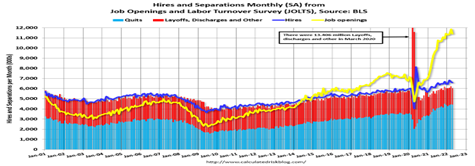
The Job Openings and Labor Turnover Survey (JOLTS) put out by the Labor Department (BLS) probably only makes sense to economists, because it gives a picture of the job market in coming months, as well as the present.

It literally measures the number of job openings (yellow line in graph) vs. hires (blue line) for a month; June in this case; enabling economist to measure whether the demand for new jobs is rising or falling. And though hires decreased slightly to 6.7 million from 7.2 million, it “was still the highest level in series history,” per the BLS.

Job openings rose 518,000 to 5.9 million in June, according to the Labor Department on Monday. That’s above the median forecast of 5.3 million jobs in an Econoday survey of economists. However, the number of jobs available was running around 7 million before the pandemic.

Job openings, another measure of demand, increased in June to 5.889 million from 5.371 million in May, so the number of hires was almost one million higher than vacancies (6.7 hires -5.9 vacancies), meaning there is large number of unfilled jobs to be filled.

So this statistic probably gives the best monthly picture of where the jobs market is headed. The number of job openings (yellow) is still down 18 percent year-over-year, and quits were down 25 percent year-over-year, says Calculated Risk.

Quits are voluntary separations. (see light blue columns at bottom of graph for trend for "quits") that tells us whether employees are moving on to better paying jobs. More workers are therefore hanging on to their current jobs at the moment, due no doubt to the uncertainty of the pandemic outcome.

In the words of the BLS, “These changes in the labor market reflected a limited resumption of economic activity that had been curtailed in March and April due to the coronavirus (COVID-19) pandemic and efforts to contain it. This release includes estimates of the number and rate of job openings, hires, and separations for the total nonfarm sector, by industry, and by four geographic regions.”

The largest gains in openings came from accommodation and food service, other service and arts. The biggest declines were in construction and state and local government education, per Marketwatch.

Why are stocks and bonds continuing to rally in the face of the worst infection and death rates in developed countries,? It’s really the record low interest rates with the benchmark 10-year Treasury bond yield down to almost zero (0.58%) at times that are keeping stock and bond prices at record highs (and bond yields at comparable lows).

FRED

Watch interest rates, as the Fed has pumped extra $trillions into the economy and held short term interest rates also close to zero. There is really too much unused money not being put into useful endeavors, because corporations are reluctant to invest in an uncertain future,and the federal government won’t do more than provide pandemic relief rather than investing in future growth—e.g., in public works projects like infrastructure, education, and the environment.

So there is no plan for post-pandemic growth right now, or maybe until November. Democrats are thinking of the future with the Biden campaign’s “Biden Plan for Leading the Democratic World,” while Republicans are still obsessed with trade wars and ignoring the Wuhan virus that is hurting us much more than China.

The bottom line is there are 13 million fewer jobs than before the pandemic, and still no national plan for combating the pandemic and therefore putting them back to work.

Harlan Green © 2020

Follow Harlan Green on Twitter: https://twitter.com/HarlanGreen