Showing posts with label Paul Krugman. Show all posts

Thursday, May 7, 2026

Stagflation Isn't Going Away

Financial FAQs

“The number of job openings was unchanged at 6.9 million in March, the U.S. Bureau of Labor Statistics reported today. Over the month, hires increased to 5.6 million while total separations changed little at 5.4 million. Within separations, both quits (3.2 million) and layoffs and discharges (1.9 million) were little changed.’ BLS.gov

FREDjolts

The FRED graph of the JOLTS report (U.S. Job Openings and Labor Turnover Survey) shows the sharp decline in the number of job openings from its high of 12 million openings in 2022 at the end of the COVID-19 pandemic. This is another sign of stagnating growth. And though stocks continue to rally to new highs, interest rates are also rising, a sign of higher inflation.

Now combine no new job growth with rising inflation and we have further signs of stagflation, the combination that stopped economic growth for most of the 1970s. It has hovered around 7 million job openings during Trump’s second term because of Donald Trump’s almost single-minded job-killing policies.

It’s not just the illegal on-again, off-again tariffs that disrupt supply chains, but the immigration sweeps taking tens of thousands of workers out of their jobs and off the streets. And most of them pay taxes that would help in reducing our record federal debt.

Cap that with all the DOGE job cuts that have eviscerated the Labor Department responsible for enforcing OSHA worker safety laws and union wage negotiations. Millions have also lost their insurance coverage because Republicans blocked renewal of subsidies that made it affordable to ordinary non-seniors.

Job formation is now at a standstill because of Trump’s anti-labor antics. It’s mostly pure greed that motivates Republicans these days who have cut social services to the bone to pay for their tax cuts.

And there is plenty of time for stagflation to worsen as a semi-permanent feature of Trumponomics, his version of Reagonomics trickle-down economic policies, since Trump has three more years.

Inflation doesn’t disappear when economic growth picks up that is inflating stock prices. All the AI investing will ultimately increase productivity in factories that make cheaper products and need fewer workers. But who will buy its products with fewer employed workers, hence consumers, to buy its products?

Nobel Laureate economist Paul Krugman has pointed out the damage Republican economic policies have done to the health and welfare of Americans and American workers, as well that lessens their productivity because more sick days means time lost from the workplace.

“There is a strong correlation between right-wing politics and increased mortality — stronger than many of the statistical associations that guide public health policy. Deep red states like Alabama and West Virginia have life expectancy comparable to, say, Kazakhstan.”

I’ve written in the past about the dumbing down of the Republican electorate that is causing this; its refusal to rely on scientific knowledge, or support vaccines and publicly funded healthcare.

“We’re seeing the forces that keep U.S. life expectancy far below that in other rich countries, that cause Texans (for instance) to die younger than residents of Massachusetts, go into overdrive at a national level.”

This will cause the death of more Americans, further shrinking our available supply of workers. It’s already happened—just 15,000 new jobs per month were created in 2025. Professor Krugman warns the carnage will continue while inflation is soaring because of his many missteps.

“The consequences will be grim,” he warns.

Harlan Green © 2026

Follow Harlan Green on Twitter: https://twitter.com/HarlanGreen

Monday, March 30, 2026

Another Gulf War?

 Popular Economics Weekly

“So it looks as if the worst and the dumbest are not just at the top of the political leadership. They’re not just on the diplomacy and strategic policymaking end, but even in the cutting edge of the military. And it’s terrifying. America as we knew it may just not exist, even in our military forces.” Paul Krugman

Amazon

Nobel Laureate economist Paul Krugman is concerned about our military because it doesn’t look like President Trump will settle the Iran War any time soon, and Dr. Krugman is fearing the results could be catastrophic for the world economy.

And Nuriel Rubini, another economist, predicted in a recent CNBC interview that Donald Trump would escalate the war on Iran and thereby risk “1970s stagflation.” Dr. Rubini isn’t infallible. He is known for falsely predicting many ‘doomsday’ scenarios, but he did predict the Great Recession.

The U.S. was seemingly caught by surprise over the extensive damage that has already been done on Gulf refineries and U.S. Military bases in the area and almost 200 American casualties killed or wounded.

A JP Morgan commodities analyst Natasha Kaneva with co-authors Artem Fakhretdinov and Lyuba Savinova cited by MarketWatch is predicting trouble ahead if the war is escalated. “Much like during the pandemic, the shock unfolds sequentially rather than simultaneously — a rolling supply disruption moving westward, dictated by shipping times and buffered unevenly by regional inventories.”

Such disruptions are already occurring because so many petroleum products that originate in the Gulf must be transported by ship, and stockpiles are already depleted. In the first three weeks of March, Kaneva discovered a fall of 155 million barrels, mainly triggered by a 211 mbpd drop in oil in transit.

What would another “1970’s stagflation” look like that occurred once before because of another oil embargo—by OPEC—and resulted in multiple recessions? The rising prices of gas, fertilizers, and natural gas are already boosting inflation from the Strait of Hormuz blockade. Stagnating growth is sure to follow, since consumers will save more, consume less, which is the classical response to such conditions.

So why then would Trump even attempt it? He seems to believe the U.S. military could pull off another Venezuela—perhaps by quickly capturing Kharg Island, Iran’s oil shipping hub, and closing the Strait of Hormuz.

That brings us back to Professor Krugman’s prognosis on American military capabilities. “There’s no question that the U.S. has unchallenged superiority in all of the conventional aspects of warfare. There’s no Iranian Air Force for, you know, there’s no Iranian Navy in any conventional sense. Unfortunately, it’s not that kind of war. The failure to have a prepared response to the modern world of drones and inferior powers which nonetheless have the ability to do a lot of damage, has been a bit of a shock.”

But Trump doesn’t seem to be listening to anyone on the economy. In giving a recent “A plus plus-plus-plus-plus-plus” grade on the U.S. economy in a recent interview with Politico cited by The Guardian, Trump is living in a fantasy world while he drives the U.S. economy into a possible recession.

The University of Michigan sentiment survey on how consumers currently think about our economy hit a new low in March. “Consumer sentiment fell back 6% this month to its lowest level since December 2025. Declines were seen across age and political party. Consumers with middle and higher incomes and stock wealth, buffeted by both escalating gas prices and volatile financial markets in the wake of the Iran conflict, exhibited particularly large drops in sentiment,” said survey Director Joanne Hsu

Hsu also said year-ahead inflation expectations climbed from 3.4% in February to 3.8% this month, the largest one-month increase since April 2025.

What if our military has been fighting the wrong war? What if Iran has the capability that Ukraine has shown with its drone technology, though vastly smaller than Russia’s military?

The lessons from Vietnam, Iraq, and Afghanistan have already been forgotten if President Trump does escalate another Gulf War; by the “worst and dumbest.”

Harlan Green © 2026

Follow Harlan Green on Twitter: https://twitter.com/HarlanGreen

Thursday, November 13, 2025

U.S. Economy Is Freezing!

 Popular Economics Weekly

“…while the economy is growing thanks to AI spending, it’s a K-shaped expansion: People who were already affluent are becoming more so, but the less well-off are under severe pressure. For example, there are clear signs that middle-to-low income consumers are struggling: car loan and credit card delinquencies are rising, and grocers report that shoppers are buying cheaper varieties of food. At the same time, the affluent are spending freely: the top 10% of the income distribution now accounts for nearly half of all consumer spending.Paul Krugman

PBS.org

This was the wrong season for President Trump’s Republicans to freeze Democrats out of the just passed continuing resolution or demolish the East Wing. We already have a record fall freeze hitting the Midwest and southern states.

Americans already feeling the freeze is also a good way to describe the Democrats landslide victories in the November elections. The record government shutdown put the U.S. economy on pause, but in fact much of the damage was already done, says Nobel Laureat Paul Krugman, just as Trump seemed oblivious to the timing of the damage being done to the White House,.

Republicans had been losing in the popularity polls this year because they chose to ignore the signs. So they believed that flying blind by keeping the federal government closed without official economic data on employment and inflation was the better option than knowing the truth.

But there are other data to fill the government void in data collecting that affect how consumers behave. The ADP, for instance, a private sector payment provider said private-sector employers shed an average of 11,250 jobs a week in the four weeks ending Oct. 25.

This hit the “middle-to-low income” consumers particularly hard that Krugman is talking about. What about inflation?

Ordinary grocery prices are climbing, forcing consumers to shop for “cheaper varieties of food.” Grocery prices have risen 18.2 percent since January 2022, making a $100 grocery bill approximately $118 today, per CBS News.

And President Trump is flailing in his attempt to mask the damage his tariff war is causing. Overall consumer inflation is stuck at 3 percent in large part because of the tariffs, so he wants to offer $2,000 rebates to consumers while the Fed is cutting interest rates. This would cost more than the import taxes he has already collected, enlarging the federal debt that has ballooned from his Big Beautiful Bill tax cuts.

And his proposed cuts to legal immigration from the longer term, historical average of one million to 7500 annually, will continue to shrink the workforce, even the number of H-1B work visas for highly qualified workers that are badly needed in the tech sector.

All of this will continue to damage economic growth at a time when worldwide economic growth is being affected by the chaos Trump has generated in tearing up existing foreign trade agreements.

No economy can tolerate such uncertain weather over the longer term. Hence investment decisions remain frozen while consumers find shelter for the coming economic winter. How severe will it be?

Harlan Green © 2025

Follow Harlan Green on Twitter: https://twitter.com/HarlanGreen

Wednesday, July 30, 2025

The EU's New Trade Deal

 Popular Economics Weekly

This will hurt the world economy, with the burden falling mainly on lower-income Americans. The Yale Budget Lab estimates that Trump’s tariffs will leave the U.S. economy 0.4 percent poorer in the long run, which is very close to my own back-of-the-envelope calculations.” Paul Krugman

I quote Paul Krugman again as with Trump’s Japan trade deal because it is also Trump’s usual smoke and mirrors—lots of promises but little substance. Why are markets relieved that Trump’s announced 30 percent EU retaliatory tariffs are now 15 percent, when retaliatory tariffs are illegal according to the Foreign Trade court?

Because it means less chaos and more predictability for the moment, but only for the moment.

Neither the EU nor Americans are better off with the new 15 percent tariffs levied on EU products, but none on U.S. exports to the EU. And it will once again shift more of the burden of paying off the tax cuts that benefit Trump and his buddies “onto poor and working-class families,” per Krugman

There is a very small trade imbalance when services as well as goods are included in our trade with the EU, despite Trump’s claims there’s a huge trade deficit. And U.S. exports to EU have just a 1 percent tax at present, so there’s no discrimination.

The biggest lie of all is Trump’s attempt to disguise the fact that a tariff isn’t an import tax, when it is levied at the U.S. Custom ports on goods entering the U.S., not elsewhere.

“…the tariffs are basically a sales tax that will reduce real income for poor and working-class families by about 1.5 percent, even as cuts in other taxes raise income for the wealthy,” says Krugman.

The trade deals are also hiding the fact that neither Japan nor the EU requirements for investing in the U.S. are specific enough.

The tariffs on EU manufactured autos will be lower than those manufactured in the U.S. and Canada, for instance, as with Japan. And the investment guarantees don’t specify whether they will result in actual factories.

So what are the Europeans really paying for? Protection. They have promised to buy more American weapons and keep Trump on their side in the Ukraine war that requires U.S. weapons to stop Putin and end the war.

There is much more to Trumponomics, Trump’s economic agenda, that I will cover in future columns. His insistence on cutting interest rates resembles GW Bush’s push to have then Fed Chair Alan Greenspan’s Governors keep interest rates artificially low to pay for his wars on terror. The inflation rate then was higher, in the 3-5 percent range.

I believe we will see inflation rise to a similar range when the tariff taxes really begin to take effect and kick in the slower growth plus higher inflation formula that prevailed during the Greenspan era at the Federal Reserve, and led to the Great Recession.

Trump contends the U.S. will no longer be paying as much to defend Europeans. Their smaller defense budgets made it possible for Europeans to afford their universal health plans and better social services, higher minimum wages, paid leave and mandated vacations.

The problem with having a conman as our president, is that most Americans won’t benefit from the cutbacks in military aid to the EU. We aren’t reducing our military budget but increasing it, while reducing our already underfunded social safety net, including social security.

What happens when the smoke clears and ordinary Americans realize that we have been short changed?

Harlan Green © 2025

Follow Harlan Green on Twitter: https://twitter.com/HarlanGreen

Friday, July 25, 2025

The Japan Tariffs

 Financial FAQs

It has been clear for a while that Trump and co. don’t understand or believe in balance of payments accounting, that they want both a smaller trade deficit and more foreign investment in America. Now their basic lack of understanding is embodied in a specific deal.” Paul Krugman

Why not quote Paul Krugman, who won a Nobel Prize for his research on foreign trade? The just announced trade deal with Japan is another illustration of the Trump administration’s ignorance of basic economic principles that will make both countries poorer.

It’s necessary to get into the ‘weeds’ of economic principles for those that want to understand just what the Trump administration is really up to; enriching the few with tax cuts that are paid for by all Americans in the higher prices that will result.

Although Japan will be building more factories in the U.S. with its $550 billion in announced investments and be able to export more Japanese vehicles to Americans, U.S. autoworkers will be hurt because Japanese autos will be cheaper than vehicles manufactured in the U.S, even with the 15 percent tariffs levied on them.

Why so? Because the parts imported and used in U.S. manufactured autos have higher tariffs, such as the 50 percent tariff on imported steel and aluminum products that go into American-made autos. That’s why the U.S, Autoworkers Union will have something to say about such a tariff agreement that will endanger the livelihoods of Ford, Stellantis, and GM’s unionized autoworkers.

GM President Mary Ybarra just announced that $1.1 billion of its $2 billion net income from second quarter earnings will be ‘eaten’ by the higher tariff costs that GM didn’t want to pass on to consumers.

The FRED graph illustrates the ups and downs of the historical trade imbalance of goods and services. The downward trending red line basically tracks the negative gap between imports and exports. It has been trending down because we are a consumer-driven economy that has imported much more than American businesses export.

The deepest trade deficit (steep drop in red line) occurred with a surge in imports January-March 2025 to get ahead of Trump’s threatened reciprocal tariffs on April 2. But when he announced the reciprocal tariffs—China’s was 145%, for instance—imports dried up and the difference narrowed so that the graph line rose quickly to the $60 to $70 billion historical trade deficit.

It's an illustration of the incredible gyrations that such chaos injects into foreign trade with Trump’s negotiating tactics, and which hurts small businesses most that depend on imports for consumer products, as well as retail giants like Walmart and Target.

The earliest effect on tariff-induced inflation apppeared in the Consumer Price Index (CPI) I reported last week. The prices of retail goods and services rose to 2.7 percent in June from a four-year low of 2.4 percent, which is why the Fed is still on hold with further rate cuts. It fears that lowering their Fed funds short-term rate could trigger an inflation panic, since it would speed up economic activity.

This would in turn panic bond holders who fear higher inflation and demand higher rates that control mortgages and yields on Treasury securities that fund the national debt, when the annual debt payments are $1 trillion.

Consumers can tolerate some higher inflation and maintain spending if the job market is good. Retail sales just rebounded in June and initial jobless claims for unemployment benefits are down again. Should the unemployment report remain in the low 4.2-4.3 percent range, consumers can keep spending despite uncertainty. But confidence polls are showing consumers are beginning to see the ultimate cost of higher tariffs—reduced social services and a worsening climate.

And this is before the appeal by the Trump administration of the Foreign Trade Court ruling that all reciprocal tariffs must be approved by the congress is decided! How is anyone to know what the final tariffs will be, in that case?

And how can he keep his promise to lower inflation while he keeps hounding the Fed to lower interest rates sooner (that would boost inflation)? He can’t keep his promise, in a word, because of his need to cut taxes. So he will raise everyone’s cost of living to pay for tax cuts that will benefit the few.

Harlan Green © 2025

Follow Harlan Green on Twitter: https://twitter.com/HarlanGreen

Tuesday, July 8, 2025

No Art of the Trade Deal

 Financial FAQs

“The point is that Trump doesn’t feel bound by trade deals America has made in the past. Why should anyone expect him to honor any new deals he makes, or claims to make, now?

“Obviously this behavior isn’t unique to tariffs. Many domestic institutions, from law firms to universities, have discovered that attempting to appease Trump buys you at best a few weeks’ respite before he comes back for more.” Paul Krugman

Nobel Laureate Paul Krugman won his Nobel Prize for his research in International Trade, so his remarks on Donald Trump’s behavior in negotiating trade deals is a good way to understand what Donald Trump has done his whole life—bullied people and institutions—because that’s all he knows how to do.

And Krugman fears it will mean Trump will continue his tariff wars, regardless of the outcomes. This certainly means some level of stagflation; higher inflation with slower economic growth, according to most economists and even Wall Streeters. Maybe not on the level of the 1970s stagflation induced by the OPEC Arab Oil Embargo.

It’s Trump’s paranoid personality if you can call it that. It’s the reason he is the con man who has lied and obfuscated his whole life and could only negotiate with lawsuits. He doesn’t really know how to negotiate so that both parties win, and therefore it is a stable relationship between parties. He only wants to overpower a perceived enemy, much like Putin or Xi, real dictators who torture and kill and their own people to maintain power.

I have written about Trump’s poor negotiating skills in past Huffington Post articles and elsewhere. Author Tony Schwarz was the first to seriously write about Trump in Trump: The Art of the Deal, his biography that created the myth that Trump was a skilled wheeler-dealer.

But it wasn’t real, Schwartz said later to New Yorker Magazine’s Jane Mayer in a famous 2016 interview.

“I put lipstick on a pig,” he said. “I feel a deep sense of remorse that I contributed to presenting Trump in a way that brought him wider attention and made him more appealing than he is.” He went on, “I genuinely believe that if Trump wins and gets the nuclear codes there is an excellent possibility it will lead to the end of civilization.”

The just announced reciprocal tariffs on Japan and Korea area a good example, says Krugman. President Trump sent out tariff letters to U.S. trading partners on Monday as he had promised, starting with Japan and South Korea before targeting Malaysia, Indonesia and other countries.

He has labeled them “reciprocal” tariffs because of his perceived unfairness of their tariff policies, but Japan and South Korea charge little or no tariffs on U.S. imports because of long standing agreements, says Krugman, so have little to negotiate.

How were the South Koreans supposed to end unfair trade practices that exist only in Trump’s imagination?” says Krugman?

Then why is Trump proposing tariffs on them anyway?

“The only possible out here would be a series of fake deals, in which countries pretend to have offered significant concessions and Trump claims to have won big victories. Some people still think that will happen — the new tariffs aren’t supposed to take effect until Aug. 1. But the tone of those letters and Trump’s clear obsession with tariffs make me doubt that he’ll call the tariffs off, in part because of my last observation: Attempts to mollify Trump always end up emboldening him to demand more.”

Then why does Trump do it and cause what will be more huge financial market dips with the loss of more $trillions in equities, many trade disruptions, and alienation of our allies?

Being ‘reciprocal’ has nothing to do with it. Trump will charge at least a 10 percent tariff on the imports from all countries because he needs the import taxes to pay down the huge budget deficit that’s been generated by his Big Beautiful Bill that Congress has just passed.

Therefore his real objective, rather than fairness, is to extract as many concessions as possible from every other country in the world that is dependent on imports to the U.S, regardless of the economic consequences.

Isn’t that what he really wants, to pay for more tax cuts for Trump and the Oligarchs, which will mean the wholesale disruption of world trade, regardless of the possible destruction of our own economy burdened with an unsustainable national debt?

Harlan Green © 2025

Follow Harlan on Twitter: https://twittter.com/HarlanGreen

Wednesday, June 4, 2025

More Signs of Slow Growth

 Financial FAQs

“The manufacturing economy continues to struggle,” Susan Spence of ISM said. “It will continue to struggle” due to all the trade uncertainty.

“The administration’s tariffs alone have created supply chain disruptions rivaling that of Covid-19,” an executive at an electronics company told ISM.

The only number in the Institute of Supply Management’s (ISM) manufacturing survey that rose were prices due to a shortage of commodities—i.e., supply. Every other component of the supply managers’ survey was contracting—such as new orders, production, and employment.

Manufacturing employment had been declining since 1980; from 19,000,000 jobs to 12,765,000 jobs in April per the FRED graph out of a total 159 million jobs.

It’s the first sector of the U.S. economy that is showing stagflation—prices are up while production is stagnating. Hence the above remarks from supply managers and Susan Spence, Chair of the ISM Survey.

The services index of the Institute for Supply Management also contracted for the first time in a year. It fell to 49.9% in May from 51.6% in April, the ISM said Wednesday. Any number below 50% signals contraction.

Economic activity in the services sector contracted in May, the first time since June 2024, say the nation's purchasing and supply executives in the latest Services ISM® Report On Business®. The Services PMI® indicated slight contraction at 49.9 percent, below the 50-percent breakeven point for only the fourth time in 60 months since recovery from the coronavirus pandemic-induced recession began in June 2020.

The Labor Department’s JOLTS report shows that the service sector is still adding jobs. Job openings rose in April for white-collar, retail, healthcare, and entertainment and recreation roles. But job listings fell at hotels and restaurants, whose business has been hurt by a decline in tourism. Some foreign visitors have put off trips to the U.S. because of the trade wars and other White House policies.

Another disheartening jobs report came out today. ADP, a private payroll processor, reported that privately run businesses created just 37,000 new jobs in May — the smallest increase in more than two years — as the most damaging global trade wars since the Great Depression spurred many firms to put a pause on hiring.

The real problem is that employers won’t begin to hire again until the trade wars are resolved, and President Trump says he isn’t letting up on the tariff wars because it will create more manufacturing jobs. But that will take years, and automation has replaced most of the manufacturing jobs (which no longer pay as well) before we see any signs of a manufacturing resurgence.

Economists such as Paul Krugman, who won a Nobel Prize for his pioneering research in foreign trade, remarking on the sudden 50 percent increase in steel tariffs, believes the damage  to the U.S. Economy from such draconian tariff rates (i.e., import taxes) is already done.

So steel tariffs don’t make any policy sense. But then neither does anything else in Trump’s trade war — and the nonsensical nature of the whole enterprise is why I don’t think he’ll find an off-ramp. After all, it’s obvious that the increased steel tariff wasn’t a considered policy, it was a temper tantrum after the Court of International Trade ruled against his other tariffs.

Is the contraction of both the service and manufacturing sectors the first sign that the U.S. economy is already in recession? This Friday’s ‘official’ U.S. Labor Department unemployment report will tell us more.

Harlan Green © 2025

Follow Harlan on Twitter: https://twitter.com/HarlanGreen

Monday, June 2, 2025

Trump's Big Beautiful Bill?

 Answering Kennedy’s Call

“The House has now passed what must surely be the worst piece of legislation in modern U.S. history. Millions of Americans are about to see crucial government support snatched away. A significant number will die prematurely due to lack of adequate medical care or nutrition. Yet all this suffering won’t come close to offsetting the giant hole in the budget created by huge tax cuts for the rich. Long-term interest rates have already soared as America loses the last vestiges of its former reputation for fiscal responsibility.” Paul Krugman-Substack

 Graph: Last Tech Age

Budget analysts have been saying (almost unanimously) that it will increase our federal debt by as much as $4trillion and raise the federal debt level to as much as 130 percent of GDP, further endangering the “full faith and credit” of the U.S. Government.

In passing their ‘Big Beautiful Bill’ (BBB) by just one vote, Republicans will worsen the income inequality and partisan divide that has picked ordinary Americans’ pocketbooks since the 1980s and President Reagan’s ‘trickle down’ economic policies.

The BBB will essentially renew the Trump administrations first term Tax Cut and Jobs Act (TCJB), that gave even more tax breaks to the wealthiest—to Trump and his oligarchs.

The U.S. Is already in 106th place of the 149 countries in income inequality as ranked by the CIA’s World Factbook, I said in 2017; with a Gini inequality index that ranks it with developing countries like Peru and Cameroon. Whereas Finland and the Scandinavian countries are at the top of equality rankings; Germany and France are ranked 12th and 20th, respectively. The higher the index, the greater the gap between wealthy and poor citizens of a country.

So how much worse can it get before MAGA followers realize Trump has never meant to fulfill the “Day 1” promises of lower inflation, more good paying jobs, and a Ukraine peace deal?

The nonpartisan Center on Budget and Policy Priorities gave the most digestible breakdown of the TCJA effects, if it passes the Senate as well:

· Giving the biggest benefits to the wealthy. Households with incomes in the top 5 percent, who have incomes over around $320,000, would receive roughly half of the benefits of extending the expiring tax cuts.

· Ballooning the deficit. Along with the 2001 and 2003 tax cuts enacted under President Bush, the 2017 law has severely eroded our nation’s revenue base. The House budget would compound the damage, adding hundreds of billions of dollars to deficits each year. Extending the 2017 tax cuts would cost $3.6 trillion through 2034.

· Failing to significantly boost economic growth, workers’ earnings, or other benefits for workers. The trickle-down benefits that proponents claimed the 2017 law would produce never materialized, and the law hasn’t come close to paying for itself. Yet the House budget claims that extending the tax cuts would generate trillions in revenue — far more than any independent estimate.

Our ranking of the worst income inequality among developed countries is bound to influence U.S. voters once the Trump’s higher import taxes take hold as well, and stagflation returns.

Even worse is the effect the BBB will have to our credit rating. Will it continue to decline? That is really what Paul Krugman is most worried about. It’s the worst kind of fiscal responsibility. Why such a blatant and foolish attempt to make the rich richer and working Americans poorer? Republicans aren’t even attempting to hide it anymore.

Harlan Green © 2025

Follow Harlan Green on Twitter: https://twitter.com/HarlanGreen

Monday, May 26, 2025

Why Harvard?

 Answering Kennedy’s Call

“But the Trumpist effort to destroy Harvard and other elite universities — for that is clearly their intention — will do vast damage to our nation’s future.” Paul Krugman

           FREDERIC J. BROWN/AFP/Getty Images)

Huffington Post

The dumbing down of the Republican party has a history long before I began to write about it in The Huffington Post. The attempt to dumb down Harvard University that Paul Krugman is talking about, by wanting to control even its curriculum and course content, is the latest attempt to bring down our educational system to the Republican Party’s dismal intellectual level.

When one political party needs ignorance to keep its followers in compliance, believing whatever the party hacks want its followers to believe, its messages will be based on conspiracy theories, rumors, or made up fictions, as Trump does with his accusations that Harvard has anti-Semitic policies.

His habitual lying hides the unpleasant truth that he just wants to pick the wallets of his followers. It’s why the poorest Americans live in Republican-controlled red states.

I first witnessed it in 2015 during the CNN Republican candidate debate that seemed to be a prolonged campaign to discount almost all scientific facts, as well as intelligent discussion of the most important issues of the day.

Especially scary was Donald Trump saying if we build up our military enough, we won't have to negotiate with anybody. Or Marco Rubio, the seemingly most moderate Republican, endorsing a 1,900 mile fence along our entire border with Mexico (or double fence, says Dr. Ben Carson) over mountains and rivers, or Carli Fiorina saying that Planned Parenthood was aborting live babies to harvest their organs.

But the anti-intellectual, anti-science bias goes much further and deeper. It is in fact an almost totally American phenomenon that Republicans have taken advantage of in an attempt to dumb down the electorate to levels that would even deny evolution.

Why would anyone not want to support public education, when it educates more than 80 percent of our students? The result is that higher education is also falling behind.

According to the National Research Council, only 28 percent of high school science teachers consistently follow the National Research Council guidelines on teaching evolution, and 13 percent of those teachers explicitly advocate creationism or "intelligent design," said Psychology Today in a very damning 2014 article entitled, Anti-Intellectualism and the Dumbing Down of America:

"After leading the world for decades in 25-34 year olds with university degrees, the U.S. is now in 12th place," said Psychology Today. "The World Economic Forum ranked the U.S. at 52nd among 139 nations in the quality of its university math and science instruction in 2010. Nearly 50 percent of all graduate students in the sciences in the U.S. are foreigners, most of whom are returning to their home countries"

What else was debated in 2015, before Trump won his first term in the White House? Republican candidates were echoing the Republican platform that advocated the deportation of all illegal aliens, would abolish or cripple whole government agencies (including the Environmental Protection Agency), shut down the federal government over Planned Parenthood funding, and maintain that a fertilized egg is a viable human being that can't be aborted.

I reported then (in 2015) journalist Chris Hedges said in a PBS interview that President Clinton in co opting moderate Republican positions, such as deregulation of the financial industry, putting 100,000 more cops on the street, and 'reforming' welfare, had driven the Republican Party to "insanity".

That’s as good a description of what Trump’s MAGA Republicans are attempting to do again. Isn’t it the perfect definition of insanity—doing the same things over and over again, expecting different results?

Harlan Green © 2025

Follow Harlan Green on Twitter: https://twitter.com/HarlanGreen

Tuesday, April 22, 2025

Higher Tariffs = Stagflation

 Financial FAQs

“Any tariff causes consumers to shift from imported goods to domestically produced alternatives that are more expensive, inferior in quality, or just not quite what they want. But with a low tariff domestic alternatives will be only a little bit worse than the imports they replace; with a high tariff many of the domestic goods consumers buy will be a lot worse than the imports they replace. Nobelist Paul Krugman

Federal Reserve Chairman Jerome Powell said in his latest remarks that the Trump tariffs were much higher than the Fed had expected. It has unsettled the financial markets so much that Fed officials don’t know whether it’s smarter to lower or raise interest rates.

The Conference Board’s Index of Leading Economic Indicators (LEI) gives one read of our economic future for the rest of the year. And it’s pointing to stagflation rather than recession.

“The US LEI for March pointed to slowing economic activity ahead,” said Justyna Zabinska-La Monica, Senior Manager, Business Cycle Indicators, at The Conference Board. “March’s decline was concentrated among three components that weakened amid soaring economic uncertainty ahead of pending tariff announcements: 1) consumer expectations dropped further, 2) stock prices recorded their largest monthly decline since September 2022, and 3) new orders in manufacturing softened.

The stock and bond markets continued to decline on the Monday after Easter—the DOW down -972 points. So, no sign of an economic resurrection there. The stagnation component is because Trump is fighting an imagined immigration war that is reducing our workforce, which is causing a labor shortage during a time of full employment. The two to three million surge in new immigrants during Biden’s term made US the fastest growing economy in the world.

And the tariff war will bring create bottlenecks once again as it did during the COVID-19 pandemic, which is when it caused the inflation component of stagflation to skyrocket and the Fed to raise interest rates to combat it.

It’s becoming more obvious what Trump means by using his “gut’ to make decisions. It’s why his “batshitcrazy” tariff decisions, in the words of Paul Krugman, are causing such chaos. Foreign governments can’t make decisions on gut instincts and so are pulling their U.S. investments, causing the stock and bond selloffs. Gold is the current flight to quality shelter in lieu of the traditional bond play.

That means he lives by his own Laws of the Jungle, where might Trumps right, and only knows how to bully rather than reason. So it’s no surprise that Trump lurches from one tariff proposal to another without researching any of its effects, causing world markets to lose faith in the full faith and credit of the U.S. Dollar and Treasury bonds.

Adam Posen, a former official at both the Federal Reserve and the Bank of England, said in a speech this week that the U.S. could suffer the biggest “stagflationary” shock in decades.

“We may get recession, we may not, but we are going to get inflation either way,” he said, as cited by MarketWatch. Even if Trump strikes deals with various countries, tariffs are likely to remain in place (at least 10 percent). These measures would raise prices, increase inflation and slow the economy — the recipe for a period of stagflation.

Harlan Green © 2025

Follow Harlan Green on Twitter: https://twitter.com/HarlanGreen

Monday, March 24, 2025

Why Kill Social Security?

 Answering Kennedy’s Call

“Let's say social security didn't send out their checks this month. My mother who’s 94, she wouldn’t call and complain. She'd think something got messed up, and she'll get it next month. A fraudster always makes the loudest noise, screaming, yelling and complaining.” Trump Commerce Secretary Howard Lutnick

It’s a sign of Republican Party and the Trump/Musk administration’s extreme incompetence (and naviete) if they believe Americans will buy Howard Lutnick’s story that only fraudsters would care if our seniors miss a social security payment when a major share of seniors list their monthly social security payment as their major (and only) source of income!

Commerce Secretary Howard Lutnick’s comments thereby reveal why Republicans and Trump want to  at least damage it enough that Republicans can privatize it for their Wall Street cronies.

It is an insane attempt to destroy social security in its current form, of course, and a reflection of Republicans’ efforts to dumb down its mostly red state electorate.

Even GW Bush attempted it, to no avail when the profit windfall that brokers would reap for managing it as a private pension fund was revealed ($5Billion at the time), which would come out of taxpayers’ pockets, of course.

Nobel Laureate Paul Krugman in a recent Substack column said why they are so blatant about it: the differences in education and the information media their red stater supporters have access to. Sixty three percent of Republican/Trump voters in 2024 were less than college educated.

Krugman also pictured who will be most harmed by his attempt to destroy social security. It will be our elderly and retired with a high school education or less, with 60 percent of their income comes from social security. And these are Republicans’ main red state supporters.

They tried something similar in Trump’s first term with more than 30 attempts to repeal Obamacare. It was a major reason Trump lost to Biden in 2020. It should be the main reason Republicans lose at least the House of Representatives in the upcoming 2026 midterm election.

The only real way to combat this wall of ignorance is with a better information infrastructure, or more effective propaganda machine, if we want to call it that. It will be necessary to expose the blatant ignorance Republicans have historically relied on to maintain their power in the red states and with swing voters that pay less attention to political news, polls have shown.

AOC and Bernie Sanders are having rallies in red and purple states like Arizona and Colorado talking what makes “common sense” to most American voters, and that have been effective in drawing up to 50,000 member crowds, for starters.

Trump/Musk are blindly rushing ahead with Musk’s so-called DOGE efficiency drive and Trump’s tariff wars that could cause horrendous damage to our economy, when there are much better ways to accomplish their stated goals of lowering regulations and decreasing the budget deficit and national debt.

Such haste is causing irreparable damage to lives and livelihoods; just as Musk’s failure to correct Tesla’s design flaws have killed people. There are better ways, and maybe the SCOTUS 5-4 ruling that Trump can’t indiscriminately fire federal workers without cause can begin to slow down the wholesale destruction enough to prevent a very large economic ‘fire’ and even a major recession, I said last week.

There is a lesson to be learned. The Tesla automobile’s sometimes fatal design flaws seem to be because of his lack of attention to details in his single-minded drive to invent new and better technologies, just as Trump’s pre-occupation with revenge and retribution clouds his thinking, and that of those that are tasked with carrying out his executive orders.

It's an opening that will combat the Republican Party’s nihilism, not to denigrate the less educated, but is common sense to most Americans—not tariffs that boost inflation and make enemies of our allies, or allow measles and bird flu epidemics to run their course rather than vaccinate, and bipartisan legislation that protects our borders rather than illegal deportations. The list goes on and on.

Common sense policies are something understood by all income groups and social classes that oligarchs and their enablers, the real fraudsters, don’t want Americans to know.

Harlan Green © 2025

Follow Harlan Green on Twitter: https://twitter.com/HarlanGreen

Tuesday, June 11, 2024

Greater Lawlessness Causes Great Recessions

 Financial FAQs

I began writing about Republicans’ disregard for laws in 2012 after the Great Recession of 2007-09, in which as many as 8 million jobs were lost. But not the Republican Party’s lawlessness itself, though it has always been the party of the wealthiest oligarchs fighting for lower taxes and downsizing of the IRS that monitors their tax shelters.

There were always lawbreakers in both political parties, but I never thought it possible that Republicans would allow a convicted felon to take over their party, who is now their presidential candidate, and who advocates programs that could cause another Great Recession.

Larry Summers, former treasury secretary under the Bill Clinton administration who also has served as the top White House economic adviser for former President Barack Obama, told The Atlantic as cited in MSN.com, of economic policies Trump wants to enact that could increase inflation, if re-elected, and perhaps lay the groundwork for another recession.

"These included compromising the independence of the Federal Reserve Board, enlarging the federal budget deficit by extending his 2017 tax cuts, raising tariffs, rescinding Biden policies designed to promote competition and reduce 'junk fees,' and squeezing the labor supply by restricting new immigration and deporting undocumented migrants already here," The Atlantic wrote in an article published last Sunday.

But that is just the beginning. Trump wants to weaken regulatory oversight by appointing more political appointees if elected that would carry out his agenda who could neutralize officials and whole departments that enforce regulations, a major cause of the Great Recession under President GW Bush.

There were many causes of the Great Recession, but front and center were the GW Bush administration appointing officials who consciously downgraded governmental powers of enforcement so that regulators such as the SEC looked the other way when Goldman Sachs, for instance, sold funds to their investors that they then secretly bet against would fail.

Real laws were broken then -- from conflicts of interest to outright fraud that were never prosecuted. The 2010 congressional hearings unveiled much of the double dealing that was rationalized by Goldman Sachs' buyer-beware code -- its clients should be sophisticated enough to know that Goldman would try to maximize its own profits, before those of its clients.

But even more damage was the disregard of basic economic safeguards by successive Republican administrations. It was really the attempt of Big Business to unravel the economic safeguards of the New Deal, first spelled out in Paul Krugman's The Great Unraveling, by advocating massive budget deficits to pay for a Pax Americana -- with especially severe consequences for the old and poor. The Bush administration then ran up the first $1 trillion federal deficit.

A culture of greater lawlessness can be traced back to the early 1980s when President Ronald Reagan trumpeted that government was the problem and more private enterprise the solution for greater prosperity.

The number of convicted criminals in those administrations tells part of the story. President Reagan's administration was marked by multiple scandals, resulting in the investigation, indictment, or conviction of over 138 administration officials, the largest number for any U.S. president.

And Salon.com had documented 34 incidents of law-breaking in just the first 4 years of G.W. Bush's Presidency, the most blatant being unmasking covert CIA operative Valerie Plame, and its fabricated claims that Iraq had weapons of mass destruction.

Former President Trump is the latest example with dozens of convicted felons in his administration that he pardoned while still President.

"Deficits don't matter" was the infamous chant of Bush VP Dick Cheney. At a time when economic inequality had risen to levels last seen in the 1920s, these administrations wanted to divert attention from a vanishing social safety net by proposing the ago-old Darwinian solution -- the free market. For only the fittest will survive in a world ruled by self-interest, rather than laws and regulations.

The United States, beginning in the 1980s once again became the most ardent advocate and practitioner of the oldest form of capitalism, now a primitive relic of 18th century enlightenment. This is but one part of our aging democracy that U.S. hegemonists put up as the model for western civilization. But it is a very imperfect model for the rest of the world as well.

A 2002 survey of 38,000 people in 44 countries by the Pew Center for the People and the Press found what they think of our American Way. "Since 2000, favorability ratings for the U.S. have fallen in 19 of the 27 countries where trend benchmarks are available ... pluralities in most of the nations surveyed complain about American unilateralism," says the study. They think we disregard their interests in pursuit of our own self-interest.

Few dispute that our capitalistic economic system has won the day. It produces great wealth, particularly for those at the top of the wealth pyramid. Robert Reich's book, The Future of Success said it best: "By the end of the (20th) century, the richest 1 percent of American families, comprising 2.7 million people, had as many dollars to spend after taxes as the bottom 100 million."

It is also no coincidence 25 states have now passed anti-union Right to Work laws that are also the poorest states with the highest income inequality, lowest educational achievement, and receive the most in public subsidies. Taking incomes and wealth away from those states' workers can only make them poorer in relation to other states and regions that is a continuing drain on public finances.

It is the real lesson of our greater lawlessness. By choosing to break laws and regulations that govern economic activity, some region are being pushed back to levels of past centuries, including holding the minimum wage at $7.25 per hour. Workers will only produce more and better products and services when they have the incentive to do so.

In the end, such greater lawlessness means a disregard for everyone but one's own clan or tribe, a greater selfishness. No country can remain prosperous with such a breakdown in social welfare. That is the lesson learned from the Great Depression and Great Recession. Policies that ignore economic as well as civil laws and well-being, that continue to divert incomes and wealth to the wealthiest, impoverish all of US.

Harlan Green © 2024

Harlan Green on Twitter: https://twitter.com/HarlanGreen

Thursday, April 11, 2024

Return of the Bully Mentality

 The Mortgage Corner

The NYTimes Bret Stephens lamented the “bullying mentality” at the heart of the pro-Hamas movement in a recent Op-ed that lamented their attempts to shut down pro-Israeli speakers. Hamas is a movement that wants to completely eliminate the state of Israel.

Such protests have even permeated UC Berkeley, my alma mater. It’s shades of the 1960s and 70s anti-Vietnam protests, but instead of peace loving and ultra-liberal protestors, many of the protests seem to be supporting violence and Hamas terrorists.

Such a mentality, or bullying behavior to use its more common term, is once again affecting the budget battles we still have today, especially concerning aid to Israel and Ukraine, with some Republicans attempting to even block debate on a bill, after the Biden administration was able to pass many bipartisan bills that supported the post-pandemic recovery.

It mirrors bullying behavior I wrote about in a 2014 contributor column for Huffington Post during earlier budget battles, in which I quoted Paul Krugman:

"But nobody expects to see a lot of prominent Republicans declaring that rejecting Medicaid expansion is wrong, that caring for Americans in need is more important than scoring political points against the Obama administration. As I said, there's an extraordinary ugliness of spirit abroad in today's America, which health reform has brought out into the open."

The "ugliness" he speaks of is really a bully mentality. Bullies prey on those weaker than them, and so the most conservative Republicans have tried every trick in the book to oppose any programs that smack of aiding those most in need.

“Not all Republicans are bullies, and not all Democrats enlightened progressives,” I said then. “But the bully mentality of House Speaker John Boehner's "no compromise" tactics, or Senator Mitch McConnell's filibustering of even the most innocuous Obama administration appointments have been the reason recovery from the Great Recession hasn't been stronger.”

And it continues with the attempts to bully House Speaker Mike Johnson into not advancing a desperately needed aid package that MAGA Republicans oppose by threatening to unseat the House Speaker.

Who are the bullies? Republican House members from conservative Red states, in the main that oppose almost any form of government aid—even for border protection that passed with bipartisan support in the Senate.

They belong to the states most dependent on government support. Smart Asset conducted a research on the states most dependent on the Federal government, and found they were Republican governments, with Red states making up 8 out of top 10 dependent states.

GeorgetownPPR

The result of such bullying behavior is easy to see from this Georgetown public Policy Review graph. Beginning 20 years ago median household annual incomes between red and blue states began to diverge—rising per annum to $60,000 in 2018 in Republican-led states vs. some $72,000 in Democratic-led states.

The divergence between Red and Blue states began in 2000 when the Bush administration passed massive tax cuts that took away the 4 years of budget surpluses created by the Clinton administration and cut back many social programs; at the same time it began the wars on terror.

The Center on Budget and Policy Priorities (CBPP), a non-partisan think tank, said at the time, “Despite promises from proponents of the tax cuts, evidence suggests that they did not improve economic growth or pay for themselves, but instead ballooned deficits and debt and contributed to a rise in income inequality.”

It also led to the largest federal budget deficit; in fact, the first one $trillion federal deficit in US history. And “the Bush tax cuts (including those that policymakers made permanent) would add $5.6 trillion to deficits from 2001 to 2018,” said the CBPP.

It began an alarming trend, the “no compromise” behavior that the Biden administrations has attempted to alleviate with such as its New New, Deal Infrastructure and Inflation Reduction Acts that are bringing back good jobs to those Red states.

Such bullying behavior has intentionally impoverished many, and this might be the best of times to study and counteract its effects with a bipartisan spirit that younger generations are keen to support in many polls.

A recent PEW Research poll, for instance, tells us why Gen Z’ers in particular support compromise over no compromise: “…members of Gen Z are more likely than older generations to look to government to solve problems, rather than businesses and individuals. Fully seven-in-ten Gen Zers say the government should do more to solve problems, while 29% say government is doing too many things better left to businesses and individuals.”

Can today’s younger generations overcome such a bullying mentality that has also permeated university campuses and fulfill the promise of a greater bipartisanship they say their prefer?

Harlan Green © 2024

Follow Harlan Green on Twitter: https://twitter.com/HarlanGreen

Tuesday, August 15, 2023

Here's to a Return of Normal!

 Popular Economics Weekly

FREDretailsales

Is it possible after years of pandemic and post-pandemic vicissitudes, the US economy is returning to normal growth, and Americans can breathe easier about the future?

By that I mean consumers are shopping as they did before the pandemic, industries are producing enough to keep inflation in check, and supply-chains fully stocked, even if the Fed won’t begin to drop interest rates until next year.

I believe so, and July’s retail sales are confirming that consumers are healthy and behaving more normally now that the tax season is over.

It surprised some economists that advanced sales for retail and food services jumped 0.7 percent in July, and 3.2 percent over July 2022, as reported by the Census Bureau. But 3 to 6 percent annual sales’ growth has been the norm going back years, seasonally adjusted but not for inflation, per the FRED graph.

Dining out and travel were the biggest beneficiaries of consumers’ largesse. Sales rose a sharp 1.4 percent at bars and restaurants, a sign that they are happy. Internet sales have risen 10.3 percent over the past year, more than double the rate of inflation.

In fact, the so-called ‘new normal’ of post-pandemic activity is looking more and more like the old normal. Unemployment should stay low for the rest of this year, at least. There are still nine million open job vacancies and wages are now rising faster than overall inflation, which should keep economic growth above 2 percent, the average longer-term US growth rate.

Why is inflation slowing so quickly without rising employment? Many economists believed higher unemployment and job losses were needed to slow consumers spending sufficiently to bring down the inflation rate.

Economists such as Paul Krugman believe that might have occurred if inflation expectations had become imbedded—i.e., in the belief that inflation would continue higher for an extended period.

But economies have recovered much more quickly, thanks in large part to the $trillions spent on the pandemic recovery—the ‘new’ New Deal I’ve been talking about.

So, there wasn’t enough time for inflation to become ‘embedded’ (an economic term) in the minds and expectations of Americans. Other countries haven’t invested as much in their recoveries, so are experiencing higher inflation.

A report just out by the NY Fed confirms that inflation expectations are subsiding. The median inflation expectation fell to 3.5 percent in July from 3.8 percent the previous month, and is the lowest reading since April 2021, the report said.

Consumers also expect home-price growth to slow slightly, said the NY Fed. They also see the cost of gas, food, medical care, college, and rent fall in the year ahead. Expectations for food inflation are at the lowest level since September 2020 (5.2 percent).

Why shouldn’t consumers feel better about their future, and act accordingly?

Harlan Green © 2023

Follow Harlan Green on Twitter: https://twitter.com/HarlanGreen

Monday, November 15, 2021

Where are the Truck Drivers?

 Financial FAQs

@PaulKrugman

If one picture can save 1,000 words, then maybe Nobel Laureate Paul Krugman’s citing of the huge decline in average hourly wages of Production and Non-supervisory Employees in Transportation and Warehousing since the 1970s goes a long way to explaining the current supply-chain bottleneck and concurrent inflation surge.

It explains even more—why so many Americans are refusing to return to their workplaces. The COVID pandemic has exposed the consequences of the overall decline in working Americans’ wages and standard of living that has shrunk the middle class and endangered our democracy.

Of course, the coincidence of declining wages and truck-driver shortages doesn’t necessarily spell causation, but at a time of soaring demand by consumers and producers for the products they deliver, they have one of the most demanding 24/7 jobs for less than college-educated workers.

And there is much anecdotal evidence from independent truckers that confirms the existing pay scale is not worth it. In October, the American Trucking Association said the U.S. needed 80,000 more truck drivers.

Shauntai Robinson, an owner operator out of the ports in South Carolina, in a post on Medium cited by Yahoo News, said that after 16 years in the industry, she was beginning to question the viability of a career as a truck driver.

"There are thousands of valid class A CDL holders, across the United States, who have elected to not drive a truck anymore," Robinson wrote. "These people have not relinquished their credentials. Instead, these valuable people have been forced to seek alternative forms of employment in order to be able to provide for their families."

On average, truck drivers working full time, year-round, earn about $43,252 annually, lower than the median for all full-time workers ($47,016), but exceed those of other blue-collar jobs, says the US Census Bureau.

FREDwages

The huge decline in transportation and warehousing wages actually mirrors the sharp decline in average hourly wages of all production and non-supervisory workers that began in 1980, as can be seen from the above FRED graph (gray bars are recessions).

That was when Big Business began its lobbying campaign to influence economic policies—morphing into what came to be known as trickle-down economic policies with the election of President Ronald Reagan in 1980.

Reaganomics accelerated the deregulation of whole industries that began in the 1970s, with directly suppressing the collective bargaining rights of workers to such an extent that there are now 26 so-called right-to-work (red) states that say a worker can work in a company employing unionized workers, and enjoying its benefits, without having to pay union dues!

The millions of workers holding back from reentering the workforce because of the worst pandemic in 100 years has perhaps awakened more than truck drivers to the need to hold out for a better economic system that has impoverished them since the 1980s, when conservative economic policies took away workers’ rights as well as drastically reduced their incomes.

President Biden’s $1.2 trillion Infrastructure Investment and Jobs Act (IIJA) was passed just in time to make a difference for working families by providing jobs that can support families.

“The bill is a significant down payment on the $2.5 trillion infrastructure investment gap that was identified in the 2021 Report Card and will benefit American businesses and families for years to come,” according to the American Society of Civil Engineers (ASCE), as I reported last week.

The COVID pandemic is bringing about a wholesale transformation of American capitalism, including an opportunity for American workers to have a voice in transforming it.

Harlan Green © 2021

Follow Harlan Green on Twitter: https://twitter.com/HarlanGreen

Friday, November 5, 2021

October Employment Roars Back

 Popular Economics Weekly

MarketWatch

Who said the labor shortage is holding back job gains? Not for the moment. It looks like the roaring 2020s are beginning to roar in earnest this fall as we slowly exit the pandemic.

Total nonfarm payroll employment rose by 531,000 in October, and the unemployment rate edged down by 0.2 percentage point to 4.6 percent, the U.S. Bureau of Labor Statistics reported today.

“Job growth was widespread, with notable job gains in leisure and hospitality, in professional and business services, in manufacturing, and in transportation and warehousing. Employment in public education declined over the month.”

People are returning to work, in part because 9 million lost jobless benefits in September as the federal extended unemployment insurance program was terminated.

The government revised the number of new jobs created in September to 312,000 from 194,000, based on new information from the businesses surveyed, said MarketWatch. And the job gains in August were raised to 483,000 from 366,000.

A total of 5.6 million payroll jobs have been created this year to date and average hourly wages have increased 4.6 percent. President Biden touted that these numbers showed that the U.S. now had the fastest job growth in the developed world.

Leisure and Hospitality, Education & Health, and Professional/Business added 320,000 jobs, manufacturing and construction added 104,000 jobs, while governments lost 73,000 jobs (from a loss in public education).

The service sector is roaring back, in other words, as restaurants, hotels, theaters and other companies in the hospitality business created 164,000 new jobs last month.

The jump in payroll employment was presaged by a recent poll of senior business executives in service-oriented companies, such as retailers and banks that rebounded to a three-month high of 58.2 from 54.9 in September, IHS Markit said Friday.

A similar survey of manufacturing activity slipped to 59.2 from 60.7, but it was still quite high. Any reading over 50 signals growth and numbers are above 55 are exceptional.

CDC.gov

Another reason for the payroll surge is the COVID infection rate continues to decline. This is in part because 70 percent of Americans have been fully vaccinated, a total of 193 million Americans

“The current 7-day moving average of daily new cases (68,793) decreased 7.4% compared with the previous 7-day moving average (74,290). A total of 45,655,635 COVID-19 cases have been reported as of October 27, 2021,” reported the CDC.

And there is reason to believe even more workers will return to their jobs this fall and winter—especially moms as their children return to schools and become vaccinated with the new children’s’ vaccines.

What could dim this optimistic prediction? Very little, in my opinion. The euro area is also roaring back with an annual growth rate of 9 percent last quarter, according to Nobel Laureate Paul Krugman.

And the rest of the world is slowly recovering from the pandemic. It’s really a matter of continuing to vaccinate the unvaccinated worldwide, which means restoring the supply-chains in this deeply interconnected world.

Is there anything that could prevent it from being restored? Maybe another war with…? Let’s hope not.

Harlan Green © 2021

Follow Harlan Green on Twitter: https://twitter.com/HarlanGreen

Wednesday, October 20, 2021

Booming Retail Sales Confirm Holiday Rally

 Financial FAQs


FRED

September retail sales and food services presage a holiday season worth celebrating, despite supply shortages, worker shortages, and the pandemic. Seasonally adjusted retail sales are up 12 percent over last September, which means that the demand for goods and some services is at a historic high.

So the shortages are due to consumers and businesses buying more than ever, more than last year and all the years before, in spite of the supply shortages.

There’s little evidence of production shortages, per se, as much as a slowdown in getting to their destinations in ports such as Los Angeles and Long Beach, where more than half of all imports to the U.S. arrive.

NY Times Paul Krugman put up a FRED graph that illustrates the huge surge in the demand for durable goods—goods like appliances and vehicles that last more than three years. It tells us that said demand can continue above the average dotted trend line into the year end holidays.

FRED

The demand for services such as leisure activities and travel is lagging because the pandemic has kept many consumers at home. But that will pick up as well once the Pandemic is subdued.

And what if the Infrastructure and Build Back Better bills pass would add additional $ trillions to programs that boost businesses and improve consumers’ lives? Then the boost in demand for goods and services could be prolonged for…years.

Should we worry about inflation because too much money is in circulation, driving up prices? Not if it’s put to productive uses, as I’ve been saying. Both physical and so-called social infrastructure spending go into increasing productivity, hence a greater supply of goods and services, not excessive speculation in the financial markets as have past tax cuts from which the wealthiest most benefited.

Studies have shown that parents in such states as California that have some of the social infrastructure proposals in President Biden’s Build Back Better Act, such as paid family leave and child care, allow them more family time and resources to raise their children, thus reducing the number of children trapped in a cycle of poverty.

And better physical infrastructure will help to cure the supply bottlenecks. “In the longer run, investments in infrastructure could help much more: U.S. ports, rail lines and so on are shabby compared with their counterparts in other countries and could be much improved.” says Krugman.

So we really need to grow what one political scientist has termed our social capital as much as physical infrastructure, if we want a sustainable recovery. It can be done by improving people’s lives.

Harlan Green © 2021

Follow Harlan Green on Twitter: https://twitter.com/HarlanGreen

Wednesday, October 7, 2020

Do We Want Another Great Recession?

Financial FAQs


 MarketWatch

Federal Reserve Chair Jerome Powell has warned of “tragic’ economic risks if another coronavirus aid package isn’t passed by congress. This is while President Trump has just said that talks over additional aid will be suspended until after the election in order that the Senate has the time left to take up Judge Amy Barrett’s Supreme Court nomination.

“Over time, household insolvencies and business bankruptcies would rise, harming the productive capacity of the economy and holding back wage growth,” Powell said. “By contrast, the risks of overdoing it seem, for now, to be smaller.”

Employment of those in the bottom rung of the wage distribution scale remains 21 percent below its February level, while it was only 4 percent lower for workers who receive higher wages, the Fed chairman said.

It seems that Republicans have painted themselves into a corner if they expect to profit from an economy sure to get worse without another aid package before the election. Why are they writing off their chances on November 3rd with an economy sure to slow again? Your guess is as good as mine.

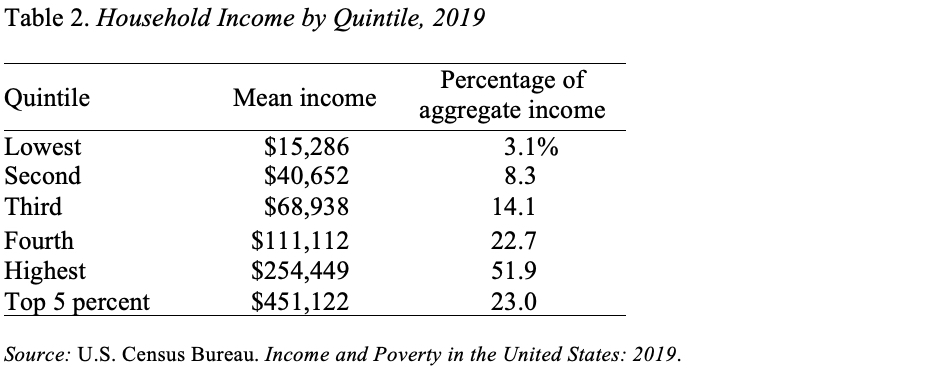
MarketWatch’s chart above highlights the problem. The top 10 percent of household income-earners now corral 51.9 percent of Americans’ aggregate income. That includes stocks as well as real estate and other investments by ‘rentiers’—those living off their assets, rather than the wages and salaries of most workers.

Out middle-income households now garner just 14.1 percent of household income, whereas it was closer to 20 percent in the 1960s and 1970s, before the cutting of taxes and deregulation of whole industries gave corporations the license to maximize their profits, rather than the welfare of their employees.

The predictions of future growth are dire without additional aid to households as well as certain industries his hardest by the pandemic shutdowns.

The NY Times Neil Irwin summarized best what is likely to happen without additional aid. “Business news headlines are reflecting a drumbeat of layoffs normally seen in recessions. In the last few weeks alone, oil giant Shell said it was cutting 9,000 positions, with Disney eliminating 28,000 and defense giant Raytheon 15,000.

“After shedding jobs in the spring, these sectors have brought workers back slowly, or not at all, through the summer. Some have continued cutting positions. Employment at corporate headquarters — “management of companies and enterprises,” in the official terminology — fell by 92,000 in March and April, with another 4,000 jobs lost since.”

He quotes Sophia Koropeckyj, an economist at Moody’s Analytics, who said we do expect there to be a new steady state, but not until 2023 or 2024,” In a new report, she estimates that 5 million people will find it difficult to get new work after the pandemic because their old jobs have disappeared or changed significantly. “I don’t think the severity of this downturn has been well understood yet given the bounce-back over the summer.”

Nobel-winning economist Paul Krugman has been saying what is obvious. Without additional government aid, we could sink into another Great Recession.

“The lesson I take is that our political dysfunction is even worse, our ability to rise to the occasion even lower, than I imagined. It’s hard to look at what’s happening now without feeling a sense of despair.”

Let us see what happens over the next few weeks. Few economists see good times ahead unless the 80 percent of households that earn wages and salaries; many are the essential workers that have a difficult time meeting even their living expenses; are given additional aid.

Harlan Green © 2020

Follow Harlan Green on Twitter: https://twitter.com/HarlanGreen