Showing posts with label personal consumption expenditure index. Show all posts

Friday, May 1, 2026

Does Inflation Ever Come Down?

Popular Economics Weekly

From the preceding month, the PCE price index for March increased 0.7 percent. From the same month one year ago, the PCE price index for March increased 3.5 percent.” BEA.gov

FREDpce

Inflation is rising again, to no one’s surprise, from its low of 2.3 percent in April 2025 when Trump first announced his worldwide tariff hikes, to 3.5 percent in March this year. The reasons are clear, inflation is rising on Trump’s watch, not Biden’s.

And inflation almost never comes down without another recession. This is verified in the above graph of Federal Reserve’s preferred Personal Consumption Expenditure price index from 1980. The gray bars are the five recessions since 1980, and each clearly shows the beginning of the sharp downward move of prices in the PCE index

The only time prices have come down without a recession since then was during President Biden’s term—from its high in June 2022 to slightly above 3 percent at the end of his term.

Biden could do this because the Fed used its best tool to combat inflation; raising interest rates at the same time as Biden succeeded in lowering the federal debt by raising corporate taxes to counter the huge influx of government money injected into the economy ($5 trillion) from Biden’s bipartisan Infrastructure, Inflation Reduction and CHIPS Acts.

The bills were passed to inaugurate the biggest modernization of the U.S. economy since the Great Depression that employed a record number of workers.

So it is possible to bring down inflation without a recession. And there is substantial harm, especially to working Americans who face higher prices for basic necessities, such as gas and healthcare, for prolonging this inflation surge.

What had caused the five recessions since 1980? Republican administrations cut taxes without paying for them, ballooning the federal debt instead of reducing it. Recessions (gray bars) occurred in 1980, 1981, 1990, 2008-09, all during Republican administrations. The short 2000 recession happened because of the COVID-19 pandemic.

This is an unnecessary inflation surge, in other words. It’s because of multiple wars being fought and a Republican congress that will not curb a president who doesn’t care about the costs and harm he is doing to Americans and the American economy.

Harlan Green © 2026

Follow Harlan Green on Twitter: https://twitter.com/HarlanGreen

Monday, August 4, 2025

The Return of Stagflation

 The Mortgage Corner

From the same month one year ago, the PCE price index for June increased 2.6 percent. Excluding food and energy, the PCE price index increased 2.8 percent from one year ago.” BEA.gov

President Trump hasn’t succeeded in convincing the Federal Reserve to cut interest rates or fired Chairman Jerome Powell just yet. So he fired the head of the Labor Department’s Bureau of Labor Statistics without cause that published the weak July unemployment report instead.

It is heralding another era of stagflation that has destroyed the wealth of too many Americans.

It now looks like he wants to recreate what happened to two other Republican Presidents—manipulating the data to disguise the fact that looming inflation can be a big problem as it was in the stagflation of the 1970s and housing bubble and Great Recession of 2008 that was the worst economic downturn since the Great Depression.

President Nixon first tried it when combatting the looming oil price-inspired inflation from the Arab Oil Embargo by fixing prices to keep them artificially low, then pushed his Fed Chair Arthur Burns to keep interest rates low in the face of slowing economic growth caused by the OPEC embargo.

It resulted in 14 percent inflation in 1980 that caused then Fed Chair Paul Volcker to raise the Fed Funds rate to 20 percent, resulting in two recessions early in President Reagan’s tenure.

President GW Bush also tried it in 2000 by pushing then Fed Chair Alan Greenspan to keep interest rates low to finance his wars on terror. Greenspan held interest rates too low for too long, which resulted in the housing bubble and Great Recession that followed.

And now Trump is looking for a successor to the Senate-vetted BLS official, Dr. Erika McEntarfer, who will manipulate employment statistics for him. The result will be less trusted unemployment reports, masking the effects of historically high tariffs that will again create product shortages and slow economic growth.

The Labor Department’s unemployment report understated what happened in the past three months, as I said last week. The U.S. economy created 73,000 nonfarm payroll jobs, but just 19,000 and 14,000 payroll jobs in revisions to May and June totals when more data came in (see graph).

The change in total nonfarm payroll employment for May was revised down by 125,000, from +144,000 to +19,000, and the change for June was revised down by 133,000, from +147,000 to +14,000, per the BLS.

Trump’s main reason for wanting to manipulate economic facts? He also wants to hide the damage to the employment numbers from what could be the loss of one million immigrants leaving the adult labor force, many of them running for cover because of the Gestapo tactics of Trump’s Homeland Security masked Storm Troopers breaking into homes and businesses to round up as many undocumented immigrants as possible, as I said last Friday.

It’s really the first indication of the immigrant’s importance in our economy, and why most of July’s hiring was in healthcare (55,000) while government employment lost 12.000 jobs and -87,000 jobs this year.

The next economic shoe to drop will be the changing of the guard at the Federal Reserve. Trump could not bully Fed Chair Powell to lower interest rates sooner, but that will soon change when he appoints a new Fed Chairman.

He will want to politicize the Fed as he is doing to the rest of the federal government when Powell steps down next year, so that he can enact more Republican ‘trickle down’ economic policies first initiated by President Reagan: in particular the tax cuts + deregulation that supposedly increases efficiencies and productivity, but instead increased corporate CEO pay to more than 300 times that of their employees while weakening union collective bargaining laws.

The results of ‘trickle-down’ economics have been frightfully obvious for decades. The Reagan-era creation has succeeded in maximizing profits of the owners of capital and corporate CEOs while suppressing incomes of salaried workers via right to work laws and low minimum wages, mostly in the poorest Republican controlled red states.

It’s why economists are now calling this the second Gilded Age. We are seeing the results—higher inflation and slowing economic growth once again unless a majority of Americans can be convinced to stop the steal of the worst robber baron of all.

Harlan Green © 2023

Follow Harlan Green on: https://twitter.com/HarlanGreen

Friday, January 31, 2025

Why Is Inflation Still a Problem?

 Financial FAQs

The Fed’s preferred inflation gauge, Personal Consumption Expenditures Index (PCE) isn’t declining because consumers continue to spend more than they earn. Why?

BEA.gov

Such spending gave a boost to retail sales and so made holiday shoppers happier. But it also highlighted the underlying problem, inflation is still too high.

The June to December BEA graph shows the difference between income (blue bar) and spending, or outlays (orange bar). It has been this way for at least one year. The declining black line in the graph measures consumers’ personal savings rate, which is back down to 3.8 percent from almost 5 percent in June 2024 because of it.

Why do consumers keep spending more than they make? One clue is that most of the spending is for housing, utilities, transportation and gasoline—necessities. It must be that consumers are not earning enough to keep up with rising prices for their basic needs.

But it also shows a bit if irrational exuberance—a form of excessive optimism that former Fed Chair Greenspan warned about in the ‘90s—and is happening in the financial markets today, which are at record highs.

“The numbers look good. Maybe even surprisingly good—and that’s not a word I throw around willy nilly,” said Barron’s Magazine’s Jack Hough recently about the financial markets.

Stubborn inflation tells us why it became the backbreaker for Democrats in this election cycle. It confirms the most basic of economic laws—the Law of Supply and Demand. The American economy as well as imports are not supplying enough goods and services to satisfy the demand for them.

Most of the inflation surge was in the service sector, as I said, and consumers want more and better services most of all. Hence personal expenditures (blue line in second graph) is hovering around 2.8 percent—too high for the Fed that wants 2 percent inflation.

Inflation in the Fed’s PCE price index for December increased 2.6 percent in one year. Excluding food and energy, the PCE price index increased 2.8 percent from one year ago.

This picture tells us the real problem—the slow recovery from the COVID-19 pandemic isn’t producing enough. World supply has not caught up with the world demand for goods and services. It is also due to so much geopolitical unrest, including the Mideast and Ukraine conflicts.

And the Trump administration wants to deport those undocumented immigrants that mostly work in the services industries, which means more worker shortages; as well as raise tariffs on many countries, which could cut GDP growth by some 1 percent, according to the Peterson Institute, a non-partisan research organization.

It will make everything that American consumers want even more expensive. And that might keep the Federal Reserve from dropping interest rates further, as they hinted in their just concluded January FOMC meeting. How about that?

There was also some good news. The U.S. economy grew at a mild 2.3% annual pace in the final three months of 2024, and the details of the report showed an economy on strong footing that was being handed over to the Trump administration. GDP grew at 3% and 3.1% in the two prior quarters.

It’s still not a good time for excessive optimism, in my opinion.

Harlan Green © 2025

Follow Harlan Green on Twitter: https://twitter.com/HarlanGreen

Friday, December 20, 2024

Bidenomics Caused Recovery

Financial FAQs

“Real gross domestic product (GDP) increased at an annual rate of 3.1 percent in the third quarter of 2024, according to the "third" estimate. In the second quarter, real GDP increased 3.0 percent. The increase in the third quarter primarily reflected increases in consumer spending, exports, business investment, and federal government spending.”

It might not seem fair to compare the Biden and Trump administrations, economically. The Biden administration will have created almost 16 million payroll jobs in four years, whereas Trump had created 6.7 million jobs until the 2000 pandemic, but lost -2.7 million jobs overall during his term because of its severity.

Though COVID-19 was made worse by Trump’s misinformation campaign that cast doubt on many of the actions needed to limit its damage, such as wearing masks in crowds and advocating chlorine injections.

But the increase in the 3rd (and final) revision to third quarter economic growth when many thought a recession was immanent this year gives testament to the strength of the economic recovery under President Biden. The U.S. economy has now expanded by at least 3% in each of the past two quarters. What’s more, the most recent estimates suggest GDP will top 3% in the fourth quarter, as well.

The result has been surging growth and full employment with declining inflation, refuting the misinformation barrage that elected Trump for a second term. The Fed’s preferred Personal Consumption Expenditure (PCE) inflation measure even came in below expectations, up just 0.1 percent in November, 2.4% annually.

But it still hasn’t answered the question of many voters:Why haven’t prices come down for the things that consumers use daily?

The simplest answer is that most consumers are flush with rising wages and leftover savings that have boosted retail sales and leisure activities. The big driver of economic growth has been consumer spending. Household spending increased to a 3.7% annual pace in the third quarter, from 3.5%. Prices would come down if consumers wanted to spend less—maybe because they had lost confidence in future growth and feared for their jobs October

But that hasn’t been the case. Consumer confidence surveys, such as by the Conference Board, are showing they aren’t that worried or unhappy about their jobs.

“Consumer confidence continued to improve in November and reached the top of the range that has prevailed over the past two years,” said Dana M. Peterson, Chief Economist at The Conference Board. “November’s increase was mainly driven by more positive consumer assessments of the present situation, particularly regarding the labor market.”

Another index by the Conference Board, it’s Index of leading Economic Indicator (LEI) that attempts to predict future growth has also turned positive. It rose for the first time since February 2022.

“A rebound in building permits, continued support from equities, improvement in average hours worked in manufacturing, and fewer initial unemployment claims boosted the LEI in November,” said Senior Manager Justyna Zabinska-La Monica.

Even Fed Chairman Powell is now saying they might have fewer rate cuts next year if such strong growth continues.

And that will hurt the anemic housing market, which just last Thursday announced the largest rise in existing-home sales in a year, all because of a slight (and temporary?) drop in mortgage rates.

The National Association of Realtors announced that total existing-home sales – completed transactions that include single-family homes, townhomes, condominiums and co-ops – improved 4.8% from October to a seasonally adjusted annual rate of 4.15 million in November. Year-over-year, sales bounced 6.1% (up from 3.91 million in November 2023).

“Home sales momentum is building,” said NAR Chief Economist Lawrence Yun. “More buyers have entered the market as the economy continues to add jobs, housing inventory grows compared to a year ago, and consumers get used to a new normal of mortgage rates between 6% and 7%.”

So even the housing market is telling us that Bidenomics has been a success. And Republicans will now be taking credit for it over the next four years, so I think they won’t dare cut those programs in the name of greater efficiency that have made President Biden’s investments in future growth so successful.

Harlan Green © 2024

Follow Harlan Green on Twitter: https://twitter.com/HarlanGreen

Thursday, October 3, 2024

NO MORE INFLATION

 Financial FAQs

The Fed is no longer worrying about inflation, since its preferred inflation gauge, the Personal Consumption Expenditure Index (PCE), recently dropped to a 2.2% inflation rate, close to the 2.0% target rate.

Fed Chairman Powell said recently the Fed is more worried that the job market is faltering, hence the -.50% Fed Funds rate cut last week with at least two more rate cuts in the offing this year. It would cut the Bank Loan Prime Rate to 7.50% that is the basis for most credit card and installment loan rates.

It is still too high for most borrowers, but auto sales have picked up, which is a sign consumers are still buying, that in means that Q3 GDP growth could also match second quarter’s GDP growth of 3.0 percent.

This is remarkable growth, even with the labor market slowdown, and the unemployment rate up to 4.3 percent in a year.

From the same month one year ago, the PCE price index for August increased 2.2 percent. Prices for goods decreased 0.9 percent and prices for services increased 3.7 percent. Food prices increased 1.1 percent and energy prices decreased 5.0 percent. Excluding food and energy, the PCE price index increased 2.7 percent from one year ago.

Job formation is slowing, as the BLS JOLTS report showed 8 million job vacancies, with 5.3 million Hires and 5.0 million Separations in the month. The 300,000 difference approximates the net number of new hires in August.

We are still fully employed, in other words, but the number of vacancies posted by employers looking for workers has come down considerably from the 12 million job opening high during the pandemic and lockdowns.

(That’s why it’s called the Job Openings and Labor Turnover Survey.)

Consumer spending is the biggest ‘tell’ on future employment and economic growth and it barely dropped to 2.7 percent annual growth from 2.8 percent in August. The savings rate is still a healthy 4.8 percent, close to historical norms, so the surge in vehicle sales is no fluke.

Business activity in the service sector is soaring (mainly dining out, travel, leisure activities), but the manufacturing sector is still contracting.

“In September, the Services PMI® registered 54.9 percent, 3.4 percentage points higher than August’s figure of 51.5 percent. The reading in September marked the seventh time the composite index has been in expansion territory this year,” said survey Director Sterve Miller.

Whereas, manufacturing “Demand remains subdued, as companies showed an unwillingness to invest in capital and inventory due to federal monetary policy — which the U.S. Federal Reserve addressed by the time of this report — and election uncertainty,” said survey director Timothy Fiore.

I see good growth this year. More reductions in interest rates will certainly boost manufacturing, and consumers are still saving, another sign they aren’t tapped out. 

But with one political party wanting to cut back on Bidenomics, the policies spurring much of the growth, economic and job growth next year could depend on which party wins the White House in November.

Harlan Green © 2024

Harlan Green on Twitter: https://twitter.com/HarlanGreen

Friday, August 30, 2024

Consumers Solvent Much Longer?

 Financial FAQs

I said last month we know why the US economy is still growing. Consumers have kept spending. The second revision of second quarter economic growth confirmed this when Gross Domestic Product growth jumped from 2.4 to 3.0 percent!

“Real gross domestic product (GDP) increased at an annual rate of 3.0 percent in the second quarter of 2024, according to the “second” estimate. In the first quarter, real GDP increased 1.4 percent.”

This is huge, but the question remains just how much longer consumers can ‘stay in the game’ before their chips run out, to parrot a well-known remark Roosevelt’s Fed Chairman Marriner Eccles made in testimony during the Great Depression.

Consumer spending was revised up to a 2.9% rate from the initial estimate of a 2.3% gain in the report. Whereas spending was up 1.5% in the first three months of the year, and such activity accounts for two-thirds of US economic activity these days. So, it’s extremely important to track how long they can continue to spend, as well as save.

Consumer confidence is rising again, which should help sustain the rally, as consumers seem to be worrying less about their job, per the Conference Board, even though personal savings have declined to dangerous lows.

“The Conference Board Consumer Confidence Index® rose in August to 103.3 (1985=100), from an upwardly revised 101.9 in July. The Present Situation Index—based on consumers’ assessment of current business and labor market conditions—improved to 134.4 from 133.1 in July.”

That’s a small improvement, but far below the 120 to 130 pt. index range prior to the pandemic. It says consumers are still shaking off the effects of the pandemic, for starters.

One reason for their uncertainty is household incomes have fluctuated wildly for decades due to the various recessions. Household income growth plunged to -0.1% at the beginning of the COVID-19 pandemic and was only back up to its +5% pre-pandemic highs in 2022, the last year it was calculated.

Household incomes have barely kept up with inflation, in other words, never able to get ahead of the longer term 2% average inflation rate that has prevailed since the Great Recession.

This in fact highlights the dangers consumers face going forward. They continue to borrow heavily, even with historic high interest rates, to ‘stay in the game’ to maintain their current lifestyles.

Their personal savings rate has just plunged from 3.4 percent to 2.9 percent, according to the BEA. It was lower only once since 1960—to 1.4 percent in July 2005 during the housing bubble and runup to the Great Recession.

Is there any reason to believe things will improve for the majority, when the Fed does cut interest rates? There have been recommendations, such as the child tax credit that both parties want to reinstitute; also lowering taxes on middle incomes and raising it for corporations and the wealthiest; as well as taxing the earnings of hedge fund managers managing $trillions in public monies.

Let us see if more of the economic pie will be distributed to those that have no savings left. Otherwise, we already know what happens when consumers can no longer stay in the game and their chips run out.

Harlan Green © 2024

Harlan Green on Twitter: https://twitter.com/HarlanGreen

Friday, June 28, 2024

Are Consumers Confused?

 The Mortgage Corner

What are we to make of the Conference Board’s latest confidence survey?

"The decline in confidence between May and June was centered on consumers aged 35-54. By contrast, those under 35 and those 55 and older saw confidence improve this month,” said Dana M. Peterson, Chief Economist at The Conference Board.

We are in the midst of one of the greatest economic recoveries in history—from the worst pandemic in more than 100 years. Yet most consumers lack confidence because they don’t know where to look for information on the real economy, as opposed to what is on social media or in mass media headlines.

“Confidence pulled back in June but remained within the same narrow range that’s held throughout the past two years, as strength in current labor market views continued to outweigh concerns about the future. However, if material weaknesses in the labor market appear, confidence could weaken as the year progresses,” said Peterson.

I believe this reflects the fact that most consumers like their current circumstances, but not outside events that may forecast the future. Why isn’t the rest of the world doing as well as Americans, say the headlines?

A lot of the confusion unfortunately comes from social media which doesn’t differentiate fact from fiction. A recent poll maintained that 50 percent of those surveyed believe we are in a recession, when real GDP growth has averaged 2 percent since the pandemic, and we are at full employment.

It reflects what I have called irrational pessimism. The other side of the coin is irrational exuberance, when excessive optimism that prices will almost always rise can cause asset bubbles.

Nobel laureate economist Robert Shiller has written about it. That’s because most market investors rely on hearsay and word of mouth, rather than research that would paint a more accurate view of market conditions.

Much of Main Street, ordinary working adults in the main, have become irrationally pessimistic for that reason. Surveys such as a recent poll by PEW Research show this.

“About three-in-ten Americans (28%) currently rate national economic conditions as excellent or good, while a similar share (31%) say they are poor and about four-in-ten (41%) view them as “only fair.”

I also believe most Americans are emotionally exhausted and still recovering from the pandemic, so they are now spending less which is slowing economic growth.

That is reflected in the major inflation indexes which were all flat in May. The Fed’s preferred Personal Consumption Expenditures (PCE) monthly inflation index didn’t rise at all on Friday in line with retail CPI prices (in blue line) reported earlier this month as seen in above graph.

When will consumers begin to realize this? Maybe in September when the Fed is now predicted to begin to lower their interest rates. That should make all of US happier!

Harlan Green © 2024

Follow Harlan Green on Twitter: https://twitter.com/HarlanGreen

Wednesday, June 5, 2024

Fed's Preferred Inflation Indicator Softens

 Popular Economics Weekly

The latest economic data show the US economy slowed in Q1 2024, but economic growth should increase in the second quarter because consumers will continue to spend.

Personal Consumption Expenditures (PCE), the best measure of overall consumer spending, fell slightly to a 2.7 percent annual rate in April but is still higher than pre-pandemic levels.

This is apparently still too high for Fed officials, who believe PCE must come down to pre-pandemic levels of approximately 2 percent to bring down inflation to its 2 percent target rate. But that pre-pandemic inflation rate held for almost 10 years, so is that what Fed officials believe is a sustainable possibility?

The US economy was recovering from the Great recession then, which was a worldwide recession almost as damaging as the Great Depression of the 1930s. And the just-ended COVID-19 pandemic has been just as damaging, which is why the federal government came to the rescue so quickly with the various bipartisan legislation that is now being called Bidenomics.

The BEA graph shows both Disposable Personal Income (after taxes) and Outlays (the sum of PCE, personal interest payments, and personal current transfer payments) increased just 1 percent in April. The personal savings rate held at 3.6 percent.

And the second estimate of first quarter GDP growth was revised down to 1.3 percent from 1.6 percent. The decline in both PCE and Q1 economic growth has revived hopes in the financial sector that two or three rate cuts might still happen this year.

And another report, the JOLTS report that shows the number of job vacancies (i.e., unfilled job needs reported by businesses), dropped to 8.1 million openings. It is probably the most accurate predictor of future employment (or unemployment) since it measures a slightly lower demand for new jobs.

We therefore hope that Fed Chair Powell might continue to sound dovish about inflation prospects since the last FOMC meeting.

"I think it is unlikely that the next rate move would be a hike,” Powell recently said. “The Committee judges that the risks to achieving its employment and inflation goals have moved toward better balance over the past year.”

The US economy is still moving towards the Fed’s desired goal of slightly higher unemployment and lower inflation, in other words, which economists are saying was the ‘goldilocks’ condition of the last decade before the pandemic—not too hot (inflation) nor too cold (employment).

Q2 growth estimates have been declining lately. The Atlanta Fed just revised their GDPNow model estimate for real GDP growth (seasonally adjusted annual rate) in the second quarter of 2024 to 2.7 percent on May 31, down from 3.5 percent on May 24. It was mainly after a decrease in the nowcast of the second-quarter real personal consumption expenditures (PCE)growth that was reported above.

So there is little consensus on what Q2 growth from April to June may look like. The battle over what is acceptable inflation is between businesses and retailers, I said recently. The Atlanta Fed reported in a recent survey that consumer prices are rising faster than business costs because retailers must add in the costs of distribution and profits to their prices.

And consumers are finally reacting to the higher retail prices, which has the likes of Target and Walmart finally cutting prices. This should start a trend of lower retail prices matching more closely to the wholesale costs businesses must cover.

But the real problem is that the Fed’s reluctance to drop their rates has hurt manufacturing, which continues to contract. The Institute for Supply Managers (ISM) manufacturing index contracted again, just when it is most needed to rebuild our infrastructure, the 18th time in the last 19 months, say the nation's supply executives in the latest Manufacturing ISM® Report On Business®.

“The Manufacturing PMI® registered 48.7 percent in May, down 0.5 percentage point from the 49.2 percent recorded in April. The overall economy continued in expansion for the 49th month after one month of contraction in April 2020. (A Manufacturing PMI® above 42.5 percent, over a period, generally indicates an expansion of the overall economy.)”

So we hope the Fed may not be tempted to try for an unattainable goal; a decade-long inflation rate that prevailed prior to the pandemic when higher economic growth is more important than ever to modernize the American economy.

Harlan Green © 2024

Follow Harlan Green on Twitter: https://twitter.com/HarlanGreen

Saturday, April 27, 2024

Inflation Target Reached?

 Financial FAQs

Inflation is probably as close to the Federal Reserve’s inflation target of 2 percent as possible this year, according to its favorite inflation index, the Personal Consumption Expenditure Price Index (PCE) that is the best overall measure of consumer price trends.

FREDpce

In fact, all of the inflation indicators used by economists are at or close to 2 percent for both wholesale and retail goods and services. Inflation will probably remain slightly above 2 percent annually this year because consumers’ incomes have been rising faster than the cost of things to produce.

It’s mostly in the service sector, where the rising cost of recreation, entertainment, health care and the like has been the biggest source of recent inflation. The manufacturing sector has been stalled, however, because of the high interest rates.

Service prices rose 0.4% last month, the government said Friday. The biggest increases took place in housing, health care, recreation, dining and hotels. Over the past year the cost of services has risen 4%, far too high for the Federal Reserve's comfort. Before the pandemic service inflation averaged 2.2% a year.

Why? The culprit in the Fed’s eyes is too high wages and salaries that must come down to tame inflation “sustainably”, in their words. Yet without slightly higher incomes consumers wouldn’t be able to ‘sustain’ the higher economic growth that will pay for the current wars the US is supporting, modernization of US economy, and mitigation of global warming.

Of course, there are those inflation hawks (mostly Republicans) who say we cannot afford such largesse. There’s too much debt that will overwhelm the debt markets, collapse the Dollar’s value and similar forebodings.

But they forget that such spending also boosts labor productivity and economic growth! That is why GDP growth has surged, rising 4.9% and 3.6% over the last two quarters of 2023, respectively.

FREDlaborproductivity

And labor productivity has been surging. Nonfarm business sector labor productivity increased 3.2 percent in the fourth quarter of 2023, the U.S. Bureau of Labor Statistics reported, as output increased 3.5 percent and hours worked increased just 0.3 percent.

Productivity was shrinking, just -2.4 percent at its most recent low point in Q2 2022, meaning the number of hours worked was rising faster than output. But it increased to +2.6 percent in Q4 2023, a swing of more than 4 percent in 6 quarters.

It’s not clear if such a surge has to do with workers receiving better salaries and benefits; or the increasing use of technologies such as AI because of worker shortages across many industries.

But we do know that the $trillions in President Biden’s New, New Deal are being spent on developing new technologies, such as the CHIPs Act that is financing new factories in several states.

We had even more debt as a percentage of GDP during WWII. We couldn’t have won World War Two without it. And we also know the new technologies it financed created the American middle class and gave us the boom years after World War Two.

Harlan Green © 2024

Harlan Green on Twitter: https://twitter.com/HarlanGreen

Friday, March 1, 2024

Inflation Is Going Nowhere

 Popular Economics Weekly

I said recently that the US economy has made a soft landing. Here is further proof with the release of the government’s Personal Consumption Expenditure Index (PCE) that measures consumer spending.

Inflation has flattened and been stuck close to the Fed’s 2% target rate for months. This has reassured consumers enough as measured by consumer sentiment surveys that they have kept up their spending patterns, giving a boost to strong first quarter growth.

The January PCE price index increased 2.4 percent year-over-year (YoY), down from 2.6 percent YoY in December, and down from the recent peak of 7.1 percent in June 2022.

The PCE price index, excluding food and energy, increased 2.8 percent YoY, down from 2.9 percent in December, and down from the recent peak of 5.6 percent in February 2022.

FRED/CalculatedRisk

And the 6-month index PCE Price Index is up 2.5%, Core PCE Prices: 2.5%
Core minus Housing: 1.8%. That means inflation will probably remain stuck somewhere between 2 to 2.5% for the foreseeable future.

American workers are fully employed, and wages are rising slightly faster than inflation. Next week’s release of the monthly unemployment report should confirm nothing has changed.

This is why consumers remain optimistic, per the University of Michigan’s consumer sentiment survey:

Consumer sentiment moved sideways this month, slipping just two index points below January and holding the gains in sentiment seen over the past three months,” said survey director Joanne Hsu. “Expected business conditions remained substantially higher than last autumn, with short-run expectations now 63% above and long-run expectations 46% above November 2023 readings.”

This should also answer the question why fourth quarter 2023 GDP growth was holding at 3.2 percent in its second reading.

The price index for gross domestic purchases (GDP) increased (just) 1.9 percent in the fourth quarter, compared with an increase of 2.9 percent in the third quarter. The personal consumption expenditures (PCE) price index increased 1.7 percent, compared with an increase of 2.6 percent. Excluding food and energy prices, the PCE price index increased 2.0 percent, the same change as the third quarter.

Inflation has fallen dramatically, in other words. The supply chain of goods and services has caught up to demand. But also, labor productivity, the amount of goods produced per worker-hour, has risen sharply in the last 12 months.

And, though I’m repeating myself, health care spending is soaring, as a record 21.3 million people have officially signed up for healthcare insurance through the HealthCare.gov Marketplace for 2024, marking a third consecutive banner year for the program.

HHS Secretary Xavier Becerra said, “Once again, a record-breaking number of Americans have signed up for affordable health care coverage through the Affordable Care Act’s Marketplace, and now they and their families have the peace of mind that comes with coverage.”

So, I would add another reason for the improving mood of consumers: a healthier workforce is a more productive workforce.

Maybe economic stability at home is what we need with the rest of the world in turmoil.

Harlan Green © 2024

Follow Harlan Green on Twitter: https://twitter.com/HarlanGreen

Thursday, January 25, 2024

US Economy Has Landed

 Popular Economics Weekly

There’s no longer any doubt with the initial estimate of fourth quarter GDP growth just in. The US economy has made a soft landing. The economy grew 3.3 percent in Q4 after a 4.9 percent increase in Q3, and 2.5 percent for the full year.

This is while inflation, as measured by the most comprehensive inflation indicator for Personal Consumption Expenditures (PCE), has been rising at just 2 percent for the past two months!

Consumer spending was the main engine of growth, which “reflected increases in services (led by health care) and goods (led by recreational goods and vehicles),” said the BEA.

BEA.gov

This is while “The price index for gross domestic purchases (GDP) increased 1.9 percent in the fourth quarter, compared with an increase of 2.9 percent in the third quarter. The personal consumption expenditures (PCE) price index increased 1.7 percent, compared with an increase of 2.6 percent. Excluding food and energy prices, the PCE price index increased 2.0 percent, the same change as the third quarter.”

Why has inflation fallen so dramatically? There are a number of reasons, beginning with the fact that the supply chain of goods and services has caught up to the demand by consumers and companies for goods and services. But also, labor productivity, the amount of goods produced per worker-hour, has risen sharply in the last 12 months, largely because of new technologies such as AI, which has stream-lined supply chains, shortening delivery times.

Real GDP also reflected increased spending in exports, state and local government spending, nonresidential fixed investment, federal government spending, private inventory investment, and residential fixed investment. Spending and investing has increased across the board.

Why wouldn’t consumers keep buying? Americans are fully employed, and average hourly wages are rising faster than inflation (+4.1%). Inflation has been falling particularly sharply over the past 6 months (1.9%-2.5%, depending on which inflation measure we look at), I said last week.

And health care spending is soaring, as a record 21.3 million people have officially signed up for healthcare insurance through the HealthCare.gov Marketplace for 2024, marking a third consecutive banner year for the program, per the press release.

HHS Secretary Xavier Becerra said, “Once again, a record-breaking number of Americans have signed up for affordable health care coverage through the Affordable Care Act’s Marketplace, and now they and their families have the peace of mind that comes with coverage.”

So I would add another reason for the improving mood of consumers: a healthier workforce is a more productive workforce.

Oh yes, and U.S. new-home sales rose 8% to an annual rate of 664,000 in December from a revised 615,000 in the prior month, the Commerce Department reported Thursday; even with very high interest rates.

The median sales price of a new home sold in December fell to $413,200 from $426,000 in the prior month partly because for sales inventories have risen to an 8-month supply.

These are all signs of recovery that will accelerate when the Fed governors finally decide inflation is no longer a danger and begin to lower their interest rates.

Harlan Green © 2024

Follow Harlan Green on Twitter: https://twitter.com/HarlanGreen

Tuesday, December 26, 2023

Wasn't the Fed

 Popular Economics Weekly

What more does Chairman Powell and the Federal Reserve Governors need to know to announce the inflation battle has been won? Its preferred inflation indicator has shown zero monthly increases for two months.

The rate of U.S. inflation based on the Federal Reserve’s preferred PCE index actually fell in November for the first time since 2020 and indicated that price pressures continue to subside. The PCE index dipped - 0.1 percent last month, the government said Friday. Inflation was unchanged in October.

FREDpce

This is what is called a ‘soft landing’, I said last week when the unemployment rate dropped back to 3.7 percent. More jobs are being created in November’s unemployment report, though some 50,000 of the 199,000 new nonfarm payroll jobs are strikers returning to work in Hollywood productions and auto factories.

So the Fed’s actions in raising interest rates to multi-decade highs wasn’t the proximate cause of declining inflation, in what looks like an overaction to the effects of the COVID pandemic.

High inflation wasn’t the fault of rising wages, either, when job openings are still at record highs so that everyone who wants a job can find one.

Workers are getting terrific raises now that the strikes have been settled, yet inflation keeps declining. No, broken supply chains were the major culprit. It’s taken almost three years to ramp up enough production to bring down prices.

We are now seeing the results as shoppers have shown in the latest retail sales figures that they are finding more bargains during this record holiday shopping season.

Even industrial production is ramping up; so much so that Q4 projections of growth are rising again.

Orders for durable goods for products that last more than three years (cars, appliances, etc.) rose 5.4 percent in November, the U.S. government said Friday. This is the largest gain since July 2020. It is the second gain in the past three months. Transportation orders had the largest increase, rising 15.3 percent in November. This was in part because orders for motor vehicles and parts jumped 2.8 percent after the end of the UAW strike. Orders for commercial aircraft also soared but tend to fluctuate wildly month-to-month.

The Atlanta Fed raised its estimate of fourth quarter GDP growth as high as 3.0 percent and it could go higher with today’s robust durable orders release by the Commerce Department.

The U.S. Federal Reserve Board suggested that interest rates would be cut by 75 basis points in 2024 after it last FOMC meeting of 2023 in December. Can we now be in what is called a Goldilocks economy?

That is when the Fed’s interest rate isn’t so low that it ushers in inflation, yet not so high that it tips the economy into a recession. Maybe we’ve reached that point.

Once again, consumers will decide on the direction of economic growth. And holiday travel shows they haven’t slowed down much.

Auto club AAA forecasts that 115 million people in the U.S. will go 50 miles or more from home between Saturday and New Year’s Day. That’s up 2% over last year. The busiest days on the road will be Saturday and next Thursday, Dec. 28, according to transportation data provider INRIX.

And MarketWatch reports the Transportation Security Administration screened more than 2.6 million passengers on Thursday, which had been projected to be one of the busiest travel days, along with Friday and New Year’s Day. That’s short of the record 2.9 million that agents screened on the Sunday after Thanksgiving, since travel tends to be more spread over Christmas and New Year’s.

The chorus is growing on the need to begin dropping interest rates. That’s all we need to sustain this recovery.

Harlan Green © 2023

Follow Harlan Green on Twitter: https://twitter.com/HarlanGreen

Monday, June 5, 2023

Inflation or Deflation Next Year?

 Financial FAQs

FREDpersonalconsumption

The Fed’s favored personal consumption expenditures price index (PCE) has been on a sharp downward trend since June 2022 when it reached its 7 percent inflation high. Both its overall headline indicator (blue line) and core index without gas and energy prices (redline) are now rising in the 4 percent range.

A leading business economist that I like says inflation could plunge below the Fed’s 2 percent inflation target sometime next year. And that would mean a recession, so the Fed should begin to lower interest rates later this year.

“The forces that drove up inflation since the onset of the Covid pandemic are reversing rapidly,” said Ian Shepherdson, chief economist at Pantheon Economics, in a recent Barron’s article. “Over the next year, both the headline and core rates—the latter excludes food and energy prices—will drop sharply. By the end of 2024, inflation is likely to be below the Federal Reserve’s 2% target, and policy makers will be trying to stop it falling too far.”

This happened before under Fed Chair Alan Greenspan when the Fed’s prolonged rate hikes busted the housing bubble in 2007 and precipitated the Great Recession.

The inflation rate then sank below 2 percent for a prolonged period, which required Greenspan’s successor as Fed Chair, Ben Bernanke, to begin the various Quantitative Easing programs that pumped excess dollars into the economy to begin a slow recovery.

The main cause of inflation has been the supply shortages due to worldwide shutdowns from the COVID-19 pandemic. We know what happened to inflate grain and oil prices with the Ukraine War. But auto prices also skyrocketed with the shortage of chip supplies that are in all new cars.

Residential rents also soared, as work-from-home use also increased during and after the pandemic. Now rents are also returning to more normal levels.

To make his point, Shepherdson states, “Almost all of the eightfold increase in global container shipping costs has reversed, and domestic shipping costs also are falling rapidly. Semiconductor supply is back to normal, more or less, so vehicle production in April was higher than before the pandemic. About a third of the increase in auto dealers’ margins already has reversed.”

The labor market is the other shoe about to drop. The unemployment rate rose from 3.4 percent to 3.7 percent in May, with 339,000 new nonfarm payroll jobs created. This was because there are more workers in the workforce now than before the pandemic, which will slow the wage increases, another part of the inflation picture.

Most of the major economic indicators are either flat or declining, so now would be a good time for the Fed to anticipate what will happen next—a growing surplus of supplies as countries ramp up production that will further depress prices—rather than wait too long to react to changes as it did under Greenspan and during the pandemic.

It would be nice if the Fed allowed employees to keep their higher wages by not seeing rising wages in a tight labor market as the main cause of inflation. It would alleviate the record income inequality—the worst in developed countries—which in turn would help to calm the red state-blue state partisan divide, among other benefits.

We now have both hot and cold wars to win, so there’s no good reason to induce another recession.

Harlan Green © 2023

Follow Harlan Green on Twitter: https://twitter.com/HarlanGreen

Friday, May 26, 2023

US Economy Improves

 Popular Economics Weekly

FREDpceindex

After a sputtering start, it looks like the U.S. economy is picking up steam. First Quarter GDP growth was revised upward from 1.1 to 1.3 percent in the BEA’s second estimate yesterday.

And the Personal Consumption Expenditure Index (PCE) out today (Friday), the Fed’s favorite inflation indicator, confirmed consumer spending is the main engine of growth. The PCE is the best measure of consumer behavior, and rather than pulling back because of higher inflation and interest rates, spending has kept up with inflation.

Compound this with predictions of up to 2.9 percent GDP growth in Q2, and we could be off to a ‘roaring’ 2023 year and decade I’ve been touting lately.

The result won’t make our Federal Reserve Governors happy who have been hinting at the possibility of a rate pause in June, since the PCE inflation index ticked up from 4.2 to 4.4 percent YoY.


PCE data showed consumer spending sprang back to life in April, rising 0.8%, the largest gain in three months, “surpassing expectations for a 0.5% increase as Americans bought more cars and spent more on services,” said a MarketWatch commentator. Why not, when consumers are fully employed and feeling more secure about their prospects?

Within services, the largest contributors to the PCE increase were spending for financial services and insurance, health care, and “other” services (notably professional and other services). Within goods, spending for motor vehicles and parts (led by new motor vehicles) and “other” nondurable goods (notably pharmaceutical products) were the largest contributors to the increase.

And lastly, orders for U.S. manufactured goods jumped 1.1 percent in April largely because of the military, but business investment also rose sharply in another  positive sign for the economy. Manufacturing output has been shrinking over the last six months.

In a good sign, business investment rose a sharp 1.4 percent. What are corporations seeing that induces them to invest more? They are also expecting economic growth to improve.

The latest results show that consumers are in a tug-of-war with the Fed, which has been outspoken in its efforts to slow consumer spending with boosts to credit card and installment loan interest rates.

Yet Americans remained worried about the future of the economy, especially against the backdrop of another fight in Washington over the debt ceiling.

The University of Michigan sentiment survey final reading in May rebounded slightly to 59.2 from earlier in the month but was still lower than April’s 63.5 final reading.

“Consumer sentiment slid 7% amid worries about the path of the economy, erasing nearly half of the gains achieved after the all-time historic low from last June. This decline mirrors the 2011 debt ceiling crisis, during which sentiment also plunged,” said survey Director Joanne Hsu.

But they can’t be too worried as the post-pandemic surge in prosperity has been cancelling out the bad news.

Harlan Green © 2023

Follow Harlan Green on Twitter: https://twitter.com/HarlanGreen

Monday, February 20, 2023

Will It Be a Soft Landing?

 The Mortgage Corner

There is a growing optimism Jerome Powell’s Fed can engineer a so-called soft landing with its restrictive monetary policies, which means avoid an outright recession.

Why? First quarter 2023 GDP growth is predicted to be positive following strong Q3 and Q4 growth in 2022, and we are still fully employed. This is in part because the US economy has recovered faster from the pandemic than other countries.

But the Federal Reserve’s last attempt to engineer a soft landing with a 2 percent inflation target resulted in the Great Recession, the worst worldwide downturn since the Great Depression.

Alan Greenspan, the Fed Chairman and his Fed Governors at the time thought that if they raised the overnight Fed funds rate slowly enough, they could tame inflation while avoiding a recession.

The funds rate was raised in increments of 0.25 percent 16 consecutive times in a vain attempt to mitigate what actually occurred. It was an example of the Fed wanting to have its cake and eat it too.

It was a different time, however. Inflation soared then because the GW Bush administration in 2001 took their hands off regulations, allowing the falsification of credit ratings, while cutting taxes to create the first $trillion budget deficit in our history.

And many traders are under what may be a similar illusion; that a so-called ‘soft landing’ is achievable with the Fed holding to its 2 percent inflation target.

However, because inflation measures have never had more than plus or minus 2 percent accuracy, pressing for a 2 percent target could bring actual inflation to zero, which is tantamount to a recession.

This fact was explicated by David Wheelock, a St. Louis Fed group vice president and deputy director of research, in a 2017 podcast.

“The price indexes that are used to estimate inflation don’t necessarily include all goods and services in an economy. Furthermore, these indexes have a slight upward bias. So, when the observed rate of inflation is, say, 1 or 2 percent … the true measure is actually probably lower than that, closer to zero.”

FREDpce

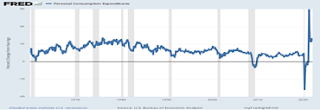
Another well-known fact is that prices plunge substantially during recessions when consumers slow spending, which is portrayed in the above FRED of personal consumption expenditures, our best measure of consumer spending.

Consumption only dipped below zero once since 1950, during the 2007-09 Great Recession that was worldwide, as I said. All other recessions (gray bars in graph) showed a consumption drop that was quickly mitigated by the Fed reversing course and dropping their interest rates.

So what is different this time? The last recession lasted just two months—from Mar-April 2020—caused by the first worldwide pandemic in 100 years that shut down economic activity completely, rather than an over-heated economy.

The inflation rate quickly dropped to zero, but took off as quickly because of the $trillions in pandemic aid, igniting the latest inflation surge. Other countries are taking longer to recover, and so the supply-chains are playing catchup to the surging demand for more goods and services.

When will a new equilibrium between supply and demand be established? It’s hard to say with a fully employed economy and consumers so willing to spend.

Larry Summers is the preeminent inflation hawk, though he has softened his rhetoric of late as inflation has subsided. I repeat a recent quote of his from Bloomberg news that has been scaring financial markets.

“We need five years of unemployment above 5% to contain inflation -- in other words, we need two years of 7.5% unemployment or five years of 6% unemployment or one year of 10% unemployment,” said Summers said in a recent speech in London. “There are numbers that are remarkably discouraging relative to the Fed Reserve view.”

His remarks are based on an outmoded thesis of classical economic theory left over from the inflationary spiral of the 1970s; suppress demand by suppressing hiring and the labor market with very high interest rates rather than wait for healthier supply-chains.

And supply-chains are recovering. The US Chamber of Commerce just reported for all of 2022 that exports of goods and services increased $453.1 billion to $3,009.7 billion, passing the $3 trillion mark for the first time. Imports of goods and services hit $3,957.8 billion, up $556.1 billion from 2021 and the highest on record.

Increasing supplies should continue to bring down inflation, in other words. But holding to a 2 percent inflation target, though Powell had said the Fed would be flexible, almost guarantees a recession.

Harlan Green © 2023

Follow Harlan Green on Twitter: https://twitter.com/HarlanGreen

Thursday, December 1, 2022

Inflation Decine Accelerating

 Financial FAQs

Another inflation indicator, the Personal Consumption Expenditure Index (PCE) is declining as well, which is a broader measure of inflation preferred by the Federal Reserve than the Consumer Price Index (CPI). This is probably why Fed Chair Powell sounded more dovish about inflation prospects in Wednesday’s press conference.

The yearly rate of inflation slowed to 6 percent in October from 6.2 percent in the prior month and a 40-year high of 7 percent last summer, as portrayed in the FRED graph below. The PCE index is the best measure of inflation, especially the core gauge that strips out volatile food and energy costs.

“From the same month one year ago, the PCE price index for October increased 6.0 percent (table 11),” said the BEA. Prices for goods increased 7.2 percent and prices for services increased 5.4 percent. Food prices increased 11.6 percent and energy prices increased 18.4 percent. Excluding food and energy, the PCE price index increased 5.0 percent from one year ago.”


FREDpce

The core rate of inflation in the past 12 months slipped to 5 percent from 5.2 percent. It’s also down from a 40-year high of 5.4 percent last February. Consumer’s items were still expensive, however.

Federal Reserve Chairman Jerome Powell’s press conference was noteworthy because he signaled that smaller rate increases (than the last 4 0.75 increases) were in the offing because there were signs that the demand for goods and services was softening.

“The time for moderating the pace of rate increases may come as soon as the December meeting,” Powell said, in a speech to the Brookings Institution.

So much depends on what consumers do over the coming months. They continue to push up prices by keeping up with inflation. Consumer spending had fallen somewhat, though the latest figures coming into the holidays were still robust.

Americans spent more in November on gasoline, per the BEA, largely reflecting an increase in prices at the pump. They also spent more on new cars, dining out and hotel stays.

But gasoline prices, a key ingredient of consumer prices, are about to take another plunge. Average national gasoline prices have already fallen to pre-Ukraine war prices of $3.50 per gallon, a boon to consumers over the holidays.

Why? China’s economy is stagnating as its Communist Party insists on locking down its cities, rather than inoculating most of its citizens, a lesson in hubris for a government that chooses coercion over the protection of its citizens.

The lesson ought to be that our Federal Reserve should listen to the citizens as well, who rather than government and the pundits, know what is best for them.

Harlan Green © 2022

Follow Harlan Green on Twitter: https://twitter.com/HarlanGreen

Thursday, July 21, 2022

Retail Sales Keep US Growing

Financial FAQs

FREDretailsales

U.S. retail sales rebounded strongly in June as Americans spent more on gasoline and other goods amid soaring inflation, which could allay fears of an imminent recession but not change the view that economic growth in the second quarter was tepid, if not slightly negative.

Is it good enough to stave off a recession next year? Consumer spending drives almost two-thirds of economic growth, with retail sales half of spending. The post-pandemic spending spike has slowly subsided from a 100-mph speed aided by government subsidies to its present 60-mph cruising speed, as I said last week; which is still above average per the FRED graph.

Maintaining that speed depends in part on the inflation picture, of course, which will slowly subside as the supply-shocks diminish. Gas prices, for instance, have dropped more than 40 cents over the past month, which is a large part of the recent inflation surge.

Reuters reports the nearly broad increase in retail sales last month was led by receipts at auto dealerships, which rebounded 0.8 percent after declining 3.0 percent in May amid shortages. Sales at service stations increased 3.6 percent.

“Gasoline prices surged in June, averaging above $5 per gallon,” said Reuters, “according to data from motorist advocacy group AAA. Prices at the pump have since declined from last month's record peaks and were averaging $4.577 per gallon on Friday.

Receipts at bars and restaurants, the only services category in the retail sales report, increased 1.0 percent, another sign of strength. There were strong gains in sales at furniture and electronics and appliance retailers. Receipts at sporting goods, hobby, musical instruments, and bookstores also rose. Online store sales rebounded 2.2 percent.

The annual CPI retail rate in the US accelerated to 9.1 percent in June of 2022, the highest since November of 1981, from 8.6 percent in May and above market forecasts of 8.8 percent.

It was mainly energy prices that rose 41.6 percent, the most since April 1980, boosted by gasoline (59.9 percent), fuel oil (98.5 percent), electricity (13.7 percent, the largest increase since April 2006), and natural gas (38.4 percent, the largest increase since October 2005).

Consumer spending is keeping up with inflation to date, with personal consumption expenditures (PCE) still up 7.2 percent overall, 5.2 percent YoY without more volatile food and energy prices, which is causing most of the current inflationary spike.

Concern about inflation eased in July alongside a sharp drop in gasoline prices over the past month, reports the University of Michigan consumer sentiment survey.

Thanks to Paul Krugman and the NY Times for this graph showing the gradual decrease in 3-year and 5-year inflation expectations, an important indicator of how consumers might behave if higher inflation isn’t prolonged.

Krugman/NYTimes

The University of Michigan's preliminary survey of consumers for July published on Friday showed consumers see inflation running at 2.8 percent over a five-year horizon, the lowest in a year and down from 3.1 percent in June. Their one-year outlook for price increases moderated to 5.2 percent from 5.3 percent a month earlier and was the lowest since February.

Inflation worries are still causing the whipsaw in financial market prices. So, how long can this surge in prices last, given the Ukraine war, China’s COVID problems, and the ongoing pandemic restrictions?

Even if growth continues to slow further, consumers at present are saying they are optimistic enough about the future to avoid a recession.

Harlan Green © 2022

Follow Harlan Green on Twitter: https://twitter.com/HarlanGreen


Friday, May 27, 2022

Consumers Disregard Inflation Data

 Financial FAQs

FREDpersonalconsumption

The Federal Reserve’s Personal Consumption Expenditures Index (PCE), its preferred inflation indicator, rose just 0.2 percent in April to mark the smallest increase in a year and a half, aided by a decline in gas prices.

The rise in the so-called personal consumption price index was the smallest since November 2020 and is cheering the financial markets as a first sign that the inflation burden may be easing.

The rate of inflation over the past year, based on the PCE, slowed to 6.3 percent in April from a 40-year high of 6.6 percent in March. It was also the first decline in a year and a half.

This is while consumers’ personal consumption expenditures have risen 6 percent in a year—see the above FRED graph. This graph in one picture shows how much consumer spending has skyrocketed since the pandemic—after just 2 percent average annual growth rates since the Great Recession. It is the highest spending increases since 1980 caused by the record inflation of the 1970s.

But maybe inflation will not be such a problem this time? If inflation continues to moderate—despite the Ukraine war and China’s slowdown—consumers could continue to be the engine of growth without the sky-high inflation of the 1970s that plagued Americans, then. Most of the supply shortages are temporary shocks caused by the pandemic and above-mentioned issues. The U.S. now leads even China (temporarily) as the world’s fastest growing economy while China wrestles with its own COVID crisis.

That is the big question. Corporations have been reporting record profits, and able to pass most of their increased product costs onto consumers. Will they continue to hire more workers at the torrid pace since the pandemic recovery, which will keep consumers happy and continuing their spending ways?

The number of Americans filing new claims for unemployment benefits fell more than expected last week as the labor market remains tight amid strong demand for workers despite rising interest rates and tightening financial conditions.

And with a record 11.5 million job openings at the end of March, layoffs are likely to be minimal and people who lose a job can easily find another one.

The minutes of the Fed's May 3-4 meeting published on Wednesday showed officials commenting that "demand for labor continued to outstrip available supply across many parts of the economy and that their business contacts continued to report difficulties in hiring and retaining workers." Many expected the labor market to remain tight and wage pressures to stay elevated for some time.

We must now wait to see what the Fed’s push to raise interest rates will do to future growth. Will it slow consumers spending and help to slow the prices rises further, averting the re-occurrence of a 1970’s-style stagflation?

Harlan Green © 2022

Follow Harlan Green on Twitter: https://twitter.com/HarlanGreen

Saturday, February 26, 2022

What Happens Now In 2022?

Financial FAQs

BEA.gov

We have a looming Cold War with Russia due to its invasion of the Ukraine, as well as inflation to worry about this year. What will it do to economic growth and jobs?

Inflation won’t recede soon with soaring oil prices, but higher economic growth is in the cards for the New Year. The Fed’s favorite indicator of consumption, the Personal Consumption Expenditure price index (PCE) gained 6.1 percent year-over-year in January, the largest gain since 1982, and consumer spending in January rose 2.1 percent month-over-month, better than the expected forecast of 1.5%.

“At least for now, consumers aren’t pulling back much on their spending in light of high inflation,” said one commentator.

Other indicators of growth aren’t slowing, either, according to the flash IHS Markit flash surveys of the manufacturing and service sectors. Both surveys have risen to the mid-50s, a strong sign of future growth in both sectors.

And Q4 GDP growth was revised slightly higher in its second estimate to 7 percent, the highest growth rate in 40 years. Job creation will also continue to grow as the Omicron variant recedes.

There is more good news on jobs. Initial jobless benefit claims fell by 17,000 to 232,000 in the week ended Feb. 19, the Labor Department said Thursday. The number of people already collecting jobless benefits fell by 112,000 to 1.48 million in the week ended Feb. 12. These so-called continuing claims are at their lowest level since March 1970, which means new job creation exceeds those being laid off or quitting.

The main issue is what all this does to continuing job growth, with the Omicron variant infections returning to pre-Omicron levels. The CDC news is also good on that front.

CDC.com

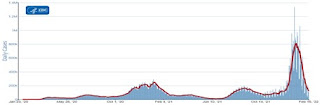
The CDC said, “as of February 16, 2022, the current 7-day moving average of daily new cases (121,665) decreased 43.0% compared with the previous 7-day moving average (213,625). A total of 78,060,327 COVID-19 cases have been reported in the United States as of February 16, 2022.

The elephant in the room that could cancel the good news is effects from the invasion of the Ukraine, of course, especially sanctions that might prolong the high inflation numbers.

Excluding volatile gas and vehicle sales, the PCE price index quoted above rose 5.2 percent, and consumers in the latest University of Michigan sentiment survey don’t see prolonged inflation.

So with the Omicron variant receding, the duration of higher inflation will depend on what is happening in the Ukraine. That will be hard to predict with a Russian dictator who seems to have lost touch with reality. Does he really want to start another Cold War with the Western world united against him?

I don't think so.

Harlan Green © 2022

Follow Harlan Green on Twitter: https://twitter.com/HarlanGreen