Friday, February 12, 2016

The Candidates Economic Promises vs. Pronouncements


Who should we believe of the leading candidates remaining in the Presidential primaries that last through June?  Bernie says he will tax the wealthiest enough to pay for his programs, such as free public college tuition and universal health care.  But that means raising middle class taxes, as well.
The Donald says he is such a successful businessman that he will negotiate us out of all our problems.  But how much can he be believed with four bankruptcies and three marriages already?
Polls show that economic issues top the voters’ concerns, so we should look at the how they will solve those issues.  Bernie believes he will save citizens money by converting to universal health care, because if everyone’s covered, the government will have the clout to negotiate down drug and hospital costs.
Though Trump says he won’t touch social security and Medicare, he would cut taxes for the wealthiest even more, which will only increase the budget deficit.  That’s because trickle-down economics doesn’t work (i.e., more tax breaks for the wealthiest), as evidenced by GW Bush’s two recessions and 8 million jobs lost during his 8 years.
            So Mr. Trump is trying to convince us that he is the better negotiator than President Obama, who has managed to pass so many progressive programs (like Obamacare) that conservatives say they feel betrayed.  His most hollow pronouncement is the Wall to keep out Hispanic immigrantss, when as many enter through Florida and New York, not to speak of California, and maybe Canada?  So he would have to build a wall that surrounds all of US!
Today’s economy is experiencing both record income inequality, since the wages and salaries of 80 percent of our workforce have barely risen above inflation for the past 30 years, and our degraded infrastructure.  And let us not forget Flint, but also the many other municipalities with drinking water problems.


Senator Bernie says we are the only developed country without universal healthcare and tuition free higher education.  Denmark is his oft-repeated example, but they pay for it with a maximum tax rate of 60 percent. Well, America had a maximum tax rate of 92 percent during President Eisenhower’s reign, which enabled US to build our freeway system, land on the moon, create the Internet, and we still had a 4 percent plus growth rate during that time.
So can Bernie’s promises be paid for?  We would have to reverse a trend of lower taxes begun in the 1970s.  That means bringing out new voters—mostly young—that have been sitting on the sidelines until now.  The New Hampshire primary results show that the new voter turnout was HUGE, in Bernie’s words.  But as Rachel Maddow pointed out on MSNBC, they were mostly Republicans.
His test will come with the upcoming Nevada caucus and South Carolina primary, with their much more diverse ethnicities.  The economic issues being debated this election year are really between facts and fiction—whether economic facts can trump political ideologies.  That’s the bottom line.  We, the United States of America can’t grow and thrive without our citizens having the benefits of every other developed country, and many undeveloped ones.
Those benefits may seem expensive, as in the Nordic countries, but the drag to economic growth from neglecting these issues is even more expensive—with the ongoing poor health outcomes, a crumbling infrastructure, and unprotected environment.

Harlan Green © 2016

Follow Harlan Green on Twitter: https://twitter.com/HarlanGreen

Wednesday, February 10, 2016

Job Openings and Hires at Record Levels


Job openings rose 5 percent to 5.6 million in December, the Labor Department said Tuesday. So why are the financial markets worrying about a looming recession?  That reading was the second-highest ever recorded, behind only July 2015, when it touched 5.7 million. Hires rose to 5.36 million from 5.25 million. That’s not just good for job-seekers—it also shows that employers and job seekers are finding each other. 


The above graph shows job openings (yellow line), hires (dark blue), Layoff, Discharges and other (red column), and Quits (light blue column) from the Labor Department’s JOLTS report. Voluntary quits also surged, rising 7 percent to 3.1 million, a sign of worker confidence. Quits are generally voluntary separations initiated by the employee. Therefore, the quits rate can serve as a measure of workers’ willingness or ability to leave jobs. ... There were 3.1 million quits in December, up from November. This is even higher than in December 2007 (2.8 million), the first month of the recession, says Calculated Risk
            Nobelist Paul Krugman has said it has taken this long for the hire rate to catch up to job openings because of the lack of overall, or aggregate demand, rather than structural factors.  (That is, the lack of workers with certain skills.)  In other words, wages haven’t been spiking in certain job categories, but have been low in all job categories.

“You see, when the Great Recession struck — a demand-side shock if ever there was one — it took no time at all for a strange consensus to develop in elite opinion, to the effect that a large part of the rise in unemployment was “structural,” and could not be reversed simply by a recovery in demand. Workers just didn’t have the right skills, you see. Many of us argued at length that this was foolish. If skills were the problem, where were the occupations with rapidly rising wages? I pointed out that people said the same thing during the Great Depression, only to see it disproved when we finally got a big fiscal stimulus called World War II.”

And even the problem with low overall wages may be disappearing.  The January unemployment report showed consumer incomes rising faster overall.  Though nonfarm payrolls rose just 151,000 in January, it was enough to push the unemployment down to 4.9 percent and average hourly earnings up 0.5 percent.
             The 0.5 percent monthly spike in average hourly earnings may largely be due to rises in the minimum wage that are beginning to take effect, say the pundits. Hooray!  This is the second strongest gain of the whole cycle, back to 2008, and means a large portion of the lowest-paid workers will finally see an improvement in their living standards.
So will the financial markets come to the realization that our economy doesn’t depend on high oil prices, as alternative energy sources such as wind and solar power begin to take over?  Those falling oil prices mean consumers have more to spend on such as autos, and yes, housing.   The good news is with residential housing where construction spending rose a very strong 0.9 percent on the month led once again by multi-family units. But single-family units have also been strong, up a year-on-year 8.7 percent.
And interest rates are back to record lows, including mortgage rates, which will also boost consumer spending, and keep us out any recession.

Harlan Green © 2016

Follow Harlan Green on Twitter: https://twitter.com/HarlanGreen

Tuesday, February 9, 2016

Why Are Mortgage Rates At Historical Lows?


Mortgage rates continued to tumble over the past week as investors fled to the safety of government bonds, pushing Treasury yields down, mortgage provider Freddie Mac said Thursday. This is no surprise given the geopolitical uncertainties buffeting economies worldwide.


The 30-year fixed-rate mortgage averaged 3.72 percent in the Feb. 4 week, down from 3.79 percent from a week earlier and is at the lowest level since April 30, Freddie Mac said. The 15-year fixed-rate mortgage averaged 3.01 percent, down from 3.07 percent. The 5-year Treasury-indexed hybrid adjustable-rate mortgage averaged 2.85 percent, down 5 basis points.

“These declines are not what the market anticipated when the Fed raised the Federal Funds rate in December,” Freddie’s chief economist, Sean Becketti, noted in a statement. “For now, though, sub-4 percent mortgage rates are providing a longer-than-expected opportunity for mortgage borrowers to buy or refinance.”

In fact, the 30-year conforming fixed rate can currently be bought down to 3.25 percent.  This is a historical low, and causing a rise in mortgage applications.  The Refinance Index increased 0.3 percent from the previous week to its highest level since October 2015, reports the MBA. The seasonally adjusted Purchase Index decreased 7 percent from one week earlier. The unadjusted Purchase Index increased 11 percent compared with the previous week and was 17 percent higher than the same week one year ago.

But for how long can these below-historically-low rates continue?  Too much oil, for one, should help to keep oil prices, and therefore inflation, almost non-existent for this year, at least.  That’s according to Barron’s resident economist Gene Epstein.  “…over the past five years,” says Epstein, “the world has found a trillion extra barrels of oil—the equivalent of 30 years of extra supply—with a third of it coming from shale, a third from deep water, and a third from oil sands. Over the past year, the costs of recovery from these sources has noticeably fallen. A return to triple-digit prices on crude oil is (therefore) unlikely for the foreseeable future.” 


            But there’s another reason for such low interest rates.  Growth is slowing worldwide, which is the major reason inflation is so low.  And Janet Yellen is now backtracking on raising the Fed’s rates any higher this year.
            But consumers don’t seem to be listening to the bad news. Consumer spending — the main engine of the U.S. economy — rose 3.1 percent in 2015 to set the fastest pace since 2005. Unless Americans suddenly turn pessimistic, they’ll keep spending at a decent clip this year and give businesses no reason to resort to mass layoffs.
One major bellwether is car sales, says Marketwatch’s Jeffry Bartash. After snapping up a record 17.5 million new vehicles in 2015, Americans were back at it in January. Sales rose last month rose at the same robust 17.5 million pace. “That’s not a sign of an increasingly anxious consumer.”

Harlan Green © 2016

Follow Harlan Green on Twitter: https://twitter.com/HarlanGreen

Wednesday, February 3, 2016

Davos Highlights Why Slower Growth

It's time for the World Economic Forum, and this year more than 40 heads of state and 2,500 other participants are unlikely to run short of topics to discuss. "Meeting against a backdrop of market jitters, heightened geopolitical risks and a renewed focus on climate change, there will be intense focus on how these A-listers propose to solve the challenges facing the global economy," reports Marketwatch about the meeting held at the ski resort of Davos, Switzerland.
What should be at the center of discussions is the increased inequality in wealth and income that is affecting U.S. economic growth in particular, but also the rest of the world. But instead of inequality, most of the attention has been focused on China's growth problems, as if China is the world's piggy bank. But it isn't.
How does inequality affect economic growth? Nobelist Joseph Stiglitz has written most recently about what he calls the "Great Malaise", and IMF President Christine LaGarde says is the "New Mediocre" in worldwide economic growth.

"The economics of this inertia is easy to understand," says Stiglitz, "and there are readily available remedies. The world faces a deficiency of aggregate demand, brought on by a combination of growing inequality and a mindless wave of fiscal austerity. Those at the top spend far less than those at the bottom, so that as money moves up, demand goes down. And countries like Germany that consistently maintain external surpluses are contributing significantly to the key problem of insufficient global demand."

What is aggregate demand? It is an economic term that describes the overall demand for goods and services from consumers, business, and government, first formulated by the British economist JM Keynes. Professor Stiglitz's thesis is that when most of the wealth goes to the top income brackets, less of it gets spent or invested in productive enterprises.


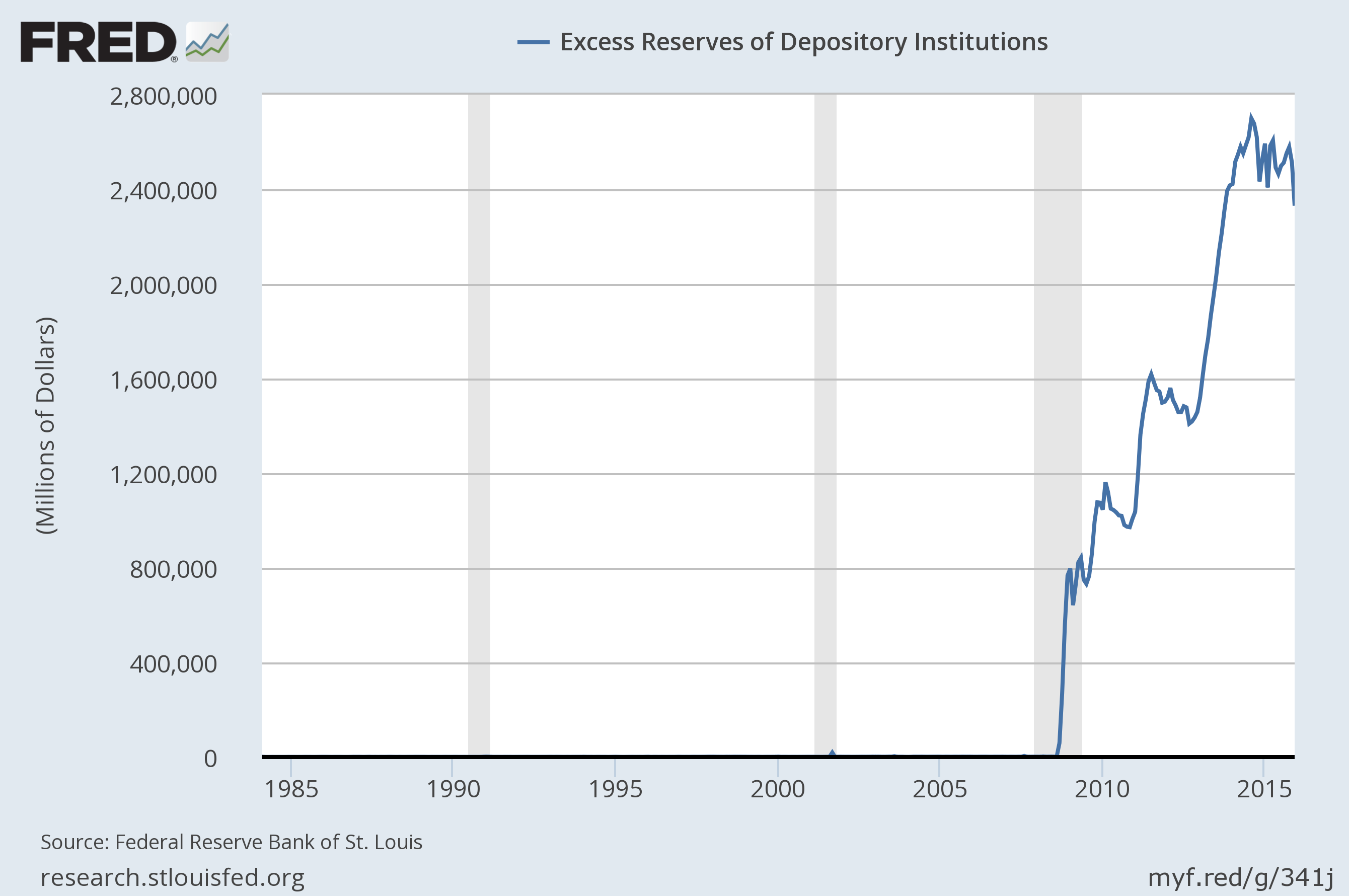
This is evidenced by the huge amounts of wealth that is hoarded where it does the least good. Corporations are holding more than $5 trillion in cash and cash equivalent assets, rather than investing it in productive enterprises. And the Federal Reserve is holding more than $2 trillion is excess reserves in MZM deposits, meaning that they earn little or no interest.
In fact, the St. Louis Federal Reserve Bank reports the Federal Reserve Banks currently hold some $2,330, 461,000 in excess reserves (that are reserves beyond the required minimum bank capital reserves), whereas it was close to $0 before the Great Recession. Why isn't it being invested productively?
The New York Fed says it is a byproduct of the Fed's easy credit policies. The Federal Reserve Banks lend to commercial banks so that banks with constrained liquidity as a result of the Great Recession will continue to lend. Those loans end up as excess reserves on the Fed's books. But who are the banks lending to? Much of Wall Street's borrowing is for leveraged buyouts, or buybacks of stock to boost stock prices (and CEO salaries, let us not forget).
This is not where banks should be lending, if the goal is to increase productivity, and so economic growth. A major reason for the Great Malaise is the huge cutback in government investments in productive enterprises, such roads and bridges, or R&D, or education, due to the ongoing austerity policies of the western world mentioned by Dr. Stiglitz.
In the U.S., it has been conservative politicians -- mainly Republicans -- that oppose any government stimulus programs, which they believe takes wealth away from those that already have it. But that 'no compromise" mentality made infamous by former House Speaker Boehner has made everyone poorer in the long run, and our public infrastructure in grave danger of collapse.
There is some hope with the new U.S. $1.1 trillion budget agreement, plus the $305 billion Highway Infrastructure Act, plus the Paris Climate Change Accord that should pump $Billions into alternative energy technologies, will mean government is coming back into the productive investment game.
That is how our public highway system was built, after all, as well as our space program, countless medical advances, public education, disaster relief, and the Internet. It took public monies to create the new technologies that private enterprise believed was either too risky, or didn't benefit them directly. So how much longer can such austerians continue to block economic growth and a more hopeful future?

"The obstacles the global economy faces are not rooted in economics, but in politics and ideology," continues Stiglitz. "The private sector created the inequality and environmental degradation with which we must now reckon. Markets won't be able to solve these and other critical problems that they have created, or restore prosperity, on their own. Active government policies are needed."

Will those attending Davos give us any new ideas on how to boost economic growth? The Paris Accord brought 200 countries together to limit global warming. Can these 'A-listers' do any better? I doubt it.

Harlan Green © 2016

Follow Harlan Green on Twitter: www.twitter.com/HarlanGreen

Saturday, January 30, 2016

Why Slower Q4 Growth?

Gross domestic product — the value of everything a nation produces — expanded at a 0.7 percent annual rate from October to December. That’s a big markdown from 2 percent growth in the fall and 3.9 percent last spring. The economy expanded at a 2.4 percent clip last year, the same as in 2014, the Commerce Department said. Alas, the U.S. hasn’t topped 3 percent growth since 2005.

But those numbers may be revised higher, as more data on imports/exports and inventories for December come in. Hence there are two more revisions to the Q4 GDP estimate put out by Commerce. Softer consumer spending, falling exports and a smaller buildup in business inventories were largely the cause of the fourth-quarter slowdown, fresh government data showed.
Graph: Marketwatch
However, the biggest drag on growth was in industrial production. Though the drop in industrial production in the fourth quarter was concentrated not in manufacturing, per se, but in mining and utilities, mostly due to falling energy prices, says Marketwatch’s Rex Nutting.

“Manufacturing output slowed in the fourth quarter, but it did grow, at an anemic annual rate of 0.5 percent. Meanwhile, mining output (mostly petroleum and other fossil fuels) plunged at a 15.5 percent rate and utilities (hurt by the warmer-than-usual fall) saw seasonally adjusted output drop at a 15.4 percent annual rate.”

On the other hand, spending on services was higher, adding 0.9 percentage points, as was spending on goods, at plus 0.5. Residential investment, another measure of consumer health, rose very solidly once again, contributing 0.3 percentage points. Government purchases added modestly to growth.

Inflation fell again, but personal consumption is holding up, as is consumer sentiment. And next week’s December unemployment report will tell us if January growth might pick up, since strong employment tends to boost consumer spending.
Consumer spending may not be that strong but consumer confidence is solid, at 98.1 in January, says the Conference Board. “Consumer confidence improved slightly in January, following an increase in December,” said Lynn Franco, Director of Economic Indicators at The Conference Board. “Consumers’ assessment of current conditions held steady, while their expectations for the next six months improved moderately. For now, consumers do not foresee the volatility in financial markets as having a negative impact on the economy.”

The assessment of the current jobs market is favorable with only 23.4 percent describing jobs as hard to get. This is a low percentage for this reading and down more than 1 percentage point from December. But improvement here is offset by a dip in those describing jobs as currently plentiful, down 1.4 percentage points to 22.8 percent.

The bottom line is economic growth has slowed due to a decline in energy and commodity prices that hurts some industrial sectors, but it helps consumers. And consumers account for some 70 percent of economic activity these days. So look for increased government spending (state and national) on public works, as well as more new home construction to keep us out of a recession in 2016. This activity is all domestic, which isn’t affected by what is happening in China, Europe, the Middle East, Russia, and other third world countries.
Harlan Green © 2016 

Follow Harlan Green on Twitter: https://twitter.com/HarlanGreen

Thursday, January 28, 2016

More Jobs = Higher Consumer Optimism = More Housing


Twenty Five states had lower unemployment, reports the Bureau of Labor Statistics, as the economic recovery continues.  That is probably why consumers continue to be optimistic and housing prices continues to soar—as high as 11 percent in Portland, San Francisco, and Denver, reports the latest S&P Case Shiller Housing Price Index.


Graph: Calculated Risk

            Only 8 states, from New Mexico to Louisiana, now have more than 6 percent unemployment.  Even energy-dependent states like Oklahoma and Texas are at less than 5 percent unemployment.
            The S&P/Case-Shiller U.S. National Home Price Index, covering all nine U.S. census divisions, recorded a slightly higher year-over-year gain with a 5.3 percent annual increase in November 2015 versus a 5.1 percent increase in October 2015. The 10-City Composite increased 5.3 percent in the year to November compared to 5.0 percent previously. The 20-City Composite’s year-over-year gain was 5.8 percent, up from 5.5 percent reported in October.


This hardly puts housing prices in bubble territory.  They rose more than 10 percent in 2014, before dipping back to the current increases.  And it is putting pressure on the housing inventory, now down to a 3 months’ supply for new housing.  So look for a continued surge in housing construction this year, which gives another boost to overall growth.


            Builders broke ground on 1.11 million homes in 2015, more than at any point since 2007, according to a recent UBS study. That was an 11 percent gain compared to 2014. The consensus view of 1.25 million that UBS cites would represent a 13 percent gain in 2016. Their own forecast is for 1.31 million starts, an 18 percent jump.
            The result is more new home sales, as sales ran at an annual pace of 544,000, the highest since February, the Commerce Department said Wednesday. November’s previously-reported 490,000 pace was revised up to 491,000.  In all, some 501,000 new homes were sold during 2015, Commerce said, a 14.5% increase over 2014’s tally.
            Consumer spending may not be that strong but consumer confidence is solid, at 98.1 in January, says The Conference Board. “Consumer confidence improved slightly in January, following an increase in December,” said Lynn Franco, Director of Economic Indicators at The Conference Board. “Consumers’ assessment of current conditions held steady, while their expectations for the next six months improved moderately. For now, consumers do not foresee the volatility in financial markets as having a negative impact on the economy.”
            Is this a good sign for future employment?  That depends if consumers continue to spend.  Retail sales have dipped below 4 percent annually in 2015, and the stock market is particularly volatile due to the uncertainty over energy prices.  But this has not affected the mood of consumers, yet. 

Harlan Green © 2016

Follow Harlan Green on Twitter: https://twitter.com/HarlanGreen