Showing posts with label Joseph Stiglitz. Show all posts

Wednesday, September 14, 2022

What is the Real Inflation Problem?

 Financial FAQs


FREDppi

What is worse, inflation rates, say, of 4 to 5 percent—slightly above historical averages, and average gas prices maybe $3.50 per gallon as they are today—or raising short term rates enough to make consumers pay more and job losses mount?

That is essentially the devil’s bargain the Fed seems to be offering Americans by Fed Chair Powell insisting that, “Reducing inflation is likely to require a sustained period of below-trend growth,” in his speech to the central bankers and economists gathered at the base of the Grand Tetons.

As financial markets continue to plunge on fears that the Fed will slow down growth so much that it will induce a recession, economists such as Nobel Prize-winner Joseph Stiglitz are warning the Fed may go too far.

“Monetary policy typically affects economic performance with long and variable lags, especially in times of upheaval,” said Professor Stiglitz in a recent Project Syndicate article. “Given the depth of geopolitical, financial, and economic uncertainty – not least about the future course of inflation – the Fed would be wise to pause its rate hikes and wait until a more reliable assessment of the situation is possible.”

“There are several reasons to hold off," continues Stiglitz. "The first is simply that inflation has slowed sharply. Consumer price index (CPI) inflation – the measure most relevant to households – was zero in July, and it is likely to have been zero or even negative in August (was 0.1%). Similarly, the personal consumption expenditure (PCE) deflator – another often-used measure based on GDP accounts – fell by 0.1% in July.”

So, the Fed may be looking in the wrong direction (the 1970s) for the causes of inflation. Wages, which were considered the main culprit for rising prices in the 70s, aren’t rising as they did then; have in fact fallen 2.8 percent behind the latest inflation surge.

Why not look at the much more severe and temporary supply-chain disruptions; the Ukraine war, and China’s COVID lockdowns as the major cause for the inflation spike?

Wholesales prices are falling even faster—with the Producer Price Index (PPI) down -0.1 percent in August reported today. The increase in the core prices without the volatile food and energy prices over the past year also slowed to 5.6 percent from 5.8 percent.

It makes more sense that markets should wait for the PPI index to come out before passing judgement on the Consumer Price Index, since the PPI ingredients (such as raw material prices) will tell us how retail (CPI) prices are trending. But, no, financial markets work on the hair-trigger principle, are too impatient in the one-click digital markets with their herd mentality to wait another day for the PPI results.

Counterbalancing rising inflation is also the super-strong Dollar making import prices cheaper for consumers and industrial materials. The dollar index, which tracks the greenback against its peers, was up 1.5 percent at 109.85 in its biggest one-day percentage gain since March 2020 after the CPI report.

Market traders and even retail players in financial markets have to be experiencing whiplash with Fed Governors continually pronouncing their take on current inflation conditions.

Yesterday’s 1200-point drop in the DOW and 100 plus point drop in the S&P indexes should be a lesson for traders to take their finger off the trigger more often and not keep firing indiscriminately at such a moving target as U.S. stock and bond prices.

It’s difficult to steer in the right direction when eyes are focused on the rear view mirror and stagflation fears of another era.

Harlan Green © 2022

Follow Harlan Green on Twitter: https://twitter.com/HarlanGreen

Tuesday, May 17, 2016

Why Too Little Inflation?

Financial FAQs

Where’s the inflation? It is barely rising, as consumers still wait for bargains, before they decide to buy. The overall Consumer Price Index in April rose just 1.1 percent, and is up 2.1 percent less food and energy prices, which have been falling this year.


Graph: Econoday

This is the major reason we saw just 0.5 percent GDP growth in Q1. It is the surest sign we are still in deflationary times, and the reason Janet Yellen’s Fed doesn’t want to raise short term rates further. We aren’t growing fast enough to put everyone to work—which includes some 8 million that are either working part time, or have stopped looking for work—which is why so many have listened to Bernie or Donald during the primaries.

Consumers sit on their pocket books when they believe prices might go lower, and job prospects aren’t so good. It is also how Japanese consumers continue to behave, as do Europeans during deflationary times, which keeps their economies from growing faster.

The U.S. isn’t as badly affected thanks to a very proactive Federal Reserve and the Obama administration $1.1T budget agreement that is pumping some infrastructure spending into public spending, as is the $305B Surface Transportation Bill that renewed the gasoline tax so that our roads and bridges can be repaired.

The new law, dubbed the Fixing America’s Surface Transportation Act, or the FAST Act, formally reauthorizes the collection of the 18.4 cents per gallon gas tax that is typically used to pay for transportation projects, and also includes $70 billion in “pay-fors” to close a $16 billion deficit in annual transportation funding that has developed as U.S. cars have become more fuel-efficient.


 Retail sales also jumped, along with consumer sentiment in April. So we should see better growth this Q2. What is causing the spike in consumer sentiment? The U. of Michigan’s consumer sentiment survey is absolutely soaring so far this month, up nearly 7 points to 95.8 for the mid-month flash, as we said last week. This is the best reading since June last year.

Retail sales surged in April a much higher-than-expected 1.3 percent for the best showing since March last year. The strength is broad based and includes auto sales which finally show some life for the first time this year, with a 3.2 percent monthly jump.

Nobelist Joseph Stiglitz has been pounding the table on what is needed for better economic growth. He says there is a deficiency in aggregate demand, a Keynesian formula that measures the overall demand in goods and service from government as well as consumer spending, and exports.
“Today’s markets are characterized by the persistence of high monopoly profits,” says Stiglitz. “The implications of this are profound. Many of the assumptions about market economies are based on acceptance of the competitive model, with marginal returns commensurate with social contributions. This view has led to hesitancy about official intervention: If markets are fundamentally efficient and fair, there is little that even the best of governments could do to improve matters.
“But if markets are based on exploitation (i.e., monopoly power), the rationale for laissez-faire disappears. Indeed, in that case, the battle against entrenched power is not only a battle for democracy; it is also a battle for efficiency and shared prosperity.”
So when the private sector won’t spend—thanks in large part to the monopoly power of Big Business that has kept most of their record profits in the board rooms or on Wall Street, rather than investing in plants and equipment—government has to tax more of those profits in order that they be put to productive use.

So welcome to the popularity of Sanders and Trump!

Harlan Green © 2016

Follow Harlan Green on Twitter: https://twitter.com/HarlanGreen

Wednesday, February 3, 2016

Davos Highlights Why Slower Growth

It's time for the World Economic Forum, and this year more than 40 heads of state and 2,500 other participants are unlikely to run short of topics to discuss. "Meeting against a backdrop of market jitters, heightened geopolitical risks and a renewed focus on climate change, there will be intense focus on how these A-listers propose to solve the challenges facing the global economy," reports Marketwatch about the meeting held at the ski resort of Davos, Switzerland.
What should be at the center of discussions is the increased inequality in wealth and income that is affecting U.S. economic growth in particular, but also the rest of the world. But instead of inequality, most of the attention has been focused on China's growth problems, as if China is the world's piggy bank. But it isn't.
How does inequality affect economic growth? Nobelist Joseph Stiglitz has written most recently about what he calls the "Great Malaise", and IMF President Christine LaGarde says is the "New Mediocre" in worldwide economic growth.

"The economics of this inertia is easy to understand," says Stiglitz, "and there are readily available remedies. The world faces a deficiency of aggregate demand, brought on by a combination of growing inequality and a mindless wave of fiscal austerity. Those at the top spend far less than those at the bottom, so that as money moves up, demand goes down. And countries like Germany that consistently maintain external surpluses are contributing significantly to the key problem of insufficient global demand."

What is aggregate demand? It is an economic term that describes the overall demand for goods and services from consumers, business, and government, first formulated by the British economist JM Keynes. Professor Stiglitz's thesis is that when most of the wealth goes to the top income brackets, less of it gets spent or invested in productive enterprises.


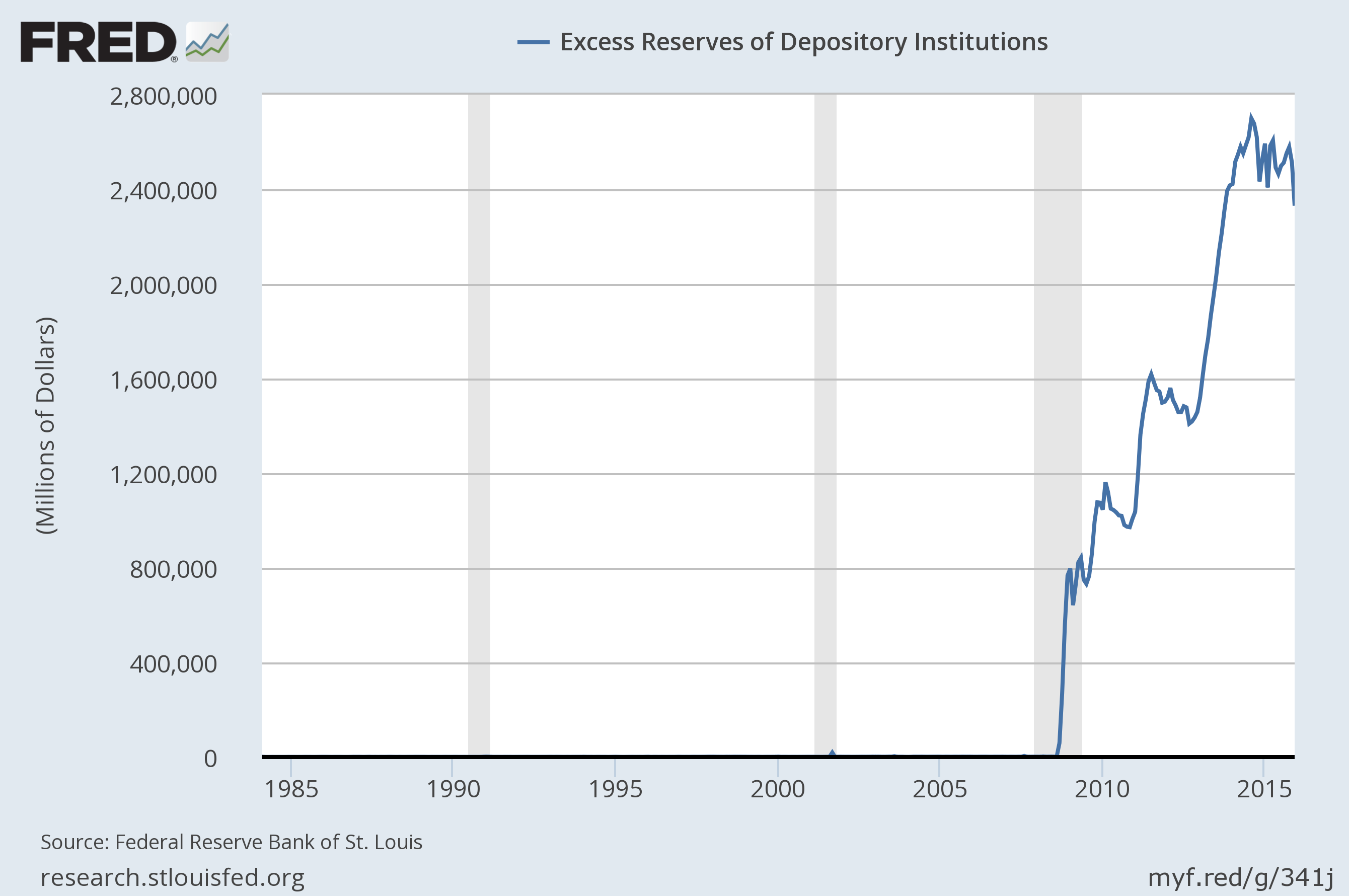
This is evidenced by the huge amounts of wealth that is hoarded where it does the least good. Corporations are holding more than $5 trillion in cash and cash equivalent assets, rather than investing it in productive enterprises. And the Federal Reserve is holding more than $2 trillion is excess reserves in MZM deposits, meaning that they earn little or no interest.
In fact, the St. Louis Federal Reserve Bank reports the Federal Reserve Banks currently hold some $2,330, 461,000 in excess reserves (that are reserves beyond the required minimum bank capital reserves), whereas it was close to $0 before the Great Recession. Why isn't it being invested productively?
The New York Fed says it is a byproduct of the Fed's easy credit policies. The Federal Reserve Banks lend to commercial banks so that banks with constrained liquidity as a result of the Great Recession will continue to lend. Those loans end up as excess reserves on the Fed's books. But who are the banks lending to? Much of Wall Street's borrowing is for leveraged buyouts, or buybacks of stock to boost stock prices (and CEO salaries, let us not forget).
This is not where banks should be lending, if the goal is to increase productivity, and so economic growth. A major reason for the Great Malaise is the huge cutback in government investments in productive enterprises, such roads and bridges, or R&D, or education, due to the ongoing austerity policies of the western world mentioned by Dr. Stiglitz.
In the U.S., it has been conservative politicians -- mainly Republicans -- that oppose any government stimulus programs, which they believe takes wealth away from those that already have it. But that 'no compromise" mentality made infamous by former House Speaker Boehner has made everyone poorer in the long run, and our public infrastructure in grave danger of collapse.
There is some hope with the new U.S. $1.1 trillion budget agreement, plus the $305 billion Highway Infrastructure Act, plus the Paris Climate Change Accord that should pump $Billions into alternative energy technologies, will mean government is coming back into the productive investment game.
That is how our public highway system was built, after all, as well as our space program, countless medical advances, public education, disaster relief, and the Internet. It took public monies to create the new technologies that private enterprise believed was either too risky, or didn't benefit them directly. So how much longer can such austerians continue to block economic growth and a more hopeful future?

"The obstacles the global economy faces are not rooted in economics, but in politics and ideology," continues Stiglitz. "The private sector created the inequality and environmental degradation with which we must now reckon. Markets won't be able to solve these and other critical problems that they have created, or restore prosperity, on their own. Active government policies are needed."

Will those attending Davos give us any new ideas on how to boost economic growth? The Paris Accord brought 200 countries together to limit global warming. Can these 'A-listers' do any better? I doubt it.

Harlan Green © 2016

Follow Harlan Green on Twitter: www.twitter.com/HarlanGreen

Friday, September 11, 2015

What Should Yellen’s Fed Do?

Popular Economics Weekly

The big question hovering over the markets (both stocks and bonds), is whether the Federal Reserve will finally begin to raise short term interest rates at next week’s FOMC meeting. Markets are uncertain, and only a few economists are saying anything. Why? Because of a tremendous (and artificial) fear of higher inflation, which shouldn’t be fearsome at all.

Nobelists Joseph Stiglitz and Paul Krugman say there is absolutely no reason to begin to raise the rock bottom interest rates yet. There’s still too many out of work—so much so, that wages and salaries are barely rising.

“If the Fed focuses excessively on inflation, it worsens inequality,” says Professor Stiglitz, “which, in turn, worsens overall economic performance. Wages falter during recessions; if the Fed then raises interest rates every time there is a sign of wage growth (a major effect on inflation), workers’ share will be ratcheted down, never recovering what was lost in the downturn.”

And much income has been lost, as Professor Krugman and the EPI have pointed out for years.

image

Graph: EPI

“Since 1973, hourly compensation of the vast majority of American workers has not risen in line with economy-wide productivity,” say the EPI authors. “In fact, hourly compensation has almost stopped rising at all. Net productivity grew 72.2 percent between 1973 and 2014. Yet inflation-adjusted hourly compensation of the median worker rose just 8.7 percent, or 0.20 percent annually, over this same period, with essentially all of the growth occurring between 1995 and 2002.”

The question is why the Fed is even discussing the possibility of higher rates with so many still out of work. There has to be some kind of mismatch in this picture, as a record 5.8 million job openings (yellow line in graph) were just reported in Labor Department’s Job Openings and Labor Turnover Survey.

The number of hires and separations edged down to 5.0 million and 4.7 million, respectively. Within separations, the quits rate was 1.9 percent for the fourth month in a row, and the layoffs and discharges rate declined to 1.1 percent. This means that

There were 2.7 million quits in July, little changed from June. Although the number of quits has been increasing overall since the end of the recession, the number has held between 2.7 million and 2.8 million for the past 11 months. Quits are generally voluntary separations initiated by the employee. Therefore, the quits rate can serve as a measure of workers’ willingness or ability to leave jobs.

So what is Chairperson Yellen and the Fed Governors to do? Their goal is to maximize the purchasing power of consumers that power most economic growth. If consumers can’t or won’t spend more, then economic growth is stuck.

image

Year-on-year wage growth is 2.2 percent, slightly higher, but inflation is falling, which means there are still too many out of work. The only way to increase wage growth is to allow a tighter labor market, which means keeping rates low as long as possible, without causing excessive inflation.

In fact, even 4 percent inflation would be preferable as a way to boost both jobs and economic growth. But will policy makers even allow such a thing? That’s the real (political) problem—the misconceptions about inflation.

Harlan Green © 2015

Follow Harlan Green on Twitter: https://twitter.com/HarlanGreen

Friday, September 19, 2014

Who Are the Real Takers?

Popular Economics Weekly

We have been there before. The Census Bureau reported that the poverty rate fell in 2013, the first drop since 2006. It fell to 14.5 percent, down from 15 percent in 2013, but 45.3 million people are still living at or below the poverty line, which for a family of four was $23,834.

Then who are the real "takers" that have held up economic growth and more jobs? It's can’t be the 47 percent that conservative polemicists and many of the 2012 presidential candidates maintained didn't pay federal income taxes. Three-quarters of entitlement benefits written into law in the United States go toward the elderly or disabled. That's according to the Center on Budget and Policy Priorities.

And it’s more than 90 percent of entitlement benefits when working households are included. Only about 9 percent of all entitlement benefits go toward non-elderly, non-disabled households without jobs (and much of that involves health care and unemployment insurance)

We should really be looking at those whose incomes have soared due to their success in slashing their own tax bills during difficult economic times, while blocking government job creation that would employ more of the 47 percent. The top 1 percent has taken 97 percent of income growth since the end of the Great Recession.

This is the first statistically significant decline in poverty since 2006 (and only the second since 2000). But the rate remained well above its 12.5 percent level in 2007 and even further above its 2000 level of 11.3 percent. At last year's rate of improvement, we would need to wait until 2018 for it to fall to or below the 2007 pre-recession level, and until 2020 to fall below the 2000 level, according to the Center For Budget and Policy Priorities.

Why do we have such a high poverty rate 5 years after the end of the Greatest Recession since the Great Recession? Who are the real takers that have not only created the greatest income and wealth inequality since the Great Depression that has created such dire poverty, but weakened our economy and power to maintain democratic values in the world?

FDR in his second inauguration speech said, “The test of our progress is not whether we add more to the abundance of those who have much, it is whether we provide enough for those who have too little.”

For starters, the red states controlled by Republicans have fought to downsize almost all government funded programs such as Medicare, food stamps, and Obamacare, yet they receive the largest share of government benefits, says Wallet Hub, a consumer finance blog.

For instance, South Carolina receives $7.87 for every $1 it pays in taxes. Mississippi and New Mexico, two of the most Red states, are ranked 40 out of 50 states in receiving the most in federal benefits, yet consistently vote for conservative policies that seek to limit government spending and benefits. And that includes badly needed spending on education, deteriorating infrastructure, and environmental regulation, all of which would provide more jobs in the underemployed U.S. economy.

This is an issue of our time, as we come severely weakened out of the Greatest Recession since the Great Depression. The takers are those who want it all, and the evidence is there for all to see—a weakened economy and a government lacking the powers to “stop evil and do good”.

“Nearly all of us recognize that as intricacies of human relationships increase,” said FDR in 1936 at the height of the Great Depression, “so power to govern them also must increase—power to stop evil; power to do good. The essential democracy of our nation and the safety of our people depend not upon the absence of power, but upon lodging it with those whom the people can change or continue at stated intervals through an honest and free system of elections.”

And so the real takers are also those who support ALEC, the American Legislative Exchange Council, or the Koch Brothers’ Americans for Prosperity that boilerplate legislation that has restricted voters’ rights by passing voter ID laws, restricting voting hours and anti-union collective bargaining, which are fundamental rights in any democracy.

It is mainly those conservative polemicists and presidential candidates who damn government in order to better their own financial position. And they have succeeded in lowering the maximum marginal tax rates from 92 percent during the Eisenhower presidency to its current low of 39 percent.

They have been so successful in taking from the wealth created by the many that the richest 10 percent now control some 50 percent of U.S. wealth, and most of the incomes growth since the end of the Great Recession, as we said.

Thomas Piketty, in his best-seller, Capital in the Twenty-First Century, perhaps said it best in attempting to explain why income and wealth inequality has worsened so much, brought about by lower taxation of the wealthiest.

“…the spectacular decrease in the progressivity of the income tax in the United and States and Britain since 1980, even though both countries had been among the leaders in progressive taxation after World War II, probably explains much of the increase in the very highest earned incomes,” he said.

Why lower taxation? Piketty explains it thusly. “Our finding that skyrocketing executive pay is fairly explained by the bargaining model (lower marginal tax rates encourage executives to bargain harder for higher pay) and does not have much to do with higher marginal productivity.”

There are several ways such record inequality slows growth. Firstly, growth is powered by what is called aggregate demand, the demand for goods and services that consumers, government, and investment generates. And since consumers power some 70 percent of economic activity and governments another 20 percent, when their spending declines, so does economic growth.

top-1

It is this record inequality that was the main cause of both the Great Depression and Recession, as declining incomes and cutbacks in government spending drastically reduced the demand for those goods and services. The years 1929 and 2010 were the years of greatest income inequality and greatest economic instability, according to Piketty and research partner Emmanuel Saez.

And economic growth has been steadily declining over the past 3 decades. It has averaged just 2 percent since the end of the Great Recession in 2009. There are numerous studies, including by the International Monetary Fund and Nobelist Joseph Stiglitz among others, that affirm the negative effect on growth of such inequality.

In fact, a recent IMF report said that “inequality can undermine progress in health and education, cause investment-reducing political and economic instability…which tends to reduce the pace and durability of growth."

So if we want to preserve our democracy, and help other countries towards greater democracy (instead of breeding more terrorism), we can no longer afford to allow the real takers to continue to take it all. The world has become too dangerous.

Harlan Green © 2014

Follow Harlan Green on Twitter: https://twitter.com/HarlanGreen

Saturday, April 6, 2013

David Stockman’s Crony Capitalism

Popular Economics Weekly

Paul Krugman is being too gentle with David Stockman, whose recent New York Times ‘rant’ glorifies the gold standard and denigrates government for standing in the way of putting “free markets and genuine wealth creation back into capitalism”.

“…like so many in his camp, Mr. Stockman misunderstands the meaning of rising debt,” writes Krugman. “Unemployment, not excessive money printing, is what ails us now — and policy should be doing more, not less.”

In fact, Stockman would return us to an earlier era of crony capitalism, before any form of financial regulation, such as by the Federal Reserve. The result then as now is huge income and wealth inequalities that have been the main cause of the Great Depression and major recessions—the last five just since 1980 during administrations that advocated deregulation and a similar opposition to financial regulation.

And then as now, there is an answer to the Oligarchies that ruled Big Business, as corporate monopolies have again concentrated their power today. President Obama gave a speech in Osawatomie, Kansas on December 6, 2011 about that earlier era. Osawatomie was the small town where Teddy Roosevelt gave his now famous “New Nationalism” speech in 1910 that called upon the three branches of the federal government to put the public welfare before the interests of money and property, because we were at a similar historical juncture. Corporate interests again control 2 branches of government—Congress and the Supreme Court—as they had in the early 1900s.

“At the turn of the last century, when a nation of farmers was transitioning to become the world's industrial giant, we had to decide,” said Obama. “Would we settle for a country where most of the new railroads and factories were being controlled by a few giant monopolies that kept prices high and wages low?... Because there were people who thought massive inequality and exploitation of people was just the price you pay for progress.”

Greater equality of opportunity is what economists such as Nobel Laureate Joseph Stiglitz are calling for today, in renewing the cry that we are all in this together. “There are four major reasons inequality is squelching our recovery,” says Stiglitz. “The most immediate is that our middle class is too weak to support the consumer spending that has historically driven our economic growth. While the top 1 percent of income earners took home 93 percent of the growth in incomes in 2010, the households in the middle — who are most likely to spend their incomes rather than save them and who are, in a sense, the true job creators — have lower household incomes, adjusted for inflation, than they did in 1996.”

Yet greater economic opportunity is more than a moral issue of what is fair, or even the core American value of everyone’s right to the pursuit of happiness. It can be inevitable if modern technology is allowed to fulfill its promise for all, rather than have it benefits be monopolized by the few.

For in an era where technology is replacing workers making the necessities of life at an ever accelerating rate, more Americans will have more leisure time to pursue their own interests. And more importantly, the ever increasing productivity of those technologies can lift all boats—that is, provide more necessities, as well as amenities to improve lives—rather than go only to the profit makers.

In giving his Kansas plea for a new nationalism of the common good, President Obama was going back to a time when Robber Barons ruled, having made enormous wealth from the founding of the railroads, banks, oil and steel industries in the 19th century.

It was the beginning of the Industrial Revolution, when most of America was rural and Oligarchs ruled government and business. Sound familiar? That has happened once again with the enormous fortunes created via deregulation and the digital revolution. And once again the majority of American households are suffering from the excesses of this modern revolution that has outdistanced the safeguards that were established to protect householders from those excesses.

“The American people are right in demanding that new Nationalism without which we cannot hope to deal with new problems,” said Roosevelt. “The new Nationalism puts the National need before sectional or personal advantage. It is impatient of the utter confusion that results from local legislatures attempting to treat National issues as local issues. It is still more impatient of the impotence which springs from over-division of governmental powers, the impotence which makes it possible for local selfishness or for legal cunning, hired by wealthy special interests, to bring National activities to a deadlock. This new Nationalism regards the executive power as the steward of public welfare. It demands of the judiciary that it shall be interested primarily in human welfare rather than in property, just as it demands that the representative.”

Actually, much of the Great Recession and slow recovery is due to widespread ignorance of economic fundamentals that depend on the public’s welfare. For no economy can prosper if educational and environmental standards are ignored, which enable social mobility and good health. It is also an ignorance of what is in our national interest. Raising educational and environmental standards, restoring our aging infrastructure, and creating a truly universal health care system make us more competitive globally.

Don’t take my word for it. Lord John Maynard Keynes saw the consequences of increasing abundance in his 1930 essay, Economic Possibilities for our Grandchildren: “Thus for the first time since his creation man will be faced with his real, his permanent problem – how to use his freedom from pressing economic cares, how to occupy the leisure, which science and compound interest will have won for him, to live wisely and agreeably and well. The strenuous purposeful money-makers may carry all of us along with them into the lap of economic abundance. But it will be those peoples, who can keep alive, and cultivate into a fuller perfection, the art of life itself and do not sell themselves for the means of life, who will be able to enjoy the abundance when it comes.”

And we are beginning to see that abundance, as well as the means to share it more fully, if the Stockman’s of the world would stop glorifying self-interested behavior. Professor Robert Shiller discusses how this can happen in his recent book, “The New Financial Order, Risk in the 21st Century”, in which he lays out what our new information technologies will be able to do, just as the Industrial Revolution ultimately benefited most Americans.

Right now we are witnessing an explosion of new information systems, payments systems, electronic markets, online personal financial planners, and other technologically induced economic innovations, and consequently much in our economy will be changed within just a few years. Almost all of our economy will be transformed within just a few decades. This new technology can do cheaply what once was expensive by systematizing our approach to risk management and by generating vast new repositories of information that make it possible for us to disperse risk and contain hazard.”

It will do all this by leveling the playing field in order to create a greater transparency of markets, as financial information in particular will be available to all. Therefore much of the risk in one’s profession, or housing value, or even health, will be able to be insured against unexpected events, such as recessions, or loss of career, or debilitating illnesses because of the new information technologies.

That is the real revolution happening today. Who will benefit from such modern information technologies--the few or the many? Because it will become more difficult for those who profit from such ignorance to accumulate excessive power. Stockman is wrong in believing we should turn back the clock. Or, as Teddy Roosevelt knew, we will continue to repeat past history.

Harlan Green © 2013

Follow Harlan Green on Twitter: www.twitter.com/HarlanGreen

Wednesday, October 31, 2012

Two Percent Growth Isn’t ‘New’ Normal

Popular Economics Weekly

There are many ways to look at the “weak” 2 percent growth numbers for Q3, though just the ‘Advance Estimate’ and so subject to at least 2 more revisions. But such weak growth isn’t due to excessive government regulations (since deregulation has not created greater overall growth, only more recessions). The record low interest rates mean that banks and corporations have too much money to spend, but no place to invest it, since consumers aren’t spending as they used to.

Weak growth over the past decade in particular can mainly be traced to the fall in household incomes, and what consumers can really afford. If their incomes were growing as in 2000 before the Bush tax cuts and wars, for instance, then we would already be back to 1990s levels of economic growth—when 4 to 6 percent annual growth rates were more normal—before the last 2 recessions (gray bars) as the graph shows.

clip_image002

Graph: Calculated Risk

And where has the lost household income flowed, since corporations have the highest profits in history as a percentage of GDP? It has been paid to the investor class and corporate CEOs, in the form of increased dividends, capital gains and stock options, or is part of the $2 trillion cash hoard held by corporations.

clip_image004

Graph: CBPP

For it is the tremendous shift of wealth that has stunted growth since 2000 and caused the Great Recession. Incomes of the wealthiest have soared, mainly because of 2001 and 2003 tax cuts that lowered investment tax rates for the wealthiest and drastically cut tax revenues, while incomes of 99 percent barely grew. This diminished purchasing power of consumers has accounted for most of the $6 trillion in lost output that resulted from the 18-month Great Recession (12/2007 – 6/2009).

It is an example of the failure of small government policies that instead of creating more prosperity for all, diverted it to the wealthiest. And the resulting record income inequality has damaged economic growth say more and more studies, such as a recent IMF study by Andrew Berg and Jonathan D. Ostry that suggests income inequality might shorten our economic expansion by one-third in jobs lost and goods products.

“…a careful look at the varying levels of inequality in different countries demonstrates just how much societal divides in wealth really matter. Countries with high inequality are far more likely to fall into financial crisis and far less likely to sustain economic growth,” said the authors in a Foreign Affairs article.

The U.S. has fallen to the lowest ranking on income inequality. The CIA World Fact Book ranks the U.S. 94th in income equality below all developed countries, Iran, and Russia. In fact, the U.S. is just above Jamaica and the poorest African countries. Wealth—both income and assets—has become concentrated among fewer and fewer Americans, in other words.

In spite of consumers’ massive loss of income, the University of Michigan reports confidence is being restored—though nothing like the 1990s readings of 100 plus. Hence the belief that consumers are becoming resigned to a ‘new’ lower growth normal. The 88.1 reading for current conditions is up a noticeable 2.4 points from September to hint at general growth for October's slate of economic data. The expectations index is up a sizable 5.5 points from September which hints at confidence in income prospects and is a positive for the holiday shopping outlook.

clip_image006

Graph: DShort

But this new normal for lower growth is nothing like the 1990s, as we’ve said, and as the graph makes clear. Contrary to Mitt Romney’s assertion that governments don’t create jobs, we can now see the effects of FEMA’s disaster relief efforts after Tropical Storm Sandy. Governments spend most revenues in the private sector—whether for defense, education, environmental protection, infrastructure or research.

So we do not have to accept slower growth, if we recognize and right the record inequality that has caused our market economy to repeatedly crash. As Nobel Economist Joseph Stiglitz was quoted in a recent review of his latest book, The Price of Inequality, “Inequality leads to lower growth and less efficiency. Lack of opportunity means that its most valuable asset — its people — is not being fully used. Many at the bottom, or even in the middle, are not living up to their potential, because the rich, needing few public services and worried that a strong government might redistribute income, use their political influence to cut taxes and curtail government spending. This leads to underinvestment in infrastructure, education and technology, impeding the engines of growth… “

Harlan Green © 2012

Friday, September 14, 2012

Income Inequality Behind Most Poverty

Financial FAQs

There were 46.2 million Americans in poverty in 2011, as median household income decreased to its lowest level since 2000, according to a Census Bureau report released this week that illustrated the toll from ongoing labor-market weakness.

The main culprit is the still high unemployment rate of 8.1 percent 3 years after the end of the Great Recession. But two other factors play a big part in creating the record poverty—the slow real estate recovery from its worst bust since the Great Depression, and growing inequality. The top 10 percent had the only income increases in 2011, according to U.S. Census figures.

Actually, both the unemployment rate and housing would be recovering much faster if inequality wasn’t so high. A recent column in Popular Economics Weekly highlighted what has happened since the 1970s to create the record inequality—plunging incomes of the middle class, for one, in both the private and public sectors, largely due to a blend of less progressive taxation and wholesale deregulation that has created a much more monopolistic corporate structure. This has diverted more corporate profits to investors and corporate CEOs. It is a lesson few policy makers seem to have learned. Even Henry Ford knew the importance of growing incomes for everyone back in 1914, as I have said, when he raised his workers’ salaries to the “unheard of salary” of $5 per day, so that they could afford to buy his Model T’s.

clip_image002

Graph: DShort.com

And Nobelist Joe Stiglitz highlighted the results of such inequality in his latest book, The Price of Inequality”. “I won’t run through all the evidence here, except to say that the gap between the 1 percent and the 99 percent is vast when looked at in terms of annual income,” he said in a Vanity Fair article, “and even vaster when looked at in terms of wealth—that is, in terms of accumulated capital and other assets.”

Such inequality has caused many of the economic ills of the past decade, including the two most recent recessions. “It is no accident that the periods in which the broadest cross sections of Americans have reported higher net incomes—when inequality has been reduced, partly as a result of progressive taxation—have been the periods in which the U.S. economy has grown the fastest. It is likewise no accident that the current recession, like the Great Depression, was preceded by large increases in inequality. When too much money is concentrated at the top of society, spending by the average American is necessarily reduced—or at least it will be in the absence of some artificial prop.”

Except for the Federal Reserve’s just announced action to implement “QE3” through 2015, nothing is being done to create more jobs with a Congress and White House deadlocked on whether tax cuts or stimulus spending is more important.

So the situation is dire, needless to say, which is why the Federal Open Market Committee extended it credit easing period into 2015. “To support continued progress toward maximum employment and price stability, the Committee expects that a highly accommodative stance of monetary policy will remain appropriate for a considerable time after the economic recovery strengthens. In particular, the Committee also decided today to keep the target range for the federal funds rate at 0 to 1/4 percent and currently anticipates that exceptionally low levels for the federal funds rate are likely to be warranted at least through mid-2015.”

Bernanke also pronounced the maximum employment target was around 6 percent, a full 2 percent drop from the current 8.1 percent, which in effect probably wouldn’t happen until at least 2015. That, combined with the ongoing euro problems and softness in China’s economy were what probably spurred the Fed to further actions.

So there is a direct connection between too much inequality and high unemployment. Professor Stiglitz said it best in the Vanity Fair article.

“It is no accident that the periods in which the broadest cross sections of Americans have reported higher net incomes—when inequality has been reduced, partly as a result of progressive taxation—have been the periods in which the U.S. economy has grown the fastest,” said Stiglitz. “It is likewise no accident that the current recession, like the Great Depression, was preceded by large increases in inequality. When too much money is concentrated at the top of society, spending by the average American is necessarily reduced—or at least it will be in the absence of some artificial prop. Moving money from the bottom to the top lowers consumption because higher-income individuals consume, as a fraction of their income, less than lower-income individuals do.”

Many are now voicing a growing concern on what record inequality has already done to U.S. economic growth and our position in the world, especially over the past decade.  Now it is really up to ordinary Americans to get that message to the policymakers who will make a difference, who understand that our economy only works when all citizens are able to participate in its benefits.

Harlan Green © 2012

Thursday, January 5, 2012

Government Has to Work—or Else

Financial FAQs

We can no longer afford to listen to those conservatives who believe government is the problem, since there is no viable recovery from the worst recession since the Great Depression without government investment in sectors that will grow our future economy—particularly in education, infrastructure and the Research and Development of new technologies such as jump-started the Internet.

So say more economists, such as Nobelist and former chief World Bank economist Joseph Stiglitz in his most recent Vanity Fair article, “The Book of Jobs” that details how we recover from the Great Recession, and which sectors will prosper and expand. This means a “wrenching transition” of our whole economy, as happened in the 1930s, which means government has to be part of the solution.

“The problem today is the so-called real economy,” says Dr. Stiglitz. “It’s a problem rooted in the kinds of jobs we have, the kind we need, and the kind we’re losing, and rooted as well in the kind of workers we want and the kind we don’t know what to do with. The real economy has been in a state of wrenching transition for decades, and its dislocations have never been squarely faced. A crisis of the real economy lies behind the Long Slump, just as it lay behind the Great Depression.”

And so just as with the Great Depression, government has to be part of the transition. Those who advocate little or no government—such as Libertarian candidate Ron Paul who would abolish just about all government—do not seem to realize it would be a return to the beginning of the Industrial Revolution so well documented by Charles Dickens—when there were no child labor laws, for instance.

Or a return to the Great Depression (really two, back-to-back) that lasted almost 10 years when there was no social security, unemployment insurance, or government investments that modernized the industrial sector for World War II.

“It is important to grasp this simple truth: it was government spending—a Keynesian stimulus, not any correction of monetary policy or any revival of the banking system—that brought about recovery,” said Stiglitz. “The long-run prospects for the economy would, of course, have been even better if more of the money had been spent on investments in education, technology, and infrastructure rather than munitions, but even so, the strong public spending more than offset the weaknesses in private spending.”

So, surprise-surprise, the Great Recession wasn’t really the fault of anyone in particular but a cascade of events that are driving us hell-bent out of the industrial, blue-collar era of factory jobs into the White Collar Service and Information Age. And we cannot do this without public-sector investments that must ease the transition; otherwise we are doomed for a “much longer long slump than necessary,” in Stiglitz’s words.

It was small government conservatives like Presidents Reagan and GW Bush that had been wasting taxpayers’ monies to pay for foreign wars and tax cuts since 1980, rather than paying down the deficit or even shoring up social security and Medicare. GW Bush wasted 4 consecutive budget surpluses of the Clinton era. And the low interest rates engineered by Fed Chairman Alan Greenspan for that purpose in turn inflated the housing bubble, lending a sense of false prosperity.

The result of such small government policies was the Fed then took away the punch bowl in 2006 and raised interest rates 17 consecutive times that in effect burst the bubble by raising all those teaser and liar loan interest rates too high for borrowers who shouldn’t have qualified for them in the first place. But that only hastened the inevitable rush away from Industrial to the Information Age. Factory jobs and salaries had already begun to decline in the 1970s along with household incomes for most Americans.

“Today we are moving from manufacturing to a service economy,” says Stiglitz. “The decline in manufacturing jobs has been dramatic—from about a third of the workforce 60 years ago to less than a tenth of it today. The pace has quickened markedly during the past decade. There are two reasons for the decline. One is greater productivity—the same dynamic that revolutionized agriculture and forced a majority of American farmers to look for work elsewhere. The other is globalization, which has sent millions of jobs overseas, to low-wage countries or those that have been investing more in infrastructure or technology.”

“What we need to do instead is embark on a massive investment program—as we did, virtually by accident, 80 years ago—that will increase our productivity for years to come, and will also increase employment now. This public investment, and the resultant restoration in G.D.P., increases the returns to private investment. Public investments could be directed at improving the quality of life and real productivity—unlike the private-sector investments in financial innovations, which turned out to be more akin to financial weapons of mass destruction.”

In other words, we need to put public monies where it will do the most good. Corporate profits today are the highest in history as a percentage of GDP—more than 14 percent—yet their CEOs haven’t been investing it wisely. Most of their profits have been either hoarded, invested overseas, or used to buy back stock to increase the stock options held by corporate executives. It has lined their own pockets, rather than that of their employees and therefore the economy as a whole.

And that is where today’s right and far right wing conservatives want even public monies to flow—into their supporters’ already full pockets—when they won’t allow the Bush tax cuts to expire that have bloated the federal deficit. This will only hasten the decline of America already suffering from record high income inequality, low rates of social mobility, record high violent crime rates, and a government they don’t want to work for the future of all Americans.

Government has to work—or else.

Harlan Green © 2011

Monday, March 21, 2011

The Japanese Lessons

Popular Economics Weekly

The Japanese twin disasters—an earthquake plus Tsunami—have highlighted both why Japan’s economy has basically sputtered since its real estate and stock bubbles burst in 1989-91, and why ours is taking so long to recover—we were not prepared for the shocks.

Japan, the country best prepared for natural disasters, wasn’t prepared for a disaster of this magnitude, just as Wall Street believed in a free market ideology that said banks knew enough to avert financial disaster in policing themselves without adequate regulatory oversight.

Just so, Japan wasn’t prepared for the bursting of its twin asset bubbles—in real estate and the stock market, when a single property in Tokyo briefly had a higher value than all of Manhattan. The result was real deflation, with prices falling for decades. And both Japan and U.S. wouldn’t put adequate resources to make up for the lost output, which is why our economy continues to sputter along.

In Japan’s case, it was because it chose to spend its monies trying to prop up failed institutions—rather than writing them off—because of the interlocking ownership of banks with corporations with real estate assets (called Keiretsu). So it couldn’t muster enough yen to stimulate more spending by its populace, who did what people instinctively do during recessions, they hoarded their assets in an attempt to keep them from losing value.

Deflation seems to be a puzzle that eludes even many economists. As Nobelist and former World Bank Chief Economist Joseph Stiglitz said recently in a Barron’s interview, “Money that isn’t spent lowers global aggregate demand”—i.e., can’t spur economic growth and so job creation.

And that is exactly what needed to be done. Dr. Stiglitz has called it Hoover economics, in memoriam of our President Herbert Hoover who tightened credit conditions at the beginning of the Great Depression, when he should have made credit easier.

clip_image002

“I am surprised that so many European leaders and some Americans, having seen the disaster of Hoover economics, are still going ahead with austerity,” he said, referring to the push by Germany and Great Britain to pay down their budget deficits. “The evidence is overwhelming that it will lead to an economic slowdown.”

The result for Japan has been an extended Great Recession, with falling prices and wages that has put it now in third place in GDP, according to the IMF, behind the U.S. and Chinese economies. We do know that deflation makes consumers more cautious. They tend to wait for prices to fall further (i.e., be discounted) before buying, whereas during inflationary times consumers react more quickly, thinking prices will be higher if they hesitate. And it is the money they spend, and not save, that circulates throughout an economy that increases aggregate demand.

clip_image004

Deflation, in a word, has been the great fear of Fed Chairman Ben Bernanke, a student of the Great Depression. And so he did not want a repeat of Hoover economics, which is why he has been pumping so much money into the U.S. economy via his various Quantitive Easing (QE) programs that have brought down interest rates on both Treasury Bonds and mortgages.

We have yet to learn the lessons of both the Japanese disasters and our own burst bubbles, according to Dr. Stiglitz. “Bernanke and Greenspan have to bear some responsibility for that ideology that bubbles don’t really exist, and they clearly do.” They weren’t prepared for the financial shocks, in other words. The lesson from Japan’s more recent disasters is that earthshaking events can happen, whether natural or manmade.

Harlan Green © 2011

Sunday, May 9, 2010

Goldman’s Defense--Innocent Fraud?

Financial FAQs

The U.S. Senate has finally begun debate on financial reform, but only after eye-opening testimony at Senator Carl Levin’s Permanent Subcommittee on Investigations by Goldman Sachs’ executives, who claimed that hedging their bets on subprime mortgages was perfectly legal, while not believing that telling clients what they thought of the securities or derivatives sold to them was relevant.

Why their belief that they were innocent of any fraud? This is when economic theory gets mixed up with ideological belief systems. Economist John Kenneth Galbraith labeled it “The Economics of Innocent Fraud” in his book of that title (2004, Houghton Mifflin, Boston). “Most progenitors of innocent fraud…are not deliberately in its service. They are unaware of how their views are shaped, how they are had. No clear legal question is involved. Response comes not from violations of law but from personal and social belief. There is no serious sense of guilt; more likely, there is self-approval.”

The inherent conflict in Goldman’s case was that of the classic inside trader, who believed that free, unregulated market forces should determine investor behavior. We now know that unregulated ‘free markets’ are a vehicle for manipulation by insiders. Goldman had inside information that their buyers didn’t—i.e., that there was a great likelihood the underlying subprime mortgages might have very high default rates. And as ‘market-makers’, their function as a pure trader was to find buyers for sellers and vice versa, without evaluating the underlying worth of the assets being traded.

Of course there were other conflicts of interest. Goldman was both an unregulated securities’ trader and an investment bank regulated by the Federal Reserve, which gave them a source of very cheap funds (i.e., because tax payer guaranteed). Until the Depression era Glass-Steagall Act was repealed in 2000, commercial banks regulated by the Fed could not also be securities’ traders. The reason was that stock, bond, and derivatives’ trading was a very risky business where caveat emptor prevailed—‘buyer beware’, in other words.

This was precisely why Senate members used the Las Vegas casino analogy at the Goldman hearings. Bets were being placed on which direction the subprime market would go, without the bettors having any ‘skin’ in the game—i.e., no equity or ownership interest in the underlying securities—just like placing a horse racing bet. It was gambling, in a word, but Las Vegas gamblers knew they were gambling as Nevada’s Senator John Ensign said at the hearings, whereas Wall Street investors did not at the time.

And, more importantly, because derivatives’ trading was unregulated, no one knew how much was bet for or against subprime mortgages at the time. It was being transacted through a shadow-banking system specifically set up to escape regulation. Whereas horse race bettors know exactly what the odds are, because regulations require the odds to be publicly posted.

The result was that traders’ profited, but those pension funds and foreign banks that had no real knowledge of the risks inherent in such trades did not. That is why this ‘last bastion of free enterprise’, as some traders call it has to become more transparent. Financial markets are now as interconnected as our environment. What happens in one part of the financial environment can affect other parts not directly involved.

The environmental analogy is apt here. Financial markets have become an internationally connected financial ecosystem subject to ‘pollution’ with toxic securities, just as our environment has become polluted with toxic chemicals. The world has become ‘flat’ and interconnected, said columnist and author Thomas Friedman, precisely because information is now transmitted at light speeds in our new digital world.

The Darwinian world’s survival of the fittest analogy was true 100 years ago when Capitalism was an infant struggling to survive in a post-feudal age world where ownership was still in the hands of the few—whether monarchs or military dictators. But once the Industrial Revolution prevailed over the feudal age, laws regulating private property rights and controlling predatory behavior became necessary.

In fact, markets only function well when there is transparency. Otherwise assets become mispriced, bubbles formed, and greater losses ensue. Nobelist George Akerlof knew this best when he did ground-breaking research on how asset markets really function. He studied the Lemon used-car market, of all things, which before it became regulated meant buyers had no knowledge whether a new or used car was a lemon—had some undetectable defect, in other words. And because buyers therefore discounted the price of those unguaranteed cars, it drove sellers with vehicles of better quality out of the market.

And that is why state vehicle Lemon Laws now require some guarantee or warranty of quality for each vehicle for sale. Professor Akerlof’s seemingly innocuous research, along with that of Joseph Stiglitz and Michael Spence won them the 2001 Nobel Prize in the Economic Sciences “for their analysis of markets with asymmetric information”, and proved that insider trading will always harm markets, if not regulated.

Professor Akerlof, also the co-author with behavioral economist Robert Shiller of “Animal Spirits”, has been very vocal about the need for regulations and laws to keep up with financial innovations. One of his favorite sayings first appeared in a New York Times editorial.

“If you let your toddler out of her playpen, you need to watch her more carefully. This wisdom is known by every American parent but has been systematically ignored in economic deregulation…Now is the time to remember the lessons of the playpen: increased scope for action must be accompanied by increased regulatory oversight.”

JK Galbraith’s innocent fraud is the reason ideology may trump economic reality. Those AAA ratings on subprime mortgage securities were an illusion, fostered by Goldman’s traders that generated tremendous profits. There is a ‘snake oil’ element in all financial markets that free market ideologues are loath to admit. “…those employed or self-employed who tell of the future financial performance of an industry or firm, given the unpredictable but controlling influence of the larger economy, do not know and normally don’t know they do not know.” Those predictions “are thought to reflect economic and financial expertise. And there is no easy denial of an expert’s foresight.”

Harlan Green © 2010