Showing posts with label Treasury. Show all posts

Tuesday, March 21, 2023

The Fed Should Reverse Course

 Financial FAQs

FRED10yr

The wild fluctuations of the 10-year Constant Maturity Treasury yield portrayed in the above St. Louis Fed graph should have alerted Federal Governors and Chairman Powell to the dangers of raising interest rates too quickly.

It is the reason three US banks have failed, who wouldn’t either hedge against or reduce their holdings backed by Treasury securities that lost value as interest rates rose.

It’s also why the Fed should begin to reverse course to lower their overnight rate target that is now at 4.5-4.75 percent.

The decline in confidence of our banking system can in part be attributed to the Fed Governors naiveté, or maybe outright ignorance, of the US banking system they are supposed to regulate.

For instance, Fed Governors did not seem to realize the risk to depositors of banks holding deposits worth more than the $250,000 ceiling set by the FDIC for insured deposits. It was 97 percent in the case of Silicon Valley Bank.

The Fed seems to have been its own worst enemy in not realizing the effect of its policy actions, as evidenced by February’s FOMC minutes.

“With respect to the relationship between monetary policy and financial stability, some participants noted that evidence regarding the link between the policy stance and elevated financial vulnerabilities was limited, with a couple of participants further observing that there were not many episodes of persistently low interest rates.”

Yet Silicon Valley Bank had been on the San Francisco Fed’s watch list for more than one year as the Fed Governors charged ahead with their rate hike policy. “By July 2022,” as reported by the NYTimes, “Silicon Valley Bank was in full supervisory review, and was ultimately rated deficient for governance and controls.”

“In addition,” continued the FOMC minutes, “some past episodes of heightened financial vulnerabilities were associated with excessive risk-taking behavior that did not seem to be very responsive to typical changes in interest rates.”

Really? The NY Times and others have reported on the hands-off attitude of Fed regulators in not doing more to demand that banks—particularly those vulnerable to large uninsured deposits—crack down on such risky behavior.

So the Fed might call a halt to its policy of taming an inflation that is mostly caused by factors outside of the Fed’s control, and focus more on banking supervision that is under its direct control.

A 2022 Gallup survey found that just 27 percent of Americans had a “great deal/quite a lot” of confidence in our banks.

At the very least, the Fed should reverse course and begin to bring down interest rates before more banks fail, and more Americans lose faith in our banking system.

Harlan Green © 2023

Follow Harlan Green on Twitter: https://twitter.com/HarlanGreen

Monday, February 20, 2017

Why Such Restrictive Mortgage Lending?

The Mortgage Corner

Earlier this month, researchers at the Urban Institute’s Housing Finance Policy Center published some of their research on lending standards. Drawing on data from the Home Mortgage Disclosure Act, they found that lower-credit applicants accounted for only 33 percent of all applicants in 2015. That compares to 62 percent in 2006, at the height of the bubble, and 50 percent in 2000, when market conditions were generally considered balanced.


What determines a “lower-credit applicant’, according to the Urban Institute? A FICO score below 700, a loan-to-value ratio less than 78 percent, and debt to income ratio less than 30 percent. That means prospective homeowners and borrowers are either easily discouraged, or other factors that tighter credit criteria are at play, since 700 is still a good credit score and even a 10 percent down payment with 45 to 50 percent debt to income ratios usually mean a credit-worthy borrower in today’s housing markets.

Of course it makes sense that borrowers with “less than perfect credit” would have a more difficult time qualifying for a mortgage. But why 7 years into this recovery would so many lower credit applicants still have problems qualifying?

There are a number of factors, including higher home prices, of course. And incomes are not rising as they should even with this low inflation environment, while mortgage rates remain historically low—still below 4 percent for conforming 30-year fixed rates—an incredible boon for prospective homebuyers given the low inflation environment..

In fact, it’s not so much that lending standards are stricter. Rather, thanks to the government ownership of conventional mortgage giants Fannie Mae and Freddie Mac, mortgages have become more expensive because of so-called fee addon’s with “less than perfect” credit scores below 700, which Fannie Mae and Freddie Mac have tacked on more recently.

Why discourage what are very credit-worthy borrowers in normal times? Costs go up exponentially with credit scores below 720 for Fannie Mae and Freddie Mac guaranteed mortgages—as much as 2.5 points, which translates to an equivalent 0.625 percent rate increase.

It seems that the US Treasury has been trying to discourage all but the most credit-worthy borrowers, all in the name of down-sizing the GSEs. In fact the Obama Treasury Department has made no secret of wanting to close down Fannie and Freddie, which is why it has been taking all of its profits since a 2012 modification to Treasury’s conservation agreement, rather than allowing them to build up their capital base.


Yet delinquency rates are almost back to historical levels. Fannie Mae reported that the Single-Family Serious Delinquency rate barely increased to 1.23 percent in November, up from 1.21 percent in October. Big Deal! The serious delinquency rate is down from 1.58 percent in November 2015. But that is close to the long term delinquency rate that is just under 1 percent. The definition of serious delinquency is mortgage loans that are "three monthly payments or more past due or in foreclosure".  

The Urban Institute’s Laurie Goodman, co-director of the Housing Finance Policy Center, sees the decline in lower-credit applicants as clearly problematic, and symptomatic of an overly-tight mortgage market, although it’s not clear whether would-be applicants are holding back because they are aware they may not qualify, or for some other reason, such as not having enough money for a down payment or losing interest in homeownership.

Earlier Urban analysis suggested that tight lending meant that 1.1 million mortgages that would have been made in 2001 were “killed” – never written – in 2015. The real answer to this problem of what is really a defacto denial of credit to lower income homebuyers is to pry Fannie Mae and Freddie Mac from the greedy grasp of Treasury and return them to the private marketplace.

There are many forms that could take, but it means Congress and the Trump Administration has to show some initiative.

Harlan Green © 2017

Follow Harlan Green on Twitter: https://twitter.com/HarlanGreen

Thursday, May 5, 2016

Fannie Mae, GSEs, Even More Important

The Mortgage Corner

With news that Fannie Mae, one of the GSEs now managed by the Federal Housing Finance Authority (and US Treasury) just showed a $1.1B profit in Q1, but must pass all of it profits to Treasury since 2012, the question of how to resolve the status of major mortgage guarantors Fannie Mae and Freddie Mac becomes even more critical.

Why? They will have no capital left after 2017, and ““Operating with essentially zero capital is not sustainable,” said Fannie CEO Tim Mayopoulos on the Thursday morning earnings call, just after his company reported a $1.14 billion profit in the first three months of the year, the 17th consecutive quarter of profitability.

Yet banks and other non-GSE lenders aren’t stepping up to the plate to replace Fannie and Freddie. And they still guarantee more the 60 percent of all conventional mortgages. Private capital is “unwilling to step in” to replace the government-sponsored enterprises as mortgage finance leaders in the secondary market, said Mayopoulos to HousingWire’s Jacob Gaffney.

This is hurting the housing market, needless to say, as the GSEs keep tightening qualification standards in an attempt to satisfy Treasury that it is shrinking its loan portfolio. The average Fannie borrower’s FICO score was 746 in the first quarter. By way of comparison, the median credit score across the entire mortgage market in 2001, before the bubble era, was 701.

And that is even high, as scores of 620 to 680 were more prevalent in past decades because it was hard for homeowners to avoid at least one mortgage late payment in a year, what with so many payments made via snail mail. In fact, both FHA and VA, the other two Government Supervised Entities, allow credit scores as low as 520.


Fannie’s serious delinquency rate also shows cleaner credit quality. It fell for the 24th quarter in a row in the beginning of the year, to 1.44 percent. According to the company’s financial statement, that number would be even lower if foreclosures didn’t take so long in many states.

And Freddie Mac reported the Single-Family serious delinquency rate decreased in March to 1.20 percent from 1.26 percent in February. Freddie's rate is down from 1.73 percent in March 2015. This is the lowest rate since August 2008.

All this is making it more difficult for younger, first-time homebuyers with generally lower incomes, savings and credit scores. The NAR’s March existing-home sales survey reported the share of first-time buyers was 30 percent in March, unchanged both from February and a year ago. First-time buyers in all of 2015 also represented an average of 30 percent.
"With rents steadily rising and average fixed rates well below 4 percent, qualified first-time buyers should be more active participants than what they are right now," said the NAR’s chief economist Lawrence Yun. "Unfortunately, the same underlying deterrents impacting their ability to buy haven't subsided so far in 2016. Affordability and the low availability of starter homes is still a major barrier for them in most markets."
So there is no reason that credit requirements should be tightening at a time when more first-time homebuyers are entering the housing market. And there is plenty of evidence that the younger generations want and need housing.

Harlan Green © 2016

Follow Harlan Green on Twitter: https://twitter.com/HarlanGreen

Tuesday, May 19, 2015

Fannie and Freddie Didn’t Do It!

Financial FAQs

As if further confirmation was needed that Fannie Mae and Freddie Mac were not even a minor cause of the housing bubble and consequent bust, the latest judgment against Nomura Securities for selling fraudulent mortgages to Fannie and Freddie should be icing on the cake; settlements that now total more than $14 billion in fines for almost all the major banks and lending institutions.

The charge is old. Critics, (mainly those caught selling fraudulent loans to Fannie and Freddie) have long maintained that the GSE’s encouraged too many people to buy homes by offering all manner of payment assistance, and even guaranteeing subprime mortgages from the likes of Countrywide Financial (that was subsequently bought by Bank of America).

A U.S. judge on Monday ruled that two more large financial entities, including Nomura Holdings Inc., made false statements in selling mortgage-backed securities to Fannie Mae and Freddie Mac ahead of the 2008 financial crisis.

U.S. District Judge Denise Cote in Manhattan ruled for the Federal Housing Finance Agency, the conservator for Fannie Mae and Freddie Mac, in a ruling that could allow the U.S. regulator to recover around $450 million.

This is one more example of how almost all of the major financial institutions jumped on the bandwagon that encouraged the housing bubble—lending money to both qualified and unqualified borrowers and then misrepresenting their quality to the main guarantors of US housing finance.

Cote, who presided over a non-jury trial, said the FHFA was entitled to judgment against Nomura and the Royal Bank of Scotland Plc, which underwrote some of the $2 billion in mortgage-backed securities, in light of misstatements they made in offering documents.

Such originators were the real problem. Nomura Securities is just one of a growing list of mortgage lenders that have had to settle fraud charges that the loans submitted to Fannie and Freddie weren’t the quality loans they had certified—16 at last count totaling more than $14 billion in fines, as we said. Their loans had not in fact conformed or even followed Fannie and Freddie’s qualification standards, including verification of income and even whether they held real jobs, when they sought their guarantee insurance.

The result was the demonization of the GSEs as undercapitalized and incapable of fulfilling their mandate to make housing more affordable to Main Street Americans. I have been writing about the resistance of US Treasury—and maybe White House—to any recapitalization of Fannie and Freddie’s corporations to cushion them from another such housing downturn, corporations that were set up in the 1930s and 40s respectively to encourage home owning.

And in successfully fulfilling their mandate, they were a major factor in creating middle class Americans’ wealth, much of which was destroyed during the Great Recession. FDR’s Home Loan Corporation came to the rescue during the Great Depression, and we should be doing the same for housing in order to aid our recovery from the Great Recession.

Then why does Treasury, and even the White House oppose recapitalizing them, in spite of their now record-breaking profits? Because Treasury seems to believe there is a better alternative. However, that is yet to be seen and the GSEs are guaranteeing more than 60 percent of originations these days, while making the Treasury literally $$billions.

The Federal Housing and Finance Authority has just issued an update on their plans to ‘reform’ the GSEs. It is a proposal to form a Common Securitizing Platform (CSP) to replace competing Fannie Mae and Freddie Mac platforms that securitize its mortgage pools.

“The objectives in developing a Single Security are to establish a single, liquid market for the mortgage-backed securities issued by both Enterprises that are backed by fixed-rate loans and to maintain the liquidity of this market over time,” says the FHFA. “Achievement of those objectives would enhance the liquidity of the TBA market and further FHFA’s statutory obligation to ensure the liquidity of the nation’s housing finance markets.”

The question then is what comes next? The Treasury says their overall objective of not recapitalizing Fannie and Freddie is to induce private originators to guarantee a larger majority of mortgages. So will Banks and other private loan originators then step up to the plate and issue pools that can be either purchased or guaranteed by the CSP, which up to now they have been reluctant to do, without the GSEs’ guarantee?

And if the Treasury dissolves the GSEs, as it says it ultimately intends in order to put, “private capital at risk ahead of taxpayers,” can private issuers of said mortgage-backed-securities be the guarantors, without substantially raising their fees and profit margins, which will raise interest rates, as well? There was a reason Fannie and Freddie conforming mortgage rates were so affordable. They had lower capitalization requirements, in part because of the superior quality of their mortgage underwriting standards, and consequent low delinquency rates.
image

Graph: Calculated Risk

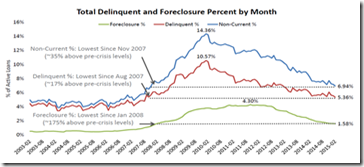
Then who will enforce the very successful underwriting standards now required by Fannie and Freddie that has brought down the default rates close to historical standards? It is the real issue that was exposed in the lawsuits. Who will police the banks and private mortgage originators that the record shows will evade those standards when it suits them?

Harlan Green © 2015

Follow Harlan Green on Twitter: https://twitter.com/HarlanGreen

Monday, March 30, 2015

Why Doesn’t Government Want Fannie, Freddie to Succeed?

The Mortgage Corner

At a time when the housing market is just beginning to recover, the US Treasury wants to close down Fannie Mae and Freddie Mac, the two GSEntities under government conservatorship.

Counselor to the Secretary for Housing Finance Policy Dr. Michael Stegman, speaking at Monday’s National Council of State Housing Agencies Legislative Conference, said, "I know that many of you want to know where we are on housing finance reform. On this subject, let me be clear: the Administration stands by our belief that the only way to responsibly end the conservatorship of Fannie Mae and Freddie Mac is through legislation that puts in place a sustainable housing finance system that has private capital at risk ahead of taxpayers, while preserving access to mortgage credit during severe downturns."

But Timothy Howard, chief economist and a senior Fannie Mae executive for 23 years, says “Fannie Mae never experienced a threat to its solvency because of difficulty rolling over its maturing debt, nor did it need to sell assets at depressed prices to survive.  The company never experienced a market crisis.  At the time it was put into conservatorship, Fannie Mae’s capital significantly exceeded its regulatory minimum.” 

So dissolving Fannie and Freddie makes no sense for several reasons. There is no financing model that has yet been created to replace both their securitization structure that in effect guarantees almost all conforming and Hi-Balance conforming loans, which account for more than 60 percent of loan originations today.

And, they are generating immense profits for the US Government that has commandeered all of their profits since a 2012 amendment to the 2008 conservatorship agreement. “As of last December, the Treasury had received a total of $225.4 billion from the companies,” says NYTimes Gretchen Morgensen in a recent column. “An additional $153.3 billion in receipts from Fannie and Freddie could be generated through fiscal year 2025, according to estimates in the 2016 budget offered by the president.”

So why does the government want to close them down when their sometimes too strict underwriting standards have brought loan default rates back to historical levels, and Fannie Mae has repaid more than the $186 billion lent to them?

The quick answer is that our government fears they may have to bail out the GSEs again, putting taxpayers at risk, with their current structure as stock holding corporations, but with an implicit government guarantee that they can’t fail.

Treasury officials (and the banking lobby) maintain it gives them an unfair interest rate advantage that has enabled them to keep lower capital reserves, and thus a lower expense overhead, therefore impeding the development of so-called “private-label” mortgages generated by commercial lenders, but not guaranteed by the GSEs.

Morgensen highlighted the ongoing debate on whether Fannie and Freddie should be re-privatized in describing a lawsuit by a major stockholder of the GSEs whose stock is in effect worthless, unless the government allows them to rebuild their equity.

“The problem with the apparent involvement by Treasury and White House officials in the decision to commandeer Fannie’s and Freddie’s earnings is that by congressional statute, the F.H.F.A. is supposed to be an independent agency, tasked by law to protect the safety and soundness of the companies. Letting the companies’ profits flow to the Treasury had the opposite effect. Allowing them to rebuild their capital with profits after they repaid the taxpayer seems more like it.”

So the only danger to taxpayers seems to be that created by the U.S. Treasury and FHFA, in not allowing them to rebuild capital as a cushion against a future housing downturn. Even if there was another housing crisis, Fannie and Freddie today would not be allowed back into the subprime market that guaranteed loans from such as Countrywide Financial that was in turn bailed out by Bank of America.

“Intervention in support of banks was done in response to sudden and uncontrollable liquidity crises that required immediate government assistance to keep the companies from failing, and involved actions and tools intended to achieve that result (not always successfully),” says Howard.  “The act of placing Fannie Mae and Freddie Mac into conservatorship was not a response to any imminent threat of failure but rather a policy decision initiated at a time of Treasury’s choosing, and involved actions and tools intended to make and keep the companies insolvent.”

Former Fannie Mae exec Timothy Howard also thinks Fannie and Freddie can still function as viable institutions. “There is no credible basis for the oft-repeated contention that they are a “failed business model,” he said.  “Even after Fannie Mae and Freddie Mac made unwise decisions to lower their underwriting standards to try to compete with private-label securitization, their loans acquired between 2005 and 2008 still performed four times as well as loans from that period financed through private-label securities, and more than twice as well as loans made and retained by commercial banks during that time.”

“The argument for bringing Fannie Mae and Freddie Mac out of conservatorship and using an amended version them as the basis of the future mortgage finance system is extremely straightforward: their credit guaranty mechanism is low-cost, efficient and effective, and has a proven track record of success.”

Need we have any other reason to break the gridlock that has kept the GSEs in conservatorship, now that the housing market is recovering? Their model works, and without them the housing market would be in far worse shape.

Harlan Green © 2015

Follow Harlan Green on Twitter: https://twitter.com/HarlanGreen

Thursday, January 17, 2013

What Budget Problem?

Popular Economics Weekly

Does Congress know that our federal budget deficit has been shrinking steadily since 2009, the end of the 18-month Great Recession? Yes, that’s right. A combination of cuts in government spending and very low interest rates on the public debt have been bringing down what is really an apples and oranges problem. Annual deficits are decreasing, but they still add to the overall public/private debt, much of which is held by the Federal Reserve in bonds they can sell back to the public when the economy improves sufficiently.

In the depths of the most recent recession, the fiscal year that ended Sept. 30, 2009, the deficit was 10.1 percent of gross domestic product, the value of all the goods and services produced. Since then, the deficit has declined to 9 percent of GDP in 2010, 8.7 percent in 2011 and 7.0 percent in fiscal 2012. Private analysts predict the deficit will be between 5.5 percent and 6.0 percent of GDP in fiscal 2013, says Calculated Risk quoting Wall Street Journal’s David Wessel.

image

Graph: Calculated Risk

And bond investors must know this, since they keep buying Treasury Bonds, whose yields are hovering near all-time lows. The U.S. has no problem paying its bills, in other words. Inflation hawks have been crying inflation over the Federal Reserve’s bond buying program since the end of the recession. Yet interest rates, the best indicator of inflationary tendencies, continued to decline to their current lows.

That is why much of the outcry over the debt ceiling has been fabricated by those who want little or no government, who believe all government spending is for the 47 percent of ‘takers’, when in fact a large part of the government ‘largesse’ goes to the wealthiest to finance their tax breaks. Most of the federal debt comes from past spending, the spending run up since 2000 in fighting two wars, the Bush tax cuts, and recession. This is after 4 consecutive years of budget surpluses under President Clinton, as the graph shows.

Because debt held by the public flows through financial markets, it has more immediate relevance to the economy than intragovernmental debt, which is a matter of internal bookkeeping. As of the end of December 2012, debt held by the public (subject to the limit) totaled $11.563 trillion, says the Concord Coalition.

The rest of government debt for the most part is intragovernmental debt, consisting of trust fund accounts that are credited with dedicated revenue such as Social Security and Medicare payroll taxes (FICA). In theory, any surpluses in these accounts are “saved” for future benefit obligations. As of the end of December 2012, intragovernmental debt (subject to the limit) totaled $4.831 trillion. Hence the grand total of federal debt is $16.4 trillion.

But we know how to pay it down. The Clinton Presidency showed us how. It is important to reduce government spending, particularly on defense, which is being done as the wars wind down. Another part is fostering job formation programs that increase tax revenues, as happened during the 10-year growth cycle of the 1990s, the longest growth cycle in our history. Twenty one million jobs were created just during the 8-year Clinton term.

In fact, history shows growth remains mediocre without government revenues to support it. This is not just to finance social welfare and senior pension programs. There is so much public infrastructure repair and upgrades that need to be financed at the state and national levels which private industry cannot initiate.

For instance, building our national highway system in the 1950s was a huge boost to growth, and there is a multi-trillion dollar deterioration of current public infrastructure. Much more needs to be spent on schools just to keep up with rising worldwide educational standards. This is not to speak of environmental protection, renewable energy, and research and development that only governments can instigate.

Americans do know how to foster growth. But it has always been due to the partnership of private and public sectors, something our current Congress seems to have forgotten.

Harlan Green © 2012

Follow Harlan Green on Twitter: www.twitter.com/HarlanGreen

Saturday, February 28, 2009

WHAT IS DEFLATION RISK?

Why the urgency of putting so much money into the various stimulus plans? Treasury Secretary Geithner’s addition to TARP, a mix of public and private investments, could cost as much as $1.5 trillion. The congressional stimulus bill, called the American Recovery and Reinvestment Plan or ARRP, will cost approximately $790 billion, while the Federal Reserve could be lending and/or guaranteeing more than $1 trillion in debt, and so on.

The recent plan unveiled by Treasury Secretary Geithner highlighted the difficulty of getting banks to lend again. Its centerpiece was a public/private proposal to relieve banks of their toxic—or nonperforming—assets. But if there is no market for these assets, then banks have no idea what they are worth. This is the main reason they are hoarding their monies—bailout funds included.

And so some kind of government guarantee is needed to bolster their value(s). Otherwise, as Citibank Chairman Vikram Pandit said, they would be irresponsible to unload these assets at today’s fire sale prices. Actually, should banks do so, they might very well reveal themselves to be insolvent.

The result is a stalemate, which is causing wages and prices to begin to spiral downward. Hence the urgency of the various plans. Such a deflationary spiral is the most debilitating form of a recession. In fact, that is when a recession becomes an actual depression, as it did in Japan during the 1990s and our Great Depression.

Most Americans have no experience of one, therefore cannot conceive of its damage—when wages as well as prices are in a prolonged slump. This leads to the opposite of the wage-price stagflationary spiral experienced in the 1970s that drove the inflation rate to 14 percent—and unemployment rate above 8 percent.

Nobelist Paul Krugman is one of those sounding the alarm. He maintains that we could see a real 3 percent drop in prices if the so-called ‘output gap’, or difference between normal Gross Domestic Product growth and the negative growth during a recession/depression, is as high as the Congressional Budget Office predicts.

That is why so much money is being thrown at the deflation problem. The ARRP stimulus is targeted at creating jobs, whether by directly subsidizing industry, or indirectly with tax cuts. The Treasury plan is designed to heal the banks’ balance sheets so they will lend again. Both plans have to work before our economy will be able to recover.

Harlan Green © 2009