Showing posts with label Ben Bernanke. Show all posts

Friday, September 15, 2023

No More Rate Hikes?

 Popular Economics Weekly

NBER.org

The latest inflation data make it almost unanimous: Chairman Powell, leading economists and even his Fed Governors are saying the Federal Reserve Governors may not raise interest rates again this year, or maybe into next year as well.

Why? Inflation has been tamed; except for gas prices, which have soared of late due to more positive economic growth and OPEC cutting oil production.

Second quarter GDP growth was 2.1 percent, and there are estimates of 4 percent or higher Q3 growth. It is a picture of the U.S. economy returning to a more normal growth pattern.

This is while the headlines are screaming that U.S. retail and wholesale prices have suddenly spiked. Wholesale PPI prices jumped 0.7 percent in August to mark the largest increase in 14 months, as did retail CPI prices the day before.

The Producer Price Index for final demand increased 0.7 percent in August, seasonally adjusted, after rising 0.4 percent in July, the U.S. Bureau of Labor Statistics reported today. The August advance is the largest increase in final demand prices since moving up 0.9 percent in June 2022.

But note that on an unadjusted basis, the index for final demand rose (just) 1.6 percent for the 12 months ended in August.

So why isn’t retail CPI inflation following suit with its overall inflation rate rising to 3.7 percent?

An NBER working paper by noted economists Olivier Blanchard and former Fed Chair Ben Bernanke, accompanied by the above NBER graph, maintain rising wages are the culprit.

“Rising commodity prices and supply chain disruptions were the principal triggers of the recent burst of inflation. But, as these factors have faded, tight labor markets and wage pressures are becoming the main drivers of the lower, but still elevated, rate of price increase.”

But the above NBER graph shows that is not yet the case. The blue portion of the bar portraying energy prices has shrunk the most. The red and yellow portions portraying wage pressure and product shortages have shrunk the same amount bringing actual inflation (black line) below 4 percent. The gray portion is a pre-pandemic historical compendium of contributions to inflation (Don’t ask what that means, read the paper for further clarity).

So once again the fear of persistent wage inflation is driving their analysis, as many blamed for the 1970s era of stagflation. Yet they almost totally ignore the role of persistent supply shortages in the inflation equation, (oil shortages in the 1970s, Ukraine-Russian war shortages and trade sanctions today), as well as the profit-taking role of producers and distributers that padded their profits because of supply bottlenecks.

The recent spike in retail CPI and wholesale Producer Price Index was also because the financial markets believe recession dangers are over and therefore the demand for gas and oil use will only increase, another indication that markets are functioning normally.

That is why Goldman Sachs chief economist Jan Hatzius is predicting no looming recession and better economic growth ahead, as I said last week.

We can also thank Bidenomics, the boost to growth that the infusion of $billions into renewal of the US economy in infrastructure, CHIPs manufacturing, and the conversion to more climate friendly policies has jump started.

Above all, we see consumers feeling prosperous enough to continue to shop and enjoy more leisure activities even with higher interest rates. The Fed has signaled they won’t be in any hurry to drop their interest rate. But that’s also a sign of interest rates returning to more normal levels that prevailed before the COVID pandemic.

Harlan Green © 2023

Follow Harlan Green on Twitter: https://twitter.com/HarlanGreen

Wednesday, November 16, 2022

Inflation Won't Stop Holiday Shoppers

 Popular Economics Weekly

When will inflation subside enough to bring down interest rates again? There are estimates that it takes from one year to 10 years to cure large inflation spikes such as occurred this year, based on what pundits and economists see as past history.

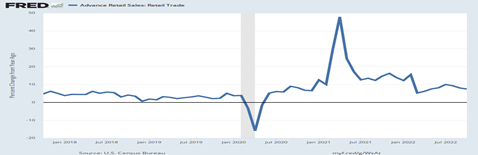
But that hasn’t stopped shoppers. Retail sales that account for some half of consumer spending jumped a huge 1.3 percent in October, 7.6 percent YoY.

FREDretailsales

Consumers are keeping up with inflation, in other words, because it’s the holidays and they want to celebrate their world returning to normal. Dining out at restaurants increased 1.3 percent in October, twice the current inflation rate.

And inflation is already cooling. The Fed has pumped up short-term rates from essentially zero to 4 percent in 2022, which has pummeled stock and bond prices. But financial markets rallied on Tuesday because the Producer Price Index (PPI) for wholesale goods and services continued to decline. Wholesale prices in October rose just 0.2 percent month-month and core inflation without food, energy and trade services declined from 5.6 to 5.4 percent YoY.

Tradingeconomics.com

My bet is that inflation will drop quickly during the coming winter as supply chains continue to improve, which ground to a halt during the worldwide pandemic lockdowns.

For instance, the NY Federal Reserve’s Global Supply Chain Pressure Index (GSCPI) stated as much in its latest release. “The GSCPI’s year-to-date movements suggest that global supply chain pressures are falling back in line with historical levels,” it said.

It means that consumer prices will continue to decline as well, since the PPI measures the raw materials and data that go into retail products and services.

Alas, retail inflation is still too high, since the CPI declined to 7.7 percent in October compared to a year ago, down from 8.2 percent in September. Predictions are all over the map as to when the inflation rate will return to a more normal range. Treasury Secretary Janet Yellen has said in recent testimony it could take several years to return to the Federal Reserve’s two percent target.

Other pundits are predicting as much as 10 years, because they cite the 1970’s era of stagflation. Inflation soared to as high 14 percent in 1981 after 10 years of wage-price spirals. It was another 10 years before inflation returned to its more normal 2-3 percent range.

But this inflationary spiral has lasted just months, not years as in the 1970s, as Nobel Prize-winner and former Federal Reserve Chair Ben Bernanke has pointed out. So, there’s no reason for anyone to press the panic button, stock and bond traders included. Consumers are riding this inflation wave just fine to date.

Why shouldn’t they be upbeat, with Americans still fully employed?

The New York Fed also publishes a Survey of Consumer Expectations of inflation also shows inflation is a short-term problem. “Median one- and three-year-ahead inflation expectations increased to 5.9 percent and 3.1 percent from 5.4 percent and 2.9 percent, respectively. (But) The median five-year-ahead inflation expectations, meanwhile, rose by 0.2 percentage point to 2.4 percent.”

Wholesale prices are still high. The Producer Price Index for final demand in the U.S. rose 0.2 percent month-over-month in October of 2022, the same as a downwardly revised 0.2 percent increase in September. Goods cost went up 0.6 percent, the largest advance since a 2.2 percent rise in June, mainly pushed by a 5.7 percent jump in gasoline cost. Prices for diesel fuel, fresh and dry vegetables, residential electric power, chicken eggs, and oil field and gas field machinery also advanced. In contrast, the index for passenger cars declined 1.5 percent. Meanwhile, services cost fell 0.1 percent, the first decline since November of 2020.

So, the inflation outlook is muddled, but consumers’ inflation expectations give us a better picture of how consumers will behave in the future. It is another ingredient that helps to determine the Fed’s next move, and when shoppers buy or hold.

All this news backs my bet of inflation falling back to historical levels as soon as next summer.

Harlan Green © 2022

Follow Harlan Green on Twitter: https://twitter.com/HarlanGreen

Saturday, February 7, 2015

The Bernanke-Yellen Led US Recovery

Financial FAQs

Friday’s January unemployment report should close the books once and for all on the debate whether austerity cutbacks in government spending (and debt) such as happened in Europe, or pro-active government policies by the U.S. Federal Reserve Banks has been the prime instigator of growth during recoveries from depressions, large or small.

A total of 257,000 payroll jobs were created in December and with revisions to the past 2 months more than 1 million jobs were created just over the past 3 months. Though the unemployment rate calculated from the separate Household report declined from 5.6 to 5.7 percent, it was because an additional 700,000 new and older folks entered the workforce, surely a sign of rising job availability.

This means what can only be called the U.S. Bernanke-Yellen recovery from the Great Recession is finally reaching its growth potential, thanks to the Fed’s efforts to keep both short and long term interest rates as low as possible with the massive buying of U.S. Treasury and mortgage-backed securities, called Quantitative Easing, among other measures. The U.S. has the best growth rate in the developed world, thanks to the actions of Fed Chairmen Bernanke and Yellen.

image

Graph: Trading Economics

Whereas the Eurozone is declining into negative growth for the third time since 2008, in what Paul Krugman is now calling Europe’s Second Great Depression, as Greece has elected a government that is rebelling against German-inspired austerity measures.

image

Graph: Trading Economics

“… Germany is demanding that Greece keep trying to pay its debts in full by imposing incredibly harsh austerity,” said Krugman in his most recent recent NYTimes Oped. “The implied threat if Greece refuses is that the central bank will cut off the support it gives to Greek banks, which is what Wednesday’s move sounded like but wasn’t. And that would wreak havoc with Greece’s already terrible economy…Beyond that, chaos in Greece could fuel the sinister political forces that have been gaining influence as Europe’s Second Great Depression goes on and on.”

The European Central Bank has begun its own tepid version of QE, but excluded Greek sovereign debt from ECB purchases, which will only make Greece’s situation more dire by increasing its borrowing costs.

It wasn’t long ago that the U.S. might have suffered the same fate. Congressional conservatives had demanded that the U.S. pay down its debts rather than spend more to create jobs, opposition that shut down government briefly and led to a downgrade of U.S. sovereign debt,

But first Ben Bernanke, a student of Japan’s two decade deflationary spiral, and now Fed Chair Janet Yellen have held firm in their resolutions to stimulate growth until Main Street experiences a sustainable recovery.

This is something that Germany, instigator of the eurozone’s austerity policies, has to learn if it wants to bring Europe out of its Second Great Depression, by supporting policies that will unite Europe into a greater union, rather than cause its disintegration.

Harlan Green © 2015

Follow Harlan Green on Twitter: https://twitter.com/HarlanGreen
Wednesday, January 7, 2015

Good Pending Sales, Home Prices in 2015

The Mortgage Corner

Pending home sales are rising again. Sales picked up steam in November, to 104.8 from a revised 104.0 in October for a better-than-expected gain of 0.8 percent. It is a sign, along with the Case-Shiller Home Price Index, that the housing market will pick up in 2015.

image

Graph: Econoday

Pending sales had been declining since last September, and only began to rise again this January. But they are still below post-recession highs. Rising prices may be the culprit, as the Case-Shiller Home Price Index rose 13.5 percent in 2014, but has now settled back to moderate 4.5 percent annual increases in recent months.

"The consistent economic growth and steady hiring we've seen the second half of this year is giving buyers enough assurance to consider purchasing a home before year's end," said NAR chief economist Lawrence Yun. "With rents now rising at a seven-year high, historically low rates and moderating price growth are likely to entice more buyers to enter the market in upcoming months."

image

Graph: Econoday

Where are those new buyers coming from? The main reason could be fresh data that show those 18 to 25 year-olds are finally leaving home, or school, when the lack of first-time homebuyers has kept existing-home sales from breaking out of a narrow range since 2009 and the end of the Great Recession. This is while housing prices have moderated their double-digit climb in 2014, making housing more affordable to those now able to find jobs.

Case-Shiller's 20 city year-on-year index for October (both adjusted and unadjusted) came in soft, at plus 4.5 percent, says Econoday, down 3 tenths from September. This is the lowest rate since October 2012 and follows a full year of low double digit gains through much of 2013 and into April this year.

So ‘the times they are a changin’. Household formation is increasing again, and history says at least 50 percent of those new householders will purchase a home. Fortune Magazine has just cited Neil Dutta, head of economics at Renaissance Macro Research, who pointed out in a note to clients that household formation in 2014 through September is already at its highest rate since 2005.

image

Graph: Fortune.com

The employment rate for folks aged 25 to 34 has grown 2.8 percent over the past year, about 29 percent faster than the overall employment rate, and they make up the largest generation ready to enter the housing market, larger than their baby boomer parents.

And don’t forget those record low interest rates, now back to last year’s pre-April rates, before Fed Chair Bernanke announcement that QE3 would end. The 30-year fixed conforming rate is now down to 3.50 percent with 0 origination points in California, for those with the best credit scores.

Harlan Green © 2014

Follow Harlan Green on Twitter: https://twitter.com/HarlanGreen

Thursday, November 6, 2014

Bullies, Not Government Is the Problem

Financial FAQs Weekly

Even though the U.S. economy grew by a 3.5 percent annual rate in the third quarter, boosted by a surge in exports and the biggest jump in federal spending in five years, Democrats don’t seem to be taking credit for it.

Why? The bullies are in control, whether they are Republican Tea Partiers that refuse to compromise on any legislation that won’t downsize government programs, the Koch Brothers who fund any candidate or cause that cuts environment regulations, or the NRA, lobbying arm of the gun industry that capitalizes on gun violence to boost weapons sales; they control Washington’s agenda these days.

And it has almost wrecked our economy several times since the 2009 end of the Great Recession. Republicans dare not take credit for it, either. “Anyone who trusts the Republicans hasn’t been paying attention to what their economic policies have been. Instead of focusing on full employment and higher wages, the Republicans have doubled down on the trickle-down policies that have failed so miserably over the past 30-plus years,” says Marketwatch economist Rex Nutting.

In fact, several times since the 2009 end of the Great Recession, Republican anti-government policies almost drove us back into recession. In 2011, Republicans took the government to the brink of default on its debt (and S&P downgrade of U.S.) , which led to an agreement with Obama, Harry Reid and Nancy Pelosi to cut spending, by automatically sequestering funds if necessary.

A year ago, the Republicans again forced the issue with a 16-day partial shutdown of the federal government, which led to another agreement with the Democrats on spending cuts.

Why do we call them bullies? Because they have been able to get away with it. And because it looks like Republicans might gain control of the Senate, it’s Democrats who have been willing to compromise, when their economic agenda has brought the unemployment rate down to 5.9 percent, and economic growth above 3 percent over the last 2 quarters.

The problem with dealing with such bullies that say it’s ‘my way or the highway’, is that they take any sign of compromise as a sign of weakness. So when Vice President Biden says, ““[L]ook, we’re — we’re ready to compromise,” bullies see it as a sign of weakness, that they have already won the battle of this midterm election, so there is no need to compromise.

“Going into 2016, the Republicans have to make a decision whether they’re in control or not in control,” the vice president told CNN’s Gloria Borger. “Are they going to begin to allow things to happen? Or are they going to continue to be obstructionists? And I think they’re going to choose to get things done.”

Unfortunately, that is not how to deal with the bully mentality that has pervaded much of today’s politics, as well as our schools. It only happens when there is a leadership vacuum, when strong leaders refuse to step forward that know how to oppose bullies. Yet we know how--history has told US. That’s how we defeated the biggest bullies of all; Hitler and Emperor Hirohito, and even Stalin. Just stand up to them, and only compromise when the bullies are willing to compromise.

Harlan Green © 2014

Follow Harlan Green on Twitter: https://twitter.com/HarlanGreen

Friday, October 31, 2014

Government Spending Boosts Q3 GDP

Popular Economics Weekly

WASHINGTON (MarketWatch) — The U.S. economy grew by a 3.5 percent annual rate in the third quarter, fueled by a surge in exports and the biggest jump in federal spending in five years, screamed one headline this morning.

That is all we need to know to understand why US economic growth is finally returning to the long term average that has prevailed since the Great Depression. This is in spite of the Great Recession and a busted housing bubble that is taking years to recover, record wealth inequality that has kept consumers from spending, and ultra-conservative House Republicans that have refused to allow even the most basic public works spending; such as to repair and replace the roads and bridges that have so fallen into disrepair, not to speak of keeping up with the educational needs of a growing population.

image

Graph: Calculated Risk

This first graph from Calculated Risk shows the increasing contribution to GDP for residential investment (RI) and state and local governments since 2005. It’s the beginning of recovery from the huge slump in RI during the housing bust (blue), followed by the unprecedented period of state and local austerity (red) not seen since the Depression.

It doesn’t tell the whole story, of course, as continuing austerity policies that cut government spending and some taxes in Japan and Europe have kept them in recession, whereas the pro-growth actions of the Fed (and boosting of some taxes) have reduced the budget deficit and kept the US government solvent.

It is a phenomenal recovery, even a miracle that this could even happen with a Congress locked in a battle over ideologies, and race. So it is thanks mainly to Ben Bernanke and Janet Yellen’s Federal Reserve QE actions, in particular, part of their pro-growth policies that pushed interest rates (especially long term rates) to record lows, just because the Fed could act outside of politics as usual.

“What’s more, the U.S. is adding jobs at the fastest rate since the recession ended in 2009 and consumers are feeling the most confidence in seven years, buoyed by a rising stock market and falling gasoline prices. As a result, most analysts believe the U.S. is likely to expand at a 3 percent pace or so in the fourth quarter to string together the best stretch of economic growth since before the Great Recession,” said the MarketWatch announcement.

So government spending was the largest contributor, up 10 percent mostly for defense, and exports up 7.8 percent annually. State and local governments’ spending rose 1.3 percent, and consumer spending slowed to a 1.8 percent annual pace from 2.5 percent in the prior quarter.

Business investment on equipment decelerated from the second quarter’s 11.2 percent gain to 7.2 percent, but is still strong. Residential housing investment grew at a low 1.8 percent rate after an 8.8 percent increase in the spring.

What does all this data mean? That there are ways around Congressional gridlock, if the executive branch and Federal Reserve concentrate on pro-growth policies that keep interest rates low, raise taxes sufficiently to lower the budget deficit, lower health care costs, support collective bargaining of employees, as well as lobby for higher household incomes to boost consumer spending (and the housing market).

And best of all, this happened with very low inflation, in spite of warnings that more government spending and the Fed’s QE policies would cause soaring inflation. Instead inflation as measured by the PCE index rose just 1.2 percent annually, down from 2.3 percent in Q2, as cheaper energy prices has kept inflation ultra-low. Even the core PCE that excludes food and energy rose just 1.4 percent.

We can now say officially that we have that goldilocks economy that prevailed through the 1990s; not too hot or too cold that will boost economic growth for years to come, if Congress can be ignored.

Harlan Green © 2014

Follow Harlan Green on Twitter: https://twitter.com/HarlanGreen

Thursday, July 24, 2014

Restricted Credit Will Impede Housing Recovery

Financial FAQs

As if we need more evidence that the Consumer Protection Finance Bureau and government regulators have listened to the wrong people when drafting their Qualified Mortgage requirements (that lowers the maximum debt-to-income ratio to 43 percent for non-agency mortgages, disallows interest only options and 40-yr amortization for starters), while Fannie Mae and Freddie Mac add huge fees and stricter underwriting criteria to anyone below a 700 credit score (which is almost perfect in today’s trying markets), the latest new-home sales should convince us.

sales

Graph: Calculated Risk

The Census Bureau reports New Home Sales in June were at a seasonally adjusted annual rate (SAAR) of 406 thousand, while May sales were revised down from 504 thousand to 442 thousand, and April sales were revised down from 425 thousand to 408 thousand. Inventories rose to a 5.8-month level from 5.2 months in May.

The National Association of Home Builders tried to put a good face on the numbers. "With continued job creation and economic growth, we are cautiously optimistic about the home building industry in the second half of 2014," said NAHB Chief Economist David Crowe. "The increase in existing home sales also bodes well for builders, as it is a signal that trade-up buyers can move up to new construction." Regionally, new-home sales were down across the board. Sales fell 20 percent in the Northeast, 9.5 percent in the South, 8.2 percent in the Midwest and 1.9 percent in the West.

But this is not good news for housing advocates so late in the recovery. For one thing, government regulators and the Obama administration are way behind the housing curve in choosing to tighten credit standards long after the problem of too easy credit was solved. The Federal Reserve and regulators have outright banned low teaser rate, negatively amortized,‘liar’ loans, and loans that don’t require income and asset verification. Mortgages delinquencies are down, existing-home sales are back to a 5 million annual sales rate, and record low interest rates should make it easier to qualify.

So why are regulators still chasing phantoms, and continue to punish lenders five years after the housing bubble burst? Instead, it’s time to encourage them to lend some of their record $1 trillion in excess reserves held by the Federal Reserves in MZM accounts (i.e, at zero interest). Without a housing recovery, there will be no substantial economic recovery, say many major economists.

For instance, former Fed Chair Bernanke has said too-tight credit conditions have squeezed both prospective homebuyers and builders. "Why has the recovery in housing been so slow? One important factor is restraints on mortgage credit," Bernanke said in 2012, adding that total outstanding mortgage credit has shrunk by about 13 percent since its peak in 2007.

Just how weak are home sales? Five years after the end of the recession, sales of new single-family homes still remain far below an annual average of more than 770,000 over the 20 years leading up to a 2005 peak, government data show.

Fannie Mae is growing more optimistic this month about U.S. sales of new single-family homes, and now sees 2014 hitting the highest level in seven years. Fannie’s  FNMA July housing-market forecast estimates that sales of new single-family homes will reach 486,000 this year — the most since 2007 — a bit higher than June’s estimate of 478,000, which would have been the greatest since 2008.

However, despite the uptick in the July forecast, over the past year Fannie has slashed its outlook for new-home sales, showing just how disappointing the market’s been in 2014. Back in July 2013, federally controlled Fannie had expected 2014 sales of new single-family homes to hit 588,000.

Rising mortgage rates, a low supply of new homes and unusually poor winter weather each took a bite out of residential sales this year. It’s also been tough for many borrowers to meet lenders’ strict credit standards, as we said. But it is home sales, and new-home sales in particular that has to improve to boost inventory and keep housing prices in the affordable range.

Harlan Green © 2014

Follow Harlan Green on Twitter: https://twitter.com/HarlanGreen

Tuesday, April 15, 2014

The Bully Mentality

Popular Economics Weekly

Why does the USA have such a problem with bullies? Whether in the schools, in politics, or on Internet social media? The result has been teenage suicides, horrendous school shootings by students who felt bullied or belittled, and now a whole political party that opposes anything that smacks of aiding the poorest, seniors, and less educated.

Paul Ryan’s latest budget proposal, is one such example of Republican bullying tactics. It is a repeat of past years’ proposal that would cut $5 trillion from government spending, 69 percent of the cuts in the Ryan budget come from programs that benefit people with low or moderate incomes, according to the Center on Budget and Policy Priorities. Why pick on the poor?

Economist Paul Krugman can’t understand it either. “…while supposed Obamacare horror stories keep on turning out to be false, it’s already quite easy to find examples of people who died because their states refused to expand Medicaid. According to one recent study, the death toll from Medicaid rejection is likely to run between 7,000 and 17,000 Americans each year.

“But nobody expects to see a lot of prominent Republicans declaring that rejecting Medicaid expansion is wrong, that caring for Americans in need is more important than scoring political points against the Obama administration. As I said, there’s an extraordinary ugliness of spirit abroad in today’s America, which health reform has brought out into the open.”

The “ugliness” is really a bully mentality. Bullies prey on those weaker than them, and so they have tried every trick in the book to oppose any programs that smack of aiding those most in need. Why? Because it would empower the less fortunate so they are not so easily bullied. The Republican-dominated red states are the best example of the bully mentality.

If Republicans can’t keep their constituents poor and less educated, then they would lose their hold over them, and so their power. Conservatives oppose expanding educational opportunities such as Head Start and pre-school aid because it would encourage rational thinking, and an appreciation of science. Their constituents would then begin to understand global warming, and maybe evolution.

Republicans opposition to expanding voters’ rights; even social security and Medicare; is because Repubs fear being outvoted by those very same immigrants, minorities and seniors that depend on those services to improve their circumstances, and would enhance economic growth, by the way. Republicans only answer is to restrict voting hours and pass draconian voter ID laws in the red states. It is restricting citizens’ voting rights, even though sacrosanct and protected by the constitution.

In fact, the bully mentality requires such ignorance of facts about economic growth as well. The slow recovery from the Great Recession has mainly been because private businesses have been reluctant to hire due to slack demand, and governments have been unable to spend more on public services. Yet Republicans have opposed any form of government stimulus spending, even on badly outmoded infrastructure that will only cost more to repair and replace in the future.

Not all Republicans are bullies, and not all Democrats enlightened progressives, of course. But the bully mentality of House Speaker John Boehner’s “no compromise” tactics, or Senator Mitch McConnell’s filibustering of even the most innocuous Obama Administration appointments have been the reason recovery from the Great Recession hasn’t been stronger.

Fostering a culture of fear and ignorance is not the way to run a political party, or a country. Such tactics that attempt to suppress the rights of those that disagree, as well as the willful denial of scientific and economic facts are a danger to our democracy, not to speak of the US position as a leader of democratic nations. That is the ugliness that has crept into American politics. It is a complete denial of greater opportunity for all but Republicans’ most conservative constituents, and disregard for the most basic human rights.

Harlan Green © 2014

Follow Harlan Green on Twitter: https://twitter.com/HarlanGreen

Thursday, April 10, 2014

Yellen’s Federal Reserve To Keep Rates Low

The Mortgage Corner

The Fed’s FOMC minutes of their last meeting were just released, and they show the Fed intends to keep interest rates low for as long as possible, until the unemployment rate drops substantially. And the Fed’s maintenance of low interest rates will do the most to boost housing sales this year.

In fact, they are dropping the 6.5 percent unemployment rate bar that former Fed Chair Bernanke had said was the point at which they would consider beginning to raise interest rates. That’s because the 6.5 percent rate has almost been reached without any improvement in the long term unemployed. It’s at 6.7 percent in March and the Labor Department’s JOLTS report says that with 4.2 million job openings (blue line in graph), the 6.5 percent rate could happen anytime.

jolts 

Calculated Risk

Jobs openings increased in February to 4.173 million from 3.874 million in January. The number of job openings (yellow) is up 4 percent year-over-year compared to February 2013, while the number of hires (blue line) hasn’t been rising as fast. So it seems reasonable that the hire numbers will pick up as more jobs become available. Meanwhile, the number of Quits and Layoffs (blue and red bars in graph) has been declining, another sign of improving job opportunities.

The Fed minutes also mentioned that there were other obstacles to higher employment—excess savings by both consumers and business that weren’t being productively invested—that could slow also down job formation.

In fact, the minutes for the first time stated that ‘lowflation’ was a problem holding back demand, and so hiring. Why? Because too low inflation—just above 1 percent at present—was a sign there wasn’t enough demand for goods and services to yet warrant additional hiring.

“Participants observed that a number of factors were likely to have contributed to a persistent decline in the level of interest rates consistent with attaining and maintaining the Committee's objectives”, said the FOMC minutes. “In particular, participants cited higher precautionary savings by U.S. households following the financial crisis, higher global levels of savings, demographic changes, slower growth in potential output, and continued restraint on the availability of credit.”

This is basic macroeconomic theory that Fed Chair Yellen has researched, and the reason she is now the Fed Chairperson. She understands economics, and why job opportunities have been growing so slowly. Both consumers and businesses are holding on to their savings. So the Fed would have to see improvement in these factors, as well, leading to slightly higher inflation, before beginning to raise interest rates.
Real estate will also benefit from the Fed’s decision. One sign of better sales is that inventories continue to improve. Housing Tracker reports that 2014 existing-home inventories (red line) are slightly above last year and improving, due to fewer foreclosures and short sales.

housetrack

Graph: Calculated Risk

“As of April 07 2014 there were about 745,168 single family and condo homes listed for sale in the 54 metro areas we track, said Housing Tracker. “The median asking price of these homes was estimated to be $269,029. Since this time last year, the inventory of homes for sale has increased by 7.7 percent and the median price has increased by 11.1 percent.”

This in itself will improve sales, but the continued prospect of lower interest rates will do the most to boost home sales this year.

Harlan Green © 2014

Follow Harlan Green on Twitter: https://twitter.com/HarlanGreen

Tuesday, April 1, 2014

Fed Chair Yellen Is the Workers’ Best Friend

Financial FAQs

We have just heard from new Federal Reserve Chairperson Janet Yellen in her first official speech entitled, What the Federal Reserve is Doing to Promote a Stronger Job Market. Her speech not only boosted the financial markets, but confirms the Fed will do all in its power to boost employee incomes by keeping interest rates low for as long as possible.

Why? Because she is one of the ordinary worker’s best friendsi.e., those 80 percent of the workforce that are wage and salary earners. It is really the wage and salary earners that determine the strength or weakness of any economy, because they power most consumer spending. And more jobs mean more tax revenues, hence less budget deficits and all the ills that go with deficit spending.  It should have been first and foremost on President Obama's agenda from Day One of his administration--but it wasn't.

“By keeping interest rates low, we are trying to make homes more affordable and revive the housing market. We are trying to make it cheaper for businesses to build, expand, and hire. We are trying to lower the costs of buying a car that can carry a worker to a new job and kids to school, and our policies are also spurring the revival of the auto industry. We are trying to help families afford things they need so that greater spending can drive job creation and even more spending, thereby strengthening the recovery…There is little doubt that without these actions, the recession and slow recovery would have been far worse.”

She is in fact the first modern Federal Reserve Chairman that is unequivocally committed to promote real job growth. How can I say that? Firstly, because she is a top macro economist, who along with husband and Nobelist George Akerlof, have done much of the major research on the labor market.

So she understands what policies create more jobs, which until now has not been the top priority of either Congress or the Obama administration, sad to say. It should be obvious that job creation has to be the first and foremost priority of all policy makers to bring the US economy back from the worst downturn since the Great Depression.

The Federal Reserve during the 1930s understood this under then Fed Chairman Marriner Eccles, which is why we had FDR’s New Deal. But until now, even ex-Chairman Bernanke seemed to be more focused on reducing debt, the result of the Great Recession, than putting enough people back to work, in order to pay down that debt.

And Paul Krugman has been writing about the need for more job-friendly policies, including in his latest New York Times Op-ed:

He said, “Instead of focusing on the way disastrously wrongheaded fiscal policy and inadequate action by the Federal Reserve have crippled the economy and demanding action, important people piously wring their hands about the failings of American workers.

“Moreover, by blaming workers for their own plight, the skills myth shifts attention away from the spectacle of soaring profits and bonuses even as employment and wages stagnate. Of course, that may be another reason corporate executives like the myth so much.”

Dr. Yellen obviously understands this, so let us hope the Board of Governors will continue to support her effort to bring back jobs and so the middle class.

Harlan Green © 2014

Follow Harlan Green on Twitter: https://twitter.com/HarlanGreen

Tuesday, February 18, 2014

Hoorays For New Fed Chair Janet Yellen

Financial FAQs

Fed Chairwoman Janet Yellen’s congressional testimony proved that she is more than qualified to steer the US economy back to health. She is the economists’ economist, in a word, willing to explain the most basic economic truths in her first marathon session (7 hours) in front of the House Committee on Financial Services.

For instance, when asked why did we need QE3 purchase of securities, she responded that the Fed had taken seriously Congress’s twin mandates of maximum employment with stable inflation. And since inflation was in fact still falling (far below what is normal for healthy growth) and employment weak, keeping interest rates as low as possible at this stage of the recovery was the best way to boost the continued growth of jobs.

She also said the Fed would continue to taper their monthly QE3 purchases. But stocks and bonds rallied this time, rather than fell as in the past on the fear that higher rates might stifle growth. The markets took her remarks instead as a sign that economic growth was strong enough to be able to accommodate higher interest rates.

But her testimony was most important, because she instilled confidence that she knew what she was talking about. She was the Vice-Chairman that had created the current Fed policies with former Chairman Bernanke, after all.

 JOLTS

Graph: Calculated Risk

The best indicator re job creation is the Labor Department’s JOLTS report that tracks the number of ‘quits’, those that voluntarily leave their jobs because of better prospects. Therefore, the quits rate can serve as a measure of workers’ willingness or ability to leave jobs. The number of quits (not seasonally adjusted) increased over the 12 months ending in December for total nonfarm and total private and was little changed for government.

The above graph, compliments of Calculated Risk, shows job openings (yellow line), hires (dark blue), Layoff, Discharges and other (red column), and Quits (light blue column) from the JOLTS.

Notice how the yellow line of job openings has been rising since 2009, the end of the Great Recession. Hires (dark blue) and total separations (red and light blue columns stacked) are pretty close each month. This is a measure of turnover.  When the blue line is above the two stacked columns, the economy is adding net jobs - when it is below the columns, the economy is losing jobs.

Jobs openings decreased slightly in December to 3.990 million from 4.033 million in November. But the number of job openings (yellow) is up 10.5 per openings year-over-year compared to December 2012, and almost double 2009 2.2 million openings, while quits increased in December and are up about 12 percent year-over-year.

This is the employment picture Fed Governors are seeing, and the reason there is still a long way to go to achieve full employment. After all, there were more than 5 million job openings in 2000 alone, and 22 million jobs created from 1992 to 2000. That was a different era, but one that the Federal Reserve is mandated to recreate.

Harlan Green © 2014

Follow Harlan Green on Twitter: https://twitter.com/HarlanGreen

Monday, January 6, 2014

Beware of the Taperians!

Popular Economics Weekly

Now that the Fed has begun to reduce its QE3 securities’ purchases $10B per month in January, what will that do for growth? My answer is it’s too soon to say. Firstly, beware of the ‘Taperians’, those who would end QE3 too soon. As outgoing Fed Chairman Bernanke explained in his most recent speech, without QE3 we might have regressed back into a recession.

“"Skeptics have pointed out that the pace of recovery has been disappointingly slow, with inflation-adjusted GDP growth averaging only slightly higher than a 2 percent annual rate over the past few years and inflation below the Committee's 2 percent longer-term target," Bernanke said at the American Economic Association annual meeting in Philadelphia. "However, as I will discuss, the recovery has faced powerful headwinds, suggesting that economic growth might well have been considerably weaker, or even negative, without substantial monetary policy support. For the most part, research supports the conclusion that the combination of forward guidance and large-scale asset purchases has helped promote the recovery."

Then there are the political ‘headwinds’. Will the next 2 years’ budget agreement mean no more budget fights for a while, or will opponents to Obamacare continue to throw up roadblocks to its implementation in the 35 states that wouldn’t set up their own health care exchanges? This would make it more expensive and wasteful of government resources, needless to say.

Yet it seems at least one Fed Governors has been sounding the need to end QE3 before its time—Richmond Fed Governor Jeff Lacker. Lacker has been most vocal in wanting to rein in QE3 almost from its start last fall, and one who most consistently voted against continuing it at subsequent FOMC meetings. The reason? He’s an inflation hawk, or ‘inflationista’ (P Krugman’s term), as well as deficit hawk that fears all those bonds bought by the Fed will create runaway inflation (and deficits), once they are sold back into the economy.

In other words, he belongs to the ‘confidence fairy’ camp (another Krugman term) that believes business confidence is the key to growth, instead of consumer demand for their products, and businesses will lose confidence when interest rates and debt servicing costs rise, increasing budget deficits. But what about consumer confidence, when consumers are currently spending at a 4 percent annual rate, which is the largest component of overall demand?

“Businesses also appear to be quite reticent to hire and invest,” said Lacker in his most recent report. “A widely followed index of small business optimism fell sharply during the recession and has only partially recovered since then. Interestingly, when small business owners were asked about the single most important problem they face, the most frequent answer in the latest survey was "government regulations and red tape." This observation accords with reports we've been hearing from many business contacts for several years now. They've seen a substantial increase in the pace of regulatory change and a substantial increase in uncertainty about the shape of new regulations. Both are said to discourage new hiring and investment commitments.”

image

Graph: DShort

However that is not all survey results show in the December 10 NFIB report reported. “The net percent of all owners (seasonally adjusted) reporting higher nominal sales in the past 3 months compared to the prior 3 months was unchanged at a negative 8 percent. Fifteen percent still cite weak sales as their top business problem, but it is the lowest reading since June 2008. The net percent of owners expecting higher real sales volumes rose 1 point to 3 percent of all owners after falling 6 points in October (seasonally adjusted), a weak showing.”

In fact, the lack of consumer demand for their products is still the chief problem, not federal regulations or high taxes, as shown by their lack of need for more credit. “…only 2 percent of NFIB members cite credit and interest rates as their top business problem, and a record 66 percent expressed no interest in a loan, obviously due to their dismal view of the future of the economy. It’s not a problem of credit supply; it’s a lack of credit demand due primarily to poor economic prospects.”

What does Lacker say about consumer demand, the largest driver of economic growth, as we said? That consumer sentiment is still depressed because of economic ‘uncertainty’. “Although consumption grew rapidly at the end of last year, we have seen similar surges since the last recession, only to see spending return to a more moderate trend. Consumer spending trends are likely to depend on whether the dramatic events of the last few years are only a temporary disturbance to household sentiment or if they instead represent a more persistent shift in attitudes about borrowing and saving. At this point, I am inclined toward the latter view (i.e., that household sentiment remains depressed).

Once again he talks about sentiments, rather than real income and wealth, which are the main determinants of consumer spending. It is their actual wealth that determines consumers’ spending habits, much more than what they feel about future prospects, research has shown.

So it’s true consumers are still being cautious, but several factors are improving consumer confidence. For example, said Bernanke, “notwithstanding the effects of somewhat higher mortgage rates, house prices have rebounded, with one consequence being that the number of homeowners with "underwater" mortgages has dropped significantly, as have foreclosures and mortgage delinquencies. Household balance sheets have strengthened considerably, with wealth and income rising and the household debt-service burden at its lowest level in decades.

If in fact Fed Governor Lackey believes consumer and business uncertainty is still too high, he should not be supporting an early end to the QE3 taper. Consumers and businesses are still facing an uncertain future. Is this the time to be taking away the credit ‘punch bowl’, with the private sector holding back?

So beware of those Taperians which cite the shortcomings of governments, rather than their own policies that hamper future prosperity.

Harlan Green © 2013

Follow Harlan Green on Twitter: https://twitter.com/HarlanGreen

Friday, January 3, 2014

The Great Income Divergence—II

Financial FAQs

Ben Bernanke is now defending his record as Fed Chairman. He shouldn’t have to, as without the Fed’s easy money policies—such as QE3—the economy would surely have plunged back into recession, as the European Union has done with its ongoing austerity policies. This is but the outcome of the Great Divergence in wealth that has occurred over the past 30 years, and why the Fed had to maintain its massive injection of money into the economy over such a long period of time.

tp11

Graph: Economix

"Skeptics have pointed out that the pace of recovery has been disappointingly slow, with inflation-adjusted GDP growth averaging only slightly higher than a 2 percent annual rate over the past few years and inflation below the Committee's 2 percent longer-term target," Bernanke said at the American Economic Association annual meeting in Philadelphia. "However, as I will discuss, the recovery has faced powerful headwinds, suggesting that economic growth might well have been considerably weaker, or even negative, without substantial monetary policy support. For the most part, research supports the conclusion that the combination of forward guidance and large-scale asset purchases has helped promote the recovery."

History will surely ask what the Great Divergence has done for America and Americans, when its results are assessed. As of now, we seem to have achieved very little for the long term, if anything—at least since 1980. Its rationale was that by transferring more wealth to investors and corporations, the suppliers of goods and services rather than the buyers of those products, would increase employment and household wealth.

But, alas, that didn’t happen. Employment was actually much higher when tax rates were raised under President Clinton, and growth was higher when governments spent more to stimulate growth, hallmarks of Keynesian policies, rather than the austerity policies that were the hallmark of the so-called supply-siders.

Perhaps its end result was the Great Recession, just as the Great Depression ended the Roaring Twenties period of excesses. We know that this Great Divergence resulted in reduced household incomes for all but the top 1 percent, record corporate profits as a percentage of GDP, and a personal savings rate that dropped to 0 during the runup to the Great Recession.

Nothing was done for the future, in other words. Two wars were fought that drained necessary resources from domestic priorities, reduced retirement pensions, environmental safeguards, and drove some large cities into bankruptcy.

Another result of the Great Divergence in wealth are the austerity policies that have gripped America and Europe since 2009, resulting in sky-high unemployment rates in some European countries, and increasing, rather than decreasing budget deficits. These policies, including opposing U.S. debt ceiling increases and across the board sequester spending cuts, are the direct result of those calling for ever smaller government, lower taxes and less social welfare spending—at a time when just the opposite is needed.

What is to be done, with so much wealth concentrated in so few hands? Will governments continue to be too weak to regulate those beneficiaries of the Great Divergence that continue to deprive minority and poor voters of their right to vote, women of their right to contraception, and employees of their right to collective bargaining in the many right to work states?

This is but a short list of damages done by the Great Divergence in wealth that cries for a resurgence of New Deal legislation and regulation.

Harlan Green © 2013

Follow Harlan Green on Twitter: www.twitter.com/HarlanGreen

Sunday, December 8, 2013

Paying Sustainable Economic Growth Forward

Popular Economics Weekly

The Fed has said it wouldn’t begin to boost interest rates until sustainable economic growth was achieved. However, no one has actually defined what that means. Fed Chairman Bernanke defines it as when full employment is achieved, or the unemployment rate drops to around 6 percent. Others have said it is when Gross Domestic Product growth is back to the historical 3 percent plus rate from its 2 percent average of late.

But those metrics aren’t really definitions of sustainable growth, since they don’t take into account that portion of GDP invested in future growth. For no growth is sustainable unless investments are made in future, longer term growth, rather than held in corporate coffers or excess bank reserves. Senator Elizabeth Warren’s “paying forward” campaign speech is a good place to start in search of a truer definition of sustainable growth.

At a campaign stop in Massachusetts while running for Ted Kennedy’s Senate seat, she famously said, "You built a factory out there? Good for you. But I want to be clear: you moved your goods to market on the roads the rest of us paid for; you hired workers the rest of us paid to educate; you were safe in your factory because of police forces and fire forces that the rest of us paid for. You didn't have to worry that marauding bands would come and seize everything at your factory, and hire someone to protect against this, because of the work the rest of us did."

That is as good a definition of sustainable economic growth as we can find. For instance, future growth isn’t possible without adequate infrastructure. Yet how much of current economic activity is funneled to roads these days with the American Society of Civil Engineers saying there is some $2.2 trillion in deferred infrastructure maintenance? Or, how much is being spent on education?

A recent OECD study of education worldwide cited the U.S. as the biggest spender in elementary education, but with meager results. And for post-high school programs, the United States is far outspent in public dollars. U.S. taxpayers picked up 36 cents of every dollar spent on college and vocational training programs. Families and private sources picked up the balance. Whereas in other OECD nations, it was roughly reversed: The public picked up 68 cents of every dollar in advanced training and private sources picked up the other 32 cents.

"When people talk about other countries out-educating the United States, it needs to be remembered that those other nations are out-investing us in education as well," said Randi Weingarten, president of the American Federation of Teachers, a labor union.

But there is one measure of sustainability that almost no one talks about, and that is boosting sustainable consumer spending. We know consumer spending makes up some 70 percent of U.S. economic activity, yet current economic policies depress household incomes by putting most of the tax burden on wage and salary earners via payroll taxes. Whereas income taxes have been steadily reduced over the past 30 years, so that billionaires such as Mitt Romney and Warren Buffet pay effective tax percentages in the teens.

Rutgers economic historian James Livingston has put it best in various Op-eds and articles.

“Growth has happened precisely because net private investment has been declining since 1919 and because consumer expenditures have, meanwhile, been increasing. In theory, the Great Depression was a financial meltdown first caused, and then cured, by central bankers. In fact, the underlying cause of this disaster wasn’t a short-term credit contraction engineered by bankers. The underlying cause of the Great Depression was a fundamental shift of income shares away from wages and consumption to corporate profits, which produced a tidal wave of surplus capital that couldn’t be profitably invested in goods production -- and wasn’t invested in goods production.”

“Now look,” said Senator Warren, “you built a factory and it turned into something terrific, or a great idea? God bless. Keep a big hunk of it. But part of the underlying social contract is you take a hunk of that and pay forward for the next kid who comes along."

There will always be a debate about how to share the wealth pie, but there should be no debate about investing in the future of America, which means our youth, but also a healthy environment and yes; a well-functioning health care system.

Harlan Green © 2013

Follow Harlan Green on Twitter: www.twitter.com/HarlanGreen

Tuesday, November 26, 2013

What Should We Be Thankful For?

Financial FAQs

There is still much we can be thankful for this Thanksgiving, in spite of tax raises and government spending cuts that affect mostly the poorest—whether it’s less food stamps, early child care, environmental protection, and maybe even fewer funds to fully implement the Affordable Care Act.

We finally have almost-universal health care, 92.7 percent of our workforce is employed, and we are better off than the Europeans. Europe is still in recession after 4 years of austerity policies that have resulted in sky-high unemployment rates, rather than benefiting from the quantitative easing policies that our Federal Reserve has initiated since September 2012 that has kept even long term interest rates at record lows.

So we can be thankful that Ben Bernanke is the current Fed Chairman. And in January pro-labor economist Janet Yellen will be the new Federal Reserve Chairman. I believe we can therefore look forward to continued low interest rates leading to greater job creation for some years to come.

We mustn’t listen to those Austerians that keep crying stocks and even real estate might be re-inflating asset bubbles, as happened with the recent housing bubble. Household income isn’t growing enough, and consumer debt is still too high to re-ignite any bubbles, though it is returning to more sustainable levels.

 image

Graph: Calculated Risk

Consumer debts have declined to the lowest level in 30 years, according to the Federal Reserve’s just released Q2 2013 Household Debt Service and Financial Obligations Ratios report. This will boost consumer spending, and housing values. The enclosed graph dating back to 1980 shows that the overall Household Debt Service ratio (red line) is actually lower than it was in 1980, while the Homeowner Mortgage (blue line) and Consumer (yellow line) ratios are back to 1980 levels.

We can also be thankful that the housing market is in recovery, with prices up some 13.3 percent just this year, according the Case-Shiller Index, reducing mortgage default and foreclosure rates. That is largely because of the Fed’s low interest rates that are helping consumers to pay down their debts.

A good report that few see is the Bureau of Labor Statistics’ JOLTS report of job openings, layoffs and transfers. Job openings are basically back to 2005 levels. But because many more millions have joined the labor force since then, it hasn’t yet brought us closer to full employment.

image

Graph: Econoday

There were 3.913 million job openings in September, up from 3.844 million in August. The number of job openings decreased in arts, entertainment, and recreation and was little changed in all remaining industries and in all four regions. But it reflects the 204,000 payroll jobs created in October, which shows job creation increasing faster than previously.

The number of hires in September was 4.585 million, essentially unchanged from 4.559 million in August. The number of hires was little changed for total private and government, as well as for all industries and all four regions. There were 4.426 million total separations in September, little changed from 4.405 million in August.

So there is more to be done to boost economic growth. But I see the cup as half full, and the economic odds are it will continue to fill.

Harlan Green © 2013

Follow Harlan Green on Twitter: www.twitter.com/HarlanGreen

Friday, September 20, 2013

Why Didn’t Fed Reduce QE3?

Popular Economics Weekly

Chairman Ben Bernanke attempted to answer that question at his post-FOMC press conference last Wednesday.  He said economic growth has slowed and so the Fed has reduced its growth projection to 2.0 to 2.30 percent for the year.  But the real reason is much of the country is still in recession, with elevated unemployment rates and the lowest labor participation rates since World War II.

Another reason may be that Janet Yellen is now Bernanke’s heir apparent as Fed Chairman, since Larry Summers is out of the running.  And Dr. Yellen has been his strongest supporter of the QE programs as Vice Chairman.  Professor Bernanke looked relieved at his press conference with a 9-1 vote supporting the decision to maintain QE3 purchase levels, referring several times to the success of QE3 and earlier easing programs that have boosted the real estate and the automotive industries, in particular.

image

Graph: Calculated Risk

Basically, 21 of the 52 states are still above the national 7.3 percent unemployment rate, according to the U.S. Census Bureau.  In fact, twenty-eight states and the District of Columbia had unemployment rate increases, 8 states had decreases, and 14 states had no change, the U.S. Bureau of Labor Statistics reported today.

Nevada had the highest unemployment rate among the states in July, 9.5 percent. The next highest rate was in Illinois, 9.2 percent. North Dakota continued to have the lowest jobless rate, 3.0 percent.

The Fed now predicts inflation will remain under 2 percent until 2016, well below its 2.5 percent threshold, as measured by the PCE index.  In its latest economist forecast, the Fed predicts an inflation rate of no higher than 1.2 percent in 2013, rising to a range of 1.7 percent to 2 percent by 2016, said Bernanke.   

Bernanke also gave another reason to maintain QE3; in response to a question whether such programs had harmed emerging market economies with such cheap U.S. dollars fuelling some of their own asset bubbles.  But he said that boosting U.S. growth would boost growth worldwide, since a healthy U.S. economy was still the main engine of growth for the world economy, while the White House and Congress were doing nothing to boost growth or create jobs. So he and the Fed had no choice to continue as the only engine of U.S. growth.

Harlan Green © 2013

Follow Harlan Green on Twitter: www.twitter.com/HarlanGreen

Thursday, September 19, 2013

Existing Home Sales Take Off

The Mortgage Corner

Existing-home sales have finally taken off, a sign that real estate might now be leading the economic recovery. Real estate has historically led past recoveries, by employing so many construction workers and professional services, but not this one to date due to the busted housing bubble.

Total existing-home sales, which are completed transactions that include single-family homes, townhomes, condominiums and co-ops, rose 1.7 percent to a seasonally adjusted annual rate of 5.48 million in August from 5.39 million in July, and are 13.2 percent higher than the 4.84 million-unit level in August 2012, reports the National Association of Realtors.

image

Graph: Calculated Risk

And total housing inventory at the end of August increased 0.4 percent to 2.25 million existing homes available for sale, which represents a 4.9-month supply at the current sales pace, down from a 5.0-month supply in July. So the very low inventory is causing housing prices to soar, which will ultimately cure much of the negative home equity still existing. Unsold inventory is 6.3 percent below a year ago, when there was a 6.0-month supply.

Lawrence Yun, NAR chief economist, said the market may be experiencing a temporary peak.  “Rising mortgage interest rates pushed more buyers to close deals, but monthly sales are likely to be uneven in the months ahead from several market frictions,” he said.  “Tight inventory is limiting choices in many areas, higher mortgage interest rates mean affordability isn’t as favorable as it was, and restrictive mortgage lending standards are keeping some otherwise qualified buyers from completing a purchase.”

But that may not be so with the Federal Reserve’s decision to put off tapering QE3 purchases. Conforming 30-year fixed mortgage interest rates plunged one-quarter percent on Wednesday to 4.25 percent for zero points origination fee in California, when the Fed announced its decision to continue the $85 billion in purchases.

The national median existing-home price for all housing types was $212,100 in August, up 14.7 percent from August 2012.  This is the strongest year-over-year price gain since October 2005 when the median rose 16.6 percent, and marks 18 consecutive months of year-over-year price increases, said the NAR.

Even more importantly, distressed homes – foreclosures and short sales – accounted for 12 percent of August sales, down from 15 percent in July, and is the lowest share since monthly tracking began in October 2008. They were 23 percent in August 2012.  Ongoing declines in the share of distressed sales are responsible for some of the growth in median price.

Granted much of the boost in home sales and rising interest rates comes from the fear that QE3 would end. But with interest rates again falling, both home purchases and mortgage refinancing will be boosted. So it looks like the Fed is maintaining it commitment to reviving the housing market, as well as economic growth in general.

Harlan Green © 2013

Follow Harlan Green on Twitter: www.twitter.com/HarlanGreen

Monday, August 26, 2013

What’s The Fed To Do?

Popular Economics Weekly

Why the debate over who should be the next Federal Reserve Chairman? There is a tug of war going on between inflation ‘doves’ and ‘hawks’ within the Fed. The debate is whether inflation is or will be a problem because of the $3 trillion plus in money the Fed has injected into the economy, which means will QE3 end sooner or later and in turn when interest rates should be allowed to rise.

And that debate really has little to do with who will succeed Fed Chairman Bernanke next year. Both Vice-Chairman Janet Yellen and Harvard economist Larry Summers are basically doves who advocate the Fed’s purchase of securities to support low interest rates until the economy recovers.

Though Larry Summers sojourn as President of Harvard was a disaster with his seeming lack of administrative abilities, and derogatory remarks against women faculty members. Whereas Dr. Yellen has been groomed to become the first female Federal Reserve Chairperson with her many years serving on the Fed’s Board of Governors.

In fact, even the debate between budget doves and hawks is artificial. The problem is that interest rates (and budget deficits) are driven by many factors, including the cost of money. And the demand (and cost) of money only goes up (while budget deficits decline) when there is a growing economy. This is not the case today, when first quarter GDP grew just 1 percent, while Q2 GDP was barely higher at a 1.7 percent growth rate. This is uncomfortably close to recession levels, even though Bernanke’s Fed has continued to buy $85 billion per month in securities.

image

Graph: Econoday

So there is little demand for money’s use at present, as mirrored by consumer loans, for instance. Even with record low interest rates, helped by the Fed’s bond purchases, consumers can only borrow so much when their incomes haven’t even risen as fast as inflation since 2000.

Chairman Bernanke explained it best in his latest congressional Q&A, as we said last week. “There's a distinction between prices being high and prices rising...(cost of living) isn't going up, it's high, it's not going up. In other words, real wages are going down because even though inflation is very low wages have been growing slower than inflation.

image

Graph: Econoday

So what is the Federal Reserve to do with household incomes still on the decline, and no inflation? Keeping interest rates as low as possible serves two purposes. It makes credit cheaper and keeps prices lower for consumers. It also makes investing in new plants and equipment cheaper, which encourages more investment in plant expansion and hiring.

Unfortunately, the other branches of government are locked in paralysis, with Republicans only interested in programs that reduce household income, rather than increasing it, by blocking employees’ collective bargaining in Republican-held states and food stamps for needy families. This has a direct effect on consumers’ real disposable incomes, which in turn reduces the very demand for goods and services that would encourage economic growth.

So the fears of asset bubbles and runaway inflation are really distractions at the present. Small government conservatives use the fear of inflation as a camouflage from their real agenda of smaller government. Conservative economists don’t like debt, period, in the belief government borrowing will crowd out private debt. But that can only happen with fuller employment and booming growth.

So the real debate is how much power should the Federal Reserve wield, if any. And that is not a debate we should be having at present. With no one else providing aid to this recovering economy, the Fed is all we have at present to prevent inflation declining further, and another recession.

Harlan Green © 2013

Follow Harlan Green on Twitter: www.twitter.com/HarlanGreen

Monday, August 12, 2013

What’s The Fed To Do?

Popular Economics Weekly

Why the debate over who should be the next Federal Reserve Chairman? There is a tug of war going on between inflation ‘doves’ and ‘hawks’ within the Fed. The debate is whether inflation is or will be a problem because of the $3 trillion plus in money the Fed has injected into the economy, which means will QE3 end sooner or later and in turn when interest rates should be allowed to rise.

And that debate really has little to do with who will succeed Fed Chairman Bernanke next year. Both Vice-Chairman Janet Yellen and Harvard economist Larry Summers are basically doves who advocate the Fed’s purchase of securities to support low interest rates until the economy recovers.

Though Larry Summers sojourn as President of Harvard was a disaster with his seeming lack of administrative abilities, and derogatory remarks against women faculty members. Whereas Dr. Yellen has been groomed to become the first female Federal Reserve Chairperson with her many years serving on the Fed’s Board of Governors.

In fact, even the debate between budget doves and hawks is artificial. The problem is that interest rates (and budget deficits) are driven by many factors, including the cost of money. And the demand (and cost) of money only goes up (while budget deficits decline) when there is a growing economy. This is not the case today, when first quarter GDP grew just 1 percent, while Q2 GDP was barely higher at a 1.7 percent growth rate. This is uncomfortably close to recession levels, even though Bernanke’s Fed has continued to buy $85 billion per month in securities.

clip_image002

Graph: Econoday

So there is little demand for money’s use at present, as mirrored by consumer loans, for instance.  Even with record low interest rates, helped by the Fed’s bond purchases, consumers can only borrow so much when their incomes haven’t even risen as fast as inflation since 2000. 


Chairman Bernanke explained it best in his latest congressional Q&A, as we said last week.  “There's a distinction between prices being high and prices rising...(cost of living) isn't going up, it's high, it's not going up. In other words, real wages are going down because even though inflation is very low wages have been growing slower than inflation.”


clip_image004


Graph: Econoday


So what is the Federal Reserve to do with household incomes still on the decline, and no inflation? Keeping interest rates as low as possible serves two purposes. It makes credit cheaper and keeps prices lower for consumers. It also makes investing in new plants and equipment cheaper, which encourages more investment in plant expansion and hiring.


Unfortunately, the other branches of government are locked in paralysis, with Republicans only interested in programs that reduce household income, rather than increasing it, by blocking employees’ collective bargaining in Republican-held states and food stamps for needy families. This has a direct effect on consumers’ real disposable incomes, which in turn reduces the very demand for goods and services that would encourage economic growth.


So the fears of asset bubbles and runaway inflation are really distractions at the present. Small government conservatives use the fear of inflation as a camouflage from their real agenda of smaller government. Conservative economists don’t like debt, period, in the belief government borrowing will crowd out private debt. But that can only happen with fuller employment and booming growth.


So the real debate is how much power should the Federal Reserve wield, if any. And that is not a debate we should be having at present. With no one else providing aid to this recovering economy, the Fed is all we have at present to prevent inflation declining further, and another recession.


Harlan Green © 2013


Follow Harlan Green on Twitter: www.twitter.com/HarlanGreen