Showing posts with label World War II. Show all posts

Wednesday, March 19, 2025

Incompetence = Recession

 Popular Economics Weekly

"Trumpian Incompetence will provoke a counterreaction, which will prove to be an opportunity and rebirth. When that happens people will be ready to hear the truth that Trump will never understand—that when you turn America into a vast extortion machine, you will get some short-term wins as weaker powers bend to your gangsterism, but you will burn the relationships, at and abroad, that are actually the source of American’s long-term might.” David Brooks NY Times

I quoted David Brooks last week because people will be ready to hear the truth when they realize that Trump’s “vast extortion machine” won’t lower inflation but raise it, won’t eliminate waste and fraud but slash essential governmental services instead (such as social security), and cut regulations that actually prevent financial markets from crashing.

Treasury Secretary Scott Bessent must therefore find excuses why inflation is still rising and the Trump/Musk administration isn’t finding much fraud, but tearing out the guts of government that make it work.

This is why Treasury Secretary Bessent is hinting at a recession in making excuses for their incompetence, because “The market and the economy have just become hooked, and we’ve become addicted to this government spending, and there’s going to be a detox period. There’s going to be a detox,”

It will take time for people to hear the truth because Trump’s executive orders are an attempt to stay ahead of the law and public media he reviles as they are uncovering his administration’s lawlessness and incompetence.

Trump believes such tactics will make him the autocrat and law unto himself he has always wanted to be; but only if the tariffs cause other countries cave in to his demands without retaliating for which the US will protect them militarily and favor them economically.

It is why Trump keeps repeating that he wants to corral Greenland, the Panama Canal, Canada and even Mexico into his new “extortion machine”.

The craziness of his intentions shows tremendous ignorance of economics and history. We haven’t done very well in protecting anyone militarily since World War Two. Even the Korean War was a stalemate after our strategic withdrawal from the Yalu River when China entered the war.

Vietnam ended with a complete withdrawal. The Afghanistan exit may have been the most humiliating retreat after our 20-year occupation, and the Iraq war ended up strengthening Iran’s influence by eliminating Saddam Hussein, its arch enemy.

Trump’s history also reveals that he has never cared about most of those that voted for him. History ProfessortimothTimothy Snyder has said his real constituents that he wants to please are fellow autocrats and dictators Russia’s Putin and China’s Xi Jinping.

Musk’s incompetence is also damaging our national security. Heather Cox Richardson reports “Sharon LaFraniere, Minho Kim, and Julie Tate of the New York Times reported that cuts to the top secret National Nuclear Security Administration have meant the loss of critical employees—from scientists and engineers through accountants and lawyers—at the agency that manages the nation’s 3,748 nuclear bombs and warheads.”

Musk is damaging our financial security as well. Judd Legum of Popular Information has reported in various interviews that an internal memo from the Social Security Administration, written by acting deputy commissioner Doris Diaz, called for requiring beneficiaries to visit a field office to provide identification if they cannot access the internet to complete verification there.

This is while they are closing Social Security offices. Diaz predicted “service disruption,” “operational strain,” and “budget shortfalls” that would create increased “challenges for vulnerable populations.”

Tariffs won’t balance the budget and take away the need for other taxes (like income taxes) either, because the targeted nations are already retaliating. The modern world is far more complex. President Mckinley’s first Gilded Age that Trump so admires used tariffs because we needed them to protect our young steel and manufacturing industries.

The first Gilded Age ended because massive corruption was unearthed during Teddy Roosevelt’s trust-busting progressive era, which led to creation of the Federal Reserve, income taxes and eventually FDR’s New Deal to protect us from future Robber Barons.

Karl Rove as GW Bush’s campaign manager and Republicans also openly yearned for a return to the McKinley’s Gilded Age. Tariffs have worked in developing new or better industries, which is why the Biden administration used them to protect our computer chip industry, which is a national security priority.

The president’s tariff authority is based on the need to protect our national security, whereas Trump wants to use it to protect his own grandiose ideas, as the authoritarian ruler he has always wanted to be.

David Brooks is right. The American public will eventually see the harm Trump's extortion machine will cause Americans as well as our friends and allies. And that by leaving the alliances that protect US—not only NATO, but the World Health Organization that protects against more pandemics, the Paris Accord where nations have agreed to bring down greenhouse gasses—we will be less secure.

Please to God this happens before we must go through another recession, or pandemic, or both.

Harlan Green © 2025

Follow Harlan Green on Twitter: https://twitter.com/HarlanGreen

Thursday, February 20, 2025

Does Trump Want Another War?

 Answering Kennedy’s Call

“I’m not sure most Americans appreciate the monumental damage President Trump is doing to the post-World War II order that is the wellspring of American global leadership and affluence.” NYTimes Nicholas Kristof

There is a growing outcry over the “monumental damage” emanating from the bromance of two ‘straight’ (and white) men on a tear of petty vindictiveness settling old scores, which can have far greater consequences.

It is tearing apart our closest alliances that protect Americans and other democratic countries from the depredations of autocrats and dictators, such as Vladimir Putin, who must imagine himself Czar Ivan the Terrible killing hundreds of thousands of his own people in attempting to conquer Ukraine to make it a part of a new Russian Empire (350,000 dead Russians at last count, per NBC’s Morning Joe).

“We have Trump and his oligarchy of ignorant shoe shiners vandalizing the network of organizations, agreements and values—largely put in place by America since the Second World War—which have given most of us, including America, on the whole an extraordinary degree of peace and prosperity.” Chris Patten, former UK Tory Chairman cited by Nicholas Kristof.

The level of ineptitude that Elon Musk’s DOGE team shows is breathtaking, as are the attempts to hide it.

All in all, what we’ve just witnessed is a stunning display of incompetence, dismissal of critical federal workers by people with no idea of what they do and why it matters. Musk and Trump have, of course, apologized and promised to do better in the future.” Nobel Laureate Paul Krugman

Why the petty vindictiveness of our Bromancers? In a frightening insight by Timothy Snyder, Author of On Freedom, they are really ‘straight’ men trying to appear strong. But that can only be done by weakening the strong that actually stand in their way.

“Trump is a strongman in the sense that he makes others weak. He is strong in a relative sense; as Musk destroys institutions, what remains is Trump’s presence. But other sorts of power meaning vanish, as Musk takes apart the departments of the American government that deal with money, weapons, and intelligence. And then the United States has no actual tools to deal with the rest of the world.”

Dr. Snyder explained what he meant in a recent New Yorker article. Trump and Putin are both fascists, which by definition means masters of propaganda that twist words such as ‘communism’, or ‘deep state’ into meanings that feed their MAGA followers’ paranoid fantasies.

Hitler’s Goebbels, and Russia’s Stalin were masters of such propaganda that led to World War Two. It is detailed in Snyder’s bestselling book, “Bloodlands,” which describes the hideous period in the 1930s and ’40s when as many as 14 million people perished at the hands of Hitler and Stalin, with Ukraine a “particularly awful” mass grave.

And Trump is using the same fascist vocabulary today in branding Ukraine’s Zelensky the dictator, when it is Vladimir Putin.

That is why Trump and Musk’s actions threaten world peace and our own domestic order. They accomplish it by weakening the military alliances that have protected us such as NATO, while eliminating whole government departments that protect our health and safety and more environmental catastrophes, while weakening the FBI and DOJ that protect Americans from domestic and foreign terrorists.

In fact, settling old scores is an attempt to protect themselves from their own mistakes (i.e., Trump’s convictions, Musk-Tesla’s auto-drive accidents) by putting the blame on others. That is why Trump says he does not know what Musk is doing, when asked. He can therefore blame Musk or his lieutenants when said mistakes are uncovered.

Both Democrats and Republicans must now find a way now to counter Trump and Musk’s biggest mistake of all, their preoccupation with vengeance to and masks their own weaknesses that could lead to another war.

It is weakening our own strength and ability to stand up to Russia and China, where a larger war is most likely to start—because they have become emboldened by our growing weakness.

Harlan Green © 2025

Follow Harlan Green on Twitter: https://twitter.com/HarlanGreen

Wednesday, March 9, 2022

Wartime Should JOLT Job Formation

 Financial FAQs

Calculated Risk

The last time we had truly full employment in America was during World War Two. It’s a horrible thought, I know, but we ought to look at the ramifications of Putin’s invasion of Ukraine.

The world was at war then and all hands were needed in in our factories to win the fight. (Remember Rosie the Riveter?) We may need to do so again if the Ukraine war spreads beyond its borders.

It could mean the huge demand for workers will continue, and push wages even higher.

Today’s JOLTS report showed that businesses continue their massive hiring effort in January and may continue to do so for the rest of this year. The Labor Department is reporting that after falling to as low as 4.6 million early in the pandemic, the number of open jobs soared above 10 million last summer for the first time ever. They have remained extremely high since then.

And though the economy has added an average of 614,00 new jobs in each of the past five months, businesses still say it’s hard to attract new employees and retain old ones.

The number of job openings was little changed at 11.3 million on the last business day of January, the U.S. Bureau of Labor Statistics reported today. Hires and total separations were little changed at 6.5 million (blue line in Calculated Risk’s graph) and 6.1 million (red bars), respectively.”

This gives us an idea of the immensity of the U.S. economy, as well as its future direction..

The yellow line on Calculated Risk’s graph shows how high the demand for jobs has risen. And more are quitting their jobs to find better jobs. Some 4.3 million quit their jobs in the month. Quits peaked at 4.5 million in November. Before the pandemic, the number of people quitting jobs averaged fewer than 3 million a month.

There were 6.3 million Hires (blue line in graph) and 6.1 million Layoffs (red bar), so we should look for more job growth this year, in spite of the touted labor shortages.

But why are so many being hired if that is the case? More are re-entering the work force than was expected.

“Some 300,000 people entered the labor market in February, pushing the increase over the past six months to 2.5 million. Perhaps not coincidentally, economists note, the surge in the labor force began around the time that extra federal benefits for the unemployed expired,” said MarketWatch’s Jeffery Bartash recently.

A wider war is probably not in the cards with NATO saying the Ukraine invasion is not “our” war, but even the threat of war has caused economic activity to pick up, historically.

And with the largest number of immigrants fleeing the war zone since World War Two, who knows what can happen next?

Harlan Green © 2022

Follow Harlan Green on Twitter: https://twitter.com/HarlanGreen

Tuesday, November 23, 2021

Does America Care Again?

 Financial FAQs

PEW Research

The American Rescue Plan, The Infrastructure Investment and Jobs Act, and the soon to pass Build Back Better Plan show that the American ‘can do’ spirit is alive, the innate generosity and optimism that is so much a part of the American spirit is returning.

Will a revival of that spirit last, in spite of the ongoing pandemic, red vs. blue state civil war, and still record joblessness?

The truest expressions of Americans’ character have come out during past catastrophes, such as the Great Depression and World War Two. And almost 10 years of unparalleled growth followed the horrors of World War One and the 1918 Spanish Flu pandemic. 

The coronavirus pandemic is bringing about a similar transformation of character and culture that was always there but sometimes hidden when times were good.

And record economic growth is following the coronavirus pandemic, with Q1 and Q2 2021 GDP up more than 6 percent, and the fourth quarter possibly growing at the same pace after the third quarter pause due to the Delta variant surge.

Americans are showing that they care for each other with these bills—that lifting children and the poorest out of poverty also lifts themselves. That renewing our roads, bridges, energy grids; and confronting the greatest threat to our future, climate change, will ensure a country that our children can be proud of and prosper in.

It’s obvious that the American Rescue Plan saved many lives and livelihoods, and the Infrastructure bill means caring for the planet as well as each other with its $billions spent on climate change and improving health and sanitation.

It’s less obvious what spending on social infrastructure does. Investing in children, improved healthcare, and paid family leave strengthens families, something both political parties should be for, but conservatives have opposed since FDR’s New Deal.

Who will get most of the good jobs in construction from rebuilding our physical infrastructure? Some 80 percent go to less-then-college-educated workers, says the White House in its initial announcement of the Infrastructure Investment and Jobs Act.

In part because of the recovery money already distributed during the pandemic, median household income has resumed its climb for the first time since 2000, as shown in the above PEW research graph. It had dropped from $70,800 in 2000 to $65,100 after the Great Recession.

In 2018, the median income of U.S. households stood at $74,600. This was 49 percent higher than its level in 1970, when the median income was $50,200. (Incomes are expressed in 2018 dollars.)

The pandemic is bringing about a whole transformation of America that will last because it is bringing Americans together again in common cause, and history shows this brings out the best in us.

Harlan Green © 2021

Follow Harlan Green on Twitter: https://twitter.com/HarlanGreen

Thursday, May 6, 2021

The Age of Narcissism Is Ending

 Answering the Kennedys’ Call

PEWResearch

The election of President Biden is bringing an end to the age of narcissism, or as Tom Wolfe titled it in 1976, “The ‘Me’ Decade”? Only 30 percent of adult Americans say they still approve of our former Narcissist-in-Chief in the latest polls since Donald Trump’s defeat in November.

Donald Trump epitomized what psychologists have described as a Narcissistic Personality Disorder (NPR). Psychologists Jean Twenge and W. Keith Campbell described in their 2009 book, “The Narcissism Epidemic”, the destructive effects of narcissistic behavior: the breakdown of institutions that bind families and communities, thus encouraging divisive and antisocial, short-term behaviors over long-term, collective decision-making.

There is much more to the definition, of course, but psychologists are in general agreement a person with NPR, such as former President Trump, has sociopathic behavior with an almost complete lack of empathy, or regard for others.

Dennis Shen, in a London School of Economics article maintains narcissistic behavior became prevalent in baby boomers and millennials, the Gen X and Y’ers born approximately between 1946 to 1980, as they focused on their own needs rather than the needs of others.

It was a sharp divergence from the post-Depression and World War II generations, when a rare consensus within America emerged, the result of existential crises in the form of the World War and looming Cold War.

“This post-war era of togetherness saw unprecedented economic stability and trust in the state as the steward of the people,” said Shen., “The nation backed global reciprocity, exemplified during the founding of the United Nations, Bretton Woods institutions and Marshall Plan.”

We now have a president who is explicitly restarting global reciprocity by rejoining alliances such as the Paris Accord on climate change, and restoring economic stability with a ‘new’ New Deal of Rooseveltian proportions—more than $6 trillion in government spending to ‘build back’ American institutions and programs designed to heal communities and families.

We also have a younger generation facing serious existential crises—diminished economic and educational opportunities, a deteriorating physical environment and polarized political environment that has endangered our constitutional-based democratic system.

And they don’t like what America has become.  Gen Zer’s (born after 1996) are more progressive and pro-government, most see the country’s growing racial and ethnic diversity as a good thing, and they’re less likely than older generations to see the United States as superior to other nations, said a recent PEW survey.

A look at how Gen Z voters view the Trump presidency provides further insight into their political beliefs. A Pew Research Center survey conducted in January of last year (2020) found that about a quarter of registered voters ages 18 to 23 (22%) approved of how Donald Trump is handling his job as president, while about three-quarters disapproved (77%).

"Millennial voters were only slightly more likely to approve of Trump (32%) while 42% of Gen X voters, 48% of Baby Boomers and 57% of those in the Silent Generation approved of the job he is doing as president."

So Americans are coming together again with the election of President Biden, who has asked “that we all do our part”—the younger generations in particular, who are reacting as did those of the Great Depression and World II when faced with existential threats.

Harlan Green © 2021

Follow Harlan Green on Twitter: https://twitter.com/HarlanGreen

Wednesday, March 31, 2021

Why the Inflation Worries?

Financial FAQs

Reuters.com

There has been too much talk of inflation, as so-called ‘bond vigilantes’ seek to take advantage of the fear that too much pandemic recovery aid will saturate the financial markets with dollars, creating runaway inflation and boosting interest rates.

That makes sense when so many dollars are in play, right? Not really.

Who are the so-called bond vigilantes that worry about inflation and bond prices? They are usually the most highly leveraged funds that have been buying assets with borrowed money at the record low interest rates that have prevailed since the pandemic and have pushed up some stock prices to stratospheric levels.

A great example is what happened on Monday to a highly leveraged hedge fund investor, reports MarketWatch:

“U.S. stocks pared losses Monday afternoon despite jitters tied to reports that a large investment fund recently was forced to sell massive holdings ($30B) in stocks, causing prices to tumble. Investors were monitoring news reports that former Tiger Asia manager Bill Hwang’s Archegos Capital Management had unwound big bets late last week after facing margin calls.”

We know that margin calls are because banks require investors to sell the underlying assets that were bought on margin when said asset prices have fallen significantly.

So where is the runaway inflation they speak of? The Fed says they want moderate inflation but have the tools to prevent runaway inflation, and will keep a close-to-zero percent short term rate policy through at least 2002.

There is lots of precedence for the Fed holding real interest rates below inflation rates. It helped to finance World War Two, and GW Bush’s invasions of Iraq and Afghanistan. This is when the real cost of money is close to zero and borrowing needs high during such exigencies.

And we are fighting a world war against COVID-19 that is disrupting economies and killing more people than all the other wars.

Another problem with bond vigilantes’ thesis is the root cause of most inflation—higher demand than existing supply. But the demand for products and services has not exceeded supply for decades—since globalization and lower trade tariffs have made goods in particular cheaper to produce and more plentiful.

There has been little problem with the supply-side of the equation in recent decades, in other words, unless we have major disruptions such as this pandemic that creates temporary bottlenecks in the delivery of said products.

There hasn't been a problem with inflation since the 1980s, either.

“Even before the coronavirus crisis, central banks globally were struggling with sluggish inflation, and the pandemic-induced downturn has only made the challenge worse,” said Reuter’s Ann Saphir.

“Too-low inflation is typically a sign of a weak economy. It also tends to drag on interest rates and makes it difficult for central banks to fight recessions with their usual tools that focus on the cost of money.”

That is why several European countries are struggling with what amounts to negative interest rates, such as Denmark where even mortgage interest rates are less than zero.

The above Reuters graph shows that inflation has barely budged (light blue and red lines), even as average hourly earnings are rising at a 5.3 percent clip. One can call this another goldilocks economy with neither too hot nor too cold growth at the moment.

So those most fearful of soaring inflation and borrowing costs are those that are highly leveraged. And we will see that leveraging disappear soon enough as business activity returns to a new normal the Fed is wanting—holding interest rates at or below inflation; thus stimulating a higher demand for goods and services that stimulates a robust recovery.

Harlan Green © 2021

Follow Harlan Green on Twitter: https://twitter.com/HarlanGreen 

Monday, May 11, 2020

Government Was Never the Problem

Popular Economics Weekly


President Reagan’s all-encompassing campaign slogan that “government is the problem” was never the problem. But competent governance has been a problem; in as much as incompetent leaders have been the problem dogging the overall prosperity and sustainable economic growth in our free enterprise capitalist system.

Herbert Hoover was an incompetent leader who was very image conscious (as is our current President). He helped to precipitate the Great Depression by ignoring the changing times—and a stock market crash due to record income inequality of that time. The “roaring twenties” unleashed so much irrational exuberance that the public came to believe anyone could become a Great Gatsby that lived beyond their means if they played the financial markets right.

It took one of our greatest presidents to look behind the mirrors to lift our spirits and win World War II. But then President Roosevelt had already a lifetime of experience running government as an Assistant Navy Secretary in the 1920s, then as the Governor of New York.

Hoover was a mining engineer before entering politics. President Reagan, the ‘Great Communicator’, was also image conscious as a former actor. His rise to power came from being the great communicator for Big Business that wanted to gain more power and globalize its work force; therefore Reagan reduced the power of labor unions to bargain for their rights and instituted trickle-down economics.

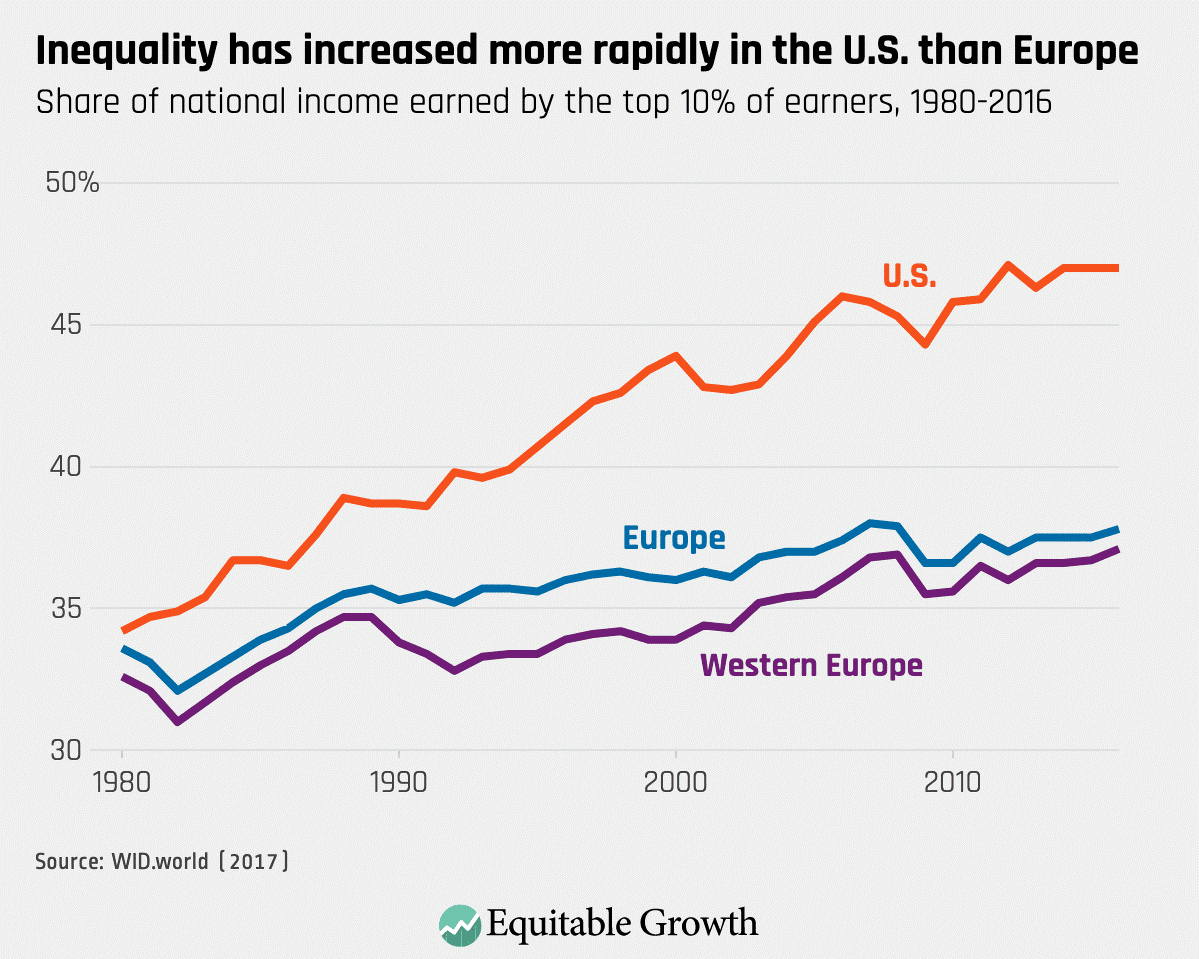
We know how that ended. Whole industries were deregulated in the name of free enterprise and allowed to form monopolies. Very little of our national wealth has consequently trickled down to the rest of us; except maybe for the top 10 percent income earners since the end of the Great Recession.

Corporate CEOs now earn more than 300 times the average salary of their employees. AT&T’s CEO is apparently scheduled to retire with a lifetime $274,000 per month pension.

President Reagan became a great leader for the wealth-holders in extracting more wealth for themselves, in other words, but not for those workers that actually produced it. And now we need competent governance more than ever to extract us from this oncoming Great Recession, or Depression, depending on how quickly Americans can return safely to work from the damage done by COVID-19.

Even Treasury Secretary Mnuchin predicts we could reach a Great Depression level unemployment of 25 percent, if we don’t return to work sooner. But studies show that the recession will be prolonged if we return to normal before implementing all the CDC-administrations guidelines of social isolation, testing, and contact tracing until an effective vaccine is created.
“We need to find ways of getting the people who are healthy, who are at lower risk, back to work and then providing the assistance to those who are most at risk, who are going to need to be quarantined or isolated for the foreseeable future,” Minnesota Federal Reserve Governor Kashkari said in a recent CBS Sunday interview.
But such a plan depends on leaders that can lead all Americans, the poor as well as wealthy. Whereas, Jennifer Senior New York Times Op-ed contributor has perhaps described the current administration best: “Vice President Pence may talk about a “whole-of-government approach” to the pandemic, but what we really have is a government of holes,” she said recently.

We will have to slog a long, hard road until we get to either an effective therapy or a vaccine, even with good leadership. It’s hard for me to see a quick, V-shaped recovery because of what we are facing, and now we have so much mixed-messaging coming from Washington that creates even greater uncertainty.

The only competent leadership is in states like New York, California, and Michigan—mostly blue states with Democratic governors. So I ask, why must the response to a pandemic that doesn’t recognize borders be so partisan?

Harlan Green © 2020

Follow Harlan Green on Twitter: https://twitter.com/HarlanGreen

Monday, April 20, 2020

How Do We Recover From This War?

Answering the Kennedys’ Call 


Robert Hormat, a former ambassador and national security advisor in three administrations, has warned in a recent article that we are already fighting a Third World War.
“This is not a confrontation of countries with nuclear and other advanced weapons, but it does involve massive numbers of countries throughout the world in a very different way. They are not fighting one another but, instead, this Third World War is against a small, unseen virus that threatens all nations — regardless of the nature of their governments or their political philosophies — and millions of their people.”
Then why call it a war? The novel coronavirus can only be defeated if we create a worldwide alliance to heal the real enemy—massive poverty levels that could result once the virus is conquered, which will be once science perfects a vaccine.

Whereas worries are growing that COVID-19 will worsen the record income and wealth inequality that already exists in America. So much so, that some studies are predicting a coming poverty epoch rather than episode, one that lasts decades instead of years. We could then have an actual World War III, as the world plunges into deeper recessions.

Studies have shown what happens when nations compete for what they see as scarce resources in a zero-sum, winner-take-all game, rather than the win-win sharing in alliances that have kept us out of major wars since World War II.
“For seven decades after World War II, the notion that global trade enhances security and prosperity prevailed across major economies,” said a recent Sunday NYTimes Op-ed by Peter Goodman, et. al. ”But in many countries—especially the United States—a stark failure by governments to equitably distribute the bounty has undermined faith in trade, giving way to a protectionist mentality in which goods and resources are viewed as zero-sum.”
And that is what we are seeing now, the ascendancy of authoritarian regimes that foment fear and breed chaos to maintain power in countries such as Hungary, where the Prime Minister has taken this opportunity to disband parliament and rule by decree.
Columbia’s Center on Poverty and Social Policy predicts poverty levels will worsen even with a normal recovery.
Our projections demonstrate that if unemployment rates rise to 30 percent, the poverty rate in the United States could increase to 18.9 percent from 15.1 percent (an increase of 21 million people) and would mark the highest recorded rate of poverty since at least 1967. Even if unemployment rates return to normal after the summer, our projections suggest poverty rates that rival those of the Great Recession.”
If we don’t confront this possibility, we might lose the opportunity to create an economic and social response to the pandemic that also lessens the occurrence of future pandemics, and the economic damages they will inevitably cause.

There will be incredible suffering at the bottom of the economic ladder, if we don’t implement policies that lessen the inequality. Without a more equitable distribution of our wealth, we remain a country divided with record suicide, alcohol and drug abuse rates of white, working class males in rust belt America that Princeton economists Anne Case and Angus Deaton, a 2015 Nobel Prize recipient, have documented in Deaths of Despair and the Future of Capitalismtheir best-seller of that title.

Richard Wilkinson and Kate Pickett, sociologists and epidemiologists, in the Spirit Level and other books, have been sounding the need for greater equality.
“More equal societies are marked by strong community life, high levels of trust, a greater willingness to help others and low levels of violence,” they said recently in The Guardian. “As inequality rises, all this goes into reverse. Community life atrophies, people cease to trust each other, and homicide rates are higher.”
The urgency is there in the face of a another looming Great Recession or Depression. The U.S. congress has already agreed to three recovery programs, such as the $2 trillion CARES Act to distribute income directly to individuals, as well as grants and loans to large and small businesses.

It won’t be easy. As Keynesian economist John Kenneth Galbraith once said about the wealth-holders, “...the privileged feel also that their privileges, however egregious they may seem to others, are a solemn, basic, God-given right.”

Americans are really staring at the possibility of a second Great Depression.  The first lasted 1o years from 1929-39 and the outbreak of World War II. The unemployment rate is expected to soar, as more than 20 million members of our 150 million work force will be out of work for a prolonged time due to COVID-19.

It will be the communities and countries that know how to care and share their wealth, rather than isolate and compete with each other for resources and knowledge, that will create a more peaceful future.

Harlan Green © 2020

Follow Harlan Green on Twitter: https://twitter.com/HarlanGreen

Monday, April 13, 2020

Collaboration vs. Confrontation—Who Wins?

Financial FAQs


Is the era of trickle-down economics, of Reagonomics that saw so much wealth redistributed to the top 1 percent, finally ending? Yes, if we want to really ‘cure’ the pandemic decimating the U.S. and world economies, because the pandemic has brought out all the weaknesses of an economic system that has boosted the wealth of the top 10 percent of college-educated and left everyone else to the mercies of globalization and a service economy that barely pays living wages.
“For seven decades after World War II, the notion that global trade enhances security and prosperity prevailed across major economies,” said a recent Sunday NYTimes Op-ed by Peter Goodman, et. al.…”But in many countries—especially the United States—a stark failure by governments to equitably distribute the bounty has undermined faith in trade, giving way to a protectionist mentality in which goods and resources are viewed as zero-sum.”
So it turns out that to defeat the ‘novel’ coronavirus we must create a new sharing society and caring world that prevents the hoarding of the resources to defeat it, which will also preserve our democracy that was built in the seventy years after WWII expressly to prevent another Stalin, Hitler and Emperor Hirohito of Japan.

Americans are now staring at the possibility of another Great Depression because of Covid-19. The unemployment rate is expected to soar, as more than 20 million members of our 150 million work force will be out of work for a prolonged time due to COVID-19.

Unless we find a new capitalist model of sharing—that mitigates the record income disparities of rich and poor last seen before the Great Depression—neither a novel coronavirus solution nor a robust economic recovery is possible.

Compounding the problem of returning to economic health is that the ‘cure’ of a prolonged national lockdown will be worse than the ‘problem’ of returning to economic growth to achieve it.There will be incredible suffering at the bottom rung of the economic latter, and it will be the communities and countries that know how to collaborate rather than compete with each other for resources and knowledge that will recover most quickly.

That is because in the words of Robert Shiller, the 2013 Novel Prize recipient, there is a second, anxiety pandemic that we must live through, and that white, non-college educated males, in particular, are still living through.

Princeton economists Anne Case and Angus Deaton, a 2015 Nobel Prize recipient, say such men are dying of drug overdoses, drink-induced liver disease and suicide — what they call Deaths of Despair and the Future of Capitalismin their best-seller of that title.
“We are feeling the anxiety effects of not one pandemic but two,” said Dr. Shiller in a recent Project-Syndicate article. “First, there is the COVID-19 pandemic, which makes us anxious because we, or people we love, anywhere in the world, might soon become gravely ill and even die. And, second, there is a pandemic of anxiety about the economic consequences of the first.”
And that is what only governments can do—enforce the cooperation needed to defeat the virus and consequent anxiety. It is what President Roosevelt did in the New Deal, because of the necessity of recovering from the Great Depression and a 25 percent unemployment rate.

This is also what a historical study of the other major international pandemic in the past century—the Spanish flu pandemic—has shown. It was those communities and cities that learned the art of cooperation and banded together to help each other, pooled their resources that had the lowest death rates and recovered most quickly.

Like the Spanish flu, this pandemic has no borders that can be shut down, no particular region or ethnic group that is immune. This is a borderless disease that requires a borderless response from every member of humanity to defeat it.
Former Obama UN Ambassador Samantha Power sounded the alarm in a recent NYTimes Op-ed: “…despite Washington’s own bungled domestic response, we nonetheless must immediately begin to build a broad and determined global anti-covid coalition. Such a coalition must create hubs for sharing scientific data in the virus, testing and vaccine efforts, taking advantage of our ability to learn from infection cycles that have peaked earlier…Unless the United States exerts leadership to prevent Covid-19 from raging out of control abroad, the crisis will not end at home.”
So let us jettison the myth of self-reliance that ignores the welfare of others in the name of private ownership of everything, and the government ownership of nothing, except military weaponry.
Richard Geldard, Author of ‘Emerson and the Dream of America: Finding Our Way to a New and Exceptional Agetitled this chapter “The New Self-Reliance”, “…because it is clear now that since Emerson’s first assertions of this theme 140 years ago, we may have assimilated personally and culturally some of the language and substance of his intention, but what remains is the actual work and its realization to a larger sphere.”
By that larger sphere, Geldard means self-discovery must lead to a greater meaning of life—the recognition we all belong to one species, and only as one family of nations can we survive a worldwide pandemic—whether it is COVID-19, or the lingering effects of overwhelming anxiety—by recognizing our inter-connectedness.

Harlan Green © 2020

Follow Harlan Green on Twitter: https://twitter.com/HarlanGreen