Friday, May 30, 2025

What's the Fed Saying?

 The Mortgage Corner

“In considering the outlook for monetary policy, participants agreed that with economic growth and the labor market still solid and current monetary policy moderately restrictive, the committee was well positioned to wait for more clarity on the outlooks for inflation and economic activity.” FOMC

Photo: Andrew Harnik/Getty Images MarketWatch

The Federal Reserve’s release of its minutes from the last FOMC meeting didn’t have much to say about the continuing tariff wars, because nothing has yet been negotiated—just some retaliatory pauses and a written understanding with the UK.

And it may take a while—could be months and years before actual trade agreements are agreed upon as they must pass congressional approval as well. The NAFTA North American Free Trade Agreement wasn’t agreed upon until 1992, though negotiations began in the late 1980s.

That puts the Fed in a very difficult position. We now know why President Trump has attempted to disguise the fact that it is an import tax. The Court of International Trade has ruled that Trump’s retaliatory tariffs are illegal.

The trade court ruled for a group of small businesses and Democratic-led states in finding that Trump tried to get around congressional approval by invoking a 1977 law that doesn’t mention tariffs.

It’s a separation of powers issue that will be fought in the courts, and may take some time, in other words.

Hence Chairman Powell’s concern that a recession may be on the horizon. “The staff viewed the possibility that the economy would enter a recession to be almost as likely as the baseline forecast.”

Why? Because higher taxes generally cause higher inflation, which trump denies will happen (it was a campaign promise), and Powell, et.al., have worked hard to get inflation down to its current level.

So it was good news that the just released Employment Cost Index rose just 2.1 percent in April; the core rate up 2.6 percent without auto and gas prices figured in. But the personal savings rate (black line in BEA graph) has been rising steadily, is up to 4.9 percent from its December low of 3.8 percent, which is a sign that consumers are becoming more cautious.

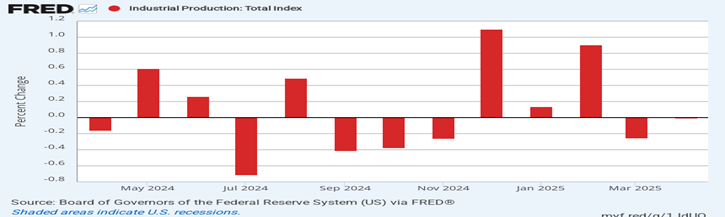
We already have a decline in two of the four major components that have determined past recessions: declining employment and flat industrial production because the tariff wars are slowing supply chains. The unemployment rate has risen from 3.6 percent in 2022 to 4.2 percent in April and long-term jobless compensation claims have been steadily rising.

The two other main indicators of a recession are consumer spending that has slowed to 1.2 percent from its usual 3-4 percent annual growth, and GDP growth that went negative -0.2 percent in Q1 for the first time since the COVID-19 pandemic.

So we could already be in a recession, and the tariff wars will certainly cause even more uncertainty.

The real problem is that Trump is trying to get around the legal process with what he asserts are emergency powers to stem the flow of fentanyl and lower the trade imbalances. Only Congress has the power to tax, not the Executive Branch, unless there’s a real emergency. Historical trade imbalances and fentanyl imports aren’t considered national emergencies that require making enemies of our closest allies.

Harlan Green © 2025

Follow Harlan Green on Twitter: https://twitter.com/HarlanGreen

Tuesday, May 27, 2025

Consumers Not Very Confident

 Financial FAQs

“Consumer confidence improved in May after five consecutive months of decline,” said Stephanie Guichard, Senior Economist, Global Indicators at The Conference Board. “The rebound was already visible before the May 12 US-China trade deal but gained momentum afterwards.”

The rebound in the Conference Board’s Consumer Confidence Index after its five-month plunge reflects how important China is in providing consumer products, and world trade. It also says consumers will have a very bumpy ride in trying to anticipate what lies ahead.

Why not? Trump has made it clear that the China pause in tariff negotiations is only temporary and that some form of higher import taxes on their products is coming. Trump’s ‘shock and awe’ negotiation tactics will eventually slow foreign trade and encourage higher inflation; just not when it will happen.

So what should consumers and investors do? Economic activity will fluctuate as well—buy the lows (i.e., discounts) and hold onto savings when prices jump. It’s what we all did during past stagflationary times.

Yes, it’s further confirmation that stagflation is on the way with more wild market activity as the public and investors attempt to anticipate what Trump will do next. This is probably why survey consumers still believe a recession could happen.

The Conference Board’s Present Situation Indexbased on consumers’ assessment of current business and labor market conditions—rose 4.8 points to 135.9. The Expectations Index—based on consumers’ short-term outlook for income, business, and labor market conditions—surged 17.4 points to 72.8, but remained below the threshold of 80, which typically signals a recession ahead.

The above graph is telling us that confidence is down to the level that last prevailed in 2020 during the COVID-19 pandemic. What was happening then? Almost no foreign trade because supply chains had been shut down from the pandemic and took years to restore.

President Trump is unfortunately causing the same supply disruptions as happened during the pandemic with his shock and awe tactics. Pandemic shutdowns were the major cause of the soaring inflation at the time (Not Biden’s New Deal legislation).

And it’s happening again. California’s Long Beach and San Pedro ports handle most west coast imports and have reported a 45 percent decline in activity while importers wait to learn what Trump may do next.

It’s the unfortunate consequence of One-man rule. Trump is deciding what the tariff rules are, not Congress. Republicans in this case have given him the power, even though he has been exhibiting increasingly erratic behavior.

Are Republicans choosing to ignore what the public may already be seeing? Is there already a coverup, an attempt to hide his declining mental acuity, as Republicans have accused President Biden’s White House of doing?

Let’s hope it doesn’t lead to another recession.

Harlan Green © 2025

Follow Harlan on Twitter: https://twitter.com/HarlanGreen

Monday, May 26, 2025

Why Harvard?

 Answering Kennedy’s Call

“But the Trumpist effort to destroy Harvard and other elite universities — for that is clearly their intention — will do vast damage to our nation’s future.” Paul Krugman

           FREDERIC J. BROWN/AFP/Getty Images)

Huffington Post

The dumbing down of the Republican party has a history long before I began to write about it in The Huffington Post. The attempt to dumb down Harvard University that Paul Krugman is talking about, by wanting to control even its curriculum and course content, is the latest attempt to bring down our educational system to the Republican Party’s dismal intellectual level.

When one political party needs ignorance to keep its followers in compliance, believing whatever the party hacks want its followers to believe, its messages will be based on conspiracy theories, rumors, or made up fictions, as Trump does with his accusations that Harvard has anti-Semitic policies.

His habitual lying hides the unpleasant truth that he just wants to pick the wallets of his followers. It’s why the poorest Americans live in Republican-controlled red states.

I first witnessed it in 2015 during the CNN Republican candidate debate that seemed to be a prolonged campaign to discount almost all scientific facts, as well as intelligent discussion of the most important issues of the day.

Especially scary was Donald Trump saying if we build up our military enough, we won't have to negotiate with anybody. Or Marco Rubio, the seemingly most moderate Republican, endorsing a 1,900 mile fence along our entire border with Mexico (or double fence, says Dr. Ben Carson) over mountains and rivers, or Carli Fiorina saying that Planned Parenthood was aborting live babies to harvest their organs.

But the anti-intellectual, anti-science bias goes much further and deeper. It is in fact an almost totally American phenomenon that Republicans have taken advantage of in an attempt to dumb down the electorate to levels that would even deny evolution.

Why would anyone not want to support public education, when it educates more than 80 percent of our students? The result is that higher education is also falling behind.

According to the National Research Council, only 28 percent of high school science teachers consistently follow the National Research Council guidelines on teaching evolution, and 13 percent of those teachers explicitly advocate creationism or "intelligent design," said Psychology Today in a very damning 2014 article entitled, Anti-Intellectualism and the Dumbing Down of America:

"After leading the world for decades in 25-34 year olds with university degrees, the U.S. is now in 12th place," said Psychology Today. "The World Economic Forum ranked the U.S. at 52nd among 139 nations in the quality of its university math and science instruction in 2010. Nearly 50 percent of all graduate students in the sciences in the U.S. are foreigners, most of whom are returning to their home countries"

What else was debated in 2015, before Trump won his first term in the White House? Republican candidates were echoing the Republican platform that advocated the deportation of all illegal aliens, would abolish or cripple whole government agencies (including the Environmental Protection Agency), shut down the federal government over Planned Parenthood funding, and maintain that a fertilized egg is a viable human being that can't be aborted.

I reported then (in 2015) journalist Chris Hedges said in a PBS interview that President Clinton in co opting moderate Republican positions, such as deregulation of the financial industry, putting 100,000 more cops on the street, and 'reforming' welfare, had driven the Republican Party to "insanity".

That’s as good a description of what Trump’s MAGA Republicans are attempting to do again. Isn’t it the perfect definition of insanity—doing the same things over and over again, expecting different results?

Harlan Green © 2025

Follow Harlan Green on Twitter: https://twitter.com/HarlanGreen

Manufacturing Not the Problem

 Popular Economics Weekly

“In April, U.S. manufacturing activity slipped marginally further into contraction after expanding only marginally in February. Demand and output weakened while input strengthened further, conditions that are not considered positive for economic growth.” ISM Manufacturing

U.S. industrial production has stalled. Manufacturers are producing more than they can sell (higher input vs. output/demand). Unable to export the excess production, the Federal Reserve’s measure of industrial production showed seven months of zero or negative growth since last April.

What does that tell us? That manufacturing is no longer as important to our economy. We are now a mostly consumer-driven society that shops until we drop (and savings are exhausted), do lots of leisure things like travel and services that cater to us, such as healthcare, education, professional services (lawyers, doctors, engineers, etc.) construction, transportation and warehousing, and financial services.

But we also develop and export lots of software; information technologies, AI, ChatGPT and the like. This is all part of the service sector that really drives our economy. So, when President Trump says we need to bring back manufacturing, there’s not much manufacturing to bring back that would improve growth.

Also, we don’t have enough workers to fill the manufacturing jobs we have now. NyTimes’ David Brooks in an excellent Op-ed piece on our manufacturing history, said manufacturers can’t find enough workers today. There are almost 500,000 vacancies in manufacturing jobs. Trump is leading us down a blind path that only benefits him and Republicans, in other words.

This is while the service sector is still growing and will continue to grow even with more tariff threats if consumers will keep spending. The financial markets are more uncertain about future growth with higher tariffs because it means higher interest rates. We shouldn’t forget that former Fed Chair Alan Greenspan’s “irrational exuberance” speech warning that the financial markets were oversold, was four years before the Dot-com bubble burst and a recession ensued in 2000.

The Institute of Supply Management’s report on the service sector remains optimistic. “Economic activity in the services sector expanded for the 10th consecutive month in April, say the nation's purchasing and supply executives in the latest Services ISM® Report On Business®. The Services PMI® registered 51.6 percent, indicating expansion for the 56th time in 59 months since recovery from the coronavirus pandemic-induced recession began in June 2020.”

The take from this news is that Trump will make up any story to justify higher tariffs. He is thereby raising import taxes on the one hand for consumers and Main Street because we import so much, while cutting taxes for the wealthiest with the other hand via renewal of his tax cut bill that will cost more than $3trillion, according to government watchdog agencies.

Add the Medicaid and benefit cuts to the tariff costs, while firing those workers that run social security, Medicare; services that benefit all of us; and we can see the huge transfer of wealth to the oligarchs that Republicans’ budget deficits are engineering.

Harlan Green © 2025

Follow Harlan Green on Twitter: https://twitter.com/HarlanGreen

Thursday, May 22, 2025

No Art of the Deal?

 Financial FAQs

“It’s 100 days into the Trump Presidency and looking more and more like President Trump is no more effective at running the country than his business interests. His book, The Art of the Deal was meant to tout his negotiating skills, but the results were never very successful.” 2017

Huffington Post

I wrote this Huffington Post piece in April 2017 after President Trump’s first 100 days in office, and nothing has changed in Trump 2.0. There was no significant legislation then and nothing has been accomplished in 2025 to date, other the Trump’s initiation of a worldwide tariff war, while Republicans are attempting to renew the Tax Cuts and Jobs Act (TCJA) that was his sole accomplishment in Trump 1.0.

Why? Because Trump’s negotiating skills have been overblown, as evidenced by his countless business failures and multiple bankruptcies. But he has been able to disguise his weaknesses, such as his inability to stay focused his need for attention, thanks in large part to his first biographer, Tony Schwartz, in Trump: The Art of the Deal, who created the myth that he was a skilled wheeler-dealer.

But it wasn’t real, Schwartz said later to New Yorker Magazine’s Jane Mayer in a famous 2016 interview.

“I put lipstick on a pig,” he said. “I feel a deep sense of remorse that I contributed to presenting Trump in a way that brought him wider attention and made him more appealing than he is.” He went on, “I genuinely believe that if Trump wins and gets the nuclear codes there is an excellent possibility it will lead to the end of civilization.”

Trump with all his weaknesses—his lies, self-aggrandizement, and short attention span—is now getting a second attempt to destroy the U.S. economy.

Renewing the TCJA, even though Moody’s downgraded U.S. Treasury debt to Aaa because the renewal won’t pay for itself, is endangering the “full faith and credit” of the U.S. Government.

The Penn Wharton Business School model predicts it would add at least $4.5 trillion to the federal debt. Cuts to Medicaid, food stamps and clean energy programs would save $1.6 trillion. But this is more than offset by the incomes of the wealthiest 1 percent and 0.1 percent.

The result is that today we have a wanna-be autocrat in charge of an economy “that creates an environment in which corruption and bribery are necessary to gain access to the ruler and either win his favor or avoid his wrath,” writes Barron’s columnist Lewis Braham.

Sound familiar with Trump’s Meme-coin investments and solicitation of $billlions from Middle east potentates?

There is a tremendous amount of research on the decline of sustainable economic growth in autocratic regimes. MIT economist Daren Acemoglo won his Nobel Prize for researching the superior growth of “inclusive” (more democratic) vs. autocratic (exploitive) governments.

“The good news is that democracy can be rebuilt and made more robust,” says Professor Acemoglo.

“The process must start by focusing on shared prosperity and citizen voice, which means reducing the role of big money in politics...The task of remaking democracy thus falls to center-left forces. If Trump’s victory serves as a wake-up call for the Democrats, then he may have inadvertently set in motion a rejuvenation of American democracy.”

In fact, we have little choice but to rebuild our democracy if we want to preserve the most basic freedoms it’s taken centuries to win.

Harlan Green © 2025

Follow Harlan on Twitter: https://twitter.com/HarlanGreen


Tuesday, May 20, 2025

Wh Needs a Tax Cut?

 Popular Economics Weekly

“A bill that cuts federal income taxes for middle-class families makes absolutely no sense, except as a sad way of camouflaging the real intent of the bill: Giving millions of dollars to the very wealthy, who happen to be the only people who are really benefiting from our uneven economic growth,” Rex Nutting

I wrote this Huffington Post piece in 2017 during President Trump’s first term when he passed the Tax Cuts and Jobs Act (TCJA) that is set to expire but is being renewed if Republicans succeed in passing their new fiscal budget.

But in seeking to repeat Trump’s first term, Trump and his Republicans are regressing to an economic model that existed more than 100 years ago, and that is completely out of touch with the modern world.

His tax cut helped very few income earners, i.e., ordinary working folk. MarketWatch economist Rex Nutting calculated that those in the 60 percent middle-income brackets—from $32,000 to $140,000 per year—pay just an average 2.5 percent in income taxes. It’s only the richest 0.1 to 1 percent income earners that pay more and therefore want the huge tax cuts Congress and the Trump administration are proposing.

The TCJA renewal in 2025 will add at least $3 trillion to our federal debt in the next 10 years, according to the Congressional Budget Office, and raise our federal debt from 120 percent to as much as 130 to 150 percent of GDP because Republicans have no mechanism to pay for it, except higher import taxes from the tariffs and cuts to health care services such as Medicaid.

Hence the just announced sovereign debt downgrade of Moody’s AAA to Aaa, the last debt rating agency that held a AAA rating on U.S. Treasury debt, which will raise the cost of U.S, Treasury securities.

The tariff war that Trump illegally initiated with the dubious rationale that it will bring back a bygone era of manufacturing (Congress has the power to regulate tariffs during wartime emergencies but they have since allowed presidents to enact them during peacetime), will cause another period of stagflation as happened in the 1970s that took 10 years and double-digit interest rates to cure.

How soon voters and investors have forgotten what stagflation was like! The Federal Reserve under Chairman Paul Volcker raised its Fed Funds rate to 20 percent in the 1980s because inflation had risen to 14 percent rate and resulted in two back-to-back recessions under President Reagan.

“Top this off with another record for corporate profits, up 7.4 percent in a year, and there is no reason to be cutting their taxes,” I said in 2017. “They haven’t been using their profits for productive purposes, so what’s needed is for them to pay higher taxes so government can use that money to invest productively in the $2 trillion plus in outmoded infrastructure that badly needs replacement,”

And that’s precisely what the Biden administration did, pass bipartisan legislation that invested $2 trillion in the Infrastructure, CHIPs and Science, and Inflation Acts to modernize the U.S. economy.

Yet voters re-elected a man in Trump 2.0 that is returning the budget and tax cut debate to an earlier historical period. President Trump is now touting the need for another Gilded Age that prevailed in 1900 when tariffs protected fledgling industries.

Tariffs became less important with the introduction of income taxes in 1913 to support government services, and the trend since then has been downward to the very low rates that prevailed until now.

Then why have so many Americans re-elected someone who is only interested in reducing taxes to enrich himself and his Oligarchs; who has shown an almost total ignorance of basic economics (in maintaining a tariff isn’t an import tax) with a history of countless business failures, and that is causing investors to flee the US economy and impoverish the rest of us?

Will it take another recession to convince voters once again that One-man rule doesn’t work if Americans still want to live and prosper in a democracy?

Harlan Green © 2025

Follow Harlan Green on Twitter: https://twitter.com/HarlanGreen

Saturday, May 17, 2025

Consumers Are Unhappy

 Financial FAQs

“Consumer confidence declined for a fifth consecutive month in April, falling to levels not seen since the onset of the COVID pandemic,” said Stephanie Guichard, Senior Economist, Global Indicators at The Conference Board. “The decline was largely driven by consumers’ expectations. The three expectation components—business conditions, employment prospects, and future income—all deteriorated sharply, reflecting pervasive pessimism about the future.”

The University of Michigan’s Sentiment Survey Index has also declined for five consecutive months, from 74 to 50.8. It’s mainly about the growing inflation fears.

Year-ahead inflation expectations surged from 6.5% last month to 7.3% this month. This month’s rise was seen among Democrats and Republicans alike. Long-run inflation expectations lifted from 4.4% in April to 4.6% in May, reflecting a particularly large monthly jump among Republicans.” Survey Director Joanne Hsu.

Why so much doom and gloom in surveys while consumers are still fully employed? Consumers don’t like uncertainty any more than businesses. and their lack of confidence could have an even larger impact on economic growth than uncertainty in the financial markets.

Consumer activity drives two-thirds of economic growth, and a recession begins when a majority begin to save more than they spend for a prolonged period. There are many ways to measure this, such as a growing cutback in retail sales.

Retail sales rose just 0.1% in April. That’s a big comedown from a 1.7% spike in March that marked the biggest increase in more than two years because consumers bought ahead of the April 2 tariff announcements that imports from all 180 countries in the world would be taxed at least 10 percent.

Retail sales account for one-third of consumer spending and and shoppers have been hunting for more bargains. Sales have declined in three of the past 13 months as portrayed in the FRED graph and were flat another three months, but are still 4.7 percent higher in a year.

Motor vehicle and parts dealers were up 9.4 percent (±1.8 percent) from last year because consumers knew that motor vehicle import taxes (i.e., tariffs) of at least 25 percent had already been announced, while food service and drinking places were up 7.8 percent (±1.8 percent) from April 2024.

The Conference Board’s Index of Leading Economic Indicators (LEI), another growth indicator that attempts to predict future growth, showed more weakness.

“The US LEI for March pointed to slowing economic activity ahead,” said Justyna Zabinska-La Monica, Senior Manager, Business Cycle Indicators, at The Conference Board. “March’s decline was concentrated among three components that weakened amid soaring economic uncertainty ahead of pending tariff announcements: 1) consumer expectations dropped further, 2) stock prices recorded their largest monthly decline since September 2022, and 3) new orders in manufacturing softened.

Manufacturing will be hardest hit, because Trump’s tariffs will bring higher inflation and interest rates, which especially hurts manufacturers because they need to borrow lots of money to build their factories. The LEI survey reported new manufacturing orders were already softening.

This will defeat what he says is the main reason for tariffs—bringing manufacturers home—as will the immigration crackdown, which reduces the working age population at a time of worker shortage. The Manufacturing Institute and Deloitte accounting firm have projected that manufacturing will need an additional 3.8 million workers by 2033. Where will they come from?

In fact, this tells us it’s not the real reason for his tariffs, since he is more concerned about cutting taxes and federal spending that would also disincentivize more domestic manufacturing investment.

No, it looks like Trump’s chaotic tariff war will create bottlenecks last seen during the COVID-19 pandemic or worse, unless he relents.

We know what those supply interruptions did to economic growth during the pandemic and why it took the succeeding Biden administration four years to fix with its bipartisan New, New Deal legislation.

Harlan Green © 2025

Follow Harlan Green on Twitter: https://twitter.com/HarlanGreen