Showing posts with label NAR. Show all posts

Thursday, October 13, 2016

Will Low Interest Rates Continue?

The Mortgage Corner


This question is behind much of the stock and bond market gyrations. We are near full employment with a 5.0 percent unemployment rate, some 11 million jobs created since the end of the Great Recession, yet we still have record low interest rates. And inflation has barely budged, with GDP growth still struggling in the 2 percent range, and predicted to continue in that range by the Atlanta Federal Reserve Bank.

But beware of the Federal Reserve’s next FOMC meeting in the first week of November. Several Fed Governors now say that it’s time to begin to raise short term rates to dampen any incipient inflation tendencies.

Marketwatch

So will such low rates continue? The simplest economic answer is there’s not much demand for money at the moment, in relation to the amount of money either in circulation or being saved by companies and individuals.

This is evidenced by the record amount of cash or other readily sellable assets—some $4.5 trillion in such assets are being held by corporations both home and abroad—and the 5.7 percent personal savings rate, which is up from its historical low of 1.9 percent in 2005, per the graph below.


In other words, even though lots of money is being hoarded in both public and private sectors, many Fed Governors are saying it’s time to raise interest rates. The private sector is investing in new plants and equipment overseas, so it’s not boosting domestic GDP growth, whereas government spending has been shut down by a very conservative Congress.

Austerity policies have ruled, in other words, just as in Europe. The only difference and reason for US growth being faster than Europe’s, is the Fed’s QE purchase of bonds vs. the EU’s almost total refusal to consider it until lately. This has put enough U.S. money into circulation to create 2 percent GDP growth, whereas the EU has suffered 2 recessions since 2008, though EU growth has picked up of late.

It has kept our interest rates at these record lows, and been good for the real estate recovery, of course. But many Fed governors are beginning to make noises that interest rates could rise after their November FOMC meeting, which occurs at the same time as the Presidential election. We can only hope that it will be a onetime rate increase followed by enough time to examine the results.

The reason is housing affordability. First-time homebuyers comprise just 30-32 percent of buyers, down from 40 percent during more normal times. And the NAR’s housing affordability index has dropped 10 percent in just one year, which measures the amount of house someone with a median income can buy. This is mainly due to the fact that the NAR’s median single-family home price has risen 15 percent just this year.

So we need those low interest rates for the housing industry to continue to recover, though we know interest rates will probably rise into next year. But with conforming fixed rates still 3.25 percent for a 1 point origination fee, it is still dirt cheap.

Harlan Green © 2016

Follow Harlan Green on Twitter: https://twitter.com/HarlanGreen

Wednesday, March 16, 2016

Builder Confidence Holds, Housing Starts Booming


Builder confidence in the market for newly-built single-family homes was unchanged in March at a level of 58 on the National Association of Home Builders/Wells Fargo Housing Market Index (HMI).“Confidence levels are hovering above the 50-point mid-range, indicating that the single-family market continues to make slow but steady progress,” said NAHB Chairman Ed Brady.  
And Housing Starts rose 5.2 percent in February to 1,178,000 units and is 30.9 percent above the February 2015 rate of 900,000, confirming builder’s increased confidence.  Single family construction was 7.2 percent higher than January.
“While builder sentiment has been relatively flat for the last few months, the March HMI reading correlates with NAHB’s forecast of a steady firming of the single-family sector in 2016,” said NAHB Chief Economist David Crowe. “Solid job growth, low mortgage rates and improving mortgage availability will help keep the housing market on a gradual upward trajectory in the coming months.”
Solid job growth is being helped by those of working age returning to the jobs market. This month, more than 4.5 million people who weren’t in the labor force found a job, according to the St. Louis Federal Reserve, even though only about 7.7 million Americans were officially unemployed the previous month. Just since December, the U.S. economy has added more than 1 million jobs and brought more than 1.5 million Americans into the labor force (based on the household survey).


            The labor force — which includes all adults over 16 who have jobs and as well as those are who actively looking for work — has increased by 2 million in the past year, the biggest 12-month gain since before the recession began in 2007, writes Marketwatch’s Rex Nutting.
            This is giving a tremendous boost to new-home construction, in particular. It is why the U.S. Census Bureau reported that construction spending during January 2016 was estimated at a seasonally adjusted annual rate of $1,140.8 billion, 1.5 percent above the revised December estimate of $1,123.5 billion. And the January figure is 10.4 percent above the January 2015 estimate of $1,033.3 billion.


On a year-over-year basis, private residential construction spending is up 8 percent. Non-residential spending is up 11 percent year-over-year. Public spending is up 13 percent year-over-year.  Looking forward, all categories of construction spending should increase in 2016. Residential spending is still very low, non-residential is increasing (except oil and gas), and public spending is also increasing after several years of austerity.
In the meantime, the number of people who have jobs has increased by 2.8 million. The strength of those numbers is startling once you consider that the population of working-age people (ages 16 to 65) has grown by only a million in the past year, says Nutting. The number of employed people is growing about three times as fast as the number of working-age adults. This means that the slack in the economy is disappearing quickly (but it’s not gone yet).
            The point of this is that with so many workers returning to the jobs market, a strong housing recovery is assured.  For it is working age Americans that want most to own a home, according to a recent National Association of Realtors survey.

Harlan Green © 2016

Follow Harlan Green on Twitter: https://twitter.com/HarlanGreen

Tuesday, September 1, 2015

Construction Leads Housing, GDP Recovery

The Mortgage Corner

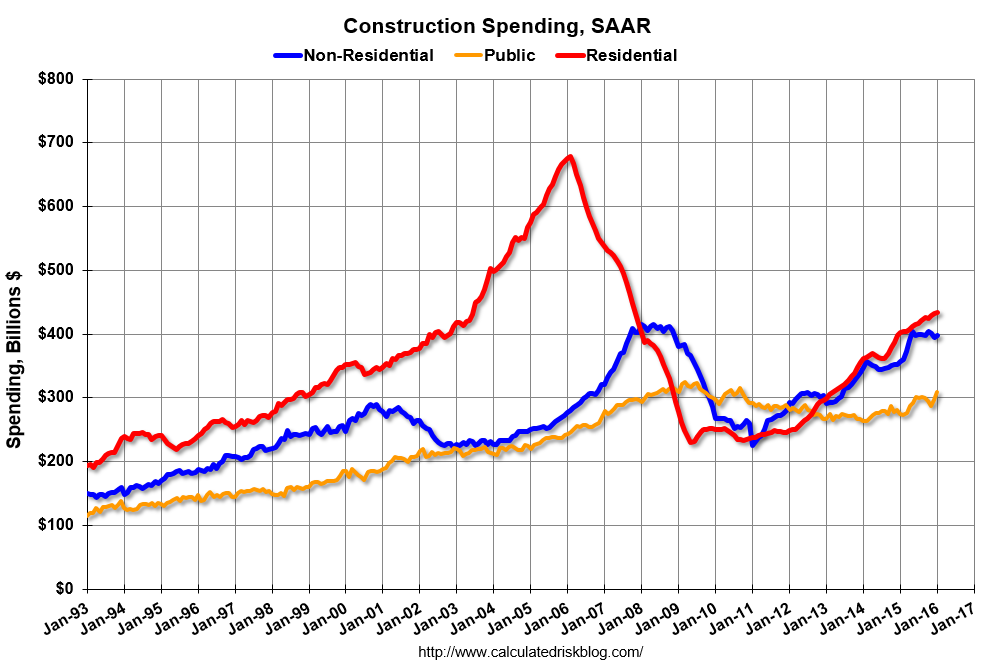
Pending home sales are still rising. And that’s in large part because both residential and non-residential commercial construction is in fact soaring. The U.S. Census Bureau of the Department of Commerce announced today that construction spending during July 2015 was estimated at a seasonally adjusted annual rate of $1,083.4 billion, 0.7 percent above the revised June estimate of $1,075.9 billion. The July figure is 13.7 percent above the July 2014 estimate of $952.5 billion.

image

Graph: Calculated Risk

This is huge, and another sign that housing this year may keep average U.S. GDP growth above 3.5 percent for the rest of 2015 and beyond, as the just revised Q2 growth rate of 3.7 percent is indicating. Housing has been the sluggard as a growth component in this recovery to date, but 2015 looks like the year that it breaks out.

The Pending Home Sales Index, a forward-looking indicator based on contract signings, increased 0.5 percent to 110.9 in July from an upwardly revised 110.4 in June and is now 7.4 percent above July 2014 (103.3). The index has increased year-over-year for 11 consecutive months and is the third highest reading of 2015, according to the National Association of Realtors.

On a year-over-year basis, private residential construction spending is up 16 percent. Non-residential spending is up 18 percent year-over-year, and public spending is up 6 percent year-over-year, reports Commerce.

That’s also why newly built, single-family home sales rose 5.4 percent to a seasonally adjusted annual rate of 507,000 units in July, according to HUD and the U.S. Census Bureau.

“This report is in line with other government data and improving builder sentiment and shows a gradual but consistent housing recovery,” said NAHB Chief Economist David Crowe. “As job growth and consumer confidence continue to strengthen, the housing market should make additional gains this year.”

Economists had forecasted gross domestic product would be revised up to 3.3 percent in Q2, but business investment was stronger than expected. Business investment helped, but it was consumers, buoyed by low interest rates and inflation boosting their confidence in future jobs and rising incomes that got them spending again.

The Commerce Department said investment in nonresidential structures was revised to show an increase rather than a contraction, reflecting stronger spending on commercial and healthcare construction. Spending on residential construction, which includes brokers' commissions, was also raised from 6.6 to 7.8 percent. More gains are likely this quarter after the Pending-Home sale report showed an increase in contracts to purchase previously owned homes (i.e., existing-homes) in July.

The large spending uptick on private construction was at a seasonally adjusted annual rate of +1.3 percent (±1.0%). Residential construction was at a seasonally adjusted annual rate of $380.8 billion in July, 1.1 percent (±1.3%). Nonresidential construction was at a seasonally adjusted annual rate of $407.0 billion in July, 1.5 percent (±1.0%).

This can only mean more jobs are being created in construction and Professional Services in the upcoming Friday unemployment report. More good news for U.S. jobs growth, in other words.

Harlan Green © 2015

Follow Harlan Green on Twitter: https://twitter.com/HarlanGreen

Tuesday, July 7, 2015

Pending Home Sales, Mortgage Applications Soar

The Mortgage Corner

Pending home sales continued to rise in May and are now at their highest level in over nine years, according to the National Association of Realtors. Gains in the Northeast and West were offset by small decreases in the Midwest and South. This is why we expect both existing and new-home sales to be the best since 2006 at the height of the housing bubble.

And mortgage activity is soaring, thanks to ultra-low interest rates, with total mortgage origination balances reaching $466 billion in the first quarter -- nearly a 75 percent increase from the same time a year ago, according to the Equifax National Consumer Credit Trends Report.

The Pending Home Sales Index, a forward-looking indicator based on contract signings, climbed 0.9 percent to 112.6 in May and is now 10.4 percent above May 2014. The index has now increased year-over-year for nine consecutive months and is at its highest level since April 2006.

image

Graph: Econoday

Pending sales were strongest in the West, up 2.2 percent in May for a 13.0 percent year-on-year gain. Pending sales in the South, up 10.6 percent year-on-year, have also been strong though the region though lower by 0.8 percent in the latest month. The Midwest was down 0.6 percent for a year-on-year plus 7.8 percent, but were up sharply in the Northeast where housing came back strongly from the severe winter, up 6.3 percent in this report for a year-on-year again of 10.6 percent.

NAR chief economist Lawrence Yun says contract activity rose again in May for the fifth straight month, increasing the likelihood that home sales are off to their best year since the downturn. "The steady pace of solid job creation seen now for over a year has given the housing market a boost this spring," said Yun. "It's very encouraging to now see a broad based recovery with all four major regions showing solid gains from a year ago and new home sales also coming alive."

Equifax said the bulk of mortgage growth has been to first mortgages, which zoomed nearly 80 percent compared to the first quarter of 2014 to $430 billion. The number of first mortgages originated in the first three months of the year was 1.78 million -- a 55 percent increase over the same time a year ago and 14 percent higher than in the fourth quarter of 2014. Originations of home equity lines of credit (HELOCs) rose 30 percent to $30.9 billion and new home equity installment loans climbed 13.6 percent to $5.0 billion.

  • Average first-lien mortgage loan amounts rose to $232,547 in March, an 11.5% increase over March 2014;
  • The number of first mortgages originated in the first three months of the year was 1.78 million, a 54.9% increase over the same time a year ago and 13.6% higher than in the fourth quarter of 2014;
  • The share of first mortgage accounts originated in the first quarter that went to consumers with an Equifax Risk Score below 620 (generally considered subprime) was 4.5%;
  • 3.1% of newly originated balances in the first quarter went to borrowers with subprime credit scores. For the same time a year ago, the share was 3.5%; and
  • The average loan amount for a first mortgage originated to a borrower with a subprime credit score in March 2015 was $152,260, up 9.9% from March 2014.

"The drop in mortgage rates that began in the fourth quarter of last year kicked off a refinance boomlet that accelerated in the first quarter, as rates fell further, averaging just 3.7 percent for the first three months of this year," said Amy Crews Cutts, Chief Economist at Equifax. "While rates have recently reversed that trend and are back up to about 4 percent, they remain extremely low historically. These rates, coupled with a housing market that is showing signs of vigor, should carry the mortgage business over the summer."

So we are seeing the housing sector back to normal growth. Existing-home sales also rose 5.1 percent in May to a 5.35 million annual rate. Home sales were plus 9.2 percent which, outside of the March 11.9 percent, is the strongest rate in nearly two years. And prices are rising, up 7.9 percent year-on-year at a median $228,700.

But, "Housing affordability remains a pressing issue with home-price growth increasing around four times the pace of wages," adds Yun. "Without meaningful gains in new and existing supply, there's no question the goalpost will move further away for many renters wanting to become homeowners."

Harlan Green © 2015

Follow Harlan Green on Twitter: https://twitter.com/HarlanGreen
Tuesday, June 23, 2015

Housing Beginning to Bloom

The Mortgage Corner

Ultra-low interest rates are finally beginning to pay off.  The housing season is beginning to bloom—for first-time homebuyers, in particular. The National Association of Realtors reports total existing-home sales, which are completed transactions that include single-family homes, townhomes, condominiums and co-ops, rose 5.1 percent to a seasonally adjusted annual rate of 5.35 million in May from an upwardly revised 5.09 million in April, largely because of the surge in first time buyers. Sales have now increased year-over-year for eight consecutive months and are 9.2 percent above a year ago (4.90 million).

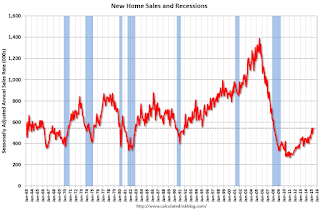
And new-home sales also soared. New single-family homes in the U.S. sold at an annual rate of 546,000 in May, hitting the fastest pace since February 2008, with growth in two of four regions, reports the U.S. Census Bureau this morning. And it revised April's rate to 534,000. May's sales rate was up 19.5 percent from a year earlier, signaling a healthy pick up, though recent sales rates remain below long-term averages.

image

Graph: Calculated Risk

This graph shows existing-home sales, on a Seasonally Adjusted Annual Rate (SAAR) basis since 1993. Sales in May (5.35 million SAAR) were 5.1 percent higher than last month, and were 9.2 percent above the May 2014 rate.

Lawrence Yun, NAR chief economist, says May home sales rebounded strongly following April's decline and are now at their highest pace since November 2009 (5.44 million). "Solid sales gains were seen throughout the country in May as more homeowners listed their home for sale and therefore provided greater choices for buyers," he said. "However, overall supply still remains tight, homes are selling fast and price growth in many markets continues to teeter at or near double-digit appreciation. Without solid gains in new home construction, prices will likely stay elevated — even with higher mortgage rates above 4 percent."

The percent share of first-time buyers rose to 32 percent in May, up from 30 percent in April and matching the highest share since September 2012. A year ago, first-time buyers represented 27 percent of all buyers.

"The return of first-time buyers in May is an encouraging sign and is the result of multiple factors, including strong job gains among young adults, less expensive mortgage insurance and lenders offering low down payment programs," said Yun. "More first-time buyers are expected to enter the market in coming months, but the overall share climbing higher will depend on how fast rates and prices rise."

The huge jump in existing-home sales means more demand for new homes, as we said last week. The median price of new homes fell 1 percent to $282,800 compared with May 2014, also a good sign for the first-time homebuyers. But there are still not enough homes for sale. The supply of new homes was 4.5 months at May's sales pace, down from 4.6 months in April.

New Home Sales

Graph: Calculated Risk

This is also why housing starts came in at a 1.036 million rate in May. Though down 11.1 percent from the April rate, which was already one for the record books. But April is now revised higher to 1.165 million, a 22.1 percent gain from March. Sealing matters is another gigantic surge in permits, up 11.8 percent to 1.275 million following a 9.8 percent gain in April.

And this is buttressed by builder confidence in the market for newly built, single-family homes in June up five points to a level of 59, according to the National Association of Home Builders/Wells Fargo Housing Market Index (HMI). This is the highest reading since September 2014, and in fact returns the index to pre-bubble (2001-02) levels.

Why the huge construction increase in June? This is while mortgage rates are rising, up some 0.375 percent since their most recent lows to 3.875 percent for 0 points in origination fees for a 30-year fixed rate conforming loan.

Firstly, it means consumers are confident enough in their future to begin to look for housing to support their growing families.  And the millennial generation aged 18 to 36 years has already surpassed their parents’ baby boomer population size, and will exceed it by 2020, according to demographers. This has to be why household formation is finally returning to normal levels of 1 million plus new households being formed per year, as the so-called echo boomers move out of their parents’ homes and or leave college to make their own nests.

So forecasters will probably be revising their second-quarter GDP estimates higher following the better housing numbers, not to mention their estimates for Thursday's index of leading economic indicators where permits are one of the components, as we said last week.

Harlan Green © 2015

Follow Harlan Green on Twitter: https://twitter.com/HarlanGreen

Tuesday, June 2, 2015

Pending Home Sales In Record Territory

The Mortgage Corner

Pending home sales hit a 9-year high in April, according to data released last Friday by the National Association of Realtors. This is an early sign that housing construction and sales will come out of their winter hibernation, as consumers begin to spend again.

The NAR’s Pending Home Sales Index rose for the fourth consecutive month in April, increasing 3.4 percent to 112.4 – a 14 percent increase over April 2014 and the largest annual increase since September of 2012. The index is now at its highest level since May of 2006.

image

Graph: Econoday

NAR chief economist Lawrence Yun said that there have been steady gains in contract activity each month this year, indicating strong buyer demand. “Realtors are saying foot traffic remains elevated this spring despite limited – and in some cases severe – inventory shortages in many metro areas,” he said. “Homeowners looking to sell this spring appear to be in the driver’s seat, as there are more buyers competing for a limited number of homes available for sale. As a result, home prices are up and accelerating in many markets.”

That has to be why construction spending is surging, as I predicted last week. Higher pending sales mean increased demand for new homes with too few existing homes available for sale at reasonable prices.

image

Graph: Calculated Risk

The U.S. Census Bureau of the Department of Commerce just announced that construction spending during April 2015 was up at a seasonally adjusted annual rate of $1,006.1 billion, 2.2 percent above the revised March estimate of $984.0 billion, and 4.8 percent above the year ago estimate of $960.3 billion.

Private non-residential spending looks very strong, up 3.1 percent and led by the power and office sectors. Public spending is also strong with a large gain for highways & streets, and a surge in educational building. Though the gain in public spending came entirely from the state and local governments as federal construction spending declined for a second straight month.

And personal incomes are beginning to show some life, which may be the underlying reason consumers are feeling more confident. Personal income increased $59.4 billion, or 0.4 percent in April, according to the Bureau of Economic Analysis, though personal consumption expenditures (PCE) decreased just $2.6 billion, or less than 0.1 percent. But we see spending also increasing with increased consumer confidence in future prospects, according to the confidence surveys.

image

Graph: Econoday

The Conference Board’s Consumer Confidence gauge is rising to pre-recession highs; another reason why both new and existing-home sales have been stronger of late. The consumer confidence report for May came in at 95.4, slightly higher than April. Income expectations are up slightly and buying plans are higher across the board, including for autos, homes, and especially for appliances.

The U. of Michigan’s consumer sentiment report also showed strength, ending May at 90.7 vs the mid-month flash of 88.6. The implied reading for the last two weeks of the month is about 93 which, though down from April's 95.9 and January's peak over 98, is still very solid, according to Econoday.

Harlan Green © 2015

Follow Harlan Green on Twitter: https://twitter.com/HarlanGreen

Thursday, April 23, 2015

March Existing-Home Sales Spike

The Mortgage Corner

Total existing-home sales, which are completed transactions that include single-family homes, townhomes, condominiums and co-ops, increased 6.1 percent to a seasonally adjusted annual rate of 5.19 million in March from 4.89 million in February—the highest annual rate since September 2013 (also 5.19 million), said the National Association of Realtors report.

 image

Graph: Calculated Risk

Sales have increased year-over-year for six consecutive months and are now 10.4 percent above a year ago, the highest annual increase since August 2013 (10.7 percent). This seems to corroborate yesterday’s Fannie Mae’s Economic & Strategic Research Group report that said economic activity was suppressed in the first quarter due largely to the West Coast port disruptions and difficult weather patterns across the Northeast, “but the economy is expected to gain momentum throughout the spring and reach previously anticipated levels by year-end.”

Total housing inventory at the end of March climbed 5.3 percent to 2.00 million existing homes available for sale, and is now 2.0 percent above a year ago (1.96 million). Unsold inventory is at a 4.6-month supply at the current sales pace, much too low for sustainable sales.

NAR Chief economist Lawrence Yun said, "The modest rise in housing supply at the end of the month despite the strong growth in sales is a welcoming sign. (But) For sales to build upon their current pace, homeowners will increasingly need to be confident in their ability to sell their home while having enough time and choices to upgrade or downsize. More listings and new home construction are still needed to tame price growth and provide more opportunity for first-time buyers to enter the market."

Prices are still rising, in other words, because of the lack of inventory. The FHFA just reported homes being purchased with conforming loans saw prices rise 5.4 percent in March. This is while new-home construction is still below par, with March starts up just 926,000, vs. the 1 to 1.2 million starts needed to increase inventories, and 2 million units annual rate at the height of the housing bubble.

image

Graph: Econoday

An even better indicator of future housing growth was the Mortgage Bankers Association weekly activity report. The Refinance Index increased 1 percent from the previous week, reports Calculated Risk. The seasonally adjusted Purchase Index increased 5 percent from one week earlier to its highest level since June 2013. The unadjusted Purchase Index increased 6 percent compared with the previous week and was 16 percent higher than the same week one year ago.

“Purchase applications increased for the fourth time in five weeks as we proceed further into the spring home buying season. Despite mortgage rates below four percent, refinance activity increased less than one percent from the previous week,” said Mike Fratantoni, MBA’s Chief Economist.

All of the above is significant evidence that the buying season should pick up after winter doldrums, as it has in past years. How much remains to be seen. Consumers also have to come out of their winter doldrums.

Harlan Green © 2015

Follow Harlan Green on Twitter: https://twitter.com/HarlanGreen

Tuesday, April 7, 2015

Mortgage Delinquencies Close to Pre-Recession Lows.

The Mortgage Corner

Calculated Risk reports Black Knight Financial Services (BKFS) released their Mortgage Monitor report for February on Monday. According to BKFS, 5.36 percent of mortgages were delinquent in February, down from 5.56 percent in January. BKFS reported that 1.58 percent of mortgages were in the foreclosure process, down from 2.22 percent in February 2014. This is approaching historical lows for delinquencies, and should mean a very good year for housing.

image

Graph: Calculated Risk

February’s delinquency rate, while still 17 percent above the pre-crisis norm of 4.6 percent, was down 49 percent from its January 2010 peak of 10.6 percent. And at 1.58 percent, the foreclosure rate remained 175 percent above precrisis norms, but was still down 63 percent from its October 2011 peak, reports Black Knight.

This breaks down as:

· 1,646,000 properties less than 90 days past due, but not in foreclosure.

· 1,067,000 properties that are 90 or more days delinquent, but not in foreclosure.

· 800,000 loans in foreclosure process.

It also means last week’s jump in Pending Home Sales was no fluke, as lower delinquency rates mean more homes with positive equity are increasing housing inventories. The National Association of Realtors Pending Sales Index is at its highest level since June 2013 (109.4), has increased year-over-year for six consecutive months and is above 100 – considered an average level of activity – for the 10th consecutive month.

So what will happen in 2015? Mortgage applications have also jumped, particularly purchase applications, as we said last week. "There was a broad based increase in mortgage applications last week (April 1) relative to the week prior. The increase in purchase volume was led by a nearly 6 percent increase in both conventional and government markets, perhaps signaling that households are finally ready to begin the home-buying season," said Lynn Fisher, MBA's Vice President of Research and Economics.

But that is largely because of still record low interest rates. The Fed wants to begin to raise interest rates sometime this year, but growth has slowed recently, due to the another severe winter, and a soaring dollar value that hurts exports. So the latest words from the Fed Governors are that low interest rates should be around for a while longer.

New York Fed Governor William Dudley said as much recently. “…as Chair Yellen remarked in her most recent press conference, removal of “patient” from the statement does not indicate that we will be “impatient” to begin to normalize monetary policy.  Rather, the timing of normalization will be data dependent and remains uncertain because the future evolution of the economy cannot be fully anticipated.”

The housing market will have a very good year, according to Core Logic’s 2015 housing forecast. “The U.S. economy is poised to grow by close to 3 percent in 2015, generating a 3- to 3.5-million-person gain in employment,” said Core Logic chief economist Frank Nothaft. “This job growth, coupled with very low mortgage interest rates and some easing in credit access, is expected to propel both owner-occupant and rental housing activity this year. This heightened level of housing demand should translate to the best home sales market in eight years.”

Let us hope the Fed remains patient for first-time homebuyers that require affordable loan rates, in particular, and are just now entering the housing market.

Harlan Green © 2015

Follow Harlan Green on Twitter: https://twitter.com/HarlanGreen
Saturday, March 28, 2015

New Home Sales Surging

The Mortgage Corner

New U.S. homes sold at an annual rate of 539,000 in February to mark the best month of sales in seven years, the government reported Tuesday. The pace of sales for January was also revised up sharply to 500,000. It's the first time annualized sales have hit 500,000 or more for two straight months since early 2008.

image

Graph: Calculated Risk

“This is 7.8 percent above the revised January rate of 500,000 and is 24.8 percent above the February 2014 estimate of 432,000," said the Census Bureau. And it reduced the for sale inventory to a 4.7 month supply, which is low considering the pent up demand for housing sales sure to grow this year, with low inflation and rising employment.

Low inflation should be a factor in housing sales this year, if oil prices stabilize, since it boosts householders’ take home pay. Price rises moderated last year. The Federal Housing Finance Authority just reported that same-home prices of homes with conforming loans rose 5.1 percent in January, down slightly from 5.4 percent in December. But we are in mid-winter, so look for more price rises as the spring selling season kicks in.

image

Graph: Econoday

Overall CPI inflation was unchanged in February, which is better than the negative -0.1 percent drop in January. Oil prices have stabilized around $50/barrel for Brent Crude at the moment, but who knows what this year will bring with so much unrest with major oil producers in the Middle East, and even Russia?

image

Graph: Trading Economics

CNBC’s Diana Olick reports that lack of existing-home inventory is the real problem. “Lack of supply of existing homes is pushing prices again, up 7.5 percent year over year to a median sale price of $202,600 in February, according to the NAR, that reported slower February existing home sales,” she says. “And don’t blame it on the weather, according to NAR chief economist Lawrence Yun.

“He calls this reacceleration of price gains, "unhealthy," per Olick. “Affordability had been helping the housing recovery inch along, but now it is weakening and fast becoming a roadblock to homeownership. Still-rising rents are contributing to the problem, keeping first-time buyers from being able to save for a down payment.”

Total existing-home sales, which are completed transactions that include single-family homes, townhomes, condominiums and co-ops, rose 1.2 percent to a seasonally adjusted annual rate of 4.88 million in February from 4.82 million in January. Sales are 4.7 percent higher than a year ago and above year-over-year totals for the fifth consecutive month.

Lawrence Yun, NAR chief economist, says although February sales showed modest improvement, there’s been some stagnation in the market in recent months. “Insufficient supply appears to be hampering prospective buyers in several areas of the country and is hiking prices to near unsuitable levels,” he said. “Stronger price growth is a boon for homeowners looking to build additional equity, but it continues to be an obstacle for current buyers looking to close before rates rise.”

The median existing-home price for all housing types in February was $202,600, which is 7.5 percent above February 2014. This marks the 36th consecutive month of year-over-year price gains and the largest since last February (8.8 percent).

Hence those rising prices and low inventories should spur more new-home construction this year.  But housing construction is barely in recovery mode, and has a long way to go to approach the 800,000 to 1 million unit per year average of past decades.

Harlan Green © 2015

Follow Harlan Green on Twitter: https://twitter.com/HarlanGreen

Monday, March 2, 2015

Pending Home Sales, Consumer Confidence Looking Better

The Mortgage Corner

Oh, the winter is freezing consumers, as I’ve said! It affected January existing-home sales, but the NAR’s January Pending Home Sales index rose sharply 1.7 percent. So pending sales of contracts signed may give a boost to existing-home sales in coming months that fell slightly in January.

Part of the reason for slightly lower home sales, according to the NAR, is that homeowners aren’t changing homes every 7 years on average as they used to. It’s now 10 years, probably due to the busted housing bubble, loss of so much housing equity, and the Great Recession, of course.

image

Graph: Econoday

But this marks the fifth consecutive month of year-over-year gains for pending sales with each month accelerating the previous month's gain, said the NAR.

Lawrence Yun, NAR chief economist, says for the most part buyers in January were able to overcome tight supply which highlights the underlying demand that exists in today's market. “Contract activity is convincingly up compared to a year ago despite comparable inventory levels,” he said. “The difference this year is the positive factors supporting stronger sales, such as slightly improving credit conditions, more jobs and slower price growth.”

“All indications point to modest sales gains as we head into the spring buying season,” says Yun. “However, the pace will greatly depend on how much upward pressure the impact of low inventory will have on home prices. Appreciation anywhere near double-digits isn't healthy or sustainable in the current economic environment.”

He is right, of course. With consumer confidence is at an all-time, post-recession high, which also bodes well for housing demand—though February's consumer confidence index fell 7.4 points to 96.4 from a revised 103.8 in January which was a 7-1/2 year high.

The dip was centered in the expectations component which fell a very steep 9.8 points to 87.2. Could it just be the winter blahs, when jobs are harder to find in part because winter weather keeps consumers from spending more?

image

The second main component of the confidence index, consumers’ present situation, also dipped but less severely, down 2.7 points to 110.2. Here, a closely watched sub-component, jobs currently hard to get, rose 1.6 percentage points to 26.2 percent which is mild indication of weakness for the monthly employment report that comes out this Friday, let us not forget.

The employment consensus is for 230,000 (Wrightson ICAP) to 235,000 (Bloomberg) jobs, a decline in the unemployment rate to 5.6 percent (reversing last month’s surprise uptick), a 0.2 percent increase in average hourly earnings and an unchanged 34.6-hour workweek.

February unemployment reports tend to start out slow and be revised in coming months, as it has in past years—by as much as 50,000 additional jobs, which would boost consumers’ attitudes.

Reuter’s Wrightson ICAP Research says February nonfarm payrolls have been revised over the subsequent two reports in each of the past five years by an average of more than 50K. Their forecast assumes that February nonfarm payroll growth this year will end up somewhere around 280K, so the preliminary estimate probably won’t be quite as strong as the final value. (Their forecast also assumes that the net revision to December and January this month will be positive but probably 25K or less).

Harlan Green © 2015

Follow Harlan Green on Twitter: https://twitter.com/HarlanGreen

Thursday, February 26, 2015

January Existing Home Sales, Mortgage Applications Dip

The Mortgage Corner

Oh, the winter freeze! It seems to put the housing market into a deep freeze, as well. Total existing-home sales, completed transactions that include single-family homes, townhomes, condominiums and co-ops, fell 4.9 percent to a seasonally adjusted annual rate of 4.82 million in January (lowest since last April at 4.75 million) from an upwardly-revised 5.07 million in December, said the NAR. Despite January’s decline, sales are higher by 3.2 percent than a year ago.

Lawrence Yun, NAR chief economist, says the housing market got off to a somewhat disappointing start to begin the year with January closings down throughout the country. “January housing data can be volatile because of seasonal influences, but low housing supply and the ongoing rise in home prices above the pace of inflation appeared to slow sales despite interest rates remaining near historic lows,” he said. “Realtors® are reporting that low rates are attracting potential buyers, but the lack of new and affordable listings is leading some to delay decisions.”

image

Graph: Calculated Risk

Better news was that the Chicago Fed National Activity Index (CFNAI) edged up to +0.13 in January from –0.07 in December, with industrial production up. Three of the four broad categories of indicators that make up the index increased from December, and only one of the four categories made a negative contribution to the index in January.

The index is a weighted average of 85 indicators of national economic activity drawn from four broad categories of data: 1) production and income; 2) employment, unemployment, and hours; 3) personal consumption and housing; and 4) sales, orders, and inventories.

Total existing-home inventory at the end of January increased 0.5 percent to 1.87 million existing homes available for sale, but is 0.5 percent lower than a year ago (1.88 million). Unsold inventory is at a 4.7-month supply at the current sales pace – up from 4.4 months in December. The median existing-home price for all housing types in January was $199,600, which is 6.2 percent above January 2014. This marks the 35th consecutive month of year-over-year price gains.

image

This follows the Conference Board’s LEI, which slowed to a not-so-strong plus 0.2 percent versus a slightly downward revised plus 0.4 percent in December. Once again the yield spread is the biggest positive for the index reflecting the Fed's near zero rate policy. Consumer expectations are the 2nd largest positive in the month, though one that may reverse in the next report given last week's plunge in the consumer sentiment index. Credit indications, which continue to be very positive in this report, are the 3rd largest positive.

Both indexes show increased employment in 2015, which should mean home sales will pick up with the selling season and better weather in the spring. “Although sales cooled in January, home prices continued solid year-over-year growth,” adds Yun. “The labor market and economy are markedly improved compared to a year ago, which supports stronger buyer demand. The big test for housing will be the impact on affordability once rates rise.”

Real estate is showing more signs of life, with the Case-Shiller Home Price Index rising again. Data released for December 2014 shows a slight uptick in home prices across the country. The S&P/Case-Shiller U.S. National Home Price Index, which covers all nine U.S. census divisions, recorded a 4.6 percent annual gain in December 2014 versus 4.7 percent in November.

image

Graph: Calculated Risk

Nine cities reported monthly increases in prices ... Both the 10-City and 20-City Composites saw year-over-year increases in December compared to November. The 10-City Composite gained 4.3 percent year-over-year, up from 4.2 percent in November. The 20-City Composite gained 4.5 percent year-over-year, compared to a 4.3 percent increase in November.

image

Graph: US Census Bureau

And lastly, January new-home sales were unchanged, but prices rose. Sales of new single-family houses in January 2015 were at a seasonally adjusted annual rate of 481,000, which is not enough product to keep prices in the affordable range. This is 0.2 percent below the revised December rate of 482,000, but is 5.3 percent above the January 2014 estimate of 457,000.

“In a promising sign, new home sales have been trending at post-recession highs for the past two months,” said NAHB Chief Economist David Crowe. “As the economy strengthens and mortgage rates remain low, we can expect continued upward movement in the housing market this year.”

So still record low interest rates (i.e., 3.50 percent conforming fixed rates) are keeping homebuyer and refinancers interested, but not enthusiastic.   And we believe mortgage rates will remain low, as evidenced by Fed Chairwoman Janet Yellen’s latest congressional testimony, which hinted that said rates could remain low for much of this year.

Harlan Green © 2015

Follow Harlan Green on Twitter: https://twitter.com/HarlanGreen

Wednesday, February 11, 2015

Mortgage Refinancings Surging in 2015

The Mortgage Corner

The still record-low interest rates are making a difference. Refinancings jumped 66 percent in January’s first two weeks, according to the MBA. And borrowers who refinanced during the fourth quarter of 2014 were able to reduce their interest rate, on average, by about 1.3 percentage points – a savings of about 23 percent, according to a recent Freddie Macs report. On a $200,000 loan that translates into saving of about $2,500 interest during the next 12 months.

image

Graph: Calculated Risk

Why? Conforming 30-yr fixed rates now are as low as 3.375 percent, and high-balance fixed rate conforming amounts can be found at 3.50 percent for 1 origination point.

"Our latest refinance report shows the refinance boom continued to wind down as the pool of potential borrowers declined over the course of 2014,” says Len Kiefer, Freddie Mac deputy chief economist. “However, because mortgage rates fell in the fourth quarter of last year, we actually saw the share of refinance originations tick up a bit despite volumes being down, a similar trend we expect to see for the first quarter of 2015 as mortgage rates have moved even lower.”

One popular program that in many cases doesn’t even require an appraisal for loan amounts up to 125 percent of value is the HARP II programs for conforming loans originated before June, 2009. Borrowers can reduce their interest rate to today’s market rates. But normal conforming qualification debt ratios and decent credit are required for HARP refinancings.

Home owners who refinanced through the government’s HARP program during the fourth quarter of 2014 saw an average reduction in their interest rate of 1.6 percentage points, according to Freddie Mac, amounting to an average savings of $3,300 in interest during the first 12 months – or about $275 in savings every month.

About 71 percent of those who refinanced their first-lien mortgage maintained about the same loan amount or lowered their principal balance by paying additional money at closing, according to the report.

But 34 percent of refinancers were able to shorten their loan terms, according to the report. This is when the conforming 15-yr fixed rate today is 2.50 percent. Overall, borrowers who refinanced in 2014 saved about $5 billion in interest over the next 12 months.

This has to spur home construction as well, since it enables the reduction of so much debt.

image

Graph: Calculated Risk

And sure enough, the U.S. Census Bureau of the Department of Commerce said that construction spending during October 2014 was estimated at a seasonally adjusted annual rate of $971.0 billion, 1.1 percent above the revised September estimate of $960.3 billion.

The latest NAR survey also showed more optimism for 2015 housing sales. An improving job market, low mortgage rates, and recent moves by the government to loosen up mortgage credit is fueling increased optimism among REALTORS®. In particular, real estate professionals are growing more confident about the housing market’s outlook for the next six months, according to the December 2014 REALTORS® Confidence Index, a survey of more than 4,000 Realtors.

So stay tuned, as winter wanes and interest rates stay low. Of course it will be up to the Federal Reserve as well, to maintain low interest rates for the rest of 2015.

Harlan Green © 2015

Follow Harlan Green on Twitter: https://twitter.com/HarlanGreen

Thursday, February 5, 2015

The Future of Interest Rates

Popular Economic Weekly

The stock market plunged yesterday, but interest rates plunged as well with the latest Fed FOMC meeting and press release. Traders felt that the Fed Governors were being too optimistic about America’s economic outlook in 2015. The first estimate of Q4 GDP growth was 2.6 percent, disappointing those who saw slower growth ahead after Q3’s 5 percent GDP growth rate. So we believe the Fed will put off its mid-summer rate hike, leaving rates at record lows for the rest of 2015.

It is exactly when interest rates begin to rise that is confusing both markets and consumers. With consumer confidence now above pre-recession levels (thanks to very low gas prices) and in a spending mood, now wouldn’t be the time to announce upcoming rate hikes, and the Federal Reserve knows that.

image

Graph: Econoday

“The Committee continues to see the risks to the outlook for economic activity, said the press release, “and the labor market as nearly balanced. Inflation is anticipated to decline further in the near term, but the Committee expects inflation to rise gradually toward 2 percent over the medium term as the labor market improves further and the transitory effects of lower energy prices and other factors dissipate. The Committee continues to monitor inflation developments closely.”

But wait a minute. There was nothing in the words that said it couldn’t be later in the year, since inflation is still falling, and wages aren’t rising for most consumers. Consumers power some 70 percent of economic activity, so a rise in their borrowing rates on autos and consumer goods could stop spending on a dime. And that’s just what the main body of its press release intimated.

Based on its current assessment, the Committee judges that it can be patient in beginning to normalize the stance of monetary policy. However, if incoming information indicates faster progress toward the Committee’s employment and inflation objectives than the Committee now expects, then increases in the target range for the federal funds rate are likely to occur sooner than currently anticipated. Conversely (my emphasis), if progress proves slower than expected, then increases in the target range are likely to occur later than currently anticipated.”

The housing market in particular wants to keep interest rates as low as possible to lure more buyers into the housing market. But there is still much uncertainty. For instance, the NAR’s Pending Home Sales index fell slightly in December, even though new-home sales jumped 11.6 percent.

The Pending Home Sales Index, a forward-looking indicator based on contract signings, decreased 3.7 percent to 100.7 in December from a slightly downwardly revised 104.6 in November, said the NAR’s press release, but is 6.1 percent above December 2013 (94.9). Despite last month’s decline (the largest since December 2013 at 5.8 percent), the index experienced its highest year-over-year gain since June 2013.

Lawrence Yun, NAR chief economist, says fewer homes available for sale and a slight acceleration in prices likely led to December’s decline in contract signings. “Total inventory fell in December for the first time in 16 months, resulting in fewer choices for buyers and a modest uptick in price growth in markets throughout the country,” he said. “With interest rates at lows not seen since early 2013, the strength in existing-sales in upcoming months will largely depend on the willingness of current homeowners to realize their equity gains from the past couple years and trade up.”

Raising rates too soon just happened in Japan. It had raised its value-added tax late last year, and Japan’s consumers stopped buying. Probably because Prime Minister Abe listened to his bankers rather than the economists, and bankers tend to worry about inflation even when there is none. Japan had endured more than 2 decades of deflation, which had reduced everyone’s incomes. It can take another decade to fix their pocketbooks, and business profits, as well.

So I believe the Fed will be reluctant to raise rates at all until the inflation rate rises from its current low, since that is a sure sign that consumers won’t pay more for things, because they can’t.

Harlan Green © 2015

Follow Harlan Green on Twitter: https://twitter.com/HarlanGreen

Wednesday, January 7, 2015

Good Pending Sales, Home Prices in 2015

The Mortgage Corner

Pending home sales are rising again. Sales picked up steam in November, to 104.8 from a revised 104.0 in October for a better-than-expected gain of 0.8 percent. It is a sign, along with the Case-Shiller Home Price Index, that the housing market will pick up in 2015.

image

Graph: Econoday

Pending sales had been declining since last September, and only began to rise again this January. But they are still below post-recession highs. Rising prices may be the culprit, as the Case-Shiller Home Price Index rose 13.5 percent in 2014, but has now settled back to moderate 4.5 percent annual increases in recent months.

"The consistent economic growth and steady hiring we've seen the second half of this year is giving buyers enough assurance to consider purchasing a home before year's end," said NAR chief economist Lawrence Yun. "With rents now rising at a seven-year high, historically low rates and moderating price growth are likely to entice more buyers to enter the market in upcoming months."

image

Graph: Econoday

Where are those new buyers coming from? The main reason could be fresh data that show those 18 to 25 year-olds are finally leaving home, or school, when the lack of first-time homebuyers has kept existing-home sales from breaking out of a narrow range since 2009 and the end of the Great Recession. This is while housing prices have moderated their double-digit climb in 2014, making housing more affordable to those now able to find jobs.

Case-Shiller's 20 city year-on-year index for October (both adjusted and unadjusted) came in soft, at plus 4.5 percent, says Econoday, down 3 tenths from September. This is the lowest rate since October 2012 and follows a full year of low double digit gains through much of 2013 and into April this year.

So ‘the times they are a changin’. Household formation is increasing again, and history says at least 50 percent of those new householders will purchase a home. Fortune Magazine has just cited Neil Dutta, head of economics at Renaissance Macro Research, who pointed out in a note to clients that household formation in 2014 through September is already at its highest rate since 2005.

image

Graph: Fortune.com

The employment rate for folks aged 25 to 34 has grown 2.8 percent over the past year, about 29 percent faster than the overall employment rate, and they make up the largest generation ready to enter the housing market, larger than their baby boomer parents.

And don’t forget those record low interest rates, now back to last year’s pre-April rates, before Fed Chair Bernanke announcement that QE3 would end. The 30-year fixed conforming rate is now down to 3.50 percent with 0 origination points in California, for those with the best credit scores.

Harlan Green © 2014

Follow Harlan Green on Twitter: https://twitter.com/HarlanGreen