Showing posts with label ai. Show all posts

Sunday, May 31, 2026

Is This Real Growth?

 Financial FAQs

Real gross domestic product (GDP) increased at an annual rate of 1.6 percent in the first quarter of 2026 (January, February, and March), according to the second estimate released today by the U.S. Bureau of Economic Analysis. Real GDP was revised down 0.4 percentage point from the advance estimate, primarily reflecting downward revisions to investment and consumer spending.” BEA.gov

FRED/Q1gdp

Economic growth this year is improving because corporations are making record profits—up 17 percent annually in Q1 2026 from an average 13 percent since the COVID-19 pandemic.

But it looks like much of the growth may be part of the tech bubble—such as massive overinvestments in chips and artificial intelligence (AI)—creating a bubble which by definition and past history will eventually deflate.

Why the sudden jump in corporate profits to 17 percent? It’s mostly from investing in the massive buildout of artificial intelligence centers and the infrastructure. How long can such GDP growth continue, especially if those future investments, such as in AI programs or the chips that power AI, may take years to turn a profit?

Republicans’ Big Beautiful Tax Cut Bill encouraged corporations to invest as much as possible this year because they could write it off in the same year, and those investments are generating serious profits in the buildout of AI data centers, for starters.

But the Biden administration’s $5trillion in investments to modernize the American economy—the CHIPS, Infrastructure, and Inflation Reduction Acts—are also contributing to the surge in growth.

Yet largely because of the Trump Administration’s mismanagement; even attempts to cancel or impede many of the Biden administration programs that would actually improve inflation, healthcare, environmental protection, and bring the manufacture of computer chips home; we are seeing those profits going into irrationally exuberant, overinvestment in future technologies with uncertain futures instead that is pushing major stocks and market indexes to record highs.

The announcements on the possibilities of AI are mind boggling. Zack Kass, Open AI pioneer and author of bestseller, The Next RENAISSANCE: AI and the Expansion of Human Potential, has said:

“If directed wisely, it will secure our needs, accelerate discoveries that serve human flourishing and unlike the products that commoditize our attention today, free us to invest in connections creativity and love.”

It will free whom, and what will they do then? It is causing massive layoffs at the likes of Amazon (30,000 employees to date) who hope that programs like Claude and ChatGPT can do much of the thinking and future planning for these corporations.

Consumers aren’t doing so well that actually make up most of the GDP growth equation. Their so-called Disposable Income (an economic term) declined to “slightly less than -0.1%” in April.

It resulted in a lowering of the personal savings rate to almost 2%, one-half of its more normal 3-4 percent rate in recent years. Consumers are stretched in other words; more than half of their incomes are now spent on the soaring costs of gasoline/energy products, household necessities, and food. This is another reason we may see slowing GDP growth ahead.

There is no question that AI has enormous potential for good, in what British economist JM Keynes made in a famous prediction in 1930, should there not be too many bumps in the promised road to a greater freedom from work:

“Thus for the first time since his creation man will be faced with his real, his permanent problem-how to use his freedom from pressing economic cares, how to occupy the leisure, which science and compound interest will have won for him, to live wisely and agreeably and well.” JM Keynes

But Keynes said this in 1930. How long has it been since then?

Harlan Green © 2026

Follow Harlan Green on Twitter: https://twitter.com/HarlanGreen

Wednesday, May 27, 2026

Consumers' Confidence Sinking

 Popular Economics Weekly

“Consumer confidence edged downward in May as the inflationary impacts of the war in the Middle East intensified,” said Dana M Peterson, Chief Economist, The Conference Board. “Consumer appraisals of current business conditions and the current labor market were moderately less positive compared to last month.” Conference Board

Conference-Board

American consumers are more worried than ever. The Conference Board and University of Michigan’s surveys are at historic lows; back to levels not seen since the COVID-19 pandemic.

Confidence then peaked in 2021 during the pandemic recovery and has been declining ever since. This is while financial market indexes are reaching unsustainable levels on the hope that the next big thing (A.I.) may bring in another Age of Enlightenment.

But beware, we have had such periods before. It looks like another period of mass hysteria over the possibilities of A.I. as companies invest $trillions, mostly in borrowed money, that is creating another asset bubble like the Dot-com and housing bubbles.

We called it Irrational Exuberance in the 1990s. It’s over enthusiastic investors over-investing in artificial intelligence.

The U. of Michigan reported,“Sentiment is now just below the previous historical trough seen in June 2022. The cost of living continues to be a first-order concern, with 57% of consumers spontaneously mentioning that high prices were eroding their personal finances, up from 50% last month.”

And consumers know why finances are eroding. Inflation can only go higher with the Iran war shortages, and tariff levels settling at 1930 pre-Great Depression levels with no formal treaties (which choked supply chains at the onset of the Great Depression).

There is no relief for either consumers or producers in sight amid the chaos that is being generated. The biggest worry is the rank naivete of a Republican Party that won’t hold its leader’s craziness to account. Americans are beginning to realize that the Trump administration has lost the Iran war, and the tariff hikes were illegal. It’s also showing up in the record lows in the polls.

In wanting to play the autocrat, Trump has booted the intelligent advisors who gave him intelligent advice. Iran can now keep the Hormuz Strait closed, while intelligence agencies are reporting Iran has enough missiles and drones to decimate the infrastructure of the other border countries, if the U.S. should try a land invasion to open the Strait.

A.I. is beginning to alarm economists, such UC Berkeley Professor Brad Delong in his Grasping Reality blog:

“The current $1.5T AI arms race: are hyperscalers building utopia, building dystopia, building digital god, or simply lighting trillions of dollars on fire in a dollar auction?”

Said $Trillions are chasing the next big thing, in other words, which happens when our government holds too much debt instead of paying it down. This results in an excess money supply sloshing around the economy looking for the next big deal, instead of investing in what Americans most need that Republicans have been intent on abolishing: (e.g, , programs to improve healthcare, environmental protection, education, climate prediction, alternative energy).

So consumers are right to be worried. This is the time for such programs that were created in the Biden administration to prepare Americans for the future, rather than a return to the past.

Can we do it without bursting another (A.I.) bubble that turns into another recession?

Harlan Green © 2026

Follow Harlan Green on Twitter: https://twitter.com/HarlanGreen

Thursday, April 30, 2026

Fitrst Quarter Economic Growth Improves

 Financial FAQs

Real gross domestic product (GDP) increased at an annual rate of 2.0 percent in the first quarter of 2026 (January, February, and March), according to the advance estimate released today by the U.S. Bureau of Economic Analysis. In the fourth quarter of 2025, real GDP increased 0.5 percent.

BEA.gov

“The U.S. economy has just powered through shock after shock,” was Fed Chair Powell’s summation of the state of the U.S. economy at his last press conference as Federal Reserve Chairmen.

First quarter 2026 real (inflation adjusted) GDP growth picked up +2.0% in the government’s first estimate, following +0.5% growth in Q4 2025, thanks to the $billions being spent in AI energy center build outs.

Kevin Warsh will take over as the new Fed Chairman in May, so there is speculation that he will push for easier monetary policy as President Trump’s pick for the new Fed Chairman by lowering the Fed’s interest rates and a more hands off management style.

Trump badly needs easy credit to maintain growth because of his economic mismanagement. A barely functioning government is either tied up in congress with the various shutdowns (last fall and current DHS funding), while illegal tariffs have choked supply chains.

Meanwhile, to Powell’s consternation, economic growth is picking up “through shock after shock”, from the Great Recession, COVID-19 pandemic, the 37-day fall government shutdown, tariffs, and the various wars that have caused energy prices to skyrocket.

The AI build out was predicted to boost growth, consumers continued to hold up their end, and government spent more on the Ukraine and Iran wars. The Defense Department reported the Iran war has already cost $25 billion in just the first two months.

And the financial markets continue to rally to new highs, so we are seeing some irrational exuberance, despite the game of chicken by Iran and Trump over the Hormuz Strait blockade. It’s obvious market investors continue to believe that Trump with his TACO policies will find a way to extricate American out of his latest war sooner rather than later.

But it also means $4 plus gas prices and soaring inflation for months to come. Even if the Iran war is settled sooner, predictions are that Middle East energy production won’t be restored to previous levels for at least one year.

The real problem is the Trump administration’s economic mistakes have taken us back to a Cold War economy—more military spending, fewer government social services, while endangering the good faith and credit of the U.S. federal government as the debt continues to balloon.

Something has to give, in other words. The financial markets won’t rally forever on the AI investment bubble, and consumers won’t keep shopping until they drop without an ensuing downturn.

The question is when on so many fronts. When will the wars end? When will enough consumers realize prices won’t come down and elect a congress that will control Trump’s extravagance and greed before he bankrupts the American economy?

When will it be one shock too many that drives us into another recession?

Harlan Green © 2026

Follow Harlan Green on Twitter: https://twitter.com/HarlanGreen

Tuesday, March 3, 2026

Stagflation --II?

 Financial FAQs

“The Producer Price Index for final demand increased 0.5 percent in January. Prices for final demand services advanced 0.8 percent, and the index for final demand goods declined 0.3 percent. On an unadjusted basis, the index for final demand rose 2.9 percent for the 12 months ended in January.” BLS.gov

FREDbls

Why shouldn’t President Trump’s new Gulf War repeat the 1970’s Arab Oil Embargo (OPEC) stagflation—slowing economic growth + higher inflation—that caused several recessions and resulted in the double-digit inflation of the era?

Iran has said it is closing the Gulf of Hormuz. It has been producing three million barrels of oil daily, has 24 percent of Middle East oil reserves and 12 percent of world reserves, and 30 percent of the world’s oil supply goes through the Gulf, according to the U.S. Energy Information Administration.

Though oil is not as important and energy source now as it was then, says Paul Krugman in Substack, it will still cause higher energy prices—maybe 10 percent higher or more, according to the experts—and oil and gas prices are still a major factor in the inflation equation.

The Producer Price Index measures wholesale prices for products and services that go into finished products have been rising throughout last year. So it is the first place economists look to see the direction of inflation.

Wholesale inflation is surging in large part because it measures the import prices of the raw materials, such as auto parts, that have been boosted by Trump’s tariffs.

Defense Department Secretary Hegseth was quick to say in the first press conference that the Iran war wouldn’t be a repeat of the Iraq war that would mire US in another long war.

But the 1970’s era of stagflation was caused by more than scarce oil. Labor unions were stronger then and could lobby for higher wages to pay for the higher prices, which in turn kept inflation rising in a wage-price spiral until it reached an eye-watering 14 percent

And we have a similar labor problem today. Workers can lobby for higher wages today because there are fewer of them in the workforce. Trump is deporting many of the undocumented workers that work in construction and agriculture, and many of the rest of the estimated 11 million are hiding rather than going to work. Also AI, CHAT GBT, and the like are causing more layoffs at major employers such as Amazon, for starters, further shrinking our workforce.

The irony is that the massive investments in building out the AI energy centers is already making electricity more expensive as well as putting more white-collar employees out of work.

This means fewer consumers are shopping when 70 percent of GDP growth is generated by American consumers! So, I see slowing economic growth as well.

A declining workforce pushing for higher wages that faces higher oil, gas and electricity prices will put more pressure on inflation, and could lead to the classic wage-price spiral that was the ultimate cause of 1970’s stagflation. This is while Trump is saying the Iran war could last just weeks?

The DOW Index has plunged more than -1100 points at this writing on fears the war will spread throughout the Middle East and beyond.

So, our stock market’s behavior will probably determine how long our TACO President will want to prolong this war.

Harlan Green © 2026

Follow Harlan Green on Twitter: https://twitter.com/HarlanGreen

Friday, February 6, 2026

Why the job Losses?

 Popular Economics Weekly

“The number of job openings continued to trend down to 6.5 million in December, the U.S. Bureau of Labor Statistics reported today. Over the month, both hires and total separations were little changed at 5.3 million each. Within separations, quits (3.2 million) were unchanged while layoffs and discharges (1.8 million) were little changed.” BLS

FRED/JOLTS

The Labor Department’s JOLTS report is another survey showing little or net job growth. That happens when the number of layoffs equals the number of hires (both hires and total separations—losses—were 5.3 million in December).

Alarm bells are ringing because it was the last this low during the worldwide economic COVID-19 pandemic (January 2021).

So now we must wait for the postponed official U.S. Labor Department unemployment report to know if we are slowly sinking into a job recession.

But workers can already see what is happening with their own eyes rather than listen to White House bromides that the economy must eventually get better. The private outplacement firm Challenger, Gray & Christmas said U.S.-based companies announced 108,435 layoffs in January, up sharply from the prior month. It was the biggest tally for the month of January since 2009.

“Generally, we see a high number of job cuts in the first quarter, but this is a high total for January. It means most of these plans were set at the end of 2025, signaling employers are less-than-optimistic about the outlook for 2026,” said Andy Challenger, workplace expert and chief revenue officer for Challenger, Gray & Christmas.”

It is up 205% from the 35,553 job cuts announced in December. January’s total is the highest for the month since 2009, when 241,749 job cuts were announced. It is the highest monthly total since October 2025, when 153,074 cuts were recorded.

There’s another reason companies have stopped hiring more workers than they are losing. They are waiting for the Supreme Court decision on whether the tariffs are legal that are making many of their products more expensive.

Trump’s executive orders are not laws, unless approved by congress. And congress has said they can be enacted if there’s a national emergency. A scarcity of strategic metals is an emergency whose imports can be taxed, but not coffee and every other product that Americans use every day because Trump doesn’t like that particular government.

What are the other culprits preventing job creation? Artificial Intelligence (AI) was cited for 7,624 job cuts in January, 7% of total cuts for the month. Companies referenced AI for 54,836 announced layoff plans in 2025. Since 2023, when this reason was first tracked, AI has been cited in 79,449 job cut announcements, 3% of all layoff plans announced in that period.

“It’s difficult to say how big an impact AI is having on layoffs specifically. We know leaders are talking about AI, many companies want to implement it in operations, and the market appears to be rewarding companies that mention it,” said Challenger.

Tariffs were cited for 294 job cuts in January, after causing 7,908 cuts in 2025.”

That is more sobering news. What will happen to the workers being laid off? Trump has cut back or cancelled many of the infrastructure programs that President Biden enacted in the Infrastructure, Inflation Reduction and CHIPs Acts that would employ these workers in sectors that are intended to modernize our economy.

But no, Trump wants to return to a fossil-fueled economy that is no longer growing (and is in fact losing workers). Republicans don’t seem to have a clue to the horrendous damage he is doing in turning back the clock to a distant era that no longer exists. It was called the Gilded Age and existed in the 1890s.

But the stock market is rallying to record highs with the DOW up 1200 at this writing. Yes, that's all due to the capital spending for new AI infrastructure. But it's creating jobs for robots, not humans.

Back to the 1890s? That can’t be done either, of course, and Americans are already seeing the results.

Harlan Green © 2026

Follow Harlan Green on Twitter: https://twitter.com/HarlanGreen

Wednesday, February 4, 2026

Where Are the Jobs--Part II?

 Financial FAQs

“Job creation took a step back in 2025, with private employers adding 398,000 jobs, down from 771,000 in 2024. While we've seen a continuous and dramatic slowdown in job creation for the past three years, wage growth has remained stable.” ADP

FREDpayrolls

The FRED (St. Louis Federal Reserve) graph tells it all. Job formation has almost disappeared in the Trump economy. It’s not only the shutdowns, which have delayed the official U.S. unemployment report that was due for January, but past months as well, so private payroll data processors like ADP fill in the knowledge gap.

But we know from the latest FRED graph of private payroll hiring that private employers are barely hiring. Just 74,000 jobs were created in November 2025 and 22,000 in January, as reported by ADP.

So the GDP growth spurts last fall 2025 are from the $ trillions being invested in AI energy centers, not in corporations expanding their workforce. Corporations are laying off workers instead.

The best examples are Amazon and now the Washington Post. The NYTimes just reported that the Washington Post told employees on Wednesday that it was beginning a widespread round of layoffs “that are expected to decimate the organization’s sports, local news and international coverage.

“The company is laying off about 30 percent of all its employees, according to two people with knowledge of the decision. That includes people on the business side and more than 300 of the roughly 800 journalists in the newsroom, the people said,” said the NYTimes

CBS News reports that in 2025, companies directly pointed to their use of AI in announcing 55,000 job cuts — more than 12 times the number of layoffs attributed to AI just two years earlier, according to outplacement firm Challenger, Gray and Christmas. Of those job losses, 51,000 were in tech, with most of the cuts concentrated in tech-heavy states such as California and Washington.

The main culprit are the tariffs that Trump is using to coerce concessions from foreign governments, but it is doing the most damage to Americans. U.S. vehicle sales plunged in January, for example. Automobile sales increased at an annual rate of 14.9 million in January, down 7% from 16.1 million in the final month of 2025, according to Wards Intelligence and profit losses of $billions have already been reported by GM and Ford due to the higher tariffs on aluminum and steel.

Consumers above all are reacting to the sudden changes in the employment picture. The Conference Board voiced their concerns in the headlineConfidence collapsed to lowest point since 2014, surpassing pandemic depths: “The Conference Board Consumer Confidence Index® fell by 9.7 points in January to 84.5 (1985=100), from an upwardly revised 94.2 in December. A 5.1-point upward revision to December’s reading of the Index resulted in a slight increase last month, reversing the initially reported decline. However, January’s preliminary results showed confidence resumed declining after a one-month uptick.

So unemployed workers are now suffering under both the rising inflation from the tariffs and AI replacing many of their jobs.

It’s not a pretty picture, while we are still waiting for the Supreme Court to rule on whether most of Trump’s tariffs are even legal. It much safer to do nothing in such circumstances—consumers to hold on to their savings and employers to replace their workers with more technology.

Harlan Green © 2026

Follow Harlan Green on Twitter: https://twitter.com/HarlanGreen

Monday, May 26, 2025

Manufacturing Not the Problem

 Popular Economics Weekly

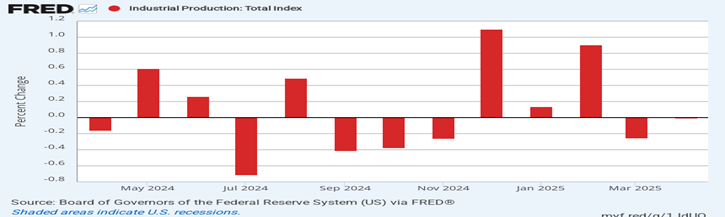
“In April, U.S. manufacturing activity slipped marginally further into contraction after expanding only marginally in February. Demand and output weakened while input strengthened further, conditions that are not considered positive for economic growth.” ISM Manufacturing

U.S. industrial production has stalled. Manufacturers are producing more than they can sell (higher input vs. output/demand). Unable to export the excess production, the Federal Reserve’s measure of industrial production showed seven months of zero or negative growth since last April.

What does that tell us? That manufacturing is no longer as important to our economy. We are now a mostly consumer-driven society that shops until we drop (and savings are exhausted), do lots of leisure things like travel and services that cater to us, such as healthcare, education, professional services (lawyers, doctors, engineers, etc.) construction, transportation and warehousing, and financial services.

But we also develop and export lots of software; information technologies, AI, ChatGPT and the like. This is all part of the service sector that really drives our economy. So, when President Trump says we need to bring back manufacturing, there’s not much manufacturing to bring back that would improve growth.

Also, we don’t have enough workers to fill the manufacturing jobs we have now. NyTimes’ David Brooks in an excellent Op-ed piece on our manufacturing history, said manufacturers can’t find enough workers today. There are almost 500,000 vacancies in manufacturing jobs. Trump is leading us down a blind path that only benefits him and Republicans, in other words.

This is while the service sector is still growing and will continue to grow even with more tariff threats if consumers will keep spending. The financial markets are more uncertain about future growth with higher tariffs because it means higher interest rates. We shouldn’t forget that former Fed Chair Alan Greenspan’s “irrational exuberance” speech warning that the financial markets were oversold, was four years before the Dot-com bubble burst and a recession ensued in 2000.

The Institute of Supply Management’s report on the service sector remains optimistic. “Economic activity in the services sector expanded for the 10th consecutive month in April, say the nation's purchasing and supply executives in the latest Services ISM® Report On Business®. The Services PMI® registered 51.6 percent, indicating expansion for the 56th time in 59 months since recovery from the coronavirus pandemic-induced recession began in June 2020.”

The take from this news is that Trump will make up any story to justify higher tariffs. He is thereby raising import taxes on the one hand for consumers and Main Street because we import so much, while cutting taxes for the wealthiest with the other hand via renewal of his tax cut bill that will cost more than $3trillion, according to government watchdog agencies.

Add the Medicaid and benefit cuts to the tariff costs, while firing those workers that run social security, Medicare; services that benefit all of us; and we can see the huge transfer of wealth to the oligarchs that Republicans’ budget deficits are engineering.

Harlan Green © 2025

Follow Harlan Green on Twitter: https://twitter.com/HarlanGreen