Showing posts with label manufacturing. Show all posts

Wednesday, June 10, 2026

Job Market Recovering

 Popular Economics Weekly

“Total nonfarm payroll employment increased by 172,000 in May, and the unemployment rate was unchanged at 4.3 percent, the U.S. Bureau of Labor Statistics reported today. Job gains occurred in leisure and hospitality, local government, and health care. Employment in financial activities declined.” BLS

FREDpayrolls

The job market is finally recovering, after almost no job growth last year. The recovery is brutal, per the head spinning FRED payroll graph above; -149,000 jobs were lost in October 2025 and -156,000 jobs were lost as recently as February 2026 before recovering in March (+214,000 jobs), April (+179,000 jobs), and now May (+172,000 jobs).

The sudden hiring surge is because manufacturing has rebounded; both from the Biden administration’s $5 trillion raised in legislation to modernize U.S. infrastructure and the $1.5-2 trillion suddenly pouring into the A.I. construction of data centers.

Corporations are investing as much as possible of their record profits in A.I. that is being touted as the next industrial revolution able to produce more of everything, thus freeing us from the jobs that produce everything.

Fed Governors are already talking about raising interest rates later this year, instead of lowering them to combat the inflation surge. Bond yields have been rising as markets are now expecting higher inflation ahead.

Consumers will be hit the hardest, as surveys now show that just 20 percent can continue to shop as they have been with the rest now living from paycheck-to-paycheck.

This is happening at the same time as retail (CPI) inflation has topped 4 percent, the first time in three years. Its energy index has now risen 23.5 percent in a year, thanks to the Strait of Hormuz closure.

So, 20 percent of consumers can travel, boosting the leisure and hospitality sector, which added 70,000 jobs in May, well above the average monthly gain of 14,000 over the prior 12 months. But food and gas are another matter for the 80 percdent.

Manufacturing payrolls added 7,000 jobs, and construction added 17,000 jobs in May but most of the job growth was in the lower-wage service sector. Employment in local government rose by 55,000, largely reflecting a gain in local government, education (+44,000). Healthcare added 35,000 jobs, in line with the average monthly gain of 38,000 over the prior 12 months.

Former Labor Secretary Robert Reich has predicted what will happen with wealth now concentrated in the hands of so few:

“When so much of our economy is in relatively few hands, we will inevitably get to the point where consumers cannot buy all the goods and services the economy is capable of producing (with A.I.). This puts the entire economy at risk.”

In a sign of the times, sales of existing homes accelerated to their fastest pace of the year in May, led by sales of homes priced at over $1 million, according to research released by the National Association of Realtors. The only categories where home sales declined last month were those homes that are most affordable priced below $250,000.

This second industrial revolution will create fewer high-wage jobs, in other words, because A.I. can already do much of the thinking, problem-solving work as well. Who will take care of the fallout? It will be jobs that improve the human element, particularly in healthcare, which A.I can certainly be helpful in modernizing.

But what about protecting the environment? A.I.’s huge computers use lots of electricity, and water to cool the super computers. But so do ordinary Americans.

Harlan Green © 2026

Follow Harlan Green on Twitter: https://twitter.com/HarlanGreen

Wednesday, June 3, 2026

Is Employment Recovering?

Financial FAQs

 “The number of job openings increased to 7.6 million in April, the U.S. Bureau of Labor Statistics reported today. Over the month, hires and total separations decreased to 5.1 million and 5.0 million, respectively. Within separations, both quits (3.0 million) and layoffs and discharges (1.7 million) were little changed.” BLS.gov

FRED/jolts

The employment picture is improving, and there are prospects for more hiring ahead. The question is how long can it last with so much economic and geopolitical uncertainty?

The manufacturing boom is one reason for the employment surge because it’s building out our aging infrastructure, thanks to the Biden administration’s $1.2 trillion Infrastructure Investment and Jobs Act (IIJA). But manufacturing is growing also due to the binge in private investment for the AI build out of data centers I’ve been writing about—maybe as much as $2 trillion in mainly borrowed money.

Biden’s IIJA provides $550 billion in new funding to rebuild roads, bridges, public transit, water systems, and broadband access across the United States on top of $650 billion authorized by Congress for work on existing infrastructure, says Wikipedia.

The latest Institute For Supply Management survey reported:

“The Manufacturing PMI® registered 54 percent in May, 1.3 percentage points higher than in April and its highest reading since May 2022 (55.9 percent). The overall economy continued in expansion for the 19th month in a row. (A Manufacturing PMI® above 47.5 percent, over a period of time, generally indicates an expansion of the overall economy.) per Susan Spence, MBA, Chair of the Institute for Supply Management® (ISM®) Manufacturing Business Survey Committee

The good news is also showing up in vastly improved jobs data. The April JOLTS report on job openings being advertised by employers jumped to 7.6 million from its low of 6.55 million last December.

There was just a 100,000 increase in hires (5.1 million) over separations (5 million), in the report, because employers remain cautious over the tariffs and Iran war. But it’s also a sign they are holding onto their existing employees.

Add to this payroll provider ADP reported that U.S. businesses created 122,000 new jobs in May to mark the biggest increase in 16 months. It’s another sign of a rebound in hiring in what’s been a tough labor market for job seekers.

“Hiring was more broad-based in May than we’ve seen in the last few years,” said Nela Richardson, chief economist at ADP, the U.S.’s largest processor of company payrolls. “The labor market continues to show sustained momentum going into the summer hiring season.”

So economic growth is holding up for now. Q1 was revised downward from an initial 2.0% to 1.6 %, due to slowing consumer spending. Second quarter growth estimates are in the 3% range, with the Atlanta Fed’s GDPNow estimate of second quarter growth at 3.0%.

But an unusually pessimistic result from the University of Michigan sentiment survey reports that inflation expectations are sky high, which will further slowdown spending as consumers become more careful with their money.

“Year-ahead inflation expectations inched up from 4.7% last month to 4.8% this month. The current reading substantially exceeds the 3.4% reading seen in February 2026 prior to the start of the Iran conflict, along with all 2024 readings. Long-run inflation expectations climbed from 3.5% in April to 3.9% in May, notably higher than the 2.8% to 3.2% range seen in 2024.”

So there are many caveats to future projections of the job market and a recovering manufacturing sector. The 2026 International Monetary Fund World Economic Outlook highlights how precarious this recovery is. Our economic wellbeing may depend on the duration of the Iran war, to no one’s surprise. If it lasts more than a few months, the likelihood of recession has increased

Harlan Green © 2026

Follow Harlan Green on Twitter: https://twitter.com/HarlanGreen


Wednesday, January 7, 2026

Too Few Jobs!


Financial FAQs

“The number of job openings was little changed at 7.1 million in November, the U.S. Bureau of Labor Statistics reported today. Over the month, hires were little changed and total separations were unchanged at 5.1 million each.” BLS.gov

CalculatedRisk

The Labor Department’s JOLTS survey is the first look at job formation before the official December U.S. unemployment report, and it isn’t pretty. The number of job hires equaled the number of ‘separations’, or those leaving the workforce for various reasons—voluntary or involuntary. 

(The blue line is Hires and red bars are Layoffs, Discharges, and other in the Calculate Risk graph. The black line is the total number of Job openings. It has fallen from its high of 12,000,000 job vacancies in 2022 after the COVID-19 pandemic.)

This means existing job positions are being replaced but no additional hires. Companies are holding on to their workforce, in other words, replacing those that are leaving for various reasons, but not expanding their workforce.

Trump’s Labor Department doesn’t tell us why but we can surmise that tariffs are the main culprit, since without the Supreme Court decision, companies don’t know if the existing so-called retaliatory tariffs enacted on April 2 are even legal. Imagine the refunds that the Trump administration has promised to return to importers if SCOTUS rules against him!

The number of hires decreased in state and local government, excluding education (-39,000) and in state and local government education (-31,000). Hires increased in federal government (+11,000), said the Bureau of Labor Statistics.

U.S. manufacturing activity fell to 47.9% in December, the Institute for Supply Management said Monday. This is the lowest reading of the year and the 10th straight month of contraction in the factory sector. Any number below 50% signals contraction.

“Looking at the manufacturing economy, 85 percent of the sector’s gross domestic product (GDP) contracted in December, compared to 58 percent in November, and the percentage of manufacturing GDP in strong contraction (defined as a composite PMI® of 45 percent or lower) increased to 43 percent, compared to 39 percent in November,” said Susan Spence, MBA, Chair of the Institute for Supply Management® (ISM®) Manufacturing Business Survey Committee.

ADP, a private payrolls purveyor, has said that just 41,000 jobs were added to payrolls in December. They were mostly in Leisure/hospitality and Education/healthcare, which means the service sector is still limping along.

This is in fact job stagnation, and with the manufacturing sector still in recession and inflation continuing to rise, it’s looking like overall economic stagflation is afoot.

How is a return of stagflation not inevitable with Republicans and Trump continuing to break up the existing world order? He has basically invaded Venezuela and threatened other countries with military intervention, how could it not be otherwise?

Who will want to do business with America at the point of a gun?

Harlan Green © 2026

Follow Harlan Green on Twitter: https://twitter.com/HarlanGreen

Monday, May 26, 2025

Manufacturing Not the Problem

 Popular Economics Weekly

“In April, U.S. manufacturing activity slipped marginally further into contraction after expanding only marginally in February. Demand and output weakened while input strengthened further, conditions that are not considered positive for economic growth.” ISM Manufacturing

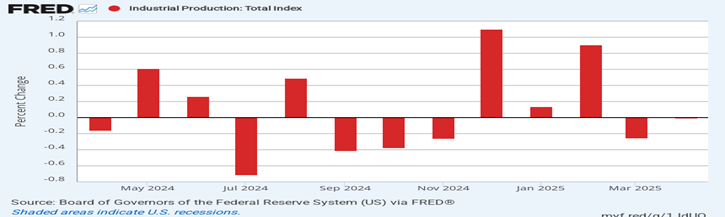
U.S. industrial production has stalled. Manufacturers are producing more than they can sell (higher input vs. output/demand). Unable to export the excess production, the Federal Reserve’s measure of industrial production showed seven months of zero or negative growth since last April.

What does that tell us? That manufacturing is no longer as important to our economy. We are now a mostly consumer-driven society that shops until we drop (and savings are exhausted), do lots of leisure things like travel and services that cater to us, such as healthcare, education, professional services (lawyers, doctors, engineers, etc.) construction, transportation and warehousing, and financial services.

But we also develop and export lots of software; information technologies, AI, ChatGPT and the like. This is all part of the service sector that really drives our economy. So, when President Trump says we need to bring back manufacturing, there’s not much manufacturing to bring back that would improve growth.

Also, we don’t have enough workers to fill the manufacturing jobs we have now. NyTimes’ David Brooks in an excellent Op-ed piece on our manufacturing history, said manufacturers can’t find enough workers today. There are almost 500,000 vacancies in manufacturing jobs. Trump is leading us down a blind path that only benefits him and Republicans, in other words.

This is while the service sector is still growing and will continue to grow even with more tariff threats if consumers will keep spending. The financial markets are more uncertain about future growth with higher tariffs because it means higher interest rates. We shouldn’t forget that former Fed Chair Alan Greenspan’s “irrational exuberance” speech warning that the financial markets were oversold, was four years before the Dot-com bubble burst and a recession ensued in 2000.

The Institute of Supply Management’s report on the service sector remains optimistic. “Economic activity in the services sector expanded for the 10th consecutive month in April, say the nation's purchasing and supply executives in the latest Services ISM® Report On Business®. The Services PMI® registered 51.6 percent, indicating expansion for the 56th time in 59 months since recovery from the coronavirus pandemic-induced recession began in June 2020.”

The take from this news is that Trump will make up any story to justify higher tariffs. He is thereby raising import taxes on the one hand for consumers and Main Street because we import so much, while cutting taxes for the wealthiest with the other hand via renewal of his tax cut bill that will cost more than $3trillion, according to government watchdog agencies.

Add the Medicaid and benefit cuts to the tariff costs, while firing those workers that run social security, Medicare; services that benefit all of us; and we can see the huge transfer of wealth to the oligarchs that Republicans’ budget deficits are engineering.

Harlan Green © 2025

Follow Harlan Green on Twitter: https://twitter.com/HarlanGreen

Saturday, May 17, 2025

Consumers Are Unhappy

 Financial FAQs

“Consumer confidence declined for a fifth consecutive month in April, falling to levels not seen since the onset of the COVID pandemic,” said Stephanie Guichard, Senior Economist, Global Indicators at The Conference Board. “The decline was largely driven by consumers’ expectations. The three expectation components—business conditions, employment prospects, and future income—all deteriorated sharply, reflecting pervasive pessimism about the future.”

The University of Michigan’s Sentiment Survey Index has also declined for five consecutive months, from 74 to 50.8. It’s mainly about the growing inflation fears.

Year-ahead inflation expectations surged from 6.5% last month to 7.3% this month. This month’s rise was seen among Democrats and Republicans alike. Long-run inflation expectations lifted from 4.4% in April to 4.6% in May, reflecting a particularly large monthly jump among Republicans.” Survey Director Joanne Hsu.

Why so much doom and gloom in surveys while consumers are still fully employed? Consumers don’t like uncertainty any more than businesses. and their lack of confidence could have an even larger impact on economic growth than uncertainty in the financial markets.

Consumer activity drives two-thirds of economic growth, and a recession begins when a majority begin to save more than they spend for a prolonged period. There are many ways to measure this, such as a growing cutback in retail sales.

Retail sales rose just 0.1% in April. That’s a big comedown from a 1.7% spike in March that marked the biggest increase in more than two years because consumers bought ahead of the April 2 tariff announcements that imports from all 180 countries in the world would be taxed at least 10 percent.

Retail sales account for one-third of consumer spending and and shoppers have been hunting for more bargains. Sales have declined in three of the past 13 months as portrayed in the FRED graph and were flat another three months, but are still 4.7 percent higher in a year.

Motor vehicle and parts dealers were up 9.4 percent (±1.8 percent) from last year because consumers knew that motor vehicle import taxes (i.e., tariffs) of at least 25 percent had already been announced, while food service and drinking places were up 7.8 percent (±1.8 percent) from April 2024.

The Conference Board’s Index of Leading Economic Indicators (LEI), another growth indicator that attempts to predict future growth, showed more weakness.

“The US LEI for March pointed to slowing economic activity ahead,” said Justyna Zabinska-La Monica, Senior Manager, Business Cycle Indicators, at The Conference Board. “March’s decline was concentrated among three components that weakened amid soaring economic uncertainty ahead of pending tariff announcements: 1) consumer expectations dropped further, 2) stock prices recorded their largest monthly decline since September 2022, and 3) new orders in manufacturing softened.

Manufacturing will be hardest hit, because Trump’s tariffs will bring higher inflation and interest rates, which especially hurts manufacturers because they need to borrow lots of money to build their factories. The LEI survey reported new manufacturing orders were already softening.

This will defeat what he says is the main reason for tariffs—bringing manufacturers home—as will the immigration crackdown, which reduces the working age population at a time of worker shortage. The Manufacturing Institute and Deloitte accounting firm have projected that manufacturing will need an additional 3.8 million workers by 2033. Where will they come from?

In fact, this tells us it’s not the real reason for his tariffs, since he is more concerned about cutting taxes and federal spending that would also disincentivize more domestic manufacturing investment.

No, it looks like Trump’s chaotic tariff war will create bottlenecks last seen during the COVID-19 pandemic or worse, unless he relents.

We know what those supply interruptions did to economic growth during the pandemic and why it took the succeeding Biden administration four years to fix with its bipartisan New, New Deal legislation.

Harlan Green © 2025

Follow Harlan Green on Twitter: https://twitter.com/HarlanGreen
Friday, May 16, 2025

Trump's Manufacturing Scam

 Financial FAQs

Why? It’s not like we’re a small country or full of stupid people. No, it’s the takeover of the economists and bankers. Simply put, modern American law is oriented towards ensuring very high returns on capital to benefit Wall Street and hinder the ability to make things.” Matt Stoller, American Economic Liberties Project

Matt Stoller’s cry is a sign that even Libertarians are alarmed at Donald Trump and the Republicans’ scheme to grow the manufacturing sector. It’s another scam that enables them to turn the economic clock back to the 19th century, the Gilded Age of Robber Barons and rampant corruption and downsize government while ignoring modern laws and even the constitution.

Trump is doing it by raising tariff rates to a level not seen since 1930 at the onset of the Great Depression. But it won’t bring back a manufacturing industry that was lost to a globalized economy over the past 30 years.

The Manufacturing Institute and Deloitte accounting firm have projected that manufacturing will need an additional 3.8 million workers by 2033, in part due to the Biden administration’s $2 trillion worth of projects already invested by the Infrastructure, CHIPs and Science, and Inflation Reduction Acts, according to a recent NPR report.

And the Trump administration’s goal of deporting millions of undocumented workers as well as eliminating DEI programs that develop more skilled minorities will defeat his purpose by hollowing out the required workforce.

Early 19th century was a time of few laws to protect working folk, and there was no income tax until 1913 when Teddy Roosevelt’s Progressive era began to level the income playing field for workers. Oligarchs had to pay income taxes for the first time.

It was Ronald Reagan and the Business Roundtable of corporate CEOs that began the “takeover of the economists and bankers” that moved whole industries overseas while reducing their income taxes—from a maximum personal tax rate as high as 92 percent in President Eisenhower’s time—transferring $trillions that once went to the 80 percent of Americans earning salaries to the oligarchs that owned the capital and became “rentiers”; i.e., living off the capital created by their workers.

Trump wants a return to the era because it’s how he made his money. Who better than a convicted felon, a “liar and cheat” his whole life in the words of his erstwhile attorney Michael Cohen, to con Americans into believing that a tariff war against the whole world is the best way to bring back our manufacturing industry that has already migrated to Southeast Asia and China?

He has rationalized the economic chaos his tax war is creating with the promised goal of returning to an earlier era when we were a manufacturing superpower. But workers had fewer rights and benefits until Roosevelt’s New Deal.

Are we to believe it justifies more tax cuts for himself and his oligarchs that will grow our record federal debt ever higher, endangering the “full faith and credit” of the U.S. Government, as well as creating another era of stagflation with possible double-digit inflation and interest rates as happened in the 1970s?

Trump is attempting to recreate a time (1900) when we invaded and occupied Cuba and the Philippines. The reason for his nonsensical pronouncements that Canada should become our 51st state and Greenland a U.S. territory now begin to make sense.

Democrats do have an answer to the huge wealth gap between blue states and red states that might bring US back to present times. Start with small steps such as lobbying to raise the national minimum wage, currently $7.25 per hour to what it is today when inflation adjusted—$10.50/hour. That is already the case in 30 of the mostly blue states, where the minimum wage has risen above $15 per hour.

It will be a terrific struggle that will take time. President Trump and Republicans have erected such a wall of ignorance to protect his administration—officials of such incompetence that they lack the ability to even think for themselves that they will obey his commands without question and even anticipate them beforehand (Pete Hegseth, et. al.).

We aren’t a country of stupid people that can’t see the erosion of rights and civil liberties the Trump administration is justifying that enacts a return to an earlier century. The mass protests and demonstrations against Trump and Musk’s chainsaw tactics are proving it.

It’s a good time to return the Democratic Party to the party that has always supported greater equality for wage-earners and farmers. That is the best way Democrats can block Trump’s impossible time travel back to an earlier century that no longer exists.

Harlan Green © 2025

Follow Harlan on Twitter: https://twitter.com/HarlanGreen

Friday, March 14, 2025

Do Job Cuts = Recession?

 Popular Economics Weekly

“I don’t see any kind of well-thought-out, comprehensive strategy coming out of the White House,” said Bernard Baumohl, chief global economist at the Economic Outlook Group, a nonpartisan forecasting firm.

What is the White House strategy? Is it based on the campaign promises to bring down inflation on “Day 1”, eliminate waste and fraud, and cut regulations that impede new investments, such as in AI?

The White House to date is attempting to explain why it hasn’t developed a strategy. Treasury Secretary Scott Bessent opined that,

“The market and the economy have just become hooked, and we’ve become addicted to this government spending, and there’s going to be a detox period. There’s going to be a detox,” Bessent, a former hedge-fund manager, said during a CNBC interview.

This description of a “detox” period is alarming, because the term has nothing to do with an economic plan, or anything else, but in fact means the Trump administration is hinting that a recession may be required to wean US off what they deem as too many government services that benefit ordinary Americans rather than the Oligarchs that have jumped onto the Trump/Musk bandwagon.

The wet dream of Republicans and conservatives has historically been to downsize government to little more than military defense. That’s why Trump has targeted USAID and the Department of Education, as well as cuts to social security, Medicare, and Medicaid.

Douglas Holtz-Eakin, a former (Republican) director of the Congressional Budget Office, said it was a fine sentiment for a Treasury secretary to want to reduce government spending but noted that there was no GOP plan in sight to accomplish this goal in any sustainable way, according to MarketWatch.


Part of the problem in downsizing government is that it’s extremely difficult to bring federal government spending below 20 percent of Gross Domestic Product as portrayed in the above FRED historical graph dating from 2010. Spending surged above that level only twice to aid recoveries from the Great Recession and COVID pandemic.

Part of that surge was the Biden administration’s new, New Deal legislation that has already brought 700,000 manufacturing jobs home in the CHIPS, Infrastructure and Inflation Reduction Acts.

These were public/private investments that resulted in the US having the fastest economic recovery from COVID-19 in the developed world.

Trumps says he also wants to bring manufacturing jobs home with the trade tariffs. But his single-minded emphasis on tariffs against friend or foe without negotiating up front will increase inflation, largely because it will be reciprocated, launching a trade war.

And rather than eliminating waste and fraud, the DOGE firings are downsizing or eliminating departments and agencies that make it work—such as the FAA, Energy Department, VA and even social security—which will do exactly the opposite—make us less safe.

“It all seems to be very capricious,” continued Baumohl, “and I think this has been of great concern, not just to U.S. and foreign investors, but certainly to consumers, and we’ve seen that in the abrupt decline in confidence, which is now showing up in in their spending patterns. Once consumers start to cut back, there is nothing that the government can do to make sure that the economy keeps out of recession, because we’re talking about 70% of all economic activity.”

Will such a strategy, or lack of it, work? American consumers are already starting to give the final word. The University of Michigan’s consumer sentiment survey showed consumers becoming even more pessimistic about their future.

“Consumer sentiment slid another 11% this month, with declines seen consistently across all groups by age, education, income, wealth, political affiliations, and geographic regions. Sentiment has now fallen for three consecutive months and is currently down 22% from December 2024.” said Survey Director Joanne Hsu.

It looks like the Trump/Musk administration doesn’t want Americans to know what they are really up to, and it is leading to the wholesale destruction of the U.S. economy.

It will take more than picketing Tesla factories and dealerships for Americans to prevent what is sure to become a recession from happening.

Harlan Green © 2025

Follow Harlan Green on Twitter: https://twitter.com/HarlanGreen

Saturday, August 24, 2024

U.S. Economy Has Landed

 Popular Economics Weekly

It’s about time. Fed Chairman Powell has finally admitted in so many words that the U.S. economy has made a ‘soft landing’; economists’ term for inflation to have declined sufficiently that the Fed can begin to ease credit conditions by cutting their interest rates.

This will give a boost to the manufacturing sector that has been in recession, and many other sectors as well. It will most of all aid those consumers who had to borrow heavily just to maintain their lifestyle, and whose savings are exhausted. Most of all, it will avoid a recession that had probably begun in the housing and manufacturing industriesvisio.

"The time has come for policy to adjust. The direction of travel is clear," Powell said in a speech to the central bank's summer retreat in Jackson Hole. "The timing and pace of rate cuts will depend on incoming data, the evolving outlook and the balance of risks," he said.

Even more importantly, he said, we will do “everything we can to support a strong labor market.” That was a huge admission that rising wages and excessive consumer demand wasn’t the inflation culprit. It was the pandemic-induced shutdown that made everything more expensive.

What must have added urgency to his announcement was the Bureau of Labor Statistics downward revision of one year’s job formations by -818,000 nonfarm payroll jobs from March 2023 to March 2024. It turns out the labor market wasn’t as strong as originally thought.

It was mostly in the service sector, which had created the most jobs to date—professional and business services, where employment was revised down by 358,000 during the period. Leisure & hospitality had the second-largest downward revision of 150,000.

This is while the Federal Reserve’s preferred Personal Consumption Expenditure (PCE) inflation measure has remained at 2.5 percent ever since January 2024.

I have opined in past columns that inflation won’t go much lower, as long as we have decent economic growth. If prices do in fact turn negative, which is the meaning of deflation, then we will have a recession.

That is as good a definition of recession. One sees this clearly in the FRED graph above where PCE inflation dipped sharply at the 2020 recession (gray bar) and has fallen in every other recession since 1960.

There is little to fear from such an event at the moment, since predictions for third quarter economic growth are in the 2% range. Both the Atlanta Fed and New York Fed’s GDPNow estimates have dropped to 2%, because there is little investment in the housing market due the high cost of money. But that could change and boost third quarter growth with the Fed’s rate cuts.

The 30-year conventional fixed mortgage rate has dropped from 7.8% to 6.4% in less than one year. It didn’t impress the National Association of Home Builders, in part because there is still a 7.8-month buildup of new homes for sales.

There was a sudden bump in new-home sales in July, up 11 percent and 5.6 percent in a year because of the lower mortgage rates.

(But) “Despite the monthly bump in new home sales data, higher rates continue to sideline buyers as housing affordability challenges remain,” said Carl Harris, chairman of the National Association of Home Builders (NAHB) and a custom home builder from Wichita, Kan. “The only sustainable way to ease high housing costs is to implement policies that allow builders to construct more attainable, affordable housing.”

The Fed’s decision is huge on many fronts. Stock and bond prices should be able to regain the highs reached before the Fed began to raise interest rates, for starters.

Lower interest rates should also help to cure the housing shortage.

Harlan Green © 2024

Follow Harlan Green on Twitter: https://twitter.com/HarlanGreen


Tuesday, June 18, 2024

Retail Sales Falter--What Can Follow?

 Financial FAQs

American consumers are tiring after two years of no relief from higher prices and interest rates. They are now looking for bargains everywhere in the latest retail sales report from the Census Bureau.

It’s the second month of the second quarter that sales have disappointed, and consumer spending is a large part of Q2 growth.

“Advance estimates of U.S. retail and food services sales for May 2024, adjusted for seasonal variation and holiday and trading-day differences, but not for price changes, were $703.1 billion, up 0.1 percent (±0.4 percent) * from the previous month, and up 2.3 percent (±0.5 percent) above May 2023,” said the U.S. Census Bureau.

This was in part because gas prices had declined -2.2 percent. Revised April retail sales had declined -0.2 percent. The retail report is going to boost both stock and bond prices, which means interest rates should continue to decline. It also means consumers are spending less on travel and entertainment, parts of the service sector that have been powering most of the economic growth to date.

The biggest negative in the May retail report was a 0.4% decline in spending at restaurants. Restaurant spending has fallen in four of the past six months for the first time since the pandemic. Sales also fell at home centers, grocery stores and stores that sell furniture — a residue of rising housing prices and high mortgage rates.

Yet sales rose at internet retailers, clothing outlets and big-box electronics stores, suggesting Americans still have some money left over to pay for so-called discretionary goods, or things people want, rather than need, to buy.

But manufacturing is taking up some of the slack as overall industrial production rose 0.9% in May, the Federal Reserve also reported on Tuesday. That is the biggest gain since last July. The manufacturing component rose 0.9% in May after a 0.4% fall in the prior month.

Part of the boost was from motor vehicles and parts output that jumped 0.6% after a 1.9% drop in the prior month. Excluding cars, total industrial output increased 0.7%, so auto sales are helping to boost growth.

What does it mean for Q2 economic growth? Estimates are still all over the map. The latest data was good enough to keep the Atlanta Fed’s GDPNow estimate of Q2 growth at 3.1 percent, up from 2.6 percent on June 6. It remained above 3 percent because a drop in PCE (consumer spending) was outweighed by a rise in second-quarter real gross private domestic investment growth (i.e., replacing inventory and buying new equipment) and second-quarter real government spending growth (on such as combatting climate change and modernizing the American economy).

Fed officials now must decide if they want to slow economic growth even more, and maybe risk a downturn come the fall. Do they want to spoil the holidays for shoppers by not cutting interest rates? I wonder if they will dare in this election year.

Harlan Green © 2024

Harlan Green on Twitter: https://twitter.com/HarlanGreen

Thursday, August 18, 2022

U.S. Industrial Production Surging

 Financial FAQs

FREDindustrialproduction

U.S. industrial production is the highest since 2018, continuing its climb from the two-month 2020 recession (gray bar in graph). Automobile production highlighted the surge.

This is huge, folks, and a sign that GDP growth in the third quarter may be positive after the first two quarters of negative growth in 2022. Capacity utilization rebounded to 80.3 percent in July from 79.9 percent in the prior month. Output of the U.S. industrial sector was at an all-time high, above the level hit in 2018.

Why the manufacturing surge now? President Biden’s $1.2 trillion infrastructure bill includes funding allocations of $89.9 billion to improve public transit, $65 billion toward better internet connectivity and access, and money for 500,000 electric vehicle charging stations, which could help address charging “deserts;” areas where it isn’t currently available.

“All of that’s good news for manufacturers who are already experiencing high demand, which could “continue on for months, if not years, going forward,” David Zrostlik, president of Stellar Industries, recently said in the Wall Street Journal.

The bill will also improve workers’ productivity by modernizing our transportation networks.

“The infrastructure bill widely focuses on improving passenger and freight transportation, for instance, so steel and material suppliers, including companies that produce materials for buses, trains, bridges, rail, or related equipment, could see heavy activity. Makers of products supporting things like 5G infrastructure and EV stations, too, will see improved demand,” said a Forbes Magazine article on its effects.

Retail sales also surged, which could even boost revisions to Q2 GDP from a negative to possibly breakeven says Reuters’ Wrightson/ICAP.

“Core sales in July (excluding autos and gas) were up 0.7% versus our forecast of a sluggish 0.1% increase, and the May and June levels were revised up markedly.  By themselves, this morning’s numbers should contribute to an upward revision to Q2 GDP on the order of half a percentage point.”

U.S. Manufacturing rose 0.7 percent in July after falling in the prior two months. Motor vehicles and parts output rose 6.6 percent after a 1.3 percent fall on the prior month. Excluding autos, total industrial output increased 0.3 percent. Auto assemblies were the highest since August 2020. Utilities output fell 0.8 percent in July. Mining output, which includes oil and natural gas, rose 0.7 percent, the third straight solid gain.

As important in bringing down oil prices was that oil and gas drilling is at a 7-year high. U.S. crude oil prices have dipped below $90 per barrel of late, and who knows how much lower they may decline?

Prices could ease further if Iran agrees to a new draft nuclear agreement after it backed off from its demand that the Islamic Revolutionary Guards be removed from the U.S. terrorism list, reports the NY Times, opening a potential of at least one million more barrels a day of Iranian petroleum exports (which would make up for the loss from the end of U.S. Petroleum Reserve contribution in November).

Harlan Green © 2022

Follow Harlan Green on Twitter: https://twitter.com/HarlanGreen

Friday, October 18, 2019

Slower Retail Sales Hint at Lower Q3 Growth

Popular Economics Weekly


U.S. retail sales that mirror consumer spending, which powers some two-thirds of U.S. GDP growth, fell for the first time in seven months in September, raising fears that a slowdown in the American manufacturing sector could be starting to bleed into the consumer side of the economy.

The Commerce Department said Wednesday that retail sales dropped 0.3 percent last month as households slashed spending on building materials, online purchases and especially automobiles. The decline was the first since February.

Retail sales have increased 2.3 percent year-over-year, which is not a good number, as can be seen in the above graph dating from 2015. It averaged closer to 4 percent from 2010 to 2015, before falling to its current level.

And manufacturing has been hurting this year, as manufacturing production fell 0.5 percent, in the Fed’s latest Industrial Production report, after rising 0.6 percent in August due to a strike at General Motors. U.S. industrial output overall dropped 0.4 percent from a month earlier in September 2019.  

That was the sharpest decline in industrial output since April. For the third quarter as a whole, industrial production rose at an annual rate of 1.2 percent following declines of about 2 percent in both the first and the second quarters, per the below graph, with brown bars in graph showing negative growth. 

Tradingeconomics.com

Hence economic growth is looking weaker for the third quarter, with GDP growth now forecast at just 1.5 percent, according to a projection by CNBC and Moody’s Analytics.
“Weak consumer spending and inventory data caused economists responding to the Rapid Update tracker to lower their collective GDP projections by one-tenth of a percentage point to 1.5 percent, the lowest level yet for Q3,” said CNBC.
Consumers must keep spending more than they are saving to keep this economic afloat, in other words. The University of Michigan sentiment survey says consumers are optimistic on that score.

Econoday commented that last Friday’s U of Michigan survey bounced sharply higher in October, to a much stronger-than-expected 96.0 that easily exceeds Econoday's consensus range.
“The assessment of current conditions is the strong point in October's report, up nearly 5 points to 113.4 in what is a positive indication for consumer spending this month. Expectations are also higher, up 1.4 points to 84.8 and together with the jump in current conditions, suggest that the impeachment inquiry of President Trump is not having a significant impact on the consumer. In fact, the report notes that the ongoing GM strike was mentioned by respondents nearly twice as much as the impeachment.”
The GM strike has reportedly been settled, but the trade wars haven’t, so it remains to be seen whether consumers can remain this optimistic about their future.

Harlan Green © 2019

Follow Harlan Green on Twitter: https://twitter.com/HarlanGreen

Monday, October 7, 2019

How Much Has US Economy Slowed?

Financial FAQs


It’s a difficult question to answer. The ISM’s non-manufacturing Indexes still show growth, which is two-thirds of economic activity, but we are close to that edge of no growth at all.
The NMI® registered 52.6 percent, which is 3.8 percentage points below the August reading of 56.4 percent,” reports Anthony Nieves, Chair of the Institute for Supply Management. “This represents continued growth in the non-manufacturing sector, at a slower rate. The Non-Manufacturing Business Activity Index decreased to 55.2 percent, 6.3 percentage points lower than the August reading of 61.5 percent, reflecting growth for the 122nd consecutive month. The New Orders Index registered 53.7 percent; 6.6 percentage points lower than the reading of 60.3 percent in August. The Employment Index decreased 2.7 percentage points in September to 50.4 percent from the August reading of 53.1 percent. The respondents are mostly concerned about tariffs, labor resources and the direction of the economy,” said Nieves.
 We know the US economy is slowing, and the manufacturing activity is already contracting—the first of the four indicators that are used to call a recession—per the ISM’s Manufacturing Diffusion Index.


And last week’s Associated Data Processing survey came in at 135,000 jobs created, which is a slight downward trend. Just 8,000 jobs were added to the goods-producing sector, whereas 127,000 jobs were added to the service-providing sector, according to ADP.

ADP private payroll survey is usually within 50,000 of the US Bureau of Labor Statistics monthly survey coming out tomorrow, which isn’t much help in predicting the BLS unemployment report.
So there you have it. Employment growth has leveled off. i.e., is no longer increasing. Tomorrow’s report may also show more weakness in job creation.

The 10-year Treasury yield also slipped back into the 1.5 percent range, a sign that there is little demand for credit. Interest rates this low are also a sign of pessimism about future growth, which can be self-fulfilling.

I believe our economy will continue to barely grow, and so avoid an outright recession; at least until next year’s presidential election, when the trade wars might or might not be finally resolved. That seems to be the consensus.

Harlan Green © 2019

Follow Harlan Green on Twitter: https://twitter.com/HarlanGreen

Friday, August 30, 2019

Q2 GDP Growth Slowing—What Else?

Popular Economics Weekly


The 2nd estimate of second quarter Real Gross Domestic Growth slowed to 2 percent, from 3.1 percent in January. It looks like growth is slowing to the average rate that has prevailed since the end of the Great Recession.

Consumers are reacting to the slowdown in the U. of Michigan sentiment survey of 600 telephone respondents, which was well below expectations and the lowest reading since October 2016. The expectations component also fell more than 10 points in the month with the current conditions component down more than 5 points.
“The report cites consumer apprehension over rising tariffs which, for this phone sample, were spontaneously mentioned by 1/3 of the respondents” said Econoday.
There have been other signs of slower growth as well. The Economist reports US Steel announced earlier in August it would lay off 200 workers in Michigan. Sales of camper vans dropped by 23 percent in the 12 months ending in July, threatening the livelihoods of thousands of workers in Indiana, where many are made. Factory workers are not the only ones on edge. Lowes, a retailer, recently said it would slash thousands of jobs. Halliburton, an oil-services firm, is cutting too.

Why the slowdown now? Consumers are still spending (brown line), as the BEA’s Disposal Personal Income graph shows—but it’s a lot more than they are earning (blue line).


This means they could stop spending if any more shocks occur, such as the possibility that China might wait until after the 2020 election to make a deal.  Exports and residential investments also declined from Q1.


Manufacturing is the mainstay of exports. Employment in durable-goods manufacturing peaked in June 2006, about a year and a half before the onset of recession. This year has been another brutal one for industry. An index of purchasing managers’ activity registered a decline in August.

Since last December manufacturing output has fallen by 1.5 percent. Hours worked—considered to be a leading economic indicator—are declining. Some of this is also linked to President Donald Trump’s trade wars, which have hurt manufacturers worldwide.

Last Friday China said it would  increase existing tariffs from 5 percent to 10 percent on more than 5,000 U.S. products, including soybeans, oil and aircraft. A 25 percent duty on American-made cars would also be reinstituted. The value of these products is estimated by the Chinese Commerce Ministry to total around $75 billion.

Trump responded after financial markets closed by saying he would raise current U.S. tariffs. A 10 percent duty on $300 billion in Chinese goods will be raised to 15 percent in September while a 25 percent tariff on $250 billion in imports would be increased to 30 percent in October.

And on Wednesday, MarketWatch’s Robert Schroeder reported a coalition of 161 manufacturers, farmers, retailers, natural gas and oil companies as well as other business groups, as well as other business groups, sent a letter asking Trump to postpone tariff rate increases on Chinese goods slated to take effect this year.

Does that look like they are near to making a deal?

Harlan Green © 2019

Follow Harlan Green on Twitter: https://twitter.com/HarlanGreen

Thursday, July 18, 2019

Retail Sales Soaring

Financial FAQs


Retail sales rose in June for the fourth month in a row, quieting concerns that the trade wars and weaker manufacturing output would also drag down consumer spending.

The most surprising strength in the report was a 0.7 percent jump in auto sales. Nonretailers (Internet), which continue to feed off of traditional retailers such as department stores, according to Econoday, was also surprising with a 1.7 percent for the second month in a row.

And discretionary spending, such as for restaurants, was up 0.9 percent following prior gains of 1.0 percent, 0.7 percent, and 0.8 percent. “This shows that consumers, flush with confidence and fully employed, are enjoying themselves,” said Econoday.

The list of strengths goes on with both furniture and building materials snapping back with 0.5 percent gains that point to strength for residential investment. Clothing stores saw sales also rise 0.5 percent as did health & personal care stores.

More good news was today’s Federal Reserve Industrial Production report that showed renewed strength in manufacturing—particularly in motor vehicle production. It’s still far below last year’s manufacturing output, however, that was mainly due to the 2017 tax breaks that raised profits.

Manufacturing is by far the largest component in this report and June's results are almost uniformly strong, led by a 2.9 percent monthly rise for motor vehicle production and a 0.7 percent rise for selected hi-tech. Business equipment production posted a second strong increase at 0.5 percent that follows May's 0.4 percent rise in gains that should ease the Fed's concerns over business investment.

Construction supplies also show strength, up 0.5 percent and 0.6 percent in the last two reports in what are positive signals for construction demand that reinforces the increased furniture and building materials gains in retail sales.

One month’s gain in manufacturing does not constitute a trend, however. But consumers are flush and confident, so economists may begin to raise their growth forecasts if this trend continues.

Harlan Green © 2019

Follow Harlan Green on Twitter: https://twitter.com/HarlanGreen

Sunday, April 7, 2019

March Job Creation Still Exceeds Population Growth

Popular Economics Weekly

Stanford economist and Former Chief Economic Advisor Ed Lezear said last week on CNBC that job creation still exceeds population growth, which is a sign the US economy continues to expand, but at a slower rate, as shown in the BLS March unemployment report on Friday.
“Total nonfarm payroll employment increased by 196,000 in March, and the unemployment rate was unchanged at 3.8 percent, the U.S. Bureau of Labor Statistics reported today. Notable job gains occurred in health care and in professional and technical services.”
February was revised slightly up to 33,000 instead of the 20,000 initial nonfarm payroll total, also an encouraging gain that hints growth in the economy might be picking up again. Hiring increased in most major segments of the economy, most notably health care and white-collar firms. The flush of new jobs kept the unemployment rate near a 50-year low, the Labor Department said.


Health-care and Educational Service providers led the way again, adding 70,000 jobs. Health-care has boosted hiring by almost 400,000 in the past year. Professional and technical firms hired 34,000 workers, restaurants increased staff by 27,000 and construction companies took on 16,000 new workers. A month earlier, builders cut employment by the most in a year and a half during a spell of severe cold and heavy snowfall.

But manufacturers trimmed 6,000 jobs after barely any gain in February. And retailers eliminated 12,000 jobs. The manufacturing losses seem to be coming from uncertainty over the prolonged trade negotiations with multiple countries. Manufacturers are complaining about the rising price of imported parts from tariffs that make their finished products more expensive.


Another sign of a manufacturing activity slowdown was the decline in February Durable Goods Orders reported earlier this week. There was a cooling for aircraft orders, so that durable goods orders fell -1.6 percent with the ex-transportation reading very low at just a 0.1 percent gain.

Orders for core capital goods also fell -0.1 percent (ex-aircraft and autos), which are factory-produced tools, buildings, vehicles, machinery and equipment that increase future growth and productivity. The fact that orders have dropped below 5 percent annually when maintaining more than 6 percent annual growth the past 2 years is a definite sign of slowing activity.

But the 3-month 180,000 payroll hiring average is more than needed to employ the lower number of working-age adults entering the workforce. The workforce participation rate of 60.6 percent is also healthy, and governments have helped by adding 19,000 jobs since January.
MarketWatch reports another plus for economic growth. “Motor vehicle sales reached a seasonally adjusted annual rate of 17.45 million in March, up from 16.57 million in February, according to data from Autodata. That’s the highest reading in three months and represents a recovery from a downbeat start to the year. The MarketWatch-compiled consensus expectation was for a 16.8 million rate.”
What’s not to like about the unemployment report? Employers are paying more, and even willing to retrain workers to fill the skilled-worker void. The housing market has also picked up with record-low interest rates holding. The Mortgage Bankers Association reports refinance applications jumped 39 percent last week.

Harlan Green © 2019

Follow Harlan Green on Twitter: https://twitter.com/HarlanGreen

Monday, January 21, 2019

Conflicting Growth Signals?

Popular Economics Weekly


How do we reconcile the fact that industrial production in 2018 was very good, probably due to producers stocking up before more new tariffs are announced, and consumer sentiment has plunged to a 2-year low because of the government shutdown?

A surge in motor vehicle production together with construction supplies along with a strong gain for business equipment caused a 1.1 percent December increase in manufacturing production that far surpasses Econoday’s consensus range where the top estimate was only 0.4 percent.

Consumers power most economic activity with their spending, so when they grow worried about future prospects, spending and economic growth slow down. Hence the reduced growth expectations in 2019, as there is a growing consensus that a prolonged government shutdown will begin to harm large and small businesses.

Trump’s chief economic advisor Kevin Hasselt reports the shutdown has cost $1.2 billion in economic activity per week in just the first three weeks of 2019, and could cost much more if the shutdown continues.


In what is the first major economic indication of trouble tied to the government shutdown, the consumer sentiment index plunged to a 90.7 reading that is far below consensus estimates of 95.5. The expectations component fell nearly 9 points to 78.3 with current conditions also taking a hit, down more than 6 points to 110.0.

Richard Curtin, chief economist of the U. of Michigan sentiment survey, reported “Consumer sentiment declined in early January to its lowest level since Trump was elected. The decline was primarily focused on prospects for the domestic economy, with the year-ahead outlook for the national economy judged the worst since mid-2014. The loss was due to a host of issues including the partial government shutdown, the impact of tariffs, instabilities in financial markets, the global slowdown, and the lack of clarity about monetary policies. Aside from the direct economic impact from these various issues on the economy, the indirect effect meant that half of all consumers believed that these events would have a negative impact on Trump's ability to focus on economic growth."

Another casualty of the shutdown was that some government statistics, such as retail sales, haven’t reported for December. December sales are expected to be healthy, but then we have the usual January letdown as consumers retrench while waiting for their tax refunds that may also be delayed because of the shutdown.

So consumers are beginning to recognize the record shutdown length is affecting this year’s economic prospects,. And we shouldn’t forget what happened the last time higher tariffs were enacted. It was just prior to the 1929 stock market plunge. The Smoot-Hawley Tariff Act of 1930 raised import tariffs by an average 20 percent, which helped to turn it into the Great Depression.

Are we about to repeat that history?

Harlan Green © 2019

Follow Harlan Green on Twitter: https://twitter.com/HarlanGreen

Friday, June 22, 2018

Trade Wars Not Good For Future Growth Either

Popular Economics Weekly

The Conference Board Leading Economic Index® (LEI)for the U.S. increased 0.2 percent in May to 109.5 (2016 = 100), following a 0.4 percent increase in April, and a 0.4 percent increase in March.

This monthly announcement of the LEI is a good predictor of future economic growth because it reports on 12 items that measure trends on everything from interest rates, to housing permits, to stock prices, and hours in the work week. It is slowing, surely not a coincidence with the talk of a worldwide trade war.
“While May’s increase in the U.S. LEI was slower than in recent months, the improvements in a majority of its components offset the declines in leading indicators of labor markets and residential construction,” said Ataman Ozyildirim, Director of Business Cycles and Growth Research at The Conference Board. “The U.S. LEI still points to solid growth but the current trend, which is moderating, indicates that economic activity is not likely to accelerate.”
That’s because raising tariffs on imported goods and services is raising taxes, which Republicans aren’t supposed to do, and all reputable economists agree slows growth.

Here’s another reason why it not good to raise taxes on imported goods. Firstly, some 80 percent of what consumers buy is imported. And consumers overall incomes haven’t been rising at all in 2017 when inflation is subtracted from the total.


Marketwatch economist Rex Nutting reports that although GDP growth in Q2 could be as high as 4.5 percent, 2014 was a much better year when average nominal wages were rising 1.3 percent above the inflation rate. And that is really what determines consumers’ demand for goods and services.

With consumers already skating on thin ice with their finances; so much so that their personal savings rate has sunk to a decade low 2.3 percent; raising taxes could well bring us to a tipping point. Let’s not forget a recession starts when economic activity has peaked, and can go no higher, and starts an inevitable decline.

Another economic indicator just out is the IHS Markit US Manufacturing PMI, which fell to 54.6 in June from 56.4 in May, well below market expectations of 56.5. The reading pointed to the slowest expansion in factory activity in 7 months, preliminary estimates showed. New work rose the least since September, partly reflecting a slight drop in export sales.
 

Was the drop in exports because of the tariff wars? The Great Recession began in December 2017 with the US still at full employment. Job losses didn’t accelerate until it dawned on the public in mid-2008 that Wall Street and the banks were in big trouble.

The unemployment rate fluctuated wildly, from a low of 4.7 percent in 2008 to a peak of 10.1 percent in 2009, after the U.S. housing bubble burst and Wall Street saw collapses unlike those seen since the Great Depression in the 1930s.

Future economic growth seems to be trending downward, so the effects of this trade war will loom sooner or later.

Harlan Green © 2018

Follow Harlan Green on Twitter: https://twitter.com/HarlanGreen

Wednesday, March 28, 2018

US Manufacturing Leads 2018 Growth For How Along?

Popular Economics Weekly

Graph: Econoday

US manufacturing looks to lead US economic activity this year. Why? Durable goods orders are growing incredibly fast, which are any products that last more than 3 years. This means aircraft and military goods orders, as well as appliances and other household items.

The blue columns of the graph track monthly order totals for durable goods which came in at $247.7 billion in February for a jump of 3.1 percent compared with January. The green line tracks shipments of durables which totaled $249.7 billion for a 0.9 percent increase which is sizable for this measure.

A subset of these factory orders are core capital goods, which boost labor productivity (meaning goods produced per worker hour) that has been lagging for years. Capital goods get the most attention as demand for these, from machinery to computers points to increasing fixed investment as businesses put new equipment in place to meet what they expect will be rising demand ahead.


Much of the strength comes from core capital goods orders (i.e., nondefense ex-aircraft that boost manufacturing productivity) where year-on-year growth, moved up nearly 2 percentage points to 8.0 percent, says Econoday. One caveat is that orders for primary metals surged a monthly 2.7 percent in a gain that may reflect, based on reports from regional and private surveys, rising prices for steel and aluminum.

 
That is a sign that the ongoing tariff negotiations mean rising prices for manufactured and consumer goods. Let’s not forget that most of the world’s trade agreements are centered on reducing prices by locating production of these goods where they are most cheaply produced—an economic concept called comparative advantage. Adding tariffs only adds to their costs, and American consumers with their limited incomes will suffer, as we import most of our consumer products.

But Americans working in industries that use steel and aluminum products will also be affected by rising prices, which has to reduce demand for their products, as well.

It's worth noting that these prices were already climbing ahead of possible steel and aluminum tariffs announced earlier this month. Fabrication orders rose 0.8 percent in February with machinery, which is at the very heart of the capital-goods group, rising 1.6 percent.

So it seems the cost of equalizing our trade agreements will on balance do little to correct our trade imbalance, because as products become more expensive they reduce demand for those products. That is, unless the salaries of US workers and consumers increase at the same rate. But then aren’t we back to the feared wage-and-price spirals of the 1970s that caused record inflation, and caused the Fed to raise interest rates to record levels in the 1980s?

The Fed might do the same if it sees such inflation in the cards again.  The way to increase demand for anything is to lower their costs, not raise them, which our current low-tariff trade agreements have been doing.

Harlan Green © 2018

Follow Harlan Green on Twitter: https://twitter.com/HarlanGreen

Monday, February 5, 2018

Why the ‘Yuge’ Stock Market Selloff?

Popular Economics Weekly

Stock indexes had the largest one-day drop in history today; what happened? The quick answer is that too much money is chasing too few stocks, believe it or not. The record low interest rates—the 10-year treasury yield just dropped back to 2.75 percent from 2.85 percent before Friday’s selloff—is an indication of the huge cash hoard held by corporations and Wall Street from the successive Quantitative Easing programs by Central Banks that have kept interest rates at record lows.

This is while a Credit Suisse report released last March titled “The Incredible Shrinking Universe of U.S. Stocks,” says between 1996 and 2016, the number of publicly-listed stocks in the U.S. fell by roughly 50 percent — from more than 7,300 to fewer than 3,600 — while rising about 50 percent in other developed nations.

Why do corporations and their Republican lobbyists keep pushing for lower taxes, as I said in an earlier column? They say it will create more jobs. But, alas, that isn’t shown by the record. An excellent New York Times Op-ed by Sarah Anderson at the Institute for Policy Studies points out that many corporations create very few jobs with those profits.

She reported on 92 public-held American corporations between 2008-15 that pay less than 20 percent in taxes. They had a median job growth rate of 1 percent vs. 6 percent for all private sector corporations during that time. And 48 of those companies actually cut 438,000 jobs, while their chief executives’ pay last year averaged nearly $15 million, compared with the $13 million average for all S&P 500 companies.

This should tell us who doesn’t use their profits to increase productivity and growth of their markets; as well as where corporate profits are spent; on stock buybacks that have reduced the number of outstanding publicly listed shares to enhance stockholder returns and CEO paychecks.

It means huge swings in stock prices from too much money chasing too few stocks, should traders panic; which is what they did today and Friday. Yet the panic selling had no underlying reason. Factory orders and the service sector economy is growing even faster than last year while the unemployment rate is still stuck at 4.1 percent and maybe going lower as fewer unemployed workers are even available to fill jobs.

The year-on-year growth for durable orders in the factory sector which has been sloping higher, is now 11.5 percent in December from 8.7 percent in November. This a sign that manufacturing growth is still trending higher, while the ISM non-manufacturing index is at an almost all-time high of 59; which means 59 percent of those surveyed see increased growth in the service sector.


The ISM non-manufacturing sample is also reporting some of the very best conditions in the 20-year history of this series, reports Econoday and the ISM. New orders are arguably more important than any composite result and the reading, at 62.7, is back at last year's peak. Employment is a special standout, up more than 5 points to a very rare plus 60 score of 61.6 which is by the far the best of the post-2008 expansion.

So what to make of the 'yuge' selloff? Some traders are saying it was a series of electronic trading “glitches” that sent prices plunging for no economic reason, and stock prices fall below their intrinsic valuations. Algorithms were at fault on selling billions of shares on the click of a button that had been pre-programmed to sell when prices dropped to a certain level, while other algorithms were programmed not to buy while stocks continued to fall.

It meant computers were chasing each other’s tails; as if they had them. That’s what happens when algorithms rule over common sense, and traders lose their common sense.

Harlan Green © 2018

Follow Harlan Green on Twitter: https://twitter.com/HarlanGreen