Showing posts with label housing market. Show all posts

Tuesday, January 30, 2024

Will 2024 Be Even Better?

 The Mortgage Corner

The US economy grew either 2.5 percent or 3.1 percent annually in 2023, whichever GDP growth indicator you choose.

Why such strong growth when the rest of the world is still recovering from the COVID pandemic? Even China is struggling from its mishandling of COVID-19, after literally locking people in their buildings for weeks to prevent its spread.

USTreasury.gov

The US recovered more quickly because of the various, bipartisan aid packages that quickly created vaccines and dumped some $5 trillion in cash into consumer and business pockets—such as the PPI and PPE payments to cover losses incurred by the pandemic.

This is portrayed in the US Treasury graph of developed countries’ jobless rates. Only Japan and Germany have unemployment rates below our 3.7 percent, which has held now for two years.

That means ‘Helicopter’ Ben Bernanke, Fed Chair Alan Greenspan successor during the Great Recession, was right. He was nicknamed such because he was first to advocate the various Quantitative Easing packages that showered (oops, I mean injected) enormous amounts of cash into the US economy that brought US out of the Great Recession of 2007-2009, so named because it caused almost as much damage as the Great Depression.

The Biden administration is doing the same with joint government-private investments in infrastructure and the mitigation of climate change that are injecting $ trillions more into the economy in productive ways that will pay for themselves and more.

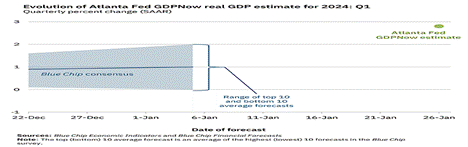
Now a first look at 2024 is the Atlanta Fed’s GDPNow estimate of first quarter growth. It sees a continuing recovery.
AtlantaFed

“The initial GDPNow model estimate for real GDP growth (seasonally adjusted annual rate) in the first quarter of 2024 is 3.0 percent on January 26. The initial estimate of fourth-quarter real GDP growth released by the US Bureau of Economic Analysis on January 25 was 3.3 percent, 0.9 percentage points above the final GDPNow model nowcast released on January 19.”

The Atlanta Fed’s estimate of future GDP growth has been surprisingly accurate, in other words, and more positive than that of most Blue Chip economists surveyed as shown in the Atlanta Fed graph.

Further evidence of a surging economy is rising consumer confidence. The Conference Board’s Consumer Confidence Index® rose in January to 114.8 (1985=100), up from a revised 108.0 in December. It was the highest since December 2021, and marked the third straight monthly increase.

“January’s increase in consumer confidence likely reflected slower inflation, anticipation of lower interest rates ahead, and generally favorable employment conditions as companies continue to hoard labor,” said Dana Peterson, Chief Economist at The Conference Board. “The gain was seen across all age groups, but largest for consumers 55 and over.”

And lastly, Pending Home Sales Index (PHSI)* – a forward-looking indicator of home sales based on contract signings – increased to 77.3 in December. Year over year, pending transactions were up 1.3%. An index of 100 is equal to the level of contract activity in 2001.

"The housing market is off to a good start this year, as consumers benefit from falling mortgage rates and stable home prices," said Lawrence Yun, NAR chief economist. "Job additions and income growth will further help with housing affordability, but increased supply will be essential to satisfying all potential demand."

Lower interest rates will be the key to further recovery. Consumers are saying they are happier and a strong employment report on Friday should confirm 2024 may be an even better year.

Harlan Green © 2024

Follow Harlan Green on Twitter: https://twitter.com/HarlanGreen

Wednesday, December 20, 2023

Consumers Happier This Season

 Financial FAQs

Consumer confidence in December as measured by the Conference Board’s Consumer Confidence Index is rising again; it jumped 10 points to 110.7 from 101. Why should that be, with all the doom and gloom and geopolitical uncertainty bombarding us daily?

I think it’s because consumers are seeing falling prices and lower inflation, especially gasoline prices with average gas prices approaching $3 per gallon for the first time in years. And consumers continue to shop both online and in stores because they are finding more bargains, with retail sales surging.

“December’s increase in consumer confidence reflected more positive ratings of current business conditions and job availability, as well as less pessimistic views of business, labor market, and personal income prospects over the next six months,” said Dana Peterson, Chief Economist at The Conference Board.

And the unemployment rate has fallen back to 3.7 percent with more workers than ever joining the workforce. Why shouldn’t consumers’ temperaments improve?

Conference Board

“While December’s renewed optimism was seen across all ages and household income levels, the gains were largest among householders aged 35-54 and households with income levels of $125,000 and above.

This is also understandable as they comprise the largest percentage of the adult-age workforce with average hourly waging rising 4.0 percent—at least 1 percent above a falling inflation rate.

More good news is a recovery in the housing market. Single-family construction is soaring. Why? These adult-age consumers believe it’s time to own a home.

Overall housing starts increased 14.8 percent in November to a seasonally adjusted annual rate of 1.56 million units, according to a report from the U.S. Department of Housing and Urban Development and the U.S. Census Bureau.

“The single-family starts figure is remarkably strong, and we would not be surprised to see this figure revised lower or fall back slightly in the next month, given the nearly 20 % rise in November,” said NAHB Chief Economist Robert Dietz. “NAHB is forecasting an approximate 4 % gain for single-family starts in 2024, as mortgage rates settle lower, economic growth slows and inflation moves lower.”

If I were the Fed Governors, I wouldn’t wait for inflation to drop further to begin to lower interest rates, I said last week. The inflation rate has been falling steadily for more than a year and we could be in a deflationary spiral. Sound impossible? It might happen if the Fed doesn’t see the writing on the wall.

Nobel Laureate Paul Krugman has been scolding certain economists of late in a NYTimes Op-ed who don’t believe what is happening.

“From an economic point of view, 2023 will go down in the record books as one of the best years ever—a year in which inflation came down amazingly fast at no visible cost, defying the predictions of many economists that disinflation would require years of high unemployment.”

The cost of living measured by the Consumer Price Index rose just 0.1 percent in November thanks to lower oil prices. Without food and gas prices, so-called core consumer prices rose a somewhat sharper 0.3 percent last month and matched the Wall Street forecast. And the annual rate of inflation slowed to 3.1 percent in November from 3.2 percent in the prior month, matching the lowest level since early 2021.

Consumers are starting to believe what they are experiencing, in other words. Gas prices are at the top of the list, but how about dining out?

There was a 11 percent increase in dining out sales, and Christmas may equal Thanksgiving as the highest travel month ever. Don’t consumers carry the most weight on which direction this economy is heading?

Harlan Green © 2023

Follow Harlan Green on Twitter: https://twitter.com/HarlanGreen

Monday, December 18, 2023

How Low Can Interest Rates Go?

 The Mortgage Corner

Stocks and bonds are rallying after Chairman Powell sounded dovish for the first time at his December press conference following their last FOMC meeting of the year.

“The question of when it will be appropriate to begin dialing back the policy restraint” was clearly “a discussion for us at our meeting today,” Powell said. The Fed is “likely at or near the peak rate for this cycle.”

Plunging interest rates are best illustrated by the 10-year benchmark fixed rate Treasury note yield that sets mortgage rates. It has plunged below 4 percent for the first time since the pandemic.

And the 30-year fixed-rate mortgage fell for the seventh week in a row, averaging 6.95 percent as of Dec. 14, according to data released by Freddie Mac on Thursday. A year ago, the 30-year fixed-rate mortgage was averaging at 6.31 percent.

It remained below 5 percent from the end of the Great Recession until May 2022 when the Fed began to raise interest rates. I predict it should drop below 5 percent sometime next year as inflation continues to decline and the Fed begins its rate dropping schedule.

FRED30yrfixed

We are already seeing the results—holiday sales are booming. Retail sales are surging now, up 4.1 percent annually both online and in stores. Dining out is up 11 percent annually.

Advance estimates of U.S. retail and food services sales for November 2023, adjusted for seasonal variation and holiday and trading-day differences, but not for price changes, were $705.7 billion, up 0.3 percent (±0.5 percent)* from the previous month, and up 4.1 percent (±0.7 percent) above November 2022.”

The housing market is on hold until mortgage rates fall more.

NAR Chief Economist Lawrence Yun forecasts that 4.71 million existing homes will be sold, the housing market is expected to grow, and Austin, Texas will be the top real estate market to watch in 2024 and beyond.

Yun predicts home sales will begin to rise next year – by 13.5 percent compared to 2023, and the median home price will reach $389,500 – an increase of 0.9 percent from this year.

Builder confidence in the market for newly built single-family homes is improving slightly. It rose three points to 37 in December, according to the National Association of Home Builders (NAHB)/Wells Fargo Housing Market Index (HMI) released today.

“With mortgage rates down roughly 50 basis points over the past month, builders are reporting an uptick in traffic as some prospective buyers who previously felt priced out of the market are taking a second look,” said NAHB Chairman Alicia Huey. “With the nation facing a considerable housing shortage, boosting new home production is the best way to ease the affordability crisis, expand housing inventory and lower inflation.”

AtlantaFed

The Fed’s abrupt change in course has also boosted Q4 economic growth prospects. The Atlanta Fed’s GDPNow growth estimate just leaped from 1.2 percent to 2.6 percent, due to “…fourth quarter real personal consumption expenditures growth, fourth-quarter real gross private domestic investment growth, and fourth-quarter real government spending growth.”

So I don’t believe it’s too early to predict a better New Year for investors and homeowners!

Harlan Green © 2023

Follow Harlan Green on Twitter: https://twitter.com/HarlanGreen

Wednesday, November 15, 2023

Where's the Inflation--Part II?

 Popular Economics Weekly

We can also look at the behavior of wholesale prices to see if inflation has been conquered. The Producer Price Index has been at or below the Fed’s target 2 percent since May 2023. It’s the cost of raw materials that go into finished products, so it should have told Fed officials that retail inflation will soon follow that is now rising at 3.2 percent.

What is holding up retail CPI prices? Market scarcities that have enabled producers to temporarily boost their profit margins. But the PPI tells us that scarcities are quickly disappearing; in autos and gas, for instance, where prices had the largest drop in the PPI.

FREDppifinaldemand

“The Producer Price Index for final demand fell 0.5 percent in October, seasonally adjusted, after advancing 0.4 percent in September, the U.S. Bureau of Labor Statistics reported today. The October decline is the largest decrease in final demand prices since a 1.2-percent drop in April 2020.”

What more proof does the Fed need to begin thinking about dropping interest rates? Corporations are reporting record profits in the third quarter due to those pandemic-induced scarcities and 98 percent reporting in the third quarter say they are increasing their dividends, a sure sign of increased profits.

The PPI is slightly higher without volatile foods, energy, and trade services, advancing +0.1 percent in October, the fifth consecutive rise. For the 12 months ended in October, prices for final demand less foods, energy, and trade services moved up 2.9 percent.

This may be the ‘head fake’ that Chairman Powell was talking about at a recent conference. What if food and energy scarcities surface again with all the geopolitical uncertainty?

If it wasn’t for the huge 4.9 percent Q3 GDP growth, economists will begin to worry that falling inflation shows a drop in the demand for goods and services, which does signal a slowdown.

Slowing retain sales can be the first sign of any slowdown in activity. Are shoppers already shopped out for the holidays? Retail sales have declined, falling 0.1 percent in October for the first time in seven months, but the decline is unlikely to last as Americans enter the holiday-shopping season, especially if prices are no longer rising.

There was better news with housing. The 30-year fixed-rate mortgage dropped a quarter of a percent to 7.50%, the largest one-week decrease since last November, according to Freddie Mac, the guarantor of mortgages.

It should kick start more housing sales, according to Lawrence Yun, the NAR’s chief economist. Yun forecasts that interest rates will drop to between 6-7% by the spring buying season and anticipates that more sellers will enter the market.

“Builders are back on their feet, up 5% in newly constructed home sales year to date,” said Yun. “Builders can simply create inventory. In a housing shortage environment, builders are really benefiting.”

What happens next year may depend on the housing market, which traditionally takes up approximately 7 percent of GDP activity, but is also a leading indicator of market direction.

The overall decline in interest rates we are already seeing will give a boost to almost every sector of economic activity going into next year.

Harlan Green © 2023

Follow Harlan Green on Twitter: https://twitter.com/HarlanGreen

Wednesday, July 12, 2023

Homebuying Season Continues

 The Mortgage Corner

We know the spring buying season barely got off the ground because of elevated mortgage rates. But there are enough homes for sale to continue purchases into the summer.

Analysis by Redfin, the national real estate and housing finance entity, showed active listings still high in June, but down -8.1 percent YOY from 2021 and 2022 per the Redfin graph of active listings below.

There is enough supply (2.5 months) that median housing prices fell $50,000 last year in June, from $397,000 to less than $350k in December 2022. But prices rose again this June 2023 to $382,861, so the question is what happens next?

This always depends on supply, and builders have been playing catchup, as I’ve been saying. There are now as many new homes as existing homes for sale.

So, will supply improve enough and interest rates hold steady enough to allow prices a downward trajectory for the rest of this year, as well?

Redfin.com

“There are two things that would jumpstart the housing market: A big drop in mortgage rates and/or a big surge of new listings,” said Redfin Deputy Chief Economist Taylor Marr. “Neither of those things happened this spring; instead, rates rose and new listings dropped to record lows. And with one or two more interest-rate hikes expected this year, mortgage rates are likely to remain elevated at least through the summer, continuing to limit both demand and supply.”

Supplies should increase because groundbreaking on U.S. single-family homebuilding projects surged in May by the most in more than three decades and permits for future construction also climbed, suggesting the housing market may be turning a corner after getting clobbered by Federal Reserve interest rate hikes.

“The May housing starts data and our latest builder confidence survey both point to a bottom forming for single-family residential construction earlier this year,” said NAHB Chief Economist Robert Dietz. “However, due to weakness at the start of the year, single-family housing starts are still down 24% on a year-to-date basis.”

What gives us hope the Fed will slow its rate hikes is consumer inflation continues to decline. U.S. consumer prices rose a modest 0.2% in June. The CPI rate of inflation slowed to the lowest level since 2021. The last time inflation was this low was in March 2021.

The overall Consumer Price Index inflation rate plunged from 4 to 3 percent in 12 months, its core rate without food and energy prices fell to 4.8 percent.

But even though there wasn’t much of a spring homebuying season this year, there was a spring building season,” Redfin’s Marr said. “That means there’s hope for more listings somewhat soon, with homebuilders working to fill the inventory bucket.”

NAR chief economist Lawrence Yun said in reaction to the good inflation report that falling gasoline prices and healthcare service costs were helpful. Rents are still climbing at a brisk pace, rising by 8.3 percent, but have turned the corner for sure. Rents were rising at 8.8 percent in the early part of the year, so this is the slowest gain in 7 months.

Rents comprise 40 percent of the Consumer Price Index, and with so many apartment units under construction, rents should continue to decline, thus improving the inflation rate and prospect for lower mortgage rates.

Harlan Green © 2023

Follow Harlan Green on Twitter: https://twitter.com/HarlanGreen

Wednesday, October 19, 2022

Homebuilders Losing Confidence

The Mortgage Corner

Calculated Risk

Builder confidence in the market for newly built single-family homes dropped eight points in October to 38—half the level it was just six months ago—according to the National Association of Home Builders (NAHB)/Wells Fargo Housing Market Index (HMI) released today.

This is the lowest confidence reading since August 2012, except for the onset of the pandemic in the spring of 2020, and means the housing sector has been hit hardest by higher interest rates, which have reached nosebleed territory for prospective homebuyers.

“This will be the first year since 2011 to see a decline for single-family starts,” said NAHB Chief Economist Robert Dietz. “And given expectations for ongoing elevated interest rates due to actions by the Federal Reserve, 2023 is forecasted to see additional single-family building declines as the housing contraction continues. While some analysts have suggested that the housing market is now more ‘balanced,’ the truth is that the homeownership rate will decline in the quarters ahead as higher interest rates and ongoing elevated construction costs continue to price out many prospective buyers.”

Existing-home sales look no better. The National Association of Realtors reports year-over-year, sales faded by 19.9% (5.99 million in August 2021).

"The housing sector is the most sensitive to and experiences the most immediate impacts from the Federal Reserve's interest rate policy changes," said NAR Chief Economist Lawrence Yun. "The softness in home sales reflects this year's escalating mortgage rates. Nonetheless, homeowners are doing well with near nonexistent distressed property sales and home prices still higher than a year ago."

This is small comfort to a housing market already in recession, said economist Diane Swonk.

“Mortgage demand plummets 86% from year ago as refis continue to evaporate along with new mortgage demand. The data adds to the collapse we saw in home builder sentiment earlier this week and marks a 25 year low. The housing market recession will get demonstrably worse,” she said in a recent Tweet @DianeSwonk.

The real problem hurting housing is inflation that has spiked higher interest rates, something that President Biden and Democrats have little control over. Worldwide food and energy prices first began to surge with Russia’s invasion of the Ukraine.

The UK just reported its consumer-price index increased 10.1 percent in September year-on-year, up from 9.9 percent in August, according to data from the U.K.’s Office for National Statistics published Wednesday.

The rise in inflation was driven by higher food and non-alcoholic beverage prices, which increased by 14.5 percent on year compared with 13.1 percent in August. Meanwhile, the continued fall in the price of motor fuels made the largest downward contribution, the ONS said.

The UK has one of the better inflation numbers. Turkey, Russian, Brazil and many other countries hit hard by the supply shortages still have double-digit inflation rates.

So, let’s put the blame for high inflation where it belongs—China’s troubles with COVID lockdowns, a war, and lingering hangover from the pandemic, ok?

Harlan Green © 2022

Follow Harlan Green on Twitter: https://twitter.com/HarlanGreen