Showing posts with label mortgage rates. Show all posts

Tuesday, March 10, 2026

What Housing Recovery?

 The Mortgage Corner

Existing-home sales increased by 1.7% month-over-month in February, according to the National Association of REALTORS® Existing-Home Sales report. The report provides the real estate ecosystem—including agents, homebuyers and sellers—with data on the level of home sales, price, and inventory.” NAR

FRED30yrmortgage

It’s been months since I last wrote about the housing market, and why it’s  had such a slow recovery. FRED’s 30-year fixed mortgage graph tells us why, which is the reason we have a housing shortage.

The 30-year average fixed rate mortgage was a level 3% until 2022 during the COVID-19 pandemic until the Fed raised interest rates to combat rising inflation. It’s 6.0% today, after dipping very briefly to 5.98% last month.

It's this high today because Trump’s Iran war is costing $1 billion per day on borrowed money due to his Big Beautiful Tax Bill, which will add to the current $39 trillion in federal debt.

Are we seeing a housing revival with the slight uptick in existing home sales? Hope springs eternal, as the saying goes. Sales have hovered around 4 million residential units since the busted housing bubble and 2008-09 Great Recession. There has never been enough to satisfy the demand since then, because the busted housing bubble restricted new home building for almost 10 years and 30-year fixed rate mortgages have hovered above 6% ever since, per the FRED graph.

But, “Housing affordability is improving, and consumers are responding,” said NAR Chief Economist Dr. Lawrence Yun. “Still, there is a long way to go to return to pre-pandemic levels of transaction activity. There are more than 6 million more jobs than in 2019, yet home sales per year are down by one million.”

There isn’t much of a housing supply inventory, and builders aren’t cooperating now with less than a four-month supply of existing home inventory on the market at the current slow sales rate.

This is while privately-owned housing starts in October were punk, at just a seasonally adjusted annual rate of 1,246,000. It is 4.6 percent below the revised September estimate of 1,306,000 and is 7.8 percent below the October 2024 rate of 1,352,000, says Calculated Risk.

Unaffordably high mortgage rates are one reason for the construction shortage, but Trump’s tariffs on building materials are also adding to construction costs.

Higher import taxes on steel, copper, lumber and other materials are lifting construction prices and interrupting some jobs. Immigration enforcement is worsening worker shortages and delaying projects.

“We get so many things thrown at us in the construction industry,” said Tony Rader, the chief relationship officer at National Roofing Partners, a commercial roofing company in Coppell, Texas. “It just seems like every time we turn around, we’ve got something else to fight.”

So, we must throw in the costs of empire building because Republicans are so fond of waging wars. It’s not only the Federal Reserve keeping rates high, but also the huge federal debt has been boosting bond yields. It is the reason we still have a housing shortage of 2-5 million units, depending on who you ask, since the Great Recession and housing bubble.

Harlan Green © 2025

Follow Harlan Green on: https://twitter.com/HarlanGreen

Wednesday, August 20, 2025

We Can Fix the Housing Shortage

 The Mortgage Corner

Privately-owned housing starts in July were at a seasonally adjusted annual rate of 1,428,000. This is 5.2 percent above the revised June estimate of 1,358,000 and is 12.9 percent above the July 2024 rate of 1,265,000. Single-family housing starts in July were at a rate of 939,000; this is 2.8 percent above the revised June figure of 913,000.” US Census Bureau

FREDconstruction

The housing shortage is something most of us worry about but are helpless to fix, it seems. There are many culprits—the NIMBY crowd that won’t allow more affordable housing near their single-family homes in cities, too high mortgage rates, but most of all the seeming inability of builders to supply enough new homes due to the shortage of construction workers.

First some history. Originally, much of it was due to the busted housing bubble that led to the Great Recession in 2008. More than one million new homes were built than could be sold, a classic example of oversupply. This resulted in just 600,000 new homes being constructed annually until 2012 when the Fed began its quantitative easing policies under Fed Chair Ben Bernanke that dropped 30-year fixed mortgage rates below 5% for the first time since the 1970s.

This is why I’m using residential housing construction as a good way to measure housing supply in the above FRED graph of housing construction. Starts have hovered around 1.4 million units since 2022 and the end of the COVID-19 pandemic (gray bar).

Construction had soared immediately after the pandemic due to the rock-bottom 30-year fixed mortgage rates, then plateaued to the current 1.4 million. But the Fed raised the rock-bottom rates to combat surging inflation and fixed mortgage rates soared to 7%, making housing purchases almost unaffordable to first-time, entry level buyers.

So, we know high mortgage rates are a major component of the housing shortage. But we can also answer maybe the largest part of the problem, the lack of new homes as highlighted in a recent Forbes Magazine article. Trump’s immigrant sweeps are not only hurting housing construction, but the job market in general.

Immigrants make up 34% of the construction workforce, according to the Associated General Contractors of America. In states like California, Texas, New Jersey, Florida, Georgia and New York, they account for about half. Construction drives 4.5% of U.S. gross domestic product, making it the country’s tenth largest industry.

“Broaden the view and the impact grows. Residential housing, once you include rent and utility payments, fuels 15 to 18% of GDP, according to the National Association of Home Builders. Add commercial building to the mix and construction rises to the top of the chart.”

The good news what may come out of the housing shortage and homeless scourge. The highly unpopular immigrant sweeps of ICE agents invading homes, public streets, and workplaces.

The sharp drop in nonfarm payrolls in the last three unemployment reports is being blamed on the loss of possibly one million immigrants from our labor force, according to labor economists. This will hurt economic growth, because immigrants have traditionally supplied one million new Americans each year to our rapidly declining population growth rate.

Forbes cites a working paper published this month from the American Enterprise Institute (AEI), a conservative economics policy center, that found the Trump administration’s immigration policy will likely result in a negative net migration in 2025—something the U.S. has not experienced in decades”that would shrink labor participation and “put significant downward pressure on growth in the labor force and employment.”

It's a very sad tale. Trump’s Republicans have turned their backs on what has been the life blood of American Democracy that we can do little about without  without recognizing that we can't do it without immigrants.

Harlan Green © 2025

Follow Harlan Green on: https://twitter.com/HarlanGreen

Friday, January 20, 2023

Housing Market Swoon--Part II

 The Mortgage Corner

 CalculatedRisk

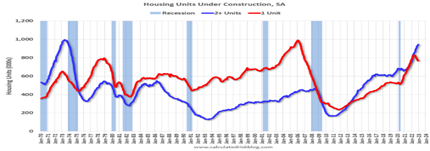
Despite improved builder sentiments, privately‐owned housing starts were down in December at a seasonally adjusted annual rate of 1,382,000. This is 1.4 percent below the revised November estimate of 1,401,000 and is 21.8 percent below the December 2021 rate of 1,768,000.

An estimated 1,553,300 housing units were started in 2022 (red line single unit, blue line 2+nnits in above graph). This is 3.0 percent below the 2021 figure of 1,601,000, so housing construction is also in a “swoon”.

And existing-home sales faded for the eleventh straight month to a seasonally adjusted annual rate of 4.02 million. Existing-home sales totaled 5.03 million in 2022, down 17.8 percent from 2021, as last year’s rapidly escalating interest rate environment weighed on the residential real estate market.

“December was another difficult month for buyers, who continue to face limited inventory and high mortgage rates,” said NAR Chief Economist Lawrence Yun. “However, expect sales to pick up again soon since mortgage rates have markedly declined after peaking late last year.”

The 30-year fixed-rate mortgage averaged 6.15 percent as of Jan. 19, according to data released by Freddie Mac on Thursday. That’s down 18 basis points from the previous week — one basis point is equal to one hundredth of a percentage point.

Last week, the 30-year was at 6.33 percent Last year the 30-year was averaging at 3.56%. Rates are now at the lowest level since September 2022.

It is causing a surge in mortgage applications, according to the Mortgage Bankers Association.

The MBA reported its Market Composite Index, a measure of mortgage loan application volume, increased 27.9 percent on a seasonally adjusted basis from one week earlier.  The Refinance Index increased 34 percent from the previous week and was 81 percent lower than the same week one year ago. The seasonally adjusted Purchase Index increased 25 percent from one week earlier.

The modest drop in interest rates also helped to end a string of 12 straight monthly declines in builder confidence levels, although sentiment remains in bearish territory as builders continue to grapple with elevated construction costs, building material supply chain disruptions and challenging affordability conditions, per Bill McBride, author of the Calculated Risk blog.

Joel Kan, MBA’s Vice President and Deputy Chief Economist, said “This week’s builder sentiment index from the NAHB reflected an improving outlook and increased buyer traffic, as mortgage rates have backed off from recent highs. The housing market is still in need of more starter and entry-level homes, especially when current demographic trends point to the potential for more younger households to enter homeownership in the near future. New construction of these units will help these buyers entering the housing market.”

Mortgage rates should continue to decline, aided by homebuilders who are now offering initial interest rates as slow a 4 percent to entice buyers. They can do this by buying down a fixed rate and adding its costs to the purchase price, or offering shorter term fixed rates or even an adjustable rate loan.

Will this end the housing “swoon”? There is lots of pent-up demand, and we still have a housing shortage.

Harlan Green © 2023

Follow Harlan Green on Twitter: https://twitter.com/HarlanGreen