Tuesday, October 8, 2024

Why Have Republicans Dumbed Down So Many?

 ANSWERING the KENNEDYS CALL

What is the reason Republicans have become the party of anti-intellectuals? The danger is that it may drown out any intelligent discourse about the most important issues of our day. It's driving at least one of our political parties into insanely ridiculous positions.
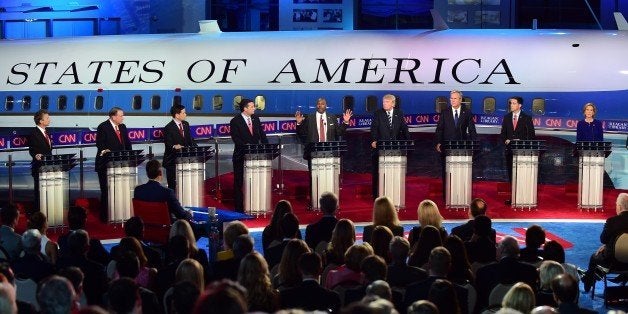
Republican presidential hopefuls (L-R), Kentucky Sen. Rand Paul, former Arkansas Gov. Mike Huckabee , Florida Sen. Marco Rubio, Texas Sen. Ted Cruz, real estate magnate Donald Trump, former Florida Gov. Jeb Bush, Wisconsin Gov. Scott Walker, and former CEO Carly Fiorina, listen as retired neurosurgeon Ben Carson (C) speaks during the Presidential debate at the Ronald Reagan Presidential Library in Simi Valley, California on September 16, 2015. Republican presidential frontrunner Donald Trump stepped into a campaign hornet's nest as his rivals collectively turned their sights on the billionaire in the party's second debate of the 2015. AFP PHOTO / FREDERIC J. BROWN (Photo credit should read FREDERIC J. BROWN/AFP/Getty Images)

Huffington Post

I wrote in 2015 about the issues Republicans discussed in their primary debates. It also explains why Donald Trump took over the party. And nothing has changed in 2024.

We saw in the 2015 CNN Republican candidate debate the results of what seemed to be a prolonged campaign to discount almost all scientific facts, as well as intelligent discussion of the most important issues of the day.

Especially scary was Donald Trump saying if we build up our military enough, we won't have to negotiate with anybody. Or Marco Rubio, the seemingly most moderate Republican, endorsing a 1,900 mile fence along our entire border with Mexico (or double fence, says Dr. Ben Carson) over mountains and rivers, or Carli Fiorina saying that Planned Parenthood was aborting live babies to harvest their organs.

What is the reason Republicans have become the party of anti-intellectuals—some even want to abolish the Department of Education, and otherwise defund public education?

Journalist Chris Hedges once said in a PBS interview President Clinton in co-opting moderate Republican positions, such as deregulation of the financial industry, putting 100,000 more cops on the street, and reforming welfare, had driven the Republican Party to "insanity".

But the anti-intellectual, anti-science bias goes much deeper. It is in fact an almost totally American phenomenon that Republicans have taken advantage of to ‘dumb down’ the electorate to levels that would believe whatever an aging, increasingly incoherent Donald Trump says.

Why would anyone not want to support public education, when it educates more than 80 percent of American students?

The result is that higher education is also falling behind. According to the National Research Council, only 28 percent of high school science teachers consistently follow the National Research Council guidelines on teaching evolution, and 13 percent of those teachers explicitly advocate creationism or "intelligent design," said Psychology Today in a very damning 2014 article entitled, Anti-Intellectualism and the Dumbing Down of America:

"After leading the world for decades in 25-34 year olds with university degrees, the U.S. is now in 12th place," said Psychology Today. "The World Economic Forum ranked the U.S. at 52nd among 139 nations in the quality of its university math and science instruction in 2010. Nearly 50 percent of all graduate students in the sciences in the U.S. are foreigners, most of whom are returning to their home countries."

Republican candidates are still echoing the Republican platform that advocated the deportation of all illegal aliens, would abolish or cripple whole government agencies (including the Environmental Protection Agency), shut down the federal government over Planned Parenthood funding, and maintain that a fertilized egg is a viable human being that can't be aborted.

Pundits give other reasons for such a dumbing down of a segment of the electorate--such as social media and television replacing literacy, or education that no longer teaches math and science or even history.

Maybe that has enabled the Donald Trumps of the world to shout louder. The danger is that it may drown out any intelligent discourse about the most important issues of our day. It has driven one of our political parties into no longer believing in Democracy.

Harlan Green © 2024

Follow Harlan Green on Twitter: https://twitter.com/HarlanGreen

Thursday, October 3, 2024

NO MORE INFLATION

 Financial FAQs

The Fed is no longer worrying about inflation, since its preferred inflation gauge, the Personal Consumption Expenditure Index (PCE), recently dropped to a 2.2% inflation rate, close to the 2.0% target rate.

Fed Chairman Powell said recently the Fed is more worried that the job market is faltering, hence the -.50% Fed Funds rate cut last week with at least two more rate cuts in the offing this year. It would cut the Bank Loan Prime Rate to 7.50% that is the basis for most credit card and installment loan rates.

It is still too high for most borrowers, but auto sales have picked up, which is a sign consumers are still buying, that in means that Q3 GDP growth could also match second quarter’s GDP growth of 3.0 percent.

This is remarkable growth, even with the labor market slowdown, and the unemployment rate up to 4.3 percent in a year.

From the same month one year ago, the PCE price index for August increased 2.2 percent. Prices for goods decreased 0.9 percent and prices for services increased 3.7 percent. Food prices increased 1.1 percent and energy prices decreased 5.0 percent. Excluding food and energy, the PCE price index increased 2.7 percent from one year ago.

Job formation is slowing, as the BLS JOLTS report showed 8 million job vacancies, with 5.3 million Hires and 5.0 million Separations in the month. The 300,000 difference approximates the net number of new hires in August.

We are still fully employed, in other words, but the number of vacancies posted by employers looking for workers has come down considerably from the 12 million job opening high during the pandemic and lockdowns.

(That’s why it’s called the Job Openings and Labor Turnover Survey.)

Consumer spending is the biggest ‘tell’ on future employment and economic growth and it barely dropped to 2.7 percent annual growth from 2.8 percent in August. The savings rate is still a healthy 4.8 percent, close to historical norms, so the surge in vehicle sales is no fluke.

Business activity in the service sector is soaring (mainly dining out, travel, leisure activities), but the manufacturing sector is still contracting.

“In September, the Services PMI® registered 54.9 percent, 3.4 percentage points higher than August’s figure of 51.5 percent. The reading in September marked the seventh time the composite index has been in expansion territory this year,” said survey Director Sterve Miller.

Whereas, manufacturing “Demand remains subdued, as companies showed an unwillingness to invest in capital and inventory due to federal monetary policy — which the U.S. Federal Reserve addressed by the time of this report — and election uncertainty,” said survey director Timothy Fiore.

I see good growth this year. More reductions in interest rates will certainly boost manufacturing, and consumers are still saving, another sign they aren’t tapped out. 

But with one political party wanting to cut back on Bidenomics, the policies spurring much of the growth, economic and job growth next year could depend on which party wins the White House in November.

Harlan Green © 2024

Harlan Green on Twitter: https://twitter.com/HarlanGreen

Wednesday, October 2, 2024

LUCKY LOSER--Part II

 A Distrust of the Truth

Born to a rich father who made him the beneficiary of his own highly lucrative investments, Trump received the equivalent of more than $500 million today via means that required no business expertise whatsoever.

Last night’s Vice President’s candidate debate highlighted the differences between two men coming from the same Midwest. Senator JD Vance was the polished Ivy League debater, and Governor Tim Walz the earnest teacher and sportsman eager to tell the truth about himself and the country.

So what should we think of Donald Trump, Vance’s leader of MAGA Republicans, a man who claims to be the smartest person in the world, and his opponent a loser, who would not release his tax returns, and has even forbidden the release of his school grades, from prep school to college?

Maybe we have heard this so many times that we have become inured to Trump’s blatant obfuscation. But I have always thought it meant only a very stupid person would say what Donald Trump has said repeatedly as he has tried any means to cloak his repeated business failures yet was “Born to a rich father who made him the beneficiary of his own highly lucrative investments…that required no business expertise whatsoever.”

This was highlighted in Pulitzer Prize-winners Russ Buettner and Susanne Craig’s just released book, Lucky Loser that raises a bigger question in a Washington Post review by Bethany McLean about the ‘fake it ‘til you make it’ ethos of modern America. In a world that conflates the ‘trappings of wealth with expertise and ability,’ where ‘fame, detached from any other marketable talent or skill,’ is ‘a highly compensated vocation,’ does it even matter if you never actually make it?”

The outright distrust of truth is a propaganda tool used by autocrats that public media has normalized. This probably tells us best why he was able to take over the Republican Party that has drifted so far from conservative values and was once the environmental party when Republican President Nixon signed the US Environmental Protection Agency into law in 1970.

Nobel Laureate Paul Krugman cited the damage Trump and MAGA Republican propaganda policies could do to the country in a recent NYTimes Op-ed.

He cites Trump’s response to a question in Michigan on what he would do to keep auto jobs in Michigan: “So, pretty much as we’ve been saying and what I want to do and be able to do—look, your business years ago, in this area, I was honored as the man of the year. It was maybe 20 years ago. Oh, and the fake news heard about it, they said it never happened.”

In a word, the chaos in Trump’s mind has morphed into his economic policies that would cause widespread damage to the American economy. What Krugman calls Trumponomics “could create economic disruptions similar to those caused by the Covid-19 pandemic…Round up millions of foreign-born workers would cause an immediate large reduction in labor supply. Tariffs would drive up the cost of imported goods as surely as shipping costs and inadequate port capacity did in 2021-22.”

A recent report by the Peterson Institute for International Economics, a serious non-partisan think tank cited by Krugman, posited that the labor shortages and higher tariffs on imports Trump proposes would return inflation to pandemic levels of 6 to 9 percent.

Republicans had learned to “fake it ‘til you make it” when the Trump administration attempted to break up the USEPA during his tenure so that Trump’s call to “Drill Baby Drill” for more fossil fuels could continue and their call to preserve tax cuts first enacted under Trump will further increase the national debt.

Buettner and Craig’s work exposes how many passes Trump has gotten over the years, how thoroughly he is a creation of the public media that has normalized his propaganda as another kind of truth, without revealing the real man behind it who has never known truth in his own world, and public media as the authors write, ‘rarely revisited his claims and afforded credibility to everything he said.”

The Vice-Presidential debate highlighted the vast gap between truth and propaganda, between substance and the lies that attempt to conceal it. Polls are showing the public can understand the difference, will our media?

Harlan Green © 2024

Harlan Green on Twitter: https://twitter.com/HarlanGreen

Thursday, September 26, 2024

US Growth Picks Up Speed

 Popular Economics Weekly

Any signs of a recession are declining. The U.S. economy is picking up speed in the BEA’s third and final revision of second quarter GDP growth. The U.S. economy has held the 3.0 percent growth rate, mostly due to strong consumer spending, our main growth engine, which was revised down to 2.8% from 2.9%.

Government spending was also an important ingredient, revised up to 3.1% from 2.7% in the second revision, as more Bidenomics investments kicked in. And, the personal consumption expenditures (PCE) price index in the GDP report was 2.5 percent, the same as the previous estimate. Excluding food and energy prices, the PCE price index increased 2.8 percent, also the same as the previous estimate.

The BEA also reported that profits from current production (corporate profits with inventory valuation and capital consumption adjustments) almost doubled in the final revision. So strong economic growth continues without any inflation increase.

The real take from these results is that government investment is driving much of the higher growth where it counts, in future growth, whereas most corporate profits finance corporate stock buybacks that benefit corporate executives, stock and bondholders but not the public sector of roads, bridges, the environment, and healthcare supported by public investment.

The White House said last June just how well Bidenomics policies have been working. “Our economy has added more than 13 million jobs—including nearly 800,000 manufacturing jobs—and we’ve unleashed a manufacturing and clean energy boom. There were more than 10 million applications for new small businesses filed in 2021 and 2022—the strongest two years on record.”

It has given a significant boost to labor productivity, which began to rise in 2023 and boosts wage earners’ standard of living.

Nonfarm business sector labor productivity increased 2.5 percent in the second quarter of 2024, the U.S. Bureau of Labor Statistics reported today, as output increased 3.5 percent and hours worked increased 1.0 percent. (All quarterly percent changes in this release are seasonally adjusted annualized rates.) From the same quarter a year ago, nonfarm business sector labor productivity increased 2.7 percent.

This in turn has stimulated more capex spending—private sector investments that expand production facilities—which is growing at 6% in Q2 2024, seasonally adjusted.

The Economic Strategy Group highlighted the importance of the recent surge in labor productivity: “US labor productivity has enjoyed a period of renewed growth over the past year, interrupting a nearly twenty-year decline: the 2.7 percent productivity growth in 2023 outpaces the 1.5 percent annual average since 2004, and it nearly matches the 2.9 percent pace seen during the country’s last productivity surge in the 1990s.”

The Economic Strategy Group report said a major factor in the productivity surge was the post-pandemic surge in business creation that was also highlighted in the 10 million small business increase touted by the White House report.

There is no question it has taken both public and private sector spending to continue our post-pandemic recovery and reduce worries of an impending recession.

Harlan Green © 2024

Follow Harlan Green on Twitter: https://twitter.com/HarlanGreen

Wednesday, September 25, 2024

Our Housing Problem

 The Mortgage Corner

We know we have a housing shortage, but not how to fix it. Politicos are finally beginning to take notice because of the damage that has been done—especially to working Americans who no longer can afford a home of their own.

VP Harris is the first to respond to the need, saying she has a policy to create 3 million new dwellings in her first term as President, if she is elected. In addition to the one million units already in various stages of development, she would create two million additional units with the following incentives:

  • · A new tax incentive for building starter homes
  • · Expanding tax incentives for businesses that build affordable rental housing
  • · Double the Biden-Harris proposed innovation fund for local initiatives to solve housing issues
  • · Cut red tape and streamline permitting processes to get houses up quicker

Why shouldn’t governments fix it? The primary cause of our housing shortage was the busted housing bubble when one million too many homes were built for a number of reasons that caused the housing bubble, such as those liar loans that lenders allowed to qualify buyers with no real income.

But lax government regulation was also part of the problem. There was very little oversight of the financial chicanery that caused the failure of Lehman Brothers and the Great Recession that followed.

Housing construction went from a high of 1.4 million units annually in 2005 to just 600,000 units per year in the 10 years that followed the Great Recession.

Because of its severity, builders stopped building enough homes for a population that continued to add one million new households every year. That’s a shortfall of 4 million units over 1o years(1m-600kx10=4m). Add the fact that the millennial generation was the most populous generation since the baby boomers and had nowhere to live—so many continued to live with their parents.

It will take multiple government actions, from changing zoning laws that create more density at the state and local levels to a national program such as VP Harris outlined to cure the shortfall.

The private sector has supported public sector help in the past, when cures for the 10-year construction lapse were being discussed. I wrote about it in a 2012 Huffington Post blog piece:

“Congress isn't the only reason for housing's problem. The Obama administration is still not serious about either their HAMP or HARP II loan modification programs. They had set aside some $11 billion from the ARRA legislation back in 2009 that hasn't been spent!

“The result was banks and Wall Street kept begging the Federal Reserve to provide stimulus by buying up to as much as $1 billion more of mortgage-backed securities (to keep mortgage rates low).”

There are signs of life in today’s housing market. Mortgage rates have been plunging since the Federal Reserve began to cut interest rates, and new-home construction has picked up with enough supply to lower new-home prices. The seasonally adjusted estimate of new houses for sale at the end of August was 467,000. This represents a 7.8 month supply at the current sales rate. The median sales price of a new home sold in August fell to $420,600 from $429,000 in the prior month.

Sales of new single-family houses in August 2024 were at a seasonally adjusted annual rate of 716,000, according to estimates released jointly today by the U.S. Census Bureau and the Department of Housing and Urban Development. This is 4.7 percent (±10.6 percent)* below the revised July rate of 751,000, but is 9.8 percent (±22.1 percent)* above the August 2023 estimate of 652,000.

It could be the beginning of an upward trend in overall sales, but the question now is not so much about mortgage rates, which will help sales and affordability, but adequate supply that matches more closely with household formation.

The dearth of supply is just one of the ways Americans have been paying for the excesses of the Great Recession and housing bubble. It can only be fixed with a national program that teams the public and private sectors to make housing affordable once again for entry-level as well as middle class American renters and buyers.

Harlan Green © 2024

Follow Harlan Green on Twitter: https://twitter.com/HarlanGreen

Tuesday, September 24, 2024

The Confused Consumer

 Financial FAQs

The Conference Board’s index of consumer confidence sank to 98.7 this month from a revised 105.6 in August the Conference Board said Tuesday.

Consumer confidence dropped in September to near the bottom of the narrow range that has prevailed over the past two years,” said Dana M. Peterson, Chief Economist at The Conference Board…Consumers’ assessments of current business conditions turned negative while views of the current labor market situation softened further.”

There are really too many ways to measure economic health, and consumers are prone to pick and choose their favorite economic subject—whether it is inflation, job conditions, or just general business conditions they hear about—hence their uncertainty.

Right now, consumers are worried about what will happen as a result of the Federal Reserve decision to finally cut interest rates after two years. The Fed’s decision is both a good and bad sign, It’s good because the cost of borrowing will now drop sharply based on loan rates—for housing as well as goods and services that depend on borrowed money.

The Bank Prime Loan Rate is 8.50%, which is why credit card rates have been above 20 percent for so long, and card rates could crop as low as 15% based on the Fed’s current projections, as I’ve said.

But it’s also a sign the Fed is worried that it waited too long. Fed Chair Powell in his remarks after the announcement of the recent -0.50% rate cut, said they probably would have begun the rate cuts in their July meeting; if they had known of the Labor Department downward revision to one year’s job totals—812,000 fewer jobs were created from April 2023 to March 2024.

Consumer confidence is also being affected by the Presidential election. The NY Times reports that Arizona voters in surveys see a completely different picture of the economy, based on their political affiliation.

When asked in a recent Times/Siena Poll if “the nation’s problems were so bad that it was in danger of failing,” 72 percent of Republicans agreed vs. just 16 percent of Democrats.

Wow, why such a difference? We know why MAGA Republicans want the reality to be apocalyptic—they should believe what Trump says not actual government data. That is what their propaganda is designed to do, and because the US economy is so diverse it works for those that want to hear bad news when actual facts are publicly available.

So why the pessimistic tilt in this poll? Consumers seem to be seeing what the Fed Governors are seeing, a growing unease over the job market. Though still at full employment, company hirings have slowed down.

“The deterioration across the Index’s main components likely reflected consumers concerns about the labor market and reactions to fewer hours, slower payroll increases, fewer job openings—even if the labor market remains quite healthy, with low unemployment, few layoffs and elevated wages,” said the Conference Board’s Peterson.

In actuality, hirings have slowed after two years of record job formation, and inflation is almost back to pre-pandemic levels. Yet the “Perceived Likelihood of a US Recession over the Next 12 Months ticked up in September but remained well below the May 2020 peak, per the poll.

So what are consumers to believe? My recommendation is use your common sense. Read reputable, widely available news sources. Ask how the company you work for is doing? The cost of things borrowed will come down, but inflation overall is back to its historical level of 2 percent; any lower than that and it would be signs of a looming recession.

We should be returning to a more normal economy with normal job creation, now that the two weakest legs of growth—manufacturing and housing—will begin to benefit from lower interest rates.

Harlan Green © 2024

Harlan Green on Twitter: https://twitter.com/HarlanGreen

Saturday, September 21, 2024

LUCKY LOSER: How Donald Trump Squandered His Father’s Fortune and Created the Illusion of Success

 Answering Kennedy’s Call

Born to a rich father who made him the beneficiary of his own highly lucrative investments, Trump received the equivalent of more than $500 million today via means that required no business expertise whatsoever.

A new book just out by Pulitzer Prize-winning journalists Russ Buettner and Suzanne Craig conducts an explosive investigation into the history of Donald Trump’s wealth, revealing how one of the country’s biggest business failures lied his way into the White House, says the Random House press release.

I first wrote about this in 2016 when Trump first became President: his multiple bankruptcies of the Trump Casinos when other Atlantic City Casinos were successful, Trump University charged as a criminal enterprise (under RICO), and the fact that he had to rely on Russian Oligarchs to finance his real estate empire when U.S. banks would no longer lend to him, are just the tip of the iceberg of business incompetence.

“This is a page turner, with spectacular anecdotes,” said a review by Washington Post’s Bethany McLean . . . “[Lucky Loser] shows in meticulously documented detail how ‘even when Trump appeared to be at his best, he was failing,’ with massive losses on his core business.

Buettner and Craig first revealed his real financial condition in a 2016 NYTimes article.

“The 1995 tax records, never before disclosed, reveal the extraordinary tax benefits that Mr. Trump, the Republican presidential nominee, derived from the financial wreckage he left behind in the early 1990s through mismanagement of three Atlantic City casinos, his ill-fated foray into the airline business and his ill-timed purchase of the Plaza Hotel in Manhattan.”

It heightens the absurdity of Republicans allowing Trump’s MAGA movement to take over the Republican Party.

These are the acts of a bully, rather than leader, I said then, which is why he seems to have so much in common with V Putin, Marine Le Pen, and other demagogues. Acting tough can be a plus when dealing with North Korea, or even Russia, but not when dealing with Americans who don’t like him or his very anti-American policies.

Fortune Magazine also reported in 2016 before becoming the Republican candidate for president on candidate Trump’s negotiating tactics: “The legal actions provide clues to the leadership style the billionaire businessman would bring to bear as commander in chief. He sometimes responds to even small disputes with overwhelming legal force. He doesn’t hesitate to deploy his wealth and legal firepower against adversaries with limited resources, such as homeowners. He sometimes refuses to pay real estate brokers, lawyers and other vendors.”

And, “As he campaigns, Trump often touts his skills as a negotiator,” said Fortune. “The analysis shows that lawsuits are one of his primary negotiating tools. He turns to litigation to distance himself from failing projects that relied on the Trump brand to secure investments.

“The authors prove that without his father’s support, Trump would have been nothing,” continues Washington Post’s McLean. “The book also raises a bigger question about the ‘fake it ‘til you make it’ ethos of modern America. In a world that conflates the ‘trappings of wealth with expertise and ability,’ where ‘fame, detached from any other marketable talent or skill,’ is ‘a highly compensated vocation,’ does it even matter if you never actually make it?”

This probably tells us best why he was able to take over the Republican Party that has drifted so far from conservative values and was once the environmental party when Republican President Nixon first signed the USEPA into law in 1972.

Republicans had learned to “fake it ‘til you make it”, as was proved by the Trump administrations record in breaking up the USEPA so that Trump’s call to “Drill Baby Drill” for more fossil fuels can continue, and preserving tax cuts first enacted under Trump what will further increase the national debt.

Buettner and Craig’s book will hopefully uncover the truth of Trump’s MAGA policies before it is too late, as most of the modern media has failed to do.

Buettner and Craig’s work exposes how many passes Trump has gotten over the years, how thoroughly he is a creation of the medial that has chased fame over blame, which as the authors write, ‘rarely revisited his claims and afforded credibility to everything he said,” concludes McLean’s review.

And now recognizing more signs of Trump’s mental deterioration as he ages makes it even more important that we in the media tell it like it is.

Harlan Green © 2024

Harlan Green on Twitter: https://twitter.com/HarlanGreen