Showing posts with label economic growth. Show all posts

Thursday, November 13, 2025

U.S. Economy Is Freezing!

 Popular Economics Weekly

“…while the economy is growing thanks to AI spending, it’s a K-shaped expansion: People who were already affluent are becoming more so, but the less well-off are under severe pressure. For example, there are clear signs that middle-to-low income consumers are struggling: car loan and credit card delinquencies are rising, and grocers report that shoppers are buying cheaper varieties of food. At the same time, the affluent are spending freely: the top 10% of the income distribution now accounts for nearly half of all consumer spending.Paul Krugman

PBS.org

This was the wrong season for President Trump’s Republicans to freeze Democrats out of the just passed continuing resolution or demolish the East Wing. We already have a record fall freeze hitting the Midwest and southern states.

Americans already feeling the freeze is also a good way to describe the Democrats landslide victories in the November elections. The record government shutdown put the U.S. economy on pause, but in fact much of the damage was already done, says Nobel Laureat Paul Krugman, just as Trump seemed oblivious to the timing of the damage being done to the White House,.

Republicans had been losing in the popularity polls this year because they chose to ignore the signs. So they believed that flying blind by keeping the federal government closed without official economic data on employment and inflation was the better option than knowing the truth.

But there are other data to fill the government void in data collecting that affect how consumers behave. The ADP, for instance, a private sector payment provider said private-sector employers shed an average of 11,250 jobs a week in the four weeks ending Oct. 25.

This hit the “middle-to-low income” consumers particularly hard that Krugman is talking about. What about inflation?

Ordinary grocery prices are climbing, forcing consumers to shop for “cheaper varieties of food.” Grocery prices have risen 18.2 percent since January 2022, making a $100 grocery bill approximately $118 today, per CBS News.

And President Trump is flailing in his attempt to mask the damage his tariff war is causing. Overall consumer inflation is stuck at 3 percent in large part because of the tariffs, so he wants to offer $2,000 rebates to consumers while the Fed is cutting interest rates. This would cost more than the import taxes he has already collected, enlarging the federal debt that has ballooned from his Big Beautiful Bill tax cuts.

And his proposed cuts to legal immigration from the longer term, historical average of one million to 7500 annually, will continue to shrink the workforce, even the number of H-1B work visas for highly qualified workers that are badly needed in the tech sector.

All of this will continue to damage economic growth at a time when worldwide economic growth is being affected by the chaos Trump has generated in tearing up existing foreign trade agreements.

No economy can tolerate such uncertain weather over the longer term. Hence investment decisions remain frozen while consumers find shelter for the coming economic winter. How severe will it be?

Harlan Green © 2025

Follow Harlan Green on Twitter: https://twitter.com/HarlanGreen

Thursday, October 30, 2025

Will Fed Give Up the Inflation Fight?

 Financial FAQs

 “Consumers continue to express frustration over the persistence of high prices, with 44% spontaneously mentioning that high prices are eroding their personal finances, the highest reading in a year.” University of Michigan Sentiment Survey

FREDcpi

Federal Reserve Chair Jerome Powell said at his most recent press conference (after the Fed’s October FOMC meet) that they were still committed to achieving a 2 percent inflation target.

Why ? Because inflation is still too high and Chair Powell, et. al., see too much uncertainty ahead. That’s no surprise given the government shutdown, and continuing tariff wars.

The last period of moderate inflation was the decade after the Great Recession, as seen in the Fred Consumer Price Index chart (large gray bar is GR)—that ended with the COVID-19 pandemic. It was during the Obama administration when regulations were created that required banks to play by the rules and hold more capital.

But what if the rules are changed again that allow higher inflation and fewer regulations that the Trump administration says it wants?

The moderate inflation ended because of the COVID-19 pandemic when massive liquidity was injected into the economy during the first Trump and Biden administrations to speed up the recovery. Inflation jumped to a high of 9 percent before declining until the retaliatory tariffs, rising again to its current 3%.

So now there is growing doubt that the Fed can maintain the 2 percent inflation target, since the newest members of the Fed Governors that vote on interest rates were Trump-appointed. And a Trump pick will become the new Federal Reserve Chair next year.

This is while President Trump has been calling for lower interest rates, which with higher tariffs would lead to higher inflation.

Trump claims that won’t happen even though he has raised tariffs to Taft-Hartley, Great Depression levels (thus raising import prices), has raised federal debt because of his Big Beautiful Tax Bill, and is loosening financial regulations that limit market speculation (e.g., in Bitcoin).

Add all this to the chaos generated by a White House that almost daily revises its decisions (e.g., TACO Trump), which makes it almost impossible to predict what will happen next.

Trump won’t admit he is responsible for the rise in consumer prices since April 2. But it happened at the same time that he announced his retaliatory tariffs on the rest of the world.

There is pushback from the bond market, which doesn’t like inflation because it reduces the value of bonds. We can see that certain financial markets are already reacting to the inflation uptick with higher interest rates, which is making consumers increasingly unhappy, even with the second -0.25 percent rate cut in October.

This translates into higher mortgage rates as well, which won’t make the housing industry happy either. So, who will lobby against more easy money to prevent another Great Recession, which happened the last time Republicans pushed through such an easy money agenda by blatantly ignoring financial regulations?

Though no one was punished for it, and American taxpayers paid for the bailout of our financial system. Will that happen again, now that Republicans are once again in charge?

Consumers don’t like higher prices, period, and there is another election in 2026. They might even remember the eight million job losses that followed what was the worst economic downturn since the Great Depression.

Harlan Green © 2025

Follow Harlan Green on Twitter: https://twitter.com/HarlanGreen

Wednesday, October 29, 2025

The Truth About High Tariffs

 Popular Economics Weekly

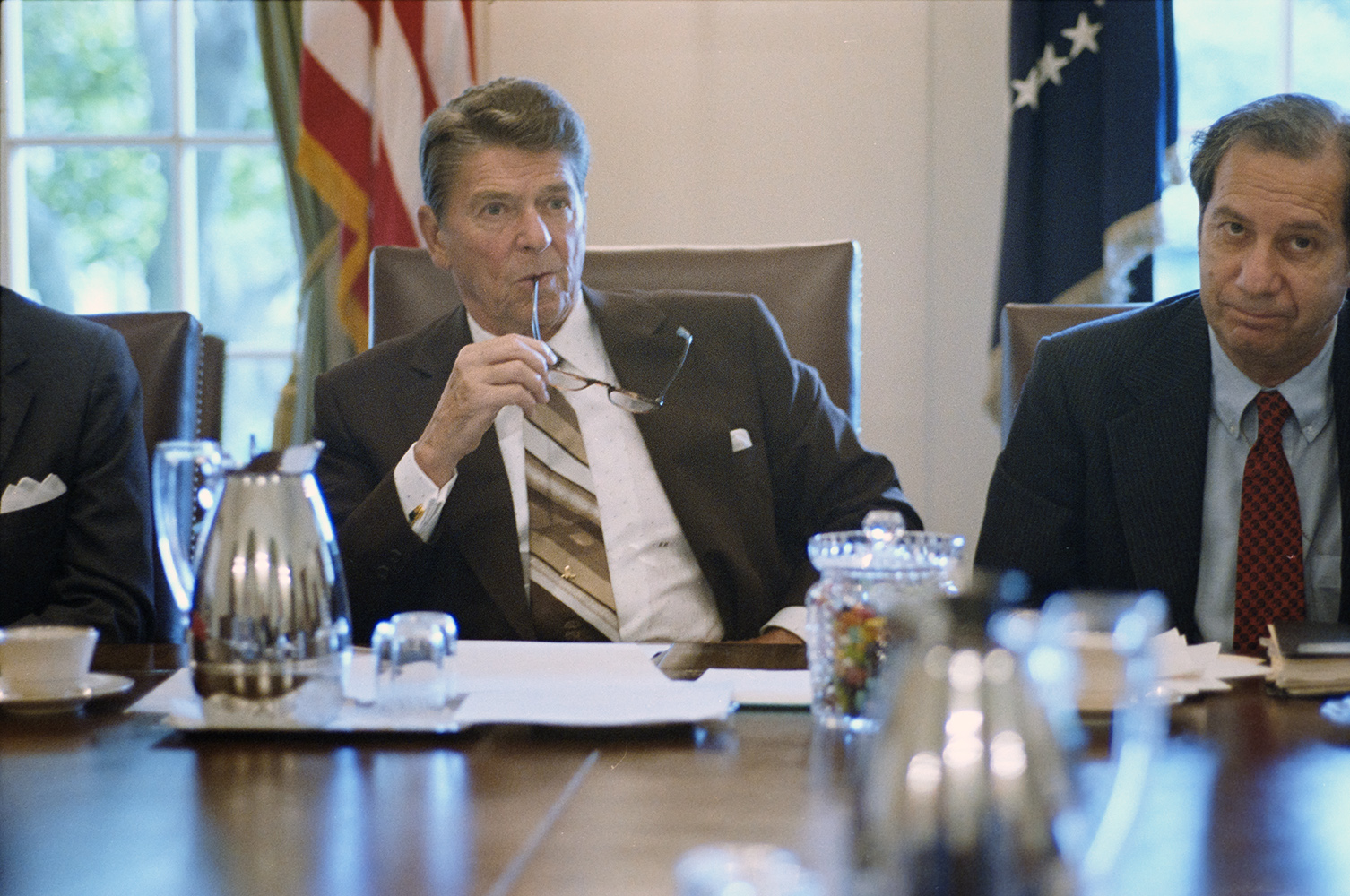
“High tariffs inevitably lead to retaliation by foreign countries and the triggering of fierce trade wars. Then the worst happens: markets shrink and collapse, businesses and industries shut down, and millions of people lose their jobs.” President Reagan

Reagan Library

Was President Reagan predicting what would happen in Trump’s second term as president?

President Trump didn’t like Ontario Prime Minister Dog Ford’s posting of a 1987 radio address by President Reagan criticizing high tariffs that went viral because it was describing what was happening with Trump’s illegal, retaliatory tariffs that are destroying the American economy and chasing our allies into deals with China.

It was obvious President Trump didn’t want his public to know that starting a tariff war with all 180 countries in the world would trigger “fierce trade wars” and sow economic chaos.

Add the job losses for “millions of people” his massive downsizing of the federal workforce that provides the benefits that protect all Americans, while attacking our institutions of higher learning that prepare us for the future, we can see where this can lead.

His actions are already contributing to a skilled worker shortage and the shrinkage of huge segments of the U.S. working age population with his attacks on immigrants that make up 40 percent of our agricultural workers and a large part of our service industry workers.

Is the chaos he is causing designed to destroy the U.S. economy as we know it, “markets shrink and collapse, businesses and industries shut down,” so that all or most power will be concentrated in the hands of the oligarchs and close allies that support him?

It happened in Russia after the collapse of the Soviet Union. Its collapse caused Russian oligarchs and Putin to snap up whole industries for pennies on the dollar, thus concentrating their wealth where Putin could control it.

Why can’t it happen here? Trump adores Putin as his model, but he would need a cowed tribe of supporters similar to Russia’s serb population, the serfs of old, liberated little more than 100 years ago, to sustain his power. Right now, it’s Trump’s White Christian Nationalists (like Putin’s Russian Orthodox supporters), but they are a small minority.

President Trump will only succeed in his scheme if he can convince enough Americans that his tariffs against the rest of the world (and higher inflation) are good for US because it would bring back better-paying industrial jobs to his base in the Midwest that had suffered from the globalization of manufacturing.

But that’s not what President Reagan said. He would also have to convince enough Americans that destroying large segments of the U.S. economy—in public health, environmental protection, social services—is worth the cost of higher tariffs, rather than live as his red state supporters have suffered under Republican rule; many with no minimum wage, minimal or no health care, no environmental protection from increasingly frequent natural disasters, and above all, a distrust in science that would provide them a better future.

We should ask ourselves, why would President Trump enact his agenda outside of most customs and laws, demolish the East Wing of the White House to build a 90,000 square foot ballroom without approved plans or permits?

Trump can only be stopped from his attempt to set up an American version of Putin’s Oligarchy, if enough Americans will believe in President Reagan’s predictions.

Harlan Green © 2025

Follow Harlan Green on Twitter: https://twitter.com/HarlanGreen

Monday, October 27, 2025

Housing Market Is Recovering

 The Mortgage Corner

WASHINGTON (October 23, 2025) – Existing-home sales increased by 1.5% month-over-month in September, according to the National Association of REALTORS® Existing-Home Sales Report. The Report provides the real estate ecosystem, including agents and homebuyers and sellers, with data on the level of home sales, price, and inventory.

FREDexistinghomes

It’s about time. We are seeing a housing revival with existing home sales on a 7-month high for the first time since the 2008-09 Great Recession (wide gray band in FRED graph), as reported by the National Association of Realtors (NAR).

The housing market has been stuck in part because the Fed held off cutting interest rates until its September FOMC. The cut was just -0.25%, and two more rate cuts are expected this year.

That may start a more sustained housing recovery, as fixed mortgage rates are also beginning to decline despite rising inflation since April and Trump’s retaliatory tariffs. (Bond holders don’t like inflation because it reduces the value of bonds.)

"As anticipated, falling mortgage rates are lifting home sales," said NAR Chief Economist Dr. Lawrence Yun. "Improving housing affordability is also contributing to the increase in sales."

Affordability has improved because "Inventory is matching a five-year high, though it remains below pre-COVID levels," Yun added. "Many homeowners are financially comfortable, resulting in very few distressed properties and forced sales. Home prices continue to rise in most parts of the country, further contributing to overall household wealth."

The 30-year conforming fixed mortgage rate for best credit holders has dipped below 6% to about 5.875% for 0 pts. in closing costs, or 5.50% for a 1 pt. origination fee. The 15-year fixed rate is now 5.25% for 0 pts., and 4.875%, 1 pt. at this writing.

This year’s housing revival first showed up in a boost in new-home sales, according to the National Association of Homebuilders (NAHB). Sales of newly built single-family homes jumped 20.5% earlier in August, to a seasonally adjusted annual rate of 800,000 from an upwardly revised reading in July, according to newly released data from the U.S. Department of Housing and Urban Development and the U.S. Census Bureau.

Much of the new-home sales boost was due to a construction surge to as much as 1.9 million annual units after the COVID-19 pandemic, seasonally adjusted. That and record low interest rates during the pandemic caused bloated inventories that builders are attempting to reduce. So they are offering interest rate buydowns to reduce mortgage rates. It cuts into builders’ profits but adds little to the sales price.

Housing construction has declined since then, decreasing 8.5% in August to a seasonally adjusted annual rate of 1.31 million units and construction will probably remain lower until more buyers come into the housing market as mortgage rates decline further.

What about mortgage rates? That hasn’t stopped homebuyers before. The 30-year conforming fixed rate hovered between 7.5% to 5.0% from the beginning of the housing bubble in 2000 to 2010 when homebuyers went wild with subprime loans, until the Great Recession.

The moral of this tale is that homebuyers and lenders have always found a way to finance a purchase with an almost infinite variety of mortgage choices. But the U.S. population is beginning to shrink because of the immigration restrictions. Builders and governments must find more creative solutions to affordable housing to bring more young adults into the housing market.

Challenging affordability conditions have always created headwinds for the housing sector, but that never stopped those that wanted to own a residence during the era of double-digit interest rates in the 1980s and 90s.

The average 30-year conforming fixed rate mortgage didn’t drop below 10% until the 1990s and 7.5% until 2001.

I foresee lenders finding creative ways to finance more homebuyers in the coming years as well.

Harlan Green © 2025

Follow Harlan Green on: https://twitter.com/HarlanGreen

Tuesday, October 21, 2025

When Will It End?

 Popular Economics Weekly

The government shutdown is a good time to look at how Donald Trump’s economy is doing in his second term, if we want any peace and prosperity at all once the real costs of the tariff war and his tax cuts become obvious.

“With yet another round of tariffs taking effect this week — this time on cabinets and other furniture, timber and lumber — the White House insists that its policies are about “fairness” and “reciprocity.” The evidence now tells a different story of higher prices for Americans, lower margins for U.S. firms, collapsing exports in flagship industries, investment paralysis and mounting risks of an economic slowdown.” Veronique de Rugy LATimes

Part of the problem is that Trump has always needed a lot of help to survive his storied temper tantrums, multiple business failures and bankruptcies. He learned how to play a successful businessman that he was not in “The Apprentice” TV show that he touted in his early book, Trump: How to Get Rich.

Huffington Post

With his luxury buildings, award-winning golf courses, high-stakes casinos, and glamorous beauty pageants, Donald J. Trump is one of a kind in American business. Every day, he lives the American dream. Now he shows you how it’s done, in this rollicking, inspirational, and illuminating behind-the-scenes story of invaluable lessons and rich rewards,” said Amazon’s “How To Get Rich” book blurb.

His “American Dream” was never meant for the many, just the few. Many Americans are not living the dream that Trump promised because raising the tariffs to Great Depression levels in the name of “fairness and reciprocity” is raising the prices for all Americans, and slowing economic growth.

The LATimes reported a recent KPMG survey finds that “60% of businesses reported decreased overseas sales” in the first six months of Trump’s tariffs. KPMG finds that nearly half of American companies have already raised prices because of tariffs; two-thirds have passed at least part of those costs on to shoppers; and nearly 40% have paused hiring, with a third cutting jobs.

CEOs overwhelmingly expect tariffs to weigh on business for years. Goldman Sachs estimates U.S. consumers are now footing 55% of the total tariff bill, while foreign exporters bear only a sliver of the costs.

“So much for draining the swamp. All of this explains the wild uncertainty business leaders have experienced in recent months. Retailers are now bracing for 100% tariffs on Chinese goods scheduled for Nov. 1, right before the holiday rush. Some firms have scurried to ship early, but even a few days’ delay at sea could blow up their margins. With deadlines set, delayed and often re-announced with each news conference, companies can’t plan or invest,” said de Rugy.

The NYTimes cites a Moody’s Analytics report that the top 10 percent of U.S. households now account for nearly half of all domestic spending. And the Federal Reserve just reported that consumers’ revolving credit shrank (-5.5%) for the first time since 2020 during the COVID-19 pandemic.

Republicans and Donald Trump have put on quite a show to convince Americans that they are better off by cutting government jobs and benefits in the name of a better use their benefits.

But it’s turning out “How To Get Rich” is a scheme to benefit the very few whose taxes have been reduced. The shutdown will end when enough Americans realize it is being paid for with higher inflation and taxes (tariffs) for the many.

Harlan Green © 2025

Follow Harlan Green on Twitter: https://twitter.com/HarlanGreen

Thursday, October 16, 2025

Whose Inflation Is It?

Financial FAQs

“Still, despite multiple offsetting drivers, the tariff shock is further dimming already lackluster growth prospects. We expect a slowdown in the second half of this year, with only a partial recovery in 2026, and, compared to last October’s projections, inflation is expected to be persistently higher. Even in the United States, growth is weaker and inflation higher than we projected last year—hallmarks of a negative supply shock.” IMF Global Economic Outlook 2025

FREDcpi

No one wants to admit who is responsible for the sharp rise in consumer prices since April 2. Democrats and the Biden administration had worked to bring the Consumer Price Index (CPI) portrayed in the above graph down to 2.3% from its high of 9% that occurred in 2023 from the COVID-19 pandemic.

But it began to rise again in this April at the same time that Trump announced retaliatory tariffs on the rest of the world. Republicans say the inflation was caused by Biden’s massive government spending programs that sped up the COVID-19 pandemic recovery.

Most economists maintain that the inflation spike was caused in large part because of the supply shortages during the pandemic. President Trump’s tariff war on imports from the rest of the world that he announced on April 2 exacerbated the product shortages as exporters scrambled to find cheaper supply routes to avoid the higher tariffs.

Add to this the looming worker shortage from tighter immigration policies that are shrinking the foreign-born labor supply—another negative supply shock on top of that from tariffs—that is beginning to affect labor productivity.

The International Monetary Fund (IMF) in its latest Global Economic Outlook report says both the tariffs and a looming worker shortage are “hallmarks of a negative supply shock” that will eventually slow down world economic growth.

China is now restricting the export of rare earth minerals, for which Trump has threatened to add an additional 100 percent tariff on China’s exports to US. And the government shutdown will only make things worse in closing down the statistical departments that tell us where we are and might be in six months.

“Overall, despite a steady first half, the outlook remains fragile, and risks remain tilted to the downside,” reports the IMF. “The main risk is that tariffs may increase further from renewed and unresolved trade tensions, which, coupled with supply chain disruptions, could lower global output by 0.3 percent next year. Apart from this, four simmering downside risks are especially worrying.”

What are they? U.S. financial markets are overinvested in AI with little to show for it, while AI is already causing white-collar layoffs, exacerbating the job losses incurred by the ICE roundup of undocumented immigrants.

And we have a record $39 trillion federal debt weighing on the credit markets that is competing with the private capital needed for new plants and equipment investment.

The Trump administration is vainly attempting to equate the record tariff rates, now at Great Depression levels, let us not forget, with some promised domestic industrial revival.

And Trump wants an easy money Federal Reserve to help grease its wheels. How do you think interest rates and inflation will respond to easier credit? The same way inflation and interest rates responded to Joe Biden’s New, New Deal?

We can’t borrow our way out of this debt mess with tax cuts for the wealthiest.

Harlan Green © 2025

Follow Harlan Green on Twitter: https://twitter.com/HarlanGreen


Tuesday, October 14, 2025

A Different Federal Reserve

Financial FAQs

“Warsh would chart a new course that de-emphasizes the inflationary impact of factors such as supply chains and tariffs in favor of a views of inflation driven by government spending and the money supply.” Barron’s

Graph: Last Tech Age

The Federal Reserve is about to go through a regime change. Though President Trump initially appointed current Fed Chairman Jerome Powell, he hasn’t been happy with Powell’s leadership in his second presidential term because he wants easier credit conditions.

The Fed Governors had been resisting Trump’s pressure to lower interest rates until their rate cut in September, fearing the inflationary effects of Trump’s ongoing tariff wars, which have been boosting inflation.

So what does President Trump want to do? Move the goalposts, so that higher inflation is no longer the danger that the current Fed Board of Governors believe in maintaining their 2% inflation target. This is despite Trump’s promise to bring down inflation on “Day One”.

And Kevin Warsh, a bright young conservative economist who was just interviewed in Barron’s might be the next Fed President to do just that, along with other recently-appointed Fed Governors that are more Trump-friendly.

Do what? The fact that he is the husband of an Estee Lauder heiress worth $billions should tell us all we need to know. He, or someone as conservative, is being groomed as the new Fed Chair to protect great wealth.

A summary of Warsh interview in Barron’s above quote tells us how. He is following the Republican line that most inflation comes from government overspending, for which government must print money. The cure is to cut the size of government in every way rather than raise taxes to pay for it.

So they would blame President Biden and Chairman Powell for the skyrocketing inflation that happened when the Fed printed $2.9 trillion in less than three months, bought roughly $543 billion worth of debt in a week, and reduced interest rates to nearly zero, according to Powell’s Britannica bio.

It caused the Fed’s extensive intervention in the U.S. economy after the COVID-19 crisis of 2020 because consumer inflation then skyrocketed to a high of 9% so that the Fed began to raise short term rates to bring down inflation.

Republicans then made it a cause celebre even though it’s now obvious Trump never intended to bring down inflation on “Day One” or any other day.

In fact, most of the government largesse (with Republicans’ bipartisan support) was meant to be spent on the pandemic recovery and modernization of the American economy, which would take at least a decade. And it would largely pay for itself over the longer term with higher economic growth.

The result was that the American economy recovered from the pandemic faster than the rest of the world and resulted in several quarters of +3% GDP growth.

But now Trump has raised tariffs back to 1934 levels that prevailed during the Great Depression without congressional approval, per Nobel Laureate Paul Krugman, which is raising the cost of everything for ordinary Americans.

And it was a major cause of the Great Depression because it restricted the flow of goods and services from other countries that were badly needed to recover from the Great Depression, just as the COVID-19 pandemic shut down the whole world’s economy and resulted in a brief recession.

So we know what a new Federal Reserve regime will look like with Kevin Warsh, or another such conservative at its helm. Less interference in private sector business, which means combatting inflation isn’t its only priority (therefore allowing higher inflation). And a smaller government paid for with lower taxes and fewer regulations, which means slashing federal government jobs as DOGE is still doing and cutting more public services that benefit all Americans.

It is following a frighteningly similar trajectory to the economy of the 1930s, the last time tariffs were this high, that led to the Great Depression. The question will be how long Americans will tolerate the corruption and favor-seeking that goes with protecting the wealthy, before looking for another Roosevelt and a New Deal.

Harlan Green © 2025

Follow Harlan Green on Twitter: https://twitter.com/HarlanGreen


Friday, October 10, 2025

Why Do Trump's Republicans Hate Immigrants?

 Popular Economics Weekly

“The stakes are enormous if Republicans succeed in removing most of the estimated 11 million undocumented worker (only half of which are from Mexico and the Latin countries), and cut legal immigration in half, as they have promised to do. Economic growth will plummet, since it is mainly based on growth of the working age population, as well as labor productivity, which has also fallen since 2000.” Harlan Green Huffington Post

Huffington Post

I wrote in 2017 that for most of the past half-century, adults in the U.S. Baby Boom generation – those born after World War II and before 1965 – have been the main driver of the nation’s expanding workforce. But as this large generation headed into retirement, the increase in the potential labor force would slow markedly, and immigrants will play the primary role in the future growth of the working-age population (though they will remain a minority of it).

Republicans know this. Then why have Republicans and the Trump administration opposed immigration reform when there has never been enough American-born citizens to fill the labor rolls?  America has always had a labor shortage, which is why we have always been a land of immigrants.

A hint to the answer may be in the Gestapo-like tactics of the ICE raids to deport undocumented immigrants that is supposedly because they are supplanting lower-paid jobs that could be held by American citizens. (But that has never been the case, according to various studies that show American citizens won’t take such lower-paying jobs.)

The Republican Party has come to believe that it can only maintain power by preventing minorities from voting. They have suppressed voters in red states by limiting access to polls in minority districts and getting the Supreme Court to nullify parts of the Voting Rights Act that allowed federal government oversight of voting districts to ensure they weren’t over-gerrymandered to not accurately represent the population mix.

And now it is taking a darker turn with Trump’s callup of National Guard Troops to occupy Democratic cities, and threats to call any protests signs of an insurrection. Why have Republicans become so desperate that they now want to rule by decree?

One reason is the total growth of adults in the prime working ages of 25 to 64 over the next decade will be lower than the total in any single decade since the Baby Boomers began pouring into the workforce in the 1960s. The growth rate of working-age adults will also be markedly reduced, according to a PEW Research study.

The latest immigration trends studied by Josh Bivens of the Economic Policy Institute’s (EPI), a labor think tank, echoes the PEW analysis. Future economic growth will suffer if there aren’t enough new immigrants to supplant retiring workers in our adult labor workforce.

“The fast growth of the labor force between 1948 and 2007 and the slowdown since then can be explained by three big demographic changes: the Baby Boom that saw high fertility rates from the late 1940s to the mid-1960s and then a sharply lower fertility rate since, the steady influx of women into the labor force from 1948 until roughly 2000, and population aging that has seen the share of the over-65 population rise rapidly since 2007,” said Bivens.

We know that President Trump has always been racist; calling any immigrants that aren’t from white, Caucasian countries, such as Norway, criminals and the lowest of the low, hence his appeal to White Christian Nationalists.

Withholding funds from states and institutions in the name of suppressing DEI hiring is the Trump administration’s attempt to impoverish Americans in the blue states, as they have done in the red states. Their answer to the smaller workforce is the hope that AI and robots will fill the labor market void.

It is the reason for the huge rally in AI companies that is driving today’s stock market highs, driven by the hope that AI can replace our declining population.

The EPI’s Bivens says the labor force of the U.S.-born population will likely fall each year for the next decade. So what can we do to alleviate the hardships to come because Republicans have no answer for the half of our working population that will be replaced by AI, and already live month-to-month with no excess savings?

The EPI says it can be done with a social safety net that serves all Americans, not just the wealthy. “In addition to policies that prioritize tight labor markets, policies should target the following for adults:

  • reductions in opioid use
  • reductions in incarceration rates
  • improvements in policies that support parents and caregivers
  •  substantial improvements in the pay and working conditions of jobs of the future (like caregiving jobs) to attract and retain workers

“Investments in today’s children are crucial for boosting the labor force participation of future generations, such as safety net policies that promote long-term health and educational investments. 

This isn’t a pie-in-the-sky wish list but what can be done today, as it has been done in the past when such autocracies fail, as they always do.

Harlan Green © 2025

Follow Harlan Green on Twitter: https://twitter.com/HarlanGreen

Monday, June 9, 2025

Immigrants Make a Difference

 Popular Economics Weekly

“Total nonfarm payroll employment increased by 139,000 in May, and the unemployment rate was unchanged at 4.2 percent, the U.S. Bureau of Labor Statistics reported today. Employment continued to trend up in health care, leisure and hospitality, and social assistance. Federal government continued to lose jobs.” BLS

The above FRED graph is the best picture of where the jobs market has been headed over the past two years (May 23-May 25). It’s a slow downward trend that is averaging a monthly gain of 149,000 over the prior 12 months.

But since January 2025 and Donald Trump’s inauguration (last five bars in graph), job growth has averaged just 124,000 per month increases, and Trump’s anti-immigrant policies will continue to harm the job market and economic growth

It's becoming obvious that firms are hiring less because of rising uncertainty caused by the DOGE cuts and Trump’s tariffs. And don’t forget the immigration crackdown that is reducing the number of workers available for those jobs. The Trump administration has trumpeted the ‘removal’ of some 72,000 undocumented immigrants already, and intention to remove more than one million over the next year.

We know what that will do to our workforce. Some 625,000 working adults have dropped out of the adult workforce just in May, which means they stopped even looking for work.

So, it’s difficult to know if the immigration crackdown is causing more to simply stop working as well as the hiring slowdown. We know that immigrants, whether legal or undocumented, have become a major component of our job market with our declining population growth.

According to the Center for Migration Studies, a non-partisan think tank, an estimated 8.3 million unauthorized immigrants contribute to the economy, representing about 5% of all workers. This number has increased since 2019 but is like the 2007 figure. Lawful immigrants make up most of the immigrant workforce at 22.2 million, or 13% of all workers. Many work in construction (1.5 million) and restaurants (1 million), and fewer in Agriculture and farms.

Reducing the number of workers will hurt both our employment picture, as well as future growth, since if the normal one million plus annual influx of immigrants is reduced, it will impact GDP growth as well.

But in wanting so badly to feed red meat to his MAGA followers with the propaganda that immigrants are evil and criminals, employers cannot find the workers they need. There are still more than 7 million job vacancies, according to the Labor Department’s JOLTS report.

This didn’t have to happen, if Trump had allowed the bipartisan immigration bill to pass that Biden had negotiated, which gave a path to citizenship and allowed immigrants to obtain legal work permits.

But the Trump administration isn’t interested in economic growth as much as branding non-European whites as undesirables—even though our Hispanic population, mostly South and Central American, are of white European origin.

It's how autocrats stay in power. President Trump is dividing Americans in artificial ways—whether by economic class, or birth origins—any way he can think up to exacerbate the divisions.

And it will not only shrink the working population, but U.S. economic growth as well.

Harlan Green © 2025

Follow Harlan Green on Twitter: https://twitter.com/HarlanGreen

Wednesday, April 30, 2025

It's Trump's Economy Now

 Popular Economics Weekly

“Real gross domestic product (GDP) decreased at an annual rate of -0.3 percent in the first quarter of 2025 (January, February, and March), according to the advance estimate released by the U.S. Bureau of Economic Analysis. In the fourth quarter of 2024, real GDP increased 2.4 percent.”

It’s President Trump’s economy now after the first 100 days of his second term.

The U.S. economy contracted in the first quarter of 2025 for the first time in three years, reflecting a surge in imports ahead of President Donald Trump’s tariffs and a slowdown in consumer spending.

The BEA graph of economic growth from Q4 2023 tells us all we need to know to compare President Biden’s economic record and Trump’s misrepresentations and lies of his economic record as president. Biden had an average growth rate of +3.2 percent over his term vs. Trump’s -0.3 percent contraction in the first quarter 2025. And it can’t get much better, because worldwide tariff wars take a long time to settle.

Is this what Americans wanted in re-electing Donald Trump, who has proven once again after failed casinos, Trump University, and countless lawsuits, he has never been a successful businessman?

The real question is how could so many Americans been fooled into thinking Trump knew what he was doing?

Some supporters believed that because economic growth was positive in Trump’s first term he could repeat his performance. But in fact, it followed President Obama’s eight years of investments that boosted the recovery from the 2008 Great Recession, the worst recession since the Great Depression.

How could it have been different, since Trump based his whole economic policy on his most blatant lie, that tariffs were not a tax on imports that would be paid by American importers and consumers, hence were not inflationary when he promised to bring down the price of groceries on ‘Day 1’.

Americans can now look behind Trump’s curtain of lies with the first actual reading on Trump’s economic record. Joe Biden’s economy was one of the strongest since World War Two, aided by the passing of bipartisan legislation that renewed our infrastructure, mitigated climate change and strengthened our social safety net, legislation that was equivalent to Roosevelt’s New Deal.

We can also see clearly that Elon Musk’s DOGE is attempting to tear all of this down by illegally firing the government employees and cutting the funds that congress appropriated to implement Biden’s New, New Deal

The American public can also see Republicans’ real goal in the current budget negotiations—continuing to grow the wealth of its Oligarchs by cutting taxes, while taking away the services that benefit all Americans.

Economic growth will continue to shrink, in other words. The ADP National Employment Report of private job creation just out for April shrank to 62,000 from 147,000 jobs in March, presaging what will happen with the upcoming official U.S. unemployment report for April.

Consumers have also pulled back their spending, a sure indicator of a possible recession. And the Conference Board just reported another record drop in consumer confidence.

“Consumer confidence declined for a fifth consecutive month in April, falling to levels not seen since the onset of the COVID pandemic,” said Stephanie Guichard, Senior Economist, Global Indicators at The Conference Board. “The decline was largely driven by consumers’ expectations. The three expectation components—business conditions, employment prospects, and future income—all deteriorated sharply, reflecting pervasive pessimism about the future.”

We must now face the fact that President Trump has already damaged the most powerful economy and country in the world with his lies and incompetence.

What’s next? He answered in an interview with The Atlantic,“The first time, I had two things to do — run the country and survive; I had all these crooked guys,” Trump said. “And the second time, I run the country and the world.”

Really? The American public is already answering President Reagan’s famous dictum, “Are you better off today than you were four years ago.” with a resounding NO!

Harlan Green © 2025

Follow Harlan Green on Twitter: https://twitter.com/HarlanGreen

Saturday, February 22, 2025

Trump's Choice--Economic War, Not Peace

 Answering Kennedy’s Call

“Our society has been peaceful and healthy for so long that for many people serious disaster has become inconceivable. Americans who parade around in amateur militia groups and brandish Nazi symbols do so partly because they are unable to conceive of what life would actually be like in a fascist state.” James Marriott of The Times, cited by Heather Cox Richardson

Our peaceful, healthy and democratic society is being rudely awakened by Donald Trump’s choices in his second term election. Because of the years of good times, Americans are not prepared for what will come next. But neither are the two ‘straight’ men doing the most damage who have chosen to take a chainsaw to the federal budget with little planning or fore thought of the consequences.

We can look forward to more chaos in the financial markets, for starters. Because Republicans’ next battle will be their attempt to pass a 2025 fiscal year budget and cut taxes at the same time. Because it is obvious that neither Trump nor Musk have any idea how our economy works.

One sign of their ignorance is Trump’s insistence that foreign corporations and governments pay the tariff taxes levied on U.S. imports. Tariffs are taxed and paid at the point of entry, either by the importers or their clients adding to their cost, which is inflationary

We are already seeing economic damage in the chaotic way Musk’s DOGE is downsizing watchdog federal agencies that monitor financial activity, such as the FCC and SEC, ignoring laws and congressional mandates. No economy can grow amid such ignorance of the ingredients that make it work, that create trust in its institutions.

GW Bush in 2000 tried to ignore most regulations that govern economic activity in Republicans’ earlier quest for a “free” market by ignoring regulations that protect markets that catch the cheaters. The Great Recession followed, the worst worldwide downturn since the Great Depression.

Republicans seem to have forgotten that lesson in their current support of what Trump/Musk are doing. Musk’s DOGE employees are not only blindly firing employees in the agencies that give consumers and investors’ confidence in the future, but the unpredictability of their actions is revealing that Musk/Trump never had a viable plan to do it.

The Clinton administration was the last administration to successfully shrink federal spending. It was carefully planned and led to the longest period of economic growth since WWII—for 10 years until the 2001 9/11 Twin-tower attacks.

They planned it carefully by taking the time to work with congress and institute budget cuts gradually over several years with the goal of shrinking government spending to 2 percent of GDP. It resulted in four years of budget surpluses from 1996 to 2000.

We are already seeing the toll on consumers from the incompetence of Musk’s DOGE hackers working in secret, some with criminal records. The University of Michigan sentiment survey of consumer confidence has plummeted.

Survey confidence dropped 10% from January to the lowest level since late 2023. The second of two readings of consumer sentiment in February slipped to 64.7 from 67.8 earlier in the month.

According to the report, Americans’ expectations for inflation over the next five to 10 years rose to 3.5% from 3.3% earlier in the month and from 3.2% in January. This is the largest month-over-month increase since May 2021.

And as if to confirm their fears, the DOW plunged almost -800 points and the S&P more than -100 points last Friday.

It is while Bloomberg reports U.S. business activity nearly stalled in February amid mounting fears over tariffs on imports and deep cuts in federal government spending, erasing all the gains notched in the aftermath of President Donald Trump's election victory.”

This is hardly a vote of confidence for an administration that was elected on the promise of reducing inflation.

Republicans and Trump’s electorate seem to have no idea what living under a fascist government means, where all power is concentrated in the executive branch under one man, with full disregard of the laws of the land, the constitution, the judiciary and congress.

It is sad they haven’t taken the more successful track to downsizing government that President Clinton took, another impeached president (not convicted). Working with congress and the laws of the land resulted in the Clinton administration’s four years of budget surpluses, not the impending chaos and economic destruction ahead caused by Trump and Republicans choice of vengeance over cooperation.

Harlan Green © 2025

Follow Harlan Green on Twitter: https://twitter.com/HarlanGreen

Tuesday, February 11, 2025

Tariff Wars--Part III

 Popular Economics Weekly

“It is inconceivable that other countries won’t retaliate, even if some of the governments might not want to retaliate, their citizens will demand that you can’t allow yourself to be beaten up. When you make like a gorilla thumping on his chest, are countries just going to say, ‘Are we chopped liver?’ Their politics will demand that they do something.” Nobelist Joseph Stiglitz

The real tariff wars have now begun. Not only has Trump announced 25 percent tariffs on all steel and aluminum imports but will soon instigate so-called reciprocal tariffs on those that impose tariffs in response.

Such blanket tariffs do not make economic sense, and it counters the advice of Trump’s own chief tariff negotiator, Robert E. Lighthizer.

Lighthizer, just wrote in a NYTimes Op-ed that “Countries with Democratic governments and mostly free economies should come together and create a new trade regime.”

Yet the just announced tariffs fall on our most democratic and free economic allies—Canada, Brazil, Mexico, South Korea, Japan, and Germany with which we already have trade regimes.

He has justified his tariffs with an outright lie; that foreign governments or export entities pay the tariffs when it is in fact a tax on the importer, or consumers when it’s passed on to the users of said imports.

Then why the lie, that Trump has maintained since his first term that didn’t work out so well for Americans? U.S. farmers, for instance, had to be reimbursed with taxpayer funds for the lost soybean and wheat exports that China would no longer buy.

Lighthizer all but admitted in a recent 60 Minutes interview why Trump has maintained the lie. The import taxes collected will help to finance the tax cuts that Trump wants, which benefit his wealthiest supporters, already immensely wealthy oligarchs, many sitting behind him during his inauguration.

And he cannot finance those tax cuts without a new budget agreement, because even his Republican supporters won’t tolerate a larger budget deficit with total federal debt now 120 percent of Gross Domestic Product, the highest since World War Two.

Does Trump really listen to his chief tariff negotiator when he has essentially abandoned just such existing trade regimes as NAFTA, the EU’s, or Obama’s Transpacific Trade Agreement? The 11 Asian countries left in the PTT agreement; Australia, Brunei, Canada, Chile, Japan, Malaysia, Mexico, New Zealand, Peru, Singapore, and Vietnam; went ahead and created their own trade regime when Trump abandoned it to keep from taxing each other’s imports.

The financial markets are reacting as they did when Trump first announced tariffs on Mexico and Canada, then quickly rescinded for 30 days—all indexes are plunging and interest rates continuing to rise in the expectation of higher inflation due to the rising prices that will follow.

And this at a time when the Federal Reserve must decide whether the inflation bogey man is back. Why wouldn’t those countries affected by Trump tariffs raise their tariffs in response, less they look weak to their citizens when Trump’s gorilla is thumping on their chests?

There is also the fact that higher taxes will mean slower growth, and so in wanting to appear strong, Trump will in fact be weakening the economies and alliances that have kept the U.S. strong.

Harlan Green © 2025

Follow Harlan Green on Twitter: https://twitter.com/HarlanGreen

Monday, December 30, 2024

Who Wants to Know?

 Financial FAQs

“Fewer than a quarter of Americans (23%) currently rate the country’s economic conditions as excellent or good, while 36% say they are poor and about four-in-ten (41%) view conditions as “only fair,” PEW Research

Why do so many Americans doubt the strength of the American economy that is the fastest growing in the developed world since the COVID-19 pandemic? It depends on their politial leanings, according to the latest PEW Research poll.

PEW Research has been measuring political attitudess for decades. As many as 81 percent of Republicans had positive views of the nation’s economy during Trump’s first presidency, whereas a higher percentage of Democrats were positive during President Biden’s term, per the PEW graph.

It is a condemnation of the lack of economic literacy among American voters, and I maintain largely a reflection of its lack in our educational system.

This is also a reflection of the fact that economic science is still in its infancy. In fact, Adam Smith, who wrote the first treatise on economic theory, The Wealth of Nations, was a Scottish Professor of Moral Philosophy who was the first to show that a successful economy was based on its citizenry guided by an invisible hand to make the right moral choices (honesty, good character).

And economies went awry when those in charge didn’t follow the rules of good character, which have always been autocratic rulers out to serve themselves rather than their citizens, such as in China and Russia. And why is that possible?

A large fraction of voters do suffer from economic illiteracy. Indeed, it is fair to say that an ample majority do not understand the basics of how markets work. They are especially confused about labor and international markets. Voters also have severe misconceptions about how government spends their tax dollars, and are extraordinarily pessimistic about long-run economic conditions,” says Professor Bryan Caplan of George Mason University, citing a recent Washington Post/ Henry J. Kaiser Family Foundation/ Harvard University Survey Project.

Most voters lack even an elementary understanding of economics. When prices change, vague conspiracy theories - not supply-and-demand - are their default explanation, says Professor Caplan.

One survey item that captured the public's anti-market bias is the question asking why the price of gasoline rose back in 1996. Is the reason the "normal law of supply and demand," or is it instead "oil companies trying to increase profits"? An overwhelming majority of economists - 89% - point to supply and demand. An almost equally lopsided fraction of the public - 74% - say the opposite.

Why so much ignorance of financial markets and basic economic conditions that everyone should know to make accurate decisions about their financial future? An economic education was not a high priority for Americans during more prosperous times, a time of a growing middle class after the Great Depression and World War Two.

According to the Council for Economic Education’s latest biennial Survey of the States, a nonpartisan education organisation, just 28 states required K-12 students to take an economics course to graduate, until the COVID-19 pandemic and world-side economic shutdown.

But since the pandemic more than two-thirds of all states are now requiring personal finance classes for high school graduation.

The 2024 Survey found that 35 states now require students to take a course in personal finance to graduate. The new regulations in those dozen states will lead to over 10 million additional K–12 students – 21 percent of current students – gaining guaranteed access to this knowledge, the Survey notes.

The picture isn’t much better in higher education. Only 3.3 percent of colleges required students to take a basic economics course, according to a 2014 study by the American Council of Trustees and Alumni, titled "What Will They Learn?"

ACTA looked at 1,098 colleges and universities. The organization found 3.3 percent require an economics class, 18.3 percent require a U.S. government or history class, and 37 percent make students take a literature course.

There is one additional reason for Americans’ economic illiteracy. It is the well-studied phenomena of herd behavior that was called irrational exuberance by former Fed Chairman Alan Greenspan in an earlier decade.

Nobel Laureate Robert Shiller attributed it to a mental laziness that caused the housing bubble. People tend to listen to hearsay and word of mouth rather than rely on their own judgements to make financial decisions.

“It was, and is, about how errors of human judgment can infect even the smartest people, thanks to overconfidence, lack of attention to details, and excessive trust in the judgments of others, stemming from a failure to understand that others are not making independent judgments but are themselves following still others—the blind leading the blind,” said Dr. Shiller.

It is a sorry picture of our economic illiteracy, and the reason so many citizens are easily fooled by leaders without the requisite character traits, such as good morals and character, that Adam Smith said were required to run a successful economy and government that is for all the people.

Harlan Green © 2024

Follow Harlan Green on Twitter: https://twitter.com/HarlanGreen
Wednesday, October 2, 2024

LUCKY LOSER--Part II

 A Distrust of the Truth

Born to a rich father who made him the beneficiary of his own highly lucrative investments, Trump received the equivalent of more than $500 million today via means that required no business expertise whatsoever.

Last night’s Vice President’s candidate debate highlighted the differences between two men coming from the same Midwest. Senator JD Vance was the polished Ivy League debater, and Governor Tim Walz the earnest teacher and sportsman eager to tell the truth about himself and the country.

So what should we think of Donald Trump, Vance’s leader of MAGA Republicans, a man who claims to be the smartest person in the world, and his opponent a loser, who would not release his tax returns, and has even forbidden the release of his school grades, from prep school to college?

Maybe we have heard this so many times that we have become inured to Trump’s blatant obfuscation. But I have always thought it meant only a very stupid person would say what Donald Trump has said repeatedly as he has tried any means to cloak his repeated business failures yet was “Born to a rich father who made him the beneficiary of his own highly lucrative investments…that required no business expertise whatsoever.”

This was highlighted in Pulitzer Prize-winners Russ Buettner and Susanne Craig’s just released book, Lucky Loser that raises a bigger question in a Washington Post review by Bethany McLean about the ‘fake it ‘til you make it’ ethos of modern America. In a world that conflates the ‘trappings of wealth with expertise and ability,’ where ‘fame, detached from any other marketable talent or skill,’ is ‘a highly compensated vocation,’ does it even matter if you never actually make it?”

The outright distrust of truth is a propaganda tool used by autocrats that public media has normalized. This probably tells us best why he was able to take over the Republican Party that has drifted so far from conservative values and was once the environmental party when Republican President Nixon signed the US Environmental Protection Agency into law in 1970.

Nobel Laureate Paul Krugman cited the damage Trump and MAGA Republican propaganda policies could do to the country in a recent NYTimes Op-ed.

He cites Trump’s response to a question in Michigan on what he would do to keep auto jobs in Michigan: “So, pretty much as we’ve been saying and what I want to do and be able to do—look, your business years ago, in this area, I was honored as the man of the year. It was maybe 20 years ago. Oh, and the fake news heard about it, they said it never happened.”

In a word, the chaos in Trump’s mind has morphed into his economic policies that would cause widespread damage to the American economy. What Krugman calls Trumponomics “could create economic disruptions similar to those caused by the Covid-19 pandemic…Round up millions of foreign-born workers would cause an immediate large reduction in labor supply. Tariffs would drive up the cost of imported goods as surely as shipping costs and inadequate port capacity did in 2021-22.”

A recent report by the Peterson Institute for International Economics, a serious non-partisan think tank cited by Krugman, posited that the labor shortages and higher tariffs on imports Trump proposes would return inflation to pandemic levels of 6 to 9 percent.

Republicans had learned to “fake it ‘til you make it” when the Trump administration attempted to break up the USEPA during his tenure so that Trump’s call to “Drill Baby Drill” for more fossil fuels could continue and their call to preserve tax cuts first enacted under Trump will further increase the national debt.

Buettner and Craig’s work exposes how many passes Trump has gotten over the years, how thoroughly he is a creation of the public media that has normalized his propaganda as another kind of truth, without revealing the real man behind it who has never known truth in his own world, and public media as the authors write, ‘rarely revisited his claims and afforded credibility to everything he said.”

The Vice-Presidential debate highlighted the vast gap between truth and propaganda, between substance and the lies that attempt to conceal it. Polls are showing the public can understand the difference, will our media?

Harlan Green © 2024

Harlan Green on Twitter: https://twitter.com/HarlanGreen

Wednesday, September 4, 2024

Why No Recession?

 Financial FAQs

I said last month we know why the US economy is still growing. Consumers keep spending, and the unemployment rate, though rising, is just 4.3 percent. The second revision of second quarter economic growth confirms this as well, jumping from 2.4 to a 3.0 percent growth rate.

But the downward revision of -818,000 nonfarm payroll jobs by the BLS from March 2023 to March 2024 showed not as many jobs were created as originally estimated, and it has begun to panic the financial markets.

And if consumers don’t keep spending where they spend the most—leisure and healthcare—what will keep US from a recession? It’s government spending via Bidenomics, President Biden’s legislation to modernize the economy. We should ignore the protests from conservatives of too much government spending and too much public debt for the moment. It’s what is keeping us at full employment.

Paul Krugman opined earlier in the year on the particulars of President Biden’s ‘New’ New Deal legislation, which is investing as much in the U.S. economy as Roosevelt’s New Deal.

“The fact, however, is that Biden has put in place a very ambitious agenda — major enhancements of Obamacare, student debt relief, big infrastructure spending, large-scale promotion of semiconductors and green energy that have led to a surge in manufacturing investment.”


It has led to a very big jump in Manufacturing investment, for starters, that is creating more high-paying jobs—800,000 manufacturing jobs to date. Although overall manufacturing activity has been shrinking per the latest surveys—even with investments in the construction of new Manufacturing facilities having soared from $78 billion in 2020 to $237 billion this July—it should means better days ahead for the manufacturing sector.

This is important because July’s BLS Job Openings and Labor Turnover Survey (JOLTS) report shows a weakening labor market. The number of job openings dropped to 7.7 million from its high of 11 million openings in 2022 as the economy rushed to recover from the COVID-19 pandemic. (That’s still a lot of jobs looking for workers.)

The number of job openings decreased in health care and social assistance (-187,000); state and local government, excluding education (-101,000); and transportation, warehousing, and utilities (-88,000). Job openings increased in professional and business services (+178,000) and in federal government (+28,000).

 BLS.gov

This is further evidence that growth will continue and perhaps keep consumers shopping for bargains, which is why inflation and rising prices should no longer be a problem, even as the Fed begins to cut interest rates this month.

Consumer confidence is rising again as well, which should help sustain the rally, as consumers seem to be worrying less about their job, per the Conference Board survey, even though personal savings have declined to dangerous lows.

“The Conference Board Consumer Confidence Index® rose in August to 103.3 (1985=100), from an upwardly revised 101.9 in July. The Present Situation Index—based on consumers’ assessment of current business and labor market conditions—improved to 134.4 from 133.1 in July.”

So we still depend on consumers to carry most of the load to sustain the strong growth, but government has to give a hand to keep them “in the game,” as I’ve been saying.

We will know more come Friday’s unemployment report.

Harlan Green © 2024

Harlan Green on Twitter: https://twitter.com/HarlanGreen

Saturday, July 20, 2024

The Greater Lawlessness--Republicans War On America

 Answering Kennedy’s Call

Trump’s selection of J.D. Vance as Vice-President means the chaos of Trump’s first administration will continue on steroids, as Trump will have a VP who will assist him in continuing to tear down one institution after another that protects ordinary Americans.

JD Vance looked down on working class whites he grew up among when he wrote his memoir, “Hillbilly Elegy”. “You can walk through a town where 30 percent of the young men work fewer than 20 hours a week and find not a single person aware of his own laziness,” as cited by Paul Krugman in a recent NYTimes Op-ed.

“We don’t study as children, and we don’t make our kids study when we’re parents,” he said. But now that he’s the Republican Vice President candidate, those lazy males have suddenly become victims of the surge of illegal immigrants that are “poisoning the blood of Americans”, in Trump’s words, and taking their jobs Vance has said in numerous speeches and interviews.

But that’s not the case. The unemployment rate of adult white males is just 4 percent, below the current national unemployment rate, said Krugman, a Nobel prize winner in economics.

As an example of the chaos during his first administration when Trump was taking babies away from immigrant mothers and attempting to build a wall, I wrote this 2017 Huffington Post piece on how his immigration policies will damage the US economy.

“For most of the past half-century, adults in the U.S. Baby Boom generation – those born after World War II and before 1965 – have been the main driver of the nation’s expanding workforce, reports the PEW Research Center. But as this large generation heads into retirement, the increase in the potential labor force will slow markedly, and immigrants will play the primary role in the future growth of the working-age population (though they will remain a minority of it).

“The stakes are enormous if Republicans succeed in removing most of the estimated 11 million undocumented worker (only half of which are from Mexico and the Latin countries), and cut legal immigration in half, as they have promised to do. Economic growth will plummet, since it is mainly based on growth of the working age population, as well as labor productivity, which has also fallen since 2000,” I wrote then.

It is one more example of the Bully Mentality I’ve been writing about ad nauseum that is particular to the Republican Party—the bullying behavior of the strongest preying on the weakest that has made citizens of the red states they control the poorest.

How much of a bully is JD Vance? He is now mimicking Donald Trump’s behavior. In an interview with ABC News "This Week" anchor George Stephanopoulos, Vance doubled down on his views of the 2020 election, saying the results shouldn't have been immediately certified, and he went on to suggest Trump should ignore "illegitimate" U.S. Supreme Court rulings.

"If I had been vice president, I would have told the states, like Pennsylvania, Georgia and so many others, that we needed to have multiple slates of electors and I think the U.S. Congress should have fought over it from there," he continued. "That is the legitimate way to deal with an election that a lot of folks, including me, think had a lot of problems in 2020. I think that's what we should have done."

It is returning to the Law of the Jungle, the Darwinian struggle where the fittest survive and prosper that Donald Trump now with the assistance of his Vice Presidential candidate will return America to.

It is monumental hypocrisy of a man from Kentucky who grew up among the very people he has made into victims, a red state that has suffered so much from what is now the official policy of Donald Trump’s party.

Harlan Green © 2024

Follow Harlan Green on Twitter: https://twitter.com/HarlanGreen

Wednesday, November 1, 2023

US Budget Deficit Not the Problem

 Financial FAQs

Harvard Economics Professor and former Treasury Secretary Larry Summers said Tuesday during an event staged by the Center for American Progress, a Democratic Party-aligned think tank, that the U.S. budget deficit, which came in at $1.7 trillion in 2023, “is probably a more serious problem than it ever has before.”

Really? We have the fastest growing economy in the developed world—up 4.9 percent annually in the third quarter. But the new Republican House Speaker wants to slash spending in the name of cutting the deficit, which is an attempt to cut back on President Biden’s New, New Deal programs that will modernize the American economy by “paying it forward” in the words of Senator Elizabeth Warren for future generations.

So, this is not the time to worry about the budget deficit, though it’s the highest since World War Two.

Professor Summers had been very good at convincing Presidents Clinton and Obama at reducing budget deficits. So much so that President Clinton had four consecutive years of budget surpluses from 1996-2000. That worked when the Soviet Union broke up ending the Cold War and the US was able to make huge cuts in military spending.

But it’s not good advice today as it wasn’t a good idea to limit FDR’s New Deal spending when our government had to re-arm to win World War II. There are two regional wars today, and we’ve had to spend $trillions just to win the COVID world war.

The massive debt accumulated during WWII was paid down quickly when the technological advances spurred by those wartime investments brought soaring economic growth and post-war prosperity.

FREDdebt/GDP

The same will happen today because the $trillions in debt that is modernizing the US economy, the educational system, and our social safety net is investing in future growth.

We are already seeing the results with soaring Q3 GDP growth and a historically low unemployment rate, but only if the debt is paid down with growth rather than slashing spending prematurely at the time it is most needed.

The current budget battle is over what to spend. Republicans want to raise the retirement age for Social Security and Medicare and cut benefits, as well as slash spending on money already approved to expand IRS operations, which is meant to collect long overdue taxes, thus improving the deficit.

It’s the Repubs backdoor way of cutting federal spending by reducing tax revenues, thus protecting their wealthy donors who have thrived with all manner of tax shelters.

Their initial proposal is to pay for Biden’s war funding by taking $14 billion away from the IRS budget, which budget analysts say will actually cost $40 billion because of lost tax revenues from the reduction of tax collections.

And what about aiding the democracies fighting two wars and winning the climate change battle, just as we needed to win WWII to survive as a democracy?

Our government must also worry about the Fed. The debate is still when the Fed will begin to lower their short-term rates in time to prevent a recession.

Harlan Green © 2023

Follow Harlan Green on Twitter: https://twitter.com/HarlanGreen

Thursday, April 27, 2023

US Economy Already In Recession

 Popular Economics Weekly

First quarter 2023 economic growth was not good, after all the conjecture over where US growth is headed. The U.S. economy grew at just a 1.1 percent annual rate in the first three months of this year, as declining business investment offset strong consumer spending causing the slower growth.

Consumer spending kept US economic growth barely positive. So the Fed’s rate hikes are making a difference. But it was businesses cutting back on spending and stocking inventories, not consumers that slowed Q1 growth.

Consumer spending is the main engine of U.S. growth and grew 3.7 percent, the government said Thursday. It was the biggest increase in almost two years. Businesses are now aggravating the inflation problem by not meeting consumers’ needs, reducing investments and production at a time when consumers are still consuming, thus keeping prices from declining more quickly.

What is the Fed to do with one more rate hike scheduled? They are harming future growth six month to a year ahead, while consumers want to spend because they are still fully employed.

One economist believes we are already in a rolling recession, with some sectors still growing while others are shrinking. Consumers still love leisure activities like dining out and travel, for instance, but are buying fewer things like cars and other durable goods.

Businesses like manufacturing see this as recessionary and so have cut back on investments, and hence future growth.

“The strong and healthy job market is one of the reasons we’re not seeing every sector declining simultaneously as we do in a classical recession,” said Sung Won Suhn, an economist at Loyola Marymount University. “This is the bedrock of the economy that’s enabled a more moderate rolling recession,” who was cited in the Washington Post.

We can therefore say the Fed has already induced a recession, but a mild one if the Fed will now pause in its rate hikes. They should pause because the simple fact is regional banks are still in trouble, such as First Republic that has seen another multi-billion dollar withdrawal of deposits that sent its stock plunging 50 percent recently.

So the Fed maintains it is now the job market that is causing stubborn inflation because Americans are still fully employed!

But is it wise for the Fed to now want to put workers out of work at a time when banks are faltering, there is a major European war, and there is still a scramble for available resources?

Harlan Green © 2023

Follow Harlan Green on Twitter: https://twitter.com/HarlanGreen

Friday, December 30, 2022

Here's To A Happier New Year!

 Popular Economics Weekly

AtlantaGDPNow

Will US economic growth fall off a cliff in January? Maybe not. The Atlanta Federal Reserves’ GDPNow estimate has just raised their estimate of fourth quarter GDP growth to 3.7 percent and it was right on predicting higher Q3 growth.

Yet the pundit chorus is growing for at least two quarters of negative growth in 2023 due to the Fed’s hawkish stance on inflation.

The GDPNow model estimate for real GDP growth (seasonally adjusted annual rate) in the fourth quarter of 2022 is 3.7 percent on December 23, up from 2.7 percent on December 20,” said the GDPNow report.

After recent releases from the US Census Bureau, the US Bureau of Economic Analysis, and the National Association of Realtors, the nowcasts of fourth-quarter real personal consumption expenditures growth and fourth-quarter real gross private domestic investment growth increased from 3.4 percent and -0.2 percent, respectively, to 3.6 percent and 3.8 percent, respectively.

One reliable indicator, the Conference Board’s Index of leading Indicators (LEI), is predicting a recession next year.

Ataman Ozyildirim, Senior Director, Economics, at The Conference Board said: “Despite the current resilience of the labor market—as revealed by the US CEI in November—and consumer confidence improving in December, the US LEI suggests the Federal Reserve’s monetary tightening cycle is curtailing aspects of economic activity, especially housing. As a result, we project a US recession is likely to start around the beginning of 2023 and last through mid-year.”

But the jury is still out among economists on what may happen next year. Harvard economist Jeffery Frankel, a leading growth expert, believes it’s not so inevitable in a Project Syndicate column.

“Clearly, the reports that the United States was in recession during the first half of the year were premature, especially given how tight the US labor market is. And, despite the confidence with which many again proclaim the inevitability of a downturn, the chances of one in the coming year are well below 100%.”

In fact, there are too many ‘known unknowns’ to paraphrase Bush Defense Secretary Donald Rumsfeld.

Let’s take the unemployment situation for starters. The unemployment rate is still at post-World War II lows, and 4.9 million jobs were created in 12 months, the fastest jobs recovery since the 1990 “Desert Storm” recession (black line in graph).

Calculated Risk

Why are we still at fill employment? There were record levels of government spending, to not only to aid the pandemic recovery but modernize our infrastructure, upgrade our healthcare system and the environment. This is New Deal level spending such as brought us out of the Great Depression.

The $1 trillion infrastructure bill is the largest in history. And it was needed since we had just survived the Great Recession that almost repeated the Great Depression as well as a pandemic that killed more than one million Americans.

Government came to the rescue then, as it is doing now.

The increase in real GDP for the third quarter reflected increases in exports, consumer spending, nonresidential fixed investment, state and local government spending, and federal government spending, per the BEA.

It will do so again, and we have record corporate profits—still the highest as a percentage of GDP ever.

“Consumer confidence bounced back in December, reversing consecutive declines in October and November to reach its highest level since April 2022,” said Lynn Franco, Senior Director of Economic Indicators at The Conference Board. “The Present Situation and Expectations Indexes improved due to consumers’ more favorable view regarding the economy and jobs. Inflation expectations retreated in December to their lowest level since September 2021, with recent declines in gas prices a major impetus. Vacation intentions improved but plans to purchase homes and big-ticket appliances cooled further. “

Consumers, at least, haven’t got the message that a recession is immanent. With so much government support, maybe they see a New Deal in the New Year.

Harlan Green © 2022

Follow Harlan Green on Twitter: https://twitter.com/HarlanGreen