Showing posts with label stagflation era. Show all posts

Friday, September 18, 2026

Will It Be a 'Hard Landing'?

Popular Economics

“The US LEI receded slightly in August, the first monthly decline since March of this year,” said Justyna Zabinska-La Monica, Senior Manager, Business Cycle Indicators, at The Conference Board. “Four out of ten components fell compared to the previous month, with consumer expectations remaining a significant strain on the Index.”


LEI

Does the new Fed chairman want to be another Paul Volcker, whose Board of Governors raised the Fed Funds rate to 20 percent to cure the stagflation surge of the 1970s? We don’t need another ‘hard landing’, the economic term for an engineered recession.

New Fed Chair Kevin Warsh said at the most recent FOMC meeting that the Fed would do what it takes to restore confidence in the Federal Reserve to fulfill its mandate of low inflation with maximum employment.

And to make its point the 12 Fed Governors voted unanimously to raise their Fed Funds rate +0.25 percent, thus raising the Prime Rate from 6.75 to 7.00 percent that governs most installment loan and credit card rates.

So the surge in August retail sales might not be a good thing, as much as consumers would like to celebrate another good holiday, since how is the Fed to bring down inflation otherwise when consumers are a major cause of it?

The core personal consumption expenditure index—the version of the Fed’s preferred inflation measure for consumers that excludes food and energy prices—has exceeded the Fed’s 2% target for over 60 months.

The Conference Board’s Index of Economic Indicators (LEI) that attempts to predict future growth has been flashing signals of a slowdown for months per its graph above (downward slope of blue line).

But even the tariffs and Mideast wars haven’t slowed down consumer spending enough. The Fed is saying that it has waited too long to act to bring down inflation, which is endangering economic growth and the U.S. currency.

Chairman Warsh also said five years was too long to wait for the inflation rate to return its 2 percent target rate because of the tariffs and Middle East unrest. It was last this low during the COVID-19 pandemic.

Of course, “The odds of a serious Fed policy mistake are uncomfortably high and rising,” warned Mark Zandi, chief economist at Moody’s Analytics, in a post on X, I quoted last week.

Barron’s Randall Forsythe cites David Rosenberg of Rosenberg Research on what can be the most dangerous mistake, “Unless oil prices come down quickly. The only way by which interest rates bring inflation back to the 2% target is “by destroying enough demand to offset the supply loss. That is a recession by design,” he concludes.

Economists call it a ‘hard landing’. And that has always been the dilemma; how can the Fed boost interest rates just enough to engineer a ‘soft landing’, which means bring inflation back down to its long-term average without causing a recession?

This is the rock and a hard place I’ve been talking about. It can’t be done without real pain.

Harlan Green © 2026

Follow Harlan Green on Twitter: https://twitter.com/HarlanGreen

Monday, March 9, 2026

Very Weak Employment Report

Popular Economics Weekly

“Total nonfarm payroll employment edged down by 92,000 in February, and the unemployment rate changed little at 4.4 percent, the U.S. Bureau of Labor Statistics reported today. Employment in health care decreased, reflecting strike activity. Employment in information and federal government continued to trend down.” BLS.gov

FREDpayrolls

The U.S. economy lost a total of -92,000 payroll jobs in February and the unemployment rate edged up to 4.4 percent occurred just when President Trump began his Middle East war.

What timing! It will be an unmitigated disaster, not only because it will be so badly done, but because of its timing. We will soon have soaring inflation, the likes of which we haven’t seen since the 1970’s decade of stagflation, and the American public doesn’t want it, per the latest PEW Research poll:

· Trump’s approval rating stands at 37%, down from 40% in the fall.

· By more than two-to-one, Americans say the administration’s actions have been worse than they expected (50%) rather than better (21%).

· Only about a quarter of Americans today (27%) say they support all or most of Trump’s policies and plans, down from 35% when he returned to office last year. That change has come entirely among Republicans.

The Bureau of Labor Statistics report basically cancelled out the +126,000 job gain in January, which may be a predictor of what’s to come this year with a looming economic stagnation.

Included was the loss of -69,000 healthcare workers employed in December and January, currently the highest job growth sector, because of a Kaiser Health employee strike which has since been settled.

It’s not a pretty picture. Every other sector lost jobs except for social assistance workers in February. So why would President Trump go to war when the U.S. economy is losing so many jobs?

Crude oil prices have risen the fastest on record, according to DOW Jones Market Data, and are at $100 per barrel at this writing and still rising.

The U.S. economy is frozen in place because American businesses also want to see what will happen with the tariffs as Trump’s attempts to use another trade statute that may also be illegal without doing the required analysis that justifies the higher levies.

And the Fed can’t move either. With fewer jobs being created it should be dropping interest rates further to stimulate hiring, but oil prices are driving up inflation so it might have to raise interest rates instead to slow rising inflation.

But he would rather rule by fiat, even start a war because Isreal’s Netanyahu is said to have told him Khomeini and his staff would be in one place above ground last Saturday where they could be bombed to oblivion; and they were. What if it had been a meeting to discuss Trump’s latest proposals for peace?

Trump ran his many failed businesses by declaring bankruptcy when they went under, but he can’t do the same with the U.S. economy because it must pay its bills by law. But there are other effects of such mismanagement—U.S. Dollar devaluation, higher interest rates and investors fleeing U.S. financial markets, which they are already doing.

Reuters reports U.S. investors are pulling money out of their own stock market at the fastest pace in at least 16 years “as Big Tech returns fade and better-performing overseas markets look more attractive.”

“In the last six months, U.S.-domiciled investors have pulled some $75 billion from U.S. equity products, with $52 billion flowing out since the start of 2026 alone, the most in the first eight weeks of the year since at least 2010, according to LSEG/Lipper data.”

He won’t be able hide the signs of his mismanagement style in a slowing economy, in other words. If not congress, it will really be a very unhappy consumer who determines what happens next; at the ballot box or elsewhere.

Harlan Green © 2026

Follow Harlan Green on Twitter: https://twitter.com/HarlanGreen

Tuesday, May 27, 2025

Consumers Not Very Confident

 Financial FAQs

“Consumer confidence improved in May after five consecutive months of decline,” said Stephanie Guichard, Senior Economist, Global Indicators at The Conference Board. “The rebound was already visible before the May 12 US-China trade deal but gained momentum afterwards.”

The rebound in the Conference Board’s Consumer Confidence Index after its five-month plunge reflects how important China is in providing consumer products, and world trade. It also says consumers will have a very bumpy ride in trying to anticipate what lies ahead.

Why not? Trump has made it clear that the China pause in tariff negotiations is only temporary and that some form of higher import taxes on their products is coming. Trump’s ‘shock and awe’ negotiation tactics will eventually slow foreign trade and encourage higher inflation; just not when it will happen.

So what should consumers and investors do? Economic activity will fluctuate as well—buy the lows (i.e., discounts) and hold onto savings when prices jump. It’s what we all did during past stagflationary times.

Yes, it’s further confirmation that stagflation is on the way with more wild market activity as the public and investors attempt to anticipate what Trump will do next. This is probably why survey consumers still believe a recession could happen.

The Conference Board’s Present Situation Index—based on consumers’ assessment of current business and labor market conditions—rose 4.8 points to 135.9. The Expectations Index—based on consumers’ short-term outlook for income, business, and labor market conditions—surged 17.4 points to 72.8, but remained below the threshold of 80, which typically signals a recession ahead.

The above graph is telling us that confidence is down to the level that last prevailed in 2020 during the COVID-19 pandemic. What was happening then? Almost no foreign trade because supply chains had been shut down from the pandemic and took years to restore.

President Trump is unfortunately causing the same supply disruptions as happened during the pandemic with his shock and awe tactics. Pandemic shutdowns were the major cause of the soaring inflation at the time (Not Biden’s New Deal legislation).

And it’s happening again. California’s Long Beach and San Pedro ports handle most west coast imports and have reported a 45 percent decline in activity while importers wait to learn what Trump may do next.

It’s the unfortunate consequence of One-man rule. Trump is deciding what the tariff rules are, not Congress. Republicans in this case have given him the power, even though he has been exhibiting increasingly erratic behavior.

Are Republicans choosing to ignore what the public may already be seeing? Is there already a coverup, an attempt to hide his declining mental acuity, as Republicans have accused President Biden’s White House of doing?

Let’s hope it doesn’t lead to another recession.

Harlan Green © 2025

Follow Harlan on Twitter: https://twitter.com/HarlanGreen

Tuesday, May 20, 2025

Wh Needs a Tax Cut?

 Popular Economics Weekly

“A bill that cuts federal income taxes for middle-class families makes absolutely no sense, except as a sad way of camouflaging the real intent of the bill: Giving millions of dollars to the very wealthy, who happen to be the only people who are really benefiting from our uneven economic growth,” Rex Nutting

I wrote this Huffington Post piece in 2017 during President Trump’s first term when he passed the Tax Cuts and Jobs Act (TCJA) that is set to expire but is being renewed if Republicans succeed in passing their new fiscal budget.

But in seeking to repeat Trump’s first term, Trump and his Republicans are regressing to an economic model that existed more than 100 years ago, and that is completely out of touch with the modern world.

His tax cut helped very few income earners, i.e., ordinary working folk. MarketWatch economist Rex Nutting calculated that those in the 60 percent middle-income brackets—from $32,000 to $140,000 per year—pay just an average 2.5 percent in income taxes. It’s only the richest 0.1 to 1 percent income earners that pay more and therefore want the huge tax cuts Congress and the Trump administration are proposing.

The TCJA renewal in 2025 will add at least $3 trillion to our federal debt in the next 10 years, according to the Congressional Budget Office, and raise our federal debt from 120 percent to as much as 130 to 150 percent of GDP because Republicans have no mechanism to pay for it, except higher import taxes from the tariffs and cuts to health care services such as Medicaid.

Hence the just announced sovereign debt downgrade of Moody’s AAA to Aaa, the last debt rating agency that held a AAA rating on U.S. Treasury debt, which will raise the cost of U.S, Treasury securities.

The tariff war that Trump illegally initiated with the dubious rationale that it will bring back a bygone era of manufacturing (Congress has the power to regulate tariffs during wartime emergencies but they have since allowed presidents to enact them during peacetime), will cause another period of stagflation as happened in the 1970s that took 10 years and double-digit interest rates to cure.

How soon voters and investors have forgotten what stagflation was like! The Federal Reserve under Chairman Paul Volcker raised its Fed Funds rate to 20 percent in the 1980s because inflation had risen to 14 percent rate and resulted in two back-to-back recessions under President Reagan.

“Top this off with another record for corporate profits, up 7.4 percent in a year, and there is no reason to be cutting their taxes,” I said in 2017. “They haven’t been using their profits for productive purposes, so what’s needed is for them to pay higher taxes so government can use that money to invest productively in the $2 trillion plus in outmoded infrastructure that badly needs replacement,”

And that’s precisely what the Biden administration did, pass bipartisan legislation that invested $2 trillion in the Infrastructure, CHIPs and Science, and Inflation Acts to modernize the U.S. economy.

Yet voters re-elected a man in Trump 2.0 that is returning the budget and tax cut debate to an earlier historical period. President Trump is now touting the need for another Gilded Age that prevailed in 1900 when tariffs protected fledgling industries.

Tariffs became less important with the introduction of income taxes in 1913 to support government services, and the trend since then has been downward to the very low rates that prevailed until now.

Then why have so many Americans re-elected someone who is only interested in reducing taxes to enrich himself and his Oligarchs; who has shown an almost total ignorance of basic economics (in maintaining a tariff isn’t an import tax) with a history of countless business failures, and that is causing investors to flee the US economy and impoverish the rest of us?

Will it take another recession to convince voters once again that One-man rule doesn’t work if Americans still want to live and prosper in a democracy?

Harlan Green © 2025

Follow Harlan Green on Twitter: https://twitter.com/HarlanGreen

Tuesday, April 22, 2025

Higher Tariffs = Stagflation

 Financial FAQs

“Any tariff causes consumers to shift from imported goods to domestically produced alternatives that are more expensive, inferior in quality, or just not quite what they want. But with a low tariff domestic alternatives will be only a little bit worse than the imports they replace; with a high tariff many of the domestic goods consumers buy will be a lot worse than the imports they replace. Nobelist Paul Krugman

Federal Reserve Chairman Jerome Powell said in his latest remarks that the Trump tariffs were much higher than the Fed had expected. It has unsettled the financial markets so much that Fed officials don’t know whether it’s smarter to lower or raise interest rates.

The Conference Board’s Index of Leading Economic Indicators (LEI) gives one read of our economic future for the rest of the year. And it’s pointing to stagflation rather than recession.

“The US LEI for March pointed to slowing economic activity ahead,” said Justyna Zabinska-La Monica, Senior Manager, Business Cycle Indicators, at The Conference Board. “March’s decline was concentrated among three components that weakened amid soaring economic uncertainty ahead of pending tariff announcements: 1) consumer expectations dropped further, 2) stock prices recorded their largest monthly decline since September 2022, and 3) new orders in manufacturing softened.

The stock and bond markets continued to decline on the Monday after Easter—the DOW down -972 points. So, no sign of an economic resurrection there. The stagnation component is because Trump is fighting an imagined immigration war that is reducing our workforce, which is causing a labor shortage during a time of full employment. The two to three million surge in new immigrants during Biden’s term made US the fastest growing economy in the world.

And the tariff war will bring create bottlenecks once again as it did during the COVID-19 pandemic, which is when it caused the inflation component of stagflation to skyrocket and the Fed to raise interest rates to combat it.

It’s becoming more obvious what Trump means by using his “gut’ to make decisions. It’s why his “batshitcrazy” tariff decisions, in the words of Paul Krugman, are causing such chaos. Foreign governments can’t make decisions on gut instincts and so are pulling their U.S. investments, causing the stock and bond selloffs. Gold is the current flight to quality shelter in lieu of the traditional bond play.

That means he lives by his own Laws of the Jungle, where might Trumps right, and only knows how to bully rather than reason. So it’s no surprise that Trump lurches from one tariff proposal to another without researching any of its effects, causing world markets to lose faith in the full faith and credit of the U.S. Dollar and Treasury bonds.

Adam Posen, a former official at both the Federal Reserve and the Bank of England, said in a speech this week that the U.S. could suffer the biggest “stagflationary” shock in decades.

“We may get recession, we may not, but we are going to get inflation either way,” he said, as cited by MarketWatch. Even if Trump strikes deals with various countries, tariffs are likely to remain in place (at least 10 percent). These measures would raise prices, increase inflation and slow the economy — the recipe for a period of stagflation.

Harlan Green © 2025

Follow Harlan Green on Twitter: https://twitter.com/HarlanGreen

Monday, March 31, 2025

Can We Prevent Stagflation?

 Popular Economics Weekly

During the 1973 Arab-Israeli War, Arab members of the Organization of Petroleum Exporting Countries (OPEC) imposed an embargo against the United States in retaliation for the U.S. decision to re-supply the Israeli military and to gain leverage in the post-war peace negotiations…The onset of the embargo contributed to an upward spiral in oil prices with global implications. The price of oil per barrel first doubled, then quadrupled, imposing skyrocketing costs on consumers and structural challenges to the stability of whole national economies. history,state.gov

The 1970s stagflation, a combination of stagnant growth and high inflation, was not a happy time. It caused then Federal Reserve Chair Paul Volcker to raise the Fed Funds rate to as high as 20 percent to tame the inflation tiger in the 1980s and many bank failures.  

It might happen again, but not because of an energy shortage. Friday’s report on the Commerce Department’s Personal Consumption Expenditure Index (PCE) raised alarms that inflation was on the rise, which is one of the two main components of stagflation. Inflation hasn’t been tamed, as it rose 2.5 percent, 2.8 percent without food and energy prices, per the BEA graph.

Stagflation last happened in the 1970s because of the 1973-74 Arab oil embargo that caused gas stations to run out of gas and consumer prices to soar. It ultimately resulted in a 14.8 percent CPI inflation rate in 1980. And it was more than a decade before inflation and interest rates dropped back to single digits, and we lived through three recessions.

This was also the beginning of the Second Gilded Age so well documented by political scientists Jacob Hacker and Paul Pierson in Winner-Take-All Politics: How Washington Made the Rich Richer—and Turned Its Back on the Middle Class that was initiated by President Reagan and supported by the Business Roundtable of Chief corporate Executives.

It began the huge transfer of wealth from wage earning Americans to the owners of capital with successive tax cuts and restrictions on labor organizing, as well as the massive deregulation of industries such as the airlines and telecommunications.

US Corporations took advantage of the globalization of technologies and began the massive move of factories overseas, along with the blue-collar jobs that had built middle America, to countries with cheaper wages and fewer environmental regulations.

The gutting of rust belt jobs in the Midwest resulted in the red state-blue state split we have today, with right to work laws in those states that restrict the right of unions to collect dues from their members, many with wages still stuck at the national $7.25 per hour minimum wage.

This is while economic growth, the other main element of stagflation, is slowing. Why? Consumers are not happy with the high prices and economic uncertainty caused by Trump’s tariffs and Elon Musk’s DOGE massive job cuts, so they aren’t spending as they did in the past, and consumers are the main driver of economic growth.

The loss of tens of thousands of federal jobs and depopulating the service sector industry, the fastest growing economic sector that depends on undocumented workers, will do the same.

This is reflected in falling consumer confidence. The University of Michigan’s final February survey said: “Consumer sentiment extended its early month decline, sliding nearly 10% from January. The decrease was unanimous across groups by age, income, and wealth. All five index components deteriorated this month, led by a 19% plunge in buying conditions for durables, in large part due to fears that tariff induced price increases are imminent.

All of these factors make a reduction in first quarter economic growth more likely. In fact, the Atlanta Fed’s estimate of first quarter growth declined further into negative territory.

The GDPNow model estimate for real GDP growth (seasonally adjusted annual rate) in the first quarter of 2025 is -2.8 percent on March 28, down from -1.8 percent on March 26. The alternative model forecast, which adjusts for imports and exports of gold as described here, is -0.5 percent.

Can we prevent a recurrence, in which we again have double digit inflation and slow to no growth? Trump would have to learn how to negotiate with congress rather than issue unlawful executive orders and take away Elon Musk’s chainsaw for that to happen.

Harlan Green © 2025

Follow Harlan Green on Twitter: https://twitter.com/HarlanGreen

Wednesday, November 16, 2022

Inflation Won't Stop Holiday Shoppers

 Popular Economics Weekly

When will inflation subside enough to bring down interest rates again? There are estimates that it takes from one year to 10 years to cure large inflation spikes such as occurred this year, based on what pundits and economists see as past history.

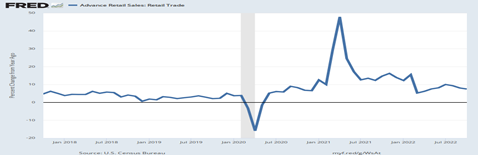
But that hasn’t stopped shoppers. Retail sales that account for some half of consumer spending jumped a huge 1.3 percent in October, 7.6 percent YoY.

FREDretailsales

Consumers are keeping up with inflation, in other words, because it’s the holidays and they want to celebrate their world returning to normal. Dining out at restaurants increased 1.3 percent in October, twice the current inflation rate.

And inflation is already cooling. The Fed has pumped up short-term rates from essentially zero to 4 percent in 2022, which has pummeled stock and bond prices. But financial markets rallied on Tuesday because the Producer Price Index (PPI) for wholesale goods and services continued to decline. Wholesale prices in October rose just 0.2 percent month-month and core inflation without food, energy and trade services declined from 5.6 to 5.4 percent YoY.

Tradingeconomics.com

My bet is that inflation will drop quickly during the coming winter as supply chains continue to improve, which ground to a halt during the worldwide pandemic lockdowns.

For instance, the NY Federal Reserve’s Global Supply Chain Pressure Index (GSCPI) stated as much in its latest release. “The GSCPI’s year-to-date movements suggest that global supply chain pressures are falling back in line with historical levels,” it said.

It means that consumer prices will continue to decline as well, since the PPI measures the raw materials and data that go into retail products and services.

Alas, retail inflation is still too high, since the CPI declined to 7.7 percent in October compared to a year ago, down from 8.2 percent in September. Predictions are all over the map as to when the inflation rate will return to a more normal range. Treasury Secretary Janet Yellen has said in recent testimony it could take several years to return to the Federal Reserve’s two percent target.

Other pundits are predicting as much as 10 years, because they cite the 1970’s era of stagflation. Inflation soared to as high 14 percent in 1981 after 10 years of wage-price spirals. It was another 10 years before inflation returned to its more normal 2-3 percent range.

But this inflationary spiral has lasted just months, not years as in the 1970s, as Nobel Prize-winner and former Federal Reserve Chair Ben Bernanke has pointed out. So, there’s no reason for anyone to press the panic button, stock and bond traders included. Consumers are riding this inflation wave just fine to date.

Why shouldn’t they be upbeat, with Americans still fully employed?

The New York Fed also publishes a Survey of Consumer Expectations of inflation also shows inflation is a short-term problem. “Median one- and three-year-ahead inflation expectations increased to 5.9 percent and 3.1 percent from 5.4 percent and 2.9 percent, respectively. (But) The median five-year-ahead inflation expectations, meanwhile, rose by 0.2 percentage point to 2.4 percent.”

Wholesale prices are still high. The Producer Price Index for final demand in the U.S. rose 0.2 percent month-over-month in October of 2022, the same as a downwardly revised 0.2 percent increase in September. Goods cost went up 0.6 percent, the largest advance since a 2.2 percent rise in June, mainly pushed by a 5.7 percent jump in gasoline cost. Prices for diesel fuel, fresh and dry vegetables, residential electric power, chicken eggs, and oil field and gas field machinery also advanced. In contrast, the index for passenger cars declined 1.5 percent. Meanwhile, services cost fell 0.1 percent, the first decline since November of 2020.

So, the inflation outlook is muddled, but consumers’ inflation expectations give us a better picture of how consumers will behave in the future. It is another ingredient that helps to determine the Fed’s next move, and when shoppers buy or hold.

All this news backs my bet of inflation falling back to historical levels as soon as next summer.

Harlan Green © 2022

Follow Harlan Green on Twitter: https://twitter.com/HarlanGreen

Wednesday, September 14, 2022

What is the Real Inflation Problem?

 Financial FAQs


FREDppi

What is worse, inflation rates, say, of 4 to 5 percent—slightly above historical averages, and average gas prices maybe $3.50 per gallon as they are today—or raising short term rates enough to make consumers pay more and job losses mount?

That is essentially the devil’s bargain the Fed seems to be offering Americans by Fed Chair Powell insisting that, “Reducing inflation is likely to require a sustained period of below-trend growth,” in his speech to the central bankers and economists gathered at the base of the Grand Tetons.

As financial markets continue to plunge on fears that the Fed will slow down growth so much that it will induce a recession, economists such as Nobel Prize-winner Joseph Stiglitz are warning the Fed may go too far.

“Monetary policy typically affects economic performance with long and variable lags, especially in times of upheaval,” said Professor Stiglitz in a recent Project Syndicate article. “Given the depth of geopolitical, financial, and economic uncertainty – not least about the future course of inflation – the Fed would be wise to pause its rate hikes and wait until a more reliable assessment of the situation is possible.”

“There are several reasons to hold off," continues Stiglitz. "The first is simply that inflation has slowed sharply. Consumer price index (CPI) inflation – the measure most relevant to households – was zero in July, and it is likely to have been zero or even negative in August (was 0.1%). Similarly, the personal consumption expenditure (PCE) deflator – another often-used measure based on GDP accounts – fell by 0.1% in July.”

So, the Fed may be looking in the wrong direction (the 1970s) for the causes of inflation. Wages, which were considered the main culprit for rising prices in the 70s, aren’t rising as they did then; have in fact fallen 2.8 percent behind the latest inflation surge.

Why not look at the much more severe and temporary supply-chain disruptions; the Ukraine war, and China’s COVID lockdowns as the major cause for the inflation spike?

Wholesales prices are falling even faster—with the Producer Price Index (PPI) down -0.1 percent in August reported today. The increase in the core prices without the volatile food and energy prices over the past year also slowed to 5.6 percent from 5.8 percent.

It makes more sense that markets should wait for the PPI index to come out before passing judgement on the Consumer Price Index, since the PPI ingredients (such as raw material prices) will tell us how retail (CPI) prices are trending. But, no, financial markets work on the hair-trigger principle, are too impatient in the one-click digital markets with their herd mentality to wait another day for the PPI results.

Counterbalancing rising inflation is also the super-strong Dollar making import prices cheaper for consumers and industrial materials. The dollar index, which tracks the greenback against its peers, was up 1.5 percent at 109.85 in its biggest one-day percentage gain since March 2020 after the CPI report.

Market traders and even retail players in financial markets have to be experiencing whiplash with Fed Governors continually pronouncing their take on current inflation conditions.

Yesterday’s 1200-point drop in the DOW and 100 plus point drop in the S&P indexes should be a lesson for traders to take their finger off the trigger more often and not keep firing indiscriminately at such a moving target as U.S. stock and bond prices.

It’s difficult to steer in the right direction when eyes are focused on the rear view mirror and stagflation fears of another era.

Harlan Green © 2022

Follow Harlan Green on Twitter: https://twitter.com/HarlanGreen