Showing posts with label Producer Price Index. Show all posts

Thursday, June 13, 2024

No More Inflation?

 Popular Economics Weekly

It will probably be hard to believe for those scarred by the post-pandemic inflation scare that believe inflation isn’t declining, but there was no inflation increase in May for both wholesale (PPI) and retail (CPI) inflation indexes.

Yes, for the first time in two years the Consumer Prices Index was unchanged, a zero-point inflation rise. Wholesale inflation, the Producer Price Index out the next day was unchanged for the first time in one year.

What does that tell us? Firstly, gas prices and housing (rents) have been declining of late after an initial uptick in the first quarter due to various shortages. Consumers are also becoming more cautious when they shop with major retailers like Target, Walmart, and grocery chains that are beginning to discount their products as shoppers look for bargains.

It will cause bonds in particular to rally because interest rates, including mortgages, finally begin to decline from their two-year highs.

U.S. wholesale (PPI) prices fell in May for the second time in three months — thanks partly to lower gas prices — in perhaps another sign an upturn in inflation earlier this year is fading. The producer price index actually fell 0.2% last month, the government said Thursday.

The retail and wholesale graphs illustrate the sudden drop in inflation, and the fact that the Q1 shortages were temporary. So, now it’s largely leisure activities—e.g., dining out, travel—in the service sector of the American economy, and housing rents that have kept consumers spending and the overall inflation rates higher.

This all fits in neatly with why the Fed believes it must keep interest rates high enough to slow down consumer spending even more, so that borrowing costs, for instance, remain intolerably high (i.e., with 8.5% Prime Rate). And that’s probably why last month’s retail sales were flat.

The cost of goods dropped 0.8 percent largely because of falling gas prices. Food prices also declined. The cost of services, the biggest driver of inflation, was unchanged in May after a big increase in the prior month.

The gradual slowdown in activity is obviously working. Weekly initial claims for unemployment insurance have been rising, signaling a slowdown in hiring. Initial jobless claims rose 13,000 — to 242,000 — in the week ending June 8, the Labor Department said also on Thursday.  That’s the highest level of claims since last August.

What’s keeping the Fed from cutting rates is that wages are still climbing 4.1 percent and Fed officials believe, for some reason, that the unemployment rate should rise above 4 percent—i.e., more employees must lose their jobs for inflation to decline further.

Housing rents, the main ingredient of retail CPI inflation, won’t come down until more housing is built. But that can’t happen until lower interest rates stimulate both the construction and sales of more homes!

That’s playing brinkmanship, in my opinion. It’s not taking into account the possibility of a major geopolitical surprise spooking financial markets, or consumers who are no longer flush with savings from the pandemic aid.

It could be China invading Taiwan, for instance? One can also imagine what might happen if North Korea accidentally sets off a nuclear confrontation. The Russian Navy is now also making regular visits to Cuba, and President Kennedy’s Russian missile crisis is not a very distant memory.

Harlan Green © 2024

Follow Harlan Green on Twitter: https://twitter.com/HarlanGreen

Friday, April 12, 2024

Inflation Still Declining

 Popular Economics Weekly

The inflation rate for wholesale goods and services (PPI) is still declining, which will hearten the inflation doves after yesterday’s Consumer Price Index (CPI) seems to be stuck in a 3 percent range. So, the Fed has a dilemma, which one to choose and use to forecast future inflation?

The Producer Price Index for final demand rose 0.2 percent in March, seasonally adjusted, the U.S. Bureau of Labor Statistics reported today. The index for final demand increased 2.1 percent for the 12 months ended in March, the largest advance since rising 2.3 percent for the 12 months ended April 2023.

What? You mean wholesale inflation is already down to 2 percent? This annual cost of raw materials and services has been at or below 2 percent for a year and hit zero percent in June 2023 as the supply chains recovered.

So, where’s the inflation the Fed is worried about? It’s because of rising wages and the higher profits of producers (corporations) and distributors that took advantage of the supply shortages during the Covid pandemic are added into the Consumer Price Index.

So-called equivalent rents are also incorporated into the CPI. And that is a lagging indicator that is based on last year’s rents, which aggravates Realtors, because one reason for the housing shortage (and higher rents) is fewer new homes are being built, largely because of higher construction costs from the very high interest rates engineered by the Federal Reserve!

The NAR’s chief economist Lawrence Yun has been loudly complaining about this anomaly:

"March inflation figures were very bad, which also means bad news for interest rates. Consumer prices reaccelerated to 3.5%,” said Yun. “This is higher than the 2% target inflation, which raises eyebrows regarding the Federal Reserve's delay in cutting interest rates. The bond market immediately responded with high yields to compensate for the loss in purchasing power.”

“One strange data point is rent, Yun said, “which the official data shows at 5.8%. The unofficial data from the apartment industry indicates falling rent due to over-construction. If rent data calms, then overall inflation will automatically be lower. It is, therefore, possible to get to the 2% inflation target by year's end, even with bumps and delays."

Said rising wages are also one reason our economy is doing so well. Consumers continuing to shop is a sign of continuing prosperity, is it not?

So why do so many Fed Governors remain hawkish and want to continue the inflation fight, instead of dropping interest rates? It could push economic growth down into no growth territory, as economists and some Fed Governors are warning.

New York Fed President John Williams said Thursday that monetary policy "is in a good place," helping to restore supply and demand balance to the economy.

"There's no clear need to adjust monetary policy in the very near term," Williams told reporters after a speech in New York.

The Fed therefore has a dilemma, as I said—when to drop their interest rates without losing their credibility in fighting inflation?

Willem Buitner and Ebrahim Rehbari, two English economists, say first improve their forecasting methodology, in a Project Syndicate article:

“There is a vibrant debate about whether firms abnormally raised their profit margins in recent years. A recent Fed study finds that nonfinancial corporate profits rose to 19% over gross value-added in the second quarter of 2021, up from 13% in the fourth quarter of 2019. But once prices have risen and profit margins are high, they are less – not more – likely to rise further than before the large price adjustments. Normalizing energy prices, supply chains, and profit margins all contributed to the faster-than-expected decline in inflation in the second half of 2023.”

They then cite Fed Chair Jerome Powell, paraphrasing Winston Churchill, recently called forecasters “a humble lot – with much to be humble about.”

It may be the opposite lesson from the Great Recession when CPI retail prices plunged to a negative 2 percent in July 2009, in part because the Fed held their 5.25% maximum rate too long.

Inflation remained in the 2 percent target range for the next 10 years, but also did GDP growth, as budget debates and a government shutdown plagued the Obama administration, which meant badly needed infrastructure, technology and climate change legislation wasn’t passed until the Biden administration.

So, the Fed should pay more attention to PPI wholesale inflation that indicates the Fed is close to its inflation target, since even slightly higher inflation is helpful when higher growth is necessary to modernize the US economy.

Harlan Green © 2024

Follow Harlan Green on Twitter: https://twitter.com/HarlanGreen

Thursday, March 14, 2024

Retail Inflation Is the Problem

 Popular Economics Weekly

There is a reason the Biden administration wants to prevent the merger of Kroger and Albertsons Supermarket chains. It lowers competition at a time when the largest retailers are now responsible for much of the inflation that has fueled the Fed’s reluctance to lower interest rates.

How do we know that? Retail companies such as Walmart, Home Depot, Costco, Lowes, CVS, and Target have reported record profits since the Pandemic, according to a recent report by Accountable.us, a nonpartisan 501(c)3 organization that reports on “special interests that too often wield unchecked power and influence in Washington and beyond.”

It reports that “a new analysis of earnings data of the ten largest U.S. retailers by market capitalization finding that they all raised consumer prices while collectively reporting $24.6 billion in increased profits during their most recent fiscal years. These same companies also ramped up spending on shareholder handouts by nearly $45 billion year-over-year for a total of $79.1 billion.”

FREDppi

This is while wholesale PPI price inflation for the raw materials that go into retail products is close to zero. The PPI approached zero percent in June 2023 and has remained below 2 percent annually since then. Supply may become oversupply, in other words, continuing to bring down wholesale prices.

This is opposed to the most recent Consumer Price Index of retail prices that is still hot, with annual inflation rate up slightly from 3.1 to 3.2 percent in February, and core inflation with food and energy prices now 3.8 percent.

It highlights the chasm between wholesale and retail prices that must factor in labor and capital costs. But those costs remain largely constant, so much of the difference must come from higher profit margins of retailers.

Voices are now growing louder for an earlier rate cut than in June that markets have currently predicted, in part because retail sales are faltering. Retail sales rose 0.6% in February from the previous month, according to Census Bureau data, but January retail sales previously posted a surprise -1.1% decrease. They have been trending downward since September 2023.

FREDretailsales

Retail inflation is largely due to corporate greed, which is out of the Fed’s control.

So there are now voices saying the Fed should pay less attention to its target rate of 2 percent and reduce interest rates sooner. “Given that the labor market is tight, the economy is running well and corporate fundamentals are looking pretty good, I’m not sure we need 2% inflation,” said another economist in a MarketWatch interview.

The chorus for rate cuts will grow louder as further weaknesses in retail sales appear in coming months.

Harlan Green © 2024

Follow Harlan Green on Twitter: https://twitter.com/HarlanGreen

Friday, February 16, 2024

Slower Retail Sales, Lower Inflation?

 Financial FAQs

The New Year is proving to have lots of ups and downs as consumer spending slows from the holidays. Tax season is afoot, of course, a time when consumers tend to save more and spend less.

That’s why retail sales fell sharply in January, while November and December sales were revised down. Financial markets rallied because it could mean the Fed cuts rates sooner if such weakness continues.

Wholesale inflation has also fallen sharply, is now close to zero percent annually, yet the financial markets continue to misread the data, fearing the Fed will put off rate cuts until later this year.

The Calculated Risk-enhanced retail sales graph is a great picture of what has happened since the COVID pandemic—incredible swings in activity that continue to confuse both Main Street and Wall Street, thereby mudding the economic waters.

FRED/BLS.gov/CalculatedRisk

“Advance estimates of U.S. retail and food services sales for January 2024, adjusted for seasonal variation and holiday and trading-day differences, but not for price changes, were $700.3 billion, down 0.8 percent from the previous month, and up 0.6 percent above January 2023,” said the Census Bureau.

Sales were up 3.1 percent from a year ago, below the 5 percent longer term average. Should this be worrisome? It isn’t adjusted for inflation, so retail sales were flat when adjusted for retail inflation that is running at 3 percent.

It means consumers could be taking a break in the first quarter of 2024. Why not? Blizzards in the northern states, tornadoes in the south and midwest, are certainly reasons for consumers to take a pause.

Meanwhile the Producer Price Index (PPI) for wholesale goods and services continues to plunge, as I said. This is the cost of goods and services that go into retail (CPI) inflation, which means overall inflation will continue to fall as well.

PPI Final Demand is now up just 0.9 percent in 12 months, far below the Fed’s 2 percent target. It jumped 0.6 percent in January but monthly prices declined 0.1 percent in December 2023 and advanced just 0.1 percent in November.

FREDppi

That is why economists are saying the inflation dragon has been slayed and consumer confidence is improving. One hint of what’s in store for the New Year was the New York Fed’s 2024 Survey of Consumer Expectations, which shows improvements in households’ perceptions and expectations of their financial conditions and credit availability.

Of particular note was that perceptions about households’ current financial situations improved in January with more respondents reporting being better off than a year ago and fewer respondents reporting being worse off. The percentage of respondents expecting to be financially the same or better off 12 months from now is 76.5%, its highest level since September 2021. (my emphasis)

This is a major reason consumer confidence has been rising over the past several months.

I reported last week that the University of Michigan’s sentiment survey, for instance, also reported consumers much more optimistic about their finances and the inflation outlook.

“Consumer sentiment confirmed its early month reading, surging 13% to reach its highest level since July 2021, reflecting improvements in the outlook for both inflation and personal incomes,” said survey director Joanne Hsu. “January's gain has been exceeded only five times since 1978, one of which was last month at an even larger increase of 14%.”

So contrary to what the financial market are reacting to, both wholesale and retrial inflation continues to trend down. But it’s a bumpy ride,, one Fed Governor warned, and as illustrated in the graphs.

Harlan Green © 2024

Harlan Green on Twitter: https://twitter.com/HarlanGreen

Saturday, January 13, 2024

Signs of Deflation Begin to Appear

The Mortgage Corner

Today’s Producer Price Index for Final Demand, a measure of the cost of wholesale prices, provides the first concrete evidence that we may be entering a period of deflation this New Year.

And, perhaps require the Fed to begin to lower interest rates as soon as in March. Though ongoing wars may cause future shortages but that isn’t happening at present.

Why? Raw material costs are declining into deflation territory, a sign of overproduction, which means prices that consumers must pay for the finished product or service will possibly decline into negative territory as well—when the excess profit margins of distributors and retail sellers that took advantage of the pandemic shortages also subsides.

Overproduction last happened in the 2007-09 Great Recession, as I’ve said, and began a period of Quantitative Easing requiring the Fed to buy massive amounts of securities to increase liquidity enough to boost the inflation rate back to the 2 percent range.

Wholesale prices this round first went into negative territory in July 2022 (-0.28%) per the FRED PPI graph, then fluctuated wildly for several months as supply chains recovered. But the PPI has been negative for the past 3 months, which is a sign that most supply chains have more than recovered.

FREDppi

The danger of overproduction has happened many times in the past and been a major cause of recessions. The Great Recession was caused by the overproduction of housing, for example; some one million excess units.

We saw signs of this in yesterday’s Consumer Price Index as well, when the so-called core index without food and energy prices declined to 3.9 percent for the first time since May 2021, mainly due to lower energy, healthcare, and used car prices.

Energy prices are declining because non-OPEC countries are now outproducing OPEC oil producing countries, for starters, and the food category was up just 2.7% year-over-year, with food away from home up 5.2% during the month and food at home up just 1.3%.

The FAO Food Price Index, which tracks monthly changes in the international prices of commonly traded food commodities, was 13.7% lower last year than the 2022 average, but measures of sugar and rice prices growing in that time.

The pace of inflation for food at home has now been below the Federal Reserve's overall target rate of 2% for three straight months, although the overall level of food prices is still elevated compared to two and three years ago.

Another reason for the deflation concern is consumers usually cut back their spending in the spring. The holiday spending spree is over, and tax season is approaching, which makes personal savings a priority.

In fact, we are already in the Fed’s 2 percent target range. The Personal Consumption Expenditure Price (PCE) Index is already at 1.9% and Core CPI Prices at 2.0% over the past 6 months.

What Fed officials seldom admit is the 2 percent inflation target isn’t a reliable target because there is no accurate measure of inflation as economists such as former Fed Chairman Ben Bernanke have admitted.

Overproduction can become a serious problem as it was during the Great Recession, but the possibility of supply disruptions because of the ongoing Ukraine and Middle East conflicts have made financial analysts leery of even mentioning the possibility of deflation.

The possibility of deflation scared the Fed enough under former Chairman Ben Bernanke to cut the Fed Funds rate to zero percent for a prolonged period—from December 2008 to February 2016.

Can that happen again if the Fed doesn’t begin to lower interest rates sooner?

Harlan Green © 2024

Follow Harlan Green on Twitter: https://twitter.com/HarlanGreen

Thursday, October 12, 2023

Too Low Inflation a Danger

 Popular Economics Weekly

Rather than worry about too much inflation still in the pipeline, we should worry about too little inflation going forward. The Producer Price Index of wholesale goods and services in September was 2.2 percent. It hit the Fed’s 2 percent target rate sometime between April-May this year. It then plunged to a zero inflation rate in June 2023 before rising to the current 2.2 percent inflation rate.

FREDppi

Too low inflation was the worry in 2009 after the Great Recession and the reason former Fed Chair Ben Bernanke instituted the Quantitative Easing (QE) policies that injected enough money into the system to bring the inflation rate back to its 2 percent target.

Today’s 2.2 percent PPI tells us the cost of wholesale goods and services has reached the Fed’s target rate and is a reason the Fed may have gone too far in suppressing wholesale prices. It means the supply chains have recovered and could even be over producing, which would continue to depress prices.

Why be worried when prices have risen so much in just two years? Final Demand Producer prices peaked in March 2022 at 12 percent. Consumers want prices to come down, after all.

But it’s a very dangerous monetary policy to suppress demand with such high interest rates for a prolonged period as Fed officials are saying they want to do.

Companies and consumers can quickly change course should there be more unforeseen consequences, such as a wider Middle East war creating scarcities that push prices up again. The 3.3 percent rise in final demand energy prices was the major culprit of the September PPI report.

The retail Consumer Price Index for September was a bit higher because of rising shelter costs and gas prices. But the headline all items annual inflation rate remained at 3.7 percent as in August.

“The index for shelter was the largest contributor to the monthly all items increase, accounting for over half of the increase. An increase in the gasoline index was also a major contributor to the all items monthly rise,” said the BLS.

So which index is more accurate?

The other Personal Consumption Expenditure Index (PCE) is rising at 3.5 percent over 12 months, right in the middle, and is probably the best picture of overall inflation. It shows the same bell curve and has also flattened of late.

“It’s the latest encouraging sign for Fed policymakers, who have been raising interest rates since March 2022 in a campaign to slow the economy and cool price increases,’ said NYTimes Jeanna Smialek. “While economic momentum has held up better than expected, a less ebullient housing market and a grinding return to normalcy in the car market have helped key prices — like automobile and rents — to fade.”

Unfortunately, the release of the Fed’s September FOMC minutes showed Fed officials aren’t yet getting the message that their credit policy may be too restrictive.

MarketWatch reporter Greg Robb summed it up: “The 12 voting Fed officials were unanimous in their decision to keep interest rates at a 22-year high, between 5.25% and 5.5 while penciling an additional rate hike before the end of the year to bring down inflation. “Almost all” of the 19 Fed officials supported holding rates steady, the minutes said.”

I am hoping circumstances will convince the Fed too low inflation can be a danger..

Harlan Green © 2023

Follow Harlan Green on Twitter: https://twitter.com/HarlanGreen

Friday, May 12, 2023

Wholesale Inflation is Tamed

 Financial FAQs

BLS.gov

April’s Producer Price Index for final demand confirmed the wholesale cost of goods and services has already returned to a 2 percent range, which should enable Fed officials to say the battle against COVID-induced inflation is almost won. But will they?

“The Producer Price Index for final demand advanced 0.2 percent in April, seasonally adjusted, the U.S. Bureau of Labor Statistics reported yesterday. On an unadjusted basis, the index for final demand moved up 2.3 percent for the 12 months ended in April.”

April’s Consumer Price Index slowing as well, showing retail prices dropping to a 4.9 percent inflation rate yesterday. It means other factors are keeping retail inflation higher than the wholesale cost of materials.

The so-called PPI should be a more accurate measure of inflation, since it reflects the downward trending costs of stuff that goes into retail goods and services.

Supply chains are being replenished, in other words. Retail inflation has remained higher because corporations today are making record profits by padding their profit margins. They took advantage of the sudden supply shortage during the COVID pandemic.

But as supplies are replenished—particularly by the Asian countries including China that produce most consumer goods—wholesale prices have fallen sharply, forcing corporations to lower their profit margins to a more normal level.

Average hourly wages of employees are also rising faster than normal (4.4 percent), and now the Fed considers higher wages to be the main inflation danger. So, it has prolonged their tightening cycle because it wants corporations to cool the red hot labor market.

Some 80 percent of wholesale costs was in the service sector that caters primarily to consumers that love their leisure activities such as travel and dining out. Over one-third of the April advance in the index for final demand services can be traced to a 4.1-percent rise in prices for portfolio management. The indexes for food and alcohol wholesaling, outpatient care (partial), loan services (partial), hospital inpatient care, and guestroom rental also moved higher.

We can now see clearly why consumers are fearing a recession. The University of Michigan sentiment survey plunged because of such fears.

“Consumer sentiment tumbled 9% amid renewed concerns about the trajectory of the economy, erasing over half of the gains achieved after the all-time historic low from last June,” said survey director Joanne Hsu. “While current incoming macroeconomic data show no sign of recession, consumers’ worries about the economy escalated in May alongside the proliferation of negative news about the economy, including the debt crisis standoff.”

The Fed must pause any further rate hikes while congress works out some kind of debt ceiling compromise. Any compromise will slow economic growth further, which should bring down retail prices as well.

Harlan Green © 2022

Follow Harlan Green on Twitter: https://twitter.com/HarlanGreen

Wednesday, March 15, 2023

What Is the Fed's Next Move?

Popular Economics Weekly

FREDcpi

The retail Consumer Price Index rose from essentially zero in May 2020 to 8.9 percent YoY in June 2022. It has dropped to 6 percent in February, per the US Census Bureau’s latest inflation report.

This is what panicked Federal Reserve officials to begin the draconion interest rate increases that have caused at least two bank failures, and maybe more, of mid-size banks whose oversight was weakened with a modification of the Dodd-Frank legislation in 2018.

The largest failure to date is the Silicon Valley Bank, whose depositors withdrew a record $42 billion in a matter of days. Taxpayers might now be picking up the tab because of the promise by the US Treasury and FDIC to make all depositers whole (but not stock and bond holders).

The rising costs of renting and homeownership accounted for more than 70 percent of the increase in consumer prices last month due to the well-documented housing shortage.

The cost of recreation, plane tickets, auto insurance and furniture also rose sharply because the service sector is booming. Leisure/Hospitality, Education & Health had the fastest job growth in last Friday’s February unemployment report.

Some good news was that the cost of energy, including gas and natural gas, declined in February. And grocery prices rose 0.3 percent to mark the smallest increase in 21 months. They are still up 10.2 percent in the past year, however.

The wholesale cost of goods also fell last month in the Bureau of Labor Statistic’s Producer Price Index as well, led by the third straight decline in food prices. Notably, wholesale egg prices sank 41 percent. The cost of eggs had soared since the fall, doubling in price in some parts of the country.

The PPI report captures what companies pay for supplies such as fuel, metals, packaging and so forth. These costs are often passed on to customers at the retail level and give an idea of whether inflation is rising or falling.

Crunching the numbers, it has taken nine months for CPI inflation to drop to 6 percent from its peak last June. It should take approximately six months to return to the Fed’s 2 percent inflation target, if it continues to decline at the same rate that it rose, which is sometime in the fall.

But supply chains are taking longer to recover because of China’s COVID missteps and the Ukraine war that has no end in sight.

So what is the Fed to do? It would be a good time to pause and see if inflation continues to decline, as well as to ascertain whether higher interest rates do more damage to the banking industry that may have invested too heavily in certain assets.

Harlan Green © 2023

Follow Harlan Green on Twitter: https://twitter.com/HarlanGreen


Wednesday, September 14, 2022

What is the Real Inflation Problem?

 Financial FAQs


FREDppi

What is worse, inflation rates, say, of 4 to 5 percent—slightly above historical averages, and average gas prices maybe $3.50 per gallon as they are today—or raising short term rates enough to make consumers pay more and job losses mount?

That is essentially the devil’s bargain the Fed seems to be offering Americans by Fed Chair Powell insisting that, “Reducing inflation is likely to require a sustained period of below-trend growth,” in his speech to the central bankers and economists gathered at the base of the Grand Tetons.

As financial markets continue to plunge on fears that the Fed will slow down growth so much that it will induce a recession, economists such as Nobel Prize-winner Joseph Stiglitz are warning the Fed may go too far.

“Monetary policy typically affects economic performance with long and variable lags, especially in times of upheaval,” said Professor Stiglitz in a recent Project Syndicate article. “Given the depth of geopolitical, financial, and economic uncertainty – not least about the future course of inflation – the Fed would be wise to pause its rate hikes and wait until a more reliable assessment of the situation is possible.”

“There are several reasons to hold off," continues Stiglitz. "The first is simply that inflation has slowed sharply. Consumer price index (CPI) inflation – the measure most relevant to households – was zero in July, and it is likely to have been zero or even negative in August (was 0.1%). Similarly, the personal consumption expenditure (PCE) deflator – another often-used measure based on GDP accounts – fell by 0.1% in July.”

So, the Fed may be looking in the wrong direction (the 1970s) for the causes of inflation. Wages, which were considered the main culprit for rising prices in the 70s, aren’t rising as they did then; have in fact fallen 2.8 percent behind the latest inflation surge.

Why not look at the much more severe and temporary supply-chain disruptions; the Ukraine war, and China’s COVID lockdowns as the major cause for the inflation spike?

Wholesales prices are falling even faster—with the Producer Price Index (PPI) down -0.1 percent in August reported today. The increase in the core prices without the volatile food and energy prices over the past year also slowed to 5.6 percent from 5.8 percent.

It makes more sense that markets should wait for the PPI index to come out before passing judgement on the Consumer Price Index, since the PPI ingredients (such as raw material prices) will tell us how retail (CPI) prices are trending. But, no, financial markets work on the hair-trigger principle, are too impatient in the one-click digital markets with their herd mentality to wait another day for the PPI results.

Counterbalancing rising inflation is also the super-strong Dollar making import prices cheaper for consumers and industrial materials. The dollar index, which tracks the greenback against its peers, was up 1.5 percent at 109.85 in its biggest one-day percentage gain since March 2020 after the CPI report.

Market traders and even retail players in financial markets have to be experiencing whiplash with Fed Governors continually pronouncing their take on current inflation conditions.

Yesterday’s 1200-point drop in the DOW and 100 plus point drop in the S&P indexes should be a lesson for traders to take their finger off the trigger more often and not keep firing indiscriminately at such a moving target as U.S. stock and bond prices.

It’s difficult to steer in the right direction when eyes are focused on the rear view mirror and stagflation fears of another era.

Harlan Green © 2022

Follow Harlan Green on Twitter: https://twitter.com/HarlanGreen

Monday, July 15, 2019

Why Worry About Inflation?

Popular Economics Weekly


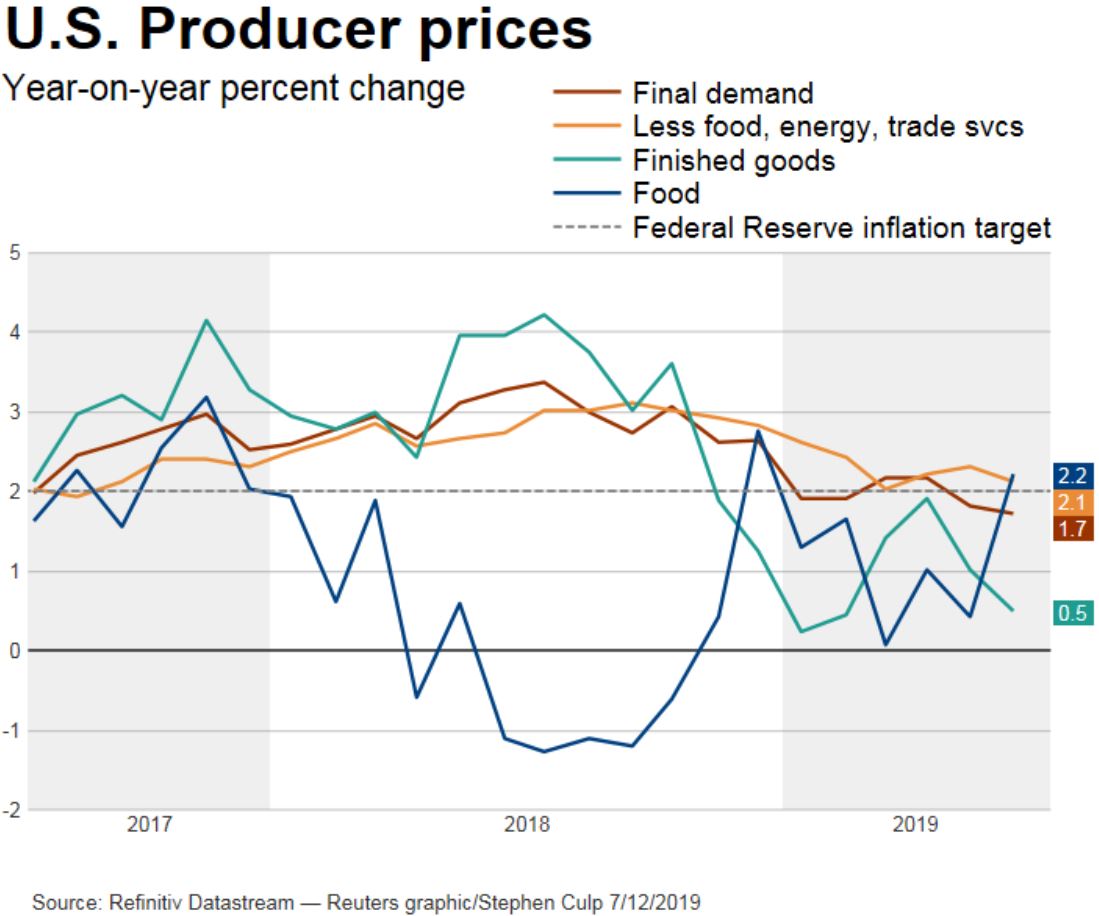
Almost everyone, including Fed Chair Powell, is worried about the low inflation rate.  It’s usually nearing 4 percent at this late stage of an economic recovery, not the current 2 percent if the US economy were running on all cylinders. Consumers should be spending more and businesses investing more to expand their markets—especially with the lowest unemployment rate in almost 50 years.

But the largest corporations don’t need to invest more. They have become fat and happy controlling their market share because they have been allowed to grow enough to buy up or stifle much of their competition. And with reduced competition they can spend most of their profits on stock buybacks and soaring CEO compensation packages.

Last Friday’s wholesale Producer Price Index indicated as much, with raw materials for finished goods and services barely budging. There is very little wholesale inflation on raw materials, in spite of the increased tariffs being levied on Chinese goods and elsewhere. This is a very strange because fewer less foreign trade should mean imported goods are more expensive, not cheaper.

The Producer Price Index for final demand advanced 0.1 percent in June, seasonally adjusted, reported the U.S. Bureau of Labor Statistics. Final demand prices moved up 0.1 percent in May and 0.2 percent in April. On an unadjusted basis, the final demand index rose 1.7 percent for the 12 months ended in June, the lowest rate of increase since advancing 1.7 percent in January 2017.

The real problem that Alexandria Ocasio Ortiz for one, highlighted in her questioning of Fed Chair Jerome Powell lzt week is why there is almost no inflation, even with a full employment rate of 3.7 percent? She wanted interest rates lowered sooner to boost higher growth, with some 6-7 million workers either not looking for work, or working part time, but would prefer working fulltime and earn a living wage.

Powell said the U.S. is suffering from a bout of uncertainty caused by trade tensions and weak global growth, but he pledged to do whatever it takes to shore up the economy in what Wall Street took as a sign the central bank will cut interest rates soon.


The retail Consumer Price Index fared slightly better. Year-on-year the core is up 1 tenth to 2.1 percent. Housing and medical care which together make up about 1/2 the index -- are also on the high side, said Econoday.

But outside the core, energy prices fell a sharp 2.3 percent on the month with the gasoline subcomponent down 3.6 percent. Energy prices, which are down 3.4 percent on the year, are not helping the Fed achieve its 2 percent inflation goal.

Trade wars are not really winnable anymore, as I’ve been saying; because we no longer live in a win-lose world where the strong are able to prey or even conquer the weak and vulnerable so easily. Our world has become too populous, and thanks to modern technologies too interlinked for it not to affect world trade upon which economic growth depends.

World trade is now in decline, which means US manufacturing and exports are in decline. So we hope US consumers keep spending, since they make up two-thirds of economic activity, if we grow at all this year.

Harlan Green © 2019

Follow Harlan Green on Twitter: https://twitter.com/HarlanGreen

Monday, March 21, 2016

Existing-Home Sales Fall, Inflation Too Tame


After increasing to the highest annual rate in six months, existing-home sales tumbled in February amidst very low supply levels and robust price growth in several sections of the country, according to the National Association of Realtors. Led by the Northeast and Midwest, all four major regions experienced sales declines in February.
And though several of the Fed’s Open Market Committee are still pushing for higher interest rates, there is still little sign of inflation at the wholesale or retail level, which means wages are not rising fast enough (that aprox. 2/3rds of product costs) to boost consumer demand, and hence economic growth.
Total existing-home sales1, which are completed transactions that include single-family homes, townhomes, condominiums and co-ops, dropped 7.1 percent to a seasonally adjusted annual rate of 5.08 million in February from 5.47 million in January. Despite last month's large decline, sales are still 2.2 percent higher than a year ago.  


Lawrence Yun, NAR chief economist, said existing sales disappointed in February and failed to keep pace with what had been a strong start to the year. "Sales took a considerable step back in most of the country last month, and especially in the Northeast and Midwest," he said. "The lull in contract signings in January from the large East Coast blizzard, along with the slump in the stock market, may have played a role in February's lack of closings. However, the main issue continues to be a supply and affordability problem. Finding the right property at an affordable price is burdening many potential buyers."  
Year-on-year, the producer price index (for wholesale goods and services), at dead zero, is a full 1 percentage point below the CPI while the producer core rate, at plus 1.2 percent, is 1.1 percentage point behind the CPI core.
So there is really no reason to worry about inflation.  The Fed should instead be concerned with boosting growth.  As the primary Presidential debates are highlighting, the various trade agreements have sent most of the high-paying blue collar jobs overseas.  What is left?  The lower-paying service sector jobs, such as in health care. 
There is the hope that housing will boost construction jobs, which are higher paying.  Indeed, the lower February existing-home sales are mainly due to the lack of inventory, which is down to a 4.4 month total, and the consequent higher prices.
"The overall demand for buying is still solid entering the busy spring season,” said Yun, “but home prices and rents outpacing wages and anxiety about the health of the economy are holding back a segment of would-be buyers."
The median existing-home price for all housing types in February was $210,800, up 4.4 percent from February 2015 ($201,900). February's price increase marks the 48thconsecutive month of year-over-year gains.
And total housing inventory at the end of February increased 3.3 percent to 1.88 million existing homes available for sale, but is still 1.1 percent lower than a year ago (1.90 million). That is why unsold inventory is at a 4.4-month supply at the current sales pace, up from 4.0 months in January.
Dr. Yun speculates part of the inventory decline may be due to large funds that are still buying up vacant units.  "Investor sales have trended surprisingly higher in recent months after falling to as low as 12 percent of sales in August 2015," adds Yun. "Now that there are fewer distressed homes available, it appears there's been a shift towards investors purchasing lower-priced homes and turning them into rentals. Already facing affordability issues, this competition at the entry-level market only adds to the roadblocks slowing first-time buyers."
            Rising housing prices do boost inflation, but rising incomes even more so.  So when incomes aren’t rising more than, say, 2.5 percent per year, then housing prices cannot rise much faster.  The biggest constraint on housing today, even with still ultra-low interest rates, is in fact static household incomes.

Harlan Green © 2016

Follow Harlan Green on Twitter: https://twitter.com/HarlanGreen

Thursday, May 14, 2015

Still No Signs of Inflation, Or Higher Growth

Financial FAQs

We still see no signs of inflation, in spite of the oil price hikes. The latest sign is the wholesale Producer Price Index (PPI) of wholesale goods. It is down and continuing to fall, in a word. Producer prices for total final demand fell 0.4 percent in April which is far below the Econoday low estimate for minus 0.1 percent. And this isn’t a good omen for higher growth this year.

image

Graph: Econoday

It also means the Fed may be in no hurry to raise interest rates this year at all. Or, or to sell any of the $4 trillion in securities it has purchased to keep more $$$ in circulation. Unfortunately, these $$$ are going nowhere, since they end up with those that need money the least, the top one percent income earners. The savings rate of the wealthiest is now above 50 percent, whereas that of the poorest 20 percent Quintile among US is basically down to 0 percent—that’s right, they are unable to save at all.

image

Graph: Business Insider

So now we know why the easy money Fed policies haven’t had more effect on boosting our GDP growth rate above 2 percent. In the last two decades, like that of many other developed nations, US growth rates have been decreasing. In the 50’s and 60’s the average growth rate was above 4 percent, in the 70’s and 80’s dropped to around 3 percent. In the last ten years, the average rate has been below 2 percent, in large part because household incomes have declined for most Americans that now spend more than they save to even maintain their current standard of living.

image

Graph: Trading Economics

Excluding food & energy, PPI producer prices fell 0.2 percent which is below the low estimate for no change. The overall year-on-year reading is at a record low of minus 1.3 percent. So there is little US demand for the raw materials that make up PPI components, including oil and gas, at the moment. So called Final energy demand fell a steep 2.9 percent in April with the year-on-year rate at minus 24.0 percent. Gasoline prices fell 4.7 percent in the month.

Final demand for food extended its long negative run, at minus 0.9 percent with the year-on-year rate at minus 4.2 percent. Final demand for services is down 0.1 percent with the year-on-year rate one of the few readings in the plus column, at 0.9 percent which nevertheless is well below the Fed's general inflation target of 2.0 percent.

Is this just from the winter freeze and tornadoes that have hit the South and Midwest? Or, will it be necessary to find other ways to put some of those savings to work to repair our ageing infrastructure that would boost our growth rate, and keep government solvent?

Harlan Green © 2015

Follow Harlan Green on Twitter: https://twitter.com/HarlanGreen

Tuesday, April 16, 2013

Deflation and Our Plunging Deficit

Popular Economics Weekly

The federal budget deficit is shrinking rapidly, says Goldman Sachs Chief Economist Jan Hatzius. And that is not such a good thing at the moment, since the private sector isn’t spending enough. It means this very weak recovery will continue, with deflationary tendencies still in the air.  And we do not want even lower inflation right now, as it depresses both incomes and economic growth.

President Obama’s new budget proposal doesn’t really help, since he wants to cut entitlement spending, which takes money out of circulation when more money in circulation is needed.

Deflationary tendencies are showing up in the Producer Price Index for wholesale goods, which has been close to zero since the end of the Great Recession. The annual rate in March just dropped to 1.1 percent from 1.8 percent in February (seasonally adjusted). The core rate held steady at 1.7 percent.

 image

Graph: Econoday

The federal budget deficit is a subject Hatzius has been following for some time....”[I]n the 12 months through March 2013, the deficit totaled $911 billion, or 5.7 percent of GDP,” he said in a research note. “In the first three months of calendar 2013--that is, since the increase in payroll and income tax rates took effect on January 1--we estimate that the deficit has averaged just 4.5 percent of GDP on a seasonally adjusted basis. This is less than half the peak annual deficit of 10.1 percent of GDP in fiscal 2009.”

So it’s not hard to understand what caused the March plunge in retail sales of 0.4 percent, versus the 1 percent increase in February. Some of it was due to bad weather and the payroll tax increases, but most was due to shrinking private and government spending.

Personal incomes are fluctuating wildly due to the payroll tax increases, so my take is, it ain’t the weather as some pundits are saying! Sure personal income rebounded 1.1 percent in February after a drop of 3.7 percent in January and a 2.6 percent jump in December, as we said last week. But it’s not enough to boost demand. Consumer spending just isn’t holding up, the main reason for government to keep spending.

image

Graph: Econoday

Personal spending jumped 0.7 percent after rising 0.4 percent in January. Strength was in nondurable goods, but that was mostly higher gasoline prices. Consumer outlays are up 3.3 percent annually, but if prices aren’t rising then that’s not enough to boost overall growth.

Government spending has already decreased 4 percent in the past 2 years, the largest amount since demobilization of the Korean War. For then important spending priorities can be met—such as infrastructure, research and development, as well as hiring back some of the 600,000 teachers let go because of state budget shortfalls.

What about the mounting debt? Rutgers Economic Historian James Livingston has an answer. Bring corporate taxes back to the levels during the Eisenhower era, when they were taxed at a 52 percent rate and made up some one-third of tax revenues, instead of the much less progressive payroll tax that burdens most of us. Corporate taxes now make up just 9 percent of revenues, according to Professor Livingston.

So where there’s the will there’s a way, as the saying goes. We know how to climb out of the debt trap. Lessen the burden of taxing personal incomes and increase it for corporations that have record-breaking profits and are hoarding some $4.25 trillion in cash, according to the St. Louis Federal Reserve. It is a case of some good history repeating itself, for a change.

Harlan Green © 2013

Follow Harlan Green on Twitter: www.twitter.com/HarlanGreen

Tuesday, July 17, 2012

Consumers Becoming Healthier—Part II

Financial FAQs

Consumers seem to be doing better, as I said last week, in spite of their worries about jobs, the economy and budget deficits (their own more than governments’). Consumer credit jumped $17.1 billion in May for the largest increase since the $19.1 billion boost seen in November 2011, which means they are spending more. Gains for the latest month were seen in both revolving and nonrevolving credit.

clip_image002

Graph: Econoday

Nonrevolving credit, which is being driven higher by strong demand for student loans including in the latest month, rose $9.1 billion.  Auto loans also played a supporting role. Revolving credit jumped a giant $8.0 billion which is by far the strongest gain of the recovery. A key question is why revolving credit rose so much. Are consumers more confident about jobs and are more willing to spend?  Are consumers using credit cards to fill in for slumping income? 

The data do not directly answer those questions, says Econoday.  Odds are it is a combination of both.  Consumers with jobs are less worried about a layoff.  And consumers that are underemployed may be resorting to credit cards.  But on a clearly positive note, credit card issuers indeed have returned to the practice of extending credit.  Overall, the boost in credit outstanding is helping to sustain the recovery.

One big mystery is why retail sales have been falling, but once again the Commerce Department is using a seasonal adjustment factor, which means sales may actually be rising, but not as fast as in past summers.

clip_image004

Graph: Calculated Risk

The U.S. Census Bureau said that advance estimates of U.S. retail and food services sales for June, adjusted for seasonal variation and holiday and trading-day differences, but not for price changes, were $401.5 billion, a decrease of 0.5 percent from the previous month, but 3.8 percent above June 2011. The press release also said that the monthly estimate has a ±0.5 error range, and the annual estimate could be off by as much as ±0.7 percent. And we know unit auto sales are surging, so retail sales estimates are notoriously volatile and subject to revisions.

But there is another adjustment that may be skewing the retail numbers, which don’t adjust for price changes, as we said. That is plunging prices that are putting us into deflationary territory.

clip_image006

Graph: Econoday

Though the producer price index in June edged up 0.1 percent, it followed a sharp 1.0 percent plunge the prior month.  And it had been following sharply since February 2012. This can be attributed to falling demand, of course, but that might be from other parts of the world, like Europe that is falling back into recession, or China that recently lowered its interest rates to boost domestic demand. In April, China’s producer price index (PPI) was negative, and this contraction has since gathered steam. In June, prices fell 2.1 percent year-on-year, suggesting a large part of the economy is already in deflation.            .

But though job worries for the unemployed are paramount, their prospects may also improve in coming months, according to the latest JOLTS report. There were 3.6 million job openings on the last business day of May, little changed from 3.4 million in April, said the U.S. Bureau of Labor Statistics. But what is little about the fact that it is way up from 2.4 million openings at the end of the recession in June 2009?

clip_image008

Graph: Calculated Risk

Jobs openings increased in May to 3.642 million, up from 3.447 million in April. The number of job openings (yellow) has generally been trending up, and openings are up about 18 percent year-over-year compared to May 2011. Quits increased slightly in May, and quits are now up about 6 percent year-over-year. These are voluntary separations and more quits might indicate some improvement in the labor market (see light blue columns at bottom of graph for trend for "quits").

We will have more to report on industrial production, retail and housing sales later in the week. They may show that although the economy has slowed during the summer months, growth should pick up in the fall.

Harlan Green © 2012