Showing posts with label CPI. Show all posts

Thursday, October 15, 2026

A Brutal Inflation Report

Financial FAQs

“The Consumer Price Index for All Urban Consumers (CPI-U) increased 0.6 percent on a seasonally adjusted basis in September after rising 0.4 percent in August, the U.S. Bureau of Labor Statistics reported today. Over the last 12 months, the all items index increased 3.7 percent before seasonal.” BLS.gov

FREDcpi

The misjudgments and ignorance of our wanne-be dictator who likes wars is coming home to roost. Consumers are being hit with the second-largest monthly inflation spike since Trump began to bomb Iran (see graph), which makes it inevitable that there will be more interest rate hikes by the Federal Reserve.

This is largely because of the shortage of oil and energy supplies as Iran has been knocking out Middle East oil wells and refineries while closing the Strait.

The Bureau of Labor Statistics reported the gasoline index rose 9.1 percent in September, accounting for over half of the monthly all items increase. The energy index increased 5.2 percent over the month following a 2.1-percent increase in August.

But it hasn’t yet stopped consumers from shopping. Advance estimates of U.S. retail and food services sales for September 2026 not for inflation were up 0.8 percent (±0.4 percent) from the previous month, and up 6.3 percent (±0.5 percent) from September 2025.

Yet much of it was spent on soaring gas prices, or diesel prices which are approximately one dollar higher per gallon than gasoline.

That’s because we are in the middle of the A.I. investment boom that will keep the financial markets at record levels and the economy growing into next year. But everything will be more expensive.

Trump claims his war is to prevent Iran from ever having nuclear weapons. But President Obama had already accomplished it with his Joint Comprehensive Plan of Action (JCPOA) in 2015 in which Iran signed a treaty with the major world powers to never develop a nuclear weapon,

Trump cancelled the treaty that would have kept the Middle East at peace because of his hate for a Black President, so now the Strait of Hormuz is closed and petroleum supplies will be more expensive and more difficult to obtain when it ultimately reopens because Iran controls the access.

There was never a mention of the Strait of Hormuz in Obama’s Treaty because it was an international waterway.

So what happens next? If the A.I. construction continues and consumers keep shopping, we will have decent economic growth. The Atlanta Fed’s GDPNow third quarter GDP estimate is holding at 3.6 percent, up from 2.2 percent in Q2.

And inflation will continue to rise. Wholesale prices that go into consumers prices also took a huge jump of 1.3 percent in September. And that is for the raw materials like steel, lumber, etc., that go into retail products. So, prices will keep rising.

Our Federal Reserve must therefore continue to raise their interest rates to maintain credibility. Their Fed Funds rate controls short term interest rates for credit cards and installment loans, which controls the Wall Street Prime Rate, which is already 7 percent.

It hasn’t slowed down consumers yet because of the chain of events I just mentioned. The stock market is profiting from the A.I. construction and record profits of corporations. But they must slow their shopping eventually, maybe after the holidays when they run out of savings.

The A.I. centers will be taking much of the energy supplies when they open. The Atomic Energy Agency (AEI) estimates that a “typical AI-focused data centre consumes as much electricity as 100,000 households, but the largest one is under construction today will consume 20 times as much.”

I have an interesting thought. Trump could bring inflation back down to earth if he wasn’t so in love with Putin by taking The Ukraine’s side in that war. If Ukraine was given the full support with weapons and intelligence of our “great military”, Russia would have to sue for peace, as the saying goes.

And what then? It could no longer support Iran, who might then also sue for peace. Image what could happen next. Sanctions could be lowered or even eliminated, and world trade could begin to return to normal times.

But is Trump too crazy in love with himself for that to happen? Then remove him and save the world from another brutal recession.

Harlan Green © 2026

Follow Harlan Green on Twitter: https://twitter.com/HarlanGreen

Thursday, July 16, 2026

“The economy hasn’t lost its mojo.” MarketWatch

 Financial FAQs

“Advance estimates of U.S. retail and food services sales for June 2026, adjusted for seasonal variation and holiday and trading-day differences, but not for price changes, were $768.6 billion, up 0.2 percent (±0.4 percent)* from the previous month, and up 6.7 percent (±0.5 percent) from June 2025.” Census.gov

FREDretailsales

Headlines, such as that consumers “haven’t lost their mojo” have popped up when retail sales rose 0.2 percent in June. It’s a sign of consumers are willing to ‘shop until they drop’, which may keep the U.S. economy growing for some time.

It also means that same level of irrational exuberance of the 1990s is back once again, with the major market indexes at record levels, and consumers seemingly oblivious to the conditions that prevailed during the late 1990s.

 Nobel Laureate Robert Shiller first presented the term irrational exuberance to Alan Greenspan’s Federal Reserve Governors in 1996 to evidence how overvalued stock market levels had become at the time. But it wasn’t until 2000 that the dot-com asset bubble burst that many market commentators and some economists are comparing to the current record market rally.

The MarketWatch headline portrays most of the media’s reaction to the latest Advance Retail and Food sales report by the U.S. Census Bureau. The slightly hysterical headline is really a sign of relief because of the slight drop in monthly gas prices that prevailed during the 60-day cease fire agreement.

But the cease fire has ended. And it reveals how badly the Trump tariffs and Iran war have hurt consumer spending, still the backbone of U.S. economic growth. We have been a consumer-driven economy since the 1950s and end of World War II.

And since retail sales are not inflation adjusted, when adjusted for inflation, gas and food in particular have become less affordable. Retail inflation is still above 3 percent. Retail sales have fluctuated wildly, as per the above graph, rising 6.7 percent in 12 months because consumer bought more in earlier months to get ahead of the rising inflation—i.e., before the Iran War began to jack up everyday prices.

Though sales at car dealers and online merchants both jumped about 2 percent in June, sales fell at grocery, clothing and healthcare stores, says MarketWatch.

So, consumers are still shopping because they must, putting them further in debt. The Consumer Price Index for basic necessities like gas and food is still above 3 percent, as I said, and the wholesale (PPI) price index for raw materials that go into retail goods is 5.5 percent annually, the U.S. Bureau of Labor Statistics reported. It’s still the largest rise in more than three years.

We don’t have to look at just the dot-com bubble to compare, either. I see an unsettling resemblance to the ‘roaring twenties’ of an earlier era from the recovery of another pandemic, the Spanish Flu pandemic of 1919 to 1920 that killed what would be millions of Americans if at our current population level.

It was a long recovery—until 1929 and the Black Friday stock market crash that led to the Great Depression, caused in part by another era of high tariffs that led to product shortages.

How long may this era of irrational exuberance last that has driven the financial markets to record levels with so much wealth pouring into a new space age that will take us years to return to the moon, much less turn a profit?

We are at another turning point in what currently looks like an A.I. revolution, much like the Internet’s introduction that took decades to adopt, and recovered from a Great Recession, let’s not forget.

So the best way to survive another bout of irrational exuberance is to be patient, in my opinion, rather than listen to the crowd that promises the next big thing.

Harlan Green © 2026

Follow Harlan Green on Twitter: https://twitter.com/HarlanGreen

Tuesday, May 12, 2026

Consumers In A Strait Jacket

Popular Economics Weekly

“The Consumer Price Index for All Urban Consumers (CPI-U) increased 0.6 percent on a seasonally adjusted basis in April, after rising 0.9 percent in March, the U.S. Bureau of Labor Statistics reported today. Over the last 12 months, the all items index increased 3.8 percent before seasonal adjustment. BLS.gov

FREDcpi

The Consumer Price Index for retail goods is the highest in three years and a reason the recent (December) Harris poll for The Guardian says 57 percent of Americans believe the U.S. is already in a recession—despite last week’s strong unemployment report and initial Q1 2026 2% economic growth.

One of the reasons for the inflation upsurge is the Hormuz Strait blockade by the U.S. and Iran as President Trump attempts to squeeze Iranian oil exports, when President Trump has said many times in many confusing ways the Iran war is over? We might find out after the Chinese summit.

That’s because China imports 40-50 percent of its oil via the Hormuz Strait according to most experts. And it’s almost the only leverage Trump has in his negotiations with Chairman Xi over the stranglehold Xi has on strategic minerals that make things like super magnets to power computers and jet fighters.

Food prices as well as that for petroleum products have a huge impact on inflation, per the CPI.  It’s the everyday items like food that are depressing American consumers big time.

· The index for food rose 0.5 percent in April after being unchanged in March. Five of the six major grocery store food group indexes increased in April.

· The index for meats, poultry, fish, and eggs increased 1.3 percent over the month as the index for beef rose 2.7 percent.

· The fruits and vegetables index increased 1.8 percent in April and the nonalcoholic beverages index rose 1.1 percent.

· The index for dairy and related products increased 0.8 percent over the month and the index for cereals and bakery products rose 0.1 percent in April.

The University of Michigan Sentiment Survey tells us why Americans are depressed:

“About one-third of consumers spontaneously mentioned gasoline prices and about 30% mentioned tariffs. Taken together, consumers continue to feel buffeted by cost pressures, led by soaring prices at the pump. Middle East developments are unlikely to meaningfully boost sentiment until supply disruptions have been fully resolved and energy prices fall,” said survey director Joanne Hsu

And when will that happen? I believe Trump is using the blockade to pressure China on trade concessions, rather than Iran; which is one reason he keeps belittling Iran’s efforts at ending the blockade. Iran is only important as a means of holding China’s feet to the fire on the Hormuz Strait.

Although it’s in both China and America’s best interest to conclude a trade treaty asap, and then work to re-open the Strait, it could still take months to finalize. And before gas prices and inflation begin to come down.

Harlan Green © 2026

Follow Harlan Green on Twitter: https://twitter.com/HarlanGreen

Friday, April 10, 2026

Our Inflation Nation

 Financial FAQs

“The Consumer Price Index for All Urban Consumers (CPI-U) increased 0.9 percent on a seasonally adjusted basis in March, after rising 0.3 percent in February, the U.S. Bureau of Labor Statistics reported today. Over the last 12 months, the all items index increased 3.3 percent before seasonal adjustment. BLS.gov

FREDcpi

We knew it was coming. Not just when. The Iran war is in its second month and has already produced the largest supply shock to the global oil market in history, the IEA said last month.

On Tuesday, the head of the group, Fatih Birol, told French newspaper Le Figaro as reported by several news agencies that the current crisis is more severe than the oil shocks of 1973 and 1979, and the 2022 Ukraine-war shock, combined.

And there’s no end in sight as the world’s largest economy is making the supply shortages worse. It’s an incredible reversal of our standing in the world.

The high spike in the CPI inflation graph above is a disheartening picture of what happens when mad kings attempt to control economies and countries that have a chokehold on supply chains needed by the world economies.

This is just the latest mismanagement by the Trump administration—and Republican Party also has allowed, let’s not forget—of the American economy. President Trump wanting to pay for his tax cuts with higher tariffs had already snarled supply chains and caused a second post-COVID inflation round.

The Biden administration had wrestled annual CPI inflation below 3 percent in 2024 from the earlier COVID-19 pandemic spike, where it stood until now.

And Trump apparently thought attacking a country that bordered a waterway through which 20 percent of petroleum supplies and products flowed would not do further damage to the world’s economies.

So what was he thinking? The problem is he doesn’t bother to think things through at all. This is the second spike that has raised the cost of living since the tariff induced inflation. So why would polls show a majority of voters believe Republicans are better at economic growth?

Is it because Trump runs the federal government from Mar-a-Lago, or one of his golf courses (That’s a joke.)?

The all-items consumer index rose the most—3.3 percent for the 12 months ending March, after rising 2.4 percent for the 12 months ending February. It rose 2.6 percent less food and energy over the year. The energy index increased 12.5 percent for the 12 months ending March, as a result of the Iran war.

And American consumers are already feeling it. The University of Michigan survey of consumer sentiment fell to a record low of 47.6 in April from 53.3 in the prior month.

“Consumer sentiment sank about 11% this month, extending a decline that began with the start of the Iran conflict, and is currently about 9% below a year ago. Demographic groups across age, income, and political party all posted setbacks in sentiment, as did every component of the index, reflecting the widespread nature of this month’s fall,” said Survey Director Joanne Hsu

It doesn’t mean consumers will shop more once they receive their Trump tax refunds. But inflation is a growth killer, and countries such as Russia or even Turkey that are experiencing one-man rule have had nothing but double-digit inflation for decades, because their leaders thought they knew better than anyone else how to run their country.

Harlan Green © 2026

Follow Harlan Green on Twitter: https://twitter.com/HarlanGreen

Thursday, October 30, 2025

Will Fed Give Up the Inflation Fight?

 Financial FAQs

 “Consumers continue to express frustration over the persistence of high prices, with 44% spontaneously mentioning that high prices are eroding their personal finances, the highest reading in a year.” University of Michigan Sentiment Survey

FREDcpi

Federal Reserve Chair Jerome Powell said at his most recent press conference (after the Fed’s October FOMC meet) that they were still committed to achieving a 2 percent inflation target.

Why ? Because inflation is still too high and Chair Powell, et. al., see too much uncertainty ahead. That’s no surprise given the government shutdown, and continuing tariff wars.

The last period of moderate inflation was the decade after the Great Recession, as seen in the Fred Consumer Price Index chart (large gray bar is GR)—that ended with the COVID-19 pandemic. It was during the Obama administration when regulations were created that required banks to play by the rules and hold more capital.

But what if the rules are changed again that allow higher inflation and fewer regulations that the Trump administration says it wants?

The moderate inflation ended because of the COVID-19 pandemic when massive liquidity was injected into the economy during the first Trump and Biden administrations to speed up the recovery. Inflation jumped to a high of 9 percent before declining until the retaliatory tariffs, rising again to its current 3%.

So now there is growing doubt that the Fed can maintain the 2 percent inflation target, since the newest members of the Fed Governors that vote on interest rates were Trump-appointed. And a Trump pick will become the new Federal Reserve Chair next year.

This is while President Trump has been calling for lower interest rates, which with higher tariffs would lead to higher inflation.

Trump claims that won’t happen even though he has raised tariffs to Taft-Hartley, Great Depression levels (thus raising import prices), has raised federal debt because of his Big Beautiful Tax Bill, and is loosening financial regulations that limit market speculation (e.g., in Bitcoin).

Add all this to the chaos generated by a White House that almost daily revises its decisions (e.g., TACO Trump), which makes it almost impossible to predict what will happen next.

Trump won’t admit he is responsible for the rise in consumer prices since April 2. But it happened at the same time that he announced his retaliatory tariffs on the rest of the world.

There is pushback from the bond market, which doesn’t like inflation because it reduces the value of bonds. We can see that certain financial markets are already reacting to the inflation uptick with higher interest rates, which is making consumers increasingly unhappy, even with the second -0.25 percent rate cut in October.

This translates into higher mortgage rates as well, which won’t make the housing industry happy either. So, who will lobby against more easy money to prevent another Great Recession, which happened the last time Republicans pushed through such an easy money agenda by blatantly ignoring financial regulations?

Though no one was punished for it, and American taxpayers paid for the bailout of our financial system. Will that happen again, now that Republicans are once again in charge?

Consumers don’t like higher prices, period, and there is another election in 2026. They might even remember the eight million job losses that followed what was the worst economic downturn since the Great Depression.

Harlan Green © 2025

Follow Harlan Green on Twitter: https://twitter.com/HarlanGreen

Monday, August 18, 2025

This Inflation Isn't Temporary

Popular Economics Weekly

The Producer Price Index for final demand rose 0.9 percent in July, seasonally adjusted, the U.S. Bureau of Labor Statistics reported today. Final demand prices were unchanged in June and moved up 0.4 percent in May. BLS.gov


FREDppi

The Trump administration wants Americans to believe the current inflationary surge is temporary. Why? Because it needs the Fed to lower interest rates to keep economic growth from stalling because of the tariffs. And lowering interest rates in what is still a fully-employed economy is inflationary.

It’s the kind of reverse logic that has characterized so much of the MAGA crowd that wants to believe conspiracies (Epstein?) rather than economic realities.

The Producer Price Index of wholesale goods just out is another unwelcome fact that inflation isn’t temporary because of the tariffs. The tariffs paid by American importers at ports of entry are already showing up in the prices of raw materials producers must pay that will ultimately be passed on to American consumers and businesses.

The PPI is showing July wholesale prices (dark red line) have risen much faster than retail prices (light red line) in the above FRED graph—3.3% vs. 2.7% in a year.

Coffee prices are already up 15%, for instance. Could that have to do with the 50% tariff Trump has levied on Brazil, a major coffee grower, because he doesn’t like its socialist government?

So an unfavorable PPI is another measure of inflation the Trump administration will want to ‘cook’ if their choice for a new head of the Bureau of Labor Statistics is confirmed by the Senate.

 It prices the raw materials and services that go into the retail CPI Index that measures the final consumption of finished products and services. That’s no surprise because material input costs have been rising since April 2 and the announcement of the tariff wars, which belies Trump’s lies that the countries exporting to us will bear the cost of those import taxes for the great privilege of selling to US, yet are ultimately paid by Americans!

All eyes are now on what Fed Chair Powell will say at the Kansas Fed’s Jackson Hole conference this week. Will the 12 Fed Governors that vote at the FOMC meetings decide once again that there is little likelihood of an interest rate cut in September?

They may have to, because the biggest rise in wholesale prices was in the service sector that powers almost two-thirds of consumer activities (leisure, travel, dining out, transportation, and construction).

The index for final demand services moved up 1.1 percent in July, the largest advance since rising 1.3 percent in March 2022. It showed importers are also increasing their profit margins and so passing on the increased costs to consumers and businesses.

Over half of the broad-based July increase is attributable to margins for final demand trade services, which 

And consumers are beginning to notice, according to the University of Michigan’s consumer sentiment survey.

“Consumer sentiment fell back about 5% in August, declining for the first time in four months. This deterioration largely stems from rising worries about inflation. Buying conditions for durables plunged 14%, its lowest reading in a year, on the basis of high prices,” reports survey Director Joanne Hsu.

Though it hasn’t done much damage to retail sales just yet. Retail sales rose 0.5% last month following a nearly 1% increase in June, reports the Census Bureau.

Automobile sales rose for the second month in a row, said MarketWatch’s Jeffry Bartash. Car buyers have been buying vehicles for the past few months to once again avoid anticipated price increases in the coming months as tariffs take full effect.

So the damage is already being done by Donald Trump’s tariffs. Even grocery prices are soaring that depend on what is produced domestically. Now why would grocery prices also be increasing that aren’t taxed by tariffs? Could it be that there are fewer farm workers to harvest the crops this year?? The ICE folks could answer that question!

Harlan Green © 2025

Follow Harlan Green on Twitter: https://twitter.com/HarlanGreen


Thursday, August 14, 2025

Trade Wars = Stagflation


Popular Economics Weekly

“The Consumer Price Index for All Urban Consumers (CPI-U) increased 0.2 percent on a seasonally adjusted basis in July, after rising 0.3 percent in June, the U.S. Bureau of Labor Statistics reported today. Over the last 12 months, the all items index increased 2.7 percent before seasonal adjustment.” BLS.gov

FREDcpi

The damage is already being done from Donald Trump’s tariffs that are for the most part illegal—higher inflation. And American consumers and businesses will soon realize what it does to their pocketbooks as they begin to pay for his big, beautiful tax cuts for the wealthiest.

Inflation has been rising since April when President Trump announced his trade war on the rest of the world. The core retail Consumer Price Index without gas and food prices that the Federal Reserve prefers increased to 3.1% annualized, way above the Fed’s target rate to keep inflation from getting out of control.

Though the CPI energy index decreased 1.6% for the 12 months ending July, the food index increased 2.9% over the last year, which worries consumers more. And food prices will continue to increase as Trump chases almost half of the agricultural workers from American fields they harvest in his roundup of undocumented immigrants.

We can learn from past episodes the effects of inflation when out of control, such as the 1970’s stagflation from the OPEC embargo induced oil shortages. The COVID-19 pandemic caused more recent product shortages and supply chains shutdowns as well that pushed CPI inflation to 9% in 2022 and was the Democrats undoing.

The COVID-induced inflation backed down to 3% in a year (June 2023), but voters believed Trump when he said he would bring down inflation on “Day 1”.

Trump’s trade wars are affecting economic growth, the other part of the stagflation equation, because exporters are disrupting supply chains in their attempts to avoid the higher tariffs. And because Trump has declared tariffs on everyone, it’s more difficult for exporters to find a work around.

We have barely begun to see the effect of the tariff hikes because Trump keeps postponing many of them, giving China another 90 days to come to terms, for instance, though China’s tariff rate is already 30 percent.

Slowing growth will begin to show up soon enough in his tariff scheme. Q2 GDP grew 3% after its negative -0.5% shrinkage in Q1 because imports dried up after April 2 when Trump announced his trade war.

But GDP growth will shrink again as importers begin to pay a higher tax when more tariff agreenebts kick in. There is one problem, however. Trump may have to refund the $130 billion his administration has already collected to those very same importers, if his appeal to the Foreign Trade Court is denied. And the appeals court may decide so, since he had declared the trade deficit a national emergency, which means the Trump administration must return those funds.

As Paul Krugman said recently on Lawrence O’Donnell’s MSNBC show, The Last Word, it will then be Trump’s problem to unscramble the accounting mess that it will cause in returning the money to those importers that were levied.

Americans will soon see the results in growth when their prices begin to rise in earnest. Trump is literally using the tariff taxes paid by American businesses and ultimately consumers in higher prices to pay for the tax cuts given to his wealthiest supporters, as I said. And that will begin to stall economic growth very soon as Americans have less to invest and spend.

It will be the price we must pay, unfortunately, until enough voters realize President Trump and his Republicans have foisted a giant Ponzi scheme on the American people.

Harlan Green © 2025

Follow Harlan Green on Twitter: https://twitter.com/HarlanGreen

Friday, July 25, 2025

The Japan Tariffs

 Financial FAQs

“It has been clear for a while that Trump and co. don’t understand or believe in balance of payments accounting, that they want both a smaller trade deficit and more foreign investment in America. Now their basic lack of understanding is embodied in a specific deal.” Paul Krugman

Why not quote Paul Krugman, who won a Nobel Prize for his research on foreign trade? The just announced trade deal with Japan is another illustration of the Trump administration’s ignorance of basic economic principles that will make both countries poorer.

It’s necessary to get into the ‘weeds’ of economic principles for those that want to understand just what the Trump administration is really up to; enriching the few with tax cuts that are paid for by all Americans in the higher prices that will result.

Although Japan will be building more factories in the U.S. with its $550 billion in announced investments and be able to export more Japanese vehicles to Americans, U.S. autoworkers will be hurt because Japanese autos will be cheaper than vehicles manufactured in the U.S, even with the 15 percent tariffs levied on them.

Why so? Because the parts imported and used in U.S. manufactured autos have higher tariffs, such as the 50 percent tariff on imported steel and aluminum products that go into American-made autos. That’s why the U.S, Autoworkers Union will have something to say about such a tariff agreement that will endanger the livelihoods of Ford, Stellantis, and GM’s unionized autoworkers.

GM President Mary Ybarra just announced that $1.1 billion of its $2 billion net income from second quarter earnings will be ‘eaten’ by the higher tariff costs that GM didn’t want to pass on to consumers.

The FRED graph illustrates the ups and downs of the historical trade imbalance of goods and services. The downward trending red line basically tracks the negative gap between imports and exports. It has been trending down because we are a consumer-driven economy that has imported much more than American businesses export.

The deepest trade deficit (steep drop in red line) occurred with a surge in imports January-March 2025 to get ahead of Trump’s threatened reciprocal tariffs on April 2. But when he announced the reciprocal tariffs—China’s was 145%, for instance—imports dried up and the difference narrowed so that the graph line rose quickly to the $60 to $70 billion historical trade deficit.

It's an illustration of the incredible gyrations that such chaos injects into foreign trade with Trump’s negotiating tactics, and which hurts small businesses most that depend on imports for consumer products, as well as retail giants like Walmart and Target.

The earliest effect on tariff-induced inflation apppeared in the Consumer Price Index (CPI) I reported last week. The prices of retail goods and services rose to 2.7 percent in June from a four-year low of 2.4 percent, which is why the Fed is still on hold with further rate cuts. It fears that lowering their Fed funds short-term rate could trigger an inflation panic, since it would speed up economic activity.

This would in turn panic bond holders who fear higher inflation and demand higher rates that control mortgages and yields on Treasury securities that fund the national debt, when the annual debt payments are $1 trillion.

Consumers can tolerate some higher inflation and maintain spending if the job market is good. Retail sales just rebounded in June and initial jobless claims for unemployment benefits are down again. Should the unemployment report remain in the low 4.2-4.3 percent range, consumers can keep spending despite uncertainty. But confidence polls are showing consumers are beginning to see the ultimate cost of higher tariffs—reduced social services and a worsening climate.

And this is before the appeal by the Trump administration of the Foreign Trade Court ruling that all reciprocal tariffs must be approved by the congress is decided! How is anyone to know what the final tariffs will be, in that case?

And how can he keep his promise to lower inflation while he keeps hounding the Fed to lower interest rates sooner (that would boost inflation)? He can’t keep his promise, in a word, because of his need to cut taxes. So he will raise everyone’s cost of living to pay for tax cuts that will benefit the few.

Harlan Green © 2025

Follow Harlan Green on Twitter: https://twitter.com/HarlanGreen

Wednesday, July 16, 2025

Inflation Week is Here

Financial FAQs

“The Consumer Price Index for All Urban Consumers (CPI-U) increased 0.3 percent on a seasonally adjusted basis in June, after rising 0.1 percent in May, the U.S. Bureau of Labor Statistics reported today. Over the last 12 months, the all items index increased 2.7 percent before seasonal adjustment.” BLS.GOV


June is the month that the Trump tariffs are beginning to raise the price of imported goods, which is pushing the inflation rate higher.

The first inflation report is the Consumer Price Index (CPI) on retail goods and services (see graph). It rose to 2.7 percent in June from a four-year low of 2.4 percent, which is why the Fed is still on hold with further rate cuts. It fears that lowering their Fed funds short-term rate could trigger an inflation panic, since it would speed up economic activity.

This would in turn panic bond holders who fear higher inflation and demand higher rates that control mortgages and yields on Treasury securities that fund the national debt, when annual debt payments are already $1 trillion.

Gas prices and housing costs rose. Prices fell for new and used vehicles, hotels and airfares. So, the inflation problem is with goods, while the service sector price declines showed that consumers are dining out and traveling less because of the uncertainties generated by a tariff war.

Why should consumers spend more when the prices of cars and other durable goods that last more than three years, and are mostly either manufactured overseas or the parts are imported, will be hit by the tariffs? And don’t forget Trump wants to dock every country in the world that exports to us with at least a 10 percent tariff rate

This is before the appeal by the Trump administration of the Foreign Trade Court ruling that all reciprocal tariffs must be approved by congress is decided! How is anyone to know what the final tariffs will be, in that case?

There is more to come this week with wholesale inflation (Producer Price Index) and the Fed’s favorite, Personal Consumption Expenditure index (PCE), to follow.

So why are the financial markets rallying to new highs as we speak? It is blind faith, in my opinion, that TACO Trump will chicken out again on the higher import taxes just announced on the likes of Japan, the EU, and even Brazil where we already have a trade surplus from exporting more to Brazil more than we import.

Is it that Trump loves the drama and can’t resist firing broadsides at what he doesn’t like? Or, more likely he desperately needs to collect import taxes to bring down the huge national debt brought on with the tax cuts, but without causing more inflation, something he promised to bring down on ‘Day One’.

How can he keep his promise to lower inflation while he keeps hounding the Fed to lower interest rates sooner (that would boost inflation)? He can’t, in a word, because of his need to cut taxes. So he is raising taxes on everyone else dependent on imports.

Harlan Green © 2025

Follow Harlan Green on Twitter: https://twitter.com/HarlanGreen 

Thursday, April 17, 2025

How Much LONGER Do We Wait?

 The Mortgage Corner

“The Consumer Price Index for All Urban Consumers (CPI-U) decreased 0.1 percent on a seasonally adjusted basis in March, after rising 0.2 percent in February, the U.S. Bureau of Labor Statistics reported today. Over the last 12 months, the all items index increased 2.4 percent before seasonal adjustment.”

Will home sales pick up at all this year? It could happen. Because inflation is declining at the moment, thanks to the tariff chaos. That’s because economic growth is slowing as the supply bottlenecks increase for autos, auto parts, construction materials and just about everything else that is imported.

This will ultimately drive-up prices, unless ultimately resolved, or we have a recession.

Fed Chair Powell said recently that the tariffs are causing too much uncertainty for the Fed to act one way or the other now, which is reflected in the sudden drop in the Consumer Price Index inflation in the above graph. There is the fear of recession in the air, which is discouraging home buyers as well.

It’s also keeping much needed new home construction on the sidelines. “Policy uncertainty is having a negative impact on home builders, making it difficult for them to accurately price homes and make critical business decisions,” said NAHB Chief Economist Robert Dietz. “The April HMI data indicates that the tariff cost effect is already taking hold, with the majority of builders reporting cost increases on building materials due to tariff

Privately-owned housing starts in March were at a seasonally adjusted annual rate of 1,324,000. This is 11.4 percent below the revised February estimate of 1,494,000 but is 1.9 percent above the March 2024 rate of 1,299,000.

Housing should be aided by moderating consumer inflation but fixed mortgage rates are still hovering close to 7 percent. Housing construction is attempting to fill the supply void. But prices won’t improve because of the tariffs on Canadian lumber and metals such as aluminum, for starters.

Meanwhile housing costs continue to go up. Newsweek reports that between March 2024 and March 2025, the biggest year-over-year price jumps were reported in the cost of natural gas (up 147.6 percent), copper wire and cable (up 13.4 percent), softwood lumber (up 12.6 percent) and construction sand, gravel and crushed stone (up 8.3 percent).

Who can still afford to buy a home? The NAR's 2025 Home Buyers and Sellers Generational Trends report found that the combined share of younger boomers (ages 60–69) and older boomers (ages 70–78) rose to 42% of all home buyers in the past year. Millennials dropped to 29% of all buyers – down notably from 38% a year ago. Generation X buyers (ages 45–59) held steady at 24%.

So first-time, entry-level homebuyers are being left out of the market at present. Home sales would pick up if the Fed Governors would realize how lower rates would energize buyers. I believe the Fed could lower rates in June, just in case the supply bottlenecks really begin to grind activity to a halt. Everyone seems to be waiting to see what President Trump’s grand plan may be, other than to intimidate every other country on the planet (which won’t work).

So, the tariffs are making home buying even less affordable. It looks like we will have to wait until the Fed begins to cut interest rates again and we see lower mortgage rates.

With the crazies in charge, who knows when?

Harlan Green © 2025

Follow Harlan Green on Twitter: https://twitter.com/HarlanGreen

Thursday, December 12, 2024

Was Inflation the Problem?

 Popular Economics Weekly

“The West Wing may believe Bidenomics is working because the macroeconomic gurus at the Federal Reserve are telling the White House it’s working. But Bidenomics has failed to create sufficient tangible improvement in the lives of most voters in a world in which groceries still cost more than they did a year ago, average rent and mortgage rates have spiked and health and child care grow ever more unaffordable. Mr. Biden cannot win in 2024 unless he speaks to the economy as it is, not as he wishes it was,”Karen Petrou, NYTimes.

The Consumer Price Index for All Urban Consumers (CPI-U) increased 0.3 percent on a seasonally adjusted basis in November, after rising 0.2 percent in each of the previous 4 months, the U.S. Bureau of Labor Statistics reported today. Over the last 12 months, the all items index increased 2.7 percent before seasonal adjustment.

As shown in the FRED cpi graph dating from 2000, the last inflation surge began in 2020 during the Biden administration and the COVID-19 pandemic. A majority of voters in the presidential election decided prices and inflation had been too high for too long, therefore President Biden was blamed for it.

But no, it was the pandemic’s sudden supply shortages that caused the surge, not Biden’s Bidenomics’ legislation that enabled the quickest recovery in the developed world. Yet it took 3.5 years for inflation to return to today’s 2.7 percent annual rate, still above the Fed’s 2 percent target goal.

There was another reason for the anger over such high and prolonged inflation. The incomes of half of U.S. households could not keep up with the inflation surge. Most of the increase in household income was achieved in the period from 1970 to 2000. In these three decades, the median income increased by 41%, to $70,800, at an annual average rate of 1.2%, says PEW Research.

The warning shot about the discontent of American workers was written in 2023 by Karen Petrou, a NYTimes guest columnist, in which she said that “ 64 percent of households live paycheck to paycheck from time to time, according to a March consumer survey. These families are barely making it through the week, let alone accumulating the wealth essential for financial resilience and, over time, financial security.’

Why such an increase in income inequality? A series of recessions (gray bars in the FRED graph) occurred during tempestuous times—the Gulf War, the various wars on terror in Iraq and Afghanistan, the Great Recession, and busted housing bubble.

The median household income in 2015 – $70,200 – was no higher than its level in 2000, marking a 15-year period of stagnation, an episode of unprecedented duration in the past five decades.

The unemployment rate rose from 4.2 percent to 5.7 percent during the shorter-lived 2001 recession (and 9/11 Twin-towers attack). It rose from 5 percent to 10 percent during the Great Recession that ended in 2009. And those in the lower ‘income brackets suffered the most financial damage, as is always the case.

And the reason for those recessions was in large part because “it is like a poker game where the chips have become concentrated in fewer and fewer hands,” again quoting Roosevelt’s Federal Reserve Chairman at the time.

Ms. Petrou concluded, “Listening to advisers — not voters — is a fatal campaign error, one that Hillary Clinton made in 2016. Mr. Biden only narrowly pulled out a win in 2020 because Mr. Trump wasn’t listening to voters when it came to Covid. Now they’re tuned in to Mr. Trump’s perspective on the economy because he is, in his way, listening to them.”

The irony is that it is just those Bidenomics’ programs that are funding factories in many of the red states that can help to ease the inequality that has affected so many working folk, and that is the source of most of the discontent.

Harlan Green © 2024

Follow Harlan Green on Twitter: https://twitter.com/HarlanGreen

Thursday, September 12, 2024

Inflation Still in Decline

 Popular Economics Weekly

The Consumer Price Index for All Urban Consumers (CPI-U) increased 0.2 percent on a seasonally adjusted basis, the same increase as in July, the U.S. Bureau of Labor Statistics. Over the last 12 months, the all items index increased 2.5 percent before seasonal adjustment,” said the Bureau of Labor Statistics (BLS).

Both the retail Consumer Price Index (CPI) and wholesale Producer Price Index (PPI) iinflation indicators continued to decline in August, which ensures the Fed will keep its promise and begin to cut short-term interest rates next week at its FOMC meeting.

Wholesale PPI prices have declined faster, now down to a 1.8 percent annual rise for raw materials. Retail CPI prices are holding at 2.5 percent annually, mainly because rental rates are still high due to the housing shortage. Gas and home grocery prices continued to decline.

The FRED graph compares both indexes, with CPI the dark brown line. The graph shows wholesale PPI inflation (light blue line has been at or below the Fed’s 2 percent target rate several times. Whereas retail CPI prices have been more stubborn, holding at 2.5 percent annually, but plunging sharply from 3.5 percent just this March.

The PPI index actually dropped to zero inflation in June 2023 then rose again. It’s evidence that supply chains have recovered despite the monthly variations, whereas retail inflation is held up by other elements of the supply chain—such as distributors and retail stores adding in their costs and profit margins.

The CPI index for shelter rose 0.5 percent in August and was the main factor in the all items increase. The food index increased 0.1 percent in August, after rising 0.2 percent in July. The index for food away from home rose 0.3 percent over the month, while the index for food at home was unchanged. The energy index fell 0.8 percent over the month, after being unchanged the preceding month.

It’s further evidence of a very soft landing. The all-items CPI was the smallest 12-month increase since February 2021.

So what is next? How will lower interest rates affect the markets going forward?

The Atlanta Fed estimate of Q3 growth was raised to 2.5 percent on September 9, up from 2.1 percent on September 4, mainly from private domestic investment, as higher government spending in infrastructure has kicked in. 

So higher economic growth will mainly be due to even more industrial activity as the cost of borrowing continues to decline. But housing construction is sure to be boosted as well, since construction financing will now be cheaper.

That’s probably why the National Association of Homebuilders (NAHB) reported a surprising rise in new-home sales in July.

Sales rose 10.6% to a 739,000 seasonally adjusted annual rate from “significant upward revisions” in June, according to newly released data from the U.S. Department of Housing and Urban Development and the U.S. Census Bureau. The pace of new home sales is up 5.6% from a year earlier.

And this is before any Fed rate cuts. But mortgage rates have already declined substantially with the 30-year conventional Fannie/Freddie fixed rate now as low as 5.75% for one origination point with the best credit record.

“The Census estimate of new home sales is often volatile and subject to revisions and it is possible that the July estimate for sales will be revised lower next month, said chief economist Robert Dietz. “NAHB is forecasting gradual improvements for the home building sector as the Fed eases monetary policy and mortgage interest rates trend lower.”

Another factor in the uptick of home sales is that credit conditions may be loosening for borrowers, reports the Mortgage Bankers Association (MBA).

“Credit availability increased in August, with the conventional credit index reaching its highest level since July 2022. This was driven by increased cash-out refinance and non-QM programs,” said Joel Kan, MBA’s Vice President and Deputy Chief Economist.

Everything is now pointing to a better year ahead with lower interest rates, in other words. But a very large fly in the ointment will be what can happen with the upcoming Presidential election.

Harlan Green © 2024

Follow Harlan Green on Twitter: https://twitter.com/HarlanGreen

Thursday, January 11, 2024

Please Get Inflation Right!

 Financial FAQs

Today’s news that the Consumer Price Index (CPI) was “slightly hotter than expected”, per the Wall Street Journal, caused financial markets to plunge on the assumption the Fed will reduce interest rates more slowly than markets would like to reach its 2 percent inflation target rate.

FREDcpi

Yet if we look at past history in the above FRED cpi graph dating from 1950, the only time the Fed reached its target rate of 2 percent inflation for any length of time was right after WWII into the 1960s, and following the Great Recession of 2007-2009 until the COVID pandemic!

So, what does that tell us about monetary policy that is the Feds playing field? It has taken great recessions or WWII (i.e., widest gray bars in graph) to bring down inflation to the Fed’s 2 percent target.

Wow, can acceptable inflation levels only be achieved via recessions? That’s a terrible way to control inflation, in my opinion.

In fact, after 1980 and the Paul Volcker Fed era of sky-high interest rates, the US economy grew very well while averaging 2.5 to 5 percent inflation, until December of 2007 and the start of the Great Recession, which was worldwide let us not forget.

We even had four years of budget surpluses from 1996 to 2000 during the Clinton administration, and the longest period of prosperity (10 years) without a recession.

Yet a few Fed Governors are proving reluctant to accept the fact that inflation is in a prolonged down swing, when today’s ‘slightly hotter’ CPI was almost solely due to sticky used car prices and rental rates.


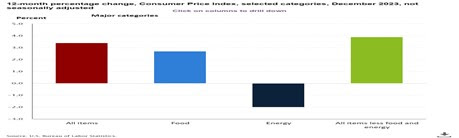
The above  official BLS graph explains the ingredients of CPI inflation best. The biggest inflation drop was energy (black bar), along with food (blue bar), though its Core index (green bar) was above the All Items index.

“In December, the Consumer Price Index for All Urban Consumers increased 0.3 percent, seasonally adjusted, and rose 3.4 percent over the last 12 months, not seasonally adjusted.”

What is the real cause of the inflationary surge? Most economists now say it was suddenly interrupted supply-chains caused by the pandemic that returned to normal, thus increasing the supply of things and services, not excessive demand because of suddenly wealthy consumer spending too much due to all the pandemic recovery aid.

Economics Professor James Galbraith, son of New Deal Economist John Kenneth Galbraith said, “There is a wave of reporting to the effect that the Fed deserves credit [for the drop in inflation]. But the fact is that the peak in rising prices occurred in June 2022, and that was only three months after the Fed started raising interest rates.”

Average hourly private sector wages are the main driver of demand-side inflation (via consumer spending) and they peaked in March 2022 at 5.9 percent. Average earnings had already dropped to 5.4 percent in June 2022, continuing their decline to 4.1 percent in December 2023.

So why do Fed Governors keep saying that the unemployment rate must rise to lower inflation? New York Federal Reserve President John Williams, one of the most influential Governors, was cited recently at a White Plains, NY speech per MarketWatch saying U.S. interest rates will likely need to stay high “for some time” until senior central bank officials are confident the rate of inflation is returning to 2 percent. He said the labor market would need to soften a bit more, potentially bumping up the unemployment rate to 4 percent from the current level of 3.7 percent.

We have had the unemployment rate below 4 percent for two years, current 6-month inflation is hovering at 2.5 percent and still declining, and consumers continue in record numbers to travel and enjoy leisure activities, I said recently.

Why spoil the party unnecessarily with another recession?

Harlan Green © 2024

Harlan Green on Twitter: https://twitter.com/HarlanGreen