Showing posts with label household incomes. Show all posts

Thursday, December 12, 2024

Was Inflation the Problem?

 Popular Economics Weekly

“The West Wing may believe Bidenomics is working because the macroeconomic gurus at the Federal Reserve are telling the White House it’s working. But Bidenomics has failed to create sufficient tangible improvement in the lives of most voters in a world in which groceries still cost more than they did a year ago, average rent and mortgage rates have spiked and health and child care grow ever more unaffordable. Mr. Biden cannot win in 2024 unless he speaks to the economy as it is, not as he wishes it was,”Karen Petrou, NYTimes.

The Consumer Price Index for All Urban Consumers (CPI-U) increased 0.3 percent on a seasonally adjusted basis in November, after rising 0.2 percent in each of the previous 4 months, the U.S. Bureau of Labor Statistics reported today. Over the last 12 months, the all items index increased 2.7 percent before seasonal adjustment.

As shown in the FRED cpi graph dating from 2000, the last inflation surge began in 2020 during the Biden administration and the COVID-19 pandemic. A majority of voters in the presidential election decided prices and inflation had been too high for too long, therefore President Biden was blamed for it.

But no, it was the pandemic’s sudden supply shortages that caused the surge, not Biden’s Bidenomics’ legislation that enabled the quickest recovery in the developed world. Yet it took 3.5 years for inflation to return to today’s 2.7 percent annual rate, still above the Fed’s 2 percent target goal.

There was another reason for the anger over such high and prolonged inflation. The incomes of half of U.S. households could not keep up with the inflation surge. Most of the increase in household income was achieved in the period from 1970 to 2000. In these three decades, the median income increased by 41%, to $70,800, at an annual average rate of 1.2%, says PEW Research.

The warning shot about the discontent of American workers was written in 2023 by Karen Petrou, a NYTimes guest columnist, in which she said that “ 64 percent of households live paycheck to paycheck from time to time, according to a March consumer survey. These families are barely making it through the week, let alone accumulating the wealth essential for financial resilience and, over time, financial security.’

Why such an increase in income inequality? A series of recessions (gray bars in the FRED graph) occurred during tempestuous times—the Gulf War, the various wars on terror in Iraq and Afghanistan, the Great Recession, and busted housing bubble.

The median household income in 2015 – $70,200 – was no higher than its level in 2000, marking a 15-year period of stagnation, an episode of unprecedented duration in the past five decades.

The unemployment rate rose from 4.2 percent to 5.7 percent during the shorter-lived 2001 recession (and 9/11 Twin-towers attack). It rose from 5 percent to 10 percent during the Great Recession that ended in 2009. And those in the lower ‘income brackets suffered the most financial damage, as is always the case.

And the reason for those recessions was in large part because “it is like a poker game where the chips have become concentrated in fewer and fewer hands,” again quoting Roosevelt’s Federal Reserve Chairman at the time.

Ms. Petrou concluded, “Listening to advisers — not voters — is a fatal campaign error, one that Hillary Clinton made in 2016. Mr. Biden only narrowly pulled out a win in 2020 because Mr. Trump wasn’t listening to voters when it came to Covid. Now they’re tuned in to Mr. Trump’s perspective on the economy because he is, in his way, listening to them.”

The irony is that it is just those Bidenomics’ programs that are funding factories in many of the red states that can help to ease the inequality that has affected so many working folk, and that is the source of most of the discontent.

Harlan Green © 2024

Follow Harlan Green on Twitter: https://twitter.com/HarlanGreen

Thursday, July 13, 2023

What Happened to Inflation?

 Popular Economics Weekly

FREDppifinaldemand

What happened to the inflation problem? The latest wholesale inflation data show the Fed has more than succeeded in its campaign to tame inflation.

The wholesale Producer Price Index (PPI) for final demand in wholesale goods and services barely grew at all (see the FRED graph above) in the Bureau of Labor Statistics latest release.

Wholesale prices rose just 0.1 percent in June, extending a string of weak readings that suggest inflation in the U.S. is likely to continue to decelerate. Over the past 12 months the PPI plunged to 0.1 percent from 1.1 percent in the prior month. That’s the lowest reading since September 2020.

This is while Americans are still fully employed. The Fed consensus had postulated at least a 5 percent unemployment rate would be needed to bring inflation down to their 2 percent target rate. And former Treasury Secretary Larry Summers infamously said unemployment could go as 7 percent with the loss of several million jobs to tame the inflation tiger.

It will only intensify the debate among economists whether there will be a ‘soft landing’, or whether there will be no landing at all—a ‘no landing’ scenario in which economic growth continues to be positive into next year, regardless of the predictions that higher interest rates must ultimately lead to a recession (i.e., negative growth).

In fact, wholesale inflation (mainly the cost of raw materials) is in danger of turning negative, which means retail prices could also fall. (This would be a danger sign if not for other factors, since falling prices are a deflationary trend if passed on to retail prices, which usually means a looming recession.)

But with the current 3.6 percent unemployment rate, and $trillions being invested in modernizing US infrastructure this decade, this is unlikely. Americans will be employed in better-paying jobs for years to come.

Even the so-called core prices the Fed loves to cite as a more stubborn indicator of inflation decelerated to 2.6 percent from 2.8 percent, marking the smallest increase since March 2021.

Why this sudden deceleration in inflation, after all the predictions that it will remain high and become embedded in consumers’ expectations?

Firstly, the supply-chain shortage has disappeared, and every country is racing to resupply themselves from the effects of the pandemic,

I earlier cited a Global Finance Magazine article that touted the increased capital spending everywhere today, not just in the US, since the pandemic:

“Despite concerns that economic growth may slow as central banks tap the brakes to combat inflation, companies around the globe are in a spending boom for capital such as factories and for things like digitalization and automation, 5G networks and the transition to clean energy.”

The other concern has been that wage increases might cause inflation expectations to become ‘embedded’ in prices for years to come.

FREDwagesandsalaries

Yet household incomes haven’t kept up with inflation since the 1970s, as portrayed in the FRED graph dating from 1950. They are now rising at just 1.2 percent quarterly, seasonally adjusted, in the face of full employment, according to the latest FRED data.

So now we have the means and opportunity to begin the process of renewing the American economy with governments spending again, and maybe avoiding any recession with a ‘no landing’ outcome.

Harlan Green © 2023

Follow Harlan Green on Twitter: https://twitter.com/HarlanGreen

Monday, June 12, 2023

Homeowners Have Record Equity

 The Mortgage Corner

Meredith Whitney, a noted real estate consultant recently interviewed on CNBC’s Squawk Box, said American homeowners have a record amount of equity in their homes. The average Loan-to-Value (LTV) of mortgages has dropped to 30 percent, which means they have 70 percent equity in their homes.

She asserted, therefore, there is little to no chance of another busted housing bubble as happened in 2007 that led to the Great Recession. Many economists see the real estate sector as a leading indicator of what may happen next to our economy. It could mean there is even less of a chance that a recession may occur this year if it is based on a collapse of real estate values as happened in 2007.

Corelogic

“The average U.S. homeowner now has more than $274,000 in equity — up significantly from $182,000 before the pandemic,” reports CoreLogic Chief Economist Selma Hepp. “Also, while homeowners in some areas of the country who bought a property last spring have no equity as a result of price losses, forecasted home price appreciation over the next year should help many borrowers regain some of that lost equity.”

The U.S. housing market is short more than 300,000 affordable homes for middle-income buyers, according to a new analysis from the National Association of Realtors® and Realtor.com®.

“Middle-income buyers face the largest shortage of homes among all income groups, making it even harder for them to build wealth through homeownership,” said Nadia Evangelou, NAR senior economist and director of real estate research. “A two-fold approach is needed to help with both low affordability and limited housing supply. It’s not just about increasing supply. We must boost the number of homes at the price range that most people can afford to buy.”

Households have another leg to stand on despite rising interest rates. The net worth of U.S. households rose by 2 percent in the first three months of the year to $148.8 trillion, putting it close to a record high and suggesting the economy might have enough fuel to keep growing or at least to avert a steep recession, according to the Federal Reserve’s flow of funds report.

INGeconomics

Most of the increase in net wealth in the first quarter was tied to a rebound in the stock market. The value of equities held by households jumped by $2.4 trillion. The ING graph shows the actual increase in the orange bars above the blue line pre-COVID trend.

Household debt increased at a 2.2 percent annual rate in the first quarter to $19.2 trillion, marking one of the smallest increases in the past decade. Debt had grown as fast as 8 percent as the U.S. emerged from the pandemic, said the Federal Reserve.

Meredith Whitney in another Barron’s interview, said reviving the housing sector from its current slump means finding housing for Gen Z’ers and the second half of millennials that don’t have money. How are they going to become homeowners?

The construction industry is trying to help. Calculated Risk’s Bill McBride reported recently that there are 1.675 million units under construction, just 35 thousand below the all-time record of 1.710 million set in October 2022.

Of these, there are currently 977 thousand multi-family units under construction.  This is the highest level since September 1973, and close to the record of 994 thousand in 1973 (being built for the baby-boom generation).

So builders and home seekers are seeing that the alternative to buying is renting and that has to make up the difference until more affordable housing is constructed.

Harlan Green © 2023

Follow Harlan Green on Twitter: https://twitter.com/HarlanGreen

Tuesday, November 23, 2021

Does America Care Again?

 Financial FAQs

PEW Research

The American Rescue Plan, The Infrastructure Investment and Jobs Act, and the soon to pass Build Back Better Plan show that the American ‘can do’ spirit is alive, the innate generosity and optimism that is so much a part of the American spirit is returning.

Will a revival of that spirit last, in spite of the ongoing pandemic, red vs. blue state civil war, and still record joblessness?

The truest expressions of Americans’ character have come out during past catastrophes, such as the Great Depression and World War Two. And almost 10 years of unparalleled growth followed the horrors of World War One and the 1918 Spanish Flu pandemic. 

The coronavirus pandemic is bringing about a similar transformation of character and culture that was always there but sometimes hidden when times were good.

And record economic growth is following the coronavirus pandemic, with Q1 and Q2 2021 GDP up more than 6 percent, and the fourth quarter possibly growing at the same pace after the third quarter pause due to the Delta variant surge.

Americans are showing that they care for each other with these bills—that lifting children and the poorest out of poverty also lifts themselves. That renewing our roads, bridges, energy grids; and confronting the greatest threat to our future, climate change, will ensure a country that our children can be proud of and prosper in.

It’s obvious that the American Rescue Plan saved many lives and livelihoods, and the Infrastructure bill means caring for the planet as well as each other with its $billions spent on climate change and improving health and sanitation.

It’s less obvious what spending on social infrastructure does. Investing in children, improved healthcare, and paid family leave strengthens families, something both political parties should be for, but conservatives have opposed since FDR’s New Deal.

Who will get most of the good jobs in construction from rebuilding our physical infrastructure? Some 80 percent go to less-then-college-educated workers, says the White House in its initial announcement of the Infrastructure Investment and Jobs Act.

In part because of the recovery money already distributed during the pandemic, median household income has resumed its climb for the first time since 2000, as shown in the above PEW research graph. It had dropped from $70,800 in 2000 to $65,100 after the Great Recession.

In 2018, the median income of U.S. households stood at $74,600. This was 49 percent higher than its level in 1970, when the median income was $50,200. (Incomes are expressed in 2018 dollars.)

The pandemic is bringing about a whole transformation of America that will last because it is bringing Americans together again in common cause, and history shows this brings out the best in us.

Harlan Green © 2021

Follow Harlan Green on Twitter: https://twitter.com/HarlanGreen

Wednesday, October 7, 2020

Do We Want Another Great Recession?

Financial FAQs


 MarketWatch

Federal Reserve Chair Jerome Powell has warned of “tragic’ economic risks if another coronavirus aid package isn’t passed by congress. This is while President Trump has just said that talks over additional aid will be suspended until after the election in order that the Senate has the time left to take up Judge Amy Barrett’s Supreme Court nomination.

“Over time, household insolvencies and business bankruptcies would rise, harming the productive capacity of the economy and holding back wage growth,” Powell said. “By contrast, the risks of overdoing it seem, for now, to be smaller.”

Employment of those in the bottom rung of the wage distribution scale remains 21 percent below its February level, while it was only 4 percent lower for workers who receive higher wages, the Fed chairman said.

It seems that Republicans have painted themselves into a corner if they expect to profit from an economy sure to get worse without another aid package before the election. Why are they writing off their chances on November 3rd with an economy sure to slow again? Your guess is as good as mine.

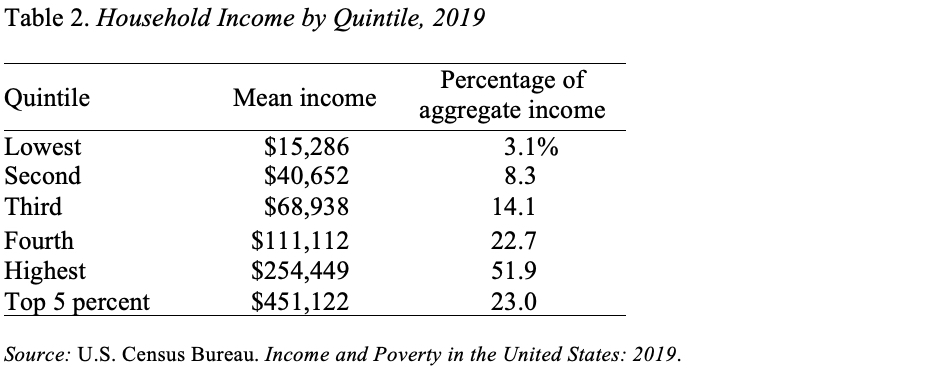
MarketWatch’s chart above highlights the problem. The top 10 percent of household income-earners now corral 51.9 percent of Americans’ aggregate income. That includes stocks as well as real estate and other investments by ‘rentiers’—those living off their assets, rather than the wages and salaries of most workers.

Out middle-income households now garner just 14.1 percent of household income, whereas it was closer to 20 percent in the 1960s and 1970s, before the cutting of taxes and deregulation of whole industries gave corporations the license to maximize their profits, rather than the welfare of their employees.

The predictions of future growth are dire without additional aid to households as well as certain industries his hardest by the pandemic shutdowns.

The NY Times Neil Irwin summarized best what is likely to happen without additional aid. “Business news headlines are reflecting a drumbeat of layoffs normally seen in recessions. In the last few weeks alone, oil giant Shell said it was cutting 9,000 positions, with Disney eliminating 28,000 and defense giant Raytheon 15,000.

“After shedding jobs in the spring, these sectors have brought workers back slowly, or not at all, through the summer. Some have continued cutting positions. Employment at corporate headquarters — “management of companies and enterprises,” in the official terminology — fell by 92,000 in March and April, with another 4,000 jobs lost since.”

He quotes Sophia Koropeckyj, an economist at Moody’s Analytics, who said we do expect there to be a new steady state, but not until 2023 or 2024,” In a new report, she estimates that 5 million people will find it difficult to get new work after the pandemic because their old jobs have disappeared or changed significantly. “I don’t think the severity of this downturn has been well understood yet given the bounce-back over the summer.”

Nobel-winning economist Paul Krugman has been saying what is obvious. Without additional government aid, we could sink into another Great Recession.

“The lesson I take is that our political dysfunction is even worse, our ability to rise to the occasion even lower, than I imagined. It’s hard to look at what’s happening now without feeling a sense of despair.”

Let us see what happens over the next few weeks. Few economists see good times ahead unless the 80 percent of households that earn wages and salaries; many are the essential workers that have a difficult time meeting even their living expenses; are given additional aid.

Harlan Green © 2020

Follow Harlan Green on Twitter: https://twitter.com/HarlanGreen


Wednesday, April 17, 2019

What’s Wrong With Capitalism—Part II?

Financial FAQs

Pete Buttigieg, Mayor of South Bend, Indiana and Presidential candidate, said to NBC’s Chuck Todd, “of course I’m a capitalist and America is a capitalist society, but it’s got to be democratic capitalism,” per the NYTimes’ Michael Tomasky.

But that hasn’t always been the case in America. Today we are approaching a very undemocratic form of capitalism—oligarchism, where a small percentage of Americans control most of the wealth and benefit from its laws—particularly since the end of the Great Recession.

Corporations and their stockholders have garnered 96 percent of the wealth generated since it ended in June 2009. Why? Because the busted housing bubble caused many in the middle class to either lose the equity in their homes, or their homes outright. The damage was so great that median household wealth has declined 30 percent since 2017, according to the Federal Reserve.


And taxes have been drastically cut that would fund public spending to restore some of that lost wealth—on badly deteriorated infrastructure, higher educational standards (US student test scores are now below that of other developed countries), research in new technologies, healthcare, and the environment.

These programs would help to restore some of the record income and wealth inequality that has resulted, and made America a world power in decline. A super majority of economists say public spending programs boost economic growth for the simple reason that it redistributes tax revenues where they will do the most good—to the 99 percent that have lost the most from the Great Recession.

Buttigieg has made some vague proposals to right the inequality that, after all, was the major cause of both the Great Depression and Great Recession. So why wouldn’t we want to bring back a democratic capitalism that works for all Americans?

But there is an even more important ingredient that nurtures democratic capitalism, besides public investments. It is healthy local community involvement in civic activities. Ball State, Indiana economist Michael J Hicks reports in an assessment of Mayor Pete’s accomplishments, a major component of his South Bend’s success has been local civic involvement in community organizations, such as their very active Rotary Club. “It was more like an interdisciplinary research colloquium, combined with an interfaith conference and millennial business forum,” said Hicks.

There are many studies that show positive results of what is a little known field of study—community development, also known as community organizing—that was first put into practice in the US in the 1930s with New Deal legislation as a way to counteract effects of the Great Depression that boosted the formation of labor unions.

The National Industrial Recovery Act (1933) provided for collective bargaining. The 1935 National Labor Relations Act (also known as the Wagner Act) required businesses to bargain in good faith with any union supported by a majority of its employees. 

The United Nations defines community development broadly as "a process where community members come together to take collective action and generate solutions to common problems."
One of its best-known practitioners was Saul Alinsky, based in Chicago, who is credited with originating the term community organizer during this time period. Alinsky wrote Reveille for Radicals, published in 1946, and Rules for Radicals, published in 1971. With these books, Alinsky was the first person in America to codify key strategies and aims of community organizing.
Wikipedia cites the International Association for Community Development (www.iacdglobal.org), the global network of community development practitioners and scholars, as "a practice-based profession and an academic discipline that promotes participative democracy, sustainable development, rights, economic opportunity, equality and social justice, through the organisation, education and empowerment of people within their communities, whether these be of locality, identity or interest, in urban and rural settings".
Community development has today taken on a new popularity, as communities torn apart by globalization and loss of manufacturing jobs, particularly in the rust belt, seek to rebuild themselves.
Sociologists like Robert Putnam, author of Bowling Alone, the Collapse and Revival of American Community, have been vocal in calling for a revival of local civic participation in the rebuilding of American communities.
He says in Bowling Alone, “Financial capital - the wherewithal for mass marketing - has steadily replaced social capital - that is, grassroots citizen networks - as the coin of the realm.”
Then the problem becomes how to restore the social capital of civic engagement into its rightful place in the community? It has to begin with putting public capital back into the public sector as was done with the New Deal, in order to restore democratic capitalism, a capitalism that can work for all Americans.

Harlan Green © 2019

Follow Harlan Green on Twitter: https://twitter.com/HarlanGreen

Tuesday, January 15, 2019

Is There Too Little Inflation?

Financial FAQs 

 
The Consumer Price Index for All Urban Consumers (CPI-U) declined 0.1 percent in December on a seasonally adjusted basis after being unchanged in November, the U.S. Bureau of Labor Statistics reported Friday. Over the last 12 months, the all items index increased 1.9 percent before seasonal adjustment.

The major reason has been falling gas prices. Energy fell 3.5 percent in December as gasoline prices dropped for a second straight month, down 7.5 percent. Transportation costs in general slipped as airfares continued their decline, down 1.5 percent on the month following a 2.4 percent drop in November, according to Econoday.

It’s also why we have abnormally low interest rates at this late stage of the recovery, which actually mirror the amount of excess savings. No matter how much individuals and businesses have borrowed since the Great Recession, interest rates have stayed low. It’s as if there’s a bottomless supply of liquidity that holders of said currencies—including most of the world’s central banks—are eager to put to work in some way.

This could also be a worrisome indicator of what economists call slack demand. Consumers and businesses are spending less and saving more, in spite of the U.S. economy being fully employed with a 3.9 percent unemployment rate. The overall demand for goods and services has fallen from historical levels since the Great Recession as consumers and businesses have become more cautious than in other recoveries, when consumer economic activity now determines some 70 percent of economic growth.

This is while household incomes have barely kept up with inflation for decades from the progressive weakening of employee bargaining rights since the 1980s, and may only now be increasing with the fully-employment economy.


Former Fed Chair Janet Yellen has entered the discussion with her prediction that the U.S. is stuck in a low-inflationary environment. “All evidence suggests we’re going to be in an environment of low interest rates for a long time,” she said at a recent tech conference.

Such slack overall demand could also be a problem because the Trump trade wars are pushing up the cost of materials. This is hurting U.S. sales overseas, because U.S. export firms have had to raise their prices due to the rising costs of imported materials, such as aluminum and steel that have 10 and 25 percent tariffs, respectively.

Low inflation is therefore a two-edged sword in many ways. Lower inflation means products are more affordable to larger segments of the population, but it is also a sign that without rising prices producers cannot boost profits, hindering their growth prospects.

All-in-all, such stubbornly low inflation can also mean lower prospects for future job and income growth, hence lower overall economic growth, as well.

Harlan Green © 2019

 Follow Harlan Green on Twitter: https://twitter.com/HarlanGreen

Thursday, September 13, 2018

Does Lower Inflation Mean a Goldilocks Economy?

Popular Economics Weekly


Consumers are being helped by consumer prices that are barely rising. The Consumer Price Index is up just 2.7 percent, and core CPI without food and energy prices up 2.2 percent in 12 months. This has kept interest rates at historic lows since the Great Recession and is the reason for an economy that is neither too hot nor too cold.

Just how long it will last is an enduring question for economists. One infallible feature of an incoming recession is sharply rising interest rates. But historically low interest rates over an extended period can also mean most consumers aren’t earning enough to boost their buying power, which in turn ‘powers’ higher prices and inflation—a sign of intractable income inequality.

The Great Recession was largely caused by Alan Greenspan’s Fed raising interest rates 16 consecutive times—a total of 4 percent—that caused all the ‘liar’ loans with negative amortization and no real income or asset verification to become unaffordable to lower-income borrowers and homeowners.

That isn’t the case today—yet. The wealthiest 10 percent—what is basically left of the middle class that has profited since the Great Recession—has a very high savings rate. But not the ‘other’ 90 percent, so that average annual incomes are rising at 2.7 percent; also the consumer inflation rate today.

Households carried a record $13.3 trillion in debt at the end of June, Federal Reserve records show. That tops the prior peak of $12.7 trillion in 2008 during the middle of the Great Recession. High debt levels, especially in mortgages, contributed to the 2008 financial panic and the severity of the recession, as I said.

But low interest rates and inflation are keeping delinquencies very low at the moment, and lending standards remain quite stringent in the post-crisis era, according to a recent Moody’s study reported by MarketWatch. As such, there’s less danger of another housing market collapse.


That is the catch. Interest rates and inflation must remain very low for delinquencies to remain ‘very low’, and that won’t last much longer with wage pressures growing, fewer workers available for hire, and the Federal Reserve saying it will continue to raise short-term rates.

Business confidence is soaring as well, thanks to the economic ‘porridge’ being neither too hot nor too cold. The NFIB Small Business Optimism Index soared to 108.8 in August, a new record in the survey’s 45-year history, topping the July 1983 high-water mark of 108. The record-breaking figure is driven by small business owners executing on the plans they’ve put in place due to dramatic changes in the nation’s economic policy.
And small businesses create most of the jobs. “Today’s groundbreaking numbers are demonstrative of what I’m hearing every day from small business owners – that business is booming. As the tax and regulatory landscape changed, so did small business expectations and plans,” said NFIB President and CEO Juanita D. Duggan. “We’re now seeing the tangible results of those plans as small businesses report historically high, some record breaking, levels of increased sales, investment, earnings, and hiring.”
So how long can such goldilocks growth last? It is the ideal condition economic planners work for, but lasts only very briefly until debt levels rise to unsustainable levels, given the inherent fluctuations and dynamism in any economy. Vigilance in looking for signs of higher interest rates and slower growth is therefore a major requirement to stay ahead of those fluctuations.

Harlan Green © 2018

Follow Harlan Green on Twitter: https://twitter.com/HarlanGreen
Sunday, August 26, 2018

Labor Productivity is the Golden Fleece

Financial FAQs


Rising labor productivity is the golden fleece of economic growth, the pot of gold at the end of the rainbow, because major economists maintain it is really the only way workers can raise their standard of living. This means raising incomes above the inflation rate, which is where average household incomes have been stuck since the end of the Great Recession.

The sheep’s fleece was an ancient Greek method of extracting gold from flowing streams.  The heavier gold flakes would stick to the fleece, hence the Greek myth of Jason bringing home the Golden Fleece came to signify the accumulation of wealth and power.

For that reason it’s good news that labor productivity seems finally to be recovering. Workers’ output rose at a very hot 4.8 percent rate in the second quarter, up from an already solid 2.6 percent rate in the first quarter. Hours worked rose at a 1.9 percent rate vs. the first quarter's 2.6 percent.

But we don’t see its benefits being passed on to wage and salary earners. Wages have stagnated and income inequality increased because workers’ productivity hadn’t risen substantially since 2010, as the graph shows; when benefits from ARRA, the $831 billion American Recovery and Reinvestment Act enacted during the first year of President Obama’s administration, petered out. It was much too inadequate to help restore states’ and consumers’ personal wealth from the worst recession since the Great Depression.
“Obama officials and Congress clearly made a big mistake early in the recession by focusing more intently on saving banks — and, thus, bankers and investors — and much less on directly helping families facing foreclosures and layoffs,” says a recent NY Times Op-ed. “Later in the recovery, the decision by Republican leaders in Congress to oppose every Obama proposal prevented the government from doing much to help people regain what they had lost or to heat up the tepid recovery with infrastructure spending and other stimulus measures.”
More government public sector aid was necessary, in other words, because the private sector was recovering from their losses and had little money to invest.
And “Government puts a lot of money into basic research, whereas businesses tend to fund late-stage development that can be quickly commercialized,” says MarketWatch’s Rex Nutting. “However, federal funding for research hasn’t kept pace with the growth in the economy; in the past 10 years, federal R&D investments have risen just 0.3 percent per year after adjusting for inflation.”

A major reason for the rise in productivity at the moment has to be that companies are investing more in new plants and equipment; in part because of the Republican tax cut in corporations’ nominal tax rate, but also because there is a huge deficit in skilled workers that has required businesses to invest more heavily in technologies that replace those missing workers. There are now about one million more job openings than jobs being created each month.

So workers aren't really benefiting from the productivity increase, as nominal compensation fell to a 2.0 percent rate from 3.7 percent in the first quarter, according to Econoday. When adjusting for inflation, real compensation rose 0.3 percent and was little changed from the first quarter's 0.2 percent rate.
Why?? Firstly, many more low-paying service sector jobs are being created than manufacturing jobs; which have been shipped overseas by corporations where wage and benefit costs are a fraction of Americans’. It is a major reason President Trump has initiated tariff increases in the hope foreign manufactures become less competitive in a bid to bring home some of those manufacturing jobs.

But that may or may not succeed, as a burgeoning trade war with higher tariffs would probably raise prices and inflation to a level that would nullify any benefits from more domestic jobs. Nobel economist Paul Krugman has said that it could eliminate 8 to 9 million jobs from companies that would shrink as a result of the increased tariffs, due to foreign businesses looking elsewhere for cheaper products not affected by the tariffs.

Increasing the national minimum wage from $7.25/hour last set in the 2009 would definitely help the lower wage sector, which Big Business has been resisting. Workers are producing more than ever, at present. But that doesn’t mean their standard of living will rise because of it, unless employers pass on more of the productivity increase to their employees

Harlan Green © 2018

Follow Harlan Green on Twitter: https://twitter.com/HarlanGreen

Thursday, July 26, 2018

Housing Market Slows

The Mortgage Corner

Existing-home sales decreased for the third straight month in June, as declines in the South and West exceeded sales gains in the Northeast and Midwest, reports the National Association of Realtors. The ongoing supply and demand imbalance helped push June’s median sales price to an existing-home new all-time high.
“Total existing-home sales, https://www.nar.realtor/existing-home-sales, said the NAR, “which are completed transactions that include single-family homes, townhomes, condominiums and co-ops, decreased 0.6 percent to a seasonally adjusted annual rate of 5.38 million in June from a downwardly revised 5.41 million in May. With last month’s decline, sales are now 2.2 percent below a year ago.

Pending home sales that measure future sales also decreased modestly in May and have fallen on an annualized basis for the fifth straight month, according to the NAR. This seems to show a slowing of demand for housing, though the Realtors' economist Yun believes it’s more due to lack of supply, and fewer entry-level homes available.

Lawrence Yun, NAR chief economist, said closings inched backwards in June and fell on an annual basis for the fourth straight month. “There continues to be a mismatch since the spring between the growing levels of homebuyer demand in most of the country in relation to the actual pace of home sales, which are declining,” he said.
“The root cause is without a doubt the severe housing shortage that is not releasing its grip on the nation’s housing market. What is for sale in most areas is going under contract very fast and in many cases, has multiple offers. This dynamic is keeping home price growth elevated, pricing out would-be buyers and ultimately slowing sales.”
Why do we still have a housing shortage 9 years after the Great Recession? For the first half of 2018, a steady job market and a shortage of existing homes for sale has bolstered housing starts, said the Commerce Department. New home construction has climbed 7.8 per cent year-to-date.

And homebuilders are also relatively confident that the expansion will continue. The National Association of Home Builders/Wells Fargo builder sentiment index declined slightly to a reading of 68 in June, but any reading above 50 signals growth.

So another ‘root cause’ has to be affordability, as prices continue to climb. The report was mixed good news, as prices continue to rise, up 4.5 percent for the median to $276,900, while buyers saw a 4.3 percent rise in the number of homes on the market, at 1.950 million relative to sales, a gain to 4.3 months from 4.1 months.


It was thought new-home sales would give a boost to housing, but even new- homes sales are slower in June. The Calculated Risk graph shows new-home sales lagging historically from other recoveries, when sales reached 800,000 units annually.
“Sales of new single-family houses in June 2018 were at a seasonally adjusted annual rate of 631,000, according to estimates released jointly today by the U.S. Census Bureau and the Department of Housing and Urban Development. This is 5.3 percent below the revised May rate of 666,000, but is 2.4 percent above the June 2017 estimate of 616,000."
The sales slowdown has to be from after-effects of the Great Recession, what was also the Great Housing Bust when so many homeowners lost their home and life-savings. It’s a combination of lenders being much more cautious and consumers earning much less these days. For instance, first-time buyers totaled just 31 percent of existing homebuyers, vs. the 40 percent long term average.

Household incomes have been stagnant since the 1980s after inflation, and both incomes and net worth have actually declined since the Great Recession, so we are seeing the results in the housing market, as the costs of home-building continue to climb with inflation.

For example, the just enacted Canadian lumber tariffs are adding $9,000 on average to building costs, according to the National Association of Home Builders. "Not only are consumers and builders concerned about the current lumber tariffs, but also the next round of proposed tariffs on a number of goods and services," said NAHB Chair Randy Noel.

In fact, there has not been a concerted effort to boost consumers’ incomes at all since the Great Recession. Rather, the effort has been to suppress wages, with more states restricting collective bargaining rights of both union and non-union employees. There are now 28 right-to-work states that restrict the amount of dues unions can collect, and even the Supreme Court has just rescinded a 40-year old precedent that allowed public employee unions to collect dues from non-union members that enjoy the same benefits.

Do we need any more reasons to understand the slowdown in home buying?

Harlan Green © 2018

Follow Harlan Green on Twitter: ttps://twitter.com/HarlanGreen

Thursday, August 17, 2017

Retail Sales Back, But Not Consumers

The Mortgage Corner

It turns out consumers decided to shop again in July, as retail sales surged in all categories. This includes online sales these days, as retailers adapt to the new reality that one large store size doesn’t fit all. But it may be a one-time surge, as wages are barely rising above inflation, while major brick and mortar stores are disappearing, and factory discount outlets thrive.

Nonstore retailers, vehicle dealers, building materials stores lead the report -- all major categories. Secondary readings are all strong: up 0.5 percent ex-autos, up 0.5 percent ex-autos ex-gas, and up 0.6 percent for the control group. Annual sales had risen above 5 percent in January, then declined until this month. So it’s hard to know if consumers in fact feel more prosperous.


Target, for instance, is opening more than 100 ‘small-store’ outlets near universities and colleges that was announced at their second quarter earnings call. Target Chief Executive Brian Cornell said the retailer would be nearly doubling the number of small-format stores it has this year, with the ultimate goal of having more than 100 open for business over a three-year period. The plan is to have 30 in 2017, said Chief Operating Officer John Mulligan, with nine opening in July and four opening in the first quarter.
“While we’ve only been open a few weeks, our July openers have been particularly strong out of the gate and as Brian highlighted, the guest response has been phenomenal,” Mulligan said on the Wednesday call, according to a FactSet transcript. “For the seven smallest format stores that have been open for more than a year, we’re continuing to see sales productivity more than double the company average and these stores have been delivering high-single-digit comp increases so far in 2017.”
We reported earlier that most households aren’t earning enough income to do more than pay their bills, such is the record income inequality. The monthly reading for this measure did finally show some life in the prior week's employment report with an unadjusted 0.3 percent gain, but it will take a continued run of strength to level out the 2-year trend line which remains in a deep downslope, said Econoday.

So we remain doubtful this retail surge can continue given all the actual brick and mortar stores closed or about to close. Brokerage firm Credit Suisse said in a research report released earlier this month that it's possible more than 8,600 brick-and-mortar stores will close their doors in 2017.

For comparison, the report says 2,056 stores closed down in 2016 and 5,077 were shuttered in 2015. The worst year on record is 2008, when 6,163 stores shut down, due to onset of the Great Recession.

Why? Is it only Amazon online shopping? No, because consumer incomes are barely rising, as I said, they look for discounts everywhere, and brick and mortar stores with their higher overhead, can’t cut prices as much, and can’t offer the variety that Amazon offers.

Now we hear that Amazon also wants to compete on the ground. What next? It will probably be more like an Apple store that samples its services and directs customers to its online warehouses, also springing up everywhere. Who can match that kind of cost-cutting when workers’ stagnant wages and salaries mean they will continue to discount shop for bargains.

Guess what is missing that would boost economic growth? Infrastructure spending, and now that Big Business has walked away from President Trump’s business councils, and Prez Trump is dissing Senate Republican leaders, good luck on getting anything done!

Harlan Green © 2017

Follow Harlan Green on Twitter: https://twitter.com/HarlanGreen

Monday, September 19, 2016

Popular Economics Weekly

Janet Yellen’s Fed meets again this midweek to decide whether to raise short term rates. It probably won’t happen, because they can’t decide if the US economy is ‘half-full’—i.e., still growing enough to boost inflation—or ‘half empty’, which means the economy is barely growing.

A terrific New York Times conversation between two extraordinary women, Senator Elizabeth Warren and Tracee Ellis Ross, actress and daughter of Diana Ross, brought out what is at stake in this election between the Haves and Have-nots, and best describes the current political debate.
“Go listen to those guys on the floor of the Senate talking about people who are losing their homes,” said Senator Warren, “describing them like you’d talk about furniture that should be tossed out. It’s a “they” that’s so far away.”
“But it’s not just in politics, it’s everywhere,” said Ms. Ross. “This “otherness” that’s all of a sudden part of our culture. People grabbing to what’s theirs out of fear it might be taken away.”
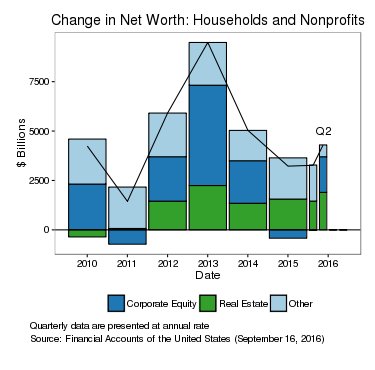
Yet The Federal Reserve has said most recently household net worth rose to $89.06 trillion in the second quarter, a rise of $1.07 trillion, or 1.2 percent to a record level as a percentage of Gross Domestic Product. The gains were almost equally split between the $452 billion rise in equities and the $474 billion advance in the value of real estate. So even middle-class homeowners are benefiting from the current recovery.


The fear mongers, such as Donald Trump, would have us believe the economic pie is fixed, a zero-sum game, in Senator Warren’s words, in which the wealthiest hoard their wealth in order to spend it on themselves, for themselves. (But) “That was not America. We were building an America that said, “If we educate all our kids, we”ll actually make more (of everything),” says Warren.

New data showing middle-class household incomes growing at the fastest rate since the recession seemed to confirm that a recovery that’s remained slow and uneven is finally touching the lives of ordinary, especially middle-class Americans. So there is more of the ‘pie’ being created, not the zero-sum that Trumpeteers would have us believe.


It is also why so many seem to believe Trump’s blame-game, which wants to “blame the immigrants, blame women, blame people who have different religious beliefs than you, blame people who aren’t the same color as you,” says Warren. “Because if everyone turns on each other—then the same old system that keeps billionaires on top stays right where it is.”

In fact, this explains the almost eternal struggle between the Haves and Have-nots, as well. Capitalism, the system that Adam Smith described best in his 1776 book, The Wealth of Nations, created today’s wealth by ‘paying it forward,’ by investing part of the profits in future growth.

And that is the real game of those Haves that support Trump and all his ugliness. They want to propagate the “same-old system”, the system that must build walls to make American great again.

Harlan Green © 2016

Follow Harlan Green on Twitter: https://twitter.com/HarlanGreen