Showing posts with label immigration visas. Show all posts

Thursday, January 13, 2022

A Softer Landing For Inflation?

 Popular Economics Weekly

FREDcpi

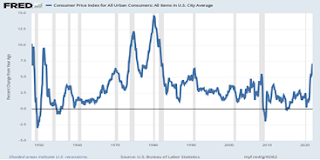
Will inflation keep rising, squeezing consumers, or return to a more normal range this year? The Consumer Price Index (CPI) that measures retail goods and services rose to 7.1 percent in December and has forced the Fed to promise to raise interest rates several times to ‘tame’ a rising inflation rate that seems to worry the pundits and bankers more than most consumers.

That’s because once the Fed starts taking money out of circulation by selling the $4 trillion plus in securities it’s holding, the money supply should shrink and thus take away the punch bowl of easy money that has prevailed during the pandemic and pushed the financial markets to record highs.

So, the debate du jour is can the Fed take away the punchbowl without sinking the economy into another recession? There’s a lot of money in circulation, thanks to all the pandemic aid, but what happens when it’s withdrawn? The hope is for what is called a ‘soft landing’, a slowing of economic activity that doesn’t morph into an economic slump.

It would be nice if inflation could tame itself without too much government intervention. Inflation could moderate this year because consumers annually cut back on spending after the holidays to pay down their credit cards and save for the income tax season.

But even so, the Fed must act to look like it’s on the ball by making noises that it’s ready to raise the price of borrowed money by acting preemptively. That is supposed to lower inflation expectations and thus dis-incentivize consumers and businesses from rushing to buy before the next price rise.

Do such expectations of future inflation really affect consumers’ behavior? That’s still an open question among economists.

And the answer is much more complicated today because this inflation is caused by a serious shortage—of goods, services, and employees to manufacture and distribute them.

So all of this is in turn dependent on the course of the ongoing COVID-19 pandemic that is keeping workers away from work, and causing the supply chain bottlenecks.

As a side note, a recent study by two UC Davis Labor economists in Econofact.org — Labor Shortages and the Immigration Shortfall, posits that part of the labor shortage is due to a shortfall in immigrants over the past two years—some 2 million working age adults—due to restrictions placed on immigration from the pandemic.

And approximately 1 million are college-educated, which could impact productivity and employment over the longer term.

They cite other causes for the labor shortage, such as increased retirement and increased bargaining power of workers as playing an important role.

The authors also contend, “While more generous unemployment and welfare benefits introduced during the crisis may have discouraged workers from taking low-paying jobs in 2020 and early 2021, they do not seem to be the cause of current shortages, since most of those benefits expired by mid-2021. Recent anecdotal and preliminary evidence finds a push by workers for more job-flexibility, safety and, generally, better conditions causing resignations and contributing to unfilled job openings.”

So the labor shortage could last for years, unless Washington and Congress get their immigration act together. Immigration has historically been a major source of U.S. population and job growth.

In fact, we shouldn’t forget that we are a nation of immigrants that has always been dependent on immigrants, and the effect of the immigration shortfall is much more worrisome than inflation because studies show they bring a high level of skills that are good for economic growth.

So even speeding up approval of a backlog of 460,000 entry visas cited by the State Department as still unprocessed could make this a softer landing.

Harlan Green © 2022

Follow Harlan Green on Twitter: https://twitter.com/HarlanGreen

Wednesday, January 9, 2019

America’s Immigration Problem

Popular Economics Weekly


The Calculated Risk graph says it best in the Labor Department’s latest Job Openings and Labor Turnover Survey (JOLTS). There are still about one million more job openings (yellow line) than hires (deep blue line). There have been more openings than hires since January 2015, according to Calculated Risk.

This tells us several things about the U.S. economy. Firstly, America has a skilled labor shortage because technological innovation exceeds the existing labor force—in fact throughout its history.

America is still a young country in many ways, and our birthrate is declining. This is in contrast to older developed and developing countries in Europe and Asia that have had existing labor surpluses before the various technological revolutions.

Secondly, it is why we so badly need new immigrants to fill those vacancies. Therefore restricting immigration is counter-productive in so many ways. It restricts the growth of our labor force, which directly affects economic growth, and denies America’s history as the land of opportunity. America was founded by immigrants, and it is immigrants that contribute new ideas as well as new blood to our creative mix.

Lastly, the huge gap between job hires and openings tells us there shouldn’t be a fear of recession, or even a significant slowdown, for maybe years to come. Why? Job openings continue to far exceed the six million looking for work, according to the (BLS).

The number of job openings fell to 6.9 million on the last business day of November, the U.S. Bureau of Labor Statistics (BLS) reported today. Over the month, hires edged down to 5.7 million, quits edged down to 3.4 million, and total separations were little changed at 5.5 million. Within separations, the quits rate and the layoffs and discharges rate were unchanged at 2.3 percent and 1.2 percent, respectively. This release includes estimates of the number and rate of job openings, hires, and separations for the nonfarm sector by industry and by four geographic regions.

The BLS said large numbers of hires and separations occur every month throughout the business cycle. When the number of hires exceeds the number of separations, employment rises, even if the hires level is steady or declining. Conversely, when the number of hires is less than the number of separations, employment declines, even if the hires level is steady or rising.

And over the 12 months ending in November, hires totaled 68.0 million and separations totaled 65.6 million, yielding a net annual employment gain of 2.4 million. (These totals include workers who may have been hired and separated more than once during the year.)

So U.S. economic growth should continue to perk along, even if it slows to the historical rate of 2 percent that has prevailed since the end of the Great Recession. It may never climb above that rate without more workers joining the workforce, and there is more public sector investment. We know what those investments should be—infrastructure modernization, improving educational opportunities, combating global warming, etc.—that would give a big boost to labor productivity as well.

The ideal would be to spend more in public investments, but if congress can’t agree on more spending, either American households increase their number of offspring (which is highly unlikely) and/or we reverse the current administration’s anti-immigration policies.

Harlan Green © 2019

Follow Harlan Green on Twitter: https://twitter.com/HarlanGreen

Thursday, October 11, 2018

What Is ‘New Normal’ U.S. Growth?

Popular Economics Weekly


There is a current debate whether the U.S. will escape the ‘new normal’ of slower economic growth since the Great Recession, when American households lost a collective $9 trillion in value and consumers cut back on their spending to make up for the losses.

It is part of the debate among economists whether the U.S. and other so-called ‘mature’ economies are locked into what is called secular stagnation, an era where markets can no longer expand enough to boost economic growth that benefits all segments of the population.

The answer, alas, is slower growth in the U.S. for the foreseeable future, unless the 80 percent of wage-earning consumers find a way to bring back their lost incomes that have barely kept up with inflation since the 1970s, or governments find a way to raise enough taxes to make up for the shortfall in household incomes by funding more public sector benefits, such as increasing the social safety net and public investments in education, infrastructure, and basic research that increase future productivity.

Why have workers’ wages and household incomes remained stagnant for so long? There has been a sharp shift of incomes and wealth away from the working classes to rentiers, or the owners of capital and their managers.

There was a sharp decline in labor productivity since 2007, for the same reason. Along with the Great Recession, businesses invested even more of their profits to enhance their own stock prices (and CEO salaries), rather than in new equipment and factories that would expand labor’s productivity, which is the preferred way to boost workers’ standard of living.

Economists also postulate that economic growth is the sum of the growth rates of labor productivity and population—the working-age population, in particular. The working-age population began its decline as baby boomers began to retire in 2001, and another six million of those workers have elected not to return to work since the Great Recession.

Graph: Seeking Alpha

The above graph illustrates that equation. When the worker population increased—particularly when women and baby boomers entered the workforce from the 1970s onward—the U.S. had 3 percent plus economic growth. But in 2001 the boomers began to retire and we have the current worker shortage.


Real vs. Potential GDP charts as above show the departure from what would be its potential—when GDP growth averaged 3.25 percent, historically. Consumer spending makes up roughly two-thirds of aggregate demand, which is the economic term for total dollars spent for goods and services that make up U.S. Gross Domestic Product. When its other elements—net exports, capital investments, and government expenditures—also decline, we have slower growth, which has been the case since 2007.

Today we have an even worse labor problem—the current White House wants to cut back immigration quotas by 50 percent and deport as many undocumented workers, as possible—including Dreamer children who have grown up in the U.S.—when only immigrants and their offspring will provide enough working age adults to make up for the loss of the baby boomer workforce.

Harlan Green © 2018

Follow Harlan Green on Twitter: https://twitter.com/HarlanGreen

Wednesday, October 3, 2018

America's Concentration Camps for Children

ANSWERING THE KENNEDYS CALL 


There should no longer be any doubt that the Trump administration is pursuing policies last used in Nazi Germany—concentration camps that now house up to 13,000 young Hispanic refugees—mostly unaccompanied minors who are seeking asylum in America.

To deal with the surging shelter populations, which have hovered near 90 percent of capacity since May, according to the New York Times, mass reshuffling is underway and shows no signs of slowing. Hundreds of children are being shipped from shelters to Tornillo in West Texas each week—mostly in the middle of the night to escape publicity--totaling more than 1,600 so far.
“Roughly 100 shelters that have, until now, been the main location for housing detained migrant children are licensed and monitored by state child welfare authorities, who impose requirements on safety and education as well as staff hiring and training,” said the NYTimes.
“The tent city in Tornillo, on the other hand, is unregulated, except for guidelines created by the Department of Health and Human Services. For example, schooling is not required there, as it is in regular migrant children shelters.
“The number of detained migrant children has spiked even though monthly border crossings have remained relatively unchanged, in part because harsh rhetoric and policies introduced by the Trump administration have made it harder to place children with sponsors.”
Does the Trump administration have no shame? What made America great is the fact that we are a land of immigrants, yet President Trump and his white-nationalist supporters want to restrict immigration to 50 percent of what it was historically—“to more like those from Norway,” he has said.
“Traditionally, most sponsors have been undocumented immigrants themselves, and have feared jeopardizing their own ability to remain in the country by stepping forward to claim a child. The risk increased in June, when federal authorities announced that potential sponsors and other adult members of their households would have to submit fingerprints, and that the data would be shared with immigration authorities.”
There is a reason America and Americans have always welcomed immigrants. America has been a nation whose innovation and new industries have outdistanced its labor workforce, historically, hence been always been in need of a new influx of workers.

For most of the past half-century, baby boomers — those born after World War Two and before 1965 — have been the main driver of the nation’s expanding workforce, but now that they’re heading into retirement only two groups of workers are projected to grow over the next two decades: immigrants and those whose parents are first-generation immigrants, a new report by the Pew Research Center, a nonprofit think tank in Washington, D.C., concluded. “The most important component of the growth in the working-age population over the next two decades will be the arrival of future immigrants,” it said.


Which is why it is so important to find a path to citizenship for the 11 million undocumented workers that fulfill jobs very few America citizens will take. And there have been several bills to give a path to those undocumented workers employed in agriculture, construction, and the hospitality industries. But, alas, congress has not been able to pass any of them.

Roughly 36 percent of plasterers and stucco masons were undocumented workers in 2014, the highest share of any occupation, according to a report released recently by the Pew Center. Some 30 percent of miscellaneous agricultural workers, 31 percent of drywall and ceiling tile installers and 28 percent of graders and sorters of agricultural products and 23 percent of sewing machine operators were also undocumented. Also 12 percent of miscellaneous personal appearance workers — manicurists and pedicurists and makeup artists — were undocumented.

Chart: PEW

More than 43.7 million immigrants resided in the United States in 2016, accounting for 13.5 percent of the total U.S. population of 323.1 million, according to American Community Survey (ACS) data.
And a recent CNBC report mentioned America’s chronic labor shortages, as the ongoing recovery from the Great Recession is now highlighting. “A report Thursday from ADP and Moody’s Analytics cast an even sharper light on what is becoming one of the most important economic stories of 2018: the difficulty employers are having in finding qualified employees to fill a record 6.7 million job openings,” said CNBC.

But chronic labor shortages have always been the case, and are part of our history. Trump’s, racist, anti-immigration policies are only making matters worse, not to speak of what can only be called his de-facto ethnic cleansing of non-Eurocentric populations.

Harlan Green © 2018

Follow Harlan Green on Twitter: https://twitter.com/HarlanGreen

Monday, January 22, 2018

Shutdown vs. “S***hole” Countries

Popular Economics Weekly

The just ended government shutdown has little to do with 9 million children’s health insurance under the CHIP plan, or extending the Dreamers protection under DACA. It really has to do with President Trump’s insistence on shutting down immigration from non-white countries, as was evident from Trump’s “S***hole” comments that he wanted to limit immigration from African and other non-white countries.

What is so shocking about Trump’s comments is they repeat those of one who he claims not to admire. Adolf Hitler in 1928 openly admired America’s racist policies of that time that excluded non-whites and Jews from immigrating to the U.S.:
“The American Union feels itself to be a Nordic-German state and by no means an international porridge of peoples. This is revealed by its immigration quotas ... Scandinavians … then Englishmen and finally Germans have been accorded the largest contingent,” said Hitler even before the Nazi’s took power.
Specifically, Hitler admired the US Immigration Act of 1924 – also known as the Johnson-Reed Act – “which had erected openly racist barriers to immigration on the basis of a “national quota” system,” according to Yale Law Professor James Whitman.
“It was not until the 1965 US Immigration and Nationality Act that the US began to separate itself from the worst aspects of its racist past. And, as Trump’s presidency makes clear, that past has yet to be permanently overcome,” said Professor Whitman in a Project Syndicate article.
There is a reason why US immigration laws became more open. The US has always suffered from a labor shortage, so that it has been newly arrived immigrants that have filled the labor deficiency.


PEW Research states that More than 41 million immigrants lived in the U.S. as of 2013, more than four times as many as was the case in 1960 and 1970. By comparison, the U.S.-born population is only about 1.6 times the size it was in 1960. Immigrant population growth alone has accounted for 29 percent of U.S. population growth since 2000.

That is the most glaring sign that new workers are needed to maintain economic growth. US population growth cannot keep up with our demand for new workers. There is no other way to fill the 6 million job openings reported each month in the Labor Department’s JOLTS report.

Debate on the current House bill that doesn’t include an extension of the Dreamers’ protections was continued for 3 weeks, in the hopes that a bi-partisan bill keeping open the door for immigrants from what President Trump considers to be “S***hole”, non-white countries will be passed.

So this is important for economic reasons; as well as recognizing that America has always been a land of immigrants; that we keep a flow of qualified immigrants and their families coming from countries that can provide the workforce America has always needed to grow and prosper.

Harlan Green © 2018


Follow Harlan Green on Twitter: https://twitter.com/HarlanGreen

Wednesday, January 17, 2018

Immigration and Trump’s “S***Hole” Comment

Popular Economics Weekly

How should we remember Martin Luther King, Jr. on his holiday? That greater equality creates greater prosperity for all; as well as greater peace.

President Trump’s S***Hole comments were meant as a signal to his neo-nazi supporters that he wanted to exclude as many non-whites from immigrating to America as he could, and encourage more from European countries like Norway.

This means he isn’t interested in stronger economic growth over the longer term, since much of the economic growth today can be attributed to non-whites and women, according to an excellent column by the Conversable Economist, Tim Taylor, commemorating MLK Jr.’s holiday.


Non-whites and women have been contributing a larger share to our economic growth than White men since at least 1960 in high-skill occupations. Before then, many labored in the lower-skilled, unnoticed occupations that weren’t always included in growth statistics.

Professor Taylor quotes a policy brief from the Stanford Institute for Economic Policy Research cited by Peter Klenow. The percentage of White men in the high-skilled occupations of Doctors, Lawyers and Managers, “defined as lawyers, doctors, engineers, scientists, architects, mathematicians, executives/managers,” has fallen substantially, while that of Black men, White and Black women has soared. The number of White women entering these professions has tripled, Black men quadrupled, and Black women grown eight times from 1960 to 2008.

The result? Klenow estimates that economic growth increased by 15-20 percent due to these minorities entering the higher-skilled occupation, just from the fact that their numbers increased as a share of the overall profession, while the percentage of White men has fallen by approximately one-third.


It also highlights another important fact. Economic growth depends on population growth plus labor productivity. And annual labor productivity has declined approximately 50 percent since 2007, as has U.S. population growth. So the only way to boost economic growth from its current 2 percent range is to increase the working age population via immigration.

The lesson therefore is that we need greater diversity in our workforce, not less as President Trump and his racist supporters want, since our birth rates are declining; a valuable lesson to remember on Martin Luther King, Jr. Day.

Harlan Green © 2018

Follow Harlan Green on Twitter: https://twitter.com/HarlanGreen

Thursday, March 9, 2017

U.S. Will Badly Need Immigrants

Popular Economics Weekly

For most of the past half-century, adults in the U.S. Baby Boom generation – those born after World War II and before 1965 – have been the main driver of the nation’s expanding workforce, reports the PEW Research Center. But as this large generation heads into retirement, the increase in the potential labor force will slow markedly, and immigrants will play the primary role in the future growth of the working-age population (though they will remain a minority of it).


The stakes are enormous if Republicans succeed in removing most of the estimated 11 million undocumented worker (only half of which are from Mexico and the Latin countries), and cut legal immigration in half, as they have promised to do. Economic growth will plummet, since it is mainly based on growth of the working age population, as well as labor productivity, which has also fallen since 2000.
 

The causes of the drop in labor productivity are largely because of the fall in capex spending, the investment in new plants and equipment, which has fallen by half since 2010, in large part because of the Great Recession, but also because corporations have chosen to move so many jobs overseas where labor is cheaper, rather than investing domestically to improve the productivity of American workers.
 
Graph: Econoday

The plunge in capex has been most noticeable last year, perhaps because of uncertainty over economic growth in what is the 7th year of this long growth cycle, or uncertainty about results of the President election. Such expectations can be self-reinforcing in these anecdotal surveys, of course, given the poor 1.9 percent GDP growth in 2016.

The ISM manufacturing survey, which tracks anecdotal assessments from a national sample of purchasers, made big headlines in the week with a 4.7 point jump in its new orders index to 65.1. This level of order growth was last exceeded in August 2009 and follows two prior 60 readings.

The number of adults in the prime working ages of 25 to 64 – 173.2 million in 2015 – will rise to 183.2 million in 2035, according to Pew Research Center projections. That total growth of 10 million over two decades will be lower than the total in any single decade since the Baby Boomers began pouring into the workforce in the 1960s. The growth rate of working-age adults will also be markedly reduced, says the study.

So the Trump administration has to be careful of what they wish for, if they want to boost economic growth domestically.

Harlan Green © 2017

Follow Harlan Green on Twitter: https://twitter.com/HarlanGreen

Saturday, February 4, 2017

Homeland Security Rescinds Muslim Travel Ban


Popular Economics Weekly

It is a well-known fact that the US has had a history of labor shortages, dating from the Revolutionary War. Colonial America was defined by a severe labor shortage that employed forms of unfree labor such as slavery and indentured servitude and by a British policy of benign neglect (salutary neglect). Over half of all European immigrants to Colonial America arrived as indentured servants, says Wikipedia.

Then why would the Trump administration enact an immigration ban on seven primarily Moslem countries, when we need all the immigrants we can import to fill the 5.5 million job openings that remain unfilled, as well as find the workers for his promised $1 trillion in infrastructure projects?

Hence the need and tradition of immigrants adding new blood and man (and women) power to our workforce. The colonies were also characterized by religious diversity, with many Congregationalists in New England, German and Dutch Reformed in the Middle Colonies, Catholics in Maryland, and Scots-Irish Presbyterians on the frontier. Sephardic Jews were among early settlers in cities of New England and the South. Many immigrants arrived as religious refugees: French Huguenots settled in New York, Virginia and the Carolinas. Many royal officials and merchants were Anglicans.

They need to come from all religions, in other words, particularly Islam, which is the third most populous religion with 1.6 billion practitioners

So when will the Trump team get that message, especially after contempt citations are already being filed as he defies the latest court injunctions against his temporary travel ban?
At least one contempt of court citation has been filed against President Donald Trump and another is likely to be submitted on Friday, charging that the administration has defied court orders by denying entry to the United States by an untold number of immigrants from seven predominantly Muslim countries.

The Commonwealth of Virginia filed its contempt motion late Wednesday night in Alexandria federal court. Meanwhile, an attorney who is trying to assist more than 200 Yemenis in gaining entry into this country said Thursday that her office will file a contempt motion of its own on Friday in U.S. District Court in Los Angeles.

“The Trump administration is acting as if he is running a dictatorship,” attorney Julie Ann Goldberg said in a telephone interview from Djibouti, where her clients are being held in transit. “It’s as if he has forgotten there are three branches of government in this country and has totally disregarded any judicial order. He is ignoring them across the country.”
 Judges in Brooklyn, Boston, Alexandria, Va., and Seattle, as well as two more in Los Angeles have issued orders to stop the government from carrying out the executive order Trump signed last Friday that suspended for 90 days the issuance of visas to people from seven countries deemed by the U.S. government to present a terrorist threat. They are Syria, Libya, Sudan, Iran, Somalia, Iraq and Yemen. The president’s executive order also suspended refugee admissions from all countries for 120 days.

Federal officials have issued statements saying that they are taking steps to “immediately” comply with the court orders. As of Thursday, the government had recommended denials of boardings to 1,136 immigrants with visas or other documents who sought entry into the United States, while they had granted waivers to 87 immigrants. Restrictions appear to have been lifted nationwide on lawful permanent residents of the United States, some of whom had difficulty gaining entry into the country in the earliest stages of the order’s rollout.

And now we have the revelation that more than 100,000 entry visas were revoked in the middle of the night, without notifying the courts or agencies that are involved. But because a Washington State Federal Judge has granted a nationwide injunction to lift the travel ban, the Department of Homeland Security has just announced it has suspended all actions to implement the immigration order and will resume standard inspections of travelers as it did prior to the signing of the travel ban.

And now a State Department official tells CNN the department has reversed the cancellation of visas that were provisionally revoked following the President's executive order last week -- so long as those visas were not stamped or marked as canceled.

Harlan Green © 2017

Follow Harlan Green on Twitter: https://twitter.com/HarlanGreen