Showing posts with label capex spending. Show all posts

Friday, July 7, 2023

Americans Still Fully Employed

 Popular Economics Weekly

MarketWatch.com

Hiring has been slowing in some business sectors, but government, education & health, and construction sectors kept the BLS unemployment rate at a historic low of 3.6 percent per the MarketWatch graph.

American governments and construction are hiring because the Infrastructure, Inflation Reduction and CHIPS Acts are modernizing the US economy for the first time in more than 70 years.

This is what should happen when the private sector hasn’t been investing in the future. So-called Capex, or capital expenditures, have been low for years, and now with raising interest rates they will invest more when governments come along.

It happened during the 1930’s New Deal and after World War II, before government retreated to mainly support Social Security and Medicare, as well as the mortgage industry to create the post-war housing boom.

FREDcapex

Reaganomics and the conservatives’ “deficits don’t matter” crowd took over in the 1980s with massive tax cuts as well as spending cuts in favor of stock buybacks and enriching corporate CEOS.

Capex spending (funds used by a company to acquire, upgrade, and maintain physical assets such as property, plants, buildings, technology, or equipment) plunged to almost zero (0.8 percent) in Q1 2023 per the St Louis FRED graph, which shows the sharp plunge in capital expenditures after 1980. And no country can take care of its citizens if most of its private capital goes to boosting stock buybacks and corporate profits.

Global Finance Magazine touted the increased capital spending everywhere today, not just in the US, since the pandemic:

“Despite concerns that economic growth may slow as central banks tap the brakes to combat inflation, companies around the globe are in a spending boom for capital such as factories and for things like digitalization and automation, 5G networks and the transition to clean energy.”

And this spending should continue for the rest of this decade, given the $Trillions allotted to American industry to do the job, and a fully employed economy. Even the government’s latest JOLTS report (Job Openings and Labor Turnover Survey) out last Thursday showed almost 10 million job vacancies waiting to be filled.

Harlan Green © 2023

Follow Harlan Green on Twitter: https://twitter.com/HarlanGreen

Wednesday, October 12, 2022

Too Much Disinflation Is Bad Planning

 Financial FAQs

FREDcapex

The rumblings of an oncoming disinflationary spiral are becoming louder. And it may be as difficult to tame as the current inflationary spike that so worries the Federal Reserve.

What is disinflation as opposed to outright deflation? It’s when prices are still rising but at a lower inflation rate, vs. outright deflation when prices are falling, which occurs during a recession. Deflation last happened during the Great Recession and busted housing bubble.

The COVID pandemic and war in Ukraine have thrown a monkey wrench into economic policy-making because inflation reared up so quickly after the worldwide shutdown of economic activity, when governments and Central Banks spent $trillions in various COVID rescue packages in the face of worldwide shortages of goods and services—especially food and energy sources

The problem is how to cure inflation without causing a recession, since raising interest rates too rapidly harms future economic investment, particularly capital expenditures (capex), as well as consumer spending. Capex investment has abruptly declined after its rapid rise post-COVID, per the above FRED graph.

Adam Tooze, a well-regarded economic historian, is one of the loudest sounding the disinflation alarm in a recent NYTimes Opinion.

“We now find ourselves in the midst of the most comprehensive tightening of monetary policy the world has seen. And raising interest rates is not going to bring more gas or microchips to market, but rather the contrary. Reducing investment will limit capacity and thus reduce future supply”

Former Fed Chair Ben Bernanke, one of three economists just awarded the 2022 Economics Nobel Prize, is contributing to the chorus. He warned that our Fed’s attempt to “fine tune” economic stability risks with interest-rate policies was not a good idea. “I don’t think we understand that well enough, except in perhaps extreme conditions, to try to fine-tune financial stability using monetary policy,” he said when interviewed at the Brookings Institute.

What is our Federal Reserve to do when the Produce Price Index for raw materials and wholesale goods that came out today is still rising? The increase in wholesale prices over the past year is up 8.5 percent, down slightly from 8.7 percent in the prior month. Inflation is still running near a 40-year high.

But prices are already plunging is many areas not covered by the standard inflation indexes. The New York Federal Reserve has said its September Survey of Consumer Expectations found that respondents projected their spending will rise by 6 percent over the next year, a sharp drop from the 7.8 percent rise predicted in the August survey. The bank noted that decline in spending expectations was the biggest since the survey began in 2013, while inflation expectations are holding steady, even declining slightly in the near term.

Adam Tooze’s plea echoes what many economic planners worry about. It’s taken more than two years to bring the COVID pandemic under control. Why not give the world’s economies more time to recover?

Harlan Green © 2022

Follow Harlan Green on Twitter: https://twitter.com/HarlanGreen

Saturday, April 30, 2022

What Recession--Part II?

 Financial FAQs

Orders for U.S. durable goods—long-lasting goods such as computers and cars rose in March, and business investment rebounded after the first decline in a year, signaling that the U.S. economic activity is still on a growth path, despite the Ukraine invasion and record inflation. Who knows what will happen with energy prices?

Orders advanced for the sixth time in the last seven months. What’s more, the initially reported 2.2 percent decline in new orders in February was revised to show a smaller 1.7 percent drop, the government said Tuesday.

Businesses are investing more (see graph) because they are upbeat about future growth.

FREDBusinessinvestment

And inflation may be peaking with the Federal Reserve’s preferred inflation gauge—the PCE index. Over the past 12 months, the personal consumption price index has climbed 6.6 percent, up from 6.4 percent in February, the government said Friday. That’s the steepest increase since 1981.

Yet a narrower measure of inflation that omits volatile food and energy costs, known as the core PCE, rose by just 0.3 percent in March for the second month in a row. That matched the Wall Street forecast. What’s more, the rate of core inflation in the past year slipped to 5.2 percent from 5.3 percent, marking the first month-to-month decline in more than a year.

This is huge folks. It’s almost as if U.S. businesses don’t see problems ahead with energy shortages because of a prolonged Ukrainian war—for the U.S. economy, at least. Business investment has increased 10 percent in the past year and there’s little evidence that companies are sharply cutting back.

And consumers’ strong demand for durable goods is a sign they are not so pessimistic. While some data from the Conference Board’s consumer confidence survey showed a dip in consumer confidence this month, households were eager to buy big-ticket items like motor vehicles, television sets and clothing dryers within six months.

Consumers were also inclined to buy a house, despite surging mortgage rates and record home prices.

“Consumer confidence fell slightly in April, after a modest increase in March,” said Lynn Franco, Senior Director of Economic Indicators at The Conference Board. “The Present Situation Index declined, but remains quite high, suggesting the economy continued to expand in early Q2. Expectations, while still weak, did not deteriorate further amid high prices, especially at the gas pump, and the war in Ukraine. Vacation intentions cooled but intentions to buy big-ticket items like automobiles and many appliances rose somewhat.”

The Conference Board’s Index of Leading Economic Indicators (LEI) is another measure that is showing strong growth ahead, despite the growing pessimism among economists that those ‘headwinds’ we’ve talked about (interest rates, energy shortages, inflation, war, etc.) could slowdown growth or bring it to a screeching halt sometime next year.

The ten components of The Conference Board Leading Economic Index® for the U.S. cover a broad swath of economic activity, including: Average weekly hours in manufacturing; Average weekly initial claims for unemployment insurance; Manufacturers’ new orders for consumer goods and materials; ISM® Index of New Orders; and even Building permits for new private housing units.

And all components continue to trend upward.

ConferenceBoard.org

“The US LEI rose again in March despite headwinds from the war in Ukraine,” said Ataman Ozyildirim, Senior Director of Economic Research at The Conference Board. “This broad-based improvement signals economic growth is likely to continue through 2022 despite volatile stock prices and weakening business and consumer expectations. The Conference Board projects 3.0 percent year-over-year US GDP growth in 2022, which is slower than the 5.6 percent pace of 2021, but still well above pre-covid trend.”

So, by investing in their future, businesses are betting on a better future for Americans.

Harlan Green © 2022

Follow Harlan Green on Twitter: https://twitter.com/HarlanGreen

Wednesday, February 3, 2021

Q4 GDP Growth Weakens

 Popular Economics Weekly

Calculated Risk

This Real Gross Domestic Product graph dating from 1959 shows that the US economy in 2020 had its worst contraction since the end of World War II. No surprise given we have the worst COVID-19 infection rates and death totals in the world.

But that doesn’t dim predictions of economists for a ‘Roaring '20's’ recovery this year that matches the recovery from the Spanish flu pandemic of 1918-19, if we get the economic aid that harks back to a more progressive, New Deal, era when government was the solution.

It has taken the coronavirus pandemic to end 40 years of trickledown economics, a Gilded Age that benefited corporate owners rather than their workers. Raising the minimum wage, childcare payments, and aid to state and local governments will benefit those lower-paid, essential workers that are not in the surging stock and bond markets.

The advance estimate of real fourth quarter GDP was 4 percent when adjusted for inflation after the record Q3 jump of 33 percent. But overall GDP still shrank by 3.5 percent last year due to the pandemic shutdowns, which gives an inkling of the task ahead for President Biden in crafting a recovery plan from the worst pandemic in 100 years.

Economist James K. Galbraith said recently in Project-Syndicate, “Biden has correctly billed his plan an “American Rescue Plan,” rather than as a “recovery” or “stimulus” program. If successful, the package will stem the pandemic, stave off a variety of social calamities, and prevent the collapse of state and local government services. Economic reconstruction is important; but it is a separate objective that can be advanced in a second package.”

Biden is asking for $1.9 trillion just to rescue the American economy. If Democrats can pass it without too many cuts, as well as an infrastructure bill that will create millions of new jobs, economic forecasters are predicting even higher GDP growth this year—upwards of 5 to 6 percent.

The New York Fed’s Nowcast predicts a 6.5 percent jump in 2021 Q1 growth. Most of it the prediction comes from an increase in manufacturers’ production and inventories of durable goods, which have been building as nondefense capital goods orders are on a tear, reports the US Census Bureau.

FREDdurablegoods

Businesses are ramping up investments in capital goods that will ensure future growth. Business orders for durable goods such as tools, appliances and new cars rose in December for the eighth month in a row, which should mean a stronger U.S. economic rebound this year.

Why the optimism when Republicans resisted new spending on anything but tax cuts, border walls and defense over the past four years? The COVID-19 pandemic has brought this Gilded Age to a crashing halt, as I said.

The party of Roosevelt won the election with the massive support of younger generations that want what citizens of the other developed countries enjoy—universal health care, a higher minimum wage, better social services, public education, paid vacations—the list goes on and on.

It might even reduce the social unrest and red vs. blue state polarization that has endangered American democracy!

Harlan Green © 2020

Follow Harlan Green on Twitter: https://twitter.com/HarlanGreen

Friday, January 10, 2020

December Job Formation Slipping

Popular Economics Weekly


This MarketWatch graph gives an instant picture of December payroll formation. The consumer-driven service sector is booming with more than 154,000 nonfarm payroll jobs created in December, but 19,000 jobs were lost in the Mining and Manufacturing sectors. Average hourly pay growth is slowing as well.

This is worrisome in the sense that plenty of lower-paying jobs are being created in Construction, Retail and Wholesale Trade, Transportation, Professional Services, Education/Health, and Leisure activities; hence the record low unemployment rate; but higher-paying job losses for blue collar workers (-19,000) brought the net job gains down to 145,000.
The Labor Department also reported, “In 2019, payroll employment growth totaled 2.1 million, compared with a gain of 2.7 million in 2018. Incorporating revisions for October and November, which decreased payrolls by 14,000, monthly job gains averaged 184,000 over the past 3 months.”
MarketWatch’s Jeffry Bartash conjectured that skilled workers are so hard to find that companies are afraid to layoff anyone in case the economy does speed up. Hence the job growth is in services, rather than manufactured things made by those blue collar workers.

We now have to look for signs that a signed Phase I tariff agreement with China can keep this economy growing. Estimates for Q4 GDP economic growth are still hovering around just one percent, because companies are not investing in capital investments for future growth. And so manufactured exports that were supposed to expand due to the various trade agreements are also declining.


In fact, this St Louis Federal Reserve-generated graph since 1994 for nondefense capital orders of manufacturing goods excluding aircraft shows that so-called capex expenditure growth was 10 percent during boom periods (Gray bars portray 2001 and 2007-09 recessions). But such investments are currently contracting at 1 percent, not a good sign for future growth.

The growth rate was last at 10 percent from 2010-12 due to a boost in government spending that brought us out of the Great Recession, but Tea Party-led Republicans then decreed spending caps and even a 2013 government shutdown that has limited public investments since then.

Private sector corporations would rather use their record profits from the Great Recession recovery to buy back stock and enhance CEO salaries, as I have been saying, so there has been little investment in public works—like infrastructure, education, the environment, and Research & Development, all spending that would restore our flagging labor productivity.  Hence annual economic growth has slowed to the current crawl of 2 percent since then.

And Iraq is now asking U.S. soldiers to leave Iraq because the U.S. Iraqi Prime Minister Adel Abdul-Mahdi in a late Thursday night phone call to Secretary of State Mike Pompeo also said, “American forces had entered Iraq and drones are flying in its airspace without permission from Iraqi authorities, and this was a violation of the bilateral agreements.”

War is a great distracter from real problems that only better economic growth can solve. How can such hostile behavior help to keep any economy growing, much less ours? That is the question yet to be answered.

Harlan Green © 2019

Follow Harlan Green on Twitter: https://twitter.com/HarlanGreen

Saturday, July 27, 2019

Economic Growth is Slowing

Financial FAQs


Gross domestic product, the official report card on the economy, grew at a 2.1 percent annual pace from the start of April to the end of June, the government said Friday. GDP slowed from a 3.1 percent gain in the first three months of the year.

American consumers don’t seem to care about signs of slowing growth in manufacturing and housing, as most can find good jobs and rising wages in the service sector of the economy, and they are flush with cash. The BEA reports disposable personal income increased $193.4 billion, or 4.9 percent, in the second quarter, compared with an increase of $190.6 billion, or 4.8 percent, in the first quarter. Real disposable personal income (after inflation is factored in) increased a very impressive 2.5 percent, compared with an increase of 4.4 percent in Q1.

But they are becoming more cautious about the future as the personal saving rate -- personal saving as a percentage of disposable personal income – is at 8.1 percent in the second quarter, compared with 8.5 percent in the first quarter, which are highs for this recovery.

The increase in real GDP in the second quarter reflected positive contributions from personal consumption expenditures (PCE), federal government spending, and state and local government spending that were partly offset by negative contributions from private inventory investment, exports, nonresidential fixed investment and residential fixed investment, said the BEA. Imports, which are a subtraction in the calculation of GDP, increased.

The deceleration in real GDP in the second quarter reflected downturns in inventory investment, exports, and nonresidential fixed investment. These downturns were partly offset by accelerations in PCE and federal government spending.

Economists had been predicting the slowdown for some time, as businesses are investing less this year. Manufacturing is the culprit, as no one wants to invest more in plant and equipment with the ongoing trade wars, as we have been saying. There is too much economic uncertainty in China and the EU, and growth in the rest of the world is also slowing because of the overall decline in foreign trade due to the uncertainties, according to the IMF.

The surge in consumer spending was also predicted by the jump in retail sales reported last week. Retail sales rose in June for the fourth month in a row, quieting concerns that the trade wars and weaker manufacturing output would also drag down consumer spending. The most surprising strength in the report was a 0.7 percent jump in auto sales, which the only component of manufacturing seeing steady growth. Nonretailers (Internet), which continue to feed off of traditional retailers such as department stores, was also surprising with a 1.7 percent for the second month in a row.


So any further decline in GDP growth will probably be due to a slower accumulation of inventories and capital investments (as seen in the above capital-goods orders graph) and a growing negative imbalance in exports vs. imports with the decline in manufacturing.

If the Trump administration and Republicans would realize the damage confrontational trade wars and other fear-mongering policies do to GDP growth, they would end such tactics. But it is obvious they only see an upside in their continuing confrontation with allies and adversaries alike, which should come back to haunt them next year when the inevitable worldwide growth slowdown impacts US, and the Presidential election.

And guess what?  The price index for gross domestic purchases increased 2.2 percent in the second quarter, compared with an increase of 0.8 percent in the first quarter, which is a sign of looming inflation, and makes it more unlikely the Fed will want to lower their short term interest rates anytime soon.

Harlan Green © 2019

Follow Harlan Green on Twitter: https://twitter.com/HarlanGreen

Monday, December 3, 2018

Q3 Economic Growth Still Strong

Financial FAQs


Q3 real GDP growth was up 3.5 percent, according to the U.S. government Bureau of Economic Analysis. “With this second estimate for the third quarter, the general picture of economic growth remains the same; upward revisions to nonresidential fixed investment and private inventory investment were offset by downward revisions to personal consumption expenditures (PCE) and state and local government spending,” said the BEA.

Consumer spending is up 3.6 percent, and there is virtually no inflation. Prices are rising 1.7 percent annually per the GDP price deflator that measures the prices of all final goods and services produced domestically.

Econoday

Soaring corporate profits weren’t a big help to growth, however, as most of the profits are being spent on stock buybacks, though there was a slight increase of capital expenditures. Investment in equipment climbed 3.5 percent vs. virtually no increase in the preliminary estimate.

And spending on structures such as office buildings and drilling rigs fell 1.7 percent instead of -8 percent in the first estimate. Profits were up 19.4 percent after taxes, and tax payments fell 32.9 percent from last year. Corporates profits are therefore up 10.3 percent in a year, the best showing since 2012.

We also now have the Fourth National Climate Assessment, which is much more accurate than the previous reports from 13 federal agencies in pinning down the damage to economic growth. If nothing is done to mitigate its effects on coastal cities’ flooding from rising sea levels, increasing wildfires in drought-stricken regions, and the increasing frequency and ferocity of hurricanes and tornadoes, economic growth will suffer substantially.
“In the absence of significant global mitigation action and regional adaptation efforts, rising temperatures, sea level rise, and changes in extreme events are expected to increasingly disrupt and damage critical infrastructure and property, labor productivity, and the vitality of our communities.”
Need we say more about ignoring physical reality in all its forms? Profits must be invested where they will do the most good. If corporations won’t heed the looming threats to not only the environment but livelihoods as well, then government will find a more beneficial use for the $trillions being hoarded in the private sector.

Harlan Green © 2018

Follow Harlan Green on Twitter: https://twitter.com/HarlanGreen
Wednesday, October 25, 2017

Boom Times for Manufacturing

Popular Economics Weekly

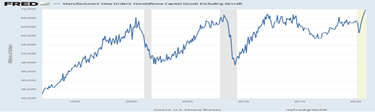
A measure used by economists to track investment, known as core capital orders (minus defense and aircraft), rose 4 percent in the 12 months ended in September. It has risen 1.3 percent for three consecutive months, according to the Commerce Department.

Core orders are spent domestically for the most part, so this is happening just when it’s needed—to rebuild the hurricane and wildfire damaged states of Florida, Texas, California, as well as U.S. Territories of Puerto Rico and the Virgin Islands.

Graph: FRED

It will also boost economic growth, since it boosts labor productivity, one of the two components that determine GDP growth. The other component is population growth, but the U.S. population is barely growing, as is immigration that supplies the majority of new workers.

The main beneficiary of higher capex spending will be manufacturing, which is already showing improvement with a cheaper dollar exchange rate that has boosted exports.


And today we have durable-goods orders that rose 2.2 percent in September, beating forecasts. Durable goods are all goods that last three or more years—including auto vehicles, defense and aircraft. These orders have climbed 7.8 percent in the past year, the fastest pace since early 2012.
“Strength in the manufacturing sample is centered in new orders and employment,” says Econoday. “Of special note are unusual delivery delays, which help lift the composite indexes and are the result of lingering disruptions and stretched workloads following Hurricanes Harvey and Irma.”
So we are seeing effects of the hurricanes in boosting economic activity. The role of capital expenditures is especially important, as it means the replacement of much of our aging infrastructure as well.

And don’t forget at least 1 million motor vehicles were destroyed by the hurricanes that will need to be replaced. But buyers shopping for used replacement vehicles should be aware of the pitfalls of those storm-damaged cars that are put back on the market.

Consumers should take precautions like getting a history of repairs and checking the VIN number in the National Insurance Crime Bureau and National Motor Vehicle Title Information System databases, reports Fortune Magazine. Even without a database, strange stains and smells can be a red flag that a car has weathered a flood. Consumers buy a used car should check for signs of water damage — mineral deposits, mildew and the smell of mold or overpowering scents of cleaning supplies that may be trying to mask it.

Harlan Green © 2017


Follow Harlan Green on Twitter: https://twitter.com/HarlanGreen

Saturday, August 19, 2017

Will There Be Tax Reform?

Popular Economics Weekly

After Republicans’ failure to repeal Obamacare, they will now attempt to pass a budget, and tax reform plan. But the $1 trillion in spending cuts (mainly from Medicare) they hoped with the repeal of Obamacare, which would go into tax cuts for corporate, capital gains and upper income personal tax brackets, probably won’t happen.

And that could be a good thing, if it focuses solely on enriching a few. Corporate taxes aren’t too high with all the loopholes that bring down the effective corporate tax rate to 13 percent, rather than the nominal 23.8 percent rate, while the maximum personal tax rate was 92 percent in the 1950s under President Eisenhower when the U.S. was building our modern productivity- enhancing infrastructure, which badly needs an upgrade. And corporations already have record corporate profits as a percentage of GDP, which most aren’t using to increase capital expenditures and so productivity (and growth).

Any attempt at tax reform will run into the moderates in a split Republican Party that want to maintain Medicare and other social programs that aid those in the poorest overwhelmingly Republican red states. So the moderates will stymie efforts to cut spending in social programs, which means that Repubs can’t cut taxes without creating a very large budget deficit—even larger than it is now.

Tax cuts matched with spending cuts have only increased the budget deficit under the various Republican plans. Whereas the Obama administration drastically reduced annual budget deficits while rescinding most of the Bush tax cuts. The formula worked. This raised most taxes back to Clinton administration levels, while maintaining the various social programs that benefited the poorest and disabled.

Corporations are not investing what they should and could because they prefer using financial engineering to finagle stock prices to enrich investors (and executives) while squeezing employees’ incomes that hurts their producitivity. 

Whereas public sector investment is so important when it gets spent on productivity-enhancing infrastructure upgrades. It becomes revenue neutral because it stimulates higher growth, just as it did in the last 4 years of the Clinton administration, which yielded actual budget surpluses.

Republicans’ sole focus on spending and tax cuts is a mistake. The CBPP reports the House GOP agenda issued in 2016 a tax reform plan, which they haven’t amended, and that a 2016 Tax Policy Center (TPC) analysis shows would overwhelmingly benefit the highest-income households.  Under the plan, 76.1 percent of the net tax cuts would flow to the richest 1 percent of households in 2017.  And by 2025, essentially all of the net tax cuts — 99.6 percent — would go to the top 1 percent.


The figures are similarly striking for households with incomes over $1 million, who would reap 71.2 percent of the tax cuts in 2017 and 96.5 percent of the net tax cuts in 2025.[1]  The plan is actually more regressive and more heavily tilted toward those at the top of the income scale than past GOP tax cut proposals.

On the individual tax side, the new tax rate structure would have three brackets of 12 percent, 25 percent, and a top rate of 33 percent.  High-income people’s pass-through income — business income that’s claimed on individual tax returns — would be taxed at a special lower top rate of 25 percent. 

Evidence of the damage from corporations’ financial engineering (instead of productivity-enhancing investments) is the collapse in the number of listed companies. In a Credit Suisse report released in March titled “The Incredible Shrinking Universe of U.S. Stocks,” there were 7,322 in 1996; today there are 3,671. It is important not to confuse this with a shrinking of the stock market: the value of listed firms has risen from 105 percent of GDP in 1996 to 136 percent now. But a smaller number of older, bigger firms dominate bourses.

Consequently between 1996 and 2016, the number of publicly-listed stocks in the U.S. fell by roughly 50 percent — from more than 7,300 to fewer than 3,600 — while rising by about 50 percent in other developed nations, said Credit Suisse. 

A spike in M&A activity also accounted for the rapid acceleration in delistings (and fewer stocks) as well. Private equity has been a dominant force. In 1980, PE deal volume slightly exceeded $1 billion. By 1996, that number had reached $80 billion. And today, it sits at a staggering $825 billion.

Though it’s an old (but time tested) proverb, when private enterprise won’t step up to save economic growth, government has to fill the void.  The best tax reform is that which invests in the future of American productivity, rather than in Wall Street's financial engineering.

Harlan Green © 2017

Follow Harlan Green on Twitter: https://twitter.com/HarlanGreen

Thursday, March 9, 2017

U.S. Will Badly Need Immigrants

Popular Economics Weekly

For most of the past half-century, adults in the U.S. Baby Boom generation – those born after World War II and before 1965 – have been the main driver of the nation’s expanding workforce, reports the PEW Research Center. But as this large generation heads into retirement, the increase in the potential labor force will slow markedly, and immigrants will play the primary role in the future growth of the working-age population (though they will remain a minority of it).


The stakes are enormous if Republicans succeed in removing most of the estimated 11 million undocumented worker (only half of which are from Mexico and the Latin countries), and cut legal immigration in half, as they have promised to do. Economic growth will plummet, since it is mainly based on growth of the working age population, as well as labor productivity, which has also fallen since 2000.
 

The causes of the drop in labor productivity are largely because of the fall in capex spending, the investment in new plants and equipment, which has fallen by half since 2010, in large part because of the Great Recession, but also because corporations have chosen to move so many jobs overseas where labor is cheaper, rather than investing domestically to improve the productivity of American workers.
 
Graph: Econoday

The plunge in capex has been most noticeable last year, perhaps because of uncertainty over economic growth in what is the 7th year of this long growth cycle, or uncertainty about results of the President election. Such expectations can be self-reinforcing in these anecdotal surveys, of course, given the poor 1.9 percent GDP growth in 2016.

The ISM manufacturing survey, which tracks anecdotal assessments from a national sample of purchasers, made big headlines in the week with a 4.7 point jump in its new orders index to 65.1. This level of order growth was last exceeded in August 2009 and follows two prior 60 readings.

The number of adults in the prime working ages of 25 to 64 – 173.2 million in 2015 – will rise to 183.2 million in 2035, according to Pew Research Center projections. That total growth of 10 million over two decades will be lower than the total in any single decade since the Baby Boomers began pouring into the workforce in the 1960s. The growth rate of working-age adults will also be markedly reduced, says the study.

So the Trump administration has to be careful of what they wish for, if they want to boost economic growth domestically.

Harlan Green © 2017

Follow Harlan Green on Twitter: https://twitter.com/HarlanGreen

Thursday, March 2, 2017

2017 Manufacturing Off To Good Start


Popular Economics Weekly

What is happening with manufacturing? The ISM manufacturing index jumped 1.7 points in February to a 57.7 level that beats the consensus by 1.3 points. This is the strongest rate of monthly growth in composite activity since August 2014. So does it mean Trump can keep his promise of bringing back those blue collar jobs lost to the likes of China?

It’s in spite of higher dollar exchange rates that have boosted consumer spending because of cheaper import prices, which dropped GDP growth in Q4 and the year, to 1.9 percent. (Import sales subtract from GDP growth.) So what gives? Is it the Trump euphoria over his promise to cut taxes and regulations?

The report in fact is filled with superlatives led by a 4.7 point jump in new orders to 65.1. This rate of monthly growth was last matched in December 2013 and last exceeded in August 2009. Backlog orders jumped 7.5 points to 57.5 in a reading last exceeded in March 2014. Production is also very strong, up 1.5 points to a 62.9 level that is the best since March 2011.This is while consumer confidence index continues to make new post-election highs and new cycle highs at a 114.8 February level, which beats consensus estimates and makes for a strong 3.2 point gain from January.

But beware, says Econoday, “This report perhaps is the greatest expression yet of post-election strength in anecdotal surveys, strength that has yet however to find its way to actual government data on the factory sector which have been consistently soft.”

The data includes just released auto sales, softer at 17.5 million units. Wrightson ICAP had estimated a seasonally adjusted annualized sales pace of 17.7 million.  That would still be a little below the December/January average of 17.9 million, but would represent an increase of roughly 1 percent in both month-to-month and YOY terms.  And it would be about 1.4 percent above the actual 2016 total of 17.46 million, which was a record high.


Then there is the January durable goods report for items that last 3 or more years. It shows the usual volatility behind which are sagging numbers for key readings, said Econoday. Aircraft, both domestic and defense, skewed durable goods orders sharply higher in January, up 1.8 percent to hit the consensus. Not hitting the consensus, however, are orders that exclude aircraft as well as all other transportation equipment. This reading fell 0.2 percent to come in well below Econoday's low estimate for a 0.2 percent gain.

The worst news in the report is a 0.4 percent decline in orders for core capital goods (nondefense ex-aircraft). This ends 3 months of strength for this reading and pulls the rug out from expectations for a first-quarter business investment boom as indicated by business confidence readings.

And longer term investments happen when core capital expenditures are on the increase. So will the manufacturing boom continue?

Harlan Green © 2017


Follow Harlan Green on Twitter: https://twitter.com/HarlanGreen

Wednesday, March 1, 2017

Slower Q4 Growth, (But) Higher Consumer Confidence

Financial FAQs

The growth in the U.S. economy in the final quarter of Barack Obama’s presidency remained at 1.9 percent, held down by a bigger trade deficit even as consumer spending rebounded strongly. In fact, Q4 GDP growth slowed in part because consumers are spending more, thus boosting imports (which is subtracted from GDP), while exports have been weaker due to the stronger US dollar.

This is while the Conference Board's consumer confidence index continues to make new post-election highs and new cycle highs at a 114.8 February level, which beats consensus estimates and makes for a strong 3.2 point gain from January.


But how long will this ‘Trump’ enthusiasm effect last, with his historically low approval ratings for a new president (at least among Democrats and Independents), as well as his failure to start his term with a burst of substantial legislation, as Barack Obama did, writes New York Times Op-ed columnist David Leonhardt?
“The political scientist Matt Glassman in a recent tweetstorm had the best summary I’ve seen,” said Leonhardt. “First, it is radically unusual that party Senators are opposing the President AT ALL. It’s basically unprecedented,” Glassman wrote. “In a normal presidency, party Senators would be on TV constantly, pushing the President’s message and defending his policies.”
The government’s second look at gross domestic product in the fourth quarter showed a bigger increase in purchases by consumers than initially reported: 3 percent vs. 2.5 percent. What Americans spend has the biggest influence by far on GDP (as much as two-thirds of GDP), and the official scorecard for the U.S. economy.

Yet the increase in what consumers spent was offset by somewhat smaller gains in business investment and local and state spending, revised government figures reveal. As a result, GDP was unchanged from the original estimate.

Consumer confidence is rising in tandem with retail sales. Retail sales are making a breakout of their own. It's an upward revision to what was already a strong December, now at a 1.0 percent surge. This goes in the books as the best December since 2004, reports Econoday. Retail sales have now posted five straight monthly gains in a streak that was last matched 3 years ago, back in early 2014.

Graph: Econoday

The Conference Board’s Consumer Confidence report included an 8 tenths dip in those saying jobs are currently hard to get to a very low 20.3 percent, a reading that points to strength for the February employment report coming this Friday. Expectations for future jobs are also strengthening with more, 20.4 percent, more opening up and fewer, at 13.6 percent, seeing less jobs ahead.

Strength in jobs sentiment also makes for strength in income expectations where the spread between optimists and pessimists (18.3 vs 8.2 percent) is a very healthy 10.1 percentage points.

Other details include an uptick in buying plans for autos and no change in inflation expectations, which are at 4.9 percent, soft for this particular confidence reading. Higher confidence has to be the major reason consumers have opened their pocket books, but how long will this last? Much of it is due to initial enthusiasm that President Trump can carry out his agenda announced in last night’s congressional speech.

That is the question, with so many intelligence scandals and conflicts of interest surrounding him. He has to first prove he can lead his own party, which isn’t the case so far.

Harlan Green © 2017

Follow Harlan Green on Twitter: https://twitter.com/HarlanGreen

Wednesday, September 28, 2016

Holiday Cheers--Consumers Feeling Happier!

Popular Economics Weekly

It’s back to school time, and consumers are feeling the holiday spirit already. Americans in September were most optimistic about the economy since the summer of 2007, in part because of a happier view of the U.S. labor market. And coupled with rising wages, could mean a very good holiday season for businesses.


The index of consumer confidence climbed to 104.1 this month from 101.8 in August, the Conference Board said Tuesday. That’s well above the 99.3 forecast of economists and it marks the highest level since August 2007, just a few months before the onset of the Great Recession.

The Conference Board says it is about better job security, but I believe rising wages are a better reason for optimism. The present situation index, a measure of current conditions, climbed to 128.5 from 125.3. That’s also the highest level since August 2007.
“Consumers’ assessment of present-day conditions improved, primarily the result of a more positive view of the labor market,” said Lynn Franco, director of economic indicators at the board. “Looking ahead, consumers are more upbeat about the short-term employment outlook, but somewhat neutral about business conditions and income prospects.”
But there is also new data showing middle-class household incomes growing at the fastest rate since the recession, which seemed to confirm that a recovery is finally touching the lives of ordinary, especially middle-class Americans.

This may shake up retail sales that have also been in a summer swoon, because the largest wage growth is occurring in the lowest income brackets that have to spend most, if not all, of their incomes to maintain a decent standard of living.


This could largely be due to the rise in the minimum wage in some large cities, of course. The official poverty rate fell 1.2 percentage points between 2014 and 2015 to 13.5 percent, and the number of people in poverty fell by 3.5 million, says the Census Bureau. The threshold for a family of two adults and two children to be considered living in poverty was $24,036. 

Rising consumer confidence is a good sign for continued economic growth, needless to say. But will it be enough to get us out of the 2 percent GDP growth rate of late? We will actually need much more, like more capital expenditures that have been cut back during the years when budget cuts were the priority, rather than productive investments.

Harlan Green © 2016

Follow Harlan Green on Twitter: https://twitter.com/HarlanGreen

Friday, September 16, 2016

Poverty Level Down, As Incomes Surge

Popular Economics Weekly

Fewer Americans lived in poverty in 2015 and median incomes charted their first increase since the Great Recession, according to data released Tuesday by the Census Department. The official poverty rate fell 1.2 percentage points between 2014 and 2015 to 13.5 percent, and the number of people in poverty fell by 3.5 million, Census said. The threshold for a family of two adults and two children to be considered living in poverty was $24,036.


And new data showing middle-class household incomes growing at the fastest rate since the recession seemed to confirm that a recovery that’s remained slow and uneven is finally touching the lives of ordinary, especially middle-class Americans.


In fact, this could be the income growth needed to bring US back to 3 percent GDP growth; something that hasn’t happened since 2007 before the Great Recession. Millions of Americans escaped poverty last year and incomes rose at their biggest gainever, as the 6-year long economic recovery finally hit home for households. Median middle-class wages surged 5.2 percent between 2014 and 2015, the Census Department said Tuesday, the first annual increase since 2007, just before the economy plunged into recession.

This is in large part due to almost non-existent inflation, which has not returned to even the Fed’s 2 percent target, hence the reluctance of Janet Yellen’s Federal Reserve to raise interest rates at all this year. But that may change, as rising wages also have an effect on inflation, since wages make up some two-thirds of product costs.

An even better way to increase growth is to invest more in what would grow our economy; like infrastructure, education, R&D, the environment, etc. That’s why productivity has ground to a halt, which is the main driver of future growth.

At least 43 companies plan to cut, or leave unchanged, their capital spending levels in 2016, while about 20 are increasing, according to a Reuters review of Standard & Poor's 500 companies that have given explicit early guidance.

However, Citibank seems to disagree. It’s mainly the energy sector that has cut back on new investments due to the slump in energy prices. This, however, is boosting growth in capex spending in other sectors, says Tobias Levkovich, Citigroup chief equity strategist. There's no reason to think stock buybacks, the current straw man for the lack of productive investment, are replacing capital expenditures. Rather, he said, they are complementing them.
"While misperceptions abound when it comes to companies allegedly not investing in their businesses and preferring to buy back stock instead, there is little corroborating evidence," Levkovich argued. "S&P 500 companies have had capital investment dollars ahead of the amount used for buybacks for more than four and a half years and capex has hit a record every year since 2011."
And a major reason for this is the low cost of capital is today’s low inflationary environment. So there is good reason to keep interest rate as low as possible, until we see signs of more normal GDP growth.

Harlan Green © 2016

Follow Harlan Green on Twitter: https://twitter.com/HarlanGreen