Showing posts with label aggregate demand. Show all posts

Friday, August 17, 2018

Are Interest Rates Dangerously Low?

Popular Economics Weekly


Why should historically low interest rates be a problem, you say?  Doesn’t that help consumer demand by enabling consumers to buy more by borrowing more cheaply, and economic growth by encouraging companies to create more jobs?  Not when rates have remained low for such an extended period.

Interest rates are far too low this late in the recovery from the Great Recession. It isn’t only because the Treasury Yield Curve slope has been steadily declining since 2014 that measures the difference between the 10-year and 2-year Treasury bond yields, as we said last week.

The Benchmark 10-year Treasury yield itself hasn’t risen above 3 percent in at least one year. It was this low for sustained periods during the Great Recession, when it dipped below 2 percent. But it shouldn’t be as low today (2.85 percent at this writing). In fact, interest rates haven’t recovered from the Great Recession. It normally ranges from 4 to 5 percent during prosperous times when there is a greater demand for money—e.g., from 2000 to 2008—as the FRED graph shows.

It signals a significant weakness in aggregate demand for goods and services; which is the sum of demand by consumers, investors, government spending and net exports, (and somewhat mirrors the weak 2 percent GDP growth since then). This could means we are dangerously close to another recession, if economic shocks such as the Turkish Lira plunge, or a full-fledged trade war occurs.

Consumer spending is perking along above 3 percent only because of excessive borrowing due to the low interest rates, rather than rising incomes, so it won’t be sustainable. And capital spending is half of what it should be with the stimulus from the Republican tax cuts and $1.3 trillion in additional federal spending.

Exports—another component of aggregate demand—is momentarily rising, but it could be a one-time surge in orders to escape rising costs from the trade war. And there is always the threat of cuts to government entitlement programs like food stamps, Medicare and Medicaid, which increases costs of many low and middle-income consumers.

So we could be teetering on the edge of an economic slowdown, no matter what the pundits are saying about full employment and the latest 4.1 percent GDP 2nd quarter growth, with excessive government and private debt providing little cushion for support should geopolitical and financial problems worsen.

However, there is a caveat to this dismal scenario. It may not be a recession for all Americans. Household debt — including mortgages, credit cards, auto loans, student loans and other credit — grew for the 16th consecutive quarter in the April-to-June period, rising by 0.6%, or $82 billion, to $13.29 trillion, the New York Fed reported Tuesday.

That’s because the recovery has really benefited just the top 10 percent income-earners, who have been able to pay down their debts. With personal disposable incomes at a $15.46 trillion annual rate in the quarter, the debt-to-income ratio dipped to 86 percent. That’s the lowest, by a tiny amount, since the fourth quarter of 2002. At the height of the credit bubble in 2008, debts topped at 116 percent of disposable income.

And we have government debt approaching 100 percent of GDP by 2020, according to the watchdog Congressional Budget Office. The sad denouement of this scenario could be that another downturn will hurt those most dependent on the federal government for protection, as has happened in the past.

Harlan Green © 2018

Follow Harlan Green on Twitter: https://twitter.com/HarlanGreen

Wednesday, January 4, 2017

Why The Years of Slow Growth?


Popular Economics Weekly

Pundits have decried it. Donald Trump has criticized the ‘lousy’ U.S. economy in many of his Tweets, and economists have lamented the 2.4 percent GDP growth rate since 2000, at the time of the dot-com bubble bust. This is when prior recoveries have averaged 3-4 percent growth—at least in the early years.
The agonizingly slow pace of recovery from the Great Recession is easy to explain, say most economists. The Economic Policy Institute (EPI), a labor think tank, recently said it best. It is the result of austerity policies championed by Republican policymakers at the federal and state levels.
“Like every other postwar recession before it, the Great Recession was caused by a shortfall in aggregate demand, meaning that the spending of households, businesses, and governments was not sufficient to keep the economy’s resources fully employed,” said the EPI.


Per capita government spending in the first quarter of 2016—27 quarters into the recovery—was nearly 3.5 percent lower than it was at the trough of the Great Recession. By contrast, 27 quarters into the early 1990s recovery, per capita government spending was 3 percent higher than at the trough; 23 quarters following the early 2000s recession (a shorter recovery), it was 10 percent higher; and 27 quarters into the early 1980s recovery, it was 17 percent higher.

What is aggregate demand, and how is it increased? FDR’s incredibly intelligent Fed Chairman Marriner Eccles explained it in his memoir Beckoning Frontiers (1951):
As mass production has to be accompanied by mass consumption, mass consumption, in turn, implies a distribution of wealth ... to provide men with buying power. ... Instead of achieving that kind of distribution, a giant suction pump had by 1929-30 drawn into a few hands an increasing portion of currently produced wealth. ... The other fellows could stay in the game only by borrowing. When their credit ran out, the game stopped.
He understood our U.S. economy was entering the era of mass consumption, and unless consumers plus businesses plus government spent and/or invested enough money in it, there would be little or no growth. If fact, it was the severity of the contraction in spending that caused both the Great Depression and Great Recession.

And because there was record income inequality in 1929—only equaled again in 2007—consumers ran out of money to spend, which meant in turn businesses stopped investing. So it had to be government that injected sufficient demand into the U.S. economy to keep it from collapsing completely. That was the reason for the New Deal that employed millions in government-paid jobs, as well as social security, unemployment insurance and all the social programs that enabled US to win WWII.

The pickup in government spending in the early 2000s recession and 1980s recovery were during Republican administrations (i.e., during GW Bush and Reagan presidencies), which meant they had no problem spending public monies to boost economic growth. But when it came to Obama’s term, every attempt was made by the mostly Republican House in particular to cause him to fail.

It began with the election of some 80 Tea Party members to the House in 2010, then government shutdown in 2011 when they refused to ok a budget, so that the U.S. government almost ran out of operating funds, resulting in the first loss of AAA rating for U.S. debt by a bond rating agency in modern history.

That is why real annual GDP growth during Reagan’s term peaked at 7.3 percent, and GW Bush’s term at 3.8 percent. The highest modern growth rate was achieved during FDR’s New Deal and WWII, which boosted U.S. growth to a peak of 18.9 percent in 1942. Real GDP growth (i.e,, after inflation) has been downhill ever since.


As CBS News recently wrote in a report entitled, Obama May Become First President Since Hoover Not to See 3% GDP Growth: “The last year that real GDP grew by 3.0 percent or more, according to BEA, was in 2005, when it grew by 3.3 percent. Since then, the United States has gone a record ten straight years (2006-2015) without a year in which the growth in real GDP was at least 3.0 percent.”

So in fact without government spending to boost demand during slow times our economy has suffered. And now President-elect Trump has proposed a $1 trillion infrastructure spending plan that is sure to boost growth again.
“Despite the Great Recession being the sharpest and longest on record since World War II,” wrote the EPI, “and despite monetary policy reaching its conventional limits to boost spending early in the recession, policymakers made damaging decisions to limit public spending following the recession’s trough in 2009. This growth has been historically slow relative to other business cycles even as the economy needed substantially faster-than-average growth to mount a full and timely recovery.”
So let the record show, government has never been the problem when Republicans needed to boost growth, only when Democrats do. What is wrong with this picture?

Harlan Green © 2016

Follow Harlan Green on Twitter: https://twitter.com/HarlanGreen

Wednesday, June 22, 2016

Housing Now Leading Economic Recovery

Popular Economics Weekly
Harvard economist and GW Bush chief economic advisor Greg Mankiw’s recent New York Times Upshot column attempts to explain why US growth is so slow. “Here is the sad fact,” he says: “Over the last decade, the growth rate of real G.D.P. per person has averaged just 0.44 percent per year, compared with the historical norm of 2.0 percent. At a rate of 2.0 percent, incomes double every 35 years. At a rate of 0.44 percent, it takes about 160 years to double.”
And Mankiw blames it on policy missteps. E.g., when Barack Obama took office in 2009, the economy was in the midst of the Great Recession, and President Obama’s advisers relied on standard Keynesian theory when they proposed a large increase in government spending to energize the economy.  But it wasn't enough.

Instead of waiting for the stimulus spending to take effect, Obama listened to conservative economists (such as G Mankiw) and supported tax increases too soon in an attempt to pay down the debt accumulated during the Bush administration. The economy hadn’t yet recovered from a very Great Recession. President Roosevelt made the same mistake in 1937 when he also raised tax rates with a Republican Congress, which shrank growth so much that it prolonged the Great Depression.

We do have more signs of improved growth led by housing sales, which may offset some of the policy missteps--due in large part to misjudging the depth of the Great Recession. Sales of previously owned homes increased in May to the highest level in nearly a decade, reports the National Association of Realtors, another sign of durable demand in the housing market despite ongoing headwinds. And a recovering housing market has historically been a leading economic indicator of healthier consumers, hence future growth.


Existing-home sales rose 1.8 percent to a seasonally adjusted annual rate of 5.53 million, the National Association of Realtors said Wednesday. That was 4.5 percent higher compared to a year ago and the highest pace since February 2007 during the housing bubble.
Lawrence Yun, NAR chief economist, says existing sales continue to hum along, rising in May for the third consecutive month. "This spring's sustained period of ultra-low mortgage rates has certainly been a worthy incentive to buy a home, but the primary driver in the increase in sales is more homeowners realizing the equity they've accumulated in recent years and finally deciding to trade-up or downsize," he said. "With first-time buyers still struggling to enter the market, repeat buyers using the proceeds from the sale of their previous home as their down payment are making up the bulk of home purchases right now."
Any recovery depends on boosting aggregate demand—the demand for goods and services from all sectors of the economy, including governments. And to date the Obama administration has been too lax in encouraging both private and public investment that would expand capacity, and so productive jobs.

This is particularly true of government jobs. State and local government employment has been the largest drag on job growth. State and local governments lost 129,000 jobs in 2009, 262,000 in 2010, 247,000 in 2011, and 29,000 in 2012, for a total of 669,000 jobs lost due to the Great Recession. 

Through November 2015, reports Calculated Risk, state and local employment is up a net 70,000.   So, in the aggregate, state and local government layoffs are over.  However state and local government employment is still 561,000 below the pre-recession peak.  It is public sector jobs that have suffered the largest decline due to the Great Recession, in other words. Here is the comparison during presidential terms of government job creation.


The public sector grew during Mr. Carter's term (up 1,304,000), during Mr. Reagan's terms (up 1,414,000), during Mr. G.H.W. Bush's term (up 1,127,000), during Mr. Clinton's terms (up 1,934,000), and during Mr. G.W. Bush's terms (up 1,744,000 jobs).

However public sector declined significantly since Mr. Obama took office (down 638,000 jobs in 2015). These job losses have mostly been at the state and local level, but more recently at the Federal level.  This has been a significant drag on overall employment, needless to say.

How does one boost additional growth with a no-compromise Republican Congress that resists any and all Obama initiatives? (Yet he was able to pass Obamacare, but unable to defend it, resulting in the all-Repub 2014 Congress!).

So public employment is as important as private sector jobs. Not only does this put more people to work, but it provides the necessary energy-transportation-communication networks without which private industry cannot operate.

Harlan Green © 2016

Follow Harlan Green on Twitter: https://twitter.com/HarlanGreen

Wednesday, April 27, 2016

Fed Stays in Accommodative Mode

Popular Economics Weekly

It looks like Janet Yellen’s Fed will continue to keep interest rates low this year, based on the latest FOMC press release. This is great news for the housing market, in particular, but not necessarily for consumers that continue to save more than they are spending, for fear of another economic slowdown.
“The Committee expects that economic conditions will evolve in a manner that will warrant only gradual increases in the federal funds rate,” said the press release; “the federal funds rate is likely to remain, for some time, below levels that are expected to prevail in the longer run. However, the actual path of the federal funds rate will depend on the economic outlook as informed by incoming data.”
And sure enough, the NAR’s gauge of future closings, the Pending Home Sales Index, a forward-looking indicator based on contract signings, climbed 1.4 percent to 110.5 in March from an downwardly revised 109.0 in February and is now 1.4 percent above March 2015 (109.0). After last month’s slight gain, the index has increased year-over-year for 19 consecutive months and is at its highest reading since May 2015 (111.0).
Lawrence Yun, NAR chief economist, says last month’s pending sales increase signals a solid beginning to the spring buying season. “Despite supply deficiencies in plenty of areas, contract activity was fairly strong in a majority of markets in March,” he said. “This spring’s surprisingly low mortgage rates are easing some of the affordability pressures potential buyers are experiencing and are taking away some of the sting from home prices that are still rising too fast and above wage growth.”


Why are consumers cutting back on spending, per latest retail sales figures that show lower auto sales, in particular? Consumer confidence has declined, is one reason. The Conference Board’s index slipped more than 2 points to 94.2 when it is 100 plus during normal growth periods (but is roughly in line the 6-month trend). Weakness in the report is centered in the expectations component which fell 4.3 points to 79.3, said Econoday. Here, in contrast to the assessment of the current jobs market, there's outright pessimism with 17.2 percent seeing fewer jobs ahead vs only 12.2 percent seeing more ahead.

Pundits aren’t sure why confidence in future jobs and growth has declined, when more than 200,000 new jobs per month have been created over the past 2 years, and 11 million jobs during Obama’s presidency. But incomes are still not rising fast enough for the majority of consumers, though the Fed maintains household incomes will eventually rise faster, as the unemployment rates falls further.

What is usually overlooked, however, are the almost deflationary times we consumers currently live in. Believe it or not cheaper gas and energy prices are just one of the factors causing this uncertainty about future prospects.

Graph: Econoday

History shows that consumers spend less when prices are falling, because they expect prices to fall further. Whereas consumer spending picks up when prices are rising, in an attempt to save money by getting ahead of the next price increase. This is Japan’s history during its 2 decades of deflation.

What will cause retail inflation to return to its historical 2 percent plus level? Economists say it is greater aggregate demand, or the demand for goods and services by both consumers, businesses, and governments.

The sectors are related, of course, with rising household incomes the main driver of growth, since ithis stimulates more investments in plants and equipment—so-called capex spending, that in turn stimulates more job growth.

But in fact, governments have been the least spendthrift due to falling tax revenues, hence the huge backlog in deferred infrastructure maintenance and construction (more than $2 trillion per the American Society of Civil Engineers), as well as public investment in schools, new research, protecting the environment, social security and Medicare, and so forth.

Harlan Green © 2016

Follow Harlan Green on Twitter: https://twitter.com/HarlanGreen

Wednesday, February 3, 2016

Davos Highlights Why Slower Growth

It's time for the World Economic Forum, and this year more than 40 heads of state and 2,500 other participants are unlikely to run short of topics to discuss. "Meeting against a backdrop of market jitters, heightened geopolitical risks and a renewed focus on climate change, there will be intense focus on how these A-listers propose to solve the challenges facing the global economy," reports Marketwatch about the meeting held at the ski resort of Davos, Switzerland.
What should be at the center of discussions is the increased inequality in wealth and income that is affecting U.S. economic growth in particular, but also the rest of the world. But instead of inequality, most of the attention has been focused on China's growth problems, as if China is the world's piggy bank. But it isn't.
How does inequality affect economic growth? Nobelist Joseph Stiglitz has written most recently about what he calls the "Great Malaise", and IMF President Christine LaGarde says is the "New Mediocre" in worldwide economic growth.

"The economics of this inertia is easy to understand," says Stiglitz, "and there are readily available remedies. The world faces a deficiency of aggregate demand, brought on by a combination of growing inequality and a mindless wave of fiscal austerity. Those at the top spend far less than those at the bottom, so that as money moves up, demand goes down. And countries like Germany that consistently maintain external surpluses are contributing significantly to the key problem of insufficient global demand."

What is aggregate demand? It is an economic term that describes the overall demand for goods and services from consumers, business, and government, first formulated by the British economist JM Keynes. Professor Stiglitz's thesis is that when most of the wealth goes to the top income brackets, less of it gets spent or invested in productive enterprises.


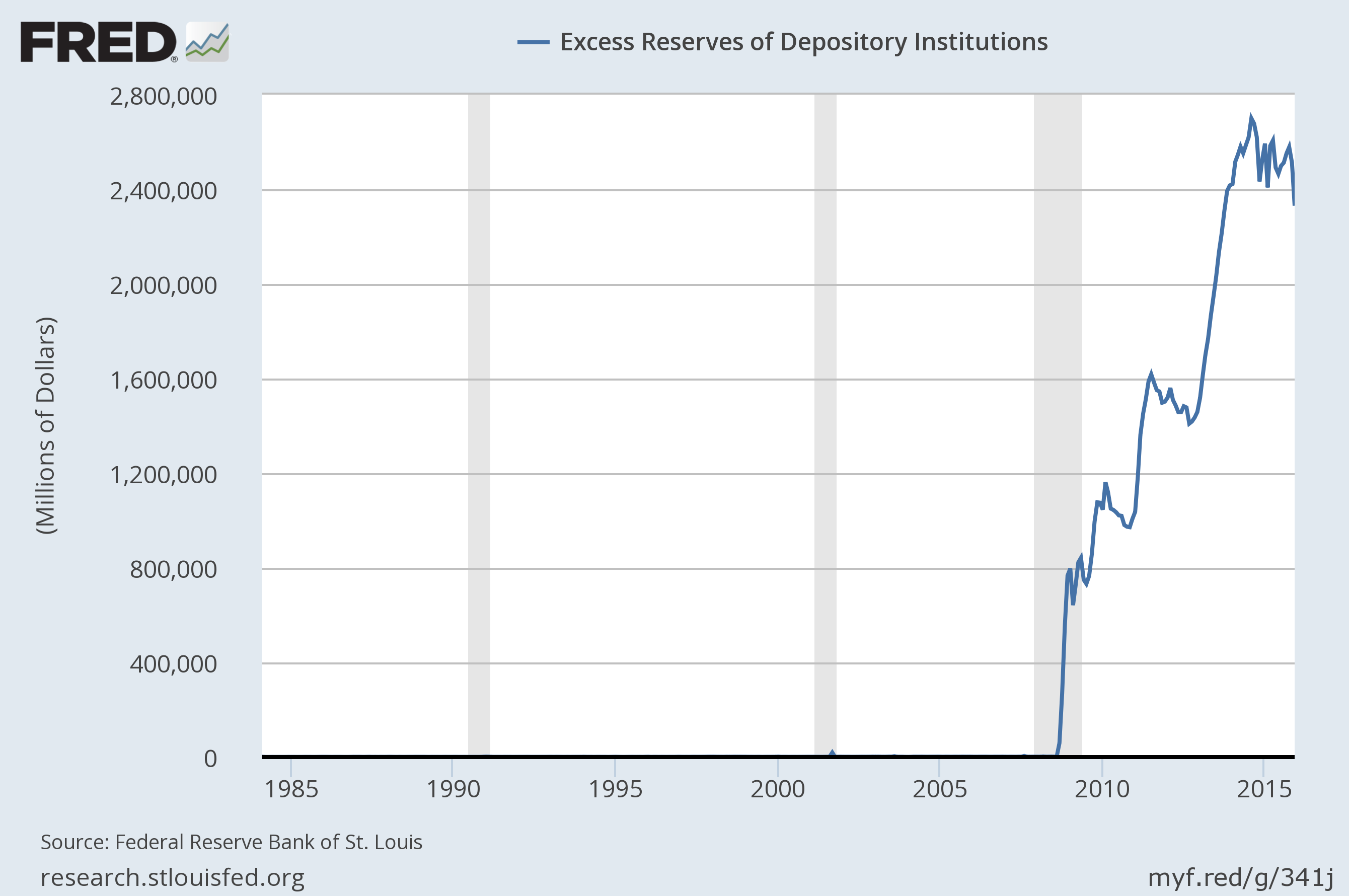
This is evidenced by the huge amounts of wealth that is hoarded where it does the least good. Corporations are holding more than $5 trillion in cash and cash equivalent assets, rather than investing it in productive enterprises. And the Federal Reserve is holding more than $2 trillion is excess reserves in MZM deposits, meaning that they earn little or no interest.
In fact, the St. Louis Federal Reserve Bank reports the Federal Reserve Banks currently hold some $2,330, 461,000 in excess reserves (that are reserves beyond the required minimum bank capital reserves), whereas it was close to $0 before the Great Recession. Why isn't it being invested productively?
The New York Fed says it is a byproduct of the Fed's easy credit policies. The Federal Reserve Banks lend to commercial banks so that banks with constrained liquidity as a result of the Great Recession will continue to lend. Those loans end up as excess reserves on the Fed's books. But who are the banks lending to? Much of Wall Street's borrowing is for leveraged buyouts, or buybacks of stock to boost stock prices (and CEO salaries, let us not forget).
This is not where banks should be lending, if the goal is to increase productivity, and so economic growth. A major reason for the Great Malaise is the huge cutback in government investments in productive enterprises, such roads and bridges, or R&D, or education, due to the ongoing austerity policies of the western world mentioned by Dr. Stiglitz.
In the U.S., it has been conservative politicians -- mainly Republicans -- that oppose any government stimulus programs, which they believe takes wealth away from those that already have it. But that 'no compromise" mentality made infamous by former House Speaker Boehner has made everyone poorer in the long run, and our public infrastructure in grave danger of collapse.
There is some hope with the new U.S. $1.1 trillion budget agreement, plus the $305 billion Highway Infrastructure Act, plus the Paris Climate Change Accord that should pump $Billions into alternative energy technologies, will mean government is coming back into the productive investment game.
That is how our public highway system was built, after all, as well as our space program, countless medical advances, public education, disaster relief, and the Internet. It took public monies to create the new technologies that private enterprise believed was either too risky, or didn't benefit them directly. So how much longer can such austerians continue to block economic growth and a more hopeful future?

"The obstacles the global economy faces are not rooted in economics, but in politics and ideology," continues Stiglitz. "The private sector created the inequality and environmental degradation with which we must now reckon. Markets won't be able to solve these and other critical problems that they have created, or restore prosperity, on their own. Active government policies are needed."

Will those attending Davos give us any new ideas on how to boost economic growth? The Paris Accord brought 200 countries together to limit global warming. Can these 'A-listers' do any better? I doubt it.

Harlan Green © 2016

Follow Harlan Green on Twitter: www.twitter.com/HarlanGreen

Wednesday, January 13, 2016

Why Has It Taken So Long?


The latest Federal Reserve press releases—firstly, the minutes of last FOMC meeting, and also its reduced projections of expected inflation—tell us the Fed is still in austerity mode, due to a fear of non-existent inflation.  And it is that unjustified fear that puts the brake on growth, since even the fear that the Fed will tighten credit conditions via its control of short term interest rates affects business investment.


The just released FOMC minutes reveals there was hardly a consensus in raising the Fed Funds rate to 0.5 percent from 0.25 percent.  Why?  Because many of the Fed Governors don’t believe inflation will rise at all this year from the present 1.3 percent annual Personal Consumption Expenditure index rate it favors.
This is while Nobelist Joseph Stiglitz has been decrying the lack of concern over the slow recovery from the Great Recession; lest we forget has grown more slowly than during the Great Depression.  And the Fed hasn’t been as proactive as I could be.
But what can duplicate the conditions that led to President Roosevelt and the New Deal programs (which were created by a woman, Labor Secretary Francis Perkins, by the way) that gave enough benefits to workers and trade unions so they could ultimately negotiate for a living wage and working conditions?
“In early 2010, I warned in my book Freefall, which describes the events leading up to the Great Recession, that without the appropriate responses, the world risked sliding into what I called a Great Malaise,” said Stiglitz. “Unfortunately, I was right: We didn’t do what was needed, and we have ended up precisely where I feared we would.”
            We needed another New Deal, in other words, but there was neither a Roosevelt with the experience and political savvy to push through the job creation programs of the 1930s, nor such a loss of faith in capitalism that prevailed then.  Let’s not forget that Herbert Hoover lost his job precisely because private industry ran for the exits, refusing to create jobs, so government job programs such as the CCC, and WPA employed those millions left jobless and became the bulwark that saved the US economy during that time.
Now we sadly have history repeating itself.  “The economics of this inertia is easy to understand,” continues Stiglitz, “and there are readily available remedies. The world faces a deficiency of aggregate demand, brought on by a combination of growing inequality and a mindless wave of fiscal austerity. Those at the top spend far less than those at the bottom, so that as money moves up, demand goes down. And countries like Germany that consistently maintain external surpluses are contributing significantly to the key problem of insufficient global demand.”
            History has repeated itself in several ways.  Income inequality was this high in 1929, as well as a stock market bubble.  A six-year drought in the Midwest created the Dust Bowl, and made millions homeless.  And credit was too easy then as well and consumers overspent, believing that stock values would never fall. 
John Steinbeck described those times the best in A Primer on the '30s' by John Steinbeck, 1960, pgs. 17-31: “I remember the Nineteen Thirties, the terrible, troubled, triumphant, surging Thirties. ... I remember '29 very well ... the drugged and happy faces of people who built paper fortunes on stocks they couldn't possibly have paid for. ... In our little town bank presidents and track workers rushed to pay phones to call brokers. Everyone was a broker, more or less. At lunch hour, store clerks and stenographers munched sandwiches while they watched stock boards and calculated their pyramiding fortunes. Their eyes had the look you see around a roulette wheel ...”
Why is it important that we remember those times?  Why is it so important to learn from history, you say?  Because the Great Depression led to WWII in direct ways.  Hitler rose out of a Germany shamed by its failed economy, and so chose dictatorship.
[I]n the Thirties when Hitler was successful,” continued Steinbeck, “when Mussolini made the trains run on time, a spate of would-be Czars began to rise. Gerald L.K. Smith, Father Coughlin, Huey Long, Townsend - each one with plans to use the unrest and confusion and hatred as the material for personal power.”
And today we have blatantly racist Republican presidential candidates like Donald Trump and Senator Ted Cruz doing the same. 
Professor Stiglitz says we know what to do: “…some of the world’s most important problems will require government investment. Such outlays are needed in infrastructure, education, technology, the environment, and facilitating the structural transformations that are needed in every corner of the earth.
Therefore, “The obstacles the global economy faces are not rooted in economics, but in politics and ideology. The private sector created the inequality and environmental degradation with which we must now reckon. Markets won’t be able to solve these and other critical problems that they have created, or restore prosperity, on their own. Active government policies are needed.”
There is a price we pay for ignoring the lessons of history, in other words. 

Harlan Green © 2016

Follow Harlan Green on Twitter: https://twitter.com/HarlanGreen

Saturday, January 9, 2016

Still Not Enough Jobs!

The economy produced 292,000 jobs in the final month of 2015, the Labor Department said Friday. Pundits had predicted a 200,000 plus increase in nonfarm jobs. And because job creation exceeded their predictions, those pundits and some economists will say the Fed has to continue to raise their rates this year. But in spite of the good jobs numbers over the past 3 months—some 2.7 million jobs were created in 2015—there are still more than 7 million job seekers that can only find part time work or no work.

Employment gains in November and October were also considerably stronger, Labor Department revisions show. Some 252,000 new jobs were created in November instead of 211,000. October’s gain was raised to 307,000 from 298,000, marking the biggest increase of 2015.


But continuing to raise interest rates will only hurt economic growth, when real GDP growth is still in the 2 percent range. In fact, annual GDP growth has averaged just 2.21 percent since 2010, and been declining since 2000.

Why the slow growth? A major reason is the decline in household incomes since the 1970s that have barely kept up with inflation. Hourly pay has risen just 2.5 percent in the past 12 months, matching a six-and-a-half-year high—which isn’t very high. And that has hurt personal consumption—i.e., consumer spending—which hasn’t been able to rise enough to offset the other factors holding back growth—such as almost no government investment in R&D, and public infrastructure, seriously hurting economic productivity.

That’s because most jobs were created in the lower-paying service sector, while millions of higher-paying manufacturing jobs have migrated overseas. So most workers aren’t getting big bumps in their paychecks. Hourly pay usually rises at a 3 percent to 4 percent annual pace when the economy is really humming.

And that is the ‘real’ reason we have had almost non-existent inflation. It is the hourly pay of the 80 percent of non-supervisory workers that contribute two-thirds of product costs, and it is the direction of product costs that determine whether prices are rising (or falling).

In fact, the Fed should be signaling it wants inflation to rise to the 3 to 4 percent range, a sign that wages are finally rising beyond inflation.  Because that would raise market interest rates that savers are calling for, without the Fed having to intervene.

Harlan Green © 2016
Follow Harlan Green on Twitter: https://twitter.com/HarlanGreen

Wednesday, January 6, 2016

Why Does Bernie Love Denmark?

Presidential candidate Bernie Sanders is breathing fire on the campaign trail these days, including his most recent campaign speech that advocated the breakup of too-big-to fail banks.  "We will no longer tolerate an economy and a political system that has been rigged by Wall Street to benefit the wealthiest Americans in this country at the expense of everyone else," said Sanders.

Then why does Senator Bernie Sanders love Denmark, and has been mentioning it and the other Scandinavian countries as ideal models for a developed country, one he would like the U.S. to emulate?

“In Denmark, social policy in areas like health care, child care, education and protecting the unemployed are part of a "solidarity system" that makes sure that almost no one falls into economic despair,” he said in a 2015 Huffington Post article. “Danes pay very high taxes, but in return enjoy a quality of life that many Americans would find hard to believe.”


 A recent Center For Economic Policy and Research report highlighted the differences between Nordic countries and the United States.  The differences are mainly because of their superior social safety nets.
           
For instance, the U.S. has the lowest average longevity at 78.8 years, vs. Denmark’s 80 years, while citizens of Iceland and Sweden live 82 years.  Do their colder climates have something to do with it?  No, more likely is the fact that they have to work fewer hours for almost the same income, with better health, educational and retirement outcomes.

  
It’s well-known that U.S. health care costs are double that of all other developed countries, as are infant mortality rates, while homicide rates are more than double of any other developed country.  We know, for instance, there are more than 32,000 gun deaths per year in the U.S., with the majority due to suicides—which also tells us the mental toll that comes with an inadequate social safety net that doesn’t support its citizens.

So it should be no surprise the U.S. has the highest income developed world, before and after taxes and transfers. The higher the Gini Coefficient number portrayed in the graph, the higher the inequality.  With the exception of the United States, there is a perfect correlation between market inequality and the role of fiscal policy in reducing inequality.

That is to say, western capitalist-oriented economies generate profits that go to the major wealth holders, so fiscal policies need to rebalance this effect.  And that is what the Nordic countries in particular, do so well.  “Countries with greater levels of market income inequality are more proactive at reducing inequality through their tax and spending systems,” says the CEPR.

Then why is there opposition in our Congress, particularly, to U.S. citizens having the same benefits as other developed countries, when we are supposed to be the richest country in the world?  It’s the successful opposition to higher taxes by the wealthiest among US.  The wealthiest have succeeded in reducing their taxes and tax rates since President Reagan, the first ultra-conservative Republican president.

The result is ugly—and shows the U.S. is not the land of opportunity for many Americans.  Instead, we have the result of a largely unregulated financial system--higher death rates, violent crime and incarceration rates, as well as inadequately funded health care, retirement, and educational systems. 
 
Harlan Green © 2016

Follow Harlan Green on Twitter: https://twitter.com/HarlanGreen