Showing posts with label FDR. Show all posts

Monday, November 3, 2025

Are We Flying Blind?

 Popular Economics Weekly

"The United States economy is like a poker game where the chips have become concentrated in fewer and fewer hands, and where the other fellows can stay in the game only by borrowing. When their credit runs out the game will stop." Marriner Eccles


wallpaperaccess.com

The famous above quote by Roosevelt’s Federal Reserve Chairman, Marriner Eccles on what he believed caused the Great Depression is a warning that the U.S. economy is now flying blind during this government shutdown.

Eccles should know. He guided Federal Reserve policy during the Great Depression that implemented the New Deal.

Economic downturns occur when consumers are tapped out and begin to borrow more than they spend. It is the reason that retail sales and consumer confidence surveys are important signs of whether consumers will continue to shop, or drop, as the saying goes.

And given the economic chaos being sown by the Trump administration during what looks like a record government shutdown, we don’t have any official data being released on when it might happen and what it will look like. So we are flying blind.

There are past recessions that economists look at; the Dot-com bubble that burst in 2001 from over investment in fiber optics that didn’t pan out immediately because it took years for the Internet to be adopted. Now there is over-investment in AI that could follow the same path as the so-called Dot-com recession.

And the Great Depression was largely due to the Herbert Hoover administration allowing tariff rates to rise to unacceptable levels that choked off foreign trade on which many countries, including America, relied on.

There was also the too easy credit conditions of the “Roaring Twenties” that weren’t regulated yet, which allowed the American public to borrow and invest in the stock market for the first time. The October 1929 “Black Friday” market crash followed that precipitated the Great Depression.

So we can take our pick: Trump’s too high tariffs, or too little market regulation allowing shadow lending markets (or junk bonds) to flourish outside of regulated lending channels might cause the next downturn.

Trump’s newest Federal Reserve pick, and former chief economic advisor, Stephen Miran, is even sounding the alarm in calling for larger Federal Reserve rate cuts.

“If you keep policy this tight for a long period of time, then you run the risk that monetary policy itself is inducing a recession,” Miran said in a recent interview cited by the NYTimes.

Another danger sign is The Institute for Supply Management’s (ISM) latest report that American manufacturers contracted for the eighth month in a row with no end in sight because of the Trump administration tariffs, reports MarketWatch, which cited several anecdotes in the ISM Manufacturing report.

“Business continues to be severely depressed. Profits are down and extreme taxes (tariffs) are being shouldered by all companies in our space,” said one executive at a maker of transportation equipment.

“Steel tariffs are killing us,” another manufacturer told ISM.

“The tariffs are still causing issues with imported goods into the U.S.,” an executive at a chemical maker said. “The inflation issues continue.”

The closely followed manufacturing index slipped to 48.7% in October from 49.1% in the prior month, the Institute for Supply Management said Monday. Any number below 50% signals contraction.

I’ve already reported that consumers are feeling less confident in the University of Michigan Sentiment survey.

“Consumers continue to express frustration over the persistence of high prices, with 44% spontaneously mentioning that high prices are eroding their personal finances, the highest reading in a year. Interviews this month highlight the fact that consumers feel pressure both from the prospect of higher inflation as well as the risk of weaker labor markets,said Survey Director Joanne Hsu

The real danger is that we are gleaning all these signs from industry reports outside of the ‘official’ government reports on employment, inflation, and consumer spending just before the holidays.

So, the U.S. economy is flying blind without the usual flight data that tells us where we are headed. Is there a soft landing, or crash landing ahead?

Harlan Green © 2025

Follow Harlan Green on Twitter: https://twitter.com/HarlanGreen

Friday, May 16, 2025

Trump's Manufacturing Scam

 Financial FAQs

Why? It’s not like we’re a small country or full of stupid people. No, it’s the takeover of the economists and bankers. Simply put, modern American law is oriented towards ensuring very high returns on capital to benefit Wall Street and hinder the ability to make things.” Matt Stoller, American Economic Liberties Project

Matt Stoller’s cry is a sign that even Libertarians are alarmed at Donald Trump and the Republicans’ scheme to grow the manufacturing sector. It’s another scam that enables them to turn the economic clock back to the 19th century, the Gilded Age of Robber Barons and rampant corruption and downsize government while ignoring modern laws and even the constitution.

Trump is doing it by raising tariff rates to a level not seen since 1930 at the onset of the Great Depression. But it won’t bring back a manufacturing industry that was lost to a globalized economy over the past 30 years.

The Manufacturing Institute and Deloitte accounting firm have projected that manufacturing will need an additional 3.8 million workers by 2033, in part due to the Biden administration’s $2 trillion worth of projects already invested by the Infrastructure, CHIPs and Science, and Inflation Reduction Acts, according to a recent NPR report.

And the Trump administration’s goal of deporting millions of undocumented workers as well as eliminating DEI programs that develop more skilled minorities will defeat his purpose by hollowing out the required workforce.

Early 19th century was a time of few laws to protect working folk, and there was no income tax until 1913 when Teddy Roosevelt’s Progressive era began to level the income playing field for workers. Oligarchs had to pay income taxes for the first time.

It was Ronald Reagan and the Business Roundtable of corporate CEOs that began the “takeover of the economists and bankers” that moved whole industries overseas while reducing their income taxes—from a maximum personal tax rate as high as 92 percent in President Eisenhower’s time—transferring $trillions that once went to the 80 percent of Americans earning salaries to the oligarchs that owned the capital and became “rentiers”; i.e., living off the capital created by their workers.

Trump wants a return to the era because it’s how he made his money. Who better than a convicted felon, a “liar and cheat” his whole life in the words of his erstwhile attorney Michael Cohen, to con Americans into believing that a tariff war against the whole world is the best way to bring back our manufacturing industry that has already migrated to Southeast Asia and China?

He has rationalized the economic chaos his tax war is creating with the promised goal of returning to an earlier era when we were a manufacturing superpower. But workers had fewer rights and benefits until Roosevelt’s New Deal.

Are we to believe it justifies more tax cuts for himself and his oligarchs that will grow our record federal debt ever higher, endangering the “full faith and credit” of the U.S. Government, as well as creating another era of stagflation with possible double-digit inflation and interest rates as happened in the 1970s?

Trump is attempting to recreate a time (1900) when we invaded and occupied Cuba and the Philippines. The reason for his nonsensical pronouncements that Canada should become our 51st state and Greenland a U.S. territory now begin to make sense.

Democrats do have an answer to the huge wealth gap between blue states and red states that might bring US back to present times. Start with small steps such as lobbying to raise the national minimum wage, currently $7.25 per hour to what it is today when inflation adjusted—$10.50/hour. That is already the case in 30 of the mostly blue states, where the minimum wage has risen above $15 per hour.

It will be a terrific struggle that will take time. President Trump and Republicans have erected such a wall of ignorance to protect his administration—officials of such incompetence that they lack the ability to even think for themselves that they will obey his commands without question and even anticipate them beforehand (Pete Hegseth, et. al.).

We aren’t a country of stupid people that can’t see the erosion of rights and civil liberties the Trump administration is justifying that enacts a return to an earlier century. The mass protests and demonstrations against Trump and Musk’s chainsaw tactics are proving it.

It’s a good time to return the Democratic Party to the party that has always supported greater equality for wage-earners and farmers. That is the best way Democrats can block Trump’s impossible time travel back to an earlier century that no longer exists.

Harlan Green © 2025

Follow Harlan on Twitter: https://twitter.com/HarlanGreen

Wednesday, February 3, 2021

Q4 GDP Growth Weakens

 Popular Economics Weekly

Calculated Risk

This Real Gross Domestic Product graph dating from 1959 shows that the US economy in 2020 had its worst contraction since the end of World War II. No surprise given we have the worst COVID-19 infection rates and death totals in the world.

But that doesn’t dim predictions of economists for a ‘Roaring '20's’ recovery this year that matches the recovery from the Spanish flu pandemic of 1918-19, if we get the economic aid that harks back to a more progressive, New Deal, era when government was the solution.

It has taken the coronavirus pandemic to end 40 years of trickledown economics, a Gilded Age that benefited corporate owners rather than their workers. Raising the minimum wage, childcare payments, and aid to state and local governments will benefit those lower-paid, essential workers that are not in the surging stock and bond markets.

The advance estimate of real fourth quarter GDP was 4 percent when adjusted for inflation after the record Q3 jump of 33 percent. But overall GDP still shrank by 3.5 percent last year due to the pandemic shutdowns, which gives an inkling of the task ahead for President Biden in crafting a recovery plan from the worst pandemic in 100 years.

Economist James K. Galbraith said recently in Project-Syndicate, “Biden has correctly billed his plan an “American Rescue Plan,” rather than as a “recovery” or “stimulus” program. If successful, the package will stem the pandemic, stave off a variety of social calamities, and prevent the collapse of state and local government services. Economic reconstruction is important; but it is a separate objective that can be advanced in a second package.”

Biden is asking for $1.9 trillion just to rescue the American economy. If Democrats can pass it without too many cuts, as well as an infrastructure bill that will create millions of new jobs, economic forecasters are predicting even higher GDP growth this year—upwards of 5 to 6 percent.

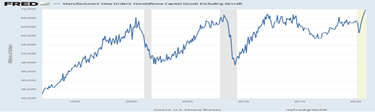
The New York Fed’s Nowcast predicts a 6.5 percent jump in 2021 Q1 growth. Most of it the prediction comes from an increase in manufacturers’ production and inventories of durable goods, which have been building as nondefense capital goods orders are on a tear, reports the US Census Bureau.

FREDdurablegoods

Businesses are ramping up investments in capital goods that will ensure future growth. Business orders for durable goods such as tools, appliances and new cars rose in December for the eighth month in a row, which should mean a stronger U.S. economic rebound this year.

Why the optimism when Republicans resisted new spending on anything but tax cuts, border walls and defense over the past four years? The COVID-19 pandemic has brought this Gilded Age to a crashing halt, as I said.

The party of Roosevelt won the election with the massive support of younger generations that want what citizens of the other developed countries enjoy—universal health care, a higher minimum wage, better social services, public education, paid vacations—the list goes on and on.

It might even reduce the social unrest and red vs. blue state polarization that has endangered American democracy!

Harlan Green © 2020

Follow Harlan Green on Twitter: https://twitter.com/HarlanGreen

Friday, April 14, 2017

Is Happiness That Important to Americans?

Popular Economics Weekly

What a strange question to ask Americans! We are the wealthiest country in the world, right? But a recent survey claims to show that wealth accumulation is not the first priority for most of the world. In fact, the 2017 United Nation’s World Happiness Report compiled by Gallup says that Americans’ pre-occupation with wealth gets in the way of being happy.

This conclusion results from a survey of 155 countries, and shows USA is now ranked 19th in being happy, due to our national preoccupation with what money buys now, rather than in the future.

Norway is ranked number one; no surprise with its oil wealth. But, “by choosing to produce its oil slowly,” says the survey, “and investing the proceeds for the future rather than spending them in the present, Norway has insulated itself from the boom and bust cycle of many other resource-rich economies. To do this successfully requires high levels of mutual trust, shared purpose, generosity and good governance, all factors that help to keep Norway and other top countries where they are in the happiness rankings.

The USA, however, hasn’t shielded itself from boom and bust cycles. The Great Recession is just the latest in a string of recessions since 1980—two under R Reagan, one during Bush I, and two under son GW Bush. And that has led to the greatest income equality since 1929 that was the beginning of the Great Depression, and also the cause of just-ended Great Recession.

We have not been good at investing in our future, and that has led to a very low savings rate and very little put aside for retirement. This is in part because our social safety net is profoundly inadequate. We have no universal healthcare, for starters, and Republicans are threatening to repeal Obamacare, and maybe even Medicare.

This is while we have a huge public debt because Congress has refused to raise enough taxes to pay for all the spending that has supported the ongoing wars as well as tax loopholes afforded corporations, and high net-worth individuals.

Why has such record income inequality led to recessions? As Marriner Eccles, FDR’s renown Federal Reserve Chairman once said about the Great Depression: “…a giant suction pump had by 1929-30 drawn into a few hands an increasing portion of currently produced wealth. ... The other fellows could stay in the game only by borrowing. When their credit ran out, the game stopped."

Credit had again run out for most Americans in 2007 due to a failed financial system and busted housing bubble. And it is just that uncertainty that is in the way of happiness. For how can anyone be happy, unless they can count on a predictable future?
“The USA is a story of reduced happiness,” said the Gallup study. “In 2007 the USA ranked 3rd among the OECD countries; in 2016 it became 19th. The reasons are declining social support and increased corruption and it is these same factors that explain why the Nordic countries do so much better.”
And the lack of such social support has resulted in poorer health outcomes for all Americans—such as declining longevities, significantly higher disease rates, and higher infant mortality. The study lists the main factors that support happiness: caring, freedom, generosity, honesty, health, income and good governance.”
In sum, the United States offers a vivid portrait of a country that is looking for happiness “in all the wrong places,” says the study. “The country is mired in a roiling social crisis that is getting worse. Yet the dominant political discourse is all about raising the rate of economic growth. And the prescriptions for faster growth—mainly deregulation and tax cuts—are likely to exacerbate, not reduce social tensions. Almost surely, further tax cuts will increase inequality, social tensions, and the social and economic divide between those with a college degree and those without.”
America has become a less caring and generous country because of its single-minded pursuit of wealth, in other words. How to re-develop those traits that Americans have historically been noted for?

Creating a quality educational system available to all, would be a start. The share of Americans receiving a college Bachelor’s Degree or better is stuck at 36 percent when a more technically savvy workforce is needed more than ever. And the educational divide between Haves and Have-nots has been increasing, which increases the political polarization.
“Clinton won 17 of the top 18 states, while Trump won 29 of the bottom 32 states,” said Gallup. And, “The deep social and economic divisions according to educational attainment seem to be similar to the dynamics of the Brexit vote and other anti-migrant parties in Europe, which find their base among voters with lower educational attainment.”
Why is greater equality, and the concept of a safety net for all Americans taking so long to achieve when it has already been achieved in all other advanced countries and economies?
One hint: Why haven’t we elected a female president when every other major western economy has? And women, because they are used to nurturing and caring for children, are much better at planning for the future

Harlan Green © 2017


Follow Harlan Green on Twitter: https://twitter.com/HarlanGreen

Sunday, March 26, 2017

A Greater Lawlessness—Self Interest vs. The Common Interest

Popular Economics Weekly

Are we at the beginning of an era of Greater Lawlessness, or nearing the end with the greatest law breaking we may have seen in our lifetime? And are we at the beginning or end of the greatest wealth accumulation by the wealthiest, of another Gilded Age that last happened in 1900, at the beginning of the Industrial Age?

In a potentially bombshell report, CNN reported Wednesday night that the FBI has information that suggests members of President Donald Trump’s team may have colluded with Russian operatives to coordinate the release of damaging information in an effort to torpedo Hillary Clinton’s presidential campaign.

FBI Director James Comey had already testified in televised House hearings that the Trump campaign team was under criminal investigation for collusion with Russian intelligence operatives in trying to undermine the legitimacy of US elections and democracy in general.

Such interference by Russian and even Wikileaks has led to the election of possibly the most corrupt President in US history, with his refusal to divest himself of his assets that are creating countless conflicts of interest, as well as blatantly ignoring the emoluments clause of the US Constitution that prohibits presidents from being compensated by foreign governments.

How did the US, leader of the free and democratic world since WWII, become so weak and vulnerable that Russian hackers could help to elect Donald Trump, an openly pro-Putin ally who wants to implement the Kremlin’s own foreign policies and subvert those of the democratic western world?

We have had major lawbreaking by Presidents before with Nixon’s Watergate, which was a break into Democratic National Committee headquarters to steal their election plans. Sound familiar?

Then there was President Reagan and the Iran-Contra Affair in the 1980s, which entailed the secret shipping of some $8 million in weapons to Khomeini’s Iranian government to aid them in their Iraq war, and more than 250 criminal convictions of Reagan era office holders for law breaking.

This was in part because President Reagan considered government the problem, and therefore its laws and regulations to be subverted or ignored when inconvenient to his goals.

What were those goals? It’s in fact a long story, but one that can be summarized easily. Such a greater lawlessness of elected representatives and presidents in particular, began with the concerted push to transfer greater wealth to the already wealthy begun in the 1970s and catalogued best in Jacob Hacker & Paul Pierson’s Winner-Take-All Politics. It was the beginning of massive tax cuts, and gutting of labor protection laws, the backbone of middle class prosperity, which weakened labor’s ability to both organize and bargain collectively, and resulted in the massive globalization of the labor force.

These policies were implemented under the rationale that self-interest trumped the common interest championed by governments, and therefore those laws that supported public interest should be subordinate to private interests. Its ideologues and supporters advocated an economic program called trickle-down economics that maintained the owners of capital knew best how to run a country and create the greatest prosperity for all with only the most minimal government regulations and protections, in order to maintain US leadership as a world power.

This led to the abuses of the housing bubble and wholesale loss of middle class wealth from overleveraged Wall Street, a shadow banking system, and failure of financial institutions such as Lehman Brothers that bankrupted millions of ordinary workers.

It led to the Great Recession, which did as much damage to the US economy as the much longer Great Depression, but without the leadership of an FDR and Francis Perkins, his Labor Secretary, who created most of the modern social safety net, including social security and the Fair Labor Standards Act, the first minimum wage and overtime laws for American workers.


It has also led to the greatest income inequality since the beginning of the Great Depression in 1929, which in turn led to the polarized electorate we have today. There is very little left of the middle class created after WWII that grew due to New Deal legislation that protected unions and collective bargaining, funded early education and government research that gave US the technological edge.

Under the aegis of a revolt against globalization, we have instead elected those who believe healthcare should be restricted only to those that can afford it, a government so diminished that it no longer is able to protect the environment, educate all in public schools and tuition-free public universities, or protect the public from Wall Street excesses, (which means another recession is inevitable).

All this could only have happened with the greater lawlessness we have today that a president and White House make no attempt to hide. President Trump seems to believe in the Mafia code, a code that trusts only his family and closest associates, where the only honor is the honor among thieves, some of whom are turning out to be Russian oligarchs whose stolen wealth he is more than happy to launder in his various real estate holdings.

CNN, basing its report on unnamed U.S. officials, said the evidence is largely circumstantial and is not yet conclusive, though the investigation is ongoing and is now focusing on the possibility of that collusion. The FBI’s information is based on “human intelligence, travel, business and phone records and accounts of in-person meetings,” CNN said.

Rep. Adam Schiff (D-Calif.) went a step further Wednesday, telling MSNBC “there is more than circumstantial evidence now” of collusion with Vladimir Putin’s Russia.

So is this the beginning, or the end of an era of rampant lawlessness that began almost 50 years ago, and that few of the lawbreakers have paid for, from Presidents to Wall Street financiers?

Maybe the various investigations will help is to understand what has happened to the no longer United States of America?

Harlan Green © 2017

Follow Harlan Green on Twitter: https://twitter.com/HarlanGreen
Wednesday, January 4, 2017

Why The Years of Slow Growth?


Popular Economics Weekly

Pundits have decried it. Donald Trump has criticized the ‘lousy’ U.S. economy in many of his Tweets, and economists have lamented the 2.4 percent GDP growth rate since 2000, at the time of the dot-com bubble bust. This is when prior recoveries have averaged 3-4 percent growth—at least in the early years.
The agonizingly slow pace of recovery from the Great Recession is easy to explain, say most economists. The Economic Policy Institute (EPI), a labor think tank, recently said it best. It is the result of austerity policies championed by Republican policymakers at the federal and state levels.
“Like every other postwar recession before it, the Great Recession was caused by a shortfall in aggregate demand, meaning that the spending of households, businesses, and governments was not sufficient to keep the economy’s resources fully employed,” said the EPI.


Per capita government spending in the first quarter of 2016—27 quarters into the recovery—was nearly 3.5 percent lower than it was at the trough of the Great Recession. By contrast, 27 quarters into the early 1990s recovery, per capita government spending was 3 percent higher than at the trough; 23 quarters following the early 2000s recession (a shorter recovery), it was 10 percent higher; and 27 quarters into the early 1980s recovery, it was 17 percent higher.

What is aggregate demand, and how is it increased? FDR’s incredibly intelligent Fed Chairman Marriner Eccles explained it in his memoir Beckoning Frontiers (1951):
As mass production has to be accompanied by mass consumption, mass consumption, in turn, implies a distribution of wealth ... to provide men with buying power. ... Instead of achieving that kind of distribution, a giant suction pump had by 1929-30 drawn into a few hands an increasing portion of currently produced wealth. ... The other fellows could stay in the game only by borrowing. When their credit ran out, the game stopped.
He understood our U.S. economy was entering the era of mass consumption, and unless consumers plus businesses plus government spent and/or invested enough money in it, there would be little or no growth. If fact, it was the severity of the contraction in spending that caused both the Great Depression and Great Recession.

And because there was record income inequality in 1929—only equaled again in 2007—consumers ran out of money to spend, which meant in turn businesses stopped investing. So it had to be government that injected sufficient demand into the U.S. economy to keep it from collapsing completely. That was the reason for the New Deal that employed millions in government-paid jobs, as well as social security, unemployment insurance and all the social programs that enabled US to win WWII.

The pickup in government spending in the early 2000s recession and 1980s recovery were during Republican administrations (i.e., during GW Bush and Reagan presidencies), which meant they had no problem spending public monies to boost economic growth. But when it came to Obama’s term, every attempt was made by the mostly Republican House in particular to cause him to fail.

It began with the election of some 80 Tea Party members to the House in 2010, then government shutdown in 2011 when they refused to ok a budget, so that the U.S. government almost ran out of operating funds, resulting in the first loss of AAA rating for U.S. debt by a bond rating agency in modern history.

That is why real annual GDP growth during Reagan’s term peaked at 7.3 percent, and GW Bush’s term at 3.8 percent. The highest modern growth rate was achieved during FDR’s New Deal and WWII, which boosted U.S. growth to a peak of 18.9 percent in 1942. Real GDP growth (i.e,, after inflation) has been downhill ever since.


As CBS News recently wrote in a report entitled, Obama May Become First President Since Hoover Not to See 3% GDP Growth: “The last year that real GDP grew by 3.0 percent or more, according to BEA, was in 2005, when it grew by 3.3 percent. Since then, the United States has gone a record ten straight years (2006-2015) without a year in which the growth in real GDP was at least 3.0 percent.”

So in fact without government spending to boost demand during slow times our economy has suffered. And now President-elect Trump has proposed a $1 trillion infrastructure spending plan that is sure to boost growth again.
“Despite the Great Recession being the sharpest and longest on record since World War II,” wrote the EPI, “and despite monetary policy reaching its conventional limits to boost spending early in the recession, policymakers made damaging decisions to limit public spending following the recession’s trough in 2009. This growth has been historically slow relative to other business cycles even as the economy needed substantially faster-than-average growth to mount a full and timely recovery.”
So let the record show, government has never been the problem when Republicans needed to boost growth, only when Democrats do. What is wrong with this picture?

Harlan Green © 2016

Follow Harlan Green on Twitter: https://twitter.com/HarlanGreen

Monday, October 24, 2016

Hillary Clinton, A New FDR?

Popular Economics Weekly

Even President Obama, among others, has said Hillary Clinton is one of the most qualified presidential candidates ever. And she has been advocating a new New Deal for America, including tuition-free public universities and colleges, paid maternity leave, child care, expanded social security and Medicare benefits, as well as more public investment at a time when the private sector has severely cut back on productive investment of any kind.

She would also be our first female president. So how should we compare her to FDR, our father figure during the Great Depression and WWII, at a time of economic suffering from the second worst depression we have just lived through?

What is little know is that the major New Deal programs created during the Great Depression, including Social Security, unemployment insurance, and the 40-yr work week, were designed and created by a female Labor Secretary, Francis Perkins, whom he had brought with him from his New York state governorship.

During her term as Secretary of Labor from 1933 to 1946, Secretary Perkins created the Civilian Conservation Corps, the Public Works Administration (WPA), and the labor portion of the National Recovery Industrial Act. With the Social Security Act, she established unemployment benefits and pensions for the many uncovered elderly Americans, and welfare for the poorest Americans. She pushed to reduce workplace accidents and helped craft laws against child labor. Through the Fair Labor Standards Act, she established the first minimum age and overtime laws for American workers, and defined the standard forty-hour work week.

Yes, Francis Perkins, a woman, was the real designer and implementer of most of the New Deal programs, without which we would not have weathered the Great Depression with enough economic strength to win WWII.

So might Hillary Clinton provide a similar vision for America during these divided times when so much of the rest of the world wants what we have? Her drive to provide tuition-free public colleges is a first step.

The now $1 trillion in student debt is holding back economic growth, for starters. It prevents students from investing in their future growth, such as a profession they prefer, rather than continuing to pay for the past investment in themselves. It has held back the number of college graduate that both earn higher salaries and are more fully employed than non-college graduates.

A recent NBER Working Paper by economist Enrico Moretti, showed a percentage point increase in the supply of college graduates raises high school drop-outs' wages by 1.9 percent, high school graduates' wages by 1.6 percent, and college graduates wages by 0.4 percent. The effect is larger for less educated groups, as predicted by a conventional demand and supply model. But even for college graduates, an increase in the supply of college graduates increases wages, as predicted by a model that includes conventional demand and supply factors as well as spillovers, said Dr. Moretti.


It is particularly important that the United States increases its investment in postsecondary education in the face of rising competition from its international peers, and having government take on the burden of public university debt is a first step. As recently as 1996, the United States had the second highest share of adults who had earned postsecondary education credentials and the highest share of adults with university degrees, in part because there was little or no tuition until the 1970s, when governments began to cut back on their share of state university funding, which was then taken up by rising tuition fees.

More recently, however, America’s level of achievement has fallen behind other nations. In 2012, the most recent year measured, the United States ranked fifth in the percentage of adults who had earned postsecondary education credentials, according to the Center for American Progress. Even more worrisome, the share of young Americans—those between the ages of 25 and 34—with postsecondary credentials has dropped to 12th relative to other nations, while those possessing university degrees fell to 14th.

Why is Hillary so qualified? President Roosevelt had a history of public service, first as Assistant Secretary of the Navy, then New York Governor, before serving as our President from 1932-45. Hillary has had 30 years of service, including as a State Senator, Secretary of State, and First Lady. And such a broad record of service is what it will take to even begin to heal our fractured society.

Harlan Green © 2016

Follow Harlan Green on Twitter: https://twitter.com/HarlanGreen

Tuesday, June 30, 2015

It’s Time For the 30-hour Week

Popular Economics Weekly

Don’t look now, but we should soon have the 30-hour work week as the standard, instead of the 40-hour work week last enshrined during FDR’s New Deal. Why, when Americans now work more hours than any other developed country?

There are a number of good reasons, and they have little to do with the ACA, or Obamacare, which has decreed that 30 hours per week is considered to be full time employment for large businesses that are required to offer insurance coverage to their employees.

But it has a lot to do with the labor slack in our job market that Fed Chair Yellen has been talking so much about, and the declining health and welfare of American workers. Thanks to the tech revolution and huge productivity gains of those past 30 years, fewer workers are needed to do the same amount of work in the digital world. So if fewer workers are needed to do the same work, then why are more employees working overtime?

Maybe because no one in America has thought through the consequences. What would it mean to share the workload with more people? The Germans certainly have done something about it. Rather than fire employees when times were tough in Germany’s last recession, firms hit hardest by the reduction in demand reduced their employees’ working hours to spread the pain.

And, the four-day workweek is nearly standard in the Netherlands, especially among working moms, according to a CNN Money article. Overall, the entire workforce averages around 29 hours a week -- the lowest of any industrialized nation, according to the OECD.

Some 86 percent of employed mothers worked 34 hours or less each week last year, according to Dutch government statistics, as reported by CNN. Among fathers, about 12 percent also worked a shortened workweek. Denmark is close behind with a 33 hour average work week and five weeks of paid vacation.

“Dutch laws promote a work-life balance and protect part-time workers,” said the report. All workers there are entitled to fully paid vacation days, maternity and paternity leave. A law passed in 2000 also gives workers the right to reduce their hours to a part-time schedule, while keeping their job, hourly pay, health care and pro-rated benefits.

Whereas in a U.S., a Gallup survey last summer found that the average for full-time employees was actually 47 hours—or 46 if you isolate those workers with just one job. Either way, that's almost the equivalent of an extra business day on top of the usual five-day workweek. And it’s affecting our health and longevity.

Of the more than 1,200 adults surveyed by Gallup, 21 percent said they worked 50 to 59 hours while 18 percent said they worked 60 or more. Another 11 percent estimated 41 to 49 hours. It is an insanity that American workers have become such workaholics at the expense of their health, their families, and their own sanity.

The Centers for Disease Control and Prevention cites studies that found "a pattern of deteriorating performance on psycho physiological tests as well as injuries while working long hours."

It also cited four studies that found "that the 9th to 12th hours of work were associated with feelings of decreased alertness and increased fatigue, lower cognitive function, [and] declines in vigilance on task measures."

Wouldn’t this be the least painless way for workers to catch up to the incomes of their bosses that now earn on average 303 times their average employees’ income, according to a recent EPI study? Where have most of the productivity profits since the late 1970s gone, as illustrated by the BLS graph? To those executives and their stockholders, as this graph illustrates.

image

It’s no longer a secret that America is the most over-worked country in the developed world, according to the Center For American Progress, a progressive think tank. It is the only developed country with no mandated vacation, sick leave or parental work leave allowances, which even many third world countries like Afghanistan and Ethiopia have.

In fact, it is already beginning to happen among high tech firms that allow flex hours and even work at home. A 4-day -- or compressed -- workweek is offered as an option to at least some employees at 43 percent of companies, according to the Society for Human Resource Management. But only 10 percent of those companies make it available to all or most of their employees.

And there are roughly two dozen local union contracts that include a compressed workweek option for public-service employees working in municipalities, universities and institutions such as prisons, according to the American Federation of State, County and Municipal Employees.

So there is no good reason America, the richest country in the world, should remain an underdeveloped, overworked country anymore.

Harlan Green © 2015

Follow Harlan Green on Twitter: https://twitter.com/HarlanGreen

Sunday, March 22, 2015

Celebrating Our Great Society

Popular Economics Weekly

We are in the midst of celebrating the 50th anniversary of President Johnson’s Great Society, enacted for the most part from 1964-66, perhaps the greatest legislative achievement of any president since FDR and the New Deal.

We know how FDR’s New Deal improved the lives of millions, literally preventing tens of thousands from starving to death during the Great Depression, and giving millions more a useful and productive public service job when there were none to be had in the private sector.

But the results of the Great Society are perhaps more mixed. That’s only if we wonder what might have happened if the U.S. economy was an ideological utopia, which didn’t go through its cycles of boom and bust, or the Vietnam War, or an Arab Oil Embargo, or 5 recession since 1980—the housing bubble and Great Recession being the latest examples.

Many of the programs were stymied by those events that took money away from social programs; in particular the Office of Economic Opportunity that funded many public programs similar to the Depression’s WPA. Conservatives’ ire is particularly directed at the spending for anti-poverty programs that were supposed to eliminate poverty, but were in fact meant to give the poorest a ‘leg up’ in their race to escape poverty.

Spending to help the poor doubled from 1965-68, and within 10 years the percentage of Americans living below the poverty line declined to 12 percent from 20 percent. Those were also the years of highest economic growth of the middle class. The rate has fluctuated greatly in the past 50 years. According to the census, 15.9 percent of Americans lived in poverty in 2012, which is just a couple of points lower than where the Census estimates it stood in 1965.

We really don’t know, for instance, how many jobs were created by the Office of Economic Opportunity. Those were also boom years when President Johnson dropped the top marginal tax rate from 91 to 71 percent. More than 4 years of 6 and 7 percent Gross National Product growth followed, employing anyone that wanted a job. The U.S. Gross National Product (Since 1991 the U.S. has used Gross Domestic Product as a more accurate measure of US output.) rose 10 percent in the first year of the tax cut, and economic growth averaged a rate of 4.5 percent from 1961 to 1968, says Wikipedia.

Johnson's tax cut measure triggered what one historian described as "the greatest prosperity of the postwar years," according to the Washington Post. GNP increased by 7, 8 and 9 percent in 1964 to 1966, respectively. The unemployment rate fell below 5 percent. But the OEO did much more, as did most of the Great Society programs.

Do we really have to be reminded of the Clear Air and Water Acts that have kept our water and air cleaner than they would have been otherwise?  Or the Civil and Voting Rights Acts that banned discrimination and abolished the blatant ban on African Americans voting in the South?  Or the enactment of Medicare and Medicaid that has reduced the poverty rate of seniors from 1 in 7 living below the poverty line in 1965 to 1 out of 3 in 2013? 

We also now have consumer protection laws such as the Cigarette Labeling and Advertising Act requiring labeling of dangerous chemicals in cigarettes, and the National Highway Safety Administration setting safety standards for our highways.  Almost all of the Great Society programs have saved or improved the lives of millions of Americans.

That is something that can only be measured in non-economic ways. Head Start, for instance, has served more than 31 million children from birth to age 5 since 1965. In 2012-13, 1.13 million children and pregnant women were served by Head Start, according to the program. The vast majority – 82 percent – were children ages 3 and 4.

And how do we measure the value of its cultural contributions, such as PBS, the Public Broadcasting System that has 987 stations nationwide – most locally owned and operated – that broadcast NPR programming?

The Great Society also led to the fruition of the John F. Kennedy Center for the Performing Arts in Washington and created the National Endowment for the Humanities, which is one of the largest arts and culture funders in the United States.

These institutions and programs of the Great Society have in fact given a national voice to our hopes and dreams, because a nation that doesn’t care for its citizens’ hopes and dreams is a nation that has no future.

Harlan Green © 2015

Follow Harlan Green on Twitter: https://twitter.com/HarlanGreen

Friday, September 19, 2014

Who Are the Real Takers?

Popular Economics Weekly

We have been there before. The Census Bureau reported that the poverty rate fell in 2013, the first drop since 2006. It fell to 14.5 percent, down from 15 percent in 2013, but 45.3 million people are still living at or below the poverty line, which for a family of four was $23,834.

Then who are the real "takers" that have held up economic growth and more jobs? It's can’t be the 47 percent that conservative polemicists and many of the 2012 presidential candidates maintained didn't pay federal income taxes. Three-quarters of entitlement benefits written into law in the United States go toward the elderly or disabled. That's according to the Center on Budget and Policy Priorities.

And it’s more than 90 percent of entitlement benefits when working households are included. Only about 9 percent of all entitlement benefits go toward non-elderly, non-disabled households without jobs (and much of that involves health care and unemployment insurance)

We should really be looking at those whose incomes have soared due to their success in slashing their own tax bills during difficult economic times, while blocking government job creation that would employ more of the 47 percent. The top 1 percent has taken 97 percent of income growth since the end of the Great Recession.

This is the first statistically significant decline in poverty since 2006 (and only the second since 2000). But the rate remained well above its 12.5 percent level in 2007 and even further above its 2000 level of 11.3 percent. At last year's rate of improvement, we would need to wait until 2018 for it to fall to or below the 2007 pre-recession level, and until 2020 to fall below the 2000 level, according to the Center For Budget and Policy Priorities.

Why do we have such a high poverty rate 5 years after the end of the Greatest Recession since the Great Recession? Who are the real takers that have not only created the greatest income and wealth inequality since the Great Depression that has created such dire poverty, but weakened our economy and power to maintain democratic values in the world?

FDR in his second inauguration speech said, “The test of our progress is not whether we add more to the abundance of those who have much, it is whether we provide enough for those who have too little.”

For starters, the red states controlled by Republicans have fought to downsize almost all government funded programs such as Medicare, food stamps, and Obamacare, yet they receive the largest share of government benefits, says Wallet Hub, a consumer finance blog.

For instance, South Carolina receives $7.87 for every $1 it pays in taxes. Mississippi and New Mexico, two of the most Red states, are ranked 40 out of 50 states in receiving the most in federal benefits, yet consistently vote for conservative policies that seek to limit government spending and benefits. And that includes badly needed spending on education, deteriorating infrastructure, and environmental regulation, all of which would provide more jobs in the underemployed U.S. economy.

This is an issue of our time, as we come severely weakened out of the Greatest Recession since the Great Depression. The takers are those who want it all, and the evidence is there for all to see—a weakened economy and a government lacking the powers to “stop evil and do good”.

“Nearly all of us recognize that as intricacies of human relationships increase,” said FDR in 1936 at the height of the Great Depression, “so power to govern them also must increase—power to stop evil; power to do good. The essential democracy of our nation and the safety of our people depend not upon the absence of power, but upon lodging it with those whom the people can change or continue at stated intervals through an honest and free system of elections.”

And so the real takers are also those who support ALEC, the American Legislative Exchange Council, or the Koch Brothers’ Americans for Prosperity that boilerplate legislation that has restricted voters’ rights by passing voter ID laws, restricting voting hours and anti-union collective bargaining, which are fundamental rights in any democracy.

It is mainly those conservative polemicists and presidential candidates who damn government in order to better their own financial position. And they have succeeded in lowering the maximum marginal tax rates from 92 percent during the Eisenhower presidency to its current low of 39 percent.

They have been so successful in taking from the wealth created by the many that the richest 10 percent now control some 50 percent of U.S. wealth, and most of the incomes growth since the end of the Great Recession, as we said.

Thomas Piketty, in his best-seller, Capital in the Twenty-First Century, perhaps said it best in attempting to explain why income and wealth inequality has worsened so much, brought about by lower taxation of the wealthiest.

“…the spectacular decrease in the progressivity of the income tax in the United and States and Britain since 1980, even though both countries had been among the leaders in progressive taxation after World War II, probably explains much of the increase in the very highest earned incomes,” he said.

Why lower taxation? Piketty explains it thusly. “Our finding that skyrocketing executive pay is fairly explained by the bargaining model (lower marginal tax rates encourage executives to bargain harder for higher pay) and does not have much to do with higher marginal productivity.”

There are several ways such record inequality slows growth. Firstly, growth is powered by what is called aggregate demand, the demand for goods and services that consumers, government, and investment generates. And since consumers power some 70 percent of economic activity and governments another 20 percent, when their spending declines, so does economic growth.

top-1

It is this record inequality that was the main cause of both the Great Depression and Recession, as declining incomes and cutbacks in government spending drastically reduced the demand for those goods and services. The years 1929 and 2010 were the years of greatest income inequality and greatest economic instability, according to Piketty and research partner Emmanuel Saez.

And economic growth has been steadily declining over the past 3 decades. It has averaged just 2 percent since the end of the Great Recession in 2009. There are numerous studies, including by the International Monetary Fund and Nobelist Joseph Stiglitz among others, that affirm the negative effect on growth of such inequality.

In fact, a recent IMF report said that “inequality can undermine progress in health and education, cause investment-reducing political and economic instability…which tends to reduce the pace and durability of growth."

So if we want to preserve our democracy, and help other countries towards greater democracy (instead of breeding more terrorism), we can no longer afford to allow the real takers to continue to take it all. The world has become too dangerous.

Harlan Green © 2014

Follow Harlan Green on Twitter: https://twitter.com/HarlanGreen

Thursday, August 21, 2014

Where is the Inflation?

Financial FAQs

Stocks and bonds are rallying, as it looks like inflation is still falling, rather than rising. This is good news for investors, but prices aren’t rising enough to boost economic growth yet. Boosting inflation seems to be the central challenge for both US and Europe, in particular, as they attempt to recover from the Great Recession.

reuters 

Graph: Reuters

Though prices are no longer falling, they are not yet rising overall, either. And the reason is clear. Household incomes aren’t yet rising above the current low inflation level of 1.9 percent, which means they are barely keeping up with rising food, housing and services prices. If the CPI consumer price index seems suspect, then we can look at the various other indexes, including the Personal Consumption Expenses deflator followed by the Fed.

inflation

Graph: Calculated Risk

This Calculated Risk graph shows the year-over-year change for these four key measures of inflation. On a year-over-year basis, the Cleveland Fed’s median CPI (yellow line) rose 2.2 percent, the trimmed-mean CPI rose 1.9 percent, and the CPI less food and energy rose 1.9 percent. Core PCE (green line) is for June and increased just 1.5 percent year-over-year.

One can see from the graph that inflation has struggled to even reach 2 percent, the Fed’s stated goal. Whereas during the 1990s, and the longest growth cycle in our history, it remained closer to 3 percent.

So we know that low inflation is a sign of slow growth, just as in Europe. Yet policy makers know how to boost inflation—raise household incomes by supporting policies that create more jobs, of course. Yet Republicans and conservative Demos resist any kind to government expenditures that would create jobs—such as public infrastructure maintenance and repairs.

This is when government expenditures are at an all-time low as a percentage of GDP, while some $10.8 trillion in cash and cash equivalents sit in financial institutions driving up stock and bond prices. Private businesses should benefit from this cash hoard, but aren’t investing sufficiently in new plants and equipment domestically. They are investing overseas, of course, where costs are lower.

That leaves governments and consumers to boost economic growth, and as during President Roosevelt’s New Deal, consumers can’t spend more if they can’t find jobs. It’s a pity, since the long term unemployment rate is still 12 percent, including part time workers. And there is still plenty of work to be done if we want to pay forward our economic growth to future generations.

Harlan Green © 2014

Follow Harlan Green on Twitter: https://twitter.com/HarlanGreen

Tuesday, July 22, 2014

Don’t Forget the Consumers!

Popular Economics Weekly

“It’s the Consumers, Stupid,” is an oft-repeated mantra being echoed currently by Internet advocates who want to keep Internet access free. But there’s a more important reason to worry about consumer health. Consumers are still way too pessimistic in the fifth year of this recovery, and that is hurting economic growth.

consumer

Graph: Reuters

There are a lot of reasons for their malaise. Incomes that can’t rise faster than inflation are a major cause. So are consumers’ tremendous debt loads, a result of the housing bubble. But there is a deeper reason. Tax policies and political choices have emphasized employer and investor profits over employee salaries.

Rutgers economic historian James Livingston was one of the earliest to sound the alarm that consumers need help, if our economy is to continue to grow. He maintained that consumer and government spending now drive economic growth, not corporate profits, which tend to end up in inflated CEO salaries or speculative investments, or just hoarded as cash in very liquid assets. And there has been little to help consumers create more jobs or boost their incomes.

"...corporate profits are... just restless sums of surplus capital, ready to flood speculative markets at home and abroad. In the 1920s, they inflated the stock market bubble, and then caused the Great Crash,” said Livingston. “Since the Reagan revolution, these superfluous profits have fed corporate mergers and takeovers, driven the dot-com craze, financed the "shadow banking" system of hedge funds and securitized investment vehicles, fueled monetary meltdowns in every hemisphere and inflated the housing bubble."

The Congressional Budget Office says as much in its latest budget report. Thanks to the lingering effects of the recession, the aging of the country, the shrinking of the labor force, and various tax and spending policies, the nation now only has the potential to grow about 2.5 percent per year over the next decade, on average, far below the long term 3 percent average that includes the Great Depression.

“In CBO’s projections, the growth of potential GDP over the next 10 years is much slower than the average since 1950,” says the report. “That difference stems primarily from demographic trends that have significantly reduced the growth of the labor force. In addition, changes in people’s economic incentives caused by federal tax and spending policies set in current law are expected to keep hours worked and potential output during the next 10 years lower than they would be otherwise.”

debt

Graph: House of Debt

It’s been a terrible recovery, say House of Debt economists Atif Mian and Amir Sufi, the worst recovery since 1950. And with the revision of Q12014 GDP growth downward to -3.0 percent from -2.9 percent, it’s getting worse, not better. The reason is easy to see. It’s consumer incomes, and therefore spending that has fallen off and won’t return, unless more is done to encourage wage growth, for starters. The Reuters graph highlights how little consumers’ Personal Consumption Expenditures (PCE) are contributing to economic growth at present.

Yet if government was ever allowed to create jobs again, we could have above average job creation, and so higher GDP growth for decades to come. The New Deal proved that. But with Congress’s own CBO emphasizing debt, without highlighting policies that bring greater growth, there is little political will to increase job growth.

We know because net business investment declined 70 percent as a share of G.D.P. over that century, says Professor Livingston. In 1900 almost all investment came from the private sector -- from companies, not from government -- whereas in 2000, most investment was either from government spending (out of tax revenues) or "residential investment," which means consumer spending on housing, rather than business expenditure on plants, equipment and labor.

When New Deal spending kicked in, it boosted growth by literally creating millions of WPA, CCC jobs that resulted in new highways, bridges, dams, even artworks that boosted spirits and glorified the work ethic. Conversely, when government spending was cut back prematurely in 1937 in an attempt to balance the budget, the Great Depression resumed. So we see history repeating itself, once again.

Harlan Green © 2014

Follow Harlan Green on Twitter: https://twitter.com/HarlanGreen

Monday, June 30, 2014

Austerity Must End With Q1 GDP Plunge

Popular Economics Weekly

The final Q1 2014 GDP growth estimate of minus (-2.9) percent, down from the second (-1) percent drop, was a shock for several reasons. Firstly, it means our domestic economy is still sputtering, five years after the end of the Great Recession. Secondly, it means it will take more than Janet Yellen’s accommodative Fed to boost economic growth to a sustainable level.

And lastly, austerity policies that have basically frozen economic growth since then have to end. By that we mean those policies that have lowered tax revenues and limited government spending for too long. They have literally been counter-productive, and hobbled economic growth.

gdp.jpg

Graph: Trading Economics

Average economic growth over the past 4 quarters has dipped to just 2 percent, mainly because Q1 personal consumption dipped to 1 percent from its initial 3.1 percent estimate. And inventories weren’t replenished, maybe due to the horrid winter. But government outlays also shrank, not due to the weather, contributing to the growth shrinkage.

depression

What should be done? More government investment in public works, for starters. It was New Deal government-funded programs that brought US out of the Great Depression by 1933. It only retrenched back into the Depression when Congress and FDR decided to balance the budget in 1937 by cutting back prematurely on government spending.

Growth came back quickly by 1939 with just a small increase in New Deal spending. Though it took WWII to complete the recovery when government had to spend what was necessary to win the war. The budget deficit wasn’t an issue—though it rose as high as 120 percent of GDP—because government debt was paid down quickly after WWII from rising consumer incomes and spending.

Today we do not have rising middle class incomes due to many causes, including globalization of the workforce, regulations that make restrict collective bargaining and make it easier to fire workers. So as during the Great Recession, government has to create those jobs that would lower the jobless rate and boost consumers’ incomes again.

The evidence that public works programs boost growth is plain for all to see. Even the 2009 American Reinvestment and Recovery Act (ARRA) stimulus created or saved up to 3 million jobs, according to the Congressional Budget Office.

The lack of public spending today is due to budget austerity—cutting government spending prematurely when the private sector isn’t yet prepared to spend—something that is afflicting European countries as well as US. It is preventing faster growth everywhere that such budget cutting policies have been enacted.

In fact, Europe plunged back into a second recession because its northern contingent led by Germany insisted on cutting the budgets of Greece, Spain, and Ireland. This reduced their revenues and increased their deficits, plunging them back into recession. So the only way they could compete in the euro zone was to lower workers’ incomes, further compounding the pain.

Austerity has happened in the US with a conflicted president and Congress that won’t utilize the $billions sitting in banks and on corporate balance sheets by either increasing their taxes, or borrowing more at record low interest rates. It is those who oppose higher taxation and government spending that is bringing US closer to 1937. Hence the debt ceiling debacle that downgraded US federal debt.

govt

Graph: Calculated Risk

And right now, it is specifically the lack of government spending (red bar on graph) on necessary public works that is holding by GDP growth. In other words, we are in the grip of those same Austerians that insist the cure is more pain for the heavily indebted, instead of creating more jobs that would pay down that debt by restoring growth and full employment.

The Fed has tried to putting more cash in the hands of investors to encourage them to invest in more productive capacity, which is finally boosting residential investment (blue bar on graph). But the looming end of QE3 by year end will end that support of lower Treasury and mortgage rates. So it is time for Congress and the Obama Administration to act, if we want to prevent a return to depression-era growth, as happened in 1937.

Harlan Green © 2014

Follow Harlan Green on Twitter: https://twitter.com/HarlanGreen

Monday, June 3, 2013

Social Security Isn’t Dead

Popular Economics Weekly

Social Security isn’t dead, or even dying, in spite of the prediction by the Social Security Trustees that it will no longer be able to pay full benefits by 2033. That’s because the Trustees use what are called ‘intermediate’ assumptions of income and tax growth that have prevailed since the huge shift in wealth upward beginning in the 1970s, depressing incomes of the middle and lower income earning brackets.

clip_image002

The Trustees base their projection on growth rates of population, wages and employment that comprise the Gross Domestic Product, and not wanting to be overly optimistic, pick what they believe to be a medium GDP growth rate over the next 75 years in the mid-2 percent range, rather than the longer term historical rate of 3.5 percent over the past 75 years.

There are reasons for optimism, in other words, if employment and wage growth can be brought back to historical levels, instead of assuming more recent growth rates that are result of 5 recessions since 1980, which in turn were the result of experiments with so-called supply-side economics that emphasized lower tax rates for investors and and reduced government spending. This ‘experiment’ resulted in tremendous economic upheavals and $trillions in productive output lost.

clip_image004

Graph: US Social Security Admin

The Social Security Trustees own Alternative I, the “lower cost” estimate, would in fact never run out of funds. Hence the need to focus on what creates economic growth. It’s really a no-brainer.  More growth requires more jobs that pay a living wage for starters, which means more collective bargaining power and the strengthening of labor laws that have been weakened over the past 30 years.

There has been very little research, other than historical, on the ingredients of robust growth. But history does show that the continued transfer of wealth away from the consuming public to the wealthiest, while keeping corporate and high income tax rates as low as possible, hurts overall economic growth.

How? By the outright suppression of collective bargaining of wage and salary earners, either via such corporation backed groups as ALEC, the American Legislative Exchange Council, or Republican majorities in the right to work states that inhibit union organizing efforts, for starters. And those Republican majorities are due in part to blatant voter suppression laws in those states, again supported by the likes of ALEC.

Economists such as Thomas Piketty and Emmanuel Saez have shown that this has been going on for decades—since the 1970s, really, when high income tax brackets began to be lowered under the rationale that it would boost economic growth. But alas, the opposite has happened.

We need another New Deal to bring back the middle and lower class earning potential, real jobs paying wages real wages, in other words. Then we won’t have to worry about social security, worry less about Medicare, and stop the impoverishment of the majority of Americans who actually produce the wealth that should guarantee them a comfortable retirement.

Harlan Green © 2013

Follow Harlan Green on Twitter: www.twitter.com/HarlanGreen

Tuesday, August 9, 2011

Republicans’ Dark Side—Their Job Killing Machine

Financial FAQs

As Maureen Dowd just put it in a New York Times Op-ed, the debt ceiling audience has staggered away from a “slasher flick still shuddering…The gory, Gothic melodrama on the Potomac is a summer horror blockbuster—without the catharsis.” The shuddering had to come from the audience facing what Jungians would call their shadow side—the worst, most atavistic part of our nature that we have avoided facing until now.

In this case, it is the rise of the job killers—no compromise Republicans who would rather sink the economy that raise any revenues to pay down the debt. They are being led by the Tea Partiers, a mix of racists, misogynists, birthers—mostly white and less educated—who want to take back America to what it was before the last wave of immigrants reached our shores—maybe 100 years ago?

The result was incredible panic selling as ghoulish whispers of recession echoed through the financial markets. But a double-dip recession? No way, not with corporations holding $2 trillion in excess cash profits, and banks holding $1 trillion in excess reserves. These excesses are the real reason the Fed has held interest rates so low for so long. The Fed is attempting to coax them into doing something with their cash and reserve hoard, rather than hold them in MZM accounts—zero maturity earning almost zero interest rates.

Americans have not had to face the worst elements of our culture for a long time. Although our characterization of Vietnamese as “gooks” in order to make them enemies despicable enough to invade wasn’t so long ago.

The debt ceiling agreement was no catharsis because not enough was done to prevent the S&P downgrade of U.S. Treasury debt to AA+. They could not agree to reduce the deficit roughly $4 trillion, in S&P’s view, to stabilize the deficit by 2015. So S&P has begun to slash AAA ratings here and abroad.

Paul Krugman’s comment on the dark consequences of the European Union also embracing austerity when it should be stimulating growth was “Got that 30s feeling, all the way.” The results of insufficient job creation and growth would be ugly; such as the unrest in Greece cited in an AP report by Krugman.

ATHENS, Greece — They descended by the hundreds -- black-shirted, bat-wielding youths chasing down dark-skinned immigrants through the streets of Athens and beating them senseless in an unprecedented show of force by Greece's far-right extremists. In Greece, alarm is rising that the twin crises of financial meltdown and soaring illegal immigration are creating the conditions for a right-wing rise -- and the Norway massacre on Monday drove authorities to beef up security.

It took FDR, maybe our greatest President, and WWII to pull us out of the Great Depression. Right now, we have no such leadership when we need him or her the most. We happen to have President Obama, who seems to not want to face his own inability to find any villains of the Great Recession. And so the villains are prevailing at the moment.

If only he could face his enemies—which are those who want to tear him down by tearing down the economy. Roosevelt was able to face them down in his famous 1936 Madison Square Garden reelection campaign speech while on crutches and debilitated by polio:

“Never before in all our history have these forces been so united against one candidate as they stand today. They are unanimous in their hate for me—and I welcome their hatred.”

Obama has failed to recognize the bullying tactics of House Republicans, such as blatantly ruling out any kind of compromise during the debt ceiling negotiations. It was also the Nazi’s main tool of intimidation during their rise in 1930’s Germany, described most recently via U.S. Ambassador William E Dodd’s account, “In the Garden of the Beasts”.

It is even showing up in our schools with the rise of children’s bullying in schools. Is all this pessimism warranted, is the real question, or is it the product of our 24/7 media feeding frenzy that wants to show up any sensational incident or event in its worst light to gain attention?

Alas, it is more than that. It is the steady loss of opportunity and growing income inequality we have allowed to happen over the last 30 years that is the real cause of the rise of our dark side. Michael Moore answers it best in his latest letter to his followers:

“From time to time, someone under 30 will ask me, "When did this all begin, America's downward slide?..."It ended on this day: August 5th, 1981.

“Beginning on this date, 30 years ago, Big Business and the Right Wing decided to "go for it" -- to see if they could actually destroy the middle class so that they could become richer themselves. And they've succeeded.”

On August 5, 1981, President Ronald Reagan fired every member of the air traffic controllers union (PATCO) who'd defied his order to return to work and declared their union illegal. They had been on strike for just two days.

Reagan had been backed by Big Business in his run for the White House and they, along with right-wing Christians, wanted to restructure America and turn back the tide that President Franklin D. Roosevelt started -- a tide that was intended to make life better for the average working person, said Moore.

The best evidence of Republicans job killing machine is their attack on government spending in the debt ceiling agreement, when government employment has fallen by 946,000 over the past 13 months, according to Barron’s Gene Epstein, while private payrolls have grown by 1.96 million over that time. And their attack has continued in Wisconsin, Indiana, and even Ohio with cuts in public employee benefits. This is when we most need to strengthen our governmental institutions that pay for environmental protection, education, health care, and public safety.

These are not signs of an incipient recession, in other words, but a lack of responsible leadership, as even S&P said in their downgrade announcement. So how do we put the darker side of ‘U.S.’ back into its bottle? The huge stock market losses make it harder for even the no tax, free marketers to deny the results of their work. The free market had spoken, after all, and did not like what it saw.

We can hope the panic subsides and rational thought returns. But it is really up to our leaders to lead again, as President Roosevelt once did.

Harlan Green © 2011