Showing posts with label poverty rate. Show all posts

Monday, February 17, 2025

Donald Trump Is No Populist

 Answering Kennedy’s Call

An NBC News poll last April showed that Trump had a 26-point lead among voters who don’t follow political news. In contrast, voters who got their political news from newspapers, the most comprehensive form of daily news, supported Joe Biden by a vast margin, 70 percent to 21 percent. David French NYTimes

image

Mother Jones

It’s becoming clear what Donald Trump and Elon Musk have in common, when Musk has said he loves Trump 'As Much as A Straight Man Loves Another Man' on X. It is their unbridled greed that harms anyone on their way to greater fortunes.

Neither Trump nor Musk are populists. It is clear we are seeing two apex predators at work as the 2nd Gilded Age is peaking. They are doing what the Oligarchs who support Trump have always done, preyed on the weakest and most ignorant.

That is why corporate profits are at a post-WWII high, 11.8 percent of GDP, when Trump Republicans want even more tax cuts with the federal budget now 120 percent of GDP. And people without college degrees die about eight years sooner than those with four-year degrees, according to NYTimes David Brooks.

This is why women with only a high school degree or less are five times as likely to have children out of wedlock or women with a college degree. And by the sixth grade, children of poor families are performing at four grade levels lower than the children of affluent families.

These sad statistics cited by David Brooks in a recent NYTimes op-ed are the result of years of tax cuts without paying for them by Republican administrations that has made the red states they govern the poorest states. and resulted in the record federal debt we now have.

Worsening the harm to ordinary Americans, Trump and Musk want to root out DEI personnel and programs that promote greater opportunity and replace them with even less competent personnel, such as Pete Hegseth, JFK, Jr. and Tulsi Gabbard.

In just Donald Trump’s first week in office, it’s becoming obvious that the lies he promotes will be no different than during his first term as president. He is counting on the American electorate who voted for him to not believe what they are seeing, as I said recently—a worsening climate, worsening inflation, less healthcare services, military preparedness, and public education.

These disparities exist mostly in the red states, to no one’s surprise, where essential public services are less available. There is an enormous poverty gap between the red and blue states, and Republican administrations have done nothing to bridge it.

“Some of the chasms are sociological. People with only high school degrees or less are much more likely to say they have no close friends. They are more likely to live in towns where social capital is collapsing and the young are fleeing.”

Why is it so many Americans don’t believe what they see? This is largely due to where they live—the red states.

Thom Hartman of the Hartman Report, a NYTimes best-selling author, says it’s because Republicans worship cheap labor — and having a steady and reliable supply of cheap labor requires widespread poverty.

It is what Trump’s electorate voted for, while:

— Blue states account for about 71 percent of America’s GDP, whereas Red states only produce 29 percent of our income and wealth.
The median family income in Blue states is $74,243. In Red states it’s $63,553. Individual states highlight the disparity: New Jersey’s median income is $89,703, while Mississippi’s is $49,111.
— Counties that voted for Biden in 2020 are more diverse, being 35 percent nonwhite compared to 16 percent nonwhite populations in counties that voted for Trump.
Counties that voted for Biden in 2020 are better educated, with 36 percent of their population having some college education compared to Trump’s counties at 25 percent.
— Residents of Blue states live 2.2 years longer, on average, than residents of Red states. Hartman lists many more disparities on his website.

Why don’t Trump believers follow political news; news readily available in most mass media? It is why red state economies have foundered, while Trump wants to govern as he did his real estate empire; with family and loyal friends, no checks and balances; which has largely been a failure.

It is why the 2nd Gilded Age will end when Americans—particularly his populist supporters—realize this bromance of two ‘straight’ men will make all of US less safe, healthy, and wealthy.

Harlan Green © 2025

Follow Harlan Green on Twitter: https://twitter.com/HarlanGreen

Wednesday, March 4, 2020

The Wages of Fear in a Recession—Part II

Financial FAQs


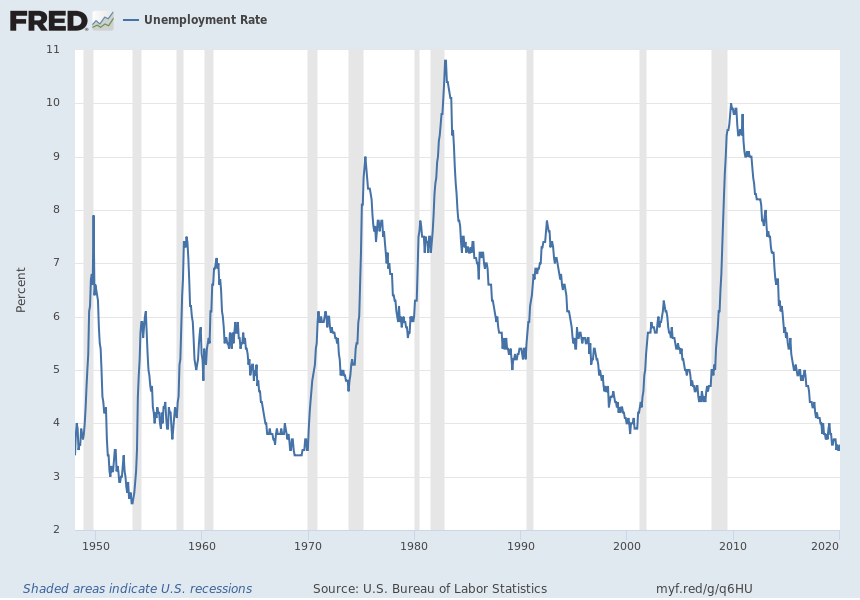
Is the U.S. economy already in recession? How can it be with more than 80 percent of the adult workforce employed? But that isn’t how recessions actually begin, as portrayed in the above St. Louis Fed unemployment rate history dating from 1950.

The latest COV-19 coronavirus news makes it a virtually certainty that the U.S. economy could go into recession this year. Why? America’s record income inequality—the worst since 1928 prior to the Great Depression—means many cannot afford to be quarantined from their work when it becomes a real pandemic that affects all of the United States.

A recent Brookings Institute study found that 44 percent of U.S. workers are employed in low-wage jobs that pay median annual wages of $18,000. And most of the 53 million Americans working in low-wage jobs are adults in their prime working years between about 25 to 54. Their median hourly wage is $10.22 per hour — above the federal minimum wage of $7.25 an hour but well below what's considered the living wage for many regions.

Recessions begin when the economy, based on four major indicators such as the unemployment rate, manufacturing and trade, and personal incomes have peaked; i.e., no longer continue to rise as determined by a Business Cycle Dating Committee of the National Bureau of Economic Research (NBER).

The NBER website states it thusly: “We identify a month when the economy reached a peak of activity and a later month when the economy reached a trough. The time in between is a recession, a period when economic activity is contracting. The following period is an expansion.”

The worldwide spread of the COVID-19 virus means a wholesale slowdown of economic activity in coming months. We are already seeing a slowdown in several U.S. sectors—especially manufacturing—and growth may have peaked in the consumer-driven service sector as well, though not yet contracting.

If American workplaces are shut down, as they are in China, S. Korea, Italy, Iran, and parts of Japan, these workers that have neither health plans to pay for sick-leave (a full 25 percent of the lowest paid service workers have no paid sick-leave coverage), or savings to fall back on until they can return to work, would have to rely on unemployment insurance or welfare.

Millions could therefore become unemployed, as happened during the Great Recession. One worrisome similarity is that stocks recently dropped to lows last seen during the Great Recession.
In other words, the U.S. is totally unprepared for any significant epidemic, or a pandemic, as CDC officials are warning. So how do we know when economic activity has peaked and begins a sustained fall?

The Great Recession began in December 2007, yet the unemployment rate had been rising for six months—from its low of 4.4 percent in June 2007 to 5.0 percent in December. And it wasn’t the Fed that declared it a recession 12 months later, but the NBER’s Business Cycle Dating Committee based at Harvard, as I have said.

The Business Cycle Dating Committee waited until December 1, 2008, a year later, to declare that the Great Recession had started in December 2007 to be sure that the rise was a continuing trend, though the unemployment rate didn’t peak and begin to come down until October 2009; at 10.0 percent, 4 months after the recession was declared to have ended!

This is not to say that is always how recessions begin, but recessions are measured from a peak of activity to its ‘trough’, as I said, when activity begins to pick up again—a total of 18 months in the case of the Great Recession.

Why do recessions begin when they do? The Great Recession in particular began because consumers and banks became so heavily indebted building too much housing in an earlier era of very low interest rates, and housing values began to decline that had been rising in double digits earlier in the decade.

Alan Greenspan’s Fed had then raised interest rates for 2 years in an attempt to slow inflation that had also reached double digits. And borrowers then began to default on their rising mortgage payments that they could no longer afford.

The U.S. economy is facing such a dangerous journey through this outbreak of the coronavirus that CNN Doctor Sanjay Gupta has said is 20 times more deadly than the ordinary flu based on initial studies, as I said last week, and WHO now says has a fatality rate of 3.4 percent, almost 40 times that of the ordinary flu.

There are 128 cases and 11 deaths, according to the latest figures from Johns Hopkins Whiting School of Engineering’s Centers for Systems Science and Engineering, including among 45 people who were repatriated from the Diamond Princess and from Wuhan, China, the city that first detected the virus in December. Six people are counted as recovered in the U.S.

Worldwide in 70 countries there are now 94,259 cases of COVID-19, at least 3,214 deaths, and about 55,393 people that have recovered primarily in China's Hubei Province.

The greatest danger to the U.S. economy is a sharp cutback in consumer confidence and spending, since it is consumers that are now keeping economic growth at 2.1 percent with the 6-month decline in manufacturing activity mainly due to the trade wars. And the COVID-19 outbreak means further supply disruptions.

Harlan Green © 2020

Follow Harlan Green on Twitter: https://twitter.com/HarlanGreen

Thursday, January 9, 2020

Why the Irrational Exuberance In Such A Dangerous Year?

Financial FAQs


We are now living in a much more dangerous world, because there is the possibility of war in the Middle East that is accompanying the various trade wars waged by the “Make America Great” White House.

In fact, it may have already begun with the “revenge” missile attacks by Iran against two Iraqi military bases housing U.S. personnel—though no casualties were reported. My wonder is that stocks are rallying on the news, with the DOW Jones up 200 points at this writing. Have stockholders forgotten the irrational exuberance reigning during Fed Chairman Greenspan’s tenure in the last decade?

It was such that Greenspan, et. al., raised the Fed’s interest rates 16 times (a total of 4 percent) over 2 years, which ultimately led to a busted housing bubble and the 2017-19 Great Recession that hasn’t been a full recovery for the majority of Americans.

In fact, median household incomes are still at 1970’s levels when inflation is subtracted, because most of the growth has been in stocks owned by just 50 percent of households, not with the wages and salaries of working folk. Hence the record income inequality that isn’t getting better, even at full employment.

And what if stocks plunge again as during the Great Recession that lost an estimated $9 trillion in value, with housing values also declining almost as much (the mainstay of middle class wealth)?
Greenspan had held rates too low for too long to finance the Bush/Cheney Iraq and Afghanistan occupations while cutting taxes at the same time, resulting in rising inflation and the largest federal budget deficit of the time.

In fact, we seem to be at the beginning of another period of irrational exuberance. The Fed dropped interest rates three times last year to boost slowing economic growth.

Manufacturing activity has been declining for the last five months, per Reuter’s Wrightson ISM Manufacturing Index graph above, mainly due to the various tariff hikes that bumped up prices on European and Chinese imports.

The service industries have been declining from a higher level of activity to the current 55 percent, reflected in the latest ISM non-manufacturing survey (also see graph, where a 50 percent result of those surveyed means breakeven growth).
“The upside surprise (of non-manufacturing survey) was almost entirely due to the subjective general business activity index, which rebounded by nearly six points to 57.2,” said Reuters.  “The employment and new orders indexes both fell.  The drop-off in employment was minimal (down 0.3 to 55.2), but the orders index fell off noticeably (down 2.2 points to 54.9, versus an annual average of 57.5). ”
Also important is the effect on world oil prices and economic growth in general, as I said in my last column, since the only reason the U.S. economy is continuing to grow is the very low inflation coupled with very low, recession-level interest rates. And that can’t be maintained if oil prices spike for some reason.


We are skating on thin ice, economically, as I said, even if oil prices and inflation don’t spike as they did during the early and mid-2000s. Oil may not be as important, but 39.7 million Americans still live at or below the U.S. poverty level, which is $21,300 for a family of three in 2017, per the U.S. Census Bureau, and median household incomes after inflation are not improving.

So the real question is why on earth did the U.S. kill Iran’s leading general and several Iraqi militia commanders at a time of recovery from the Great Recession, slowing worldwide growth, amid growing geopolitical uncertainty?

It has to be another form of irrational exuberance held by certain parties that believe this will make America Great Again, but without the friends and alliances that made America great until now.

Harlan Green © 2019

Follow Harlan Green on Twitter: https://twitter.com/HarlanGreen
Monday, January 28, 2019

What is a Living Wage?

Answering the Kennedys Call

The Washington Post published a recent interview with new Democratic House Member Alexandria Octavia-Cortez in which she said, “I think it’s wrong that a vast majority of the country doesn’t make a living wage, I think it’s wrong that you can work 100 hours and not feed your kids. I think it’s wrong that corporations like Walmart and Amazon can get paid by the government, essentially experience a wealth transfer from the public, for paying people less than a minimum wage.”

Is it true that most Americans don’t make a living wage? Actually, that is not the right question we should be asking, which has been the subject of endless debate, anyway. What constitutes a living wage has to be different for each individual. Wouldn’t someone born and raised amid extreme wealth, say, have what they consider a far different living wage than a religious ascetic?

That’s an extreme example, but why not concentrate on what I believe Congresswoman Cortez is really talking about—fair play for the majority of Americans? There are maybe 25 percent who live at or below the poverty line that must work more than 40 hours per week to even make ends meet, depriving them of family, or enough leisure time to enjoy themselves. Europeans seem to have conquered the problem in countries like Denmark and the Netherlands, where the average workweek is 34-36 hours, with four weeks' paid vacation and universal health care for their citizens.

Meanwhile, American conservatives have worked to lower taxes on the wealthiest, while enhancing the monopoly powers of corporations since at least 1980. It has resulted in the greatest income inequality in the U.S. since 1928, the wealthiest country in the world, as illustrated by this well-known Piketty-Saez graph.


The result has not been good for a participatory democracy. The American electorate has become polarized, which has brought out the worst in human nature—including anti-immigrant racism, white nationalism, and the tearing down of government regulations that safeguard health and the environment. The consequence is a much reduced middle class that once maintained civility in political discourse.

Even conservative Barron’s Magazine editor Randall Forsythe mentions a 2017 Federal Reserve Consumer Finance study that showed the huge wealth disparities during the recent federal government shutdown—four in 10 Americans would have difficulty in meeting a $400 emergency expense—while the top 1 percent of income earners now own 50 percent of stock holdings.

PEW Research in a 2018 report, reports that year-over-year average hourly earnings have been rising at 2 to 3 percent. “After adjusting for inflation, however, today’s average hourly wage has just about the same purchasing power it did in 1978, following a long slide in the 1980s and early 1990s and bumpy, inconsistent growth since then. In fact, in real terms average hourly earnings peaked more than 45 years ago: The $4.03-an-hour rate recorded in January 1973 had the same purchasing power that $23.68 would today.”
We are seeing the results of the singular focus on private profits rather than public welfare spending that should include adequate healthcare, improved infrastructure, and educational facilities that would elevate America back into the pantheon of western countries, instead of becoming an outlier that is withdrawing from the developed world.

Maybe we are also seeing how the word socialism is beginning to scare the wealthy to return some of their newly-begotten wealth to bring back a democracy that benefits the majority of Americans.

Harlan Green © 2019

Follow Harlan Green on Twitter: https://twitter.com/HarlanGreen

Wednesday, September 5, 2018

What Happens When Poverty Exists in the Valley of Plenty?

ANSWERING THE KENNEDYS CALL TO ACTION


Poverty in the Valley of Plenty is a documentary film that then California Congressman Richard Nixon and growers in the San Joaquin successfully sued to have banned for defamation. It was about the working conditions that early post-WWII farmworkers still suffered under. I was able to show a banned copy of the film to the United Farmworkers of America that had been produced by the Hollywood trade unions when I was a member of the UFW

In 1948, the National Farm Labor Union and Hollywood filmmakers who hated the virulently anti-union big farm grower DiGiorgio Fruit, the largest grape, plum, and pear grower in the world, made the film titled Poverty in the Valley of Plenty to expose the terrible conditions of the farmers. In 1947, DiGiorgio responded to a strike by firing all the strikers and replacing them with a combination of Filipinos, undocumented workers, and migrants coming to the U.S. through the Bracero Program. The last of these was an illegal move against the agreement between the U.S. and Mexico that explicitly stated braceros were not to be used as strikebreakers. The unions hated DiGiorgio so much that they waived all their wage and hour contracts to get the film made.

The conditions of farmworkers in the 1950s were such as portrayed in John Steinbeck’s The Grapes of Wrath during the Great Depression The film portrayed poor farmers from the Dust-bowl that could only find work in California’s crop-filled valleys—under conditions that aren’t much different from many of today’s lower income workers.

We have as much of a problem for at least 25 percent of working Americans that earn no more than the poverty rate for a family of four--$25,100/year in 2018, according to the U.S. Department of Health and Human Services.

Who are they? Many are single-adult families with children—mostly mothers barely making ends meet in menial jobs. The Oxford economist Robert Allen recently estimated needs-based absolute poverty lines for rich countries that are designed to match more accurately the $1.90 line for poor countries, and $4 a day is around the middle of his estimates. When we compare absolute poverty in the United States with absolute poverty in India, or other poor countries, we should be using $4 in the United States and $1.90 in India.
“Once we do this, there are 5.3 million Americans who are absolutely poor by global standards. This is a small number compared with the one for India, for example, but it is more than in Sierra Leone (3.2 million) or Nepal (2.5 million), about the same as in Senegal (5.3 million) and only one-third less than in Angola (7.4 million). Pakistan (12.7 million) has twice as many poor people as the United States, and Ethiopia about four times as many.”
Author Robert Putnam (Bowling Alone), in his book "Our Kids: The American Dream In Crisis," looks at another angle: the way income inequality is trickling down to our public education system.
Putnam points out that Americans of different classes and educational backgrounds are increasingly living apart from each other: either in educated, wealthy enclaves or the inverse—poverty again in the valley of plenty. That has a negative and stratifying effect on schools, particularly on schools in poor areas.
"What we know very well is that when rich kids go to school, in their backpack they bring their parents' aspirations, their parents' resources, their parents' trips to France, their allusions to Proust or whatever, and that benefits all the kids in town," Putnam said..”
"When poor kids go to school, they're bringing in their backpack gang violence—even if they're not personally involved—they're coming from very poor neighborhoods, they bring disarray from home, hunger at home, and those factors affect everyone else," he continued in a PBS TV interview.
The Nation Magazine cites a recent Education Law Center and Rutgers Graduate School of Education report that exposes the tremendous inequality in educational opportunities of elementary school students within wealthy and poor school districts and states. It highlights Professor Putnam’s central thesis; by worsening the chances of success of lower-income children, already hindered living in poor neighborhoods within dysfunctional family structures, it hurts all Americans.

Putnam cites the findings of Clive Belfield, an associate professor of economics at Queens College, City University of New York: “The aggregate lifetime burden of failure to face the woes of poor youth is $1.59 trillion for taxpayers and $4.75 trillion for the larger society in lost earnings, lower economic growth and lower tax revenue beyond direct costs in welfare.”

An inadequately educated public diminishes the chances democracy itself will survive, as well.

Harlan Green © 2018

Follow Harlan Green on Twitter: https://twitter.com/HarlanGreen

Friday, September 16, 2016

Poverty Level Down, As Incomes Surge

Popular Economics Weekly

Fewer Americans lived in poverty in 2015 and median incomes charted their first increase since the Great Recession, according to data released Tuesday by the Census Department. The official poverty rate fell 1.2 percentage points between 2014 and 2015 to 13.5 percent, and the number of people in poverty fell by 3.5 million, Census said. The threshold for a family of two adults and two children to be considered living in poverty was $24,036.


And new data showing middle-class household incomes growing at the fastest rate since the recession seemed to confirm that a recovery that’s remained slow and uneven is finally touching the lives of ordinary, especially middle-class Americans.


In fact, this could be the income growth needed to bring US back to 3 percent GDP growth; something that hasn’t happened since 2007 before the Great Recession. Millions of Americans escaped poverty last year and incomes rose at their biggest gainever, as the 6-year long economic recovery finally hit home for households. Median middle-class wages surged 5.2 percent between 2014 and 2015, the Census Department said Tuesday, the first annual increase since 2007, just before the economy plunged into recession.

This is in large part due to almost non-existent inflation, which has not returned to even the Fed’s 2 percent target, hence the reluctance of Janet Yellen’s Federal Reserve to raise interest rates at all this year. But that may change, as rising wages also have an effect on inflation, since wages make up some two-thirds of product costs.

An even better way to increase growth is to invest more in what would grow our economy; like infrastructure, education, R&D, the environment, etc. That’s why productivity has ground to a halt, which is the main driver of future growth.

At least 43 companies plan to cut, or leave unchanged, their capital spending levels in 2016, while about 20 are increasing, according to a Reuters review of Standard & Poor's 500 companies that have given explicit early guidance.

However, Citibank seems to disagree. It’s mainly the energy sector that has cut back on new investments due to the slump in energy prices. This, however, is boosting growth in capex spending in other sectors, says Tobias Levkovich, Citigroup chief equity strategist. There's no reason to think stock buybacks, the current straw man for the lack of productive investment, are replacing capital expenditures. Rather, he said, they are complementing them.
"While misperceptions abound when it comes to companies allegedly not investing in their businesses and preferring to buy back stock instead, there is little corroborating evidence," Levkovich argued. "S&P 500 companies have had capital investment dollars ahead of the amount used for buybacks for more than four and a half years and capex has hit a record every year since 2011."
And a major reason for this is the low cost of capital is today’s low inflationary environment. So there is good reason to keep interest rate as low as possible, until we see signs of more normal GDP growth.

Harlan Green © 2016

Follow Harlan Green on Twitter: https://twitter.com/HarlanGreen

Friday, May 22, 2015

Higher Minimum Wage Strengthens Labor Unions

Popular Economics Weekly

Unions may have been weakened by Republican efforts to abolish labor’s collective bargaining power, (in order to weaken their support of Democratic Party policies), but that may be changing as unions have found a new cause—working to raise minimum wages.

Los Angeles is the latest city to raise the minimum wage—to $15/hour in 5 years. Los Angeles is the fourth city, and by far the largest, to enact a $15 minimum in the past year, reports the New York Times. The others are Seattle, San Francisco and Emeryville, Calif. (near San Francisco). A $15 minimum has been proposed in New York City, Washington, D.C., and Kansas City, Mo.

And labor unions in the service industries are behind the push. This is exactly what unions are good at—encouraging higher wages in non-union businesses to match union benefits, such as at MacDonalds, Walmart, and even Facebook. The vote by the Los Angeles City Council was 14-1 in favor. This means it is now on the national agenda.

The $7.25/hour national minimum wage was last set in July 2009. And, according to the University of California Davis Center for Poverty Research, in 2013:

  • Five Southern states (Louisiana, Mississippi, Alabama, Tennessee and South Carolina) have no minimum wage laws.
  • Four states (Wyoming, Minnesota, Arkansas and Georgia) have state minimum wage rates that are lower than the federal rate, so the federal minimum wage applies.
  • Twenty states have laws that set the minimum wage at the federal rate.
  • Twenty-one states and the District of Columbia set their rates higher than the federal rate. Currently the state of Washington has the highest minimum wage rate at $9.32 per hour.

Unions had been stymied by outright banning of collective bargaining, or even the requirement that members don’t have to pay dues when joining a unionized shop in many of the right to work states—25 at last count, all controlled by Republican legislatures. It is a I win-You lose bargain that Republican legislatures have made with workers in their own states. The outright suppression of workers’ wages only weakens economic growth, and indeed the reddest states with the strongest anti-union laws are also the poorest.

Several other cities, including San Francisco, Chicago, Seattle and Oakland, Calif., have already approved increases, as we said, and dozens more are considering doing the same. In 2014, a number of Republican-leaning states like Alaska and South Dakota also raised their state-level minimum wages by ballot initiative.

The 67 percent increase from the current California state minimum will be phased in over five years, first to $10.50 in July 2016, then to $12 in 2017, $13.25 in 2018 and $14.25 in 2019. Los Angeles businesses with fewer than 25 employees will have an extra year to carry out the plan. Starting in 2022, annual increases will be based on the Consumer Price Index average of the last 20 years. The LA City Council’s vote will instruct the city attorney to draft the language of the law, which will then come back to the Council for final approval.

image

Graph: EPI.org

This can only strengthen collective bargaining efforts in other states, a plus for union organizing efforts. Household incomes for most Americans have been declining since 1979. The above columns show real annual income growth from 1947-79 (blue) , and from 1979 to 2015(red) . It highlights the tremendous income inequality for the poorest Americans since then, partly due to the current national minimum wage of $7.25/hour.

“The effects here will be the biggest by far,” said Michael Reich, an economist at the University of California, Berkeley, who was commissioned by LA city leaders to conduct several studies on the potential effects of a minimum-wage increase. “The proposal will bring wages up in a way we haven’t seen since the 1960s. There’s a sense spreading that this is the new norm, especially in areas that have high costs of housing.”

The groups pressing for higher minimum wages said that the Los Angeles vote could set off a wave of increases across Southern California, and that higher pay scales would improve the way of life for the region’s vast low-wage work force.  Actually, it is already happening nationally, and popular even in the right to work states that have suppressed workers’ right for so long.

The push for a $15-an-hour minimum wage is not confined to populous coastal states, said the New York Times. In Kansas City, Mo., activists recently collected enough signatures to put forward an August ballot initiative on whether to raise the minimum wage to $15 by 2020. The City Council is deliberating this week over how to respond and could pass its own measure in advance of the initiative.

Of course, there is an additional bonus to state budgets for raising the minimum wage. It takes many of those income earners at the bottom off state assistance programs like Medical, food stamps, and even welfare rolls. Why shouldn’t everyone support such a grand bargain?

Harlan Green © 2015

Follow Harlan Green on Twitter: https://twitter.com/HarlanGreen

Wednesday, March 25, 2015

A Ted Cruz Presidency?

Financial FAQs

Texas Senator Ted Cruz is about to announce his candidacy for the 2016 presidential campaign. What would his presidency look like, if he were elected? “Mr. Cruz has also begun championing a message of economic populism,” said the NYTimes on his announcement of candidacy, “denouncing income inequality and borrowing the “two Americas” metaphor used most famously by former Senator John Edwards in two unsuccessful campaigns for the Democratic presidential nomination.”

Let’s start with his silliest proposal to abolish the IRS. It tells us how he really views income inequality. There would then be no means to collect the taxes that pay his Senator salary. So he would have to work for nothing. Is that how he will tackle the scourge of income inequality afflicting those Americans that work for little or nothing?

We also know what his presidency might look like from another far right Tea Party favorite and potential candidate’s agenda; Wisconsin Governor Scott Walker. Walker’s first priority has been to downgrade union organizing and education funding in Wisconsin, in order to deprive Democrats of union support, as well as dumb down his own electorate. The result has been the lowest job creation and growth rates of all neighboring states.

Senator Cruz’s programs would have a similar result—would in fact increase income inequality—as he has opposed every economic program that would better ordinary Americans’ lives, including raising the minimum wage. “If you raise the minimum wage, the inevitable effect will be, number one, young people will lose their jobs or not be able to get their first jobs,” he said in 2013 in reaction to President Obama’s inauguration speech that included a call to raise the national minimum wage to $9 per hour.

But history has shown just the opposite effect. Where ever the minimum wage has been raised—such as in Seattle, Washington where it is $15/hr., or the state of Minnesota, where it will be $9.50/hour for large employers in 2016, employment is thriving. Seattle’s unemployment rate is now under 5 percent, and Minnesota’s unemployment rate has dropped to 3.6 percent, the lowest in 13 years.

He also opposes any climate change legislation that would reduce our dependence on carbon-creating fossil fuels, including his support of the Keystone XL Pipeline, and more offshore oil drilling. Yet even the Pentagon has documented the extreme economic costs, including future wars, of ignoring the effects of Global Warming.

And how about his call for greater liberty? He also opposes all forms of amnesty for Illegals, or ‘undocumented’ immigrants, though he’s the son of a Cuban-born immigrant. This would greatly restrict the freedom of those immigrants to become American citizens, of course.

Cruz has particularly stressed his opposition to President Obama’s executive actions on immigration, said the PBS Newshour. The Texas senator filed a bill blocking the president’s actions, which allow more undocumented residents to gain legal status, including the administration’s waivers for young people brought to the U.S. as children. Cruz argues that those actions encouraged increased illegal immigration.

And how about his call to dissolve the Affordable Care Act? Killing Obamacare would increase the poverty of the poorest and sickest among US that cannot afford, or would be ineligible for private health care insurance.

No, Senator Cruz’s presidency would neither create more liberty, nor better the lives of the poorest that suffer most from income inequality. Those liberties have been under steady assault by Tea Party members, in particular, with their no compromise positions on even the most basic poverty alleviating programs.

So his words don’t match his actions. Isn’t that called pandering, when a politician will say anything to win votes?

Harlan Green © 2015

Follow Harlan Green on Twitter: https://twitter.com/HarlanGreen

Wednesday, December 10, 2014

The Economic Consequences of Too Much Inequality

Financial FAQs

A new report released by the World Economic Forum, ranks rising inequality as the top trend facing the globe in 2015, according to a survey of 1,767 global leaders from business, academia, government and non-profits, many of whom convened recently in Dubai.

image

Its effects are barely known to economists, much less politicians. The U.S. has far and above the greatest income inequality in the developed world, as well as the highest crime and prison incarceration rates. Yet even economists such as Nobelist Paul Krugman can’t agree that this has had a measurable effect on economic growth!

image

Graph: The Spirit Level

Then what economic growth are we discussing when so many working age men (and women) are in prison, 2,300,000 at last count, the minimum wage is still $7.25 in most states, and we have had 5 recessions since 1980? Economists can’t be looking at the 90 percent of Americans that haven’t experienced any economic growth since 2009, and the recovery from the Great Recession.

The soaring inequality today matches that of 1928 before the Great Depression, and it is causing irreparable damage to our economy. Yet very little has been done about it, other than the American Recovery and Reinvestment Act’s $835 billion stimulus package of 2009 that saved or created some 3 million jobs according to the Congressional Budget Office, but whose effect petered out quickly in 2010 and reduced GDP growth to 2 percent until recently.

Economic growth has resumed with 321,000 nonfarm payroll jobs created in November, but 8 million jobs and at least $6 trillion in economic output were lost during the Great Recession, and . And with a Republican congress taking over in January, economic forecasters such as Macroeconomic Advisors are not optimistic about more job creating programs in the works due to a resumption of the budget battles soon to come, in spite of Republican protestations from new Senate Majority Leader Mitch McConnell that there will be no more government shutdowns.

Joel Prakken, a Macroeconomic Advisors co-founder, cited the effect further budget battles could have on growth in the New York Times. Past fights and the ensuing downgrade of U.S. government debt has cost approximately 1 percent in economic growth, which means instead of the 2.15 GDP growth average since Republicans took over the House in 2011, we could have had 3 percent plus growth and many more jobs.

How does inequality most affect growth? The classic answer is that since consumers power some 70 percent of economic activity, their spending power must be the driver of growth, and they cannot spend or save more with declining incomes, as the graph should make abundantly clear.

But it must be a quality of life issue, as well. How can we continue to live well in the most violent society in the developed world, with outmoded public infrastructure and educational facilities?

Richard Wilkinson and Kate Pickett’s The Spirit Level, a 30-year study of the effects of inequality, has said it best.

“Research has shown that greater inequality leads to shorter spells of economic expansion and more frequent and severe boom-and-bust cycles that make economies more vulnerable to crisis,” say Wilkinson and Pickett. “The International Monetary Fund suggests that reducing inequality and bolstering longer-term economic growth may be "two sides of the same coin". And development experts point out how inequality compromises poverty reduction.”

The consequences of growing inequality are too great to ignore.  We now know from history what they are—two great economic downturns that can only be corrected with a return to the values that have made the U.S. great—economic justice for all.

Harlan Green © 2014

Follow Harlan Green on Twitter: https://twitter.com/HarlanGreen

Saturday, November 29, 2014

Republicans Just Don’t Get It--II

Financial FAQs

Why don't Republicans get it? The 11 million illegal immigrants who have lived and raised families in the U.S. is the latest millstone around their necks that derails any hope of a Republican presidency. Last year a bi-partisan Senate passed a bill on a 68 to 32 vote that would eventually allow them citizenship, but John Boehner refused to bring it up to a House vote.

And so President Obama just issued a directive that will defer 5 million illegals from any legal action, which polls show 85 percent of Hispanics support. And we are a country founded by immigrants with every ethnic and racial group protected by our constitution.

Republicans haven’t really gotten it since the 1970s, when they supported policies to maximize profits at the expense of jobs and household incomes by weakening government oversight and regulations. It is a well-documented story of poor job creation and middle class income reductions that enabled the massive transfer of wealth (and power) to business owners and corporate CEOs—the investor class—and away from their employees that has continued today.

image

Forbes.com

Yet a country is only as strong and able to care for and protect its citizens as its government. That’s been the history lesson that today’s Republican leaders have forgotten—the lessons that earlier Republicans knew. It was Republican Presidents, such as Eisenhower that built our freeway system (when the maximum income tax rate was 92 percent), and President Nixon signed the Clean Air Act with a unanimous Senate.

The 1970s soon changed such cooperation. Republicans and their business interests began creating policies that made government more business friendly and less middle class friendly. Maybe it was the Arab Oil Embargo and the realization of how vulnerable we were to a disruption of energy supplies. It was also the era of so-called stagflation that lasted until 1980 with its sky high inflation and devalued assets.

We saw the growth business friendly lobbies, such as the Business Roundtable that began to spend heavily to influence elections and ease trade restrictions. That’s when President Reagan sounded the death knoll for unions (and collective bargaining) with the firing of Air Traffic Controllers in the PATCO strike. Corporations suddenly found it easier to terminate their employees and export those jobs and manufacturing plants overseas.

Household incomes began to shrink forever after, as President Reagan pushed through cuts in the maximum income tax rates for the wealthiest that had enabled Presidents Eisenhower to build our public infrastructure (when the maximum income tax rate was 92 percent), and Johnson to finance the Great Society that lowered poverty rates.

It was the beginning of President Reagan’s Trickle Down economic policies that his Budget Director David Stockman (in The Triumph of Politics) soon realized created horrendous budget deficits, with very little trickling down to the middle classes and below.

It made the conservatives credo of self-sufficiency a lie, as Republicans now blocked any attempt to raise the minimum wage. For how could families be self-sufficient and live on a minimum wage, unless they held two and three jobs, thus harming their families, and children of any chance for a good education?

Republicans have continued their all-out assault on government with their attempts to defund Obamacare that how insures tens of millions for the first time at lower costs, while continuing their efforts to privatize social security and Medicare.

Even public safety has been compromised with their refusal to help states rebalance their budgets that resulted in the loss of so many public employees during the Great Recession, such as police and teachers.

There is in fact no area that Republicans haven’t weakened the public commonweal. Every one of the Democrats’ infrastructure and job creation bills since 2011 have been blocked by either Senate or House Republicans in the name of paying down the public debt. Yet the productivity improvements and increased tax revenues generated by those jobs and an upgraded infrastructure are the only way to pay down that debt. And Republicans backed by their conservative lobbyists will no doubt continue to do so, until our road and bridges are no longer drivable.

It is a sad state of affairs when Republicans are no longer the wealth creators, but have become the party of no. Instead of finding ways to increase our productive capacity and boost household incomes, which are the real wealth creators, they continue to benefit the few at the top of the food chain, most of whom are only interested in enriching themselves.

PS—In an update of the 2012 jobs chart shown above, more net jobs have been created under Obama — 5,142,000 as of the August jobs report — than under George H.W. Bush — 2,637,000 — and George W. Bush — 1,282,000 — combined, according to the Federal Reserve Bank of St. Louis.

Harlan Green © 2014

Follow Harlan Green on Twitter: https://twitter.com/HarlanGreen

Friday, September 19, 2014

Who Are the Real Takers?

Popular Economics Weekly

We have been there before. The Census Bureau reported that the poverty rate fell in 2013, the first drop since 2006. It fell to 14.5 percent, down from 15 percent in 2013, but 45.3 million people are still living at or below the poverty line, which for a family of four was $23,834.

Then who are the real "takers" that have held up economic growth and more jobs? It's can’t be the 47 percent that conservative polemicists and many of the 2012 presidential candidates maintained didn't pay federal income taxes. Three-quarters of entitlement benefits written into law in the United States go toward the elderly or disabled. That's according to the Center on Budget and Policy Priorities.

And it’s more than 90 percent of entitlement benefits when working households are included. Only about 9 percent of all entitlement benefits go toward non-elderly, non-disabled households without jobs (and much of that involves health care and unemployment insurance)

We should really be looking at those whose incomes have soared due to their success in slashing their own tax bills during difficult economic times, while blocking government job creation that would employ more of the 47 percent. The top 1 percent has taken 97 percent of income growth since the end of the Great Recession.

This is the first statistically significant decline in poverty since 2006 (and only the second since 2000). But the rate remained well above its 12.5 percent level in 2007 and even further above its 2000 level of 11.3 percent. At last year's rate of improvement, we would need to wait until 2018 for it to fall to or below the 2007 pre-recession level, and until 2020 to fall below the 2000 level, according to the Center For Budget and Policy Priorities.

Why do we have such a high poverty rate 5 years after the end of the Greatest Recession since the Great Recession? Who are the real takers that have not only created the greatest income and wealth inequality since the Great Depression that has created such dire poverty, but weakened our economy and power to maintain democratic values in the world?

FDR in his second inauguration speech said, “The test of our progress is not whether we add more to the abundance of those who have much, it is whether we provide enough for those who have too little.”

For starters, the red states controlled by Republicans have fought to downsize almost all government funded programs such as Medicare, food stamps, and Obamacare, yet they receive the largest share of government benefits, says Wallet Hub, a consumer finance blog.

For instance, South Carolina receives $7.87 for every $1 it pays in taxes. Mississippi and New Mexico, two of the most Red states, are ranked 40 out of 50 states in receiving the most in federal benefits, yet consistently vote for conservative policies that seek to limit government spending and benefits. And that includes badly needed spending on education, deteriorating infrastructure, and environmental regulation, all of which would provide more jobs in the underemployed U.S. economy.

This is an issue of our time, as we come severely weakened out of the Greatest Recession since the Great Depression. The takers are those who want it all, and the evidence is there for all to see—a weakened economy and a government lacking the powers to “stop evil and do good”.

“Nearly all of us recognize that as intricacies of human relationships increase,” said FDR in 1936 at the height of the Great Depression, “so power to govern them also must increase—power to stop evil; power to do good. The essential democracy of our nation and the safety of our people depend not upon the absence of power, but upon lodging it with those whom the people can change or continue at stated intervals through an honest and free system of elections.”

And so the real takers are also those who support ALEC, the American Legislative Exchange Council, or the Koch Brothers’ Americans for Prosperity that boilerplate legislation that has restricted voters’ rights by passing voter ID laws, restricting voting hours and anti-union collective bargaining, which are fundamental rights in any democracy.

It is mainly those conservative polemicists and presidential candidates who damn government in order to better their own financial position. And they have succeeded in lowering the maximum marginal tax rates from 92 percent during the Eisenhower presidency to its current low of 39 percent.

They have been so successful in taking from the wealth created by the many that the richest 10 percent now control some 50 percent of U.S. wealth, and most of the incomes growth since the end of the Great Recession, as we said.

Thomas Piketty, in his best-seller, Capital in the Twenty-First Century, perhaps said it best in attempting to explain why income and wealth inequality has worsened so much, brought about by lower taxation of the wealthiest.

“…the spectacular decrease in the progressivity of the income tax in the United and States and Britain since 1980, even though both countries had been among the leaders in progressive taxation after World War II, probably explains much of the increase in the very highest earned incomes,” he said.

Why lower taxation? Piketty explains it thusly. “Our finding that skyrocketing executive pay is fairly explained by the bargaining model (lower marginal tax rates encourage executives to bargain harder for higher pay) and does not have much to do with higher marginal productivity.”

There are several ways such record inequality slows growth. Firstly, growth is powered by what is called aggregate demand, the demand for goods and services that consumers, government, and investment generates. And since consumers power some 70 percent of economic activity and governments another 20 percent, when their spending declines, so does economic growth.

top-1

It is this record inequality that was the main cause of both the Great Depression and Recession, as declining incomes and cutbacks in government spending drastically reduced the demand for those goods and services. The years 1929 and 2010 were the years of greatest income inequality and greatest economic instability, according to Piketty and research partner Emmanuel Saez.

And economic growth has been steadily declining over the past 3 decades. It has averaged just 2 percent since the end of the Great Recession in 2009. There are numerous studies, including by the International Monetary Fund and Nobelist Joseph Stiglitz among others, that affirm the negative effect on growth of such inequality.

In fact, a recent IMF report said that “inequality can undermine progress in health and education, cause investment-reducing political and economic instability…which tends to reduce the pace and durability of growth."

So if we want to preserve our democracy, and help other countries towards greater democracy (instead of breeding more terrorism), we can no longer afford to allow the real takers to continue to take it all. The world has become too dangerous.

Harlan Green © 2014

Follow Harlan Green on Twitter: https://twitter.com/HarlanGreen

Friday, September 12, 2014

Minimum Wages vs. Maximum Profits?

Financial FAQs

Corporate profits are at all-time highs, and workers compensation at all-time lows, as fast food workers continue to strike for higher minimum wages. Yet business interests still maintain maximum profits have to be a corporation’s primary consideration. In fact, it would be breaking their corporate charters to operate otherwise!

Actually, not so. Maximizing corporate profits at the expense of everything else—such as environmental pollution—is no longer allowed. And workers have some protections, such as safety regulations under OSHA, and limitations on the number of work hour’s minimum compensation. Then why has the glorification of profit maximization enriched stockholders and CEOs, but not their employees?

One answer is the resistance of businesses to raising the minimum wage. Some states have raised the minimum wage, such as California, and cities such as Seattle. But it’s still $7.25 per hour for most states. This is even though many studies show that higher wages create greater prosperity overall. For instance, Australia, where the minimum wage for adult, full-time workers is $16.87 per hour, currently has a 3.1 percent annual GDP growth rate, vs. 2.5 percent in the U.S.

Nobelist Joseph Stiglitz, an advocate of greater income equality has said, “Our current brand of capitalism is an ersatz capitalism. For proof of this...we have monopolies and oligopolies making persistently high profits. C.E.O.s enjoy incomes that are on average 295 times that of the typical worker, a much higher ratio than in the past, without any evidence of a proportionate increase in productivity.”

epi

Graph: EPI

The hourly compensation of a typical worker grew in tandem with productivity from 1948–1973. But after 1973, productivity grew strongly, especially after 1995, while the typical worker’s compensation was relatively stagnant. This divergence of pay and productivity has meant that many workers were not benefitting from productivity growth—the economy could afford higher pay but it was not providing it.

A new survey of Harvard Business Alumni by the Harvard Business School entitled A Troubling Divergence in the U.S. Economy highlighted several of the reasons. Business leaders in America are reluctant to hire full-time workers. Instead, many prefer investing in technology to perform work, outsourcing to third parties, or hiring part-time workers. Only 27 percent of respondents reported that their firms engage with institutions like community colleges to prepare students with workforce skills.

And when it comes to updating the public infrastructure that would support greater productivity, forty-two percent of Business School respondents reported that the condition of infrastructure like airports, ports, and roads had declined over the past three years. For every respondent who thought infrastructure had improved, nearly five felt it had worsened.

In fact, private sector growth has been lacking in both job creation and investment in plants and equipment over the past 5 years since the official end of the Great Recession. Private sector capital stock, at 22 years of age, is the oldest it has been since 1958, said economist David Rosenberg, and is strongly suggestive of an upgrade cycle (not to mention the fact that America's spending on public infrastructure at a 20-year low!).

pubsector

Graph: Calculated Risk

The Calculated Risk graph pictures public sector jobs of both the national and state governments. It grew during Mr. Carter's term (up 1,304,000), during Mr. Reagan's terms (up 1,414,000), during Mr. G.H.W. Bush's term (up 1,127,000), during Mr. Clinton's terms (up 1,934,000), and during Mr. G.W. Bush's terms (up 1,744,000 jobs).

However the public sector has declined significantly since Mr. Obama took office (down 682,000 jobs). These job losses have mostly been at the state and local level, but more recently at the Federal level.  Needless to say, this has been a significant drag on overall employment.

Is it all due to the Great Recession? We think not. The voices of wage and salary earners have been drowned out since then, and raising the minimum wage has not been made a priority by either party in Congress, or the White House to date. That is the tragedy, and the real solution to this continuing economic malaise.

The most recent protests are part of a two-year campaign to raise awareness of the plight of the fast-food worker, the latest having taken place in May. While the demonstrations haven’t led to an increase in the federal minimum wage, some states and localities have upped the minimum wage. Seattle raised the minimum wage to $15 an hour and Massachusetts residents will soon see an $11-an-hour minimum wage, according to NBC News. McDonald's Corp. is on record saying it supports a federal minimum wage increase, but not to $15 an hour, as demanded by its workers.

Harlan Green © 2014

Follow Harlan Green on Twitter: https://twitter.com/HarlanGreen

Wednesday, September 18, 2013

What is a Real Minimum Wage?

Financial FAQs

The debate on how to boost this economic recovery has now shifted to the federal minimum wage standard, now at $7.25 percent per hour. This is in part because the latest Census Bureau report shows 46.5 million Americans living below the poverty line—15 percent of all Americans.  Raising the minimum wage should be a no-brainer, as such a wage is nowhere near even the income level that sustains a household working normal hours.  For instance, the current minimum wage comes to $15,080 per year with a 40-hour week vs. $23,492 as the official poverty level for 4 in 2012, reports the U.S. Census Bureau.

But there is an even more important reason.  Higher wages translate to higher spending.  And it is consumer spending in the main that drives the demand for goods and services, with government lending a helping hand.  Higher wages also lowers debt levels, since consumers and government then borrow less. So-called capital investments, the third leg of GDP growth, accounts for much less activity.

The main argument against a raise in the minimum wage from conservatives is that it hurts job creation because fewer workers would be hired due to higher labor costs.

Really?  It’s true that labor costs generally average some two-thirds of product costs, but unit-labor costs are at all-time lows, while corporate profits are at an all-time high, as a percentage of Gross Domestic Product. 

Even MacDonald’s has given their employees advice on how to live within their means on their ‘minimum’ wage of $8.25/hr. But the recommended budget posted on their website includes no money for food, clothing, healthcare, or gas-transportation expenses, but leaves room for a second job.  And, rent can only be $600 per month, which will rent just one room in a California home.

clip_image002

Graph: MilesCorak

It’s also true that the U.S. minimum wage is in 9th place of the developed countries with minimum wage standards led by Australia with its $16.37 minimum wage for fulltime working adults over 20 years of age.  The Australians are near full employment with their unemployment rate currently in the 5 percent range, by the way, lowest in the developed world.

clip_image003

Graph: Econoday

            The so-called Employment Cost Index put out by the Bureau of Labor Statistics really shows how little American wage and salary workers are earning, vs. during more prosperous times. It is up just 1.8 percent year-over-year.

So why isn’t the importance of a higher minimum wage understood? Much of the misinformation has to do with the advent of Reaganomics, or supply-side economics theory in 1980, which says that a greater share of wealth should be diverted to investors and producers of goods and services over government and the wage and salary workers. This all in the name of new product innovation and greater growth.

But that has been proven wrong in many ways.  For instance, businesses didn’t invest more domestically in the early years of the Reagan administration with their lower tax rates and extra profits.

And though some 15 million jobs were created during President Reagan’s term with lowered tax rates, 21 million jobs were created during President Clinton’s term, when tax rates were raised again.  And just over 1 million net jobs were created during GW Bush’s 8 years, with even more draconian tax cuts while fighting 2 wars.

            The result of policies that have favored ‘supply-side’ policies since then is the top 10 percent of earners took more than half of the country’s total income in 2012, the highest level recorded since the government began collecting the relevant data a century ago, according to an updated study by Saez and Piketty.  And 95 percent of all income growth since 2009 has been garnered by the top 1 percent of income earners.

            So actual results show the need for a higher minimum wage. The 1 percent have not increased production or created jobs in the face of declining real incomes, so it is time to shift some resources back to those who actually produce the wealth.

California is doing that with its just passed raise of the minimum wage to $10 per hour phased in with $1 in 2014 and another $1 by 2016. This still comes to just $20,800 per year with a 40-hour week. So even that amount doesn’t reach the poverty level for for a family of 4 today.

Harlan Green © 2013

Follow Harlan Green on Twitter: www.twitter.com/HarlanGreen

Tuesday, January 15, 2013

The Hunger Games Are Coming…

Financial FAQs

Was the Sandy Hook Elementary School massacre the sign of an apocalyptic future? Or the Aurora Theatre shootings by a cold-blooded killer?

The Hunger Games is a riveting portrayal of how the young see the modern world, where a privileged elite has a “Stalin-like” control over who lives in plenty or poverty in a post-apocalyptic North America. Author Susan Collins has said it "tackles issues like severe poverty, starvation, oppression, and the effects of war among others."

And the young just coming of age are not far from the truth. A vision of decline and limited opportunity fills the daily news. Declining resources and global warming could cause future wars, says the Pentagon. America has become a war zone with school children no longer safe and more than 10,000 gun-related deaths per year. Even Social Security and Medicare may not be available for future generations, say its Trustees.

In fact, a record number of Americans are already living below the poverty line, while University of California economist Emmanuel Saez found the top 1 percent of households garnered 65 percent of the nation’s income growth from 2002-07, the beginning of the recession.

And that is the problem. The U.S. doesn’t suffer from a scarcity of needed resources, or the means to finance adequate social services. It has been suffering from a redistribution of the wealth upward over the past 30 years that is no longer available to finance those means.

While overall household incomes (and consequent economic growth) have been steadily declining, the wealth of the top income brackets has been as steadily increasing. And the result is what the young see—a vision of scarcity in the real world that isn’t real. Modern industry has conquered the means of production. Rather, such scarcity results from a conscious policy by a politically powerful minority that demands more benefits for them while cutting benefits for all Americans.

The result is wages, money that flowed to employees of firms, fell to a record low of 43.5 percent of GDP, while corporate profits are the highest on record. It is a level of inequality and redistribution of resources matched by a few of the poorest countries in the world. The U.S. level of inequality has been ranked just above some of Africa and Asia’s poorest countries by the CIA’s World Fact Book.

Ms. Collins has said her stories were inspired in part by TV reality games, with their fight for survival, as well as the Iraq War, a war over the control of resources. But the popularity of The Hunger Games, or Survivor and all the TV reality shows is a testimony to the present reality for millions of Americans. One reason this young adult fiction remained 100 weeks on the New York Times’ best seller list was that it does mirror the modern reality for many, where starvation and the fight for survival still exists.

That is certainly true in the developing world, but shouldn’t be true in the United States of America. The adults have badly made a hash of the modern world, says The Hunger Games. They have created poverty in the land of plenty, and so are not to be trusted.

The adults lied about the Iraq War, when they covered up the knowledge that there were no weapons of mass destruction. Adults also lied about the benefits of tax cuts for the wealthy. It made everyone else poorer. Their policies created 5 successive recessions since 1980. The Great Recession happened because adults ignored or broke existing laws and regulations in order to enrich themselves. The adults have made a hash of governing because they strove to break down the government’s power to govern.

The Hunger Games is a cry that adults can no longer rule their world wisely. So beware, adults. The young are watching you.

Harlan Green © 2012

Follow Harlan Green on Twitter: www.twitter.com/HarlanGreen

Friday, December 14, 2012

Gun Violence Has Too Many Causes

Popular Economics Weekly
The tragic Newtown, Connecticut elementary school mass shooting is just the latest in a string of mass shootings that have contributed to more than 1 million dead by guns over the past 3 decades in the U.S.—an average of almost 32,000 per year.
This is when no other country in the developed world has had more than 400 documented gun killings in a year, outside of wartime. The problem in understanding the causes of such mass shootings may be that much gun violence has many causes that make it difficult if not impossible to understand in isolation.
But not if we look at the culture of violence that has made U.S. the most violent nation on earth. In fact, gun violence, as violence in general, has too many causes. Studies bear out that record income inequality, a poor social safety net and lax, almost nonexistent gun control laws all contribute to the U.S. record as the most gun violent culture in the world.
The Trayvon Martin killing illustrated this culture with the Stand Your Ground Laws being enacted in several states. And thereby we are beginning to see where the National Rifle Association, backed by some elements of Big Business, is leading this country—into a greater lawlessness, at the very least. For the Stand Your Ground Law enshrines the gangster code—shoot first and ask questions later.
As Paul Krugman said in a March New York Times Op-ed after the Trayvon Martin killing:
“Specifically, language virtually identical to Florida’s law is featured in a template supplied to legislators in other states by the American Legislative Exchange Council, a corporate-backed organization that has managed to keep a low profile even as it exerts vast influence (only recently, thanks to yeoman work by the Center for Media and Democracy, has a clear picture of ALEC’s activities emerged). And if there is any silver lining to Trayvon Martin’s killing, it is that it might finally place a spotlight on what ALEC is doing to our society — and our democracy.”
Krugman was exposing the links between corporations and the NRA that continues to push for guns to be worn by everyone everywhere, with or without background checks or even licenses.
Why the push by the NRA, and Big Business for more guns, as I said back in April? The reason most gun advocates and the NRA give, is that it is for the purpose of self-defense in an increasingly violent world. The NRA even asserts it decreases violence. But studies cited in an excellent book, Gun Violence: The Real Costs by Philip J. Cook and Jens Ludwig show that gun use tends to increase gun violence—i.e., there are almost 4 times more fatalities in gun-related robberies than other robberies with knives, clubs, etc.
And a study cited in the Justice Department’s National Crime Victimization Survey (NCVS) on home invasions found that just 3 percent were able to use guns against someone who broke in (or attempted to do so) while they were at home, when 40 percent of households have guns.
So it turns out guns are not very helpful in self-defense. Also overlooked is the fact that criminals are predators, and predators prey on the weakest and most vulnerable, not those who look like they can defend themselves. So really, does the agenda of the NRA to abolish all gun controls do more than reinforce the fear factor, the fear that your neighbor may be your assailant?
“But where does the encouragement of vigilante (in)justice fit into this picture?” asks Krugman. “In part it’s the same old story — the long-standing exploitation of public fears, especially those associated with racial tension, to promote a pro-corporate, pro-wealthy agenda. It’s neither an accident nor a surprise that the National Rifle Association and ALEC have been close allies all along.”
The culture of violence is not a pretty picture in our crowded cities in particular. Philadelphia averaged more than 30 gun-related deaths per month in 2011, when Europe as a whole had less than 300 per year. The last time U.S. gun violence was this high was during the Great Depression, when we had gangsters like Al Capone, John Dillinger, and Bonnie and Clyde.
English Sociologist Richard Wilkinson has brought this out in books and lectures, especially his TEDx lecture on the roots of violence and crime, in which he charts that countries with the most inequality in wealth are also the most violent countries. And surprise, the U.S. is now one of the most unequal countries—in terms of wealth and opportunities for wealth—in the world, as has been brought out by the CIA World Factbook. It is ranked 94th of the 136 countries ranked by the CIA for income inequality, next to Camaroon, Zimbabwe, which are some of Africa’s poorest countries.
There are many who will say that the deeds of a psychopath cannot be prevented. But is that the point when it is so ridiculously easy for an individual to purchase an arsenal without an alarm being set off? Why would anyone such as the Aurora, Colo. shooter need 6,000 rounds, for instance, said the New York Times?
“With a few keystrokes, the suspect, James E. Holmes, ordered 3,000 rounds of handgun ammunition, 3,000 rounds for an assault rifle and 350 shells for a 12-gauge shotgun — an amount of firepower that costs roughly $3,000 at the online sites — in the four months before the shooting, according to the police. It was pretty much as easy as ordering a book from Amazon.”
Do we need another reason to require reporting such weapon sales, other than for war?
Harlan Green © 2012

Tuesday, December 11, 2012

Michigan Republicans Repeat Economy Wrecking Doctrine

Financial FAQs

Michigan has become the latest Republican-led effort to wreck economic growth in passing a right-to-work laws that restrict unions. With all apologies to Naomi Klein’s Shock Doctrine, Repubs are no longer waiting for recessions to enrich their wealthiest supporters—such as passing GW Bush tax cuts during the 2001 recession and in 2003 that caused the largest budget deficit in history, precipitating the Great Recession.

Michigan is a text book example of how ALEC and Americans for Prosperity, the big business lobby and the Koch Brothers have worked to bust unions. Michigan is the 24th state to enact Right-to-Work Laws that take away unions’ ability to organize and charge union dues to finance union benefits. But more insidiously it weakens the ability to bargain for their own wages and salaries. This is when corporate profits and CEO salaries are already the largest in history.

We know the result in the other 23 states. They are the poorest states, who require the most government assistance. So this exposes Republicans and conservatives agenda in general. Restricting union organizing and collective bargaining impoverishes the majority of wage and salary workers, which drives the poorest into government assistance at the slightest economic downturn. It therefore preserves the profits of the investors who live off of corporate profits, while passing on the costs of wrecking the incomes of the majority to government-financed programs—i.e., our tax monies.

Wisconsin’s direct restriction of collective bargaining rights for government employees was the most blatant example until now. By directly restricting their incomes and benefits, it puts a wrecking ball to economic growth in Wisconsin, putting it into the group of have-not states that have consistently lower standards of living.

Many studies have shown this, but the most convincing evidence is listing the have-not states. They include the most rural and red states in the South and Midwest dependent on government benefits to supplement the meager incomes and lower standard of living of their citizens.

image

The AFL-CIO has put out the latest statistics on union, vs. non-union incomes and benefits: Employees covered by union contracts receive 28 percent more in wages and benefits than workers without unions.  For women workers, the union advantage is 34 percent. For African American workers, the union advantage is 29 percent.  And for Hispanic workers, the union advantage is a whopping 50 percent.  When “right to work” laws weaken unions and drive down wages and benefits, workers have less to spend and the entire economy – particularly small business--suffers.

It should be blindingly obvious why Republicans are pushing their anti-union agenda. It increases their wealth and power at the expense of everyone else.

Harlan Green © 2012