Showing posts with label consumer price index. Show all posts

Wednesday, July 16, 2025

Inflation Week is Here

Financial FAQs

The Consumer Price Index for All Urban Consumers (CPI-U) increased 0.3 percent on a seasonally adjusted basis in June, after rising 0.1 percent in May, the U.S. Bureau of Labor Statistics reported today. Over the last 12 months, the all items index increased 2.7 percent before seasonal adjustment.” BLS.GOV


June is the month that the Trump tariffs are beginning to raise the price of imported goods, which is pushing the inflation rate higher.

The first inflation report is the Consumer Price Index (CPI) on retail goods and services (see graph). It rose to 2.7 percent in June from a four-year low of 2.4 percent, which is why the Fed is still on hold with further rate cuts. It fears that lowering their Fed funds short-term rate could trigger an inflation panic, since it would speed up economic activity.

This would in turn panic bond holders who fear higher inflation and demand higher rates that control mortgages and yields on Treasury securities that fund the national debt, when annual debt payments are already $1 trillion.

Gas prices and housing costs rose. Prices fell for new and used vehicles, hotels and airfares. So, the inflation problem is with goods, while the service sector price declines showed that consumers are dining out and traveling less because of the uncertainties generated by a tariff war.

Why should consumers spend more when the prices of cars and other durable goods that last more than three years, and are mostly either manufactured overseas or the parts are imported, will be hit by the tariffs? And don’t forget Trump wants to dock every country in the world that exports to us with at least a 10 percent tariff rate

This is before the appeal by the Trump administration of the Foreign Trade Court ruling that all reciprocal tariffs must be approved by congress is decided! How is anyone to know what the final tariffs will be, in that case?

There is more to come this week with wholesale inflation (Producer Price Index) and the Fed’s favorite, Personal Consumption Expenditure index (PCE), to follow.

So why are the financial markets rallying to new highs as we speak? It is blind faith, in my opinion, that TACO Trump will chicken out again on the higher import taxes just announced on the likes of Japan, the EU, and even Brazil where we already have a trade surplus from exporting more to Brazil more than we import.

Is it that Trump loves the drama and can’t resist firing broadsides at what he doesn’t like? Or, more likely he desperately needs to collect import taxes to bring down the huge national debt brought on with the tax cuts, but without causing more inflation, something he promised to bring down on ‘Day One’.

How can he keep his promise to lower inflation while he keeps hounding the Fed to lower interest rates sooner (that would boost inflation)? He can’t, in a word, because of his need to cut taxes. So he is raising taxes on everyone else dependent on imports.

Harlan Green © 2025

Follow Harlan Green on Twitter: https://twitter.com/HarlanGreen 

Thursday, October 10, 2024

Full Speed Growth Ahead--Part II

 Popular Economics Weekly

The September Consumer Price Index (CPI) continued to decline, further evidence that the inflation battle has been won. All eyes are now on whether strong economic growth can continue with the labor market beginning to falter, which the Fed has said is a primary concern.

An early sign of labor weakness is that the weekly initial claims for unemployment has risen. The number of Americans who applied for unemployment benefits surged by 33,000 to 258,000 in the week that ended Oct. 5, the Labor Department said on Thursday. This is the highest level of initial claims since early August 2023.

Some of the increase may be due to one-off events like the Boeing strike and hurricanes ravaging the east coast. But that’s another reason the Fed should continue to cut interest rates for consumers that are facing uncertain futures, whether it’s more frequent natural disasters as our planet continues to warm, or future labor unrest.

“In September, the Consumer Price Index for All Urban Consumers rose 0.2 percent, seasonally adjusted, and rose 2.4 percent over the last 12 months, not seasonally adjusted. The index for all items less food and energy increased 0.3 percent in September (SA); up 3.3 percent over the year (NSA),” said the Bureau of Labor Statistics.

Up just 2.4 percent in a year, retail inflation has reached the Fed’s target rate, for all intents and purposes. Continuing to hold interest rates too high for too long could precipitate more job losses.

NY Fed President John Williams said recently that it was now time to help the labor market.

“The FOMC “instituted and maintained a very restrictive monetary policy stance until the data gave us confidence that inflation is sustainably on course to 2 percent,” President Williams said. “With this progress toward achieving price stability, moving toward a more neutral monetary policy stance will help maintain the strength of the economy and labor market.”

Williams predicted what more balanced growth would look like:

· Real GDP to grow between 2-1/4 and 2-1/2 percent this year and to average about 2-1/4 percent over the next two years.

· The unemployment rate to edge up from its current level of about 4 percent to around 4-1/4 percent at the end of this year and stay around that level next year.

I reported another important fact last week. The BEAsaid that profits from current production (corporate profits with inventory valuation and capital consumption adjustments) almost doubled in the final revision. So strong economic growth continues as inflation is declining.

Even more optimistic growth predictions for third quarter growth come from the Atlanta Federal Reserve GDPNow estimate.

The GDPNow model estimate for real GDP growth (seasonally adjusted annual rate) in the third quarter of 2024 is 3.2 percent on October 9, unchanged from October 8 after rounding. After this morning's wholesale trade release from the US Census Bureau, the nowcast of third-quarter real gross private domestic investment growth decreased from 3.4 percent to 3.3 percent.

So why has job growth been so high, even with the Fed’s restrictive credit policies for the past two years? A grand total of 256,000 jobs were added to nonfarm payrolls in September.

September’s unemployment report showed governments, and the construction industry created 56,000 new jobs. These are largely jobs in rebuilding our infrastructure, a product of Bidenomics. Another 156,000 jobs were added in Leisure/Hospitality, Education and Healthcare.

The Infrastructure Investment and Jobs Act (IIJA), aka Bipartisan Infrastructure Law (BIL), was signed into law by President Biden on November 15, 2021. The law authorizes $1.2 trillion for transportation and infrastructure spending with $550 billion of that figure going toward "new" investments and programs.

Need we say more on what is continuing to power economic growth?

Harlan Green © 2024

Follow Harlan Green on Twitter: https://twitter.com/HarlanGreen

Thursday, July 11, 2024

Prices Are Falling!

 Popular Economics Weekly

Today could be historic for inflation watchers. It’s the first time since July 2022 that retail prices in June as measured by the U.S. Consumer Price Index (CPI) have declined.

It will be history making and effect the financial markets, housing, and maybe the presidential election where inflation has seemed to be Americans’ major worry—at least according to the polls.

The easiest signs of actual deflation for consumers are the drop of gas prices to pre-pandemic levels. Gas prices dropped 3.8% in June, the government said. And the cost of used cars and trucks fell 1.5%.

I said last month that it will probably be hard to believe for many scarred by the post-pandemic inflation scare that still believe inflation is too high, but there was no inflation increase in May for both wholesale (PPI) and retail (CPI) inflation indexes.

The FRED graph illustrates that we now have had two months of no price increases. It could have been predicted because consumers have known for months that stores were discounting, and been frequenting big box retailers like Target, Walmart and Costco.

It also tells us that housing (rents) have been declining after an initial uptick in the first quarter due to various shortages. Housing inventories have increased some 40 percent year over year, per the National Association of Realtors.

This will cause bonds in particular to rally because interest rates, including mortgages, will finally begin to decline from their two-year highs.

San Francisco Fed Chairman was the first to jump on the rate cutting bandwagon this morning. She said she now supports cutting interest rates.

“With the information we have received today, which includes data on employment, inflation, GDP growth and the outlook for the economy, I see it as likely that some policy adjustments will be warranted,” Daly said in a roundtable with reporters cited my MarketWatch’s Greg Robb.

The increase in rents in the past 12 months slowed to 5.1% in June from 5.3% in the prior month and touched the lowest level since April 2022. Rents are expected to slow even further, but just how much is unclear. Before the pandemic, they were rising about 3.5% to 3.9% a year.

The cost of "imputed" housing, meanwhile, rose a scant 0.3% in June. That's the smallest increase since July 2021. This category, known to economists as OER, is a indirect proxy for how much the cost of housing is rising.

The Biden administration’s Treasury Department is doing its part with funds to support building more affordable housing.

“Executive agencies have the power to act quickly to promote homeownership. We applaud the Biden Administration’s comprehensive, multi-agency response targeting solutions at every level of government. It will take an all-of-government approach to yield results in this fight,” said NAR’s Chief Advocacy Officer Shannon McGahn.

So, Fed Chair Powell was correct in saying at his latest congressional testimony that the Fed will not have to wait for inflation to decline to its 2 percent target rate before cutting interest rates

He was making a brave statement, because the inflation hawks will now say easing credit could stimulate another inflation surge, because consumers will therefore be able to borrow more, thus increasing the demand side of the supply-demand equation.

But lower interest rates will also stimulate more home building, increasing the supply side of the housing shortage that has kept most housing unaffordable for entry-level and first-time homebuyers.

The rather sudden drop in prices could mean more, maybe economic growth itself slowing further, and we see actual deflation? Let’s wait and see.

Harlan Green © 2024

Follow Harlan Green on Twitter: https://twitter.com/HarlanGreen

Friday, June 28, 2024

Are Consumers Confused?

 The Mortgage Corner

What are we to make of the Conference Board’s latest confidence survey?

"The decline in confidence between May and June was centered on consumers aged 35-54. By contrast, those under 35 and those 55 and older saw confidence improve this month,” said Dana M. Peterson, Chief Economist at The Conference Board.

We are in the midst of one of the greatest economic recoveries in history—from the worst pandemic in more than 100 years. Yet most consumers lack confidence because they don’t know where to look for information on the real economy, as opposed to what is on social media or in mass media headlines.

“Confidence pulled back in June but remained within the same narrow range that’s held throughout the past two years, as strength in current labor market views continued to outweigh concerns about the future. However, if material weaknesses in the labor market appear, confidence could weaken as the year progresses,” said Peterson.

I believe this reflects the fact that most consumers like their current circumstances, but not outside events that may forecast the future. Why isn’t the rest of the world doing as well as Americans, say the headlines?

A lot of the confusion unfortunately comes from social media which doesn’t differentiate fact from fiction. A recent poll maintained that 50 percent of those surveyed believe we are in a recession, when real GDP growth has averaged 2 percent since the pandemic, and we are at full employment.

It reflects what I have called irrational pessimism. The other side of the coin is irrational exuberance, when excessive optimism that prices will almost always rise can cause asset bubbles.

Nobel laureate economist Robert Shiller has written about it. That’s because most market investors rely on hearsay and word of mouth, rather than research that would paint a more accurate view of market conditions.

Much of Main Street, ordinary working adults in the main, have become irrationally pessimistic for that reason. Surveys such as a recent poll by PEW Research show this.

“About three-in-ten Americans (28%) currently rate national economic conditions as excellent or good, while a similar share (31%) say they are poor and about four-in-ten (41%) view them as “only fair.”

I also believe most Americans are emotionally exhausted and still recovering from the pandemic, so they are now spending less which is slowing economic growth.

That is reflected in the major inflation indexes which were all flat in May. The Fed’s preferred Personal Consumption Expenditures (PCE) monthly inflation index didn’t rise at all on Friday in line with retail CPI prices (in blue line) reported earlier this month as seen in above graph.

When will consumers begin to realize this? Maybe in September when the Fed is now predicted to begin to lower their interest rates. That should make all of US happier!

Harlan Green © 2024

Follow Harlan Green on Twitter: https://twitter.com/HarlanGreen

Thursday, June 13, 2024

No More Inflation?

 Popular Economics Weekly

It will probably be hard to believe for those scarred by the post-pandemic inflation scare that believe inflation isn’t declining, but there was no inflation increase in May for both wholesale (PPI) and retail (CPI) inflation indexes.

Yes, for the first time in two years the Consumer Prices Index was unchanged, a zero-point inflation rise. Wholesale inflation, the Producer Price Index out the next day was unchanged for the first time in one year.

What does that tell us? Firstly, gas prices and housing (rents) have been declining of late after an initial uptick in the first quarter due to various shortages. Consumers are also becoming more cautious when they shop with major retailers like Target, Walmart, and grocery chains that are beginning to discount their products as shoppers look for bargains.

It will cause bonds in particular to rally because interest rates, including mortgages, finally begin to decline from their two-year highs.

U.S. wholesale (PPI) prices fell in May for the second time in three months — thanks partly to lower gas prices — in perhaps another sign an upturn in inflation earlier this year is fading. The producer price index actually fell 0.2% last month, the government said Thursday.

The retail and wholesale graphs illustrate the sudden drop in inflation, and the fact that the Q1 shortages were temporary. So, now it’s largely leisure activities—e.g., dining out, travel—in the service sector of the American economy, and housing rents that have kept consumers spending and the overall inflation rates higher.

This all fits in neatly with why the Fed believes it must keep interest rates high enough to slow down consumer spending even more, so that borrowing costs, for instance, remain intolerably high (i.e., with 8.5% Prime Rate). And that’s probably why last month’s retail sales were flat.

The cost of goods dropped 0.8 percent largely because of falling gas prices. Food prices also declined. The cost of services, the biggest driver of inflation, was unchanged in May after a big increase in the prior month.

The gradual slowdown in activity is obviously working. Weekly initial claims for unemployment insurance have been rising, signaling a slowdown in hiring. Initial jobless claims rose 13,000 — to 242,000 — in the week ending June 8, the Labor Department said also on Thursday.  That’s the highest level of claims since last August.

What’s keeping the Fed from cutting rates is that wages are still climbing 4.1 percent and Fed officials believe, for some reason, that the unemployment rate should rise above 4 percent—i.e., more employees must lose their jobs for inflation to decline further.

Housing rents, the main ingredient of retail CPI inflation, won’t come down until more housing is built. But that can’t happen until lower interest rates stimulate both the construction and sales of more homes!

That’s playing brinkmanship, in my opinion. It’s not taking into account the possibility of a major geopolitical surprise spooking financial markets, or consumers who are no longer flush with savings from the pandemic aid.

It could be China invading Taiwan, for instance? One can also imagine what might happen if North Korea accidentally sets off a nuclear confrontation. The Russian Navy is now also making regular visits to Cuba, and President Kennedy’s Russian missile crisis is not a very distant memory.

Harlan Green © 2024

Follow Harlan Green on Twitter: https://twitter.com/HarlanGreen

Friday, April 12, 2024

Inflation Still Declining

 Popular Economics Weekly

The inflation rate for wholesale goods and services (PPI) is still declining, which will hearten the inflation doves after yesterday’s Consumer Price Index (CPI) seems to be stuck in a 3 percent range. So, the Fed has a dilemma, which one to choose and use to forecast future inflation?

The Producer Price Index for final demand rose 0.2 percent in March, seasonally adjusted, the U.S. Bureau of Labor Statistics reported today. The index for final demand increased 2.1 percent for the 12 months ended in March, the largest advance since rising 2.3 percent for the 12 months ended April 2023.

What? You mean wholesale inflation is already down to 2 percent? This annual cost of raw materials and services has been at or below 2 percent for a year and hit zero percent in June 2023 as the supply chains recovered.

So, where’s the inflation the Fed is worried about? It’s because of rising wages and the higher profits of producers (corporations) and distributors that took advantage of the supply shortages during the Covid pandemic are added into the Consumer Price Index.

So-called equivalent rents are also incorporated into the CPI. And that is a lagging indicator that is based on last year’s rents, which aggravates Realtors, because one reason for the housing shortage (and higher rents) is fewer new homes are being built, largely because of higher construction costs from the very high interest rates engineered by the Federal Reserve!

The NAR’s chief economist Lawrence Yun has been loudly complaining about this anomaly:

"March inflation figures were very bad, which also means bad news for interest rates. Consumer prices reaccelerated to 3.5%,” said Yun. “This is higher than the 2% target inflation, which raises eyebrows regarding the Federal Reserve's delay in cutting interest rates. The bond market immediately responded with high yields to compensate for the loss in purchasing power.”

“One strange data point is rent, Yun said, “which the official data shows at 5.8%. The unofficial data from the apartment industry indicates falling rent due to over-construction. If rent data calms, then overall inflation will automatically be lower. It is, therefore, possible to get to the 2% inflation target by year's end, even with bumps and delays."

Said rising wages are also one reason our economy is doing so well. Consumers continuing to shop is a sign of continuing prosperity, is it not?

So why do so many Fed Governors remain hawkish and want to continue the inflation fight, instead of dropping interest rates? It could push economic growth down into no growth territory, as economists and some Fed Governors are warning.

New York Fed President John Williams said Thursday that monetary policy "is in a good place," helping to restore supply and demand balance to the economy.

"There's no clear need to adjust monetary policy in the very near term," Williams told reporters after a speech in New York.

The Fed therefore has a dilemma, as I said—when to drop their interest rates without losing their credibility in fighting inflation?

Willem Buitner and Ebrahim Rehbari, two English economists, say first improve their forecasting methodology, in a Project Syndicate article:

“There is a vibrant debate about whether firms abnormally raised their profit margins in recent years. A recent Fed study finds that nonfinancial corporate profits rose to 19% over gross value-added in the second quarter of 2021, up from 13% in the fourth quarter of 2019. But once prices have risen and profit margins are high, they are less – not more – likely to rise further than before the large price adjustments. Normalizing energy prices, supply chains, and profit margins all contributed to the faster-than-expected decline in inflation in the second half of 2023.”

They then cite Fed Chair Jerome Powell, paraphrasing Winston Churchill, recently called forecasters “a humble lot – with much to be humble about.”

It may be the opposite lesson from the Great Recession when CPI retail prices plunged to a negative 2 percent in July 2009, in part because the Fed held their 5.25% maximum rate too long.

Inflation remained in the 2 percent target range for the next 10 years, but also did GDP growth, as budget debates and a government shutdown plagued the Obama administration, which meant badly needed infrastructure, technology and climate change legislation wasn’t passed until the Biden administration.

So, the Fed should pay more attention to PPI wholesale inflation that indicates the Fed is close to its inflation target, since even slightly higher inflation is helpful when higher growth is necessary to modernize the US economy.

Harlan Green © 2024

Follow Harlan Green on Twitter: https://twitter.com/HarlanGreen

Wednesday, February 14, 2024

Why the Inflation Debate?

 The Mortgage Corner

This month’s Consumer Price index looked hotter at first glance, but it wasn’t. It was slightly cooler, so there was no real reason for the DOW’s 500 pt. plunge.

That’s where the debate is raging these days. Looks matter more than substance in the financial markets. The CPI inflation data had actually improved. So why the market pessimism?

“The all items index rose 3.1 percent for the 12 months ending January (red bar in graph), a smaller increase than the 3.4-percent increase for the 12 months ending December, said the Bureau of Labor Services. The all items less food and energy index rose 3.9 percent over the last 12 months (green bar), the same increase as for the 12 months ending December. The energy index decreased 4.6 percent for the 12 months ending January (black bar), while the food index increased 2.6 percent over the last year (blue bar). “(bold emphasis mine)

BLS.gov


This indicates inflation that continues to trend down, rather than “stubborn” inflation. And that is puzzling many economists, because the CPI focuses on rents, some 40 percent of it, thus making an outsize influence on the inflation index, when there are other more balanced inflation indicators that we will talk about later.

This particularly irks Realtors and the National Association of Realtors since high interest rates are the main cause of the housing shortage, with housing barely out of its own recession.

“One big source of stubbornness to further calmness is that housing shelter inflation is rising at 6% (per the CPI). That’s a bit of a mystery since apartment rents are no longer rising and single-family rent growth is at low single-digits,” said Lawrence Yun, chief economist at the National Association of Realtors, in a statement.

The US economy has landed with the huge Q4 GDP growth spurt of 3.3 percent and 335,000 nonfarm payroll jobs created, and inflation that’s approaching the Fed’s 2% target rate.

And the Atlanta Fed GDPNow Q1 2024 growth prediction is now 3.5 percent, so growth continues this year.

What may irk Fed officials who are particularly recalcitrant to call victory over inflation is that wages continue to rise higher, even as inflation is falling. A majority of Fed officials seem to subscribe to former Fed Chair Paul Volcker’s edict that strong wage growth and a 2% inflation target can’t coexist. But that has been happening for the past two years.

Another misconception is what happens when inflation is ‘held’ at 2 percent. The post-Great Recession era of 2009-2020 was called the era of ‘great moderation’ because the inflation rate averaged 2 percent over that time. But what was the cost?

The unemployment rate had skyrocketed to 10 percent at the end of the Great Recession, and didn’t go below 4 percent until August 2018, averaging between 5-6 percent during that decade.

Job growth and wage growth were muted because the Obama administration emphasized policies that paid down the debt rather than higher growth when Republicans engineered a total government shutdown . The result was Hilary Clinton and the Democrats losing in 2016, as they were hammered on the weak growth and employment numbers.

Another economist, Duke Finance Professor Campbell Harvey, gave a more dire prediction if the Fed didn’t move faster to cut interest rates.

“All the hikes in 2023 were justified by inflation being outside the comfort zone. … It’s the same mistake and we know that higher rates are not good for economic growth,” Harvey said in a MarketWatch interview.

“It increases the cost of capital, it means less investment, it means higher borrowing costs. All of this is anti-growth,” he added. “So we need to snap out of it.”

Two other inflation indexes, for Personal Consumption Expenditures (PCE), and Producer Prices (PPI) are already in the 2 percent target range or below.

It means the Fed would rather look tough and endanger a recession than recognize that decent growth and a fully employed economy paying good wages can coexist without causing a recession.

Harlan Green © 2024

Follow Harlan Green on Twitter: https://twitter.com/HarlanGreen

Thursday, October 12, 2023

Too Low Inflation a Danger

 Popular Economics Weekly

Rather than worry about too much inflation still in the pipeline, we should worry about too little inflation going forward. The Producer Price Index of wholesale goods and services in September was 2.2 percent. It hit the Fed’s 2 percent target rate sometime between April-May this year. It then plunged to a zero inflation rate in June 2023 before rising to the current 2.2 percent inflation rate.

FREDppi

Too low inflation was the worry in 2009 after the Great Recession and the reason former Fed Chair Ben Bernanke instituted the Quantitative Easing (QE) policies that injected enough money into the system to bring the inflation rate back to its 2 percent target.

Today’s 2.2 percent PPI tells us the cost of wholesale goods and services has reached the Fed’s target rate and is a reason the Fed may have gone too far in suppressing wholesale prices. It means the supply chains have recovered and could even be over producing, which would continue to depress prices.

Why be worried when prices have risen so much in just two years? Final Demand Producer prices peaked in March 2022 at 12 percent. Consumers want prices to come down, after all.

But it’s a very dangerous monetary policy to suppress demand with such high interest rates for a prolonged period as Fed officials are saying they want to do.

Companies and consumers can quickly change course should there be more unforeseen consequences, such as a wider Middle East war creating scarcities that push prices up again. The 3.3 percent rise in final demand energy prices was the major culprit of the September PPI report.

The retail Consumer Price Index for September was a bit higher because of rising shelter costs and gas prices. But the headline all items annual inflation rate remained at 3.7 percent as in August.

“The index for shelter was the largest contributor to the monthly all items increase, accounting for over half of the increase. An increase in the gasoline index was also a major contributor to the all items monthly rise,” said the BLS.

So which index is more accurate?

The other Personal Consumption Expenditure Index (PCE) is rising at 3.5 percent over 12 months, right in the middle, and is probably the best picture of overall inflation. It shows the same bell curve and has also flattened of late.

“It’s the latest encouraging sign for Fed policymakers, who have been raising interest rates since March 2022 in a campaign to slow the economy and cool price increases,’ said NYTimes Jeanna Smialek. “While economic momentum has held up better than expected, a less ebullient housing market and a grinding return to normalcy in the car market have helped key prices — like automobile and rents — to fade.”

Unfortunately, the release of the Fed’s September FOMC minutes showed Fed officials aren’t yet getting the message that their credit policy may be too restrictive.

MarketWatch reporter Greg Robb summed it up: “The 12 voting Fed officials were unanimous in their decision to keep interest rates at a 22-year high, between 5.25% and 5.5 while penciling an additional rate hike before the end of the year to bring down inflation. “Almost all” of the 19 Fed officials supported holding rates steady, the minutes said.”

I am hoping circumstances will convince the Fed too low inflation can be a danger..

Harlan Green © 2023

Follow Harlan Green on Twitter: https://twitter.com/HarlanGreen

Wednesday, September 13, 2023

Why the Inflation Confusion--Part II

 Financial FAQs

FREDcpi

Americans want to blame someone for the post-pandemic inflation surge, according to most polls. Yet when in our history has it been a real problem affecting serious economic growth?

Consumer prices rose again in August to reach a 3.7% yearly rate, based on Wednesday’s release of the monthly consumer-price index. That marked its biggest jump in 14 months and a higher reading than the recent 3% low set in June (see chart) as the toll of the Fed’s rate hikes kicked in.

Horrors, according to some pundits! But it hasn’t affected economic growth which is again surging after the pandemic—up 2.1 percent in Q2. And just last week S&P Global Market Intelligence raised its third-quarter GDP estimate by nearly two percentage points to an annualized rate of 4%, citing strong retail sales data. It moved its annual estimate up slightly to a historically strong 2.3 percent.

What makes the above FRED consumer price index (CPI) chart more interesting is that I have dated it to World War I; yes, pre-1920 and World War I; to give inflation the proper historical perspective. It shows that inflation, in fact, has rarely been a problem in our up-and-down consumer-driven capitalist economy.

Why? We have seldom had a supply problem—i.e., not enough goods and services to balance out and keep inflation in check—because the US economy is very productive and able to quickly meet surging demand.

The 1970’s stagflation era when the CPI topped out at 14 percent in 1980 was an exception because we didn’t yet have the means to produce enough oil, and OPEC did, so they embargoed the supply to US because of our support of the Arab-Israeli War, which sent oil prices skyrocketing that we depended on.

The other major peak was 1947 when post-WWII consumers demanded more while our WWII economy was just beginning to shift out of war-mode and produce autos instead of tanks.

(The earlier 1917 to 1920 spikes were for the same reason—a WWI economy shifting back to a peacetime economy.)

Looking at the graph again, moderate inflation has been the norm—averaging around 2.5 percent and never more than 5 percent since 1980—until the post-pandemic spike, which again was mainly caused by another war, the war against the COVID-19 pandemic that paralyzed the world economy for a time, until supply chains began to catch up.

It is difficult to imagine another time when wild animals wandered in the empty streets of major cities under lockdown.

In the words of CNN senior business reporter Alison Morrow, “Demand went from zero to 100, but supplies couldn’t bounce back so easily. Factories were on lockdown or navigating Covid-19 restrictions, and raw materials were harder to get because of the sudden swell in demand. Shortages of just about everything cropped up, especially workers to unload goods and drive them to their destination. We’re still untangling the mess at ports around the world.”

And there is another war going on, the Ukraine-Russia war, which is affecting the current spike in energy prices, and is the main reason for this month’s uptick in inflation.

West Texas Intermediate Crude, the U.S. benchmark, was near $88.58 a barrel on Wednesday, with traders focused on supply concerns following decisions by Saudi Arabia and Russia to cut crude supplies through year-end. WTI was trading at a low for the year below $65 a barrel in May.

So we shouldn’t forget such historical events do occur, but also that they have never lasted for long.

Harlan Green © 2023

Follow Harlan Green on Twitter: https://twitter.com/HarlanGreen

Friday, May 12, 2023

Wholesale Inflation is Tamed

 Financial FAQs

BLS.gov

April’s Producer Price Index for final demand confirmed the wholesale cost of goods and services has already returned to a 2 percent range, which should enable Fed officials to say the battle against COVID-induced inflation is almost won. But will they?

“The Producer Price Index for final demand advanced 0.2 percent in April, seasonally adjusted, the U.S. Bureau of Labor Statistics reported yesterday. On an unadjusted basis, the index for final demand moved up 2.3 percent for the 12 months ended in April.”

April’s Consumer Price Index slowing as well, showing retail prices dropping to a 4.9 percent inflation rate yesterday. It means other factors are keeping retail inflation higher than the wholesale cost of materials.

The so-called PPI should be a more accurate measure of inflation, since it reflects the downward trending costs of stuff that goes into retail goods and services.

Supply chains are being replenished, in other words. Retail inflation has remained higher because corporations today are making record profits by padding their profit margins. They took advantage of the sudden supply shortage during the COVID pandemic.

But as supplies are replenished—particularly by the Asian countries including China that produce most consumer goods—wholesale prices have fallen sharply, forcing corporations to lower their profit margins to a more normal level.

Average hourly wages of employees are also rising faster than normal (4.4 percent), and now the Fed considers higher wages to be the main inflation danger. So, it has prolonged their tightening cycle because it wants corporations to cool the red hot labor market.

Some 80 percent of wholesale costs was in the service sector that caters primarily to consumers that love their leisure activities such as travel and dining out. Over one-third of the April advance in the index for final demand services can be traced to a 4.1-percent rise in prices for portfolio management. The indexes for food and alcohol wholesaling, outpatient care (partial), loan services (partial), hospital inpatient care, and guestroom rental also moved higher.

We can now see clearly why consumers are fearing a recession. The University of Michigan sentiment survey plunged because of such fears.

“Consumer sentiment tumbled 9% amid renewed concerns about the trajectory of the economy, erasing over half of the gains achieved after the all-time historic low from last June,” said survey director Joanne Hsu. “While current incoming macroeconomic data show no sign of recession, consumers’ worries about the economy escalated in May alongside the proliferation of negative news about the economy, including the debt crisis standoff.”

The Fed must pause any further rate hikes while congress works out some kind of debt ceiling compromise. Any compromise will slow economic growth further, which should bring down retail prices as well.

Harlan Green © 2022

Follow Harlan Green on Twitter: https://twitter.com/HarlanGreen

Wednesday, March 15, 2023

What Is the Fed's Next Move?

Popular Economics Weekly

FREDcpi

The retail Consumer Price Index rose from essentially zero in May 2020 to 8.9 percent YoY in June 2022. It has dropped to 6 percent in February, per the US Census Bureau’s latest inflation report.

This is what panicked Federal Reserve officials to begin the draconion interest rate increases that have caused at least two bank failures, and maybe more, of mid-size banks whose oversight was weakened with a modification of the Dodd-Frank legislation in 2018.

The largest failure to date is the Silicon Valley Bank, whose depositors withdrew a record $42 billion in a matter of days. Taxpayers might now be picking up the tab because of the promise by the US Treasury and FDIC to make all depositers whole (but not stock and bond holders).

The rising costs of renting and homeownership accounted for more than 70 percent of the increase in consumer prices last month due to the well-documented housing shortage.

The cost of recreation, plane tickets, auto insurance and furniture also rose sharply because the service sector is booming. Leisure/Hospitality, Education & Health had the fastest job growth in last Friday’s February unemployment report.

Some good news was that the cost of energy, including gas and natural gas, declined in February. And grocery prices rose 0.3 percent to mark the smallest increase in 21 months. They are still up 10.2 percent in the past year, however.

The wholesale cost of goods also fell last month in the Bureau of Labor Statistic’s Producer Price Index as well, led by the third straight decline in food prices. Notably, wholesale egg prices sank 41 percent. The cost of eggs had soared since the fall, doubling in price in some parts of the country.

The PPI report captures what companies pay for supplies such as fuel, metals, packaging and so forth. These costs are often passed on to customers at the retail level and give an idea of whether inflation is rising or falling.

Crunching the numbers, it has taken nine months for CPI inflation to drop to 6 percent from its peak last June. It should take approximately six months to return to the Fed’s 2 percent inflation target, if it continues to decline at the same rate that it rose, which is sometime in the fall.

But supply chains are taking longer to recover because of China’s COVID missteps and the Ukraine war that has no end in sight.

So what is the Fed to do? It would be a good time to pause and see if inflation continues to decline, as well as to ascertain whether higher interest rates do more damage to the banking industry that may have invested too heavily in certain assets.

Harlan Green © 2023

Follow Harlan Green on Twitter: https://twitter.com/HarlanGreen


Tuesday, July 5, 2022

Inflation Not the Real Danger

 The Mortgage Corner

FREDcpi

Why do polls say we are going in the wrong direction and the economy isn’t doing well? Fifty-two percent of American adults say they are worse off financially than they were a year ago, according to a survey conducted for The New York Times this month by the online research platform Momentive.

A large part of the discontent is sky-high inflation, the highest in 40 years. Yet it was much higher more than 40 years ago, per the FRED graph on the Consumer Price Index. It was over 14 percent in 1980 due to the 1970’s era of stagflation that manifested slow growth and lower employment with higher inflation, as per the FRED graph.

It’s difficult to reconcile the pessimism shown in the latest consumer confidence surveys with actual economic data. The University of Michigan’s gauge of consumer sentiment, for instance, fell again to a final June reading of 50 from an initial reading of 50.2 earlier in the month and well below May’s level of 58.4.

Yet U.S. factory orders jumped 1.6 percent in May in a show of strength among manufacturers in a report out today, and the unemployment rate has remained at 3.6 percent for two months.

Maybe it’s a general fear of what’s to come—perhaps a hangover from two years of the pandemic, and now a war that has exacerbated inflation.

The increase in factory orders exceeded the 0.6 percent forecast of economists polled by The Wall Street Journal. The rise in new orders in April was also raised to 0.7 percent from 0.3 percent.

A more recent poll of senior manufacturing executives signaled a slowdown in June. An index of manufacturers slipped to a two-year low in June as orders contracted for the first time since the start of the pandemic in spring 2020.

In fact, inflation is not the real danger to growth, but the fear of rising interest rates. Is that counter-intuitive? When the Fed or inflation hawks sound off on the dangers of inflation above the Fed’s 2 percent target rate, they really mean they don’t like the higher interest rates that tend to follow; which do slow economic growth.

Whereas higher inflation is usually a sign of robust growth; until it crimps consumers’ pocketbooks. For instance, the CPI inflation rate during the record 10-year Clinton era growth range of 2.5-3.5 percent. It only dipped below that during the recent pandemic years, a once-in-a-lifetime event.

Higher interest rates do most harm. That’s because most economic growth is powered by debt. We know the federal debt is upwards of $22Trillion, or 100 percent of GDP. Whereas consumer debt, either in the form of credit card or installment debt that includes mortgages, is up $38.1B or 10.1 percent annually, as consumers continue to spend with more borrowing.

Bloomberg

Inflation has mostly hovered around the 2 percent target rate historically, and should return to that range by next year, as the FRED graph makes clear, with spikes during extraordinary time, such as the 1970s era of stagflation, as I said.

But interest rates aren’t so flexible, and tend to become in installment loans with fixed monthly payments, in particular. So, we need to pay closer attention to interest rates, if we want to know what will happen next.

Harlan Green © 2022

Follow Harlan Green on Twitter: https://twitter.com/HarlanGreen

Wednesday, April 13, 2022

What Is the New Normal?

 Popular Economics Weekly

FREDcpi

What will the future look like with the COVID-19 pandemic about to end, and a possible new cold war with Russia just beginning? It is a time when governments come to the rescue. We’ve seen it happening with the demise of COVID-19 due to the development of miraculous vaccines that only governments can research and fund.

But it also means consumers have been given more money to spend, which has resulted in the highest monthly inflation numbers since 2005.

The consumer price index jumped 1.2% last month, driven by the higher cost of gasoline, food and housing,  the government said Tuesday. It was the largest monthly gain since Hurricane Katrina in 2005 and resulted in the highest annual increase in 40 years, crimping the spending of consumers and investments of producers.

Scary as that may be, the FRED graph shows that it has been higher in 1974 and 1980 during the Arab oil embargos when it rose to 14 percent, per the FRED graph. Inflation is also happening with commodities such as wheat and oil because of the sanctions against Russia for invading Ukraine and threatening the West with nuclear weapons if NATO interfered with Putin’s wholesale destruction of another country.

We are also seeing how the EU, US and Japanese governments have come together to aid Ukraine. But all of this takes lots of money, which only governments can spend, as I said. It took $trillions to vanquish the pandemic, and we see with the proposed 2022-23 fiscal year budget of $5.8 trillion what must be done to keep the US on a strong growth path.

It really means the transfer of more wealth from the private sector via higher taxes to pay for programs that promote more jobs and protect Americans from economic disruptions that may be caused by the Ukraine war.

For instance, the proposed budget includes a so-called “billionaire tax” that would apply a minimum tax rate of 20 percent to both the income and unrealized capital gains of households with a net worth over $100 million. The tax is projected to raise $360 billion over 10 years — more than half of it from billionaires that have prospered the most since the Great Recession of 2007-09.

To emphasize that wealthy Americans can afford higher taxes, the Times interviewer mentioned that some 130 new American billionaires were created just from 2020 to 2021.

French economist Thomas Piketty, author of the best-selling Capital in the Twenty-First Century, and sure to be a future Nobel Prize-winner in Economics, stated recently in a NY Times Magazine interview, “…the period of maximum prosperity of the U.S. economy in the middle of the century was a period where you had a top income tax rate of 90 percent, 80 percent, and this was not a problem because income gaps of 1 to 100 and1 to 200 are not necessary for growth.”

The income gaps have risen to more than 300 to 1 for CEOs vs. their employees during the 1980s as inequality levels grew to what they are today. We cannot possibly pay for the programs needed to protect Americans if such levels of inequality continue. That is already happening with the 5.6 percent annual rise in average hourly wages, with transportation, leisure and retail trade employees’ average wages rising even faster, as we said last week.

I said last week that now isn’t the time to worry about inflation or the Fed engineering a soft landing, or any ‘landing’ at all. It is precisely during such uncertain times that we need elevated growth and a government that steps up, while partisan politics step down, even with an upcoming election in November.

Harlan Green © 2022

Follow Harlan Green on Twitter: https://twitter.com/HarlanGreen

Friday, December 13, 2019

Why Are Consumers Buying Less?

Financial FAQs


President Trump tweeted this morning that U.S. and China were close to a “really big deal”, and stocks rallied with the S&P up as much as 30 points and the DOW 250 points higher in early trading. Yet both chief economic spokesman Larry Kudlow and OMB chief Mick Mulvaney said there was no agreement on reducing or eliminating the December  tariff increases on Chinese imports of consumer goods.

A report from the Wall Street Journal indicated U.S. trade negotiators are offering to cancel new China tariffs and reduce existing levies on Chinese goods by up to 50% on $360 billion worth of imports.

So there is no agreement of even a Phase I trade agreement with China, as I said yesterday, which is why inflation has remained moribund for so long. And today’s decline in the Producer Price Index for final demand—a term that describes the demand for wholesale prices that go into product prices—confirms that fact. That is the surest sign of falling prices, which is the real measure of economic growth.

The PPI is an index economists understand, but few others. It measures how much consumers and businesses want and are able to buy, because it filters into retail inflation, the market price consumers pay, which hasn’t risen much above 2 percent, either.
“The November results held the YOY increase in the headline final demand PPI steady at the October level of 1.1 percent,” said Reuters’ ICAP summary, “but trimmed the YOY rise in the narrow core index from 1.5 percent to 1.3 percent.  That is the smallest 12-month increase in the core measure since September 2017.
This tells us why predictions for Q4 GDP growth are now below 1 percent, when third quarter GDP growth was revised slightly upward to 2.1 percent. Falling final demand is a stark result of the toll from an erratic foreign policy that the Trump administration uses to play to public popularity rather than a foreign policy that serves the public interest.

It turns out that reducing tariffs on $360 million Chinese imports would be a good thing for consumers, since consumers are buying fewer imported goods, and Midwestern farmers’ bankruptcies have skyrocketed due to the lost revenues that combine with record floods decimating crop yields.

Yet Trump seems to be holding out for China to agree to $60 billion in agricultural purchases from farmers, whereas it has historically never been higher than $20 billion per year and is currently just $8 billion. Meanwhile China has gone to Brazil and other countries that grow lots of corn and soybeans to replace that from Trump’s Midwestern constituents. Will those farmers ever recover from their lost revenues that Trump has been replacing with taxpayer money, and that contributes to the $1 trillion annual budget deficit?

So in the end it is Americans who are really paying for the tariff wars that are not in the public interest; which has been obvious for a long time.

Harlan Green © 2019

Follow Harlan Green on Twitter: https://twitter.com/HarlanGreen

Monday, July 15, 2019

Why Worry About Inflation?

Popular Economics Weekly


Almost everyone, including Fed Chair Powell, is worried about the low inflation rate.  It’s usually nearing 4 percent at this late stage of an economic recovery, not the current 2 percent if the US economy were running on all cylinders. Consumers should be spending more and businesses investing more to expand their markets—especially with the lowest unemployment rate in almost 50 years.

But the largest corporations don’t need to invest more. They have become fat and happy controlling their market share because they have been allowed to grow enough to buy up or stifle much of their competition. And with reduced competition they can spend most of their profits on stock buybacks and soaring CEO compensation packages.

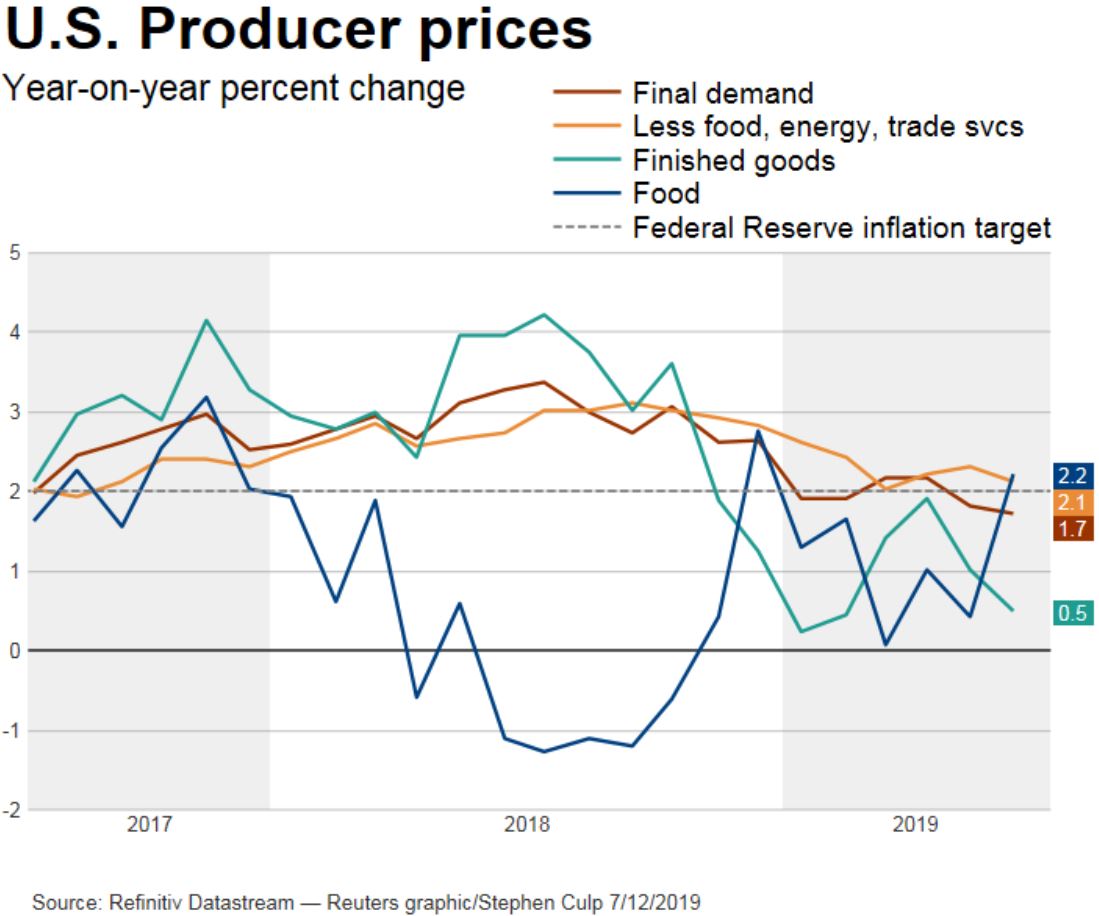
Last Friday’s wholesale Producer Price Index indicated as much, with raw materials for finished goods and services barely budging. There is very little wholesale inflation on raw materials, in spite of the increased tariffs being levied on Chinese goods and elsewhere. This is a very strange because fewer less foreign trade should mean imported goods are more expensive, not cheaper.

The Producer Price Index for final demand advanced 0.1 percent in June, seasonally adjusted, reported the U.S. Bureau of Labor Statistics. Final demand prices moved up 0.1 percent in May and 0.2 percent in April. On an unadjusted basis, the final demand index rose 1.7 percent for the 12 months ended in June, the lowest rate of increase since advancing 1.7 percent in January 2017.

The real problem that Alexandria Ocasio Ortiz for one, highlighted in her questioning of Fed Chair Jerome Powell lzt week is why there is almost no inflation, even with a full employment rate of 3.7 percent? She wanted interest rates lowered sooner to boost higher growth, with some 6-7 million workers either not looking for work, or working part time, but would prefer working fulltime and earn a living wage.

Powell said the U.S. is suffering from a bout of uncertainty caused by trade tensions and weak global growth, but he pledged to do whatever it takes to shore up the economy in what Wall Street took as a sign the central bank will cut interest rates soon.


The retail Consumer Price Index fared slightly better. Year-on-year the core is up 1 tenth to 2.1 percent. Housing and medical care which together make up about 1/2 the index -- are also on the high side, said Econoday.

But outside the core, energy prices fell a sharp 2.3 percent on the month with the gasoline subcomponent down 3.6 percent. Energy prices, which are down 3.4 percent on the year, are not helping the Fed achieve its 2 percent inflation goal.

Trade wars are not really winnable anymore, as I’ve been saying; because we no longer live in a win-lose world where the strong are able to prey or even conquer the weak and vulnerable so easily. Our world has become too populous, and thanks to modern technologies too interlinked for it not to affect world trade upon which economic growth depends.

World trade is now in decline, which means US manufacturing and exports are in decline. So we hope US consumers keep spending, since they make up two-thirds of economic activity, if we grow at all this year.

Harlan Green © 2019

Follow Harlan Green on Twitter: https://twitter.com/HarlanGreen

Wednesday, February 15, 2017

Retail Sales and Consumer Prices Show Real Life

Financial FAQs

Retail sales rose 0.4 percent last month following a much bigger gain in December than originally reported, the government said Wednesday. Economists polled had forecast a 0.2 percent increase. Retail sales are now up more than 5 percent annually, approaching more normal spending. December spending was also revised upward to 1 percent from an already strong 0.6 percent.

Graph: Econoday

And gas prices are rising along with consumer spending, which is boosting retail prices. The headline year-on-year Consumer Price Index, reflecting easy energy comparisons with 2016, is moving higher, well above the Fed's general 2 percent target at 2.5 percent. This is up 4 tenths in the month and is the highest in nearly 5 years. The core rate is also up, at a year-on-year 2.3 percent for a 1 tenth gain.

This shows an economy returning to a more normal 3 percent GDP growth rate, as well. The question now is what does this mean for jobs and the workers to fill them, as we are already near full employment.


Every major retail sector reported higher sales except for auto dealers, whose business tends to tail off after the Christmas shopping season. Auto purchases account for about one-fifth of all retail spending. And if autos and gasoline are excluded U.S. retail sales rose a robust 0.7 percent, the Commerce Department said.

Outlets such as Best Buy that sell electronics and appliances saw a 1.6 percent rise in sales, the largest gain in a year and a half. Stores that sell clothing and sporting goods also posted sales gains of 1 percent or more. Even department stores, whose sales fell sharply in 2016, got into the act. Department-store receipts surged 1.2 percent in January to mark the biggest increase in more than a year.


One clue to where additional jobs may come is the National Federation of Independent Business survey for small businesses, which account for more than 60 percent of the hires these days. And their confidence has soared since Donald Trump’s election with his promise of lower taxes and regulations.
A majority of small business owners are making no secret of their love for freer markets. “The continued surge in optimism is a welcome sign that economic growth is coming, said NFIB Chief Economist Bill Dunkelberg. “The very positive expectations that we see in our data have already begun translating into hiring and spending in the small business sector.” 
Job openings and job creation plans both posted small gains, pushing the NFIB Jobs Report into a strong, positive direction. Dunkelberg, as well said the data could signal higher GDP growth in 2017. 

The recent growth in optimism looks similar to the surge in the Index in 1983, which was followed by years of economic prosperity, said the NFIB. After eight years of struggling with government barriers, small business owners are hopeful that policy proposals from the new administration and Congress will spur economic growth in a similar manner, said NFIB President and CEO Juanita Duggan.

However, one still uncertain factor is the direction of interest rates. Both mortgage rates and Treasury yields are still at historic lows, but how long will that last with faster growth?

Fed Chair Janet Yellen surprised markets with her congressional testimony yesterday when she told lawmakers that waiting too long to raise interest rates would be “unwise.” This comment, along with assurances that the Fed will raise rates at one of its coming meetings, inspired a sharp selloff in Treasury securities. Bond yields rise as prices fall.

The yield on the 10-year Treasury note rose five basis points to 2.52 percent today, while the yield on the two-year note gained 3.3 basis points to 1.27 percent. The yield on the 30-year Treasury bond rose 4.8 basis points to 3.10 percent. But these rates are still at historical lows, and would have to rise another 1 to 2 percent to accommodate inflation rates that have historically accompanied higher growth rates.

Harlan Green © 2017

Follow Harlan Green on Twitter: https://twitter.com/HarlanGreen

Monday, January 23, 2017

Has Inflation Returned?

Financial FAQs

Inflation is here! says Econoday, per last week’s CPI report; at 2.1 percent for total consumer prices (columns in graph) and 2.2 percent for the core rate (red line). Two percent is generally considered the target rate for inflation, the rate consistent with stable and sustainable economic growth.

The last time both the CPI and the core were actually together at the 2 percent line was way back in February 2013. And then it plunged into negative territory, as the federal government shut down in 2013 for two weeks over Republican’s refusal to raise the debt ceiling. The U.S. had already lost its S&P AAA rating on sovereign Treasury debt in 2011, and instituted the sequester agreement putting an across the board cap on government spending.

Then oil prices plunged along with worldwide commodity prices in 2014 due to slowing growth in the so-called BRIC emerging economies (Brazil, Russia, India, and China), so that U.S. industries cut back their investment spending, as well.


The current rise in the CPI is mostly due to higher energy prices as economic activity (and oil prices) have picked up with U.S. final Q3 GDP growth at 3.5 percent. Energy prices are up 1.5 percent in the month, their fourth straight strong monthly gain with the yearly rate now well above the inflation rate at 5.4 percent.

But inflation may not be here to stay, as there is massive uncertainty over what exactly the Trump economic policies will be. Tax cuts and fewer government regulations will certainly stimulate additional growth, and so higher inflation, which is necessary to put more people back to work.

Medical care has also been a consistent source of strength though recent readings have been fading, up only 0.2 percent in December for a yearly 4.1 percent. Housing is another area of strength, up a tangible 0.3 percent in the month and at 3.0 percent year-on-year. Owners' equivalent rent, which is a closely watched subcomponent of housing, also rose 0.3 percent.

Graph: Econoday

Where will the growth come from? From the manufacturing sector, if Trump succeeds in implementing that massive $1 trillion infrastructure spending he has promised. The manufacturing component of the industrial production could manage only a 0.2 percent gain in December, said Econoday, one that followed a 0.1 percent decline in November.

Factory output during 2016 (red line) proved dead flat once again, not getting any help from exports (columns). Exports were on the rise several years back and were helping production as seen on the left side of the graph, but the progress has since fizzled, as the BRIC economies are still in a recession mode.

So there may not be much inflation this year. And the Fed would counteract any inflation increase with higher interest rates, anyway, which they said they would do maybe two or three times in 2017, if necessary.
Harlan Green © 2016

Follow Harlan Green on Twitter: https://twitter.com/HarlanGreen

Monday, December 21, 2015

Can Economy Grow With Higher Interest Rates?

The Federal Reserve’s Open Market Committee announced it is raising short term interest rates by ¼ percent. But can this economy continue to grow with higher interest rates, as Fed Chairwoman Yellen has promised?

That depends on several mundane factors, such as cheap gas and energy prices that have been helping to hold down consumer and producer costs. And since most consumer and many producer products are imported, the more expensive dollar exchange rate has made them cheaper. Hence the very low inflation rate these days.
image

An early sign of continued growth is the Conference Board’s Index of Leading Economic Indicators (LEI). The 12 leading indicators it tracks predict “moderate” future growth. And Congress’s new era of cooperation has resulted in the passing of two very important spending bills—the $305 billion Surface Transportation bill, and $1.14 Trillion federal budget.

Boosted by yesterday’s strong showing for housing permits (housing will be another area of strong growth next year), the LEI rose a solid 0.4 percent in November on top of October’s very strong 0.6 percent rise. Other positives include the interest-rate spread, specifically low short-term rates, and also gains for the stock market.
“The U.S. LEI registered another increase in November, with building permits, the interest rate spread, and stock prices driving the improvement,” said Ataman Ozyildirim, Director of Business Cycles and Growth Research at The Conference Board. “Although the six-month growth rate of the LEI has moderated, the economic outlook for the final quarter of the year and into the new year remains positive.”
Congress on Friday passed far-reaching legislation funding the government through next September plus passing tax breaks for business and low-income families. It was a compromise that helped the GOP, also, as the bill lifts a 40-year-old ban on oil exports.

The legislation pairs two enormous bills: a $1.14 trillion government-wide spending measure to fund every Cabinet agency through next September, and a $680 billion tax package extending dozens of breaks touching all sectors of the economy, making several of them permanent and tossing the entire cost onto the deficit.

President Barack Obama is expected to sign the legislation today. The bill cleared both chambers easily, first in the House, which passed it 316-113, followed by the Senate in a 65-33 vote.

The biggest reason this benefits economic growth is that another spending sequester was avoided, a sequester that limited spending across the board, hurting all segments of the economy. There was not even a spending cap, which means governments can function again without the interference of the Austerians, those conservatives that have been trying to restrict government spending on everything, including research and development. The $1.14 trillion spending bill avoids a shutdown next week, when the government’s current funding was scheduled to expire at 12:01 a.m. on Dec. 23.

Refunding the Highway Trust Fund that has run out of funds will be the biggest beneficiary of the $305 billion surface transportation bill. Called Fixing America’s Surface Transportation Act, or the FAST Act, it fixes and replaces badly degraded railroads, highways and bridges, hence it benefits those industries that depend on surface transportation.

One big benefit of the bill is the creation of programs to focus federal aid on eliminating bottlenecks and increasing the capacity of highways designated as major freight corridors. The Transportation Department estimates the volume of freight traffic will increase 45 percent over the next 30 years, which gives a tremendous boost to productivity.

The five-year FAST infrastructure bill is the longest reauthorization of federal transportation programs that Congress has approved in more than a decade, ending an era of stopgap bills and half-measures that left the Highway Trust Fund nearly broke and frustrated local governments and business groups. President Obama will sign the bill into law, as it fulfills his long-running push for lawmakers to pass an infrastructure bill even though it is significantly less than the $478 billion he sought in his own plan earlier this year.

image
Lastly, and perhaps the best reason interest rates won’t have much effect on future growth—at least through next year—is hourly earnings are finally rising above the very low inflation rate, which means we are reaching full employment. That’s why consumers have become more upbeat, hence are spending more. Average hourly earnings in the last unemployment report rose 2.3 percent annually, whereas the core PCE inflation index favored by the Fed has risen just 1.3 percent.

In fact, that is a major reason the Fed raised short term rates at this time, in the teeth of holiday spending. Wages and salaries are finally showing signs of life—of rising faster than inflation. Fed Chair Yellen has said many times it is a precondition for raising short term rates, which mainly influence consumer spending via credit card and auto loan rates.

So as long as inflation stays low and wages continue to increase the U.S. economy will continue to grow. And with Iran about to join the oil markets, energy prices should remain at the low end, with some analysts predicting oil prices could drop as low as $20 per barrel next year. So what’s to worry about? The Fed really can now sit on the sidelines, until and if inflation again catches up with wage and salary growth.

Harlan Green © 2015

Follow Harlan Green on Twitter: https://twitter.com/HarlanGreen

Thursday, July 16, 2015

Iran Agreement Means Low Inflation, Higher Growth

Financial FAQs

Although economists haven’t yet begun to crunch the numbers, Iran’s agreement not to produce atomic weapons or weapon-grade plutonium for at least 10 years will result in much lower oil prices, thus keeping inflation in check and interest rates at their current lows for some time to come, if not years.

This is if Congress approves the deal, of course. But lifting the economic sanctions will enable Iran to begin to sell its oil internationally sometime next year, into a world already flooded with oil products, though there is some uncertainty when this will happen.

Barron's, for instance, believes it will happen slowly, which might not affect oil prices in the short term, at least. When and if sanctions are lifted, Iran's oil production has to be ramped up, facilities upgraded, so that its products will only gradually reach international markets.

image

Graph: TradingEconomics

This is when retail inflation via the Consumer Price Index is already zero—i.e., retail prices aren’t rising at all. So it will give Janet Yellen’s Federal Reserve room to keep interest rates lower longer, thus boosting consumer spending and housing, which is beginning to show more robust growth with builder confidence at its highest level since 2005.

It will also boost consumer incomes, which are already profiting from the low interest rate environment that has reduced borrowing costs for consumers. Real (after inflation) consumer incomes are now rising at 4 percent.

image

Graph: Econoday

Wages & salaries rose 0.5 percent in the month. Both proprietors' income and rental income show especially strong gains. Spending was higher for durables, especially to autos, and also strong gains for non-durables, partly because of higher gas prices.

This in turn is boosting consumer spirits, with both the Conference Board and U. of Michigan surveys now at pre-recession levels.

image

Graph: Econoday

Optimism in the closely watched consumer sentiment report from the University of Michigan is as strong as it can get, according to Econoday. The overall index is up sharply this month and well beyond Econoday's high-end forecast. The report's expectations component, reflecting strong optimism for the jobs market, is an absolute standout at 97.8 for a 12-year high and a 13.6 point surge from May. The 13.6 point spread is the largest monthly gain since March 1991 (that's right, 1991).

There is a downside to the agreement, of course. Russia and China will benefit from doing more business with Iran, and Iran could backslide on the agreement. But there is general agreement that Iran's nuclear weapons ban will boost growth throughout developed countries with consumer-driven economies that require low inflation and cheap energy to maintain sustainable economic growth.

Harlan Green © 2015

Follow Harlan Green on Twitter: https://twitter.com/HarlanGreen