Showing posts with label builder confidence. Show all posts

Friday, April 28, 2023

More New Homes Needed

 The Mortgage Corner

Higher new home sales and rising homebuilders’ optimism foretells a strong summer sales season if builders and existing-home inventories don’t run out of housing stock. More new homes could also soften what is being termed a rolling recession with some sectors (such as manufacturing) faltering and other sectors (e.g, services ) still growing.

Builders must pick up the pace for that to happen, however.

Sales of new single‐family houses in March 2023 were at a seasonally adjusted annual rate of 683,000, according to estimates released jointly today by the U.S. Census Bureau and the Department of Housing and Urban Development.

“This is 9.6 percent (±15.2 percent) * above the revised February rate of 623,000, but is 3.4 percent (±12.7 percent)* below the March 2022 estimate of 707,000. The seasonally‐adjusted estimate of new houses for sale at the end of March was 432,000. This represents a supply of 7.6 months at the current sales rate.”


Census.gov

Builders remained cautiously optimistic in April, as limited resale inventory helped to increase demand in the new home market. Single-family builder confidence in April rose one point to 45, according to the NAHB/Wells Fargo Housing Market Index.

Currently, one-third of housing inventory is new construction, compared to historical norms of around 10%. More buyers looking at new homes, along with the use of sales incentives, have supported new home sales since the start of 2023. Builders note that additional declines in mortgage rates (to below 6%) will further boost demand.

“A lack of resale inventory combined with many builders offering price incentives helped to push new home sales higher in March,” said Alicia Huey, chairman of the National Association of Home Builders (NAHB). “However, sales are down 3.4% compared to a year ago because of the shortage of electrical transformer equipment and building material price volatility.”

Whereas pending home sales of homes under contract but not closed edged down. The Pending Home Sales Index (PHSI)* – a forward-looking indicator of home sales based on contract signings – waned by 5.2% to 78.9 in March. Year over year, pending transactions dropped by 23.2%. An index of 100 is equal to the level of contract activity in 2001.

“The lack of housing inventory is a major constraint to rising sales,” said NAR Chief Economist Lawrence Yun. “Multiple offers are still occurring on about a third of all listings, and 28% of homes are selling above list price. Limited housing supply is simply not meeting demand nationally.”

Chief economist Yun believes mortgage rates will improve the sales outlook by continuing to decline below 6 percent into next year. The 30-year conforming fixed rate is even obtainable at 5.75 percent for one origination point in California.

This is while the initial estimate of first quarter 2023 GDP growth was 1.1 percent, close to the consensus by economists. The problem is demand has far exceeded supplies, keeping housing prices and inflation too high and the Fed unhappy.

The lack of existing supply is a problem in all economics sectors, which may mean the Fed will continue to boost interest rates until markets catch up, though they’ve said they will pause for the rest of the year after another May 0.25 percent increase.

So a rolling recession could mean a bumpy ride for consumers who now must choose whether to buy now or wait until interest rates and inflation continue to moderate.

Harlan Green © 2023

Follow Harlan Green on Twitter: https://twitter.com/HarlanGreen

Tuesday, March 24, 2020

Housing Market Will Survive Coronavirus

The Mortgage Corner


What happens to housing with the COVID-19 pandemic? It had been on the road to recovery with record low interest rates; so much so that single-family housing starts have been soaring since 2019 as more millennials have formed families and entered the housing market.

But can this last? A recent LATimes survey of homebuilders showed that builders were continuing to complete projects and selling them online (sales offices have closed, so no onsite visits allowed for prospective buyers), but not starting new construction or buying new housing sites, until there is more certainty about the U.S. economy that could lose as many as 3 million jobs during the current downturn, according to some forecasts.

HUD estimates there were 1.5 million housing starts in February, The three-month moving average for single-family construction is currently at a post-recession high. Single-family starts increased 6.7 percent to a 1,072,000 seasonally adjusted annual pace in February. Multifamily starts for units in 5+ unit properties declined 17 percent to a 508,000 annualized rate after a strong yet unsustainable start for 2020 for apartment construction.

There’s a reason for the sky-high demand for housing, especially in California. Rents have soared 40 percent from 2000 to 2018, whereas incomes have risen just 8 percent after inflation, according to UC Berkeley’s Turner Center for Housing Innovation.

Surprisingly, housing may be one of those getting the most support from government—in part because there is already a severe housing shortage, which has put governments in charge of what has become the 1.3 million unit shortage of affordable housing for low income buyers in California, alone. California’hopes to mitigate the shortage with last year’s $6 billion housing bill to provide more affordable housing.

The Census Bureau just reported sales of new U.S. single-family homes are up 14.3 percent from last February. And January’s new-home sales were already at a 12-1/2-year high. It is pointing to housing market strength that could help to blunt any hit on the economy from the coronavirus and keep the longest economic expansion in history on track.


Builder confidence in the market for newly-built single-family homes fell just two points to 72 in March, according to the latest National Association of Home Builders/Wells Fargo Housing Market Index (HMI). Sentiment levels have held in a firm range in the low- to mid-70s for the past six months.
“Builder confidence remains solid, although sales expectations for the next six months dropped four points on economic uncertainty stemming from the coronavirus. Interest rates remain low,” says chief economist Robert Dietz, “and a lack of inventory creates market opportunities for single-family builders. However, down payment requirements are a limiting factor amid lower mortgage interest rates.”
But a housing market that remains healthy depends on a recovering economy, and we don’t know when that may be. Estimates run from 6 months to 18 months, if job loss estimates go to the 3 million extreme end of forecasts.

MarketWatch’s Jeffery Bartash reports a “flash” reading by the forecasting firm IHS Markit showed declines in its composite activity indexes. The manufacturing index slipped to 49.2 from 50.7, when anything below a reading of 50 indicates contraction. The flash service index sank to 39.1 in March from 49.4, marking the lowest level recorded since similar data became available in October 2009, IHS said.
“Although exports have suffered, most manufacturers continue to make necessary items, especially consumer goods for Americans stuck in their homes. Some large companies are even shifting production to help make critical medical equipment that’s in short supply,” said Bartash.
Why? Interest rates are plunging to new lows as investors rush to safe-haven bonds, driving down conforming 30-year fixed interest rates to as low as 3 percent.

This also caused refinance applications to surge more than 50 percent in a recent week, according to the Mortgage Bankers Association.

The housing market is in a holding pattern, in other words, with government aid a big factor, including directives not to evict renters behind in rent, or foreclose on homeowners behind in their payments for government-insured mortgages.

Harlan Green © 2020

Follow Harlan Green on Twitter: https://twitter.com/HarlanGreen

Wednesday, December 18, 2019

Full Speed Ahead for Housing Construction, Sales?

The Mortgage Corner


The ultra-low interest rates are making a difference as homebuilder sentiment is soaring along with new building permits, which should boost new and existing-home sales as well. For instance, more new homes on the market encourage existing-home owners to move up or downsize, depending on their age and family.

Builder confidence in the market for newly-built single-family homes increased five points to 76 in December off an upwardly revised November reading, according to the latest National Association of Home Builders/Wells Fargo Housing Market Index (HMI) released today. This is the highest reading since June of 1999.

This is making a small dent in the severe housing shortage since the Great Recession that has resulted in soaring rents and the current homelessness in communities that haven’t been building enough new housing.
“While we are seeing near-term positive market conditions with a 50-year low for the unemployment rate and increased wage growth, we are still underbuilding due to supply-side constraints like labor and land availability,” said NAHB Chief Economist Robert Dietz. “Higher development costs are hurting affordability and dampening more robust construction growth.”
All three components of that gauge -- present sales, future sales expectations and prospective buyers traffic -- improved, said Wrightson, but the biggest gain was a seven-point rise in current sales of new homes to a 21-year high of 84.  Regionally, the gains were more mixed, with the Midwest index improving sharply, the South rising marginally, and the West and Northeast declining.

Homebuilders also boosted construction on new homes in the U.S. at an annual pace of 1.37 million in November, the Commerce Department said today. This was a 3.2 percent (±10.0 percent) increase from a revised 1.32 million in October, 13.6 percent higher than a year ago.

And new building permits hit another post-recession high, up at a seasonally-adjusted rate of 1.48 million. That was 1.4 percent (±1.4 percent) above the pace of 1.46 million set in October and 11.1 percent above last year’s rate.

We know there is still a tremendous shortage of housing that came from the reluctance of builders to build for years after the Great Recession. Some of the shortage also came from Wall Street firms buying up housing abandoned from the busted housing bubble that were then turned into rentals.

A recent report by CBSN documented the carnage from the busted housing bubble and Great Recession. More than 9 million homes were foreclosed or sold at a loss after the bubble popped, leading to fears that tracts of abandoned neighborhoods would become "ghost towns."

This led government officials such as then Fed Chair Ben Bernanke to suggest foreclosed homes could be sold in bulk to private investors as rental properties. But that wasn’t enough, as there was very little government help to keep homeowners in their homes as happened during the Great Depression when the Home Owners' Loan Corporation (HOLC lent low-interest money to families in danger of losing their homes to foreclosure. By the mid-1930s, the HOLC had refinanced nearly 20 percent of urban homes in the country, allowing homeowners to stay in their homes with very lenient terms to enable them to weather the joblessness of the Great Depression.
“In the decade since the crash,” said the CBSN report, “7 million more households have become renters, while only 1 million more have become homeowners, according to Census data. And "institutional landlords," as the Wall Street investors are called, have become a major driver of the affordable housing woes many Americans are now facing—from steep rent payments all the way to eviction.”
The homeownership rate as a percentage of households that own vs. renting hasn’t recovered, dropping from its pre-recession high of 69 percent to 64.3 percent of households today. The U.S. has become a nation of renters at a time when rental rates are soaring due to the lack of new housing, resulting also in the more than one-half million homeless.

Another casualty of the Great Recession was lack of new household formation among the millennial generation children of the baby boomers who in fact outnumber their boomer parents; but alas, were without adequate available housing.

But now residential construction is beginning to meet the demand from new household formation that is back to the longer-term 1.2 million historical average, according to the U.S. Census Bureau. Millennials are paying down their college debt enough to move out of their rental or parents’ home, and forming more families.

There is more economic good news to report this week in upcoming columns. Industrial production has picked up in autos and trucks after the GM strike, according to the Federal Reserve, though not back to pre-recession levels. And job vacancies continue to soar with 1.4 million more vacancies than new job hires.

It means jobs are plentiful, so look for housing construction and home sales to keep this economic recovery afloat!

Harlan Green © 2019

Follow Harlan Green on Twitter: https://twitter.com/HarlanGreen

Thursday, February 21, 2019

Housing Market Still Alive and Well!

The Mortgage Corner


The Mortgage Bankers Association said last week its Builder Applications Survey data for January showed mortgage applications for new home purchases jumped by 43 percent from December, though was unchanged from a year ago.  This should silence the doomsayers who predict labor shortages and higher tariffs are sure to kill the housing market.
"After two lackluster months, new home sales surged...in January to the fastest pace in our survey, dating back to 2013," said Joel Kan, MBA Associate Vice President of Economic and Industry Forecasting. "Despite the jitters potential homebuyers felt in December from the volatility in the financial markets, the healthy job market and wage growth, moderating price gains and lower mortgage rates all helped home sales recover. Additionally, builders seem to be seeing improvement in their labor shortages, as recently released government survey data showed increases in construction hiring and openings in December."
Mortgage interest rates have indeed come down with a vengeance since December. The 30-year conventional fixed rate guaranteed by Fannie Mae and Freddie Mac is now 3.75 percent for a one-point origination fee, and the so-called high-balance conventional rate is 4.0 percent with one origination point for the most credit-worthy borrowers.

That’s why home builders’ confidence index jumped 4 points to 62 from 58 (percent of those surveyed), according to the latest National Association of Home Builders/Wells Fargo Housing Market Index (HMI), which is also good news.

So housing construction isn’t about to die, which is a sign economic growth isn’t gasping for air either in this full employment, low-interest rate environment. February marked the second consecutive month in which all the HMI indices posted gains. The index measuring current sales conditions rose three points to 67, the component gauging expectations in the next six months increased five points to 68 and the metric charting buyer traffic moved up four points to 48.
“Builder confidence levels moved up in tandem with growing consumer confidence and falling interest rates,” said NAHB Chief Economist Robert Dietz. “The five-point jump on the six-month sales expectation for the HMI is due to mortgage interest rates dropping from about 5 percent in November to 4.4 percent this week. However, affordability remains a critical issue. Rising costs stemming from excessive regulations, a dearth of buildable lots, a persistent labor shortage and tariffs on lumber and other key building materials continue to make it increasingly difficult to produce housing at affordable price points.”
There is more to the jump in builder confidence and new-home construction. The millennial generation is forming more new households this year, and at least 50 percent have historically wanted to buy a home. Researchers at the San Francisco Federal Reserve have been finding such an increase.
“The shares of young adults heading households now are similar to rates seen at the start of the housing boom,” said SF Fed researchers. “Moreover, while more young adults are living at home longer, data suggest they are continuing to transition to higher headship rates as they get older…Given current 12-month annual headship rates by age group, the Census Bureau projections imply household formations averaging on the order of 1.4 to 1.5 million per year through 2020. That is much better than an average of a little less than 900,000 annually over the past five years.”
MBA estimated new single-family home sales at a seasonally adjusted annual rate of 713,000 units in January, based on data from the BAS, an increase of 29.2 percent from the December pace of 552,000 units. On an unadjusted basis, MBA estimated 54,000 new home sales in January, an increase of 45.9 percent from 37,000 new home sales in December, a whopping increase.   

Conventional loans composed 68.7 percent of loan applications, FHA loans composed 18.6 percent, RHS/USDA loans composed 0.5 percent and VA loans composed 12.2 percent. The average loan size of new homes decreased from $334,944 in December to $334,532 in January.

The jump in finance applications and home building in January shouldn’t be surprising. The U.S. economy continues to perk along, seemingly ignoring any bad news, such as the just-released FOMC minutes of the December meeting that sees cloudier skies ahead for the U.S. and world economies this year.

Harlan Green © 2019


Follow Harlan Green on Twitter: https://twitter.com/HarlanGreen

Thursday, April 20, 2017

Record Low Interest Rates Boost Housing

The Mortgage Corner

The conforming 30-year fixed rate mortgage is now 3.50 percent and the so-called Hi-Balance conforming 30-year fixed rate is 3.75 percent for a 1 percent origination fee in California. And this is what has kept the demand for housing on a tear, in spite of tepid economic growth, with GDP growth still stuck at 2 percent per the Philly Fed Index seen below.

Why? It’s mainly because there is still very little inflation, and the bond market that determines mortgage rates likes low inflation. The low inflation rate may be because there’s still doubt on what growth-inducing legislation may ever get through a weak President and Congress stuck in ideological warfare. So we could see builders’ record profits continue for the rest of this year, and maybe more affordable housing.

Both new-home construction and builder optimism are at post-recession highs, but with normal seasonal fluctuations (such as mid-March Northeast blizzard), says the National Association of Home Builders (NAHB).

Following an elevated February reading, nationwide housing starts fell 6.8 percent in March to a seasonally adjusted annual rate of 1.22 million units, according to the U.S. HUD and the Commerce Department. Still, new housing production in the first quarter of this year is running 8.1 percent above the pace in 2016, reports the NAHB.


This is why builder confidence in the market for newly-built single-family homes remained solid in April, falling three points to a level of 68 on the National Association of Home Builders/Wells Fargo Housing Market Index (HMI) after an unusually high March reading, said the NAHB.
”The fact that current sales conditions has been over 70 for five consecutive months shows that there is continued demand for new construction,” said NAHB Chief Economist Robert Dietz. “However, builders are facing several challenges, such as hefty regulatory costs and ongoing increases in building material prices." 
The building industry is doing its share to boost growth as it continues to add jobs, with monthly employment data for February showing that home builder and remodeler employment increased by 18,900. Over the last 12 months, home builders and remodelers have added 136,000 jobs on a net basis and residential construction employment now stands at 2.707 million.


And where is US manufacturing activity these days? It’s still increasing in most states. The Philadelphia Federal Reserve has released the coincident indexes for the 50 states for February 2017. Over the past three months, the indexes increased in 47 states (green states), decreased in two, and remained stable in one (Michigan), for a three-month diffusion index of 90. In the past month, the indexes increased in 44 states, decreased in four, and remained stable in two, for a one-month diffusion index of 80.
“Here is a map of the three month change in the Philly Fed state coincident indicators. This map was all red during the worst of the recession, and almost all green now,” says Calculated Risk’s Bill McBride.
So, economic growth continues into the eighth year of this business cycle. And housing is usually a leading indicator of future growth, but that will depend on what looks like lower interest rates, future (lower) inflation trends, actions of the Federal Reserve, and Congress, of course.

Harlan Green © 2017

Follow Harlan Green on Twitter: https://twitter.com/HarlanGreen

Saturday, January 21, 2017

Housing Starts Surge With Builder Optimism

The Mortgage Corner

A mid-winter surge in multifamily production resulted in overall nationwide housing starts rising 11.3 percent to a seasonally adjusted annual rate of 1.23 million units, according to newly released data from the U.S. Department of Housing and Urban Development and the U.S. Census Bureau. This is Yuge, and will help to ease the shortage of rental units that has been driving up rental rates, squeezing low and moderate-income renters out of some housing markets.

Single-family construction dropped 4 percent to a seasonally adjusted annual rate of 795,000 units, but that was still 3.9 percent higher in a year. Multifamily production jumped 57 percent to 431,000 units in December. However, the monthly data for apartment production has exhibited strong volatility since August, sand the National Association of Home Builders. Still this may stop the average rent increase of 7 percent annually in high growth regions.

“This report represents firm growth for housing in 2016, as single-family starts rose 9 percent and multifamily production was down slightly,” said NAHB Chief Economist Robert Dietz. “We expect that 2017 will be another year of gradual, steady improvement in the housing market. Multifamily starts have been volatile in recent months, but should level off as supply meets demand. Meanwhile, single-family production continues to gain momentum but is limited by supply-side headwinds.”
Regionally in December, combined single- and multifamily housing production rose 31.2 percent in the Midwest, 23.5 percent in the West and 18.5 percent in the Northeast. The South posted a loss of 1.4 percent. That is an incredible increase in mid-winter, and reflects the rush to build before the predicted rise in interest rates this year.
The National Association of Home Builders (NAHB) also reported that though the housing market index (HMI) of builder optimism in future housing construction dropped slightly to 67 in January, down from 69 in December, any number above 50 indicates that more builders view sales conditions as good than poor. And this is easily the highest confidence rating since the end of the Great Recession.


The slight drop in confidence may also be because of uncertainty over future building regulations, which are set state by state, rather than nationally, and interest rates, of course, which many predict will rise, as I said.
So despite the January drop, some builders say there are still reasons to be bullish. "Builders begin the year optimistic that a new Congress and administration will help create a better climate for small businesses, particularly as it relates to streamlining and reforming the regulatory process," said NAHB Chairman Granger MacDonald.
Such optimism will evaporate, however, if interest rate rise sharply. But with the conforming 30-year fixed rate falling back to 3.75 percent in California of late, that may not happen. Could it be that optimism over future growth could also mean higher inflation, which means higher interest rates, as well?

This writer is also optimistic that with Janet Yellen and her Fed Governors still cautious about forecasting higher growth and inflation—where will all those workers come from that will be needed for any new infrastructure projects when there is already a shortage of construction workers—remains to be seen.

Harlan Green © 2017

Follow Harlan Green on Twitter: https://twitter.com/HarlanGreen

Monday, January 9, 2017

Real Estate In 2017—Good Time To Buy?

 The Mortgage Corner

Surging mortgage rates, dwindling inventory, and soaring home prices are taking a toll on Americans’ attitudes toward ownership, according to a home purchase sentiment survey released Monday. But that may be misleading, as mortgage rates have barely budged from post-WWII lows. And the construction industry and homebuilders’ sentiments are soaring, which means many more new homes will be coming into the housing market.

December 2016 Index
Change since last month Change since last year
Good time to buy 32 +2 -3
Good time to sell 13 0 +5
Home prices will go up 35 0 -5
Mortgage rates will go down -55 -4 -3
Confidence about not losing job 68 +4 -4
Household income is significantly higher 10 -5 -5
Overall index 80.7 -0.5 -2.5

The home purchase sentiment index compiled by mortgage finance provider Fannie Mae fell in December, its fifth straight monthly decline. Fannie’s index has six components. In December, two were lower compared to November, two were unchanged, and two increased. The increases were because respondents were more confident about not losing their jobs, and thought it a better time to buy. The biggest negative was their belief interest rates would rise this year. But it may be a small rise due to market uncertainties. Stocks are already oversold and interest rates still at historic lows, as I’ve said.


Construction had been lagging through most of 2016 but, like the factory sector (i.e, auto sales ended 2016 at record high of 18.5 million sold vehicles), appears to have picked up steam going into year-end, says Econoday. Spending rose 0.9 percent in November and is now up 4.1 percent annually. And non-residential construction’s boost is particularly heartening with its emphasis on infrastructure projects, up 0.9 percent with most categories showing gains led by office construction and transportation construction. Public spending was also solid including a 3.1 percent monthly jump in Federal spending (which boosts public infrastructure spending).

Residential spending rose 1.0 percent in the month on top of October's 1.6 percent gain. The gain here is concentrated in single-family homes which offset a monthly dip for multi-family units which otherwise have been leading the residential sector. Home improvements added to the spending in November.

The 30-year fixed conforming mortgage rate quoted by Fannie Mae is back down to 3.75 percent for one origination point. And what with the future uncertainty of the stock market (with indexes already at historic highs), much of the excess savings will remain in bonds, the major determinate of mortgage rates.

That is, unless worldwide growth picks up. But that won’t happen if Trump carries out his promise of trade wars to promote American workers first. That promise may be difficult to carry out, however, since his Republican colleagues have historically been free-traders.

Harlan Green © 2016

Follow Harlan Green on Twitter: https://twitter.com/HarlanGreen

Tuesday, December 27, 2016

New-Home Sales, Confidence Also At New Highs


The Mortgage Corner

Just as existing-home sales are at their cyclical highs, the Commerce Department on Friday said new home sales increased 5.2 percent to a seasonally adjusted annual rate of 592,000 units last month. That was the second highest pace since 2007, said the NAHB. Economists had forecast single-family home sales, which account for about 9.5 percent of overall home sales, rising 2.1 percent to a 575,000-unit rate last month.


The real problem is still lack of inventory with just 5.1 months of available supply (red line in graph), but builders optimism is the highest since 2005 that they can increase that inventory with a better mix of more affordable housing. Sales rose 16.5 percent from a year ago, boosted by a 43.8 percent jump in the Midwest to a nine-year high. Sales surged 7.7 percent in the West, their highest level since January 2008, but fell 3.1 percent in the South. They were unchanged in the Northeast.

“NAHB expects an increase in single-family home construction next year, fueled by a growing economy and solid job growth,” said NAHB Chief Economist Robert Dietz. “Moreover, builder confidence has risen on anticipation of reductions in regulatory costs, which is good news for home buyers and renters. However, the pace of construction will continue to be restricted by shortages of lots and labor in some markets.”

And consumers are feeling much more confident since the November elections, with most of the jump in older respondents to both the University of Michigan and Conference Board surveys. They are putting a lot of faith that Prez-elect Trump will be able to carry out his election promises of draining the Wall Street/DC swamps, in other words.

Graph Econoday

That said, the U. of Michigan consumer sentiment index edged up to a reading of 98.2 from 98 earlier this month. That was the highest reading since January 2004. And the Conference Board’s confidence index is up 12.9 points since the November election in gains driven by older consumers, as we said. The level for December is 113.7 which is the highest reading since way back in August 2001.

The University of Michigan said a record 18 percent of respondents "spontaneously mentioned the expected favorable impact of Trump's policies on the economy." Consumers anticipated that a stronger economy would create more jobs, with the share expecting higher income rising to a one-year high.

And personal incomes are rising at a 4 percent clip, the unemployment rate has dropped to 4.6 percent, and GDP growth is now up to 3.5 percent in the third revision to Q3 growth, with fourth quarter GDP growth also looking good.

So why shouldn’t consumers feel more confident of the future? It has a lot to do with Republican policies in Congress, yet Repubs say they want to repeal much of Obama’s legacy, which created the recovery from the Great Recession—the worst recession since the Great Depression. And a repeal of Obamacare and Dodd-Frank, the law that is attempting to reign in some of the excesses that caused the Great Recession, could put US back into another recession.

In other words, those voters need to be careful of what they wish for beyond the Twitters of Prez-elect Trump.

Harlan Green © 2016

Follow Harlan Green on Twitter: https://twitter.com/HarlanGreen

Tuesday, July 19, 2016

A Record Year For Mortgages?

The Mortgage Corner

First quarter mortgage numbers are in, and we could be having a very good year for mortgage originations, says Equifax, among others. According to Equifax’s report, the total dollar amount of first-mortgage originations during the first quarter of the year was $450.5 billion, which represented a year-over-year increase of 12.3 percent, the highest amount for a first quarter total since 2013.

And privately-owned housing starts in June were at a seasonally adjusted annual rate of 1,189,000, according to the US Census Bureau, which will create future demand for mortgages when completed. This is 4.8 percent above the revised May estimate of 1,135,000, but is 2.0 percent below the June 2015 rate of 1,213,000.


Single-family housing starts in June were at a rate of 778,000; it is 4.4 percent above the revised May figure of 745,000. The June rate for units in buildings with five units or more was 392,000. But starts are still not keeping up with demand, with soaring rental rates and falling vacancy rates in most metropolitan areas, a sign of a very tight—and expensive—rental market, which has to motivate many renters to become homebuyers.


No wonder, as the 30-year conforming fixed rate has dropped to as low as 3.0 percent for a 1.25 point origination fee in California on primary residences, as long as borrowers’ so-called ‘tri-merge’ mid-credit scores are above 740. This is the lowest rate since WWII, and such low rates are projected to continue through the fall, at least, according to Freddie Mac

Why? It’s fairly easy to understand, as Britain’s Brexit vote showed that the Eurozone may be a European Union in name only. The resultant uncertainty is causing a flight to safe haven investments, and US stocks and bonds provide the ultimate safe haven with US growth picking up while other countries show little or no growth.

Also, builder confidence in the market for newly built, single-family homes in July held, falling just one point to 59 from a June reading of 60 on the National Association of Home Builders/Wells Fargo Housing Market Index (HMI) released on Monday.
“The economic fundamentals are in place for continued slow, steady growth in the housing market,” said NAHB Chief Economist Robert Dietz. “Job creation is solid, mortgage rates are at historic lows and household formations are rising. These factors should help to bring more buyers into the market as the year progresses.”


Who will those future homebuyers be? First-time homebuyers now make up some 32 percent, according to the NAR. And Lawrence Yun, NAR chief economist, says although millennials have made up the largest share of buyers for three consecutive years, sales to first-time buyers and the homeownership rate for young adults under the age of 35 remain depressed at levels not seen in decades. This is despite historically low mortgage rates, escalating rental costs and low unemployment levels among those with a college education. 
“Even with potentially higher incomes, prospective millennial homebuyers residing in some of the most expensive cities in the country face the onerous task of paying steep rents while trying to save for an adequate down payment,” he said. “However, for those currently living in or looking to move to a more affordable part of the country, there are metro areas right now with solid job growth and that offer a smoother path to homeownership.”
So affordability will continue to be the main obstacle to homeownership, as well as historically heavy student debt loads for those same millennials, unless future Congresses will make public colleges in particular tuition-free, a benefit which all developed and many emerging countries already offer their young citizens.

Harlan Green © 2016

Follow Harlan Green on Twitter: https://twitter.com/HarlanGreen

Friday, June 17, 2016

Builder Optimism Returning to Historical Levels

The Mortgage Corner

After holding steady for the past four months, builder confidence in the market for newly constructed single-family homes rose two points in June to a level of 60 on the National Association of Home Builders/Wells Fargo Housing Market Index (HMI). This is the highest reading since January 2016.

And it’s for an obvious reason, as the just released privately-owned housing starts in May were at a seasonally adjusted annual rate of 1,164,000. This is 0.3 percent below the revised April estimate of 1,167,000, but is 9.5 percent above the May 2015 rate of 1,063,000. But mostly large, expensive homes are being built to date, which is hurting affordability.

“Rising home sales, an improving economy and the fact that the HMI gauge measuring future sales expectations is running at an eight-month high are all positive factors indicating that the housing market should continue to move forward in the second half of 2016,” said NAHB Chief Economist Robert Dietz.
In fact, the HMI builder optimism index is returning to a range that prevailed from 1970s to early 2000, in the run up to the housing bubble. It means that 60 percent of the builders surveyed are seeing increased business activity.


But what kind of activity? Mostly larger, even very large homes are being built, rather than the more traditional 16-1800 sf single family homes of yore. Of the estimated 648,000 single-family homes completed last year, just 136,000, or 21 percent, were homes with square footage of less than 1,800.

The number of “moderately-sized” single-family homes completed in 2015 was little changed from 2011, when overall single-family home completions hit at a “record” low. In contrast, the number of homes with 3,000 or more square feet of floor area last year was up 76 percent from 2011’s level.

This is obviously a problem for younger, first-time buyers entering the housing market. Sales of new single-family houses in April 2016 were at a seasonally adjusted annual rate of 619,000, according to estimates released jointly today by the U.S. Census Bureau and the Department of Housing and Urban Development. This is 16.6 percent (±15.4%) above the revised March rate of 531,000 and is 23.8 percent (±22.8%) above the April 2015 estimate of 500,000, said the Census Bureau.

The result has been that there is a severe shortage of affordable new housing, driving prices higher. The median sales price of new houses sold in April 2016 was $321,100; the average sales price was $379,800. The seasonally adjusted estimate of new houses for sale at the end of April was 243,000. This represents a supply of 4.7 months at the current sales rate, below the normal 5-6 month supply.

So if builders’ optimism holds we can be sure that new-home construction and sales will provide more homes for buyers—maybe even affordable homes if current construction levels hold.

The Fed has to cooperate by holding interest rates low, of course, but St. Louis Fed President James Bullard said on Friday the current economic trend of tepid 2 percent growth, coupled with a low unemployment rate and quiet inflation are likely to persist and, as a result, the U.S. central bank can sit on its hands.

Harlan Green © 2016

Follow Harlan Green on Twitter: https://twitter.com/HarlanGreen

Tuesday, April 19, 2016

Builder Confidence Holds, But Household Formation Still Weak

The Mortgage Corner

Builder confidence in the market for newly-built single-family homes remained unchanged in April at a level of 58 on the National Association of Home Builders/Wells Fargo Housing Market Index (HMI).
“Builders remain cautiously optimistic about construction growth in 2016,” said NAHB Chief Economist Robert Dietz. “Solid job creation and low mortgage interest rates will sustain continued gains in the single-family housing market in the months ahead.”


And privately-owned housing starts in March were at a seasonally adjusted annual rate of 1,089,000. This is 8.8 percent below the revised February estimate for new construction of 1,194,000, but is 14.2 percent above the March 2015 rate of 954,000, according to the Census Bureau. This is the main reason builders’ confidence remains solid.

But for it to go higher, (and housing starts return to historical levels)—the formation of new households would also have to increase to historical levels, and that will take some time, given all those millennials aged between 18-36 years that either cannot afford to live alone, or choose to rent rather than purchase a home, according to the Census Bureau.


Graph: Bloomberg

This manifests itself in in the number of 25- to 34-year-olds of working age living at home. The rate began rising in 2003, fell briefly after the recession (perhaps because of first-time buyer-assistance programs), says Bloomberg’s Barry Ritzholtz, and then started rising again. As of last year, those still of working age still at home was at a record high.
It isn't merely living in their parents’ basements;” says Ritzholtz, “more young adults are doubling up in apartments. Census data has identified this as a fast-growing living arrangement. The central theme is that expensive housing, along with a dearth of economic opportunities, forces young adults into less-than-desirable living arrangements.”
Unfortunately, there is still a shortage of homes on the market, especially entry-level housing that most millennials can afford. Single-family housing starts in March, for instance, were at a rate of 764,000; this is 9.2 percent below the revised February figure of 841,000. The March rate for units in buildings with five units or more was 312,000.

And privately-owned housing units authorized by building permits in March were at a seasonally adjusted annual rate of 1,086,000. This is 7.7 percent below the revised February rate of 1,177,000, but is 4.6 percent above the March 2015 estimate of 1,038,000.

What is the current level of new household formation? Speaking on the country’s economic outlook and monetary policy at the Economic Leadership Forum in Somerset, New Jersey, Federal Reserve Bank of New York President Bill Dudley said the U.S. economy has its strengths and weaknesses—but he expects household formation to receive a boost in 2016.

“Housing starts are still well below the rate consistent with the nation’s population growth rate, and the fundamentals of housing demand remain positive,” Dudley said. “Rising employment is likely to boost the household formation rate and low mortgage interest rates should keep housing relatively affordable, despite the ongoing recovery in home prices.”
Harlan Green © 2016

Follow Harlan Green on Twitter: https://twitter.com/HarlanGreen

Thursday, March 24, 2016

Where Are the New Homes?

Sales of newly built, single-family homes rose 2 percent in February from an upwardly revised January reading to a seasonally adjusted annual rate of 512,000 units, according to newly released data by the U.S. Department of Housing and Urban Development and the U.S. Census Bureau.

It shows progress in badly needed housing inventory, but new-home sales are still far below the 50-year average, which means there is still a tremendous amount of pent up demand for housing in the 7th year of this economic recovery that is reflected in escalating rents and housing prices. And developers are only now beginning to get it.
“This reflects a slow but steady increase in demand from homebuyers as well as increasing confidence of homebuilders,” said Trulia Chief Economist Ralph McLaughlin. “It is also a positive sign for the U.S. economy headed into 2016, as new home sales leads to new construction and consumer demand for housing-related goods and services. Despite the positive news, new home sales remain still remain about 24 percent below the 50-year average.”


Where is the shortage? It is mostly in the lower-priced brackets that most home buyers can afford.

From housing economist Tom Lawler, per Calculated Risk:  “While single-family housing production has continued to recover, the overall level of production – in terms of units – has been well short of consensus forecasts from a few years ago. In looking at the production “shortfall,” the one thing that is striking is that production of moderately sized homes has barely recovered from the cyclical lows, while production of big homes (3000+ square feet) has been running at a higher pace that in all but one year of the 1990’s, as the above graph illustrates.

This makes very little sense if builders are to meet the housing need, as 80 percent of the employed are wage and salary earners and the U.S. median household income is barely above $60,000 per year these days. That is, household incomes are finally returning to early 2000, pre-recession levels. Such a median income can buy a home worth approximately $400,000 with 10 percent down at today’s very low conforming fixed rates (still less than 4 percent).

Yet hardly any homes with 1600 square foot or less areas are being built that can be sold in moderate price ranges. Builders maintain it is because of labor and land shortages, but banks have been very slow to grant development or acquisition financing, which is the credit developers need to even acquire the land for development.


However builders remain ever optimistic in this new year. "While builders contend with industry headwinds such as labor shortages, relatively low mortgage interest rates and solid job growth should keep the housing market moving ahead as we enter the spring buying season," said NAHB Chief Economist Robert Dietz.

The inventory of new homes for sale was 240,000 in February, which is a 5.6-month supply at the current sales pace (still slow). The median sales price of new houses sold in February was $301,400. Regionally, new home sales rose 38.5 percent in the West. (But) Sales dropped 4.1 percent in the South, 17.9 percent in the Midwest and 24.2 percent in the Northeast.

Does this mean builders and banks will realize they have to build for the middle class as well as the wealthiest that can afford those 3,000 sf homes, if they want to grow the housing market?

Harlan Green © 2016

Follow Harlan Green on Twitter: https://twitter.com/HarlanGreen

Wednesday, March 16, 2016

Builder Confidence Holds, Housing Starts Booming


Builder confidence in the market for newly-built single-family homes was unchanged in March at a level of 58 on the National Association of Home Builders/Wells Fargo Housing Market Index (HMI).“Confidence levels are hovering above the 50-point mid-range, indicating that the single-family market continues to make slow but steady progress,” said NAHB Chairman Ed Brady.  
And Housing Starts rose 5.2 percent in February to 1,178,000 units and is 30.9 percent above the February 2015 rate of 900,000, confirming builder’s increased confidence.  Single family construction was 7.2 percent higher than January.
“While builder sentiment has been relatively flat for the last few months, the March HMI reading correlates with NAHB’s forecast of a steady firming of the single-family sector in 2016,” said NAHB Chief Economist David Crowe. “Solid job growth, low mortgage rates and improving mortgage availability will help keep the housing market on a gradual upward trajectory in the coming months.”
Solid job growth is being helped by those of working age returning to the jobs market. This month, more than 4.5 million people who weren’t in the labor force found a job, according to the St. Louis Federal Reserve, even though only about 7.7 million Americans were officially unemployed the previous month. Just since December, the U.S. economy has added more than 1 million jobs and brought more than 1.5 million Americans into the labor force (based on the household survey).


            The labor force — which includes all adults over 16 who have jobs and as well as those are who actively looking for work — has increased by 2 million in the past year, the biggest 12-month gain since before the recession began in 2007, writes Marketwatch’s Rex Nutting.
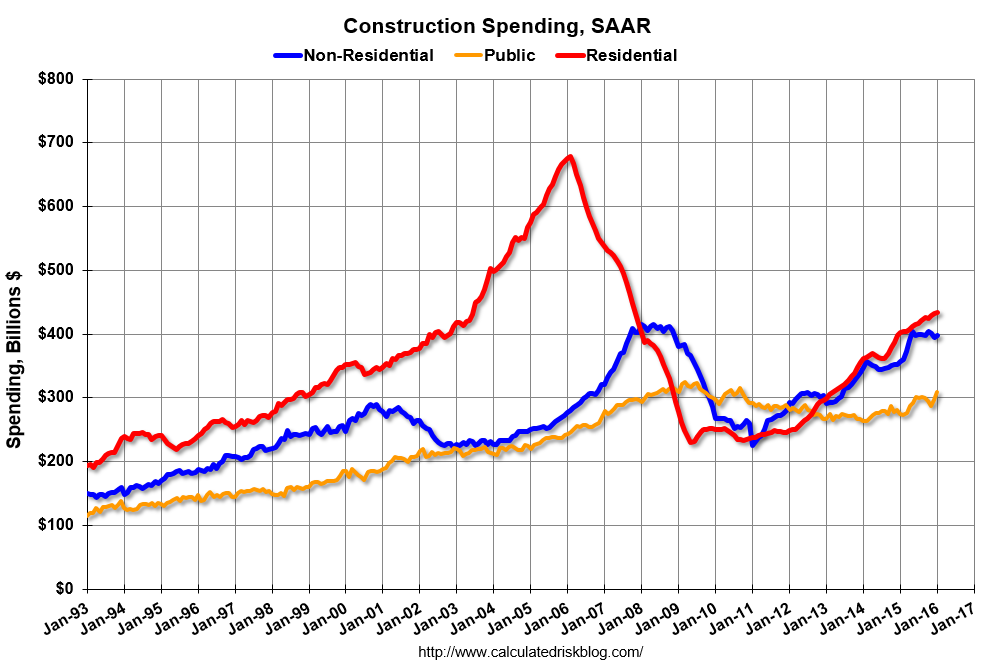
            This is giving a tremendous boost to new-home construction, in particular. It is why the U.S. Census Bureau reported that construction spending during January 2016 was estimated at a seasonally adjusted annual rate of $1,140.8 billion, 1.5 percent above the revised December estimate of $1,123.5 billion. And the January figure is 10.4 percent above the January 2015 estimate of $1,033.3 billion.


On a year-over-year basis, private residential construction spending is up 8 percent. Non-residential spending is up 11 percent year-over-year. Public spending is up 13 percent year-over-year.  Looking forward, all categories of construction spending should increase in 2016. Residential spending is still very low, non-residential is increasing (except oil and gas), and public spending is also increasing after several years of austerity.
In the meantime, the number of people who have jobs has increased by 2.8 million. The strength of those numbers is startling once you consider that the population of working-age people (ages 16 to 65) has grown by only a million in the past year, says Nutting. The number of employed people is growing about three times as fast as the number of working-age adults. This means that the slack in the economy is disappearing quickly (but it’s not gone yet).
            The point of this is that with so many workers returning to the jobs market, a strong housing recovery is assured.  For it is working age Americans that want most to own a home, according to a recent National Association of Realtors survey.

Harlan Green © 2016

Follow Harlan Green on Twitter: https://twitter.com/HarlanGreen

Tuesday, September 1, 2015

Construction Leads Housing, GDP Recovery

The Mortgage Corner

Pending home sales are still rising. And that’s in large part because both residential and non-residential commercial construction is in fact soaring. The U.S. Census Bureau of the Department of Commerce announced today that construction spending during July 2015 was estimated at a seasonally adjusted annual rate of $1,083.4 billion, 0.7 percent above the revised June estimate of $1,075.9 billion. The July figure is 13.7 percent above the July 2014 estimate of $952.5 billion.

image

Graph: Calculated Risk

This is huge, and another sign that housing this year may keep average U.S. GDP growth above 3.5 percent for the rest of 2015 and beyond, as the just revised Q2 growth rate of 3.7 percent is indicating. Housing has been the sluggard as a growth component in this recovery to date, but 2015 looks like the year that it breaks out.

The Pending Home Sales Index, a forward-looking indicator based on contract signings, increased 0.5 percent to 110.9 in July from an upwardly revised 110.4 in June and is now 7.4 percent above July 2014 (103.3). The index has increased year-over-year for 11 consecutive months and is the third highest reading of 2015, according to the National Association of Realtors.

On a year-over-year basis, private residential construction spending is up 16 percent. Non-residential spending is up 18 percent year-over-year, and public spending is up 6 percent year-over-year, reports Commerce.

That’s also why newly built, single-family home sales rose 5.4 percent to a seasonally adjusted annual rate of 507,000 units in July, according to HUD and the U.S. Census Bureau.

“This report is in line with other government data and improving builder sentiment and shows a gradual but consistent housing recovery,” said NAHB Chief Economist David Crowe. “As job growth and consumer confidence continue to strengthen, the housing market should make additional gains this year.”

Economists had forecasted gross domestic product would be revised up to 3.3 percent in Q2, but business investment was stronger than expected. Business investment helped, but it was consumers, buoyed by low interest rates and inflation boosting their confidence in future jobs and rising incomes that got them spending again.

The Commerce Department said investment in nonresidential structures was revised to show an increase rather than a contraction, reflecting stronger spending on commercial and healthcare construction. Spending on residential construction, which includes brokers' commissions, was also raised from 6.6 to 7.8 percent. More gains are likely this quarter after the Pending-Home sale report showed an increase in contracts to purchase previously owned homes (i.e., existing-homes) in July.

The large spending uptick on private construction was at a seasonally adjusted annual rate of +1.3 percent (±1.0%). Residential construction was at a seasonally adjusted annual rate of $380.8 billion in July, 1.1 percent (±1.3%). Nonresidential construction was at a seasonally adjusted annual rate of $407.0 billion in July, 1.5 percent (±1.0%).

This can only mean more jobs are being created in construction and Professional Services in the upcoming Friday unemployment report. More good news for U.S. jobs growth, in other words.

Harlan Green © 2015

Follow Harlan Green on Twitter: https://twitter.com/HarlanGreen