Showing posts with label millennials. Show all posts

Friday, February 8, 2019

What is Driving Household Formation and Home Sales?

The Mortgage Corner


The growth in household formation, the major determinate of home ownership, is slowly returning to pre-housing bubble levels, according to a 2016 report by the San Francisco Fed’s economic research dept. This is a good sign for the future of new home construction as well, that has run a deep deficit since the end of the housing bubble.

The culprit in large part has been a millennial generation reaching adulthood—those born 1981 to 1996—that have been slow to leave home and form their own households, burdened with student debt and a slow to recover job market since the end of the Great Recession.

In 2014, the U.S. Federal Reserve released data about young households under the age of 35, (millennials), and perhaps one of the most striking data points was the low level of income. The median pre-tax income level for heads-of-household below the age of 35 was $35,300 per year. Comparable levels of income for previous years of the same demographic were $38,900 in 1995 and $43,900 in 2001 (all priced in 2013 dollars so we are looking at an apples-to-apples analysis). 
“The shares of young adults heading households now are similar to rates seen at the start of the housing boom,” said the SF Fed researchers. “Moreover, while more young adults are living at home longer, data suggest they are continuing to transition to higher headship rates as they get older…Given current 12-month annual headship rates by age group, the Census Bureau projections imply household formations averaging on the order of 1.4 to 1.5 million per year through 2020. That compares favorably to an average of a little less than 900,000 annually over the past five years.”
This could be boosting new-home sales, which eventually boosts housing construction. Sales of newly built, single-family homes jumped 16.9 percent to a seasonally adjusted annual rate of 657,000 units in November after an upwardly revised October report, reports the NAHB, and according to newly released data by the U.S. Department of Housing and Urban Development and the U.S. Census Bureau. This is the highest sales pace since March 2018. However, on a year-to-date basis, sales are down 7.7 percent from this time in 2017.

Even builders recognize they are dependent on new household formation. “Solid job growth and growing household formations should support future demand for housing even as builders continue to address mounting affordability woes,” said NAHB Chief Economist Robert Dietz. “Builders are doing all they can to hold the line on costs to meet this demand, particularly at the entry-level market.”
Existing-home sales aren’t doing so well. Existing-home sales ran at a seasonally adjusted annual rate of 4.99 million in December, the National Association of Realtors said Tuesday. That was the lowest since November 2015. Sales were down 6.4 percent for the month, and 10.3 percent lower than the year-ago rate.
Lawrence Yun, NAR’s chief economist, says current housing numbers are partly a result of higher interest rates during much of 2018. “The housing market is obviously very sensitive to mortgage rates. Softer sales in December reflected consumer search processes and contract signing activity in previous months when mortgage rates were higher than today. Now, with mortgage rates lower, some revival in home sales is expected going into spring.”
But there is also the problem low inventory. There was just a 3.7 months of unsold inventory at the current sales rate. This is much too low to sustain sales anywhere near normal rates, especially in the affordable range. “…there is still a lack of adequate inventory on the lower-priced points and too many in upper-priced points,” said Yun.

We therefore maybe seeing the end of a not so virtuous circle. A fully-employed economy is drawing more millennials to form households and purchase homes. It’s about time, as the oldest cohort of millennials are approaching 38 years of age.

And reinforcing the good news on the household formation front is that more millennial women are marrying—some 1.2 million were newly-weds in 2016, according to PEW Research. That means even more households are being formed

Harlan Green © 2019

Follow Harlan Green on Twitter: https://twitter.com/HarlanGreen

Thursday, November 9, 2017

New Home Sales-Ownership Rate Rising

The Mortgage Corner

New home sales shot up 19 percent in September to a consensus crushing annualized rate of 667,000. This is the largest percentage gain in 28 years and the highest level of the cycle, since October 2007. In stark contrast, existing home sales, the green line, haven't shown any kind of bounce.


Homeownership is also rising. The Census Bureau last week reported that ownership increased to 63.9 percent in the third quarter, the highest level since 2014. The rate was up from 63.7 percent in the second quarter and 63.5 percent a year earlier. It is creeping up to the 65 percent historical ownership rate, but it remains below the 69 percent clocked at the peak of the housing bubble a decade ago.

What does this mean? Firstly, the housing supply is catching up with demand, and it will take some pressure over rising rents. The rise in homeownership comes as other forces weaken the rental market, including a surge in supply from developers hoping to cash in on rising rents. In September, the seasonally adjusted rate of apartments under construction was 596,000, nearly twice the long-term average of 300,000 units, according to U.S. Census data.

The new housing supply boosted the national vacancy rate to 4.5 percent in the third quarter of this year, compared with 3.5 percent a year earlier, according to John Chang, head of research for real-estate services firm Marcus & Millichap. Nationally, rents were up 3.5 percent between the third quarters of 2016 and ’17, compared with 4.5 percent the previous years, he said.

And it is the millennial generation, children of the baby boomers and the largest generation ever, that are boosting homeownership rates as they begin to marry and raise families. Their marriage rate over the next five years will likely play an important role in demand for apartments and houses, according to Dr. Chang.


The market is not so good for existing-home sales. Econoday reports the red line of pending sales shows the pending index flat at 106.0 and existing homes likely to hold near 5.400 million. Resale prices ($245,100 median) are far lower than new homes ($319,700), but it's not helping sales. It peaked in January and has been trending down ever since.

But if construction and new-home sales continue to pick up, it will move more millennials out of their rentals. They are taking their time to nest, and the oldest of those born from approximately 1980 to 1996 will soon be approaching 40 years of age.

Sales haven’t declined more because mortgage rates are holding @ 3.50 percent for a 30-year fixed conforming loan with 1 origination point, and 3.625 percent for the so-called Hi-balance 30-year conforming rate in high-expense states and regions.

This is actually an incredible number, as interest rates this low in the eighth year of the recovery from the Great Recession attests to the severity of the recession, and fact that household incomes are only beginning to recover.

Harlan Green © 2017

Follow Harlan Green on Twitter: https://twitter.com/HarlanGreen

Tuesday, July 25, 2017

Home Sales Disappoint

The Mortgage Corner

Existing-home sales were at a 5.52 million seasonally adjusted annual rate in June, the National Association of Realtors said Monday. That was 0.7 percent above the year-ago rate, but 1.8 percent lower than in May and marked the second-lowest monthly total of 2017.


Why? There’s a severe housing shortage with inventories down to a 4.3-month supply at the current sales rate. It is so bad that Zillow Chief Economist Svenja Gudell in a Marketwatch interview said, “There are about as many homes for sale now as there were in 1994 (1.96m), except there are about 63 million more people in this country now than there were then.”

The supply imbalance continues to push prices higher. The median sales price was $263,800 nationally, a 6.5 percent increase compared with the year-earlier period. The median price in California is now $500,000. That sets a fresh record and marks the 64th consecutive month of yearly price gains, with housing prices growing at roughly double the rate of wage gains.

It’s hard to understand why builders aren’t answering the call with demand so high and interest rates still at record lows. Part of the problem is that there are so few entry-level homes being built.
“Closings were down in most of the country last month because interested buyers are being tripped up by supply that remains stuck at a meager level and price growth that's straining their budget," said NAR economist Lawrence Yun. "The demand for buying a home is as strong as it has been since before the Great Recession. Listings in the affordable price range continue to be scooped up rapidly, but the severe housing shortages inflicting many markets are keeping a large segment of would-be buyers on the sidelines."
First-time buyers were 32 percent of sales in June, which is down from 33 percent both in May and a year ago. The longer-term average is 40 percent for first-timers as a percentage of all buyers, which are mainly younger buyers.

Graph: Apartment List

CNBC reports new data from Apartment List  that shows, although 80 percent of millennials would like to purchase real estate, very few are in a good position to buy, largely because they have nothing saved. According to the report, "68 percent of millennials said they have saved less than $1,000 for a down payment. Almost half, or 44 percent, of millennials said they have not saved anything for a down payment."

That is probably why mortgage lenders are now offering more exotic products, such as a 1 percent down payment for the conforming 30-year fixed rate with the lender chipping in another 2 percent, so that it satisfies the minimum 3 percent minimum down payment requirement for conforming loans.

Lenders are also offering high end buyers a 40-year fixed rate program for super jumbo loan amounts with the first 10 years at interest only payments. Payments then become standard 30 year principal and interest payments for the rest of the 30-year term.

Meanwhile the standard 30-year conforming fixed rate is 3.50 percent for 1 origination point in California, as it has been for months. There are still many buyers out there, in other words, but the most important population segment is the millennials, who marry later and have those student debt problems.

Harlan Green © 2017

Follow Harlan Green on Twitter: https://twitter.com/HarlanGreen

Tuesday, March 14, 2017

Homeownership Is Rising

The Mortgage Corner

An improving economy, multiple years of strong job growth and the notable increase in home values in most markets fueled a greater share of purchases from Generation X households over the past year, says the National Association of Realtors in a recent survey.

And that is helping to boost the all-important household formation of younger generations, which is what ultimately precipitates home sales, especially among those young adults who are forming families.

This is according to the National Association of Realtors® 2017 Home Buyer and Seller Generational Trends study, which evaluates the generational differences of recent home buyers and sellers. The survey additionally found that a growing number of millennials and younger boomer buyers have children living at home; student debt is common among Gen X and boomer households; more millennials are buying outside the city; and younger generations are more likely to use a real estate agent.


A notable shift in the relative household growth rates after 2007 reflects declines in “headship” rates, that is, the share of the population identified as heads of households, according to a report by the San Francisco Federal Reserve. It is mostly the result of the Great Recession that decimated the earning power of so many young adults, in particular. This means that for over five decades headship rates in the United States had increased on average before falling off in the wake of the financial crisis after 2007.

The patterns in headship rates over the housing cycle differ considerably across age groups. Specifically, in recent years most of the changes were among young adults. For two groups—ages 18 to 24 and ages 25 to 29—headship rates have declined appreciably in recent years. Headship rates among older age groups have been more stable.

Also apparent in the SF Fed’s chart is that headship rates among young adults rose considerably from the mid-1990s up to the financial crisis. That was the period of the strong housing market, rapidly rising house prices, and booming homeownership rates, including among young adults. Indeed, the movements in shares of young heads of household closely track the rise and decline in homeownership ratios.
"Gen X sellers' median tenure in their previous home was 10 years, which puts many of them selling a property they bought right around the time home values were on the precipice of declining," said NAR chief economist Lawrence Yun. "Fortunately, the much stronger job market and 41 percent cumulative rise in home prices since 2011 have helped a growing number build enough equity to finally sell and trade up to a larger home. More Gen X sellers are expected this year and are definitely needed to ease the inventory shortages in much of the country."
The uptick in purchases from Gen X buyers this year (28 percent) was the highest since 2014 and up from 26 percent in 2016. Millennials were the largest group of recent buyers for the fourth consecutive year (34 percent), but their overall share was down slightly from a year ago (35 percent). Baby boomers were 30 percent of buyers, and the Silent Generation made up 8 percent.

This year's survey also brought to light how the soaring cost of rent in many areas is likely influencing the decision of middle-aged parents to buy a home with their young adult children in mind. Younger boomers were the most likely to purchase a multi-generational home (20 percent; 16 percent in 2016), and the top reason for doing so was that children over 18 years old either moved back home or never left (30 percent; 27 percent in 2016).
"The job market is very healthy for young adults with a college education, but repaying student debt and dealing with ever-increasing rents on an entry-level salary are forcing many to either shack-up with several roommates or move back home," said Yun. "This growing trend of delayed household formation is one of the main contributors to the nation's low homeownership rate."
Similar to previous years, roughly two-thirds of millennial buyers are married. One aspect of their household that has changed is the number of children in them. In this year's survey, 49 percent of millennial buyers had at least one child, which is up from 45 percent last year and 43 percent two years ago.

With more kids in tow, the need for more space at an affordable price is increasingly pushing millennial buyers outside the city. Only 15 percent of millennial buyers bought in an urban area, which is down from 17 percent last year and 21 percent two years ago.
"Millennial buyers, at 85 percent, were the most likely generation to view their home purchase as a good financial investment," added Yun. "These strong feelings bode well for even greater demand in the future as more millennials settle down and begin raising families. A significant boost in new and existing inventory will go a long way to ensuring the opportunity is there for more of them to reach the market."
But that isn’t yet the case. Inventories are still in the 5-month range with current sales rates. So something must happen to increase housing inventories of existing homes, such as the sale of tens of thousands of foreclosed homes hedge funds purchased at fire sale prices when the housing bubble burst that are rental units.

The Blackstone’s Invitation Homes subsidiary, under the auspices of Blackstone's real estate leadership, began purchasing homes in 2012 and eventually amassed more than 60,000 homes, investing $1.2 billion in renovations. At one point it was reportedly spending $150 million per week on homes.

And now the Dallas-based single-family rental real estate investment trust, one of the largest in its class, raised $1.54 billion in an initial public offering this January. It priced 77 million shares at $20 each, well within its previously stated range of $18 and $21, said the press release.

So until hedge funds decide it’s no longer lucrative to hold rental properties, we may continue to experience a housing shortage, which means prices will continue to rise above the inflation rate for the foreseeable future.

Harlan Green © 2017

Follow Harlan Green on Twitter: https://twitter.com/HarlanGreen

Thursday, June 2, 2016

What Happened to Tuition-Free College?

Popular Economics Weekly

Senator Bernie Sanders wants it. Until the Vietnam War, most public colleges and universities had it. So what happened to our tuition-free public universities and colleges?

UC Berkeley is perhaps the poster child to what has happened to the idea of tuition-free colleges and universities. It is something most other developed countries have for its citizens but no longer in the U.S. And tuition-free higher education—particularly for taxpayer funded public colleges and universities—was in the founding charters of most higher public educational institutions.

When I entered UC Berkeley as a freshman in the late 1950s my $300 scholarship covered the first year administration fees. There was no tuition. Today UC Berkeley charges a tuition fee of $13, 518 per academic year for California residents. Out-of-state residents have to add an additional $26,682 in tuition fees.

That is why students today have accumulated some $1.2 billion in student loan debt that averages up to $35,000 per the most recently graduate student in a recent Champlain College panel discussion convened on the subject.

· The total outstanding student loan debt in the U.S. is $1.2 trillion, that’s the second-highest level of consumer debt behind only mortgages. Most of that is loans held by the federal government.
· About 40 million Americans hold student loans and about 70 percent of bachelor’s degree recipients graduate with debt.
· The class of 2015 graduated with $35,051 in student debt on average, according to Edvisors, a financial aid website, the most in history.
· One in four student loan borrowers are either in delinquency or default on their student loans, according the Consumer Financial Protection Bureau.

As late as 1960 The California Master Plan developed under Chancellor Clark Kerr supported keeping the UC system tuition-free. How much has changed since then! It’s almost as if California has been made to pay for being the vanguard for anti-war and anti-establishment protests during the 1960s and 70s; when it was in wholesale rebellion against the policies of the Cold War, or any war.

Why the exorbitant costs for higher education today, and why is it so important to make higher education affordable to most Americans, something that the young people coming to Bernie’s rallies also want? The first answer is that it’s important to have a well-educated public for a functioning democracy.
And Senator Bernie Sanders has made it a central issue in his campaign. “In a highly competitive global economy, we need the best-educated workforce in the world, says Bernie on his website. “It is insane and counter-productive to the best interests of our country and our future, that hundreds of thousands of bright young people cannot afford to go to college, and that millions of others leave school with a mountain of debt that burdens them for decades. That shortsighted path to the future must end.”
There is also the skills’ shortage employers lament about today. College graduates have the highest employment rate and incomes (blue line in graph)—and the lowest unemployment rate; actually below today’s 5 percent unemployment rate. Whereas high school grads have something like a 7 percent unemployment rate, and comparably lower incomes.


It is easiest to blame then California Governor Ronald Reagan, who once inaugurated in 1966 began his attack on higher education. It was the beginning of the Vietnam anti-war protests, and he considered UC Berkeley a hotbed of socialism, and inimical to winning the Cold War.

It was also the beginning of his government-is-the-problem campaign by shifting state resources away from educating California’s students.—firstly, by cutting state funding for higher education, and calling in the National Guard to put down student protests.

But there were other reasons for abandoning The California Master Plan to educate all Californians tuition-free than the growing political polarization from the Vietnam War. Proposition 13 was passed in 1978 that limited property taxes, the main source of state and local education revenues.

Even then annual tuition and fees for Californians was just $630. The big fee increases began in the 1980s, when California enacted the three strikes law to fight the War on Drugs and began to build a record number of prisons. California’s prison population increased 500 percent between 1982 and 2000, according to historian Ruth Wilson Gilmore in her book, Golden Gulag.

The monies went elsewhere, in other words. The expansion of educational institutions stopped, despite the surging student population of baby boomers reaching college age. The result has been that state revenues now pay less than 16 percent of the UC University systems’ costs, and student tuition fees (and debt) now pay for the majority of education costs.

The UC system no longer educates the majority of Californians. This is when a recent McKinsey & Co. report predicts the U.S. workforce will need an additional one million well-educated workers by 2020, when most of the 80 million millennials, children of the baby boomers, have reached college age.

Then where will they be educated? From so-called for-profit colleges, which now make up some 25 percent of post-secondary institutions in the U.S. And they provide a much inferior education, as profit is their bottom line rather than a rounded education.

Bernie is right in this case. That cannot be, if we are to stay competitive with the developed world. It turns out government has to become the solution, the equalizer of opportunity as it once was, if we are to reduce the soaring inequalities of income and opportunity.

Harlan Green © 2016

Follow Harlan Green on Twitter: https://twitter.com/HarlanGreen

Tuesday, April 19, 2016

Builder Confidence Holds, But Household Formation Still Weak

The Mortgage Corner

Builder confidence in the market for newly-built single-family homes remained unchanged in April at a level of 58 on the National Association of Home Builders/Wells Fargo Housing Market Index (HMI).
“Builders remain cautiously optimistic about construction growth in 2016,” said NAHB Chief Economist Robert Dietz. “Solid job creation and low mortgage interest rates will sustain continued gains in the single-family housing market in the months ahead.”


And privately-owned housing starts in March were at a seasonally adjusted annual rate of 1,089,000. This is 8.8 percent below the revised February estimate for new construction of 1,194,000, but is 14.2 percent above the March 2015 rate of 954,000, according to the Census Bureau. This is the main reason builders’ confidence remains solid.

But for it to go higher, (and housing starts return to historical levels)—the formation of new households would also have to increase to historical levels, and that will take some time, given all those millennials aged between 18-36 years that either cannot afford to live alone, or choose to rent rather than purchase a home, according to the Census Bureau.


Graph: Bloomberg

This manifests itself in in the number of 25- to 34-year-olds of working age living at home. The rate began rising in 2003, fell briefly after the recession (perhaps because of first-time buyer-assistance programs), says Bloomberg’s Barry Ritzholtz, and then started rising again. As of last year, those still of working age still at home was at a record high.
It isn't merely living in their parents’ basements;” says Ritzholtz, “more young adults are doubling up in apartments. Census data has identified this as a fast-growing living arrangement. The central theme is that expensive housing, along with a dearth of economic opportunities, forces young adults into less-than-desirable living arrangements.”
Unfortunately, there is still a shortage of homes on the market, especially entry-level housing that most millennials can afford. Single-family housing starts in March, for instance, were at a rate of 764,000; this is 9.2 percent below the revised February figure of 841,000. The March rate for units in buildings with five units or more was 312,000.

And privately-owned housing units authorized by building permits in March were at a seasonally adjusted annual rate of 1,086,000. This is 7.7 percent below the revised February rate of 1,177,000, but is 4.6 percent above the March 2015 estimate of 1,038,000.

What is the current level of new household formation? Speaking on the country’s economic outlook and monetary policy at the Economic Leadership Forum in Somerset, New Jersey, Federal Reserve Bank of New York President Bill Dudley said the U.S. economy has its strengths and weaknesses—but he expects household formation to receive a boost in 2016.

“Housing starts are still well below the rate consistent with the nation’s population growth rate, and the fundamentals of housing demand remain positive,” Dudley said. “Rising employment is likely to boost the household formation rate and low mortgage interest rates should keep housing relatively affordable, despite the ongoing recovery in home prices.”
Harlan Green © 2016

Follow Harlan Green on Twitter: https://twitter.com/HarlanGreen

Friday, March 18, 2016

Job Openings Still At Record Level


The number of job openings rose to 5.5 million on the last business day of January, the U.S. Bureau of Labor Statistics reported today. It is just below the record high set in July 2015.  Hires declined slightly to 5.0 million while separations edged down to 4.9 million. The JOLTS report highlights the millions of jobs actually lost and created each month. It highlights the rising number of job openings, which means more of the unemployed are finding work. And economic growth generally follows job growth.  
The quits rate was 2.0 percent (looked at by the Fed because it tells them how many are voluntarily leaving their old job to find a better new job), and the layoffs and discharges rate was down to 1.2 percent.
The following graph shows job openings (yellow line), hires (dark blue), Layoff, Discharges and Other (red column), and Quits (light blue column). The number of job openings (yellow) are up 11 percent year-over-year compared to January 2015.  Quits are up 1 percent year-over-year. This is a sign of growing job opportunities as quits are voluntary separations. (see light blue columns at bottom of graph for trend for "quits").


            This month, more than 4.5 million people who weren’t in the labor force found a job, according to the St. Louis Federal Reserve, even though only about 7.7 million Americans were officially unemployed the previous month. Just since December, the U.S. economy has added more than 1 million jobs and brought more than 1.5 million Americans into the labor force (based on the household survey).
It is huge, folks, and can only mean younger workers are also entering the labor force—i.e., from the millennial generation that now makes up some 53 percent of the workforce and will continue to increase.  That’s because those born between 1980 to 2000 and are the offspring of the baby boomers already number some 90 million, a veritable population explosion that will boost economic growth even further, as they enter the job market. 
Barron’s Magazine, for one, has been predicting robust, 3 percent plus GDP growth for years to come because of the population explosion that will bring years of prosperity harking back to the 1970s, when the baby boomers entered the jobs market.

“Industries from housing and autos to retailing and financial services could be transformed by their collective demands and desires,” says Barron’s Jacqueline Doherty, “while their growing wealth, coupled with their doubts about the future of government entitlement programs, could usher in a new era of saving and a bull market for stocks.”

            The Millennials—sometimes called Generation Y, and defined by many demographers as ranging from ages 18 to 37—make up the largest population cohort the U.S. has ever seen. Eighty-six million strong, it is 7 percent larger than the baby-boom generation, which came of age in the 1970s and '80s. And the Millennial population could keep growing to 88.5 million people by 2020, owing to immigration, says demographer Peter Francese, an analyst at the MetLife Mature Market Institute.

            “When the baby-boom generation drove the economy in the 1990s,” continued Doherty, “growth in gross domestic product averaged 3.4 percent a year. As the Millennials hit their stride, they could help lift GDP growth to 3 percent or more, at least a percentage point higher than current levels.”

            While it is not certain exactly when such GDP growth can be sustained, both economic theory and history says that such a large surge in population will eventually create what has been missing until now—a sustained aggregate demand that has to generate much stronger growth.

Harlan Green © 2016

Follow Harlan Green on Twitter: https://twitter.com/HarlanGreen

Wednesday, August 19, 2015

Higher Birth Rates Are Here

The Mortgage Corner

The mellennial generation, now aged 18 to 36 years, are beginning to drive higher birth rates. And that means more households being formed, which will ultimately create a higher demand for housing. Actually, a 4 million birth rate was breached in 2007, and births then declined due to the Great Recession. But the millennials are back above the 4 million birth rate again.

And housing construction is surging—no coincidence, given the rising demand for housing of any kind—rental as well as for prospective homeowners. Led by a strong jump in single-family production, nationwide housing starts inched up 0.2 percent to a seasonally adjusted annual rate of 1.206 million units in July, according to newly released data from the U.S. Department of Housing and Urban Development and the Commerce Department. This is the highest level since October 2007.

“This month’s drop in the more volatile multifamily side is a return to trend after an unusually high June,” said NAHB Chief Economist David Crowe. “While multifamily production has fully recovered from the downturn, single-family starts are improving at a slow and sometimes intermittent rate as consumer confidence gradually rebounds. Continued job and economic growth will keep single-family housing moving forward.” 

Births had declined for five consecutive years prior to increasing in 2013. They are about 7.7 percent below the peak in 2007 (births in 2007 were at the all-time high - even higher than during the "baby boom"). “I suspect certain segments of the population were under stress before the recession started,” says Calculated Risk’s Bill McBride, “- like construction workers - and even more families were in distress in 2008 through 2012. And this led to fewer babies.”

image

Graph: Calculated Risk

The above historical graph dates back to 1909, and the largest dip was before and during the Great Depression. It hit bottom in 1933, before beginning to rise again until it hit the baby boomer bulge of the 1950s and 60s.

This has to be the main reason home builder sentiment is at a 10-year high. The new home sector is increasingly a central source of strength for the economy and builders are increasingly optimistic, says the NAHB. The housing market index rose 1 point to a very strong 61 in August with the future sales component leading the way at 70. Current sales are at 66 with traffic continuing to lag but less so, at 45 for a 2 point gain in the month.

“Today’s report is consistent with our forecast for a gradual strengthening of the single-family housing sector in 2015,” said NAHB Chief Economist David Crowe. “Job and economic gains should keep the market moving forward at a modest pace throughout the rest of the year.”

Single-family starts rose 12.8 percent to a seasonally adjusted annual rate of 782,000 units after an upwardly revised June reading while multifamily production fell 17 percent to 424,000 units. And rising single family starts is another sure sign that more families and households are being formed.

What age group is having the most births? It is women in their 30s. The preliminary birth rate for women aged 30–34 in 2014 was 100.8 births per 1,000 women, up 3 percent from the rate in 2013 (98.0). The rate for this group has increased steadily since 2011. The number of births to women in their early 30s also increased in 2014, by 4 percent.

The rate for women aged 35–39 was 50.9 births per 1,000 women, up 3 percent from 2013 (49.3). The rate for this group has increased steadily since 2010. The number of births to women in their late 30s increased 5 percent in 2014.

Need we say more about the rising birth rate? All signs point to another upsurge in new household formation, needless to say, the main driver of real estate sales and the concomitant sectors that aid and drive RE—jobs in construction, insurance, professional fields, and banking, for starters.

Could it be that the real estate industry will drive 3 percent plus GDP growth for the rest of 2015, even if interest rates rise slightly? Rates are still at record lows with the conforming 30-year fixed rate at 3.625 percent for 1 origination point, and purchase mortgage applications still up 19 percent year over year, reports the Mortgage Bankers Association.

Harlan Green © 2015

Follow Harlan Green on Twitter: https://twitter.com/HarlanGreen

Wednesday, July 22, 2015

Existing-Home Sales at 8-Year High

The Mortgage Corner

It had to happen.  Why did June existing-home sales jump to an 8-year high? Fewer foreclosures is the short answer, hence more available for sale at market prices. But soaring consumer optimism due to an even better jobs market has to be the driving force causing families to build their nests.

Also, prices are rising to multi-year highs due to supply scarcities. And then there are the demographics, as the new generation is pushing older generations to move up or down, with even baby boomers wanting more retirement living.

Total existing-home sales, which are completed transactions that include single-family homes, townhomes, condominiums and co-ops, increased 3.2 percent to a seasonally adjusted annual rate of 5.49 million in June from a downwardly revised 5.32 million in May. Sales are now at their highest pace since February 2007 (5.79 million), have increased year-over-year for nine consecutive months and are 9.6 percent above a year ago (5.01 million).

image

Graph: Calculated Risk

Lawrence Yun, NAR chief economist, says backed by June's solid gain in closings, this year's spring buying season has been the strongest since the downturn. "Buyers have come back in force, leading to the strongest past two months in sales since early 2007," he said. "This wave of demand is being fueled by a year-plus of steady job growth and an improving economy that's giving more households the financial wherewithal and incentive to buy."

Inventories have dropped to 5 months, which is driving up prices. The median price, up 3.3 percent in the month to $236,400, is already a record. Part of the rise in prices is tied to a lack of distressed sales, at only 8 percent of June's total which is a record low, according to Econoday.

Adds Yun, "June sales were also likely propelled by the spring's initial phase of rising mortgage rates, which usually prods some prospective buyers to buy now rather than wait until later when borrowing costs could be higher."

And that may be an additional factor. Interest rates, though still low, have risen approximately ¼ percent since their most recent lows, with 30-year fixed conforming rates now 3.75 percent for a 1 point origination fee in California.

Total housing inventory3 at the end of June inched 0.9 percent to 2.30 million existing homes available for sale, and is 0.4 percent higher than a year ago (2.29 million). Unsold inventory is at a 5.0-month supply at the current sales pace, down from 5.1 months in May.

"Limited inventory amidst strong demand continues to push home prices higher, leading to declining affordability for prospective buyers," said Yun. "Local officials in recent years have rightly authorized permits for new apartment construction, but more needs to be done for condominiums and single-family homes."

The percent share of first-time buyers fell to 30 percent in June from 32 percent in May, but remained at or above 30 percent for the fourth consecutive month. A year ago, first-time buyers represented 28 percent of all buyers.

This is why housing starts surged nearly 10 percent last month to an annual rate of 1.17 million, just a touch below a post- recession high. Builders were especially active in the Northeast and South that suffered so much from last winter. We need more housing, in other words, as jobs and families continue to grow.

Harlan Green © 2015

Follow Harlan Green on Twitter: https://twitter.com/HarlanGreen

Saturday, July 18, 2015

Housing Starts, Builder Optimism at Recovery Highs

The Mortgage Corner

Privately-owned housing starts in June were at a seasonally adjusted annual rate of 1,174,000. This is 9.8 percent above the revised May estimate of 1,069,000 and is 26.6 percent above the June 2014 rate of 927,000. This tells us the real estate recovery is beginning to contribute to economic growth as it has in past recoveries.

So-called housing starts surged nearly 10 percent last month to an annual rate of 1.17 million, just a touch below a post- recession high. Builders were especially active in the Northeast and South that suffered so much from last winter.

And single-family housing starts in June were at a rate of 685,000; this is 0.9 percent below the revised May figure of 691,000. The June rate for units in buildings with five units or more was 476,000.

image

Graph: Calculated Risk

“While builders are reporting overall confidence in the housing market, they continue to note difficulties accessing land and labor,” said NAHB Chief Economist David Crowe. “These headwinds appear to be affecting production gains in the single-family sector.”

Builder confidence was also the highest since 2005, according to the National Association of Home Builders. Builder confidence in the market for newly built, single-family homes in July hit a level of 60 on the just released National Association of Home Builders/Wells Fargo Housing Market Index (HMI) while the June reading was revised upward one point to 60 as well. The last time the HMI reached this level was in November 2005.

“This month’s reading is in line with recent data showing stronger sales in both the new and existing home markets as well as continued job growth,” said NAHB Chief Economist David Crowe. “However, builders still face a number of challenges, including shortages of lots and labor.”

Construction on multi-dwelling projects with five units or more soared to the highest level since 1987. Builders have devoted more effort to these kinds of projects instead of their traditional focus on single-family homes because of a growing trend toward renting, especially among younger millennials, children of the baby boomers. Greater difficulty in obtaining mortgages has also compelled some people to rent.

Yet rising demand for rental units has also forced up the cost of housing, especially amid a shortage of new units available. A separate government report on Friday showed another sizable increase in the cost of shelter in June, with housing expenses up 3 percent in the past year.

It all points to rising demand for shelter for the millennial generation that is seeing better jobs and has to begin to pay off their huge educational loans. It’s a negative sum game for both student-borrowers and the economy. According to the Consumer Financial Protection Bureau, student loan debt has reached a new milestone, crossing the $1.2 trillion mark — $1 trillion of that in federal student loan debt, says Forbes Magazine.

According to The Institute for College Access and Success (TICAS) Project on Student Debt, the average borrower will graduate $26,600 in the red.  While there are lots of stories of graduates with crippling debt of $100,000 or more, this is the case for only about 1 percent of graduates.  Yet 10 percent of college graduates accumulate more than $40,000.

That is the reason so many millennials can only afford to rent at the moment, and why rental housing construction will be the priority for builders, at least until 2020 when most of the so-called echo boomers (now aged 16 to 35) have matured into adults and begin to form their own families.

Harlan Green © 2015

Follow Harlan Green on Twitter: https://twitter.com/HarlanGreen

Tuesday, June 23, 2015

Housing Beginning to Bloom

The Mortgage Corner

Ultra-low interest rates are finally beginning to pay off.  The housing season is beginning to bloom—for first-time homebuyers, in particular. The National Association of Realtors reports total existing-home sales, which are completed transactions that include single-family homes, townhomes, condominiums and co-ops, rose 5.1 percent to a seasonally adjusted annual rate of 5.35 million in May from an upwardly revised 5.09 million in April, largely because of the surge in first time buyers. Sales have now increased year-over-year for eight consecutive months and are 9.2 percent above a year ago (4.90 million).

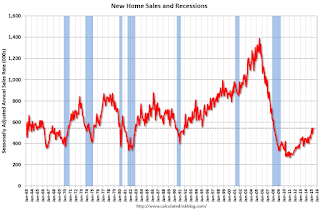
And new-home sales also soared. New single-family homes in the U.S. sold at an annual rate of 546,000 in May, hitting the fastest pace since February 2008, with growth in two of four regions, reports the U.S. Census Bureau this morning. And it revised April's rate to 534,000. May's sales rate was up 19.5 percent from a year earlier, signaling a healthy pick up, though recent sales rates remain below long-term averages.

image

Graph: Calculated Risk

This graph shows existing-home sales, on a Seasonally Adjusted Annual Rate (SAAR) basis since 1993. Sales in May (5.35 million SAAR) were 5.1 percent higher than last month, and were 9.2 percent above the May 2014 rate.

Lawrence Yun, NAR chief economist, says May home sales rebounded strongly following April's decline and are now at their highest pace since November 2009 (5.44 million). "Solid sales gains were seen throughout the country in May as more homeowners listed their home for sale and therefore provided greater choices for buyers," he said. "However, overall supply still remains tight, homes are selling fast and price growth in many markets continues to teeter at or near double-digit appreciation. Without solid gains in new home construction, prices will likely stay elevated — even with higher mortgage rates above 4 percent."

The percent share of first-time buyers rose to 32 percent in May, up from 30 percent in April and matching the highest share since September 2012. A year ago, first-time buyers represented 27 percent of all buyers.

"The return of first-time buyers in May is an encouraging sign and is the result of multiple factors, including strong job gains among young adults, less expensive mortgage insurance and lenders offering low down payment programs," said Yun. "More first-time buyers are expected to enter the market in coming months, but the overall share climbing higher will depend on how fast rates and prices rise."

The huge jump in existing-home sales means more demand for new homes, as we said last week. The median price of new homes fell 1 percent to $282,800 compared with May 2014, also a good sign for the first-time homebuyers. But there are still not enough homes for sale. The supply of new homes was 4.5 months at May's sales pace, down from 4.6 months in April.

New Home Sales

Graph: Calculated Risk

This is also why housing starts came in at a 1.036 million rate in May. Though down 11.1 percent from the April rate, which was already one for the record books. But April is now revised higher to 1.165 million, a 22.1 percent gain from March. Sealing matters is another gigantic surge in permits, up 11.8 percent to 1.275 million following a 9.8 percent gain in April.

And this is buttressed by builder confidence in the market for newly built, single-family homes in June up five points to a level of 59, according to the National Association of Home Builders/Wells Fargo Housing Market Index (HMI). This is the highest reading since September 2014, and in fact returns the index to pre-bubble (2001-02) levels.

Why the huge construction increase in June? This is while mortgage rates are rising, up some 0.375 percent since their most recent lows to 3.875 percent for 0 points in origination fees for a 30-year fixed rate conforming loan.

Firstly, it means consumers are confident enough in their future to begin to look for housing to support their growing families.  And the millennial generation aged 18 to 36 years has already surpassed their parents’ baby boomer population size, and will exceed it by 2020, according to demographers. This has to be why household formation is finally returning to normal levels of 1 million plus new households being formed per year, as the so-called echo boomers move out of their parents’ homes and or leave college to make their own nests.

So forecasters will probably be revising their second-quarter GDP estimates higher following the better housing numbers, not to mention their estimates for Thursday's index of leading economic indicators where permits are one of the components, as we said last week.

Harlan Green © 2015

Follow Harlan Green on Twitter: https://twitter.com/HarlanGreen

Wednesday, June 17, 2015

Housing Construction Soars

The Mortgage Corner

Housing construction is taking off, as I predicted two weeks ago. The numbers show actual construction starts accelerating as well as building permits for future construction. It is also boosting builder confidence to a level that signals continued growth in new construction.

As Econoday reported, “Don't let the headline fool you (i.e., slight drop in June), the housing starts & permits report points to solid strength for the housing sector.” Though the Calculated Risk graph shows how far the housing market is from a true recovery. It is only now returning to the lows of the 1990 recession.

image

Graph: Calculated Risk

Housing starts came in at a 1.036 million rate in May, down 11.1 percent from the April rate but the April rate, which was already one for the record books, is now revised higher to 1.165 million, a 22.1 percent gain from March. Sealing matters is another gigantic surge in permits, up 11.8 percent to 1.275 million following a 9.8 percent gain in April.

And builder confidence in the market for newly built, single-family homes in June rose five points to a level of 59, according to the National Association of Home Builders/Wells Fargo Housing Market Index (HMI). This is the highest reading since September 2014, and in fact returns the index to pre-bubble (2001-02) levels.

image

Graph: Calculated Risk

“The HMI indices measuring current and future sales expectations are at their highest levels since the last quarter of 2005, indicating a growing optimism among builders that housing will continue to strengthen in the months ahead,” said NAHB Chief Economist David Crowe. “At the same time, builders remain sensitive to consumers’ ability to buy a new home.”

All three HMI components posted healthy gains in June. The component gauging current sales conditions jumped seven points to 65, the index charting sales expectations in the next six months increased six points to 69, and the component measuring buyer traffic rose five points to 44, said the press release.

Why the huge construction increase in June? This is while mortgage rates are rising, up some 0.375 percent since their most recent lows to 3.875 percent for 0 points in origination fees for a 30-year fixed rate conforming loan. Firstly, it means consumers are confident enough in their future to begin to look for housing to support their growing families.

And this is, of course, the millennial generation aged 18 to 36 years that has already surpassed their parents’ baby boomer population size, and will exceed it by 2020, according to demographers.

image

Graph: CNBC

Also, household formation is finally returning to normal levels of 1 million plus new households being formed per year, as the so-called echo boomers move out of their parents’ homes and or leave college to make their own nests.

Household formation has been unusually low over the past seven years, averaging 577,000 new households. Whereas, there are approximately 15 million new households per decade being formed during normal times.

So, "there's a ton of people living in basements," Tommy Lee of Fundstrat Global Advisors said in an interview with CNBC's "Trading Nation." "Two quarters of pretty decent household formation isn't getting everybody out of the basement. I think this means we have multiple years where household formations are well over 1.3 million, 1.4 million."

Forecasters will be revising their second-quarter GDP estimates higher following today's report, says Econoday, not to mention their estimates for Thursday's index of leading economic indicators where permits are one of the components.

Harlan Green © 2015

Follow Harlan Green on Twitter: https://twitter.com/HarlanGreen

Tuesday, May 26, 2015

New-Home Sales, Case Shiller Index On the Rise

The Mortgage Corner--II

As if to confirm U.S. housing starts and building permits’ jump to their highest levels in nearly 7-1/2 years, the sales rate of new single-family houses in April 2015 rose even higher at a seasonally adjusted annual rate of 517,000, according to estimates released jointly today by the U.S. Census Bureau and the Department of Housing and Urban Development. “This is 6.8 percent above the revised March rate of 484,000 and is 26.1 percent above the April 2014 estimate of 410,000,” per the Census Bureau.

image

Graph: Calculated Risk

It means home construction is returning to pre-recession levels, as is the demand for more housing, which will spur more housing construction. The sales rate is rising fast enough to drop housing inventories to 4.6 months, at the low end of inventories.

The south was the biggest gainer, with construction up 5.8 percent. Also, the median price rose to $297,300 for a strong 8.3 percent year-on-year gain. So sales have finally reached the long term trend line, which should signal a longer term recovery as buyer’s enthusiasm tends to feed on itself, according to Behavioral Economist and Nobelist Dr. Robert Shiller.

image

Graph: Calculated Risk

As if to confirm the rising enthusiasm of buyers, the S&P Case-Shiller Home Price Index continued its climb to post-recession highs, with San Francisco now up 10.31 percent year over year, Denver and Dallas up 10 percent and 9.3 percent, respectively. Denver and Dallas housing prices have almost doubled since the Great Recession, per the above graph. San Francisco’s prices are just now approaching their bubble high.

“Home prices have enjoyed year-over-year gains for 35 consecutive months,” says David M. Blitzer, Managing Director & Chairman of the Index Committee for S&P Dow Jones Indices. “The pattern of consistent gains is national and seen across all 20 cities covered by the S&P/Case-Shiller Home Price Indices…”

Of course lower interest rates were also a factor, as I’ve said, with housing affordability increasing this year, according to the National Association of Home Builders/Wells Fargo Housing Opportunity Index (HOI).

In all, 66.5 percent of new and existing homes sold between the beginning of January and end of March were affordable to families earning the U.S. median income of $65,800, said the report. “This is up from the 62.8 percent of homes sold that were affordable to median-income earners in the fourth quarter.”

What is another catalyst? Housing formation is recovering, which is largely due to Millennials moving out of their parents’ homes, or higher education venues. Based on unusually low household formation numbers of past several years, "there's a ton of people living in basements," Fundstrat Global Advisors' Tom Lee said in a recent interview with CNBC's "Trading Nation." "Two quarters of pretty decent household formation isn't getting everybody out of the basement. I think this means we have multiple years where household formations are well over 1.3 million, 1.4 million."


Household formation will be the key to future housing growth, as the millenials’ population size has now reached that of the baby boomers, their parents. And many have yet to reach home-buying age. Household formation had dipped as low as 360,000 per annum in recent years, due to the housing bust. So this is yet another sign of a growing pool of homebuyers.

Harlan Green © 2015

Follow Harlan Green on Twitter: https://twitter.com/HarlanGreen

Monday, March 16, 2015

2014 Household Formation Rebounds

Financial FAQs

Breaking news. The latest Homeownership & Vacancy Survey, released by the Census Bureau, estimated household formation surged to 1.7 million in 2014 from 400,000 the previous year. That is really big news. Household formation, which is the bottom line demand factor for RE sales, mortgage financing, as well as the insurance and construction industries—in fact, anything related to the housing market--may finally begin to show growth from the horrible post-Great Recession years.

image

Graph: Trading Economics

This graph tells the story. Projections were for a recovery to 800,000 new households in 2014, but it looks like Millennials are beginning to leave home, or even college, and form new households in greater numbers—especially the oldest ages from 30 to 36 years. And most demographers agree millennials were born between 1980 to 1996, which means the oldest are reaching the age when they want to start a family, and that usually means buying a home.

Many of those have been renting, and we actually saw a 2.1 million surge in rental units in 2014, which has to account for many of those new households, according to the Census Bureau survey.

In fact, over the past year all the growth in net household formations has been among renters, according to the U.S. Census. For those 35 years old and younger, their home ownership rate has fallen from 44 percent to 36 percent over the past decade, which is why construction of multi-family apartments is at the highest level in a quarter-century this year.

And we know why. They can’t afford to buy until they reach an older age—in fact 30 years of age is when they achieve the median income wage of $42,000, according to a new Georgetown University study.

Through analyzing about three decades of census data—from 1980 to 2012—the study found that on average, young workers are now 30 years old when they first earn a median-wage income of about $42,000, a marker of financial independence, up from 26 years old in 1980.

image

Graph: fivethirtyeight.com

Economists now estimate millennials will spend some $1.6 trillion on home purchases and $600 billion on rent over the next five years, more per person than any other generation with more of them opting for more affordable rents versus paying the big price tags to buy homes, according to a new report from The Demand Institute, a non-profit think tank operated by The Conference Board and Nielsen. Millennials will form just over eight million new households, albeit most of them rental households, as we said.

But there is some good income news. The 2014 numbers aren’t in for a breakdown in median incomes, but the Q4 2014 Federal Reserve Flow of Funds report says the net worth of households and nonprofits rose to $82.9 trillion during the fourth quarter of 2014. The value of directly and indirectly held corporate equities increased $742 billion and the value of real estate rose $356 billion.

This can only boost the millennial generation’s financial well-being, as well, and so the housing market and its ancillary industries.

Harlan Green © 2015

Follow Harlan Green on Twitter: https://twitter.com/HarlanGreen