Showing posts with label PCE. Show all posts

Tuesday, September 1, 2026

Not A Merry Christmas?

 Financial FAQs

Personal income increased $115.1 billion (0.4 percent at a monthly rate) in July, according to estimates released today by the U.S. Bureau of Economic Analysis (BEA). Disposable personal income (DPI)—personal income less personal current taxes—increased $125.9 billion (0.5 percent), and personal consumption expenditures (PCE) increased $36.3 billion (0.2 percent).” BEA.gov


BEA.gov

We are fast approaching the shopping season and there are growing worries about consumers ability to soldier on the rest of year with the sudden drop (-0.6%)in July retail sales. They seem to be running out of money. And we know what that means, since consumer spending powers most economic activity

The picture of declining consumer incomes in the BEA’s Personal Consumption Expenditures graph is disheartening, to say the least, and could precipitate a recession sooner rather than later. It’s not only because the job market is shrinking, but our working population as well.

The U.S. economy lost -23,000 payroll jobs this July after gaining just +20,000 jobs in July. It’s the picture of a labor market stuck in neutral; most employers are neither hiring nor firing.

Yet the unemployment rate has been stuck at a fairly low 4.2 percent for months. Why wouldn’t employers hire more workers? Because there’s not as much demand for consumer products, which powers most economic growth. And demand is declining, not only because of the soaring inflation—3.7 percent in the PCE report above—but fewer shoppers.

Population growth in the United States has slowed significantly with an increase of only 1.8 million, or 0.5%, between July 1, 2024, and July 1, 2025, according to the new Vintage 2025 population estimates released today by the U.S. CensusBureau.

And we know why.

“The slowdown in U.S. population growth is largely due to a historic decline in net international migration, which dropped from 2.7 million to 1.3 million in the period from July 2024 through June 2025,” said Christine Hartley, assistant division chief for Estimates and Projections at the Census Bureau.

Low population growth = slow economic growth = fewer jobs, in other words. The decline in “net international migration” is the culprit, to no one’s surprise. Trump is bragging about the tens of thousands of deportations in his single-minded assault on undocumented immigrants; many who have worked long enough in the U.S. to raise children who are citizens now serving in the military.

Those believing that inflation will decline as more companies adopt A.I. software to replace those workers and improve labor productivity will be sadly disappointed. The bond market selloff is the first warning that higher interest rates are here to stay—as long as higher tariffs and ongoing wars raise the risk factors that govern economic activity.

“Government bond yields are hitting multi-decade highs, reflecting anxiety about debt levels, deficits and inflation. The effects will extend to mortgages, business loans and other types of credit,” said the NYTimes at this writing.

Who will buy the products if there are fewer shoppers? That is Silicon Valley’s A.I. miscalculation. Consumers already know this, and their declining personal savings rate to 3 percent (in graph) highlights this fact. They have less to spend, period.

Harlan Green © 2026

Follow Harlan Green on Twitter: https://twitter.com/HarlanGreen

Friday, June 26, 2026

No Relief From Inflation

 Popular Economics Weekly

 From the same month one year ago, the PCE price index for May increased 4.1 percent. Excluding food and energy, the PCE price index increased 3.4 percent from one year ago.”


BEA.gov

The Personal Consumption Expenditure Index (PCE), the Federal Reserve’s preferred inflation gauge that covers the widest spectrum of price changes, showed no relief in May. In fact, the PCE graph above showed inflation’s steady climb since Trump’s April 2025 Liberation Day (illegal) tariff hikes levied on the rest of the world that must now be repaid.

Refunding the tariffs to importers won’t reduce inflation because the higher import costs were passed on to consumers and producers. It becomes a chain reaction as those costs work through the economy. There are also the distributors, for instance, as well as the retailers and manufacturers’ profits that go into the chain.

The 4.1% annual inflation rate means inflation is now out of control for wholesale prices that go into the finished products as well. This is while Kevin Warsh, the new Fed Chairman, has said he is committed to bringing inflation back down to 2%.

When and how can it be done? We will be living with the likelihood the Fed may have to raise interest rates sometime this year. The Ukraine and Iran wars are creating more product shortages on top of the supply chain shortages caused by the tariffs.

The Ukraine war could be over if Trump had taken Ukraine’s side in the conflict instead of Putin’s. And how will he handle the Iranians who have the U.S. over a barrel (of more than oil) because he must bring down the price of oil-based products as well?

The U.S. economy is growing at 2% in the latest first quarter revision because consumers have kept shopping, but with a terrific toll on their personal savings rate (down to just 3%).

The financial markets have added to the frenzy because of the A.I. spending to expand data centers. There’s more than a little irrational exuberance prevailing, I said last week.

Their actions have raised consumer prices to such a level that they may not come down for years. We know this because the wholesale Producer Price Index (PPI), that measures the price of raw materials going into the finished products rose a whopping 1.1% in May, seasonally adjusted, also the largest rise in more than three years that must work its way through the product chain.

No, inflation is here to stay for a while, producing an immense asset bubble as the U.S. economy advances into the next stage of our industrial revolution. Economists have another term to describe it—creative destruction—that economist John Kenneth Galbraith said was,

“the cyclical process by which the system eliminates the people and institutions which are mentally too vulnerable for useful economic service. Unfortunately the process has larger and less benign effects, including the possibility of painful recession or depression.”

We are in this inflationary mess because of executive actions made on impulse rather than research by a President and advisors who are completely ignorant of  basic economic theory, who has said he likes the inflation and no longer cares about the economy.

Who will be the winners and losers in the A.I. economy to come at a speed that will upend the lives and jobs of the next generations?

Harlan Green © 2026

Follow Harlan Green on Twitter: https://twitter.com/HarlanGreen

Friday, May 1, 2026

Does Inflation Ever Come Down?

Popular Economics Weekly

From the preceding month, the PCE price index for March increased 0.7 percent. From the same month one year ago, the PCE price index for March increased 3.5 percent.” BEA.gov

FREDpce

Inflation is rising again, to no one’s surprise, from its low of 2.3 percent in April 2025 when Trump first announced his worldwide tariff hikes, to 3.5 percent in March this year. The reasons are clear, inflation is rising on Trump’s watch, not Biden’s.

And inflation almost never comes down without another recession. This is verified in the above graph of Federal Reserve’s preferred Personal Consumption Expenditure price index from 1980. The gray bars are the five recessions since 1980, and each clearly shows the beginning of the sharp downward move of prices in the PCE index

The only time prices have come down without a recession since then was during President Biden’s term—from its high in June 2022 to slightly above 3 percent at the end of his term.

Biden could do this because the Fed used its best tool to combat inflation; raising interest rates at the same time as Biden succeeded in lowering the federal debt by raising corporate taxes to counter the huge influx of government money injected into the economy ($5 trillion) from Biden’s bipartisan Infrastructure, Inflation Reduction and CHIPS Acts.

The bills were passed to inaugurate the biggest modernization of the U.S. economy since the Great Depression that employed a record number of workers.

So it is possible to bring down inflation without a recession. And there is substantial harm, especially to working Americans who face higher prices for basic necessities, such as gas and healthcare, for prolonging this inflation surge.

What had caused the five recessions since 1980? Republican administrations cut taxes without paying for them, ballooning the federal debt instead of reducing it. Recessions (gray bars) occurred in 1980, 1981, 1990, 2008-09, all during Republican administrations. The short 2000 recession happened because of the COVID-19 pandemic.

This is an unnecessary inflation surge, in other words. It’s because of multiple wars being fought and a Republican congress that will not curb a president who doesn’t care about the costs and harm he is doing to Americans and the American economy.

Harlan Green © 2026

Follow Harlan Green on Twitter: https://twitter.com/HarlanGreen

Tuesday, February 24, 2026

Inflation Is Contagious

 Popular Economics Weekly

From the preceding month, the PCE price index for December increased 0.4 percent. Excluding food and energy, the PCE price index also increased 0.4 percent.

From the same month one year ago, the PCE price index for December increased 2.9 percent. Excluding food and energy, the PCE price index increased 3.0 percent from one year ago.” BEA.gov

FREDpceindex

The inflation contagion is preceding unabated, per the FRED graph of the Personal Consumption Expenditure Index, the favored Federal Reserve inflation indicator.

Why? Because little to nothing has been done about inflation, although that may change with the Supreme Court’s decision to outlaw Trump’s executive orders allowing retaliatory tariffs. The evidence is that tariffs have raised prices and done nothing to lower the trade deficit that Trump has railed about, per Paul Krugman’s Substack blog.

Paul Krugman

The Fed uses the PCE index because it most broadly measures the change in goods and services prices of goods consumed “by all households, and nonprofit institutions serving households”, says the Bureau of Labor Statistics (BLS).

It is a virus-like contagion indicator because consumers can’t do much about it over the short term other than shop for more bargains. It’s caused by product shortages and Trump’s tariffs, disruptions due to Trump’s continuous changes to tariffs that percolate through the general economy.

The FRED above graph also shows that President Biden had already brought PCE inflation down to 3% in October 2023. It has remained there ever since, only beginning to creep up after Trump’s April 2025 Liberation Day tariff announcements.

And it continues its creep, which will make the Fed’s decision about when to lower interest rates more difficult. Consumers are also becoming increasingly anxious about inflation.

And minutes of the Federal Reserve’s first meeting of the new year showed that several officials wanted the central bank to report there was a chance its next move might be to raise interest rates because of the stubborn inflation data.

The Conference Board’s Confidence Index also measures such attitudes: “Consumers’ write-in responses on factors affecting the economy continued to skew towards pessimism. Comments about prices, inflation, and the cost of goods remained at the top of consumer’s minds.”

Why is inflation so contagious, to use the virus analogy? Because price changes are connected, they ‘infect’ each other as every consumer and business knows. For instance a rise in import prices raises the price of the final product, whatever it is.

Economists call the phenomenon inflation expectations. Research has shown if businesses expect high inflation, they may raise prices immediately; if workers expect it, they will demand higher wages, creating a self-fulfilling prophecy.

It’s all about attempting to predict future behavior, in other words. Consumer confidence surveys, such as the Conference Board’s Consumer Confidence Index attempt to measure inflation expectations, for instance:

Consumers’ average and median 12-month inflation expectations were little changed but remained elevated. Consumers also believed that interest rates will persist at higher levels over the next 12 months.

The good news is that even Independent voters are seeing through the propaganda and blatant lies that lay behind President Trump’s “Day One” promises.

Harlan Green © 2026

Follow Harlan Green on Twitter: https://twitter.com/HarlanGreen

Wednesday, January 28, 2026

A Better Economy for Whom?

 Financial FAQs

“Real gross domestic product (GDP) increased at an annual rate of 4.4 percent in the third quarter of 2025 (July, August, and September), according to the updated estimate released by the U.S. Bureau of Economic Analysis. In the second quarter, real GDP increased 3.8 percent.” BEA.gov

FREDgdp

The U.S. economy is growing again. Why, when polls show that a majority of Americans are unhappy with the economy and their standard of living? Because this measure of growth doesn’t answer what every day Americans need.

The U.S. standard measure for overall economic health, Real Domestic Product (GDP), grew in the second and third quarter of 2025, despite the inflation surge from President Trump’s tariffs. In fact, rising inflation is probably boosting growth at the top for major corporations because higher prices usually mean higher profits for businesses, (but not consumers).

Q3 GDP growth increased in part because consumers could continue to spend. Spending was up 3.5 percent. This is despite the higher tariffs on almost all imports entering the U.S, which caused the GDP measure of overall inflation to rise 3.4 percent, which is too high.

GDP growth is soaring at the moment for a chosen few, in other words. But most Americans are unhappy with the high prices and inflation tied to tariffs. They no longer believe Trump’s fiction that exporters or Americans will eat the cost of the price hikes from the tariff taxes.

The Fed’s preferred inflation gauge, known as the Personal Consumption Expenditures (PCE) index, also rose to a yearly rate of 2.8% in November, said the Bureau of Economic Analysis. That was up from 2.7% in October with the 12-month rate of core inflation up to 2.8% in November from 2.7%.

So will consumers continue to spend as much going into the New Year? We already know that most consumers are in a very sour mood. The Conference Board’s latest Consumer Confidence survey headline said it best: Confidence collapsed to lowest point since 2014, surpassing pandemic depths.

“Confidence collapsed in January, as consumer concerns about both the present situation and expectations for the future deepened,” said Dana M Peterson, Chief Economist, The Conference Board. “All five components of the Index deteriorated, driving the overall Index to its lowest level since May 2014 (82.2)—surpassing its COVID-19 pandemic depths.”

That is alarming, needless to say. Year 2014 was when confidence was even lower than even the COVID-19 confidence deaths because it was during the Republican’s “no compromise” government shutdown that was meant to oppose President Obama’s agenda of improving ordinary American lives via such programs as Obamacare. It was for more than 30 days—what was then the longest shut down in history.

Is this a repeat performance should congress not agree on a new budget before the end of February?

Exports also helped to boost growth because they have been increasing as well. This might be because of higher labor productivity, i.e., fewer workers are producing more. Amazon has announced it is planning to lay off 30,000 corporate employees, for instance. AI is already replacing workers in industrial and transportation industries, hence the low hire rate being seen after last October’s government shut down. All eyes will be on the labor market in upcoming months.

With only 50,000 new payroll jobs in November, Americans are frustrated by the difficulty in finding jobs. Some also mentioned more costly healthcare and insurance as well in the Confidence Board survey.

And now the blatant lies of President Trump in his attempt to cover up the murders of American citizens by ICE in Minneapolis is sowing even more chaos. No country can continue to grow for long amid such uncertainty.

The high GDP growth numbers and record Wall Street stock indexes won’t convince most Americans that all is well when they see the opposite with their own eyes. That is not the way to run a country, as I’ve been saying.

Harlan Green © 2026

Follow Harlan Green on Twitter: https://twitter.com/HarlanGreen

Wednesday, December 3, 2025

Still Flying Blind--Part II

 Financial FAQs

“Hiring has been choppy of late as employers weather cautious consumers and an uncertain macroeconomic environment. And while November's slowdown was broad-based, it was led by a pullback among small businesses.” ADP

wallpaperaccess.com

We know why consumer confidence has plunged to a new post-pandemic low. We have no news of current economic conditions to guide consumers and investors, much less what may happen next, so the U.S. economy is still flying blind.

The November unemployment report comes out on December 16, for instance, (skipping October’s report) after the Fed’s FOMC meet that decides whether another rate cut is appropriate, so we have only the ‘unofficial’ ADP private payrolls report on employment that showed -32,000 private payrolls were lost in November.

The goods sector of the U.S. economy, including Construction and Manufacturing, lost -19,000 jobs. The service sector lost -12,000 overall, though Education, Health and Leisure activities added +46,000 jobs in the sector.

September’s last ‘official’ unemployment report with 119,000 payroll jobs was ok, but that was before the government lock down. And the U.S. economy had averaged just 38,600 new jobs since April and the tariff announcements.

Dr. Nela Richardson Chief Economist, ADP said it best in the survey. Small businesses aren’t hiring because of the uncertain tariffs, since some 90 percent of small businesses import their products that are sold in the U.S.

September retail sales also reported before the shutdown. Retail sales are growing more dependent on a smaller group of consumers. The top 10% of earners in the U.S. accounted for nearly 50% of spending in the second quarter, the highest level it’s been since this data first started being collected in 1989, according to Moody’s Analytics.

And the poor ISM manufacturing index numbers show the manufacturing sector has been contracting for the past nine months.

“A closely followed manufacturing index fell to a four-month low of 48.2% in November from 48.7% in the prior month, the Institute for Supply Management said Monday. Any number below 50% signals contraction,.” MarketWatch

The Federal Reserve will probably lower interest rates another -0.25%, but next year is a rate tossup because of the inflation worries, as almost no tariff agreements have been ratified by congress and signed.

We still have a lot of postponed economic data from the government shutdown, in other words, such as personal consumption and spending data (PCE) that the Fed prefers to measure inflation. We know that annual consumer CPI inflation had jumped to 3% in September, also before the shutdown, and will probably go higher as the tariff costs are passed on to consumers and businesses.

It’s obvious that we are living in uncertain times, and the old Republican playbook of tax cuts combined with DOGE and Project 25 slashing of government benefits are hurting the 90 percent of Americans still living paycheck to paycheck, as I’ve said.

Is that enough to cause a recession, in spite of the stock market’s boost supporting the top 10 percent of Americans that can still afford more than the basic necessities?

It won’t take much to tip US into a recession. The data we need to predict the future will eventually come out. Then we will know if not only the manufacturing sector is contracting—e.g., employment, capital expenditures, and personal income—which are the other major components that determine whether we are in a recession.

Harlan Green © 2025

Follow Harlan Green on Twitter: https://twitter.com/HarlanGreen

Wednesday, October 1, 2025

It's Trump's Economy Now--Part II

 Financial FAQs

“Despite the strong economic growth we saw in the second quarter, this month's release further validates what we've been seeing in the labor market, that U.S. employers have been cautious with hiring. ADP

That’s one way to characterize the U.S. Economy. But it’s Trump and his Republicans’ economy now, no matter what happens next. The government shutdown that began on October 1 will have little effect on economic growth, regardless of who is blamed for it, according to most economists.

ADP, a private payrolls processor, reported September was the third month in a row that businesses eliminated jobs. Small and medium-sized companies lost jobs, while companies with more than 500 employees gained 33,000 jobs, mostly in healthcare and education.

It is the only employment report we may have for a while, since the Labor Department says that September’s official US unemployment report will be postponed because of the government shutdown.

Conferenceboard.org

The decline in job availability is beginning to affect consumers, reports the Conference Board’s Consumer Confidence Survey:

“Consumer confidence weakened in September, declining to the lowest level since April 2025,” said Stephanie Guichard, Senior Economist, Global Indicators at The Conference Board. “Consumers’ assessment of business conditions was much less positive than in recent months, while their appraisal of current job availability fell for the ninth straight month to reach a new multiyear low.”

It’s no wonder the Federal Reserve finally cut interest rates two weeks ago for the first time since last December, and two more cuts are scheduled for this year.

The government shutdown will make things even worse, since employees will be either furloughed, or must work without pay in its most essential functions like the military, social security, Medicare, and Medicaid.

About 750,000 federal employees could be furloughed every day, according to a Congressional Budget Office estimate out Tuesday, cited my MarketWatch’s Victor Reklaitis. “The number of furloughed employees could vary by the day because some agencies might furlough more employees the longer a shutdown persists and others might recall some initially furloughed employees,” the CBO said.

Yet inflation continues to rise with the latest Personal Consumption Expenditures (PCE) core index reporting a 2.9% inflation rate, up from its low of 2.4% in the spring.

And the manufacturing sector has been contracting for seven months, reports the Institute for Supply Management (ISM). The index of future sales orders has declined in seven of the last eight months.

“We believe we are in a stagflation period where prices are up but orders are down due to tariff policy, and, again, customers are not willing to pay the higher prices, so they are just not buying,” said one executive in the transportation sector, also cited by MarketWatch.

So, the stagflation term is rearing its ugly head once again. What a time for another government shutdown as happened during Trump and Republicans first term! It lasted 37 days and this one will create even more uncertainty with the looming tariffs.

Guess what that means for more stagflation? Fewer jobs mean consumers have less purchasing power. They have continued buying until now because most tariffs are still being negotiated, hence the current effective tariff rate is still in the teens.

But sooner or later Trump will reach agreement on the tariffs, since they still must be ratified by congress.

The Trump administration has really little room to maneuver to keep the U.S. economy from shrinking. It has added an average of just 25,000 new jobs a month from May through August after the benchmark revisions, marking the weakest four-month stretch since 2010, ignoring the COVID-19 era.

We don’t need another prolonged government shutdown or another Great Recession, in other words. Nobody wins.

Harlan Green © 2025

Follow Harlan Green on Twitter: https://twitter.com/HarlanGreen

Friday, August 29, 2025

This Inflation Isn't Temporary--Part II

 Popular Economics Weekly

From the same month one year ago, the PCE price index for July increased 2.6 percent. Excluding food and energy, the PCE price index increased 2.9 percent from one year ago. BLS.gov

BLS.gov

The PCE price index is one of several inflation measures that the Fed will use to determine whether to cut the Fed Funds rate at their September FOMC meeting. The other measures include the unemployment report and Consumer Price Index that will be out before their next meeting.

Fed Chair Powell has recently implied at the Jackson Hole Conference that if the employment picture is as bad as that of the past three months, they might even cut it -0.50%.

That would help borrowers because the Prime Rate would drop to 7.0% (from 7.5%) that lenders use for credit card and car loan rates. Consumer spending would then most likely pick up and elevate prices on top of the higher prices already appearing from the tariff taxes that Trump has levied.

This highlights the incredible stupidity of Republicans that may come to haunt them, who have passed massive tax cuts while allowing Trump to create havoc with his tariff war. They are counting on an increase in economic growth next year from higher capital investment in such as AI to pay for it and keep stagflation from happening.

But the inflation part of stagflation is already happening, in spite of the Q2 jump in GDP to 3.1% that was mostly due to the drop in imports, as the tariff taxes have begun to kick in.

Consumers are already seeing rising inflation. The Personal Consumption Expenditures price index (PCE), the Federal Reserve’s preferred inflation gauge, rose 2.9% annually without volatile food and energy price changes. That’s too high for the Fed’s target rate of 2% inflation that prevailed until the COVID-19 pandemic threw a monkey wrench in supply lines that are still recovering for most of the world.

It is a huge miscalculation for Republicans to believe that allowing Trump’s massive tariffs without their consent has anything more to do than increasing his wealth, and that of the Oligarchs that support him.

How much of the investments promised by Japan and the EU in their new tariff agreements will materialize, and how will it be spent? How much manufacturing can return to the US that must still compete with cheaper foreign products?

We know how con men operate from experience. Prices weren’t reduced or a Ukraine peace deal negotiated on ‘Day 1” as Trump had promised.

It will mostly be more smoke and mirrors that the White House propaganda machine will attempt to make Americans believe there is very little inflation and the job market won’t further worsen. Trump already fired the Bureau of Labor Statistics (BLS) head that reported job growth slowed precipitously over the past three months because he didn’t like the numbers.

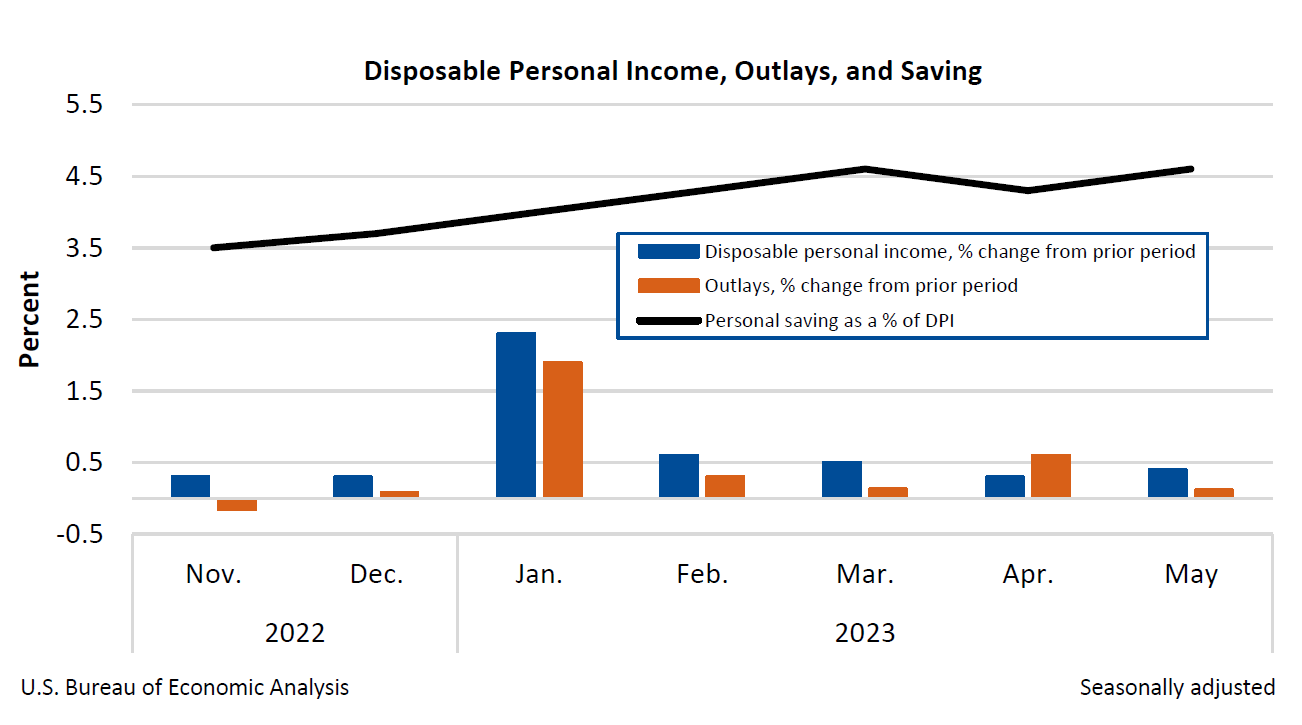
The above graph pictures how consumers have been behaving this year during the chaos. Their disposable incomes (blue bars) and savings (black line) had been rising faster than spending (outlays) until April when tax returns are due (and Trump’s retaliatory tariffs were first announced). Then it reversed. The spending rate has been increasing (brown bars) faster than savings since then as consumers are depleting their savings accounts once again.

Consumers spent more on cars, car parts and financial services (59%) of their Personal Consumption Expenditures, while gas and energy spending fell 12.1%. Their personal savings rate has hovered around 4% all year.

It’s an important indicator because personal savings rise sharply when consumers pocket their incomes if they fear something bad is about to happen, like higher unemployment. If the Fed also sees danger, then they will cut their interest rates.

And if President Trump succeeds in politicizing the Fed by firing Governor Lisa Cook and hiring another BLS head who will cook the job numbers for him, so that he can hide what is really happening in the job market, then all bets are off on just how bad the stagflation that results will be.

Harlan Green © 2025

Follow Harlan Green on Twitter: https://twitter.com/HarlanGreen

Saturday, June 28, 2025

Anxious Consumers Shop Less

 Popular Economics Weekly

Disposable personal income (DPI)—personal income less personal current taxes—decreased $125.0 billion (0.6 percent) and personal consumption expenditures (PCE) decreased $29.3 billion (0.1 percent).”

We are seeing one of the classic signs of a looming recession—consumers are spending less and saving more, and they power 70 percent of economic activity.

The personal consumption expenditures (PCE) for May from the Bureau of Economic Activity (BEA) showed the personal savings rate has risen to 4.8 percent (black line in graph), while personal consumption expenditures decreased -0.1%, Personal savings had been increasing since early 2025. No surprise, since that is when Trump’s tariff plans were first announced.

Why are they spending less? One of the reasons cited by the consumer sentiment surveys is too much future uncertainty. Not so surprising with inflation worries still high, and the on again, off again tariff announcements that probably mean even higher prices.

The PEW Centers most recent survey said the public again sees inflation as one of the top problems facing the nation, with 62 percent saying inflation is a very big problem for the country – only slightly down from the 65 percent who said this last year (2024).

The Conference Board Consumer Confidence Index® deteriorated by 5.4 points in June, falling to 93.0 (1985=100) from 98.4 in May. “Consumer confidence weakened in June, erasing almost half of May’s sharp gains,” said Stephanie Guichard, Senior Economist, Global Indicators at The Conference Board. “The decline was broad-based across components, with consumers’ assessments of the present situation and their expectations for the future both contributing to the deterioration.”

The University of Michigan’s Consumer sentiment survey surged 16% from May in its first increase in six months but remains well below the post-election bounce seen in December 2024 when last year’s economic growth was 3 percent, the highest in the developed world, and jobs were still plentiful.

“Despite June’s gains, however, sentiment remains about 18% below December 2024, right after the election; consumer views are still broadly consistent with an economic slowdown and an increase in inflation to come,” said Survey Director Joanne Hsu.

From the same month one year ago, the PCE price index for May increased 2.3 percent. Excluding food and energy, the PCE price index increased 2.7 percent from one year ago. It’s at least a sign of stagflation if the spending slowdown continues, since the PCE report also shows signs of higher inflation that the Fed is worried about.

No wonder consumers are more worried. Bloomberg research reveals AI could replace 53 percent of the white-collar market research analyst tasks and 67 percent of sales representative tasks, while managerial roles face only 9 to 21% automation risk.

The World Economic Forum's 2025 Future of Jobs Report reveals that 41 percent of employers worldwide intend to reduce their workforce in the next five years due to AI automation. Industries like technology, finance, and consulting are highlighted as particularly vulnerable.

It really looks like Republicans are trying as hard as possible to start a recession. They are shrinking the workforce by deporting undocumented immigrants who work with their hands and thus would be needed to fill some of the 400,000 vacant manufacturing jobs.

And passing Trump’s Big Beautiful Bill will create an unsustainable debt load, keeping interest rates high.

So though Biden suffered through higher inflation, it was because of the $trillions in New Deal legislation that caused 3.2 percent GDP growth during his term. The Trump administration has managed just -0.5 GDP growth in Trump's first quarter as President.

This is what happens when Republican tax cuts transfer even more wealth to the Oligarchs from middle and working class Americans.

Harlan Green © 2025

Follow Harlan Green on Twitter: https://twitter.com/HarlanGreen

Sunday, March 2, 2025

Economic Growth Slowing...Because?

 Popular Economics Weekly

“The U.S. government is currently under the control of a deeply ignorant, vengeful megalomaniac with zero impulse control. And it’s not just Elon Musk: Trump shares the same characteristics.” Nobel Laureate Paul Krugman

“The GDPNow model estimate for real GDP growth (seasonally adjusted annual rate) in the first quarter of 2025 is -1.5 percent on February 28, down from +2.3 percent on February 19.” Atlanta Federal Reserve

Watch out below, as economic growth looks to contract (-1.5 percent) in the first quarter of 2025! Trump’s abrupt announcement of tariffs on Mexico, Canada, and China, as well as Elon Musk’s indiscriminate slashing of payrolls and elimination of whole government agencies created a shock to economic growth that we have not seen in a long time.

How do we know? For starters, Trump’s tariff announcement caused a sudden plunge in predictions by Fed officials and economists of first quarter 2025 economic growth. The Atlanta Fed’s GDPNow estimate (graph above) dropped almost 4 percentage points from earlier predictions in part because of Trump’s just announced tariffs; that is a record plunge, I might add. They will be levied on Mexico, Canada, and China, which will mean higher import prices ahead for consumers when Trump had promised to lower inflation from ‘Day 1’.

And the just released U.S. Personal Consumption Expenditure (PCE) read on inflation for January (see below graph) is another reason first quarter economic growth is worsening. Consumer spending declined for the first time in two years, and consumer expenditures make up the largest component of Gross Domestic Product growth.

I said consumer spending should weaken after the holiday shopping splurge in an earlier report, Are Consumers In Danger?, and it’s happened. U.S. first-quarter consumer spending growth was just 1.6% annualized—the weakest since the second quarter of 2023. Much of the spending slowdown was due to the horrendous Los Angeles wildfires, unseasonably cold winter temperatures, and consumers replenishing their depleted savings. The personal savings rate jumped from 3.8 percent to 4.6 percent (black line in above graph).

Some good may come out of the PCE report because its inflation index declined from 2.6 to 2.5 percent, which increases the likelihood that the Fed may cut interest rates further, especially if the labor market continues to soften.

Elon Musk’s mass layoffs and complete elimination of whole federal agencies without plan or regard for the consequences will have a disastrous effect on the job market as well.

Well-regarded Chief Economist Torsten Slok of Apollo Global Management estimates there could be 300,000 federal job cuts, but when private-sector contractors that work for them are included, a total of one million jobs could be at risk, in a Barron’s article by Randall Forsythe.

And this is just the beginning. The uncertainty and craziness of Trump and Musk’s actions are already showing up in the alarming drop in consumer confidence surveys as well.

There is a better way to trim government excesses. Even Musk has acknowledged that “What @DOGE is doing is similar to Clinton/Gore Dem policies of the 1990s.”

Not really. President Clinton’s “Reinventing Government” initiative headed by VP Gore was only initiated after an initial year of planning and cooperation with congress that resulted in four years of budget surpluses.

This is a far different approach than Trump/Musk’s  blatantly illegal attempts to usurp the power of congress and the constitution, which can only lead to more court fights and budget deficits.

Harlan Green © 2025

Follow Harlan Green on Twitter: https://twitter.com/HarlanGreen

Monday, April 1, 2024

Economic Facts Tell the Truth

 Financial FAQs

Here’s another reason we have avoided a recession. Regardless of the looming tax bills due in April that traditionally causes consumers to save more and spend less, consumers are spending more and saving less, per the BEA’s Personal Consumption Expenditure release.

It’s another economic fact that indicates the US economy is doing very well, and that Main Streeters should believe, contrary to what many seem to say per the polls. But will economic facts win out over the irrational pessimism showing up in consumer polls?

In a poll by PEW Research I wrote about last week, “About three-in-ten Americans (28%) currently rate national economic conditions as excellent or good, while a similar share (31%) say they are poor and about four-in-ten (41%) view them as “only fair.”

BEA.gov

Consumers are spending more than they earn because they feel better about their own situation, in spite of what they say about economic conditions. The government’s Personal Consumption Expenditures (PCE) data that the Fed watches closely in February showed consumers’ disposable income (after taxes) increasing 1.0 percent while spending had increased 4.0 percent. The personal savings rate therefore slipped from 4 percent to 3.8 percent.

Fourth quarter economic growth was just upgraded to 3.4 percent from 3.2 percent, and consumer spending, the main engine of the economy, was revised up to a 3.3% increase in the fourth quarter instead of 3% annually as well.

Why the pessimism by ordinary consumers? Because most economic data is basically unintelligible to Main Street consumers. Duncan Foley, an economics Professor at NYU’s New School maintains that the economics profession has become so complex that economists are “becoming priestly figures, with arcane knowledge and special powers” in his book, Adams Fallacy: A Guide to Economic Theory.

He asserts economics is as much philosophy as a social science, since it attempts to measure financial behavior with economic data and formulas, many of which are understandable only by economists.

More importantly “Thinking like an economist comes hard to many people…the economic way of thinking is just as value laden as any other way of thinking and can foster dangerous mistakes of judgement.”

What is hurting consumer finances the most? The Wall Street Prime Rate has risen to 8.5 percent because the Funds rate is 5.25 percent. Consumers must spend more than they save because borrowing costs have soared for those with credit card debt and installment loans.


How much longer can consumers spend as they have, as their personal savings continue to be depleted? A recent National Bureau of Economic (NBER) working paper concludes that one reason consumers remain unconvinced that economic conditions have improved, is because if borrowing costs were included in the inflation data, the inflation rate would be much higher.

“Consumers, unlike modern economists, consider the cost of money part of their cost of living. Interest rates have reached 20-year highs in the wake of the pandemic. With higher rates, mortgage payments, car payments, and other credit payments required to finance everyday purchases have risen as well.”

So that makes the Federal Reserve part of the problem since the Prime Rate is directly keyed to the Fed Funds rate, and why wouldn’t the price of things be controlled by the cost of said things??

That could be why we see so much irrational exuberance, to use former Fed Chair Greenspan’s term, in which decisions are made via hearsay and word of mouth rather than economic facts.

Consumers must deal with the cost of money when they look at their financial condition, which should mean their mood will improve when the Fed finally decides to cut interest rates.

Harlan Green © 2024

Harlan Green on Twitter: https://twitter.com/HarlanGreen

Tuesday, January 9, 2024

When Has Inflation Declined This Steeply?

 The Mortgage Corner

When was the last time inflation rates declined this steeply? You guessed right if you said the Great Recession.

Calculated Risk’s colorful graph of various inflation indicators (gray bars are recessions) shows the history of Core CPI (red line) and Core PCE (green line) inflation from January 1990, among others. Core prices are without more volatile food and energy prices.

What does that tell us about the current drop in inflation? Maybe there’s a danger of it falling too far, too fast, fulfilling the prophecies of some that still see a looming recession. This inflation surge was worse than during the Great Recession (thickest blue bar) because of the COVID pandemic, per the graphic picture.

Calculated Risk Blog

Only the 1980-81 recessions caused a sharper inflation decline. But that was because then Fed Chair Paul Volcker raised interest rates into the double digits to combat double-digit inflation caused by the 1970’s oil crisis-fed stagflationary spiral.

In fact, we are already in the Fed’s 2 percent target range. The Personal Consumption Expenditure Price (PCE) Index is already at 1.9% and Core CPI Prices at 2.0% over the past 6 months.

And what Fed officials seldom admit is the 2 percent inflation target isn’t a dependable target. Why? Because no one really knows what the true inflation rate is! Yes, there is no measure among the vari-colored measures above that is an accurate indicator of inflation as economists such as former Fed Chairman Ben Bernanke have admitted. It could have already hit zero percent in some sectors of our economy. Hence economists consult many different indexes to arrive at a mean value.

And consumers may already believe this, since the most recent inflation assessment coming from the New York Fed says their expectations are declining fast as well.

Consumers expect the inflation rate to fall to 3 percent, according to the Federal Reserve Bank of New York. That’s the lowest anticipated one-year ahead inflation rate since January 2021, in the NY Fed’s ongoing survey of consumer expectations.

Median inflation expectations declined at all horizons, falling to 3.0 percent from 3.4 percent at the one-year ahead horizon, to 2.6 percent from 3.0 percent at the three-year ahead horizon, and to 2.5 percent from 2.7 percent at the five-year ahead horizon.

Maybe some Fed Governors, such as Michele Bowman are beginning to believe this as well who have studied the history of inflation.

Energy and food prices are falling, for starters. The U.S. is even outproducing the OPEC countries and Russia, which may not be the best way to win the inflation war. But it could convince the Fed to begin to lower short term rates sooner and preserve this recovery.

No one really wants to cause another recession, right?.

Harlan Green © 2024

Follow Harlan Green on Twitter: https://twitter.com/HarlanGreen

Monday, July 3, 2023

Inflation Falling As Consumers Keep Spending

 Financial FAQs

BEA.gov

Consumers continue to spend, and what can the Fed do about it?

This will be debated by market analysts ad nauseum until the next Federal Reserve FOMC meeting in July. And then Chairman Powell, et. al., will probably follow former chair Paul Volcker’s lead; keep raising interest rate maybe another 0.50 percent by December and see then whether the US economy really hits the skids.

The Personal Consumption Expenditure Price Index (PCE) measure of inflation fell from 4.3 percent to 3.8 percent, but its core rate excluding food and energy remained higher (4.6 percent) because travel is soaring, keeping service prices from falling as much

Personal outlays (spending) barely moved, up 0.1 percent, while personal income rose 0.4 percent so the savings rate is rising (black line in graph).

Oh yes, we are getting ahead of ourselves because July 4 is coming up and the times are good for most American consumers because they still have lots of savings and nobody is losing their job that wants to keep it.

And after the final first quarter estimate of Gross Domestic Product (GDP) growth rose to 2.0 percent, economists are beginning to predict Q2 may grow as much. Consumer spending rose 4.2 percent from a prior 3.8 percent annual clip, explaining most of the upward increase in first quarter GDP. It was the biggest gain in two years.

And, the Atlanta Federal Reserve’s GDPNow second quarter estimate of blue-chip economists and its own data research took a sharp upturn.

AtlantaFed

It was largely revised upward to 2.2 percent on June 30, from 1.8 percent on June 27, because of upward revisions to second-quarter real personal consumption expenditures growth (just reported above) and second-quarter real gross private domestic investment growth.

The manufacturing sector keeps contracting, however. The Institute for Supply Management’s manufacturing survey dipped to 46 percent in June from 46.9 percent in the prior month. It was the lowest reading since May 2020.

This is why predictions of a looming recession are still being made. Manufacturing makes up just 11 percent of GDP activity, however.

That’s why consumers are still upbeat, The latest University of Michigan sentiment survey reflected their optimism:

“Consumer sentiment rose 9% this month, a consensus improvement across all demographic groups. The year-ahead economic outlook soared 28% over last month, and long-run expectations rose 11% as well. Overall, this striking upswing reflects a recovery in attitudes generated by the early-month resolution of the debt ceiling crisis, along with more positive feelings over softening inflation,” said survey director Joanne Hsu.

This Friday’s employment report for June will give more direction for Q2, so why are consumers still so upbeat. It looks like inflation doesn’t bother them as much as the Fed.

Harlan Green © 2023

Follow Harlan Green on Twitter: https://twitter.com/HarlanGreen

Friday, May 26, 2023

US Economy Improves

 Popular Economics Weekly

FREDpceindex

After a sputtering start, it looks like the U.S. economy is picking up steam. First Quarter GDP growth was revised upward from 1.1 to 1.3 percent in the BEA’s second estimate yesterday.

And the Personal Consumption Expenditure Index (PCE) out today (Friday), the Fed’s favorite inflation indicator, confirmed consumer spending is the main engine of growth. The PCE is the best measure of consumer behavior, and rather than pulling back because of higher inflation and interest rates, spending has kept up with inflation.

Compound this with predictions of up to 2.9 percent GDP growth in Q2, and we could be off to a ‘roaring’ 2023 year and decade I’ve been touting lately.

The result won’t make our Federal Reserve Governors happy who have been hinting at the possibility of a rate pause in June, since the PCE inflation index ticked up from 4.2 to 4.4 percent YoY.


PCE data showed consumer spending sprang back to life in April, rising 0.8%, the largest gain in three months, “surpassing expectations for a 0.5% increase as Americans bought more cars and spent more on services,” said a MarketWatch commentator. Why not, when consumers are fully employed and feeling more secure about their prospects?

Within services, the largest contributors to the PCE increase were spending for financial services and insurance, health care, and “other” services (notably professional and other services). Within goods, spending for motor vehicles and parts (led by new motor vehicles) and “other” nondurable goods (notably pharmaceutical products) were the largest contributors to the increase.

And lastly, orders for U.S. manufactured goods jumped 1.1 percent in April largely because of the military, but business investment also rose sharply in another  positive sign for the economy. Manufacturing output has been shrinking over the last six months.

In a good sign, business investment rose a sharp 1.4 percent. What are corporations seeing that induces them to invest more? They are also expecting economic growth to improve.

The latest results show that consumers are in a tug-of-war with the Fed, which has been outspoken in its efforts to slow consumer spending with boosts to credit card and installment loan interest rates.

Yet Americans remained worried about the future of the economy, especially against the backdrop of another fight in Washington over the debt ceiling.

The University of Michigan sentiment survey final reading in May rebounded slightly to 59.2 from earlier in the month but was still lower than April’s 63.5 final reading.

“Consumer sentiment slid 7% amid worries about the path of the economy, erasing nearly half of the gains achieved after the all-time historic low from last June. This decline mirrors the 2011 debt ceiling crisis, during which sentiment also plunged,” said survey Director Joanne Hsu.

But they can’t be too worried as the post-pandemic surge in prosperity has been cancelling out the bad news.

Harlan Green © 2023

Follow Harlan Green on Twitter: https://twitter.com/HarlanGreen

Tuesday, April 2, 2019

Ignore the Bad News-Goldilocks Is Back!

Financial FAQs

Why has the Fed stopped raising their interest rates? Because this is the lowest inflation rate for ‘core’ consumption expenditures in three decades, as this FRED graph from 1980 onward portrays.

“We are almost 10 years deep into this expansion and inflation is still not clearly meeting our target,” said Fed Chairman Jerome Powell in the press conference ending last Wednesday’s FOMC meeting. “That’s one of the reasons we are being patient.”
“Despite the lowest unemployment rate since the late 1960s and the fastest increase in wages in a decade,” he continued, “the rate of inflation actually fell slightly in the second half of 2018. Conventional wisdom says that’s not supposed to happen when the labor market is what economists describe as “tight.”
Right, that’s not supposed to happen but regardless, it has put consumers back into the sweet spot of a Goldilocks, not-too-hot, not-to-cold economy with unemployment at a 50-year low and incomes rising at the fastest rate in 10 years, according to MarketWatch. This is not supposed to happen, per conventional wisdom.

Rather than attempting to fathom what “conventional wisdom” means, it’s more productive to understand why the Goldilocks scenario is happening again. Consumers want to spend more with their rising incomes, but the incomes of a majority of consumers aren’t rising fast enough to keep up with production of those goods, which now largely come from other countries that can produce them more cheaply.

Hence Personal Consumption Expenditures (PCE) continue to fall, in line with more slowly rising personal incomes (for the 99 percent) and inflation. This FRED graph shows that PCE consistently grew at more than 5 percent until 2000, when it began to plunge to as low as -3.7 percent during the Great Recession, and finishing up +2.5 percent in Q4 2018.

FRED

It tells us several things. Firstly, most American workers have not yet recovered from the Greatest Recession since the Great Depression, which took WWII to get US out of that funk. So this hasn’t been enough consumption to boost inflation or interest rates, which is why we continue in the 2 percent GDP growth path, and retail sales were punk during the holidays and slow to recover.

 And, there was a 35-day government shutdown in December, which further depressed incomes and sales. Retail sales picked up slightly in January, but February isn’t looking so good with sales negative for the second time in 3 months, per the FRED graph.

Lastly, the final revision of Q4 GDP growth dropped to 2.2 percent from its 2.6 percent initial estimate, which has to be another casualty of the stupidest government shutdown ever.

So though inept government policies and the record income equality keep the economy from growing faster, it enables consumers to stay in the game; and keeps the US economy from overheating; which is a good thing, right?

Harlan Green © 2019

Follow Harlan Green on Twitter: https://twitter.com/HarlanGreen

Tuesday, August 1, 2017

Great Q2 GDP Growth, But Q3?

Popular Economics Weekly

Second quarter GDP came in at a 2.6 percent annualized growth rate. This is one of the best showings of the last 2 years and keeps overall growth at 2 percent; because first quarter's growth was downwardly revised to 1.2 percent. And Q3 growth isn’t looking good, as June personal income and expenditures (PCE) just took a huge plunge—not a good omen for Q3.


June PCE income was unchanged and May revised 1 tenth lower to a 0.3 percent gain. Consumer spending was up 0.1 percent gain. Price data are flat, unchanged in the month with the core rate (less food and energy) up 0.1 percent for a second weak month in a row. The real problem is weak wage growth, as most jobs being created are in low wage industries, like hospitality and even healthcare. Year-on-year, overall prices are up only 1.4 percent with the core little better at 1.5 percent.

Graph: Econoday

What is wrong with the U.S. economy that it can’t grow faster? Nothing, really, given almost no productivity growth, and an aging population. This is maximum speed without an increase in productivity, in other words, and that won’t happen unless some of the $4.6T in deferred infrastructure spending gets done.

Can you imagine what new highways, bridges, airports, energy infrastructure, city and state water treatment facilities would do to productivity growth? Labor productivity rose at an average annual rate of 3-1/4 percent from 1948 to 1973, says the Federal Reserve, whereas, the average growth rate of productivity was about 1.7 percent in the period 1974 to 2016.
“If labor productivity grows an average of 2 percent per year,” said Fed Vice-Chair Stanley Fischer in a recent speech, “average living standards for our children's generation, will be twice what we experienced. If labor productivity grows an average of 1 percent per year, living standards will take two generations to double.”
“Governments can take sensible actions to promote more rapid productivity growth,” continued Fischer. “Broadly speaking, government policy works best when it can address a need that the private sector neglects, including investment in basic research, infrastructure, early childhood education, schooling, and public health.”
But construction spending also dropped in June—1.3 percent, mainly highways and streets in the government sector. Construction spending in manufacturing was also down. Doesn’t congress realize this is a sign that infrastructure expenditures are going down, rather than rising? This should be the priority, not attempting to repeal Obamacare, or cut taxes.

Our deficit problems would be solved if congress would focus on policies that really matter—like increasing spending on factors that enhance productivity, which would in turn increase GDP growth, which would in turn lower the budget deficit and obviate the need for draconian tax cuts.
“Reasonable people can disagree about the right way forward, but if we as a society are to succeed, we need to follow policies that will support and advance productivity growth. That is easier said than done. But it can be done,” says Fischer.
Economists such a Stanley Fischer know how this is done. In fact, we can only really survive as a viable democracy if we listen to the experts, rather than political ideologues.

Harlan Green © 2017


Follow Harlan Green on Twitter: https://twitter.com/HarlanGreen

Thursday, July 27, 2017

The End of Easy Money?

Popular Economics Weekly

The Fed just completed its July FOMC meeting and said the sale of some of its $4.5 trillion in securities would begin this year. CNBC has predicted the first installment of $300B in sales could begin anytime. This is a mere drop in the bucket and shouldn’t affect interest rates immediately.

Why? There is simply too much easy money in circulation, which is why the 10-year Treasury yield is still in the 2.3 percent range, and 30-year conforming fixed mortgage rates are below 4 percent. Money is cheap, in other words, which hurts savers but helps borrowers, such as homebuyers.

This is indeed helping homeowners, as June new-home sales just jumped 0.8 percent and are 11 percent higher this year. Should the Fed begin to sell securities they bought via the various Quantitative Easing securities purchases, it will take some of that excess money out of the economy, but should not slow down home buying.


This is because interest rates only go up if inflation rises, and the Fed’s preferred inflation gauge, the Personal Consumption Expenditures index, has tapered off to 1.4 percent growth over 12 months from a five-year high of 2.1 percent. That is not a good sign for future demand and hence growth, as I’ve been saying. But it’s good for borrowers and homebuyers.

“The month’s (new-home) sales report is consistent with our forecast, and we should see further gains throughout the year as the labor market continues to strengthen,” said NAHB Senior Economist Michael Neal. “While new home inventory rose slightly in June, it remains tight as builders face lot and labor shortages and increases in building material costs.”
The assessment of both current and future business conditions is also strong with more describing them as good. Buying plans for homes is also a positive, up a sharp 7 tenths to 6.7 percent with buying plans for autos also up, 1 tenth higher to 12.7 percent.

Graph: Econoday

So the expected rise in interest rates is just not happening. Inflation is really a gauge of present and future demand and the demand by consumers, even for so-called capital expenditures by businesses that would expand production, isn’t happening. Capex spending jumped slightly earlier this year, but has slowed and manufacturing activity is still in a positive but narrow range.

However, consumer confidence continues to soar. The Conference Board’s index is back to its highest level this year. The index rose nearly 4 points in July to 121.1. Confidence has risen about 20 points following the November election, hitting a 17-year peak of 124.9 in March. Is this due to the Trump election? We haven’t yet seen higher retail sales and other indicators of greater consumer spending that would boost GDP growth to 3 percent as Republicans have promised.

So what are consumers up to? They seem to want to save most of their earnings at present, which is a sign that consumers are not yet convinced higher economic growth is in the cards, in spite of the availability of so much easy money.

Harlan Green © 2017

Follow Harlan Green on Twitter: https://twitter.com/HarlanGreen

Tuesday, August 2, 2016

GDP Growth Still Below Average

Popular Economics Weekly

There is a reason second quarter Gross Domestic Product growth was so weak—up just 1.2 percent, after 0.9 and 0.8 percent upticks in the last 2 quarters. Pundits attributed it to the lack of capital expenditures, whereas consumer spending increased some 4.2 percent, which should mean a 3 percent annual growth rate, at least. But neither the private nor public sectors are investing much in future growth.
“The increase in real GDP in the second quarter reflected positive contributions from personal consumption expenditures (PCE) and exports that were partly offset by negative contributions from private inventory investment, nonresidential fixed investment, residential fixed investment, and state and local government spending. Imports, which are a subtraction in the calculation of GDP, decreased,” said the BEA announcement of last Friday.


Graph: Calculated Risk

Though Personal consumption expenditures (PCE) were up 4.2 percent vs. 1.6 percent in Q1, said the report, residential investment (RI) decreased at a 6.1 percent pace. Equipment investment also decreased at a 3.5 percent annualized rate, and investment in non-residential structures (i.e., commercial/industrial) decreased at a 7.9 percent pace due to the recent decline in oil prices.


It is also due to the lack of government spending. Public spending on such as infrastructure would employ millions and improve productivity, something both Presidential candidates say they want. Private sector growth should then follow, as even public works projects have to be built by private sector workers in private sector companies.

That is perhaps the major reason private sector corporations are investing less. There’s a lack of confidence in the future, what with Brexit maybe damaging future EU growth, and a certain Republican Presidential candidate threatening to blow up the US economy with massive tax cuts for the wealthiest, a trade war with the rest of the world, and no minimum wage increase.
Economist Dean Baker has said many times there is no secret to expanding employment and growth: “The point here is a simple one, we know how to get out a depression. It's called "spending money." We got out of the last Great Depression by spending lots of money on fighting World War II. But guess what, the economy doesn't care what we spend money on, it responds in the same way. So if we instead (of bailing out the banks with TARP) had spent 20 percent of GDP on building highways, housing, hospitals, and providing education and child care it also would have led to double-digit economic growth and below 3.0 percent unemployment.”
The consumer is healthy with the 4.2 percent spending increase, though consumers are saving much more these days, a result of growing incomes. Personal saving was $763.1 billion in the second quarter, compared with $847.8 billion in the first (revised). The personal saving rate -- personal saving as a percentage of disposable personal income -- was 5.5 percent in the second quarter, compared with 6.1 percent in the first, though it just dropped to 5.3 percent in this latest month.

Harlan Green © 2016

Follow Harlan Green on Twitter: https://twitter.com/HarlanGreen

Tuesday, June 2, 2015

Pending Home Sales In Record Territory

The Mortgage Corner

Pending home sales hit a 9-year high in April, according to data released last Friday by the National Association of Realtors. This is an early sign that housing construction and sales will come out of their winter hibernation, as consumers begin to spend again.

The NAR’s Pending Home Sales Index rose for the fourth consecutive month in April, increasing 3.4 percent to 112.4 – a 14 percent increase over April 2014 and the largest annual increase since September of 2012. The index is now at its highest level since May of 2006.

image

Graph: Econoday

NAR chief economist Lawrence Yun said that there have been steady gains in contract activity each month this year, indicating strong buyer demand. “Realtors are saying foot traffic remains elevated this spring despite limited – and in some cases severe – inventory shortages in many metro areas,” he said. “Homeowners looking to sell this spring appear to be in the driver’s seat, as there are more buyers competing for a limited number of homes available for sale. As a result, home prices are up and accelerating in many markets.”

That has to be why construction spending is surging, as I predicted last week. Higher pending sales mean increased demand for new homes with too few existing homes available for sale at reasonable prices.

image

Graph: Calculated Risk

The U.S. Census Bureau of the Department of Commerce just announced that construction spending during April 2015 was up at a seasonally adjusted annual rate of $1,006.1 billion, 2.2 percent above the revised March estimate of $984.0 billion, and 4.8 percent above the year ago estimate of $960.3 billion.

Private non-residential spending looks very strong, up 3.1 percent and led by the power and office sectors. Public spending is also strong with a large gain for highways & streets, and a surge in educational building. Though the gain in public spending came entirely from the state and local governments as federal construction spending declined for a second straight month.

And personal incomes are beginning to show some life, which may be the underlying reason consumers are feeling more confident. Personal income increased $59.4 billion, or 0.4 percent in April, according to the Bureau of Economic Analysis, though personal consumption expenditures (PCE) decreased just $2.6 billion, or less than 0.1 percent. But we see spending also increasing with increased consumer confidence in future prospects, according to the confidence surveys.

image

Graph: Econoday

The Conference Board’s Consumer Confidence gauge is rising to pre-recession highs; another reason why both new and existing-home sales have been stronger of late. The consumer confidence report for May came in at 95.4, slightly higher than April. Income expectations are up slightly and buying plans are higher across the board, including for autos, homes, and especially for appliances.

The U. of Michigan’s consumer sentiment report also showed strength, ending May at 90.7 vs the mid-month flash of 88.6. The implied reading for the last two weeks of the month is about 93 which, though down from April's 95.9 and January's peak over 98, is still very solid, according to Econoday.

Harlan Green © 2015

Follow Harlan Green on Twitter: https://twitter.com/HarlanGreen